


Is Dropshipping Beauty Supply Profitable? Margins, Ads, and Long-Term Reality

Dropshipping beauty supply is profitable, but not in the simplified “high margin = high profit” model many beginners assume.
The real business outcome is determined by three variables:
- Gross margin (30%–70%) provides room for profit
- Advertising efficiency determines survival
- Brand positioning determines scalability
In practical terms, successful stores usually achieve 10%–25% net profit margins, while poorly optimized stores often fall below break-even despite strong revenue.
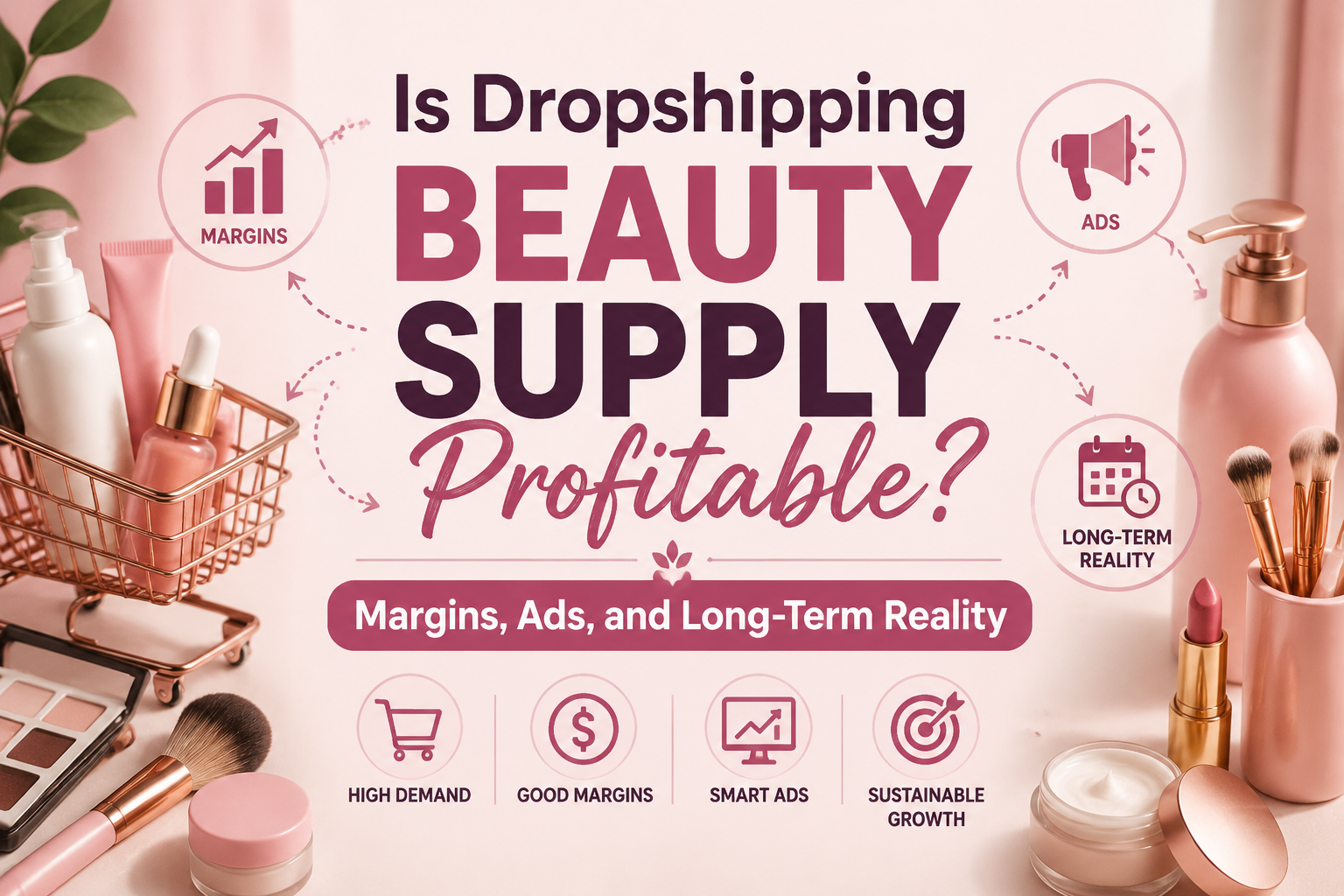
Is Dropshipping Beauty Supply Profitable? A Full Financial Reality Check
Dropshipping beauty supply products is often seen as a high-margin ecommerce model, but profitability depends heavily on cost structure rather than product price alone. In most real cases, beauty products such as skincare tools, makeup accessories, and cosmetic items operate on a gross margin range of 30% to 70%.
At first glance, this seems highly attractive compared to traditional retail. For example, a $25 skincare product sourced at $8–$12 can deliver a gross margin of around 52%–68%. However, gross margin does not reflect real profit, because advertising, payment fees, and return costs significantly reduce net earnings.
Gross Margin vs Net Profit Reality
While beauty supply products have strong markup potential, net profit is where most beginners miscalculate.
A typical breakdown for a $30 beauty product might look like this:
- Product cost: $10
- Shipping (supplier to customer): $3–$6
- Payment processing fees: ~$1
- Advertising cost (Meta/TikTok blended CAC): $8–$20
After these deductions, the actual net profit per order often falls into the $2–$8 range, meaning a net margin of 8%–25%, depending on ad efficiency.
This explains why many stores look profitable on revenue but struggle with cash flow.
Why Beauty Supply Still Performs Better Than Other Niches
Despite cost pressure, beauty supply remains one of the strongest dropshipping verticals due to demand behavior and pricing psychology.
First, the repeat purchase rate in skincare-related products is often 25%–45%, especially for consumables like serums, acne treatments, and moisturizers. This reduces dependency on constant customer acquisition compared to one-time products.
Second, beauty products support emotional buying decisions, which improves conversion rates. Typical conversion rates in this niche range from 2.5% to 4.5%, higher than general ecommerce averages of 1.5%–3%.
Third, perceived value is high. Many beauty products sourced for $5–$12 can be positioned and sold for $20–$60 depending on branding and creative marketing.
The Role of Advertising in Profitability
The biggest factor determining whether beauty dropshipping is profitable is advertising efficiency.
On platforms like TikTok Ads and Meta Ads, customer acquisition cost (CAC) typically ranges between $10 and $40, depending on targeting and creative quality. If your average order value (AOV) is below $25, profitability becomes extremely difficult.
However, stores with strong creative hooks and UGC-style ads often achieve ROAS between 2.0 and 3.5, which is the threshold for sustainable profitability.
At ROAS 2.5, a store can maintain roughly 15%–25% net profit margin, assuming stable fulfillment costs.
Scaling Effects and Hidden Profit Leverage
One overlooked aspect of beauty supply dropshipping is scale efficiency.
As order volume increases:
- Supplier pricing can drop by 10%–25%
- Shipping contracts become cheaper per unit
- Ad algorithms optimize conversion delivery
This means a store that is barely break-even at 50 orders/day can become significantly profitable at 200+ orders/day due to cost compression.
However, scaling also increases return risk, especially in skincare-related products where customer expectations are high. Return rates typically range from 5% to 15%, which must be factored into long-term profitability.
Is Skincare Dropshipping Actually a High-Profit Business?
Among all beauty supply categories, skincare consistently performs as the most stable and high-margin niche. The global skincare market is driven by daily-use demand, which creates predictable purchasing cycles and strong repeat behavior.
In dropshipping terms, skincare products such as serums, moisturizers, acne treatments, and facial tools typically show gross margins between 40% and 75%, depending on branding and positioning. A product sourced for $6–$12 can often be sold for $25–$60, especially when bundled or marketed as a solution-based routine.
Unlike makeup trends that fluctuate quickly, skincare is utility-driven, which reduces volatility and supports long-term store stability.
Demand Stability and Repeat Purchase Advantage
One of the strongest profitability drivers in skincare dropshipping is repeat purchase behavior.
Industry data shows that skincare products can achieve a repeat purchase rate of 20%–45%, particularly in categories like:
- Acne treatment systems
- Hydrating serums
- Anti-aging creams
- Sunscreen and daily care products
This repeat structure significantly increases customer lifetime value (LTV). For example, if the average first purchase is $35, a repeat cycle can push LTV to $55–$90, which reduces pressure on paid advertising.
In comparison, general impulse-buy dropshipping products often have near-zero repeat rate, making skincare structurally more profitable over time.
Gross Margin vs Real Operating Profit
While skincare products have strong gross margins, real profitability depends on acquisition costs and operational efficiency.
A typical skincare product priced at $40 may break down as follows:
- Product cost: $10–$14
- Shipping: $3–$6
- Payment fees: ~$1.5
- Advertising cost (Meta/TikTok CAC): $12–$25
After all costs, net profit per order often ranges between $4 and $12, resulting in a net margin of 10%–30%.
Stores that fail to optimize ads or creatives may see margins drop below 10%, even with strong sales volume.
Why Skincare Converts Better Than Other Beauty Products
Skincare products benefit from stronger psychological triggers than most ecommerce niches.
Conversion rates for well-optimized skincare stores typically range from 2.8% to 5%, driven by:
- Problem-solving intent (acne, aging, dryness)
- Before/after visual advertising
- High trust in “results-based” messaging
Compared to general dropshipping stores averaging 1.5%–3% conversion rates, skincare clearly outperforms in funnel efficiency.
This higher conversion rate directly improves ad efficiency and reduces CAC pressure, which is critical for profitability.
Advertising Efficiency and Scaling Dynamics
The biggest factor determining whether skincare dropshipping is profitable is advertising cost control.
On TikTok and Meta platforms, customer acquisition cost typically ranges:
- Low-performing campaigns: $20–$40 CAC
- Optimized UGC campaigns: $10–$18 CAC
- Viral content cases: below $10 CAC
When CAC stays under 40% of AOV, skincare stores can maintain healthy profitability. For a $35–$50 product, sustainable ROAS usually sits between 2.2 and 3.8.
At scale, algorithm learning improves targeting efficiency, which can reduce CAC by 15%–30% over time, further improving margins.
Risks That Affect Profitability
Despite strong economics, skincare dropshipping has several structural risks:
First, product expectation gaps are common. If results are not visible, return rates can reach 5%–12%, increasing cost leakage.
Second, compliance varies by region. EU and US skincare regulations may require ingredient transparency, which limits supplier flexibility.
Third, competition is intense. High-performing products often get saturated quickly, pushing ad costs upward.
These factors make differentiation through branding essential for long-term success.
Why Hair Extensions Are One of the Highest-Margin Beauty Products
Hair extensions represent one of the most financially attractive segments in beauty supply dropshipping due to their strong perceived value and high price elasticity.
In most cases, sourcing costs for synthetic or human hair extensions range from $8 to $35, while retail prices commonly fall between $30 and $120+ depending on length, density, and material quality.
This creates a gross margin range of 50% to 80%, significantly higher than most ecommerce niches. For premium human hair bundles, margins can even exceed 85% when bundled strategically.
The key reason is simple: hair extensions are perceived as a semi-luxury cosmetic product, not a commodity.
High AOV Structure and Profit Scaling Advantage
Unlike skincare or makeup accessories, hair extensions naturally support a high average order value (AOV). Most customers do not buy a single low-ticket item; instead, they purchase multiple bundles or complete sets.
A typical order structure looks like:
- Single bundle: $25–$45
- Full install set: $60–$120
- Premium virgin hair package: $100–$200
This high AOV structure dramatically improves profitability because fixed advertising costs are distributed across larger order values.
For example, if customer acquisition cost (CAC) is $25:
- At $40 AOV → low margin or break-even
- At $100 AOV → strong 25%–40% net margin potential
This is why hair extensions scale more efficiently than low-ticket beauty products.
Advertising Performance and Conversion Behavior
Hair extensions perform particularly well on visual platforms like TikTok, Instagram, and Pinterest due to their transformation-based appeal.
Conversion rates typically range from 2.5% to 5.5%, higher than most general ecommerce categories. The reason is emotional and visual impact—customers can immediately understand the before/after effect.
Advertising cost benchmarks:
- Low-performing campaigns: $25–$50 CAC
- Optimized UGC campaigns: $12–$25 CAC
- Viral content scenarios: below $10 CAC
When CAC remains under 30% of AOV, the business becomes highly profitable. For a $90 average order, even a $25 CAC still leaves enough margin for fulfillment and profit.
Supply Chain Advantage and Cost Control
Hair extensions benefit from a strong manufacturing ecosystem, particularly in China, India, and Vietnam. This supply chain allows consistent cost control and product variety.
However, quality differences are significant:
- Synthetic hair: $5–$15 cost, lower durability, higher return risk
- Human hair blends: $15–$40 cost, higher customer satisfaction
- Virgin human hair: $30–$80 cost, premium pricing potential
Better quality products reduce return rates and improve long-term profitability. Typical return rates in this niche range from 4% to 10%, depending on supplier quality and expectations management.
Branding and Trust as Profit Multipliers
Hair extensions are highly trust-dependent products. Customers care about texture, longevity, and realism, which makes branding a critical profit driver.
Stores that invest in branding (custom packaging, influencer marketing, and consistent product quality) often see:
- Conversion rate increase of 20%–40%
- Higher repeat purchase rate (15%–30%)
- Improved price acceptance (+10%–25% premium pricing)
Without branding, the same products quickly fall into price competition, which reduces margins significantly.
Long-Term Profitability and Market Saturation Risk
Despite high margins, hair extensions dropshipping faces increasing competition. Winning stores typically rely on:
- Strong video creatives (UGC transformation content)
- Fast supplier fulfillment (under 7–12 days shipping)
- Consistent influencer collaborations
Market saturation can increase ad costs by 15%–30% over time, so creative refresh cycles are essential for maintaining profitability.
Still, because of high AOV and strong emotional demand, this niche remains one of the few where net profit margins of 20%–40% are realistically achievable at scale.
Why Private Label Changes the Entire Profit Equation
Private label beauty dropshipping is fundamentally different from traditional “resell-from-supplier” models. Instead of selling generic products, sellers build a branded product line with custom packaging, labels, and sometimes formula adjustments.
This shift directly impacts profitability. While standard dropshipping in beauty supply typically yields net margins of 10%–25%, private label models can push that range to 25%–60%, depending on brand strength and pricing power.
The reason is simple: branding reduces price competition and increases perceived value.
A product that costs $8–$15 to produce can be positioned at $35–$80 when branded properly, especially in skincare and cosmetic segments.
Margin Structure: Why Branding Creates Pricing Power
In private label beauty, gross margins are significantly higher because pricing is no longer anchored to supplier listings or competitor stores.
Typical structure:
- Manufacturing cost: $6–$18
- Packaging & branding: $1–$4
- Total landed cost: $8–$22
- Retail price: $30–$90
This results in gross margins of 55%–75%, and in premium skincare or niche cosmetics, margins can exceed 80%.
Compared to generic dropshipping (where prices are easily compared across stores), private label allows sellers to control pricing psychology rather than compete on cost.
Marketing Efficiency and Conversion Lift
Private label brands typically achieve higher conversion rates due to trust and perceived legitimacy.
Average performance benchmarks:
- Generic dropshipping stores: 1.8%–3.2% conversion rate
- Private label beauty brands: 3.2%–6.0% conversion rate
This improvement comes from:
- Stronger product positioning (brand identity vs random product)
- Higher trust signals (packaging, reviews, branding consistency)
- Better ad performance due to cohesive storytelling
On paid traffic platforms like Meta and TikTok, this can reduce effective CAC by 10%–30%, significantly improving profit margins.
Advertising ROI and Scalability
Private label beauty brands are more resilient to advertising cost fluctuations because they rely on brand recall and repeat exposure.
Typical CAC ranges:
- Early stage: $15–$35
- Optimized campaigns: $10–$22
- Established brand traffic: $8–$18
With an average order value (AOV) of $40–$120, ROAS can stabilize between 2.5 and 4.5, depending on funnel optimization.
Unlike generic dropshipping, where each product is independent, private label allows cross-selling and bundling strategies, increasing AOV by 15%–40% over time.
Long-Term Value: Repeat Purchases and Brand Equity
One of the most important profitability advantages of private label beauty is repeat purchase behavior.
Unlike one-off impulse products, branded skincare or cosmetics can generate:
- Repeat purchase rate: 25%–50%
- Customer lifetime value (LTV): 2–3x higher than single-product stores
For example, a customer acquiring at $25 CAC with a $50 first purchase may generate total LTV of $90–$150 through repeat orders.
This LTV expansion is what separates scalable brands from short-term dropshipping stores.
Risks and Operational Complexity
Despite higher profitability, private label introduces additional complexity:
- Higher upfront inventory or MOQ requirements
- Longer product development cycles
- Need for quality control and compliance checks
- Branding and content production costs
Return rates are typically lower than generic dropshipping (around 3%–8%) because customers perceive higher trust, but failure in branding execution can quickly eliminate margin advantages.
Why Ads Decide Whether Beauty Dropshipping Is Profitable or Not
Most beauty supply dropshipping stores fail not because the products are unprofitable, but because advertising costs consume most of the margin.
While gross margins in beauty products often sit between 30% and 70%, paid traffic introduces a cost layer that completely changes the financial outcome.
On platforms like Meta Ads and TikTok Ads, customer acquisition cost (CAC) typically ranges from $10 to $40, depending on creative quality, targeting, and market saturation.
For a $30–$60 average order value (AOV), this means ads alone can take 25%–80% of revenue, leaving very little room for profit unless the funnel is highly optimized.
ROAS Thresholds That Define Profitability
In beauty dropshipping, return on ad spend (ROAS) is the most important profitability metric.
Typical benchmarks:
- ROAS below 1.8 → loss-making
- ROAS 2.0–2.5 → break-even to low profit
- ROAS 2.5–3.5 → healthy profitability
- ROAS 3.5+ → highly scalable business
For example, a store selling a $40 skincare product:
- At ROAS 2.0 → revenue barely covers ads + product cost
- At ROAS 3.0 → net margin can reach 15%–25%
- At ROAS 4.0 → scalable profit margin above 30%
This shows that profitability is not defined by product margin alone, but by advertising efficiency.
Unit Economics Breakdown: Real Profit Per Order
A typical beauty supply order might look like this:
- Average order value (AOV): $45
- Product cost: $12
- Shipping: $4
- Payment fees: $1.5
- Advertising CAC: $15–$30
In this structure, net profit per order can vary dramatically:
- Low efficiency ads → -$2 to $3 loss per order
- Moderate efficiency → $4–$10 profit per order
- High efficiency → $10–$18 profit per order
This explains why two stores selling identical products can have completely different outcomes.
Why Creative Quality Is the Biggest Profit Driver
In beauty dropshipping, ad creative quality often matters more than product selection.
UGC-style videos, before/after demonstrations, and problem-solution narratives typically reduce CAC by 20%–50% compared to generic product ads.
For example:
- Poor creative → CAC $30–$40
- Strong UGC creative → CAC $12–$22
- Viral creative → CAC under $10
Even a $10 reduction in CAC can increase net margin by 15%–30%, making creative production one of the highest ROI investments in the entire business model.
Scaling Effects and Algorithm Efficiency
Advertising platforms reward stores that generate consistent conversions.
As campaigns scale:
- Algorithm improves targeting accuracy
- Conversion rates increase slightly (1–2% uplift)
- CAC often drops by 10%–25% over time
However, scaling also introduces diminishing returns. Once audiences saturate, CAC can rise by 15%–40%, especially in competitive beauty niches.
This creates a cycle where constant creative refresh is required to maintain profitability.
The Real Profit Reality Most Beginners Miss
Even with strong products, beauty dropshipping profit is usually much lower than perceived.
Realistic industry averages:
- Early-stage stores: -10% to +5% net margin
- Optimized stores: 10%–25% net margin
- High-performing brands: 25%–40% net margin
The key difference is not product selection, but:
- Ad efficiency
- Creative testing speed
- Funnel optimization
- Repeat purchase rate
Without these, even high-margin products fail to generate consistent profit.
Dropshipping beauty supply is profitable after ads only when CAC and ROAS are tightly controlled.



No Comments