


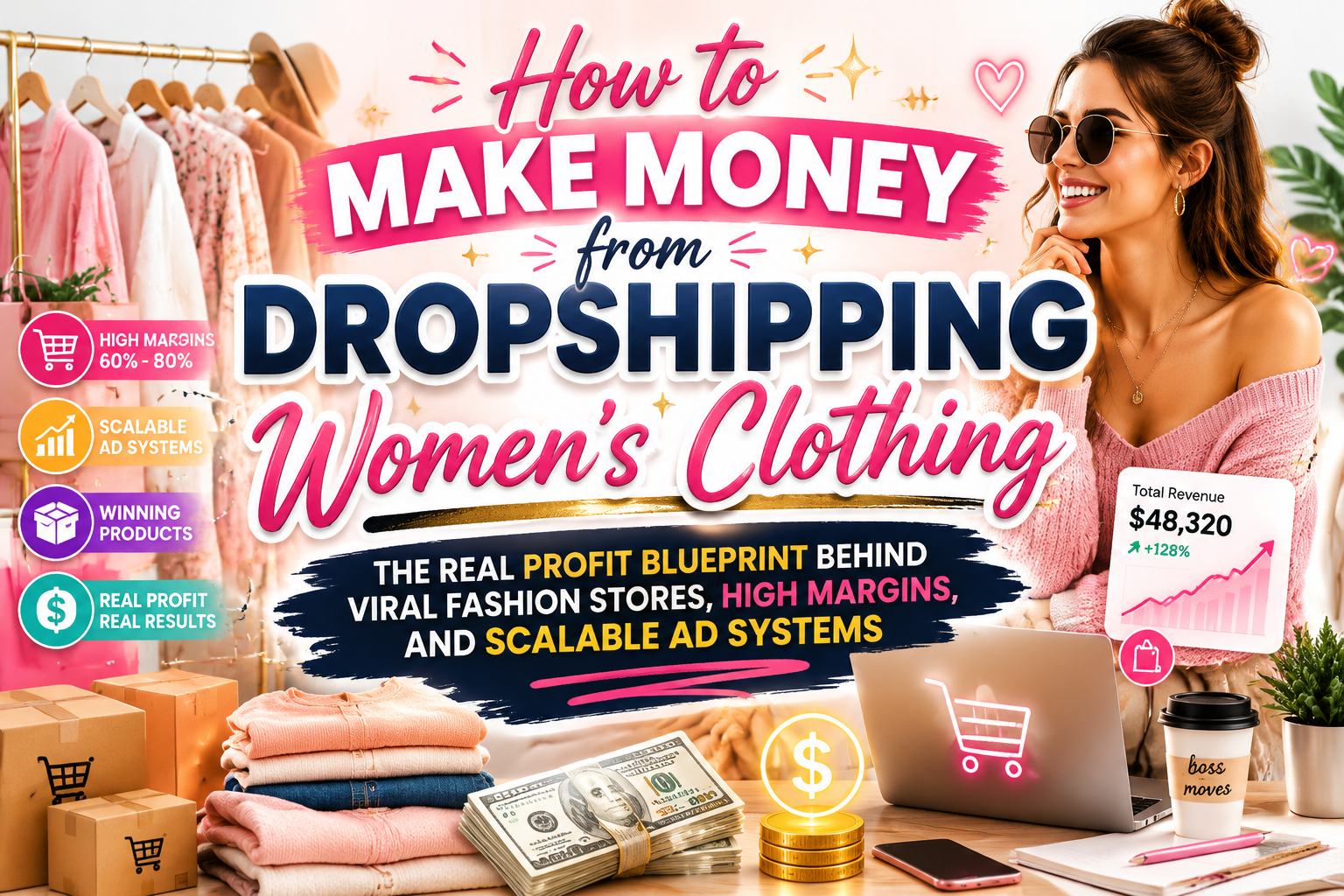
How to Make Money from Dropshipping Women’s Clothing: The Real Profit Blueprint Behind Viral Fashion Stores, High Margins, and Scalable Ad Systems

Dropshipping women’s clothing remains profitable not because of extreme margins, but because of scalable demand and fast product testing cycles. The businesses that succeed are not those with the highest markup, but those that maintain stable acquisition costs, increase AOV, and continuously optimize conversion rates.
Profit Margins, Real Earnings, and Business Model Breakdown
Most beginners assume that dropshipping women’s clothing is a “high-margin” business simply because fashion products can be marked up heavily. In reality, profitability is determined by a layered structure of costs, where gross margin, advertising efficiency, and return rates interact more than simple product pricing.
In the women’s fashion niche, typical product cost from suppliers in China ranges between $6 and $18 per item depending on complexity such as fabric quality, design, or branding customization. These items are commonly sold in Western markets between $25 and $65. On paper, this suggests a gross margin of 60% to 75%. However, this is only the starting point of the real financial picture.
Gross Margin vs Net Profit: The Critical Gap Most Sellers Misunderstand
While gross margin in women’s clothing dropshipping often looks attractive, net profit is significantly lower after accounting for advertising and operational costs. Paid traffic platforms like TikTok Ads, Meta Ads, or Pinterest Ads usually consume 25% to 45% of revenue in competitive fashion segments.
For example, if a dress is sold for $40 with a product cost of $10, the gross profit is $30, giving a 75% gross margin. However, if the average cost per purchase (CPA) is $12 to $18 in fashion campaigns, and payment processing plus platform fees take another 3% to 5%, the actual net profit per order may drop to $10–$15. This results in a realistic net margin of around 20% to 35% in well-optimized stores.
This gap between gross and net margin is where most dropshipping businesses either scale or fail.
The Role of Average Order Value (AOV) in Profitability
One of the strongest factors influencing how much money you can make from dropshipping women’s clothing is AOV. Stores that sell single low-ticket items often struggle to maintain profitability because advertising costs remain fixed regardless of product price.
Successful stores increase AOV to $60–$120 by bundling products or using upsells such as “buy 2 get 15% off” or “complete the outfit” recommendations. When AOV increases while CPA stays stable, profit per customer can double without increasing traffic costs.
For instance, if CPA is $15 and AOV is $40, profit is limited. But if AOV increases to $90 while CPA remains $15–$20, net profit margin can exceed 40%, even in competitive markets.
Return Rates and Hidden Cost Pressure in Women’s Fashion
Another overlooked factor is return rate. Women’s clothing has a higher return rate compared to most e-commerce categories, often ranging between 10% and 30% depending on sizing accuracy and product expectations.
Returns directly reduce net profit because shipping costs are rarely recoverable in dropshipping models. Even a 15% return rate can reduce effective margins by 5–10 percentage points. This is why stores that invest in better sizing charts, product images, and customer expectation management tend to outperform purely ad-driven competitors.
What Realistic Monthly Profit Looks Like
A small but optimized women’s clothing dropshipping store spending around $5,000 per month on ads can generate $10,000–$18,000 in revenue depending on conversion rate and creative performance. With a net margin of 20% to 30%, monthly profit typically falls between $2,000 and $5,000.
At scale, stores that reach consistent creative performance and strong product-market fit can push monthly revenues above $50,000, but margins often compress slightly due to higher ad competition, bringing net profitability closer to 15%–25%.
Winning Product Selection Strategy for Higher Conversions and Profit Margins
In women’s clothing dropshipping, product selection is not just a creative decision—it is a financial control mechanism. Even with strong advertising skills, a weak product typically fails because fashion is a fast-scroll, impulse-driven category where conversion happens in seconds, not days.
Unlike general e-commerce, women’s fashion products are heavily judged on visual appeal, perceived quality, and trend alignment. This means that a product’s profitability is directly linked to its ability to convert cold traffic, not just its cost or markup potential.
Stores that systematically select winning products often achieve conversion rates between 2.5% and 5%, while poorly selected catalogs struggle below 1.5%, which can completely destroy advertising ROI regardless of gross margin.
The Core Principle: Emotional Fit Over Functional Value
The most profitable women’s clothing products are not chosen because they are “useful,” but because they trigger emotional or identity-based buying decisions. Products that align with lifestyle aesthetics—such as “clean girl aesthetic,” “old money style,” or “Y2K streetwear”—consistently outperform generic items.
These categories typically maintain gross margins between 60% and 80%, but more importantly, they reduce cost per acquisition because users are more likely to convert without multiple ad exposures. In testing data across fashion stores, trend-aligned products can reduce CPA by 20% to 35% compared to non-trend items even with identical ad creatives.
Data-Driven Product Filtering: From Thousands to Winners
Successful dropshipping stores do not rely on intuition alone. Instead, they filter products through performance indicators before scaling. One of the most important signals is early engagement rate during ad testing.
A strong women’s fashion product typically shows:
- CTR above 2% in cold traffic campaigns
- Add-to-cart rate above 8%
- Conversion rate above 2.5% within the first 500–1,000 impressions
Products that fail to reach these thresholds usually generate negative ROI even if their gross margin is theoretically high.
In practical terms, a $12 cost dress that sells for $45 is irrelevant if it cannot convert efficiently. Meanwhile, a $15 cost item selling for $38 can be more profitable if it consistently achieves strong conversion signals.
The Importance of “Visual First” Product Selection
In women’s clothing dropshipping, visual perception often matters more than price elasticity. Products that photograph well under natural lighting or lifestyle settings tend to outperform studio-only or complex-texture items.
High-performing categories include flowy dresses, matching sets, basic tops with aesthetic silhouettes, and seasonal layering pieces. These products generate higher engagement rates because they are easier for customers to imagine in real-life contexts.
From a financial perspective, visually strong products reduce reliance on aggressive ad spending. Stores with strong visual products often maintain CPA ranges of $10–$18, while weak visual products may require $20–$35 CPA to achieve similar conversion levels.
Trend Velocity: The Hidden Profit Multiplier
One of the most overlooked aspects of product selection is trend velocity, which refers to how quickly a product style is gaining or losing popularity. Women’s fashion is highly trend-sensitive, and product lifecycle can be as short as 30 to 90 days.
Fast-moving trends like seasonal aesthetics or viral TikTok styles can produce short-term gross margins above 70%, but only if entered early in the cycle. Late entry reduces margins significantly because advertising competition increases CPA while conversion rates decline due to market saturation.
Stores that consistently enter trends early often generate 30% to 50% higher return on ad spend compared to late adopters.
Supplier Flexibility as a Selection Filter
Another critical factor in product selection is supplier adaptability. Even a trending product can become unprofitable if supply chain issues lead to long shipping times or inconsistent quality.
In women’s clothing dropshipping, products with flexible suppliers that allow fast restocking, size variation control, and branding customization tend to generate higher lifetime margins. These operational advantages can improve repeat purchase rates by 10% to 20%, especially when customers trust sizing consistency.
TikTok & Meta Ads Scaling System for Predictable Fashion Profit
In women’s clothing dropshipping, paid advertising is not just a growth channel—it is the primary mechanism that determines whether a business is profitable or not. Unlike SEO-driven ecommerce models, fashion dropshipping relies heavily on fast feedback loops from TikTok Ads and Meta Ads to validate products quickly.
The financial reality is simple: even products with 70% gross margins cannot scale if the cost per acquisition (CPA) is unstable. Successful stores treat ads as a controlled investment system where each campaign is evaluated based on return on ad spend (ROAS), conversion rate, and creative fatigue rather than impressions or clicks alone.
TikTok Ads: The High-Velocity Testing Engine
TikTok Ads has become one of the most powerful platforms for women’s fashion due to its algorithm-driven content discovery. A single creative can reach thousands of targeted users within hours, making it ideal for product validation.
In early-stage testing, successful women’s clothing campaigns typically aim for:
- CPA between $10 and $20
- CTR above 1.8% to 2.5%
- Conversion rates between 2% and 4%
If a product performs below these benchmarks, it usually indicates either weak product-market fit or poor creative alignment.
The key advantage of TikTok is its ability to generate low-cost engagement. In many cases, CPMs range from $4 to $10, which allows dropshippers to test multiple creatives at a relatively low risk. However, scaling is only possible when a winning creative consistently holds stable CPA after reaching $1,000–$3,000 in ad spend.
Meta Ads: The Scaling and Retargeting Layer
While TikTok is ideal for discovery, Meta Ads (Facebook and Instagram) remains the strongest platform for scaling and retargeting in women’s fashion. Meta’s strength lies in its advanced audience segmentation and conversion optimization.
At scale, profitable fashion stores often maintain:
- ROAS between 2.5x and 4x
- CPA between $12 and $25 depending on AOV
- Retargeting conversion rates 20%–40% higher than cold traffic
Meta performs particularly well for higher-ticket bundles and retargeting users who engaged with TikTok ads but did not convert. This cross-platform funnel structure significantly increases overall profit stability.
The Creative System: The Real Scaling Factor
In women’s clothing dropshipping, creative performance matters more than audience targeting. Data consistently shows that 70%–80% of campaign success depends on ad creatives rather than audience selection.
Winning creatives typically follow three formats:
- Lifestyle try-on videos showing real movement and fit
- Problem-solution hooks (e.g., “outfits that instantly upgrade your look”)
- Trend-based aesthetics aligned with current fashion cycles
High-performing creatives can reduce CPA by 20%–50% compared to static images. Once a winning creative is identified, scaling is achieved not by changing targeting but by duplicating and iterating variations of the same content.
Scaling Strategy: From Testing to Controlled Expansion
Scaling in fashion dropshipping is not linear. It is a controlled expansion process based on performance stability. A product is considered scalable only when it maintains consistent CPA for at least 3–5 days with stable ROAS.
At this stage, budgets are increased gradually—typically 20%–30% per day—to avoid algorithm reset. Sudden scaling often leads to cost spikes, which can reduce gross margin efficiency even for winning products.
For example, a product generating $15 CPA with a $45 selling price initially delivers 67% gross margin. However, aggressive scaling without optimization can push CPA to $25–$30, cutting margins in half and making the product unprofitable despite strong early performance.
Funnel Optimization: Increasing Profit Without Increasing Ad Spend
One of the most effective scaling methods is not increasing traffic, but increasing conversion efficiency. Small improvements in checkout flow, product page design, or upsell structure can increase revenue per visitor by 10%–25%.
Common optimizations include:
- Bundled offers that increase AOV from $40 to $70+
- Exit-intent discounts that recover 5%–10% of abandoning users
- Post-purchase upsells that add 15%–30% extra revenue per order
These improvements directly increase ROAS without increasing CPA, which significantly improves net profit margins.
Branding vs Generic Store Profitability Comparison and Real Margin Impact
In women’s clothing dropshipping, two fundamentally different business models dominate the market: generic stores and branded stores. While both can generate short-term revenue, their long-term profitability structure is very different.
Generic stores rely on trend-hopping and fast product turnover, while branded stores focus on identity, repeat customers, and perceived value. Although both can achieve gross margins between 55% and 80%, the real difference appears in customer acquisition cost efficiency and lifetime value (LTV).
Generic Stores: Fast Testing, High Volatility, Lower Customer Lifetime Value
Generic dropshipping stores typically focus on rapid product testing. They launch multiple unrelated products, often driven by TikTok trends or ad performance signals. This model allows quick validation but creates unstable revenue patterns.
In terms of financial performance, generic women’s clothing stores often see:
- Gross margins: 60%–75%
- CPA volatility: $12–$30 depending on competition
- Low repeat purchase rate: typically below 15%
The main issue is that customers do not associate the purchase with a brand identity. As a result, each sale requires new paid traffic acquisition. Even if a product performs well initially, profitability declines as ad costs rise or trends fade.
Over time, generic stores often struggle to maintain stable ROAS above 2.0x without constant product replacement.
Branded Stores: Higher Trust, Lower CPA Over Time, Stronger LTV
Branded dropshipping stores operate differently. Instead of selling random products, they build a consistent identity around a specific aesthetic, such as minimalist fashion, luxury-inspired outfits, or streetwear collections.
Although initial setup costs are higher, branded stores benefit from compounding advantages:
- Gross margins: 65%–85% due to pricing power
- CPA reduction over time: 10%–30% lower than generic stores
- Repeat purchase rate: 25%–45% depending on niche strength
The key advantage is trust. Customers are more likely to convert at higher price points and return for additional purchases. This reduces dependency on paid ads and improves overall LTV-to-CPA ratio.
For example, a branded store with $20 CPA and $80 AOV can achieve 75% gross margin. If even 30% of customers return, the effective profit per customer can double compared to a generic store with identical first-order margins.
Pricing Power: The Hidden Advantage of Branding
One of the most overlooked benefits of branding in women’s clothing dropshipping is pricing elasticity. Branded stores can charge 15%–40% more for similar products simply due to perceived value.
A $25 generic dress may sell for $40–$55 in a branded store if positioning and storytelling are strong. This directly increases gross margin without increasing product cost.
In contrast, generic stores often enter price competition, which compresses margins over time and forces reliance on higher ad spend to maintain revenue levels.
Advertising Efficiency: Why Branded Stores Scale More Predictably
Branded stores tend to perform better in ad platforms like TikTok and Meta because of higher engagement rates and stronger emotional resonance.
Typical performance differences include:
- CTR improvement: +20% to +40%
- Conversion rate increase: +15% to +25%
- CPA reduction: $3–$8 lower on average compared to generic stores
This happens because branded content feels more trustworthy and consistent, reducing friction during the purchase decision process.
Over time, this leads to more stable ROAS and easier scaling compared to generic stores, which often experience sudden performance drops when trends shift.
Operational Complexity vs Profit Stability Trade-Off
The main downside of branded stores is operational complexity. Building a brand requires investment in creative direction, content consistency, and sometimes inventory or private labeling.
Generic stores are easier to launch and test, making them ideal for beginners or rapid experimentation. However, they rarely achieve stable long-term profitability without continuous reinvention.
Branded stores, on the other hand, require more upfront effort but generate more predictable cash flow once established. In many cases, branded fashion stores achieve 20%–35% net margins at scale, while generic stores fluctuate between 10%–25% depending on trend cycles.
Supplier & Fulfillment Optimization for Higher Margins and Lower Risk
In women’s clothing dropshipping, supplier selection and fulfillment strategy are often underestimated compared to marketing or product selection. However, they directly influence net profit margins, refund rates, and customer lifetime value.
Even when gross margins appear strong—typically between 60% and 80% in women’s fashion—the real profitability can vary dramatically depending on shipping speed, product consistency, and return handling. In many cases, inefficient fulfillment can reduce net margins by 10% to 25%, effectively turning a profitable store into a break-even operation.
This makes supplier optimization not a backend detail, but a core profit lever.
The True Cost Structure Hidden Behind “Cheap Products”
At first glance, sourcing a women’s dress for $8–$15 and selling it for $35–$60 looks highly profitable. However, supplier pricing alone does not reflect the full cost structure.
Poor suppliers often introduce hidden costs such as:
- Longer shipping times (15–30 days) increasing refund rates
- Inconsistent sizing leading to 10%–20% return rates
- Product quality variance reducing repeat purchase behavior
- Increased customer service workload
When these factors are combined, effective gross margin can drop from a theoretical 70% to a real-world 40% or lower.
This is why supplier quality is often more important than product price itself.
Fast Shipping vs Low Cost: The Margin Trade-Off
One of the most important decisions in women’s clothing dropshipping is whether to prioritize low-cost sourcing or faster fulfillment.
Standard China-based suppliers may offer unit costs as low as $6–$12, but shipping times can range from 10 to 25 days. In contrast, optimized fulfillment centers in the US or EU may increase product costs to $12–$22 but reduce delivery time to 3–7 days.
This trade-off has a direct impact on advertising efficiency:
- Faster shipping typically improves conversion rates by 15%–30%
- Refund rates can decrease by 5%–15%
- Customer satisfaction improves repeat purchase probability
In many cases, the improved conversion rate offsets the higher product cost, resulting in higher overall profit despite lower nominal margins.
Private Label and Custom Branding: Increasing Margin Through Perceived Value
One of the most effective ways to increase profitability in women’s fashion dropshipping is through supplier-enabled customization. Private labeling, packaging upgrades, and branding inserts can significantly increase perceived value.
Products that cost $10–$15 can often be sold for 20%–40% higher prices simply by adding branding elements such as tags, packaging sleeves, or custom labels.
This pricing flexibility improves gross margins without increasing ad spend. More importantly, it strengthens brand identity, which increases repeat purchase rates over time.
In competitive niches, even a small improvement in perceived quality can translate into a $5–$15 increase in average selling price, which has a large impact on net profit per order.
The Role of Fulfillment Centers in Scaling Profitably
As a store scales, relying solely on individual suppliers becomes inefficient. Fulfillment centers or third-party logistics providers (3PLs) play a critical role in stabilizing operations.
Well-optimized fulfillment systems typically provide:
- Consolidated inventory management
- Faster shipping routes to US/EU markets
- Automated order processing integration with Shopify or WooCommerce
- Lower per-unit shipping costs at scale
At scale, using fulfillment centers can reduce per-order logistics costs by 10%–20%, while improving delivery times significantly. This improves ROAS indirectly by increasing conversion rates and reducing post-purchase friction.
Return Handling and Its Direct Impact on Net Margin
In women’s clothing dropshipping, return rates are one of the largest hidden profit drains. Depending on sizing accuracy and product expectations, return rates can range from 10% to 30%.
Efficient suppliers help mitigate this through:
- Better size charts and product accuracy
- Pre-shipment quality checks
- Local return addresses in key markets
Even a 5% reduction in return rate can increase net profit margins by 3%–8%, which is significant in a competitive fashion environment where overall margins are tightly controlled.
Seasonal Trends & Fast Fashion Cycle Profit Strategy
Women’s clothing is one of the most seasonally sensitive categories in ecommerce. Unlike evergreen products, fashion demand shifts rapidly based on weather, cultural trends, and social media aesthetics. This creates both risk and opportunity for dropshippers.
In practical terms, seasonal alignment can increase conversion rates by 20% to 60%, while misaligned inventory can cause CPA to rise by 30% or more due to lower purchase intent. Even products with strong gross margins of 60%–80% can become unprofitable if they are sold at the wrong time of year.
The Four Core Fashion Cycles That Drive Revenue
Women’s fashion typically follows four major cycles: Spring, Summer, Autumn, and Winter, each with distinct demand patterns and product categories.
Spring often favors light layers, floral dresses, and transitional outfits. Summer drives demand for short dresses, beachwear, and casual sets. Autumn shifts toward knitwear, jackets, and neutral tones. Winter focuses on heavy outerwear and comfort-oriented fashion.
Stores that align product selection with these cycles consistently achieve higher conversion rates and lower advertising costs. For example, a summer dress campaign launched in peak summer months may achieve a CPA of $10–$18, while the same product in off-season can exceed $25–$35 CPA due to reduced intent.
Fast Fashion Timing: The Difference Between Profit and Saturation
Beyond seasonal cycles, fast fashion is heavily influenced by micro-trends driven by TikTok, Instagram, and influencer culture. These trends often have short lifespans ranging from 30 to 90 days.
Early entry into a trend is where the highest profitability exists. During the early phase, competition is low, CPMs are cheaper, and conversion rates are significantly higher. Gross margins during this phase can effectively exceed 70% due to efficient ad performance.
However, once a trend becomes saturated, competition increases dramatically. CPA rises, ad fatigue accelerates, and margins compress quickly. In many cases, late-stage entrants see profitability drop from 30% net margin to below 10% within weeks.
Timing, therefore, is more important than product quality in fast fashion cycles.
Trend Detection Systems: How Successful Stores Predict Demand
Profitable dropshipping stores do not wait for trends to peak—they use early detection signals to enter markets before saturation.
Common indicators include:
- Rapid engagement growth on TikTok hashtags
- Sudden increase in Pinterest saves or searches
- Influencer repetition of similar styles
- Early spikes in AliExpress or supplier order volume
Products identified at this stage often have the highest ROI potential. Even a small 2–3 week advantage in trend entry can improve ROAS by 30%–50% compared to competitors entering later.
This early positioning is often the difference between a product generating $15 CPA versus $25+ CPA under the same ad conditions.
Inventory Flexibility and Seasonal Risk Management
One of the biggest risks in seasonal fashion dropshipping is overcommitting to inventory or suppliers too early in a cycle. Demand can shift quickly, and unsold stock can erode profit margins significantly.
Flexible sourcing models help reduce this risk by allowing:
- Small-batch testing before scaling
- Rapid supplier switching based on performance
- Short product lifecycle management (30–60 days)
Stores that adopt flexible inventory strategies are able to maintain more stable cash flow and reduce losses from trend misalignment. This improves effective annual profit margins by 10%–20% compared to rigid inventory models.
Pricing Strategy Across Seasons: Maximizing Margin Windows
Seasonal demand also affects pricing power. During peak season, customers are more willing to pay premium prices for relevant styles, allowing sellers to increase AOV by 10%–25% without negatively impacting conversion rates.
For example, a summer dress that sells for $35 in off-season may sell for $45–$60 during peak summer demand. Since product costs remain stable, this directly increases gross margin and net profit per order.
However, in off-season periods, aggressive pricing or bundling strategies are often required to maintain conversion efficiency and reduce ad waste.




No Comments