


How Dropshipping Inventory Software Prevents Overselling and Stockouts in 2026

Several years ago, inventory automation was considered a feature for advanced dropshipping businesses. Today it is rapidly becoming part of the basic infrastructure required to operate competitively.
Customers expect accurate product availability, fast shipping, and reliable fulfillment regardless of the business model behind the store. Sellers who continue relying on manual inventory management are increasingly exposed to operational risks that software can eliminate automatically.
Dropshipping inventory software does not directly increase revenue in the same way that advertising or product research does. Instead, it protects profit margins by preventing avoidable losses. In modern eCommerce, avoiding preventable losses is often just as important as generating additional sales.
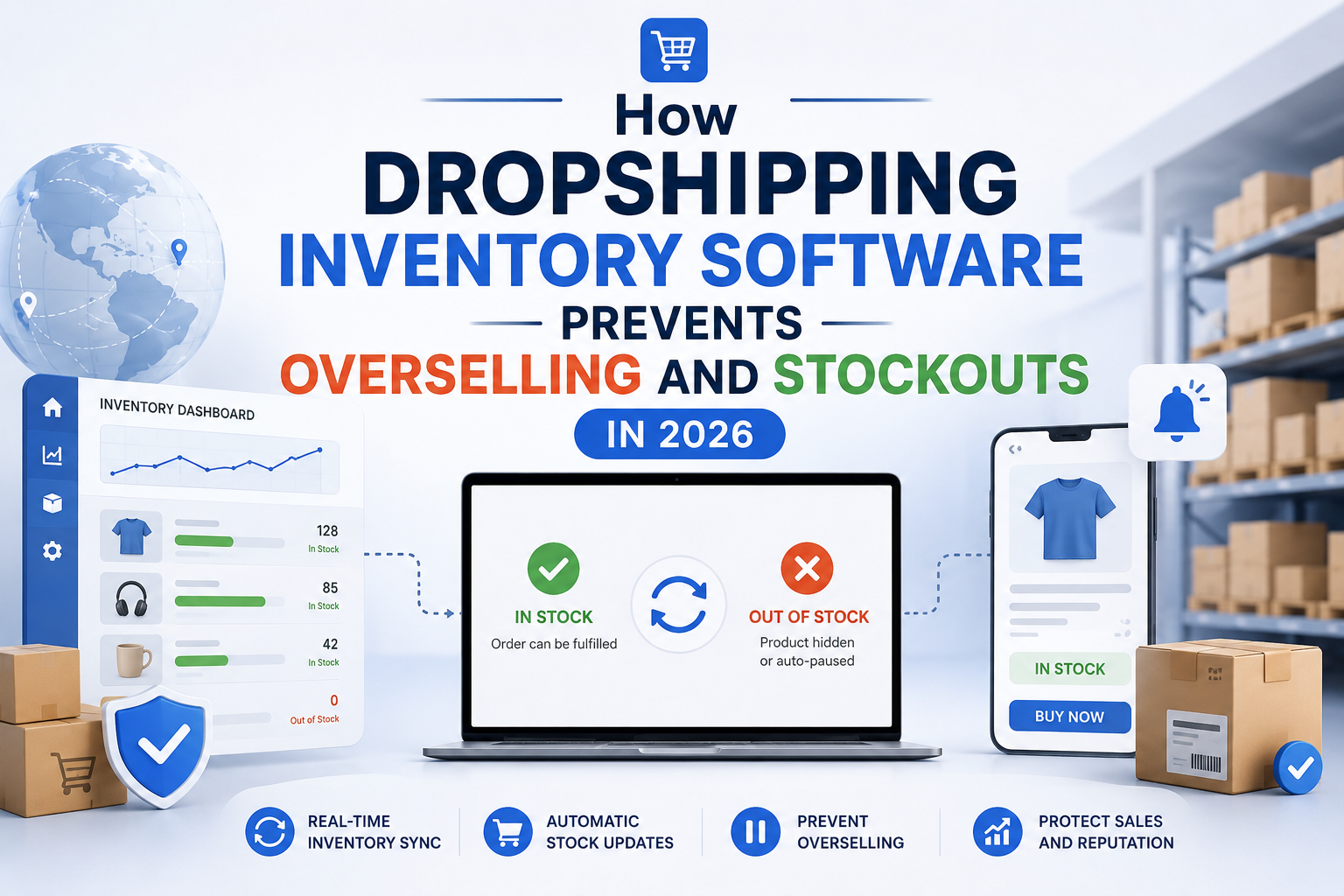
How Dropshipping Inventory Software Prevents Overselling and Stockouts
For many new dropshipping sellers, inventory management appears to be a problem that only affects large businesses with warehouses and thousands of products. In reality, inventory issues are often more dangerous in dropshipping because sellers do not physically control stock. The supplier owns the inventory, while the store owner is responsible for the customer experience. This creates a gap between product availability and customer expectations.
As advertising costs continue to increase and delivery expectations become stricter, selling an unavailable product can quickly become one of the most expensive mistakes in eCommerce. A single inventory error may result in refunds, payment disputes, negative reviews, and wasted advertising spending. This is why dropshipping inventory software has become an essential operational tool rather than an optional upgrade.
The Hidden Cost of Overselling
Overselling happens when a customer purchases a product that is no longer available from the supplier. In traditional retail, the merchant can usually verify stock levels internally. In dropshipping, however, inventory may change every few minutes as multiple sellers compete for the same products from the same supplier.
The financial impact of overselling goes far beyond refunding the customer. Advertising platforms such as Google Ads, Meta Ads, and TikTok Ads continue charging for clicks and conversions regardless of whether the order can actually be fulfilled. If a product goes out of stock after a campaign starts scaling, the seller may continue spending hundreds or even thousands of dollars promoting a product that cannot be shipped.
There are also indirect costs. Customers who receive cancellation emails often lose confidence in the store and are unlikely to return for future purchases. Chargebacks and disputes may increase, while payment processors can classify the business as higher risk if cancellation rates rise above acceptable levels.
Why Stockouts Are Becoming More Frequent
Several market trends have made inventory volatility significantly worse over the past few years.
Cross-border eCommerce has become increasingly competitive, meaning suppliers frequently experience sudden spikes in demand. Viral products driven by social media platforms can sell out within hours rather than weeks. At the same time, many suppliers operate across multiple marketplaces including Shopify, Amazon, TikTok Shop, and local wholesale platforms, causing inventory levels to fluctuate continuously.
Manual inventory updates that occur once or twice per day are no longer sufficient in this environment. By the time a seller notices that inventory has changed, dozens of additional orders may already have been placed.
How Dropshipping Inventory Software Solves the Problem
Modern dropshipping inventory software connects directly with suppliers through APIs, data feeds, or marketplace integrations. Instead of relying on manual updates, the software continuously monitors inventory levels and automatically synchronizes changes with the online store.
When supplier inventory drops to zero, the software can immediately pause advertising campaigns, hide product listings, or mark products as unavailable. Some systems can even switch to backup suppliers automatically if alternative inventory sources exist.
This real-time synchronization significantly reduces the risk of selling unavailable products while also improving operational efficiency. Store owners no longer need to spend hours checking supplier dashboards or importing spreadsheets manually.
Real-Time Synchronization Versus Scheduled Updates
Not all inventory software provides the same level of protection. Some solutions update stock every few hours, while others synchronize inventory in real time.
Scheduled synchronization may still be sufficient for slow-moving products with stable demand. However, stores that rely heavily on paid advertising campaigns or trend-driven products generally require real-time inventory visibility. A product promoted through influencer marketing or viral TikTok videos can generate hundreds of orders in a short period, making delayed inventory updates extremely expensive.
The value of real-time synchronization increases as store volume grows. What may be a minor inconvenience for ten daily orders can become a serious financial issue at one hundred or one thousand orders per day.
Best Dropshipping Inventory Software Compared: Features, Pricing, and Automation
As dropshipping businesses become increasingly automated, inventory software has evolved from a simple stock synchronization tool into the operational center of an entire store. Product imports, order routing, supplier communication, pricing updates, and inventory synchronization are now often managed through a single platform.
However, not all dropshipping inventory software is designed for the same type of business. A beginner operating a single Shopify store has very different requirements from an established seller managing thousands of SKUs across multiple marketplaces. Selecting software based only on monthly subscription price often results in unnecessary costs or missing functionality that becomes critical as the business grows.
The best inventory software is not necessarily the one with the most features. It is the one that matches the complexity, sales volume, and growth strategy of the business.
Automation Has Become the Primary Selection Criterion
Several years ago, inventory software was mainly evaluated by its ability to update stock quantities automatically. Today, automation extends much further than inventory synchronization.
Modern solutions can automatically import products from suppliers, push listing updates to stores, route orders to fulfillment partners, update tracking numbers, adjust pricing according to supplier costs, and monitor supplier availability in real time.
As customer acquisition costs continue to rise, operational efficiency becomes increasingly important. Saving two hours of manual work every day may create more value than reducing software expenses by twenty dollars per month.
For many sellers, software should be viewed as an employee rather than an operating expense.
Entry-Level Solutions Focus on Simplicity
Platforms such as ScaleOrder have become popular among new sellers because they offer relatively low costs and straightforward integration with supplier marketplaces.
These solutions are designed primarily for stores sourcing products from large marketplaces rather than private suppliers or independent manufacturers. Product imports are simple, order processing is highly automated, and setup usually requires very little technical knowledge.
The main limitation appears when businesses begin diversifying suppliers or selling across multiple channels. What works perfectly for a beginner may become restrictive as operations become more sophisticated.
Mid-Market Platforms Prioritize Flexibility
Software such as Scaleorder and Syncee target businesses that have moved beyond the initial testing phase and require more operational flexibility.
These platforms often support multiple suppliers, multiple sales channels, dynamic pricing rules, and more advanced inventory synchronization options.
The value proposition shifts from reducing manual work to improving scalability. Sellers can launch additional stores, test new markets, and manage larger product catalogs without proportionally increasing labor costs.
For businesses processing dozens or hundreds of daily orders, this operational leverage becomes increasingly important.
Enterprise-Level Software Focuses on Supply Chain Control
At higher sales volumes, inventory management becomes less about importing products and more about controlling supply chain complexity.
Solutions such as Inventory Source are designed for merchants working directly with wholesalers, distributors, and private suppliers rather than public marketplaces.
These systems typically offer direct supplier integrations, advanced SKU mapping, warehouse management functions, and detailed inventory reporting.
The objective is no longer simply keeping inventory updated. It is creating visibility across an entire fulfillment network while minimizing delays and operational disruptions.
Businesses operating branded dropshipping models or private-label stores often move toward these systems as they mature.
Multi-Channel Selling Changes Software Requirements
Many dropshipping businesses eventually expand beyond Shopify into marketplaces such as Amazon, Etsy, eBay, or TikTok Shop. Once this transition occurs, inventory synchronization becomes significantly more complex.
A product sold on one channel must immediately reduce inventory availability on all other channels. Delays create overselling risks, customer complaints, and fulfillment issues.
Software such as Spocket and other multi-channel solutions increasingly position themselves around centralized inventory visibility rather than simple product imports.
The more channels a business operates, the more valuable centralized inventory management becomes.
Pricing Should Be Evaluated Against Operational Savings
Monthly subscription fees for dropshipping inventory software can range from less than twenty dollars to several hundred dollars depending on order volume and features.
Many new sellers focus heavily on minimizing software costs while underestimating the cost of manual processes. If inventory software eliminates several hours of work each week, reduces order errors, and prevents overselling incidents, the return on investment often exceeds the subscription fee by a large margin.
The question is rarely whether inventory software is expensive. The more important question is how expensive it becomes to operate without it.
Is Dropshipping Inventory Software Worth the Cost? ROI Analysis for Growing Stores
One of the most common questions among new dropshipping entrepreneurs is whether inventory software is truly necessary or simply another subscription expense added to an already long list of monthly costs.
At first glance, paying between $30 and $300 per month for inventory management software may seem difficult to justify, especially for stores generating only a few sales per day. Since inventory software rarely creates sales directly, many sellers treat it as a cost center rather than a profit-generating investment.
However, this perspective often overlooks the real purpose of operational software. The role of inventory software is not to increase revenue but to protect profitability, improve efficiency, and reduce the probability of expensive mistakes that become more frequent as order volume increases.
Manual Inventory Management Carries Hidden Expenses
Many dropshipping businesses begin by managing inventory manually. Store owners regularly check supplier stock levels, update product availability, and adjust listings when suppliers discontinue products.
While this approach appears free, it consumes a significant amount of time. Even a relatively small store with several hundred active products may require one or two hours per day for inventory monitoring and corrections.
If that time is valued at only twenty dollars per hour, manual inventory management can easily cost several hundred dollars per month in labor alone. For larger stores, the cost increases rapidly.
The problem becomes more severe when business owners attempt to scale advertising campaigns. Operational tasks grow proportionally with sales volume, limiting the ability to focus on activities that actually generate revenue, such as product research, marketing optimization, and customer acquisition.
Refunds Often Cost More Than Sellers Expect
Inventory mistakes create financial consequences that extend far beyond simply refunding an order.
When a product becomes unavailable after a customer places an order, the seller loses the product margin, payment processing fees, and the advertising cost associated with acquiring that customer. Depending on the advertising channel, customer acquisition costs may exceed the product profit itself.
For example, a store selling a product for $60 with a gross margin of $20 may spend $15 on advertising to generate the sale. If the supplier runs out of stock, the merchant refunds the customer but still loses the advertising expenditure and payment transaction costs.
Repeating this process multiple times per month can quickly erase a significant percentage of net profit.
Customer Trust Has Financial Value
The financial impact of inventory errors is not limited to immediate order losses.
Customers increasingly expect accurate inventory information and reliable fulfillment timelines. Frequent cancellations damage trust and reduce the probability of repeat purchases.
Customer lifetime value plays an important role in long-term profitability, especially for stores attempting to build recognizable brands rather than relying exclusively on one-time transactions.
A customer who receives a cancellation notice after payment is unlikely to return for future purchases, regardless of how quickly the refund is processed.
Inventory software indirectly protects customer retention by improving operational reliability.
Automation Produces Compounding Efficiency Gains
The value of automation becomes more visible as order volume increases.
A store processing ten orders per day may only save thirty minutes of work through inventory automation. A store processing two hundred orders per day may save several hours daily while reducing the risk of operational errors.
Unlike labor costs, software expenses generally increase slowly relative to business growth. This creates economies of scale that improve profitability over time.
Many successful dropshipping businesses eventually discover that software expenses represent a smaller percentage of revenue as sales increase, while the operational benefits continue expanding.
A Simple ROI Example
Consider a store generating one hundred orders per day with an average order value of $50.
If inventory issues affect only three percent of orders, approximately three customers each day may experience delays, cancellations, or stock problems. Assuming an average advertising acquisition cost of $12 per customer, the business loses approximately $36 per day in marketing expenses alone.
Over one month, these losses exceed $1,000 without accounting for refunds, chargebacks, customer support time, or negative reviews.
Compared with these potential losses, a $99 monthly inventory software subscription becomes relatively insignificant.
The calculation becomes even more favorable for businesses with higher advertising costs or larger order volumes.
The Break-Even Point Arrives Earlier Than Most Sellers Expect
Many entrepreneurs assume inventory software only becomes necessary once a business reaches hundreds of daily orders. In reality, the economic justification often appears much earlier.
As soon as a store begins relying on paid advertising, supplier diversification, or larger product catalogs, the cost of inventory mistakes starts exceeding the software subscription cost.
The break-even point is frequently measured in prevented errors rather than additional sales.
Avoiding just a handful of canceled orders each month may be sufficient to cover the entire software investment.
How Dropshipping Inventory Software Makes Multi-Channel Selling Possible
For many dropshipping businesses, relying on a single sales channel is becoming increasingly risky. Customer acquisition costs fluctuate, platform policies change, and advertising performance can decline without warning. As a result, more merchants are expanding beyond a single storefront and distributing products across multiple marketplaces.
A seller that originally operated only through Shopify may eventually begin selling through Amazon, eBay, Etsy, Walmart Marketplace, or TikTok Shop. Each platform provides access to different customer demographics and traffic sources, reducing dependence on any single ecosystem.
However, while revenue opportunities increase with every new channel, operational complexity increases at an even faster rate. Inventory management quickly becomes one of the biggest obstacles to successful expansion.
Inventory Fragmentation Creates Operational Risk
The fundamental challenge of multi-channel selling is that inventory exists as a single pool of products while customers interact with multiple storefronts.
A supplier may only have fifty units available, but if inventory is managed separately across five sales channels, each channel may mistakenly believe all fifty units are still available for purchase.
This creates inventory fragmentation, where stock information becomes inconsistent between platforms. The result is often overselling, delayed shipments, order cancellations, and customer dissatisfaction.
As sales volume increases, manually monitoring inventory across several dashboards becomes increasingly unrealistic. What may be manageable with ten products quickly becomes impossible with hundreds or thousands of SKUs.
Real-Time Synchronization Becomes Essential
Dropshipping inventory software addresses this issue by creating a centralized inventory database that communicates with all connected sales channels.
When a customer purchases an item through Amazon, the available inventory immediately decreases across Shopify, eBay, TikTok Shop, and any other connected platform. Every storefront sees the same inventory information in near real time.
This synchronization prevents multiple customers from purchasing the same inventory simultaneously and significantly reduces fulfillment failures.
The importance of synchronization increases during promotional periods when products sell rapidly and inventory changes occur frequently throughout the day.
Without automation, even a delay of several minutes can create inventory conflicts.
SKU Mapping Is the Foundation of Cross-Platform Selling
One of the less visible challenges of multi-channel selling involves product identification.
The same product may appear under different titles, descriptions, and listing formats across multiple marketplaces. Suppliers may use one SKU while Amazon uses another internal identifier and Shopify stores use completely different product handles.
Inventory software solves this issue through SKU mapping, allowing multiple listings to reference the same underlying inventory source.
This ensures that inventory reductions occur correctly regardless of where the sale originates.
Without SKU mapping, businesses often experience duplicate inventory records or synchronization failures that become increasingly difficult to diagnose as product catalogs grow.
Marketplace Expansion Requires Centralized Control
As businesses expand into additional regions and marketplaces, operational visibility becomes increasingly important.
Store owners need to know not only how much inventory remains, but also where inventory is being sold fastest, which channels generate the highest turnover, and which products require additional supplier capacity.
Modern inventory software provides centralized dashboards that combine inventory activity across all connected channels into a single interface.
This allows businesses to make decisions based on overall demand rather than isolated marketplace performance.
For growing brands, centralized visibility often becomes more valuable than inventory synchronization itself.
Different Channels Operate at Different Speeds
Not all marketplaces behave in the same way.
Products may sell slowly but steadily on Etsy while experiencing sudden spikes on TikTok Shop due to viral content exposure. Amazon may generate predictable daily demand, while promotional campaigns on Shopify can produce sharp but temporary increases in sales volume.
These differences create unique inventory pressures.
Inventory software increasingly allows merchants to establish channel-specific rules, reserve inventory for priority marketplaces, or allocate stock according to profitability and demand patterns.
Rather than treating all channels equally, businesses can optimize inventory distribution strategically.
This level of control is difficult to achieve manually once operations reach scale.
Supplier Diversification Adds Another Layer of Complexity
Many growing dropshipping businesses eventually work with multiple suppliers rather than relying on a single source.
This improves supply chain resilience but also introduces additional inventory management challenges. Different suppliers update stock levels at different intervals, use different product identifiers, and operate under different fulfillment timelines.
Inventory software acts as an intermediary layer between suppliers and marketplaces, normalizing inventory information into a standardized format that can be distributed consistently across every sales channel.
Without this layer, multi-supplier operations often become operationally fragile and difficult to scale.
Common Dropshipping Inventory Problems and How Inventory Software Solves Them
Many dropshipping businesses assume inventory management becomes difficult only after reaching significant scale. In practice, inventory problems often begin much earlier and become one of the main reasons why stores struggle to grow beyond the initial stage.
Unlike traditional retail businesses that physically control their products, dropshipping stores depend entirely on suppliers for inventory accuracy and product availability. This dependency creates uncertainty that can spread throughout the entire business operation.
Advertising performance, customer satisfaction, fulfillment speed, and profitability are all affected by inventory quality. When inventory management breaks down, the effects are rarely isolated to logistics alone.
Modern dropshipping inventory software was developed primarily to reduce these operational vulnerabilities and create more predictable workflows.
Supplier Inventory Changes Faster Than Most Sellers Expect
One of the most common challenges in dropshipping is inventory volatility.
Many suppliers sell products through multiple distributors, marketplaces, and wholesale channels simultaneously. Inventory levels can change dozens of times throughout the day without any direct communication to the store owner.
A product that appeared fully stocked in the morning may become unavailable only a few hours later.
Manual inventory checks cannot realistically keep pace with this speed of change, especially for stores managing hundreds of products.
Inventory software solves this issue by continuously monitoring supplier stock levels and automatically updating product availability inside the store. Instead of relying on human intervention, inventory synchronization occurs automatically according to predefined rules and update intervals.
This significantly reduces the probability of inventory discrepancies reaching customers.
Product Discontinuation Creates Unexpected Revenue Loss
Dropshipping suppliers frequently discontinue products with little warning.
Unlike traditional wholesalers that often provide advance notice before inventory depletion, many dropshipping suppliers simply remove products from their catalogs once stock reaches zero.
If the seller continues advertising the product after discontinuation, traffic and advertising budgets continue flowing toward unavailable inventory.
The financial damage extends beyond refunds because customer acquisition costs have already been spent.
Inventory software can detect permanent stock shortages, automatically disable listings, pause advertisements through integrations, or notify store owners that supplier intervention is required.
This transforms product discontinuation from a customer service crisis into a manageable operational event.
SKU Inconsistency Becomes More Severe as Catalog Size Increases
Small stores often underestimate the importance of SKU management.
The same product may exist under different identifiers depending on the supplier, warehouse location, sales channel, or fulfillment partner involved in the transaction.
As businesses expand their supplier network, duplicate SKUs and inconsistent naming conventions begin creating synchronization failures.
Orders may be routed to the wrong supplier, inventory updates may affect incorrect products, and fulfillment delays become increasingly common.
Inventory software introduces standardized SKU mapping systems that create a single source of truth for every product regardless of where it originates or where it is sold.
This consistency becomes essential once product catalogs exceed several hundred items.
Peak Seasons Expose Weak Inventory Processes
Inventory systems that function adequately during normal sales periods often fail during seasonal spikes.
Events such as Black Friday, Cyber Monday, Christmas, and major promotional campaigns create sudden increases in order volume that place significant pressure on suppliers and inventory synchronization systems.
Stock levels that normally change once per day may begin changing every few minutes.
Manual inventory workflows are particularly vulnerable during these periods because employees cannot respond quickly enough to rapid fluctuations in demand.
Inventory software improves resilience by shortening synchronization intervals, increasing update frequency, and automatically enforcing inventory thresholds when stock levels become critically low.
Businesses with automated inventory systems are generally better prepared for seasonal volatility.
Bundle Products Introduce Additional Complexity
Product bundles and kits have become increasingly popular because they improve average order value and create differentiation from competitors.
However, bundles introduce inventory challenges that many businesses underestimate.
A bundle containing three products may appear available even if one component has become unavailable at the supplier level. Selling incomplete bundles inevitably leads to delays and customer dissatisfaction.
Inventory software can establish inventory relationships between bundled products and their individual components.
When one component becomes unavailable, the entire bundle inventory adjusts automatically.
This functionality is particularly valuable for stores selling customized packages, gift sets, or product combinations.
Supplier Switching Can Disrupt Operations
Many experienced dropshipping businesses eventually diversify suppliers to reduce dependency on a single source.
While supplier diversification improves resilience, it also creates inventory management complications.
Different suppliers may report inventory using different formats, update schedules, and warehouse structures. Transitioning products from one supplier to another often introduces synchronization errors if performed manually.
Inventory software acts as an intermediary layer that standardizes inventory information across suppliers and reduces the operational disruption associated with supplier migration.
This flexibility becomes increasingly important as businesses mature and negotiate relationships with private suppliers or fulfillment partners.
Inventory Visibility Supports Better Decisions
Inventory software does more than solve technical synchronization problems.
By centralizing inventory data, businesses gain visibility into stock turnover rates, supplier reliability, seasonal demand patterns, and fulfillment performance.
This information supports purchasing decisions, marketing strategies, and supplier negotiations.
Stores that understand their inventory behavior often identify growth opportunities and operational weaknesses earlier than competitors that rely on fragmented data sources.
Inventory visibility therefore becomes a strategic advantage rather than simply an operational convenience.





No Comments