


How to Make Money from Dropshipping Car Perfume Air Fresheners: The High-Margin $20K/Month System Using TikTok Ads, Branding & Supplier Leverage

Car perfume dropshipping represents a rare combination in e-commerce: low product cost, high emotional demand, strong impulse conversion behavior, and scalable supply chains. With gross margins often exceeding 70% and strong ad-driven conversion potential, it remains one of the most attractive micro-niches for 2026.
Success in this space is not determined by product availability, but by positioning, branding, and advertising execution. Sellers who treat it as a commodity market tend to struggle, while those who build emotional branding and bundle-based pricing systems can turn it into a highly profitable, repeatable business model.
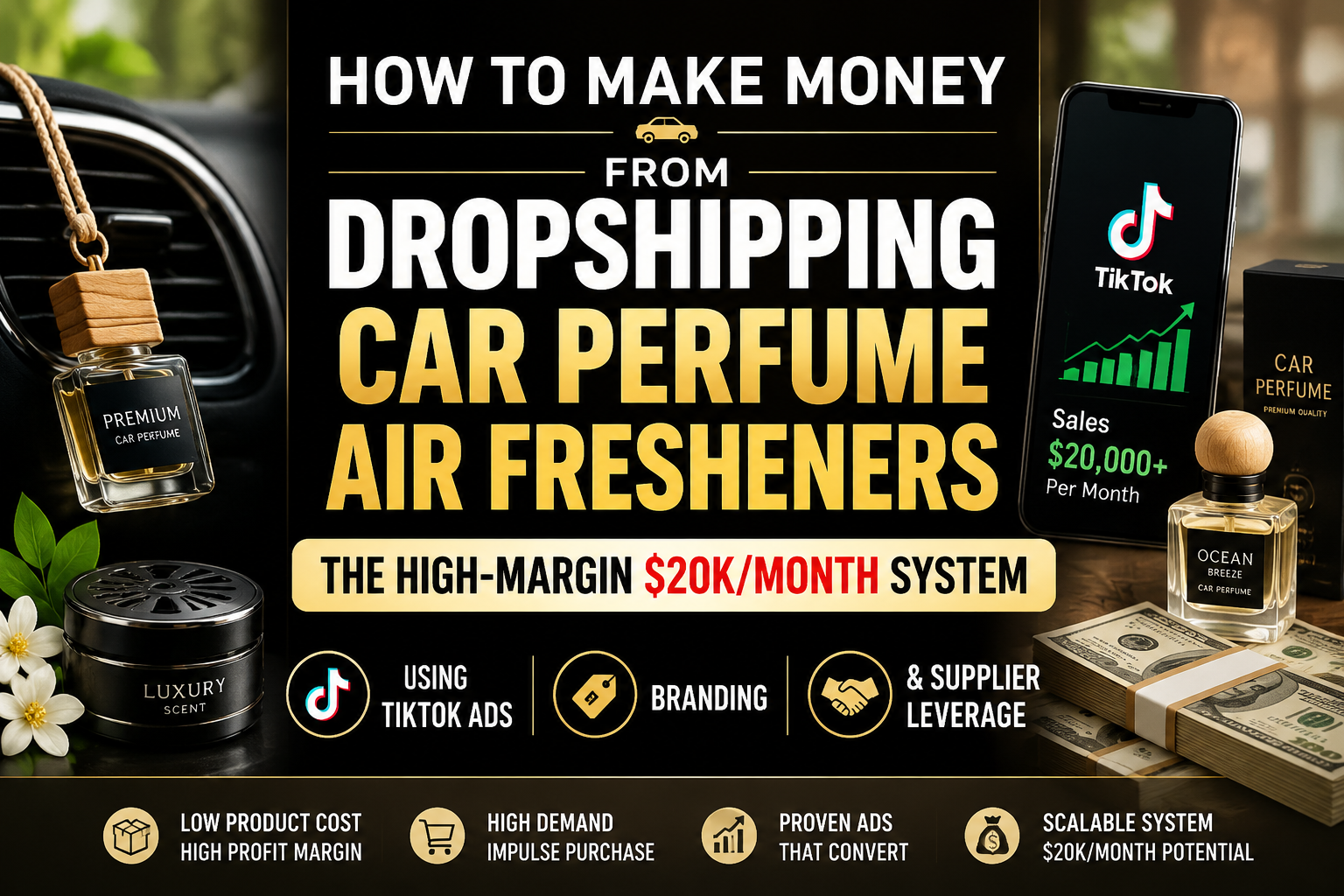
Why Car Perfume Dropshipping Is a High-Margin Micro-Niche
Car perfume and air freshener products have quietly become one of the most consistent high-margin micro-niches in the dropshipping industry. Unlike saturated fashion or electronics categories, car fragrance products sit in a unique intersection of emotional consumption, low production cost, and high perceived value. This combination creates a structural advantage for sellers who understand how to position and scale the product properly.
From a market perspective, the global automotive accessories market continues to expand alongside rising vehicle ownership. Even conservative estimates from industry reports place the car interior accessories segment growing at around 5–7% annually, with fragrance-based products being one of the most frequently repurchased subcategories. The key driver is simple: car perfumes are consumables, not durable goods, which means repeat purchase cycles naturally exist.
Why the Unit Economics Are Extremely Attractive
One of the strongest arguments for entering this niche is the gross margin structure. A typical car perfume or air freshener unit sourced from China costs between $0.30 and $1.20 depending on material quality, packaging, and fragrance oil concentration. Even premium-looking designs rarely exceed $2.00 landed cost when purchased at scale.
However, the retail pricing environment is significantly different. On Shopify, TikTok Shop, or Amazon, these products are commonly sold at $9.99 to $19.99 per unit. This creates a gross margin range of approximately 70% to 90% before advertising costs.
Even after accounting for paid acquisition—where average CPA (cost per acquisition) in TikTok Ads for impulse home or car accessories typically ranges from $3 to $7—sellers still maintain healthy contribution margins of 40% to 60% in well-optimized campaigns. This is unusually high compared to many physical product categories where margins often compress below 20% after ads.
The economics become even more favorable when bundling strategies are applied. For example, selling a “3-pack fragrance bundle” at $24.99 increases average order value while only increasing fulfillment cost marginally. In many cases, bundle-based stores achieve AOV increases of 35–80%, directly improving profitability without increasing traffic costs.
Why Demand Is Stable and Emotion-Driven
Car perfume is not a rational purchase category. It is driven primarily by sensory experience, identity expression, and emotional triggers such as cleanliness, comfort, and luxury perception. This makes it highly compatible with short-form video advertising platforms.
On TikTok and Instagram Reels, a simple visual demonstration—such as a transformation of a car interior or a “new car smell” concept—can generate conversion rates significantly higher than traditional utility products. Conversion rates of 2% to 5% are not uncommon in optimized funnels, especially when paired with strong visual storytelling.
Another important factor is low decision friction. Unlike high-ticket items, customers do not require extensive comparison or technical understanding. The buying decision is often made within seconds, especially when the price point is under $20.
Scalability Advantages Compared to Other Niches
From an operational standpoint, car perfume dropshipping has several scalability advantages. First, the product is lightweight, which reduces shipping complexity and cost. Second, it does not require sizing, compatibility checks, or technical support, which eliminates a major operational burden seen in other niches like electronics or apparel.
Third, supplier diversification is relatively easy. Multiple OEM factories offer similar formulations and packaging options, allowing sellers to quickly test new SKUs without high switching costs. This supports rapid A/B testing of fragrances, bottle designs, and branding angles.
Finally, because the product is consumable, successful stores can build recurring revenue loops through email marketing and retargeting campaigns. A customer who purchases once has a high probability of reorder within 30–90 days, especially if positioned as part of a lifestyle or “always fresh car” brand identity.
Best-Selling Car Air Freshener Types That Actually Convert in Ads
In car perfume dropshipping, most beginners assume that success depends on finding “a good fragrance.” In reality, profitability is determined far more by product format and perceived value than scent itself. The same fragrance can perform extremely differently depending on whether it is packaged as a vent clip, spray, gel, or hanging ornament.
This is because consumers do not buy car air fresheners as functional necessities. They buy them as visual upgrades to their car interior. That means the product must pass a split-second “visual trust test” before any scent or feature matters. In paid ads, especially TikTok and Meta, this visual psychology often determines whether a product achieves a 1% conversion rate or a 5% conversion rate.
Vent Clip Air Fresheners: The Conversion Leader in Paid Ads
Vent clip air fresheners consistently perform as one of the strongest formats in dropshipping due to their simplicity and perceived integration with modern car interiors. They are small, minimal, and visually “OEM-like,” which increases trust at first glance.
From a cost structure perspective, vent clips typically cost between $0.40 and $1.50 per unit depending on design complexity and material finish. Retail prices often range from $9.99 to $14.99, producing gross margins between 70% and 85%.
Their strongest advantage is not just margin but also ad performance. In short-form video ads, vent clips are easy to demonstrate—simply attaching the product to an air vent creates immediate visual clarity. This reduces cognitive load, which is a major factor in improving click-through and conversion rates.
Hanging Air Fresheners: High Emotional Appeal and Gift Positioning
Hanging air fresheners remain one of the oldest formats, but they continue to perform well when repositioned correctly. Instead of being sold as basic scent cards, modern dropshipping brands position them as aesthetic accessories or “car interior decorations.”
Production cost is extremely low, often between $0.20 and $0.80 per unit, which allows for gross margins exceeding 80% in many cases. However, the real strength lies in bundling strategy. Hanging air fresheners are frequently sold in multi-packs, increasing average order value while maintaining negligible marginal cost.
In advertising, these products perform well when paired with emotional storytelling—such as gifting, lifestyle branding, or seasonal themes. Their visual flexibility makes them suitable for viral creative testing, especially during holidays or travel seasons.
Spray Car Perfumes: Premium Positioning With Higher AOV
Spray-based car perfumes occupy a different pricing tier. They are perceived as more “luxury” or “professional-grade” compared to passive fragrance formats. This allows sellers to position them at higher price points, typically between $12.99 and $24.99.
Cost per unit is also slightly higher, usually ranging from $1.00 to $3.00, but gross margins remain strong at 65% to 80%. The key advantage of sprays is not margin percentage but average order value (AOV). Customers are more willing to pay for perceived intensity and control over fragrance application.
From a funnel perspective, sprays also reduce refund rates compared to weaker passive products because users feel they have more control over product usage, which increases satisfaction.
Gel and Solid Air Fresheners: The Stability and Subscription Opportunity
Gel-based air fresheners are often overlooked, but they offer one of the most stable long-term opportunities in this niche. Unlike sprays or vent clips, gel products provide slow-release fragrance, which creates a longer usage cycle.
Production cost is low, typically $0.50 to $1.80 per unit, with retail pricing between $10 and $18. While gross margins are similar to other formats, gel products excel in retention and repeat purchase behavior.
This format is particularly suitable for building subscription-style bundles or “refill ecosystems,” where customers are encouraged to repurchase every 30–60 days. Over time, this significantly increases customer lifetime value (LTV), which is often more important than single-sale profit.
Why Winning Stores Don’t Sell One Format Only
The most successful car perfume dropshipping stores rarely rely on a single product type. Instead, they build a structured product ecosystem combining vent clips (entry-level impulse buy), sprays (premium upsell), and bundles (AOV maximization).
This layered approach allows brands to capture different buyer psychology segments. Impulse buyers are converted through simple, low-cost items, while premium buyers are guided toward higher-margin products. When executed correctly, this structure can push blended gross margins into the 75% range before advertising costs.
How to Build a Branded Car Perfume Dropshipping Store That Beats Generic Competitors
In the car perfume dropshipping niche, most beginners compete on the wrong dimension: product selection. In reality, the product itself is highly commoditized. A vent clip or spray perfume can be sourced from hundreds of suppliers at nearly identical cost levels, typically between $0.30 and $2.50 per unit. This means product differentiation is weak, and long-term profitability depends far more on branding and positioning than sourcing advantage.
Branded stores consistently outperform generic ones because they change how customers perceive value. A product that costs $1.20 to produce can be sold for $12.99 in a generic store, but the same product can reach $19.99 to $29.99 when positioned as a lifestyle brand. This difference directly impacts gross margin expansion, often pushing it from 70% to over 85% before ad spend optimization.
Positioning: From “Car Freshener” to “Driving Experience Brand”
The first step in building a branded store is repositioning the product category itself. Instead of selling “car air fresheners,” successful brands sell concepts such as “driving comfort,” “luxury cabin experience,” or “signature car scent identity.”
This shift is critical because it changes buyer psychology from transactional to emotional. Transactional buyers compare price. Emotional buyers justify value. In paid advertising environments like TikTok and Instagram Reels, emotional framing can increase conversion rates from 1–2% to 3–6% when executed correctly.
Positioning also allows for price elasticity. For example, a generic vent clip might struggle above $12.99, but a branded “signature scent diffuser” can sustain $24.99 pricing without significant drop in conversion if visual identity and storytelling are consistent.
Increasing AOV Through Bundles and Scent Systems
One of the most important levers in branded dropshipping stores is average order value (AOV). In this niche, increasing AOV is often more impactful than reducing CPA, because traffic costs tend to remain relatively stable across competitors.
Branded stores typically use “scent system architecture” instead of single-product selling. This means offering multiple scents as a curated collection, such as “Fresh Morning,” “Deep Ocean,” or “Luxury Leather,” packaged as a set.
From a cost perspective, adding extra units increases fulfillment cost marginally—often by $0.80 to $2.00 per additional item—but retail pricing can increase from $14.99 for a single unit to $29.99–$39.99 for bundles. This creates AOV expansion of 80% to 150%, while maintaining gross margins above 75% in many cases.
Bundling also reduces perceived risk. Customers feel they are buying a complete experience rather than a single uncertain scent, which improves conversion rates and reduces refund rates.
Visual Identity and Packaging as Conversion Drivers
In this niche, packaging is not an operational detail—it is part of the marketing funnel. Because car perfumes are visually simple products, packaging becomes a major trust signal in ads and landing pages.
A branded store typically invests in three visual layers: product design, unboxing experience, and lifestyle context. Even small upgrades such as matte black packaging, embossed logos, or minimalist typography can significantly increase perceived value.
Data from performance-focused e-commerce brands shows that improving packaging presentation alone can increase conversion rates by 15% to 40%, especially for impulse-driven products under $30.
This is because customers subconsciously associate packaging quality with product performance, even when the actual fragrance formula is identical.
Brand Storytelling and Repeat Purchase Economics
The long-term advantage of branding is not just higher AOV, but also repeat purchase behavior. Car perfumes are inherently consumable, meaning customers naturally return every 30 to 90 days if the experience is positive.
Generic stores often fail to capture this because they focus only on acquisition. Branded stores, however, build retention loops through email marketing, scent discovery campaigns, and seasonal limited editions.
Even a modest repeat purchase rate improvement from 10% to 25% can dramatically increase customer lifetime value (LTV). For example, if average order value is $25, increasing repeat rate can effectively raise LTV from $25 to $50–$60 without increasing acquisition costs.
This is where branding becomes a compounding asset rather than a one-time advantage.
TikTok & Facebook Ads Strategy for Car Perfume Dropshipping
Car perfume dropshipping is fundamentally an advertising-driven business. Unlike SEO-heavy niches or complex B2B products, this category relies almost entirely on paid social traffic, especially TikTok Ads and Facebook/Instagram Ads. The reason is simple: the product is impulse-driven, visually demonstrable, and low-cost enough to support fast decision-making.
In most successful stores, over 80% of revenue is directly attributed to paid social campaigns. Organic traffic plays a secondary role, mainly reinforcing brand trust rather than generating consistent volume. This makes understanding ad economics critical for profitability.
TikTok Ads: The Highest Conversion Channel for Impulse Products
TikTok is particularly effective for car perfume products because of its short-form visual storytelling format. A successful creative does not need technical explanation; it only needs to trigger emotional relevance within the first 3 seconds.
Typical CPA (cost per acquisition) for well-optimized TikTok campaigns in this niche ranges from $3 to $8, depending on targeting and creative quality. Given that product retail prices usually sit between $12.99 and $24.99, this creates a viable contribution margin structure even after ad spend.
The strongest performing ads often follow a transformation pattern: showing a dirty or neutral car interior, then introducing the fragrance product as a “visual upgrade.” This framing increases click-through rates significantly because it connects the product with identity improvement rather than functionality.
Conversion rates on optimized landing pages can range from 2.5% to 5%, especially when urgency elements such as limited-time bundles or “new car smell” positioning are used.
Facebook & Instagram Ads: Stability and Retargeting Efficiency
While TikTok excels at cold traffic acquisition, Facebook and Instagram Ads play a different role: stabilizing conversion funnels and maximizing return on retargeting.
Facebook CPMs in this niche are generally lower than TikTok, often ranging between $5 and $12 depending on region and audience quality. However, click intent is slightly lower, meaning Facebook performs best when used for retargeting warm audiences rather than cold discovery.
Retargeting campaigns can significantly improve overall ROAS (return on ad spend). For example, users who viewed a product page but did not purchase can be retargeted with bundle offers, increasing conversion rates by 20% to 40%. This layered approach helps reduce blended CPA and stabilize profit margins.
Creative Fatigue and Why Most Dropshippers Fail
One of the biggest challenges in car perfume advertising is creative fatigue. Because the product is visually simple, winning ads often lose performance after 7–14 days of scaling.
This is where most dropshippers fail. They find one “winning ad” and scale it without building a creative pipeline. Once the ad burns out, CPA increases rapidly, sometimes doubling within a few days, turning profitable campaigns into loss-making ones.
Successful operators solve this by building a creative testing system. Instead of relying on one or two ads, they continuously test multiple angles: luxury positioning, humor-based transformation, gifting scenarios, and sensory storytelling. Even small variations in hook structure can lead to 30%–50% differences in CTR.
Funnel Structure: Turning Traffic Into Profitable Orders
A strong ad strategy is only effective when supported by a structured funnel. In this niche, the most profitable stores typically use a three-stage funnel: cold traffic acquisition, product page optimization, and post-purchase upsells.
Cold traffic from TikTok or Meta is directed to a highly visual landing page with minimal friction. The goal is to reduce decision time to under 30 seconds. Bundle offers and limited-time discounts are used to increase urgency.
Post-purchase upsells are especially important for improving AOV. For example, a $14.99 single unit purchase can be upgraded to a $29.99 bundle with scent variations or additional car accessories. This increases revenue per visitor without increasing ad spend.
Even a 20% improvement in AOV can increase overall profitability by 30% or more, assuming fixed CPA.
Scaling Logic: When and How to Increase Ad Spend
Scaling in this niche should not be linear. Increasing budget too quickly often leads to unstable CPA and declining ROAS. Instead, successful advertisers scale based on creative stability and audience saturation.
A common approach is vertical scaling only after 3–5 days of consistent CPA performance. Horizontal scaling—adding new creatives and audiences—is often more effective than simply increasing budget.
At scale, profitable car perfume stores typically maintain blended ROAS between 1.8 and 3.2 depending on market and seasonality. Stores below 1.5 ROAS usually struggle to maintain long-term sustainability unless they have strong backend retention systems.
Supplier Selection & Cost Structure Behind Car Air Fresheners: How Dropshippers Achieve 60–80% Gross Margin
In car perfume dropshipping, most beginners assume profit comes from marketing or product choice. In reality, supplier selection is the foundation of the entire business model. Because the product is lightweight, standardized, and easy to manufacture, the main competitive advantage is not innovation but cost control and packaging efficiency.
The same car air freshener can have a factory price difference of 300% depending on packaging, fragrance concentration, branding customization, and order volume. This creates a wide margin gap between unoptimized sellers and professional operators. In many cases, beginners operate at 30–50% gross margin, while optimized stores consistently reach 60–80% before advertising costs.
the True Unit Cost Structure
A typical car perfume product has several cost layers that must be understood clearly to evaluate profitability.
The base production cost for a simple vent clip or hanging air freshener is often between $0.20 and $0.80 in bulk manufacturing environments. This includes plastic casing, fragrance oil, and basic assembly.
However, once branding elements are introduced—such as custom molds, embossed logos, or upgraded packaging—the cost increases to approximately $0.80 to $2.50 per unit depending on complexity and order size. Many dropshippers underestimate packaging cost, which is often the largest hidden variable in this niche.
Shipping costs also play a critical role. Lightweight items shipped via ePacket or consolidated fulfillment typically range from $1.00 to $3.50 per unit depending on destination region. European shipping tends to be more expensive due to VAT handling and logistics regulations, while US fulfillment can be more cost-efficient with local warehouses.
When combined, the total landed cost per unit usually falls between $1.50 and $5.00 for most branded dropshipping setups.
How Retail Pricing Creates Margin Expansion
Despite relatively low production costs, retail pricing in this niche is significantly inflated due to perceived value and emotional purchasing behavior.
Most car perfume products sell between $12.99 and $24.99 in Western e-commerce markets. Premium-branded versions can even reach $29.99 or higher when positioned as luxury or lifestyle products.
This pricing structure creates a natural gross margin range of 60% to 85% before advertising costs. The key factor is perceived value, not functional value. Customers are not paying for fragrance alone—they are paying for design, branding, and emotional experience.
For example, a product costing $2.20 landed can be sold at $14.99, generating an 85% gross margin on product cost alone. Even after including payment processing fees and returns, the margin remains highly attractive compared to most physical product categories.
The Role of MOQ and Supplier Negotiation
Minimum order quantity (MOQ) is one of the most important levers for improving profitability. Many suppliers offer drastically reduced per-unit costs once order volume exceeds 500–2000 units per SKU.
At low MOQ levels, unit cost may remain at $2.50–$4.00. However, at scale, the same product can drop to $0.80–$1.50. This reduction alone can increase gross margin by 10–25 percentage points without any change in retail pricing.
Experienced operators often negotiate packaging consolidation, fragrance standardization, and multi-SKU sourcing agreements to reduce complexity and improve pricing efficiency. These operational improvements directly translate into higher profit per order.
Hidden Costs That Beginners Often Miss
While product and shipping costs are obvious, there are several hidden costs that significantly impact real profitability.
Return rates, for example, can range from 2% to 8% depending on product quality and expectation management. Although low in absolute terms, they still reduce effective margin if not accounted for properly.
Payment processing fees (typically 2.9% + $0.30 per transaction) also reduce net margin, especially for low AOV products. On a $15 order, this can represent nearly 5–8% of revenue depending on geography.
Additionally, chargebacks and refund friction in high-competition ad environments can further reduce effective gross margin by 3–5% if customer expectations are not aligned with product performance.
Why Scaling Improves Margin Instead of Reducing It
Unlike many dropshipping categories where scaling increases complexity and reduces margins, car perfume can actually improve margins at scale due to supplier leverage.
As order volume increases, sellers gain access to better pricing tiers, private labeling options, and optimized shipping routes. This reduces per-unit cost while maintaining or even increasing retail pricing through stronger branding.
At scale, well-structured stores often move from 60% gross margin at small volume to 75–80% at higher volume, assuming consistent supplier relationships and standardized packaging systems.
This makes the niche particularly attractive for long-term brand building rather than short-term arbitrage.
Why Car Perfume Is a Perfect Impulse Purchase Product
Car perfume and air freshener products belong to a rare category in e-commerce: low-cost, emotionally driven impulse purchases. Unlike high-consideration products such as electronics or apparel sizing-based goods, car fragrances require almost no rational evaluation. The decision is made within seconds, often driven by visual appeal and emotional association rather than functional necessity.
In most Western e-commerce markets, products priced between $10 and $25 fall into what marketers often call the “low-friction purchase band.” Within this range, customers are far more likely to buy based on perception rather than comparison. Car perfume fits perfectly into this bracket, making it highly compatible with TikTok, Instagram Reels, and Facebook feed advertising environments.
Sensory Psychology: Why Smell-Based Products Convert Faster
One of the strongest psychological drivers behind car perfume conversion is its connection to sensory imagination. Even though the product is purchased visually, the consumer is mentally projecting a smell experience. This creates a unique cognitive shortcut where emotion replaces rational analysis.
Research in consumer behavior consistently shows that scent-related products trigger memory association and emotional recall more effectively than purely visual goods. In practice, this means users are not just buying “a car accessory,” but an imagined driving experience—clean, fresh, luxury, or nostalgic.
This emotional projection significantly increases conversion rates. In optimized funnels, impulse-driven car perfume products can achieve conversion rates between 2.5% and 6%, which is significantly higher than many general dropshipping categories.
Pricing Anchoring and the Perceived Value Illusion
Pricing strategy plays a critical role in impulse purchasing behavior. Car perfume products benefit from strong price anchoring effects, where customers evaluate value based on perceived discount rather than absolute cost.
For example, when a product is positioned at $19.99 with a “limited-time offer” reducing it to $12.99, customers perceive a strong value gap even if the real cost difference is minimal. This psychological framing increases purchase urgency and reduces hesitation.
Because production costs are typically between $1 and $3, the perceived discount does not affect profitability significantly. Instead, it enhances conversion rates while maintaining gross margins that often range between 65% and 85%.
Anchoring is especially powerful when combined with bundle offers. A “buy 2 get 1 free” structure not only increases average order value but also strengthens perceived deal value, which further accelerates decision-making speed.
Visual Triggers: Why TikTok and Reels Dominate This Niche
Car perfume products are inherently visual transformation items. Their effectiveness in advertising is not based on technical explanation, but on before-and-after storytelling.
Short-form video platforms like TikTok amplify this effect by rewarding attention-grabbing hooks. A simple sequence showing a dull car interior transitioning into a clean, scented, aesthetic space is often enough to trigger emotional response and purchase intent.
This is why CPM efficiency in this niche is often higher than expected. Even with CPMs ranging from $5 to $15 depending on region, strong creative hooks can still produce profitable CPA ranges between $3 and $8.
The key mechanism here is attention compression: users do not need to understand the product deeply; they only need to emotionally accept the transformation narrative within a few seconds.
Low Cognitive Load and Fast Decision Making
Another major advantage of car perfume products is extremely low cognitive load. Customers do not need to compare specifications, sizes, compatibility, or technical details. This removes almost all friction from the purchase journey.
In behavioral economics, this is known as “reduced decision complexity,” which significantly increases conversion probability. The simpler the decision, the more likely it is to be made impulsively.
Landing pages that perform best in this niche typically minimize text and focus on visuals, pricing clarity, and urgency. This structure aligns with fast decision-making behavior and reduces bounce rates significantly.
Emotional Identity and Self-Expression Factor
Car perfume is not just a functional product—it is a subtle form of identity expression. Many buyers associate car interior smell with personal lifestyle, cleanliness standards, and even social status.
For example, a “luxury leather scent” or “fresh ocean breeze” product is not just about fragrance. It signals how the driver wants their environment to feel and be perceived. This emotional identity layer increases willingness to pay and reduces price sensitivity.
When branding is aligned with identity themes, conversion rates and repeat purchase rates both improve. Customers are more likely to reorder when they associate the product with their personal driving experience.



No Comments