


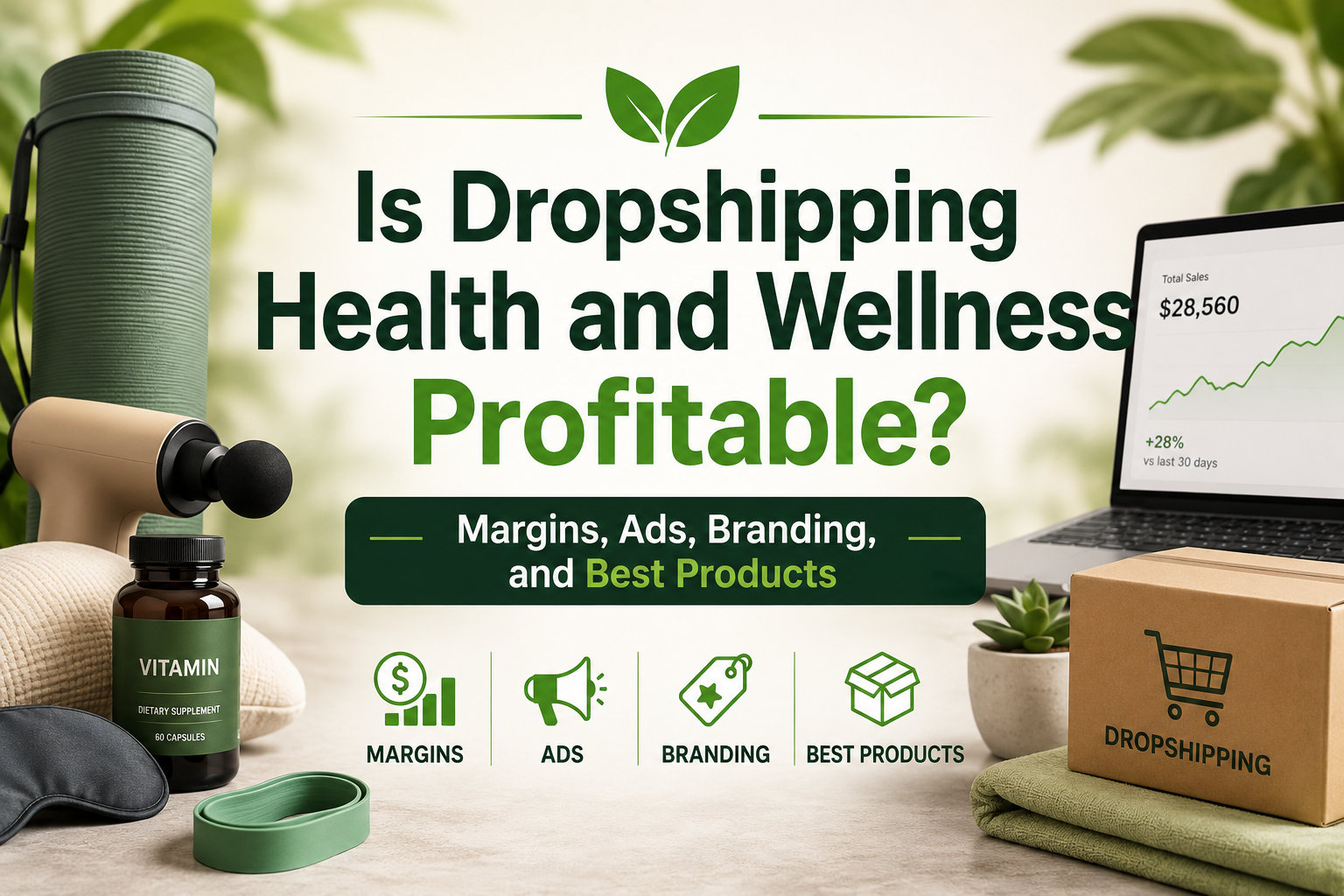
Is Dropshipping Health and Wellness Profitable? Margins, Ads, Branding, and Best Products

Health and wellness remains one of the few ecommerce sectors where high consumer demand, strong emotional purchasing behavior, and premium pricing opportunities coexist. Gross margins between 65% and 85% are still achievable in many subcategories, providing enough room to cover advertising costs while maintaining attractive profitability.
For entrepreneurs evaluating long-term ecommerce opportunities, the health and wellness industry offers a combination of evergreen demand and financial performance that few niches can currently match.
Is Dropshipping Health and Wellness Products Profitable Because of High Gross Margins?
The health and wellness industry has become one of the most attractive sectors for dropshipping entrepreneurs. While many ecommerce categories struggle with shrinking margins and aggressive price competition, health-related products often maintain gross margins between 65% and 85%, making them significantly more profitable than many traditional consumer products.
Why Health and Wellness Products Command Higher Prices
Consumers purchasing health and wellness products are usually solving a problem rather than buying entertainment or convenience. Back pain, poor posture, sleep difficulties, muscle recovery, eye strain, and sedentary lifestyles are all problems with direct impacts on quality of life and productivity.
When a product promises relief from pain or improvement in daily wellbeing, customers become less price-sensitive. A customer comparing two phone cases may choose the cheaper option, but a customer suffering from chronic neck pain is more willing to pay a premium if they believe the product can improve their condition.
This psychological difference allows wellness brands to maintain stronger pricing power than many other ecommerce categories.
Typical Gross Margins in Health and Wellness Dropshipping
Many popular wellness products have relatively low manufacturing costs while maintaining premium retail prices.
A posture corrector that costs approximately $5 to $7 from a supplier is commonly sold online for $24.99 to $34.99, producing gross margins close to 80%.
Resistance band sets often cost suppliers between $7 and $10 while retail prices range from $29.99 to $39.99, resulting in margins of approximately 72% to 78%.
Sleep masks with memory foam materials can be sourced for less than $3 but frequently retail for $14.99 to $19.99, creating margins above 80%.
Massage guns represent another attractive category. Although sourcing costs may range from $25 to $35, many branded stores successfully sell them for $89 to $129. Even after payment processing and shipping expenses, gross margins often remain above 65%.
Compared with general consumer electronics, where gross margins frequently fall below 30%, health and wellness products provide significantly more room for advertising costs and customer acquisition.
Advertising Economics Favor Higher Margin Categories
The ability to absorb advertising expenses is one of the main reasons health and wellness products perform well in dropshipping.
Current customer acquisition costs on platforms such as social media advertising often range between $20 and $40 per customer in developed markets. Low-margin products struggle to remain profitable under these conditions.
Consider a product selling for $30 with a gross margin of only 35%. After deducting advertising costs, payment processing fees, and refunds, the business may become unprofitable.
By contrast, a wellness product selling for $60 with a gross margin of 75% generates $45 in gross profit before advertising. Even after spending $25 to acquire a customer, the business can still maintain healthy operating margins.
This economic structure explains why many successful dropshipping stores intentionally focus on premium wellness products rather than low-cost impulse purchases.
Emotional Value Creates Additional Pricing Power
Another factor supporting profitability is the emotional value associated with wellness purchases.
Consumers are not simply buying a weighted blanket. They are buying better sleep.
They are not buying a posture corrector. They are buying confidence, comfort, and reduced pain during work hours.
They are not buying blue light blocking glasses. They are buying reduced eye strain and improved productivity.
Products connected to emotional outcomes consistently achieve higher average order values because customers evaluate the potential benefit rather than the manufacturing cost.
This allows brands to position themselves around transformation instead of specifications, creating substantial opportunities for premium pricing.
The Importance of Product Selection
Not every health product delivers the same profitability. Highly regulated categories such as supplements and ingestible products involve compliance risks, advertising restrictions, and customer trust challenges.
Non-regulated categories such as posture devices, sleep accessories, recovery tools, ergonomic products, and fitness accessories often provide a better balance between profitability and operational simplicity.
Many successful dropshipping stores build entire brands around solving one specific health problem rather than offering hundreds of unrelated products.
Is Dropshipping Health and Wellness Profitable in the Subscription Economy?
Many ecommerce categories depend heavily on constant customer acquisition to sustain growth. Every sale requires new advertising spending, and profitability often disappears once acquisition costs rise. The health and wellness industry operates differently. In many cases, the first purchase is only the beginning of a long customer relationship, which is why subscription-based health businesses often outperform traditional ecommerce stores in long-term profitability.
Why Recurring Revenue Changes the Economics of Dropshipping
The biggest challenge facing most dropshipping businesses today is customer acquisition cost. In mature markets such as the United States, Canada, the United Kingdom, and Australia, acquiring a new customer through paid advertising can easily cost between $25 and $50 depending on the platform and competition level.
For products with a one-time purchase pattern, the entire business depends on recovering this acquisition cost from a single transaction. This creates enormous pressure on gross margins and average order value.
Health and wellness products often avoid this problem because many products are naturally consumed over time and require replenishment. Customers purchasing collagen supplements, electrolyte powders, protein products, probiotics, sleep gummies, or vitamin blends are likely to buy again if they experience positive results.
As a result, customer lifetime value becomes significantly more important than the profit generated from the initial order.
Customer Lifetime Value Often Exceeds First Order Revenue
Many successful wellness brands are willing to break even or even lose money on the first purchase because they understand the value of repeat customers.
Consider a supplement subscription model with an average monthly order value of $38. If the average customer remains subscribed for six months, the lifetime revenue reaches $228.
Assuming a gross margin of 70%, gross profit reaches approximately $160 before advertising expenses.
If customer acquisition costs amount to $40, the business still retains substantial profitability across the customer lifecycle.
This creates an LTV to CAC ratio of approximately 4:1, which is generally considered highly attractive in ecommerce.
By comparison, many fashion dropshipping stores struggle to maintain ratios above 1.5:1 because customers rarely purchase the same product repeatedly.
Subscription Models Improve Cash Flow Predictability
Another major advantage of recurring revenue is operational stability.
Traditional dropshipping businesses often experience large swings in monthly sales performance due to seasonality, advertising changes, and viral product cycles. Revenue forecasting becomes difficult because future income depends entirely on attracting new buyers.
Subscription businesses generate a predictable revenue base every month.
A wellness business with 2,000 active subscribers paying $35 per month produces $70,000 in recurring monthly revenue before acquiring a single new customer.
This predictability allows businesses to invest more aggressively in advertising, inventory planning, and customer support because future cash flow becomes easier to estimate.
For investors and potential buyers, recurring revenue businesses also command significantly higher valuations than traditional ecommerce stores.
Retention Is More Important Than Acquisition
In subscription-based wellness businesses, improving retention often produces larger profit increases than improving advertising performance.
Increasing average customer retention from four months to six months improves lifetime value by 50% without increasing acquisition spending.
This is one reason many health brands invest heavily in onboarding emails, educational content, mobile applications, community groups, and personalized recommendations.
The objective is not simply to sell a product but to create habits and routines that integrate the product into the customer’s daily life.
Once customers build those habits, cancellation rates decline significantly.
Not Every Wellness Product Fits Subscription Models
Despite the advantages, not all health and wellness products benefit equally from recurring purchases.
Posture correctors, massage devices, ergonomic cushions, and fitness accessories are generally one-time purchases with limited repurchase frequency.
Products consumed regularly, however, are ideal candidates for subscriptions. Nutritional supplements, hydration products, protein formulas, functional beverages, and sleep support products often generate repurchase cycles ranging from 30 to 60 days.
Choosing products with natural replenishment cycles can dramatically improve business economics over time.
The Regulatory Challenge
Subscription profitability often attracts dropshippers to supplements and consumable wellness products, but these categories involve higher regulatory requirements than physical wellness accessories.
Advertising restrictions, labeling regulations, ingredient compliance, and country-specific import requirements can all increase operational complexity.
Many entrepreneurs therefore choose hybrid models that combine low-risk wellness accessories with selected consumable products sourced from certified suppliers.
This approach balances recurring revenue potential with manageable compliance risk.
Is Dropshipping Health and Wellness Profitable Despite Rising Advertising Costs?
One of the biggest concerns for ecommerce entrepreneurs in recent years has been the rapid increase in advertising costs. Customer acquisition that once cost less than $10 can now exceed $40 or even $50 in competitive markets. Many dropshipping categories that relied on impulse purchases and low-ticket products have seen margins disappear entirely.
Health and wellness products, however, continue to attract new entrants and investment despite this trend. The reason is simple: higher average order values and stronger gross margins allow many wellness businesses to absorb rising acquisition costs more effectively than traditional ecommerce categories.
Advertising Costs Have Increased Across Every Major Platform
The era of inexpensive traffic has largely disappeared.
On major social advertising platforms, cost per thousand impressions in health-related categories has risen significantly over the past five years due to increasing competition from established brands, subscription businesses, and direct-to-consumer companies.
In many Western markets, health and wellness campaigns commonly experience CPM rates between $15 and $35, while premium categories such as supplements, recovery equipment, and anti-aging products may exceed $40 during peak seasons.
Cost per click has also increased steadily. Search traffic for keywords related to sleep improvement, weight management, joint pain, posture correction, and fitness recovery frequently ranges from $0.80 to more than $2.50 per click depending on competition and geography.
For inexperienced sellers, these figures can make the health niche appear unprofitable at first glance.
High Gross Margins Offset Customer Acquisition Costs
The key difference between wellness products and many commodity products lies in gross margin structure.
A generic phone accessory sold for $19.99 may generate only $7 in gross profit before advertising. Acquiring a customer for $20 immediately creates a negative return.
Health and wellness products operate under very different economics.
Consider an ergonomic pillow sourced for $18 and sold for $69.99. Gross profit before advertising reaches approximately $52.
A recovery device purchased for $25 and sold for $89 may generate gross profits exceeding $60 before operating expenses.
Even after spending $30 to acquire a customer, the business can still maintain attractive contribution margins.
Many successful wellness stores consistently operate with gross margins ranging from 65% to 80%, providing enough flexibility to compete in increasingly expensive advertising environments.
Average Order Value Is the Critical Variable
Advertising efficiency is often determined less by cost per click and more by average order value.
Health brands frequently increase profitability through bundles and complementary products rather than relying on a single item purchase.
A customer purchasing a posture corrector may also purchase resistance bands, ergonomic cushions, or stretching equipment.
A sleep-focused store can combine weighted blankets, sleep masks, white noise machines, and aromatherapy accessories into a single purchase journey.
As a result, average order values between $60 and $100 are increasingly common within the wellness sector.
When acquisition costs remain around $25 to $35, these order values create far healthier unit economics than categories with average transactions below $30.
Customer Retention Reduces Effective Acquisition Costs
Another advantage of health and wellness businesses is the potential for repeat purchases.
Many categories such as supplements, hydration products, collagen powders, and functional nutrition products generate recurring orders every one to two months.
If a business acquires a customer for $35 and that customer makes four purchases over twelve months, the effective acquisition cost per order falls below $9.
This dramatically changes the profitability calculation.
Businesses focused exclusively on first-order return on ad spend often underestimate the value generated through customer lifetime value and retention.
For this reason, many wellness brands are willing to operate near break-even on the first transaction while generating substantial profits over the customer’s lifecycle.
Organic Traffic Has Become Increasingly Important
As paid acquisition becomes more expensive, successful health and wellness businesses increasingly invest in organic channels.
Educational blog content, search engine optimization, influencer partnerships, user-generated content, and community building help reduce dependence on paid traffic.
Health consumers typically spend more time researching products before purchasing compared with buyers in impulse-driven categories.
This behavior creates opportunities for informational content to capture demand before the customer enters the buying stage.
Many established wellness brands now generate a significant portion of their revenue from organic search traffic, improving margins and reducing advertising risk.
Premium Positioning Outperforms Price Competition
The businesses struggling most with rising advertising costs are often those competing primarily on price.
Health consumers tend to prioritize trust, expertise, quality, and perceived effectiveness over small price differences.
As a result, premium positioning frequently outperforms discount strategies.
A well-branded recovery tool priced at $89 may convert more effectively than a nearly identical product sold for $49 if the premium brand communicates superior outcomes and customer confidence.
This pricing flexibility gives wellness businesses additional protection against rising traffic costs.
Is Dropshipping Health and Wellness Profitable Through Premium Branding?
Many dropshipping businesses compete primarily on price. As more sellers enter the market, products become increasingly commoditized and margins steadily decline. The health and wellness sector follows a different pattern. In this industry, branding often matters more than manufacturing cost, allowing businesses to charge significantly higher prices for products that may originate from similar suppliers.
For this reason, some of the most profitable wellness brands are not necessarily selling unique products. They are selling trust, expertise, lifestyle aspirations, and desired outcomes.
Health Products Are Purchased for Results, Not Specifications
Consumers shopping for electronic accessories often compare technical specifications and prices before making a decision. Wellness consumers behave differently.
A customer purchasing a weighted blanket is not evaluating fabric density alone. They are seeking better sleep quality and reduced stress.
A customer purchasing an ergonomic pillow is not simply buying foam materials. They are searching for relief from neck pain and improved recovery.
A customer purchasing a posture correction device wants improved confidence, reduced discomfort, and long-term physical wellbeing.
Because customers focus on outcomes rather than production costs, health and wellness products are particularly resistant to price competition.
This creates an environment where premium branding can dramatically influence purchase decisions.
Branding Can Multiply Selling Prices Without Increasing Manufacturing Costs
One of the strongest indicators of branding power is the difference between sourcing cost and retail price.
An ergonomic seat cushion sourced for approximately $12 may sell on marketplace platforms for $29.
A premium wellness brand with professional packaging, educational content, customer testimonials, and a clear value proposition may successfully sell a comparable product for $69 or even $79.
The manufacturing cost remains nearly identical, but branding increases perceived value.
This pricing gap is common throughout the wellness industry.
Weighted blankets sourced for $28 often retail between $99 and $149 under premium brands.
Recovery massage tools costing $20 to manufacture frequently sell for more than $80.
Blue light blocking glasses with sourcing costs below $10 are regularly sold for $50 to $90 by specialized wellness brands.
Gross margins exceeding 75% become achievable not because production costs fall, but because customers perceive higher value.
Trust Plays a Larger Role in Wellness Purchases
Health-related purchases involve greater emotional and psychological risk than many ecommerce categories.
Consumers are often purchasing products that affect sleep quality, pain management, physical recovery, or overall wellbeing. As a result, trust becomes a critical factor in conversion rates.
Strong branding reduces uncertainty.
Professional photography, educational articles, scientific references, expert endorsements, and customer success stories all contribute to consumer confidence.
This explains why customers frequently choose established wellness brands over cheaper alternatives even when products appear visually similar.
The willingness to pay for trust effectively becomes an additional source of margin.
Premium Brands Benefit From Lower Advertising Costs
Branding not only increases selling prices but often improves advertising efficiency.
Consumers generally respond better to brands that communicate expertise and authority than to stores promoting generic products.
Higher trust levels can improve click-through rates, landing page conversion rates, and customer retention.
For example, increasing a conversion rate from 2% to 3% reduces the cost of acquiring each customer by approximately one-third while maintaining identical advertising spend.
This creates a compounding effect where branding simultaneously increases revenue and lowers acquisition costs.
Few ecommerce strategies produce this combination of financial benefits.
Customer Lifetime Value Expands With Brand Loyalty
Commodity products frequently generate one-time transactions because customers have little reason to return.
Health and wellness brands can create significantly stronger customer relationships.
A customer satisfied with a sleep product may later purchase recovery products, ergonomic accessories, or stress management solutions from the same brand.
This expansion of product categories increases customer lifetime value without requiring additional acquisition spending.
Many successful wellness brands eventually evolve into ecosystems rather than individual product stores.
As customer trust grows, average lifetime value often increases substantially.
Content Marketing Strengthens Brand Positioning
Unlike impulse-driven categories, wellness consumers typically conduct extensive research before purchasing.
Questions about sleep quality, posture improvement, muscle recovery, stress reduction, and productivity frequently lead customers to educational content before they reach product pages.
This behavior creates a major advantage for branded businesses investing in search engine optimization and educational marketing.
Articles, guides, scientific explanations, and customer case studies help establish authority while simultaneously generating organic traffic.
Over time, this content reduces reliance on paid advertising and further improves profitability.
Premium Branding Is More Sustainable Than Price Competition
Competing on price often creates a race to the bottom.
As competitors lower prices, margins disappear and advertising becomes increasingly difficult to justify.
Premium wellness brands avoid this problem by competing on outcomes, expertise, customer experience, and trust.
Because these advantages are difficult to replicate quickly, branded businesses often maintain stronger profitability over longer periods.
For entrepreneurs seeking long-term ecommerce opportunities rather than short-term product trends, this sustainability can become a major competitive advantage.
Is Dropshipping Health and Wellness Profitable in Evergreen Niches?
One of the biggest risks in dropshipping is dependence on short-lived trends. Products that dominate social media for several months often disappear just as quickly, leaving sellers with rising advertising costs and declining demand. The health and wellness sector operates under very different market dynamics. Many of its core problems have existed for decades and are unlikely to disappear in the foreseeable future.
This evergreen demand is one of the primary reasons why health and wellness continues to attract long-term ecommerce investment.
Health Problems Do Not Follow Product Cycles
Many successful ecommerce categories depend on fashion trends, seasonal demand, or viral social media exposure. Health problems behave differently.
People will continue experiencing poor sleep, stress, back pain, muscle soreness, eye fatigue, and sedentary lifestyles regardless of changes in technology or consumer trends.
The products that address these problems therefore benefit from unusually stable demand patterns.
A posture correction product may generate sales during economic booms and recessions alike because physical discomfort does not disappear during periods of reduced consumer spending.
Similarly, sleep improvement products often maintain demand regardless of seasonality because sleep is a universal biological requirement rather than a discretionary purchase.
This demand stability significantly reduces business volatility.
Back Pain Alone Represents an Enormous Market
Back pain remains one of the largest health-related opportunities within ecommerce.
Research consistently shows that approximately 80% of adults experience lower back pain at some point during their lives. Modern work environments have only increased this problem as office workers spend longer periods sitting in front of computers.
Remote work trends have further accelerated demand for ergonomic products and posture solutions.
As a result, products such as lumbar cushions, posture correctors, ergonomic footrests, stretching devices, and standing desk accessories continue to generate strong demand year after year.
Unlike trend-driven categories, the customer base continuously renews itself as younger generations enter office environments and experience similar problems.
Sleep Products Benefit From Structural Demand Growth
Sleep quality has become one of the fastest-growing segments within the wellness economy.
Surveys across developed countries regularly show that between 30% and 40% of adults report difficulty sleeping on a regular basis.
Increasing screen time, irregular work schedules, stress, and urban lifestyles continue to worsen the problem.
Weighted blankets, sleep masks, white noise devices, blue light blocking glasses, and relaxation products have therefore moved from niche products to mainstream wellness solutions.
Importantly, the demand drivers behind these products are structural rather than temporary.
As digital lifestyles become more common globally, sleep-related products may continue experiencing long-term growth rather than cyclical fluctuations.
Stress and Mental Wellness Continue Expanding
Stress management has evolved into one of the largest segments of the global wellness market.
Consumers increasingly view stress reduction not as a luxury but as an essential part of maintaining productivity and quality of life.
Meditation accessories, breathing devices, aromatherapy products, massage equipment, and recovery tools all benefit from this shift in consumer priorities.
Unlike traditional medical products, many stress-management products are purchased proactively rather than reactively.
Consumers often buy them before serious health issues develop, creating broader market potential and larger addressable audiences.
This proactive purchasing behavior supports long-term category expansion.
Aging Populations Create Additional Demand
Demographic changes represent another major driver of evergreen demand.
Many developed economies are experiencing rapid population aging. Older consumers typically spend more on pain management, recovery products, mobility support, sleep solutions, and physical wellbeing than younger demographics.
The global population over the age of sixty is expected to continue increasing for decades, expanding demand for wellness products designed to improve comfort and independence.
For ecommerce businesses, demographic trends provide a rare form of demand visibility that extends far beyond short-term market cycles.
Few product categories benefit from such predictable long-term expansion.
Evergreen Niches Support Better SEO Performance
Stable consumer demand also creates significant advantages in search engine optimization.
Trending products often experience sudden spikes in search volume followed by equally rapid declines.
Evergreen health topics generate more consistent search traffic over long periods.
Keywords related to posture improvement, neck pain relief, sleep quality, stress management, and recovery solutions maintain steady search volumes throughout the year.
This consistency allows ecommerce businesses to accumulate organic traffic over time rather than continuously chasing new trends.
Many successful wellness brands eventually reduce advertising dependence by building extensive educational content libraries around evergreen customer problems.
Long Product Lifecycles Improve Operational Efficiency
Products serving evergreen needs often remain relevant for years without requiring major redesigns.
This reduces sourcing complexity and minimizes the need for constant product testing.
A successful posture product launched today may continue generating revenue several years later with only minor updates to branding and packaging.
By contrast, trend-driven categories frequently require businesses to replace products every few months to maintain growth.
Longer product lifecycles allow health and wellness businesses to focus more resources on brand building and customer retention rather than continuous product hunting.
Is Dropshipping Health and Wellness Profitable Without Selling Supplements?
first products that come to mind. Vitamins, protein powders, collagen products, probiotics, and sleep gummies dominate advertising feeds and influencer campaigns across major platforms.
This creates the impression that supplements are the only way to build a profitable wellness business.
In reality, many of the most successful health-focused ecommerce brands generate substantial revenue without selling a single ingestible product. By focusing on physical wellness accessories and non-regulated products, they avoid many operational risks while maintaining attractive margins and strong customer demand.
Supplements Offer High Revenue Potential but Also High Complexity
The financial appeal of supplements is obvious.
A bottle of collagen capsules that costs $6 to manufacture may retail for $35 to $50. Subscription models further improve customer lifetime value and recurring revenue potential.
However, these advantages come with significant complexity.
Different countries maintain different rules regarding ingredient approvals, health claims, product labeling, and import requirements.
Advertising restrictions can also create major obstacles. Platforms often limit or reject advertisements that include aggressive health claims, weight-loss promises, or medical language.
For small dropshipping businesses operating internationally, compliance quickly becomes expensive and time-consuming.
Non-Regulated Wellness Products Avoid Many Legal Risks
Physical wellness accessories operate under a much simpler regulatory framework.
Products such as posture correctors, ergonomic cushions, stretching devices, sleep masks, massage tools, resistance bands, and recovery equipment generally avoid many of the compliance requirements associated with supplements.
Import restrictions are usually less severe, customs clearance is simpler, and legal exposure from health claims is significantly lower.
This allows businesses to focus more resources on customer acquisition and brand development rather than regulatory management.
For many first-time entrepreneurs, this simplicity becomes a major competitive advantage.
Gross Margins Remain Highly Attractive
Avoiding supplements does not mean sacrificing profitability.
Many non-ingestible wellness products generate margins that are comparable to or even exceed those found in supplement businesses.
A posture corrector sourced for $6 may retail for $29.99 to $39.99, producing gross margins between 75% and 85%.
Memory foam ergonomic pillows commonly cost between $15 and $20 while retail prices often exceed $70.
Massage devices sourced for approximately $30 regularly sell for more than $100 under premium brands.
Sleep accessories such as eye masks, weighted blankets, and relaxation devices also maintain margins above 65% in many markets.
These economics provide sufficient room to absorb advertising costs while maintaining attractive profitability.
Advertising Restrictions Are Far Less Severe
Advertising compliance represents one of the largest hidden costs in supplement ecommerce.
Claims involving weight loss, disease prevention, hormone support, or medical outcomes frequently trigger account reviews or ad rejections.
Non-regulated wellness products generally face fewer restrictions.
Marketing messages can focus on comfort, relaxation, recovery, productivity, and lifestyle improvements rather than medical treatment.
For example, an ergonomic chair cushion can be promoted around workplace comfort and posture support without making medical claims.
This flexibility improves campaign approval rates and reduces operational risk.
Customer Trust Is Easier to Build
Consumers often approach supplements with skepticism.
Questions regarding ingredient quality, manufacturing standards, and effectiveness create barriers to conversion.
Physical wellness products are easier for customers to evaluate visually and emotionally.
A customer can immediately understand the purpose of a weighted blanket or posture corrector simply by viewing product images and demonstrations.
This shortens the decision-making process and often improves conversion rates.
Lower skepticism can translate directly into lower customer acquisition costs.
Logistics and Returns Are More Predictable
Shipping supplements internationally introduces additional challenges.
Customs inspections, country-specific regulations, expiration dates, and temperature sensitivity all increase operational complexity.
Physical wellness products generally avoid these issues.
Most products can be shipped internationally without specialized documentation or storage requirements.
Inventory management becomes simpler and fulfillment risks decrease substantially.
For dropshipping businesses dependent on reliable international logistics, these operational advantages can significantly improve overall profitability.
Premium Branding Opportunities Remain Strong
Consumers purchasing wellness accessories often prioritize design, user experience, and perceived effectiveness over price alone.
This creates strong opportunities for premium positioning.
A generic stretching device may sell for $20 on marketplace platforms, while a branded recovery-focused company may successfully sell a comparable product for $59 or more through superior branding and educational content.
The ability to create emotional value around comfort, productivity, and wellbeing supports premium pricing strategies.
As a result, non-regulated wellness products can often achieve margins similar to premium supplement brands without inheriting the same regulatory burdens.
Supplements undoubtedly represent an important segment of the wellness economy, but they are not the only path to profitability.
Many entrepreneurs build successful health and wellness businesses around posture improvement, recovery, sleep quality, stress reduction, and ergonomic solutions while avoiding the legal and operational complexity associated with ingestible products.
For sellers seeking a balance between high margins, manageable risk, and international scalability, non-regulated wellness products may offer one of the most attractive opportunities in modern dropshipping.




No Comments