


Is Dropshipping AirPods Profitable: 6 Proven High-Margin Strategies with Personalization, Bundling, Viral Marketing, Refurbished Models, and Niche Positioning

The AirPods alternative model works because it aligns cost efficiency with consumer psychology. By sourcing low-cost products, positioning them around value rather than imitation, and leveraging high-converting video content, sellers can consistently achieve gross margins of 50% to 75%. Unlike saturated, low-margin electronics categories, this approach creates enough financial flexibility to scale sustainably.
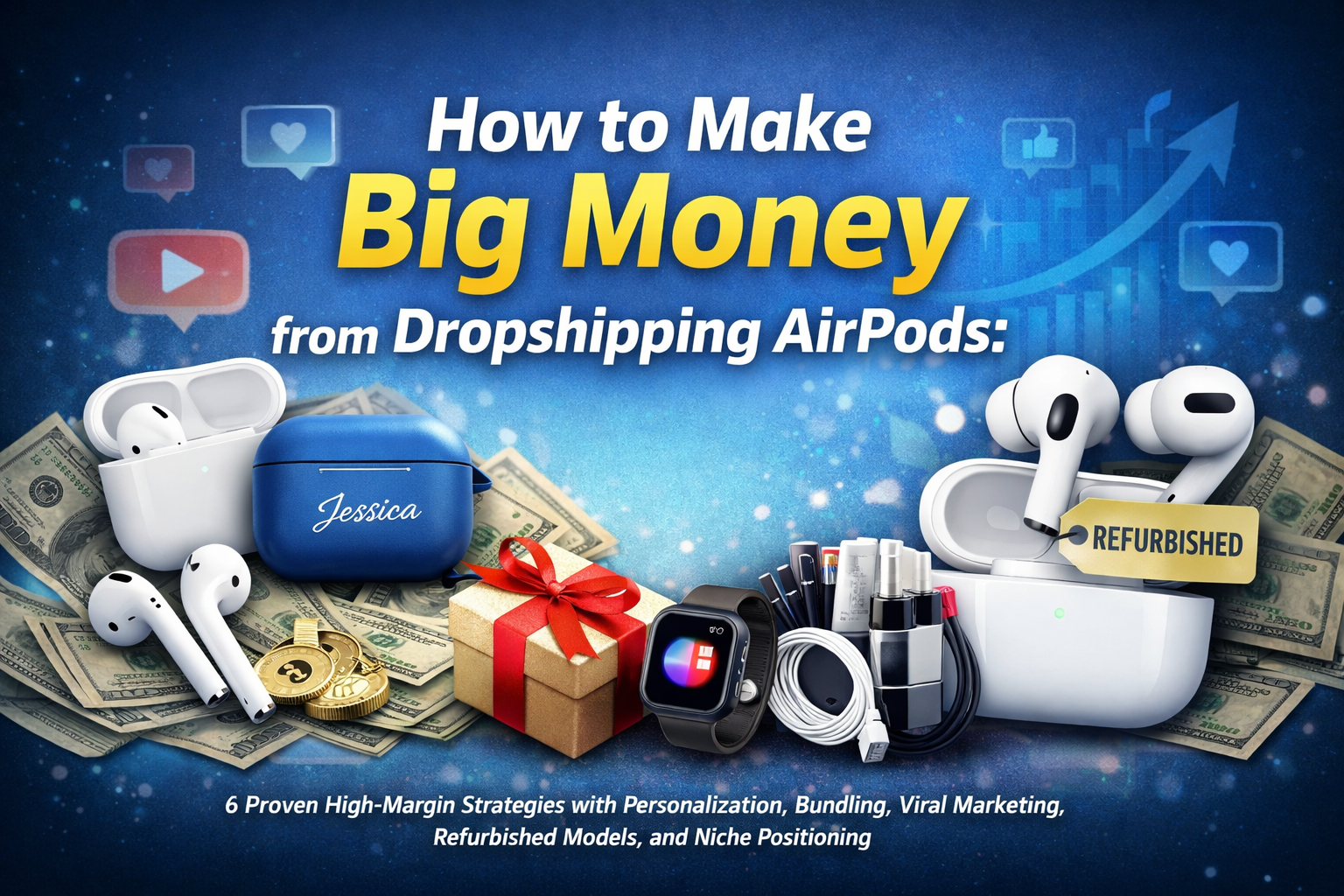
How to Profit from AirPods Alternatives: A High-Margin Dropshipping Model Built on Perceived Value
The biggest misconception in this niche is that selling Apple AirPods directly is the best way to make money. In reality, official products offer extremely thin margins, often below 15%, and come with risks such as brand restrictions, intense price competition, and limited differentiation. In contrast, the “AirPods alternative” segment—non-branded wireless earbuds designed to mimic the aesthetic and functionality—has emerged as a significantly more profitable and scalable model.
From a unit economics perspective, sourcing costs for alternative earbuds on platforms like Alibaba or 1688 typically range between $6 and $15 per unit, depending on features such as Bluetooth version, battery life, and chip quality. These same products can be positioned and sold in Western markets for $29 to $59, creating gross margins between 50% and 75%. This margin buffer is critical because it allows room for advertising spend, refunds, and still leaves a healthy net profit.
the Psychology Behind Conversion
Consumers searching for alternatives are not necessarily loyal to the Apple ecosystem; they are value-driven buyers. The purchase decision is often influenced by three factors: visual similarity, perceived performance, and price anchoring. When a product looks similar to Apple AirPods but costs 60–80% less, the perceived value increases dramatically.
This creates a strong opportunity for conversion-focused marketing. For example, comparison-style creatives such as “$129 vs $29 earbuds test” consistently outperform generic product ads. Data from TikTok ad campaigns in this niche shows that video-based comparison content can reach conversion rates of 2% to 4.5%, significantly higher than standard ecommerce benchmarks of 1% to 2%.
Positioning Strategy: Features Over Branding
The key to sustaining high margins in this model is avoiding any direct reference to trademarks while emphasizing functional benefits. Instead of selling a “clone,” successful stores position their products around features such as:
- Active noise reduction
- Long battery life (20–30 hours with case)
- Fast charging capabilities
- Ergonomic comfort for daily use
This shift from brand imitation to feature-driven marketing reduces legal risk and builds a more sustainable business. It also allows for product tiering, where you can offer “basic,” “pro,” and “premium” versions, increasing average order value and catering to different price sensitivities.
Traffic Strategy: Leveraging Short-Form Video for Low CAC
Customer acquisition cost (CAC) is where this model becomes particularly attractive. Compared to traditional Facebook ads, TikTok offers lower CPMs, typically in the $5 to $12 range. This enables aggressive testing of creatives without significant upfront investment.
Viral-style content—such as unboxing, sound tests, or durability challenges—can generate organic reach in addition to paid traffic. A single well-performing video can drive thousands of clicks, effectively lowering blended CAC and increasing overall profitability. In many cases, stores achieving consistent profitability report return on ad spend (ROAS) between 2.5x and 6x.
Scaling the Model: From Single Product to Branded Store
Once a winning product is identified, scaling should focus on brand perception rather than expanding the catalog too quickly. Creating a niche brand around “affordable premium audio” allows you to maintain pricing power and reduce dependency on constant ad spend.
Adding elements such as branded packaging, simple landing page optimization, and customer reviews can increase conversion rates by 20% to 40%. Over time, this transforms a generic dropshipping product into a semi-branded asset with repeat purchase potential.
How to Build a High-Margin AirPods Case Business Through Personalization
While most beginners focus on selling Apple AirPods or similar earbuds, experienced dropshippers understand that the real profit lies in accessories—especially personalized ones. The reason is straightforward: accessories are low-cost, highly customizable, and driven by emotional rather than functional purchasing decisions.
A standard silicone AirPods case can be sourced for as little as $0.50 to $2.00. Even when adding print-on-demand (POD) customization—such as names, initials, or graphic designs—the total cost rarely exceeds $3 to $5 per unit. These same products can be sold for $12 to $25, resulting in gross margins between 60% and 85%. Compared to electronics, which often struggle to maintain 20%–40% margins after ad spend, this model provides significantly more room for scaling.
The Psychology of Personalization: Selling Identity, Not Utility
Unlike earbuds, which are purchased for performance, AirPods cases are bought for self-expression. Consumers don’t just want to protect their Apple AirPods—they want to make them unique. This shift from utility to identity is what allows sellers to command premium pricing on otherwise inexpensive products.
Data from ecommerce personalization studies shows that customized products can increase conversion rates by 10%–30% and boost willingness to pay by up to 20%. In practice, this means a customer is far less price-sensitive when they feel the product is “theirs.” A $3 case becomes a $19 personalized item simply because it carries emotional value.
This dynamic also reduces direct competition. While generic cases are easily comparable across platforms like Amazon, personalized products are inherently unique, making price comparison difficult and preserving your margins.
Niche Targeting: Unlocking Higher Conversion Rates
The real leverage in this model comes from niche segmentation. Instead of targeting “everyone with AirPods,” successful stores focus on micro-audiences with specific identities or interests. For example, pet owners, couples, astrology enthusiasts, and anime fans all represent highly engaged segments with strong purchase intent.
A store targeting dog owners might offer cases featuring different breeds with customizable names, while a couple-focused store could sell matching “His & Hers” designs. These niche angles not only improve conversion rates but also increase average order value, especially when customers buy multiple units as gifts.
Conversion rates in well-targeted niches often reach 3% to 6%, compared to the typical 1%–2% for general stores. This efficiency directly lowers customer acquisition cost and improves overall profitability.
Operational Model: Print-on-Demand and Automation
One of the biggest advantages of this strategy is operational simplicity. By integrating with print-on-demand suppliers, you eliminate the need for inventory and reduce upfront risk. Orders are automatically fulfilled with the customer’s chosen design, making the business highly scalable.
Turnaround time typically ranges from 3 to 7 days, which is acceptable for personalized products since customers expect some delay. More importantly, the perceived value of customization offsets longer shipping times, reducing refund rates compared to generic dropshipping products.
Upselling and Bundling for Maximum Revenue
Personalized AirPods cases also open the door to effective upselling strategies. For instance, offering add-ons such as keychains, cleaning kits, or premium packaging can increase average order value by 20% to 40%. Because the base product has such a high margin, even small upsells significantly impact total profit.
Another effective tactic is “Buy 2, Get 1 Free” promotions, which work particularly well in gift-oriented niches. Since production costs are low, these offers still maintain strong margins while increasing perceived value.
How to Increase Profits with AirPods Bundling: A Data-Driven AOV Expansion Strategy
Most dropshipping stores in the Apple AirPods niche fail to scale not because of poor traffic, but because of limited average order value (AOV). When you rely on selling a single low-ticket item—whether it’s earbuds or a basic accessory—your revenue ceiling is constrained by pricing pressure and rising advertising costs.
For example, a typical alternative earbud might sell for $29 with a product cost of $12, resulting in a gross margin of roughly 58%. However, once you factor in customer acquisition cost (CAC), which can range from $10 to $18 per purchase, the remaining profit becomes marginal. This is where bundling fundamentally changes the economics.
By grouping complementary products into a single offer, you increase AOV without proportionally increasing acquisition cost. In many cases, CAC remains relatively stable, while revenue per customer rises significantly—leading to higher net profit per order.
The Economics of Bundling: Turning $29 Orders into $40+ Revenue
A well-structured bundle in the AirPods ecosystem typically includes 2–4 low-cost accessories that enhance the core product experience. Common components include protective cases, cleaning kits, anti-loss straps, and charging cables.
From a cost perspective, these add-ons are extremely efficient. A cleaning kit might cost $0.80, a silicone case $1.20, and a strap $0.50. When combined with a base product, the total cost of goods might increase from $12 to $15, but the selling price can jump from $29 to $39 or even $45.
This creates a new margin structure. Instead of earning $17 gross profit on a single item, you might generate $24–$30 per order. The resulting gross margin typically stabilizes between 55% and 70%, even after accounting for the additional items. More importantly, your profit after ads increases because CAC is spread across a higher revenue base.
Consumer Behavior: Why Bundles Convert Better
Bundling works because it aligns with how consumers perceive value. When a customer buys accessories for their Apple AirPods separately, each purchase decision introduces friction. A bundle removes that friction by presenting a complete solution.
Behavioral data shows that “all-in-one” offers can increase conversion rates by 15% to 35% compared to standalone products. This is particularly effective in use-case scenarios such as travel, fitness, or daily commuting. For instance, a “Gym Essentials Kit” that includes earbuds, a secure-fit strap, and a sweat-resistant case feels more purposeful than three individual items.
Another key factor is price anchoring. When customers see that buying items separately would cost $55, but the bundle is priced at $39, the perceived savings increases urgency and conversion likelihood.
Offer Structuring: Maximizing Perceived Value Without Killing Margins
The success of a bundle depends on how it is presented rather than just what it includes. High-performing stores rarely position bundles as “more products for more money.” Instead, they frame them as optimized solutions with built-in savings.
For example, instead of listing individual items, a store might present:
- “Essential Kit” at $29
- “Pro Kit” at $39
- “Ultimate Kit” at $49
This tiered pricing model subtly guides customers toward the middle or highest option, increasing AOV. Data across ecommerce stores shows that the “middle tier” often captures 40%–60% of total sales, making it the most important pricing anchor.
Impact on Advertising Efficiency and Scaling
From a scaling perspective, bundling directly improves advertising efficiency. Since platforms like TikTok and Facebook optimize for purchase value, higher AOV can lead to better algorithmic performance over time. This often results in lower effective CPMs and improved return on ad spend (ROAS).
Stores implementing bundling strategies frequently report ROAS improvements from 2x to 3.5x or higher, primarily due to increased revenue per conversion. Additionally, higher order values make it easier to justify influencer partnerships and paid collaborations, further expanding traffic channels.
How to Scale AirPods Dropshipping with TikTok: A Viral Marketing Framework for High ROI
In the competitive ecosystem surrounding Apple AirPods, traditional advertising channels are becoming increasingly expensive and less efficient. Facebook CPMs have steadily risen into the $12–$25 range in many Western markets, compressing margins for low- to mid-ticket products. In contrast, TikTok still offers relatively low entry costs, with CPMs typically ranging from $5 to $12, making it one of the most cost-effective platforms for scaling dropshipping stores.
However, the real advantage of TikTok is not just lower costs—it is the algorithm’s ability to amplify engaging content regardless of account size. This creates an environment where even new stores can achieve rapid visibility if their creatives resonate with user behavior patterns.
The Economics of Viral Content: From Views to Profitability
TikTok-driven ecommerce operates on a fundamentally different model compared to traditional paid ads. Instead of relying purely on targeting, it rewards content performance. A single video demonstrating a compelling value proposition—such as comparing a $29 earbud to Apple AirPods—can generate hundreds of thousands or even millions of views.
From a performance standpoint, well-optimized TikTok campaigns in this niche often achieve click-through rates (CTR) between 1.5% and 3.5%, with conversion rates ranging from 2% to 5%. When paired with a product priced in the $25–$50 range and gross margins of 50%–70%, this can produce a return on ad spend (ROAS) between 3x and 8x.
More importantly, viral reach reduces blended customer acquisition cost (CAC). If part of your traffic comes from organic distribution, your effective CAC can drop below $8, dramatically increasing net profit per order.
Creative Strategy: What Actually Goes Viral in the AirPods Niche
Success on TikTok is driven by creative formats, not polished branding. In the AirPods-related market, three content types consistently outperform:
Comparison videos are among the most effective. Showing side-by-side tests between a budget earbud and Apple AirPods creates immediate curiosity and establishes a clear value narrative. These videos often achieve higher watch times, which directly impacts distribution.
Problem-solution content also performs well. For example, demonstrating how easily standard earbuds fall out during workouts, followed by showcasing a secure-fit alternative, taps into a specific pain point. This type of content tends to convert because it feels practical rather than promotional.
Unboxing and sensory content—such as ASMR-style audio tests—leverage TikTok’s immersive format. These videos are particularly effective at building perceived product quality, even for lower-cost items.
Scaling Strategy: From Testing to Consistent Revenue
The key to scaling is volume and iteration. High-performing stores often test 10 to 20 creatives per week, quickly identifying which angles resonate. Once a winning video is found, it can be duplicated, slightly modified, and relaunched to extend its lifecycle.
Unlike static ad platforms, TikTok creatives tend to fatigue quickly, often within 3 to 7 days. This requires a continuous content pipeline, but it also creates opportunities for repeated viral hits. Each new successful video can unlock another wave of low-cost traffic.
At scale, stores typically allocate 60%–80% of their budget to top-performing creatives while reserving the remainder for testing. This balance ensures consistent revenue while maintaining growth potential.
The Role of Influencers and UGC in Reducing Costs
User-generated content (UGC) and micro-influencers play a critical role in this ecosystem. Instead of producing all creatives in-house, many successful stores collaborate with creators who already understand TikTok’s content style.
Micro-influencers (10K–100K followers) often deliver better engagement rates than larger accounts, while charging significantly less. A single influencer video can sometimes outperform dozens of branded ads, particularly when it feels authentic and unscripted.
This approach not only improves performance metrics but also builds social proof, which increases conversion rates on your product pages.
How to Profit from Refurbished AirPods: A High-Ticket Dropshipping Model Built on Trust
In the ecosystem surrounding Apple AirPods, most dropshippers compete in the low-ticket segment, where products are priced between $20 and $50. While this model offers attractive gross margins, it often requires high order volume to generate meaningful profit. The refurbished AirPods model takes a different approach by prioritizing higher average order value (AOV), allowing sellers to generate more revenue per transaction.
Refurbished units—typically sourced from liquidation suppliers, certified refurbishers, or bulk resellers—can be acquired at $40 to $90 depending on condition and model (e.g., AirPods Gen 2, AirPods Pro). These products are commonly resold at $90 to $180, resulting in gross margins between 25% and 45%. Although the margin percentage is lower than accessories, the absolute profit per order is significantly higher, often ranging from $30 to $70.
Consumer Psychology: Trust and Brand Power Drive Conversions
Unlike generic earbuds, refurbished Apple AirPods benefit from strong brand recognition and perceived quality. Consumers already trust the Apple ecosystem, which reduces the friction typically associated with purchasing electronics online.
The primary value proposition is not innovation, but price efficiency. Customers perceive refurbished products as a way to access premium technology at a discount of 30% to 50%. This creates a compelling offer, especially during periods of economic uncertainty when buyers are more price-sensitive but still value quality.
Conversion rates for refurbished electronics stores often range from 2% to 4%, higher than many cold-traffic dropshipping products, particularly when supported by trust elements such as warranties, return policies, and clear grading standards (e.g., “Like New,” “Grade A”).
Operational Considerations: Quality Control and Supplier Selection
The success of this model depends heavily on supplier reliability. Unlike standard dropshipping, where minor product inconsistencies may be tolerated, refurbished electronics require stricter quality control. Defective units, battery degradation, or cosmetic issues can quickly lead to refunds and chargebacks, eroding profit margins.
To mitigate these risks, many sellers work with certified refurbishers or platforms that offer bulk-tested inventory. While this may increase upfront costs slightly, it significantly reduces return rates and improves customer satisfaction. In practice, stores that prioritize quality often maintain refund rates below 5%, compared to 10%–15% in lower-tier operations.
Shipping times also play a critical role. Domestic fulfillment (e.g., US-based warehouses) can justify higher pricing and improve conversion rates, as customers associate faster delivery with higher reliability.
Marketing Strategy: SEO and Intent-Driven Traffic
Unlike low-ticket impulse buys, refurbished AirPods are typically purchased through intent-driven searches. Keywords such as “refurbished AirPods Pro deal” or “cheap genuine AirPods” indicate high purchase intent, making search engine optimization (SEO) and Google Ads particularly effective channels.
Cost-per-click (CPC) for these keywords generally ranges from $0.80 to $2.50, depending on competition. Given the higher AOV, even modest conversion rates can yield strong returns. For example, a $120 product with a 35% gross margin generates $42 in gross profit, leaving sufficient room for ad spend while maintaining profitability.
Content marketing also plays a role. Articles comparing refurbished vs. new units, or explaining grading systems, can build trust and capture organic traffic over time.
Upselling and Lifetime Value Expansion
While the initial purchase drives most of the revenue, upselling can further enhance profitability. Accessories such as protective cases, charging cables, or extended warranties can increase AOV by 15% to 30%. Since the customer is already investing in a premium product, they are more likely to accept additional offers that enhance longevity or usability.
Additionally, email marketing and post-purchase flows can promote related products, increasing customer lifetime value (LTV). Even a small percentage of repeat buyers can significantly impact overall profitability in a high-ticket model.
How to Dominate Niche Markets in AirPods Dropshipping: A Segmentation Strategy for Higher Margins
The majority of sellers entering the Apple AirPods niche make the same mistake: they target everyone. While this may seem like a way to maximize reach, it actually leads to lower conversion rates, higher advertising costs, and intense price competition.
In a broad market, products become commoditized. Consumers compare prices across multiple stores, forcing sellers to compete on discounts rather than value. This often compresses gross margins into the 20%–40% range after advertising costs, making it difficult to scale profitably.
Niche positioning solves this problem by narrowing the target audience and increasing perceived relevance. Instead of selling “wireless earbuds,” you sell a solution tailored to a specific use case or identity.
The Economics of Niche Positioning: Higher Conversion, Lower CAC
When you focus on a clearly defined audience—such as fitness enthusiasts, gamers, or parents buying for children—you align your product with a specific need. This alignment significantly improves conversion efficiency.
For example, earbuds designed for gym use can emphasize sweat resistance, secure fit, and durability. Products in this category are typically sourced for $8 to $18 and sold for $25 to $50, resulting in gross margins between 45% and 70%. More importantly, conversion rates in niche stores often reach 3% to 6%, compared to 1% to 2% in general stores.
This increase in conversion rate directly reduces customer acquisition cost (CAC). If your ad spend remains constant but your conversion rate doubles, your cost per purchase effectively decreases by up to 50%, dramatically improving net profit.
High-Value Niches Within the AirPods Ecosystem
Not all niches are equally profitable. The most effective segments are those with strong purchase intent and clear functional requirements.
The fitness niche is one of the most consistent performers. Customers actively search for earbuds that stay in place during workouts, making them more responsive to targeted messaging. Marketing content that demonstrates stability during running or high-intensity training tends to convert well.
The gaming niche offers another opportunity, particularly for low-latency earbuds. Gamers are sensitive to audio delay, and positioning a product as “ultra-low latency” creates a strong differentiation angle. This segment also responds well to technical specifications and performance comparisons.
The children’s market is driven by safety and parental concerns. Features such as volume limiting and durable materials appeal to parents, who are less price-sensitive when it comes to protecting their children’s hearing. This allows for stable pricing and consistent margins.
Branding Strategy: From Product Store to Identity Brand
Niche positioning enables a transition from a generic product store to a focused brand. Instead of listing multiple unrelated products, successful stores build a cohesive identity around their target audience.
For example, a fitness-focused brand might use consistent messaging around performance, endurance, and active lifestyles. This creates a stronger emotional connection with customers and increases trust. Over time, this trust translates into higher conversion rates and repeat purchases.
Brand perception also supports premium pricing. When customers feel that a product is designed specifically for their needs, they are less likely to compare it directly with cheaper alternatives.
Content and Traffic Strategy: Precision Over Volume
Marketing in a niche model is more efficient because it prioritizes relevance over reach. Instead of broad targeting, ads and content are tailored to specific scenarios. A video showing earbuds staying secure during an intense workout is far more compelling to a fitness audience than a generic product showcase.
This precision extends to keyword targeting as well. Search terms like “best earbuds for running” or “safe headphones for kids” indicate higher intent than general queries. As a result, traffic quality improves, leading to better overall performance metrics.
Scaling Potential: Expanding Within the Same Audience
Once a niche is established, scaling becomes more predictable. Instead of constantly searching for new audiences, you can expand your product line within the same segment. For example, a fitness-focused store might add related accessories such as armbands, charging cases, or recovery tools.
This approach increases customer lifetime value (LTV) while maintaining brand consistency. It also reduces the need for continuous creative reinvention, as your messaging remains aligned with a well-defined audience.
In the AirPods dropshipping space, success is not determined by how many people you reach, but by how precisely you target the right audience. Niche positioning transforms a highly competitive market into a series of smaller, more profitable opportunities.
For entrepreneurs exploring how to make big money from dropshipping AirPods, the takeaway is clear: specialization leads to efficiency. By focusing on defined customer segments, you can achieve higher conversion rates, maintain gross margins of 45% to 70%, and build a brand that is far more resilient than a generic, price-driven store.





No Comments