


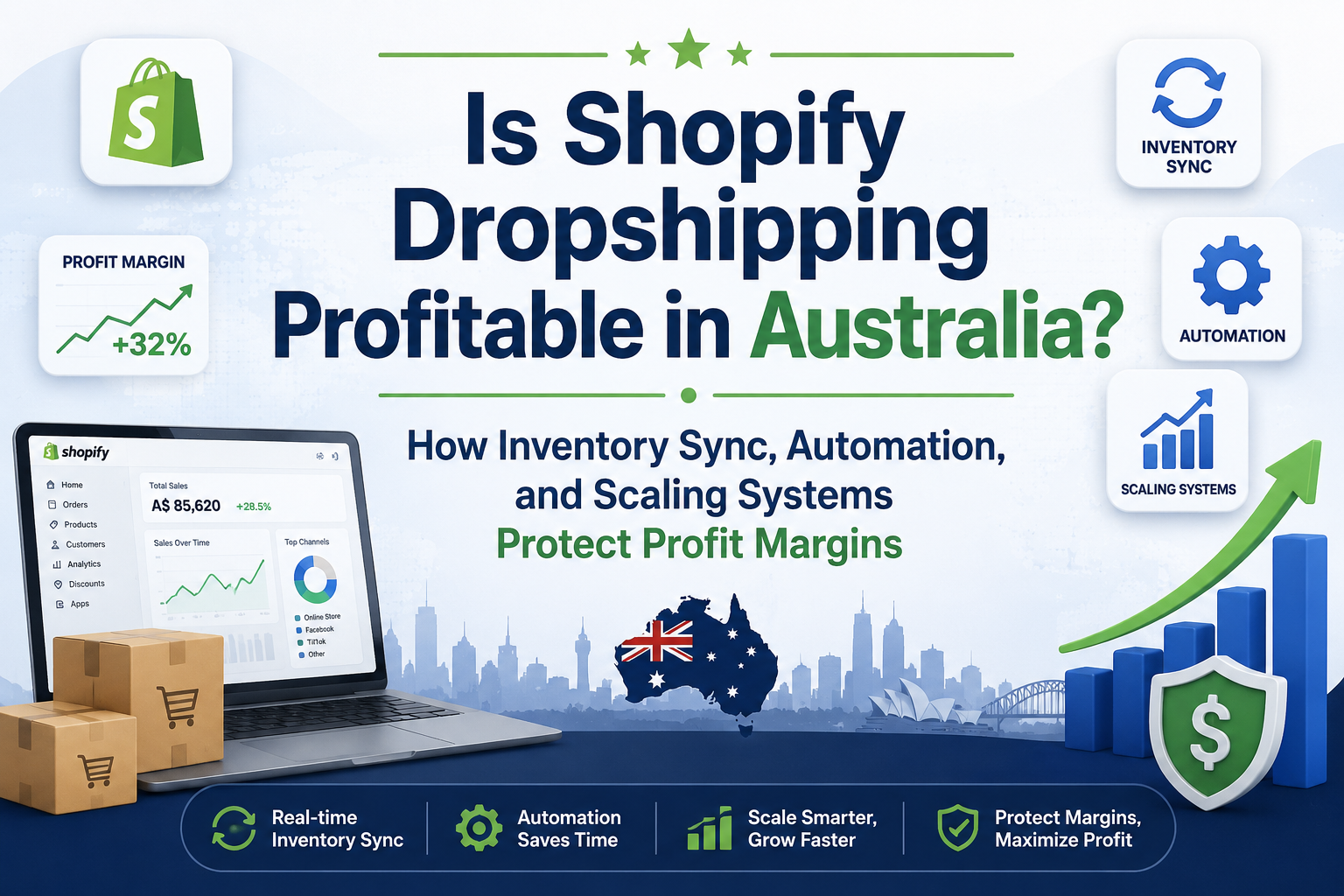
Is Shopify Dropshipping Profitable in Australia? How Inventory Sync, Automation, and Scaling Systems Protect Profit Margins

Shopify dropshipping in Australia is not inherently unprofitable, but it is structurally margin-sensitive. The market rewards operators who understand cost stacking and pricing psychology rather than those relying on trending products alone.
In short, it is profitable—but only when gross margin is engineered to survive advertising, shipping, and operational friction.
Shopify Dropshipping in Australia: Real Profit Margins, Costs, and Net Income Breakdown
When people ask whether Shopify dropshipping is profitable in Australia, they usually focus on revenue screenshots or viral “$10,000 per month” claims. But in reality, profitability in the Australian market is almost entirely determined by margin structure and cost stacking, not top-line sales.
In 2026, most Australian Shopify dropshipping stores operate in a gross margin range of 30% to 60%, depending on niche, supplier source, and pricing strategy. However, once operational costs are included, the net profit margin typically drops to 5%–20%, and in many cases even lower for beginners relying heavily on paid ads.
The key difference between profitable and unprofitable stores is not sales volume—it is how efficiently gross margin survives after logistics, advertising, and platform costs.
Gross Margin Structure in Australian Dropshipping Stores
Gross margin in Shopify dropshipping is primarily defined by the difference between product sourcing cost and retail price.
For example, a product sourced at AUD $10 from a supplier in China may be sold in Australia for AUD $25–$35. On paper, this creates a gross margin of 60%–70%. However, this margin is misleading if not analyzed with operational reality.
In Australia, consumers expect faster delivery and higher trust levels compared to global averages. This allows slightly higher retail pricing, but it also increases return pressure and customer support costs.
Typical gross margin breakdown:
- Low competition general products: 30%–45% margin
- Branded or niche products: 45%–65% margin
- High perceived value products (pet, fitness, home gadgets): up to 70%
However, gross margin alone does not reflect real profitability, especially when shipping and acquisition costs are included.
Shipping Costs and Their Direct Impact on Profit
One of the most overlooked factors affecting Shopify dropshipping profitability in Australia is shipping.
Because Australia is geographically isolated, shipping from China or the US often costs between AUD $8 to $25 per order, depending on weight and delivery speed. This can reduce gross profit by 20%–40% if not priced correctly.
Stores using 7–15 day delivery models often struggle with conversion rates unless they compensate with lower prices or aggressive marketing. Meanwhile, stores using local Australian warehouses typically achieve:
- 15%–30% higher conversion rates
- 10%–20% lower refund rates
- More stable repeat purchase behavior
However, local warehousing increases inventory risk, which shifts dropshipping closer to hybrid ecommerce.
The Real Net Profit Reality After Expenses
Once advertising and operational costs are included, the actual profitability becomes significantly narrower.
A typical Australian Shopify dropshipping store spends:
- Meta/TikTok ads: 25%–50% of revenue
- Shopify + apps: 3%–8%
- Payment processing: 2%–4%
- Refunds and chargebacks: 2%–10% depending on niche
After these deductions, the average net profit margin is usually 5%–15%, assuming the store is moderately optimized. Poorly optimized stores often operate at break-even or even negative margins despite strong sales.
This is why many dropshipping businesses in Australia fail not because they cannot generate traffic, but because they cannot maintain margin efficiency under rising ad costs.
Why Some Stores Still Scale Profitably
Despite these constraints, Shopify dropshipping in Australia can still be profitable when operators focus on margin protection rather than pure scaling.
Successful stores typically rely on:
- High perceived value products with 2x–3x markup
- Strong conversion optimization to reduce CAC
- Faster shipping solutions to increase CVR
- Bundling strategies that lift AOV above AUD $60–$120
In this model, profitability is less about volume and more about controlled unit economics. Even at moderate sales volume, a well-structured store can sustain 15%+ net margins consistently.
Is Dropshipping on Shopify Profitable in Australia When Shipping Takes 7–21 Days? China vs Local Warehousing Strategy
In Australian Shopify dropshipping, shipping time is not just a customer experience metric—it directly determines profitability. Many beginners assume profit is mainly controlled by product margin, but in reality, delivery speed influences conversion rate, refund rate, and even ad efficiency, which ultimately reshapes net profit.
Most Australia-based dropshipping stores still rely on China suppliers, where average delivery times range from 7 to 21 days, depending on logistics channel and customs processing. On the other hand, local Australian warehousing can reduce delivery time to 1 to 5 days, but introduces higher inventory and storage costs.
This creates a critical trade-off: lower cost vs higher conversion efficiency.
China Shipping Model: High Margin but Conversion Leakage
The China direct shipping model is the most common structure in Shopify dropshipping due to its low product cost and scalability.
Typical structure:
- Product cost: AUD $5–$15
- Shipping cost: AUD $3–$12
- Retail price: AUD $25–$60
- Gross margin: 40%–70%
At first glance, this model looks highly profitable. However, the 7–21 day delivery window introduces hidden revenue loss.
In the Australian market, customer expectations are closer to Amazon-level delivery standards. Stores with longer delivery times often experience:
- 10%–35% lower conversion rates compared to fast shipping stores
- 3%–12% higher refund requests
- Increased “Where is my order?” support costs
- Lower repeat purchase rates
Even if gross margin is high, the effective profit is reduced because fewer paid ads convert into completed orders.
For example, if a store spends AUD $1,000 on ads and achieves 2% conversion instead of 3%, the difference in revenue can completely erase expected profit.
Local Australian Warehousing: Faster Sales, Lower Margin Pressure
Local warehousing in Australia shifts the business model closer to hybrid ecommerce rather than pure dropshipping. Products are pre-stocked in local fulfillment centers or third-party logistics providers.
Typical structure:
- Product cost: AUD $8–$20 (higher due to bulk inventory)
- Warehousing + fulfillment: AUD $4–$10 per order
- Delivery time: 1–5 days
While gross margin may decrease slightly to 35%–55%, the real advantage comes from conversion optimization.
Stores using local fulfillment often see:
- 15%–40% higher conversion rates
- 20%–30% lower refund rates
- Stronger brand trust and repeat purchase behavior
- Higher tolerance for premium pricing (up to 20%–40% higher retail price)
This means that even with slightly lower margins per unit, total net profit can actually be higher due to improved sales efficiency.
The Break-Even Point Between Both Models
The profitability comparison between China shipping and local warehousing depends heavily on advertising costs and conversion rates.
In most Australian Shopify stores, break-even analysis shows:
- If conversion rate is below ~2%, China shipping often becomes unprofitable due to wasted ad spend
- If conversion rate is above ~3.5%, China shipping can still outperform due to lower fixed costs
- Local warehousing becomes more profitable when monthly volume exceeds consistent scaling thresholds (usually 300–800 orders/month)
The key variable is not shipping cost—it is customer acquisition efficiency (CAC vs CVR ratio).
Hybrid Strategy: The Most Profitable Model in 2026
Many successful Australian Shopify brands now use a hybrid model:
- Test products via China dropshipping (low risk validation)
- Move winning products to local warehousing
- Use China supply for long-tail or low-volume SKUs
- Reserve fast shipping for high-converting ads and retargeting traffic
This structure balances margin efficiency with conversion optimization.
In practice, hybrid stores often achieve:
- 45%–65% gross margin
- 10%–25% net profit stability
- Lower refund volatility
- Scalable ad performance without conversion decay
Shopify dropshipping in Australia is not limited by shipping time itself, but by how shipping time affects the entire funnel economics.
China shipping maximizes gross margin but weakens conversion efficiency. Local warehousing improves conversion but compresses per-unit margin. The most profitable stores in 2026 are those that dynamically balance both models based on product lifecycle and advertising performance.
Best Profitable Dropshipping Niches in Australia for Shopify
In Australian Shopify dropshipping, profitability is less about finding a “winning product” and more about selecting the right demand structure. Many beginners assume viral products are the key to success, but in reality, niche economics—especially gross margin stability and repeat demand—determine long-term profitability.
In 2026, most sustainable Australian dropshipping stores operate within 40%–70% gross margins, but only specific niches consistently maintain both high conversion rates and controlled acquisition costs.
The Australian market is relatively small compared to the US, but it has stronger purchasing power per customer, which means high-margin niches can outperform high-volume strategies.
1. Home & Living Products: Stable Demand, Strong Margin Control
Home and living is one of the most consistent-performing niches in Australia due to strong consumer spending on household improvement and lifestyle optimization.
Typical product structure:
- Sourcing cost: AUD $8–$25
- Retail price: AUD $25–$80
- Gross margin: 45%–65%
Products like kitchen tools, storage solutions, LED ambient lighting, and minimalist home decor perform well because they solve daily friction problems.
This niche also benefits from higher perceived value. Customers are less price-sensitive when products improve comfort or aesthetics, allowing sellers to maintain stable markup without heavy discounting.
2. Pet Products: High Emotional Buying and Repeat Purchases
Pet ownership in Australia is among the highest globally, which makes the pet niche extremely profitable for Shopify dropshipping.
Key financial characteristics:
- Gross margin: 50%–75%
- Average order value (AOV): AUD $40–$120
- Repeat purchase rate: significantly above average ecommerce benchmarks
Products such as grooming tools, pet toys, and feeding accessories tend to convert well due to emotional buying behavior. Unlike impulse gadgets, pet products often generate repeat demand, which improves customer lifetime value (LTV).
This allows stores to tolerate higher customer acquisition costs while maintaining profitability.
3. Fitness & Wellness: High AOV and Strong Upsell Potential
Fitness is a strong niche in Australia due to high participation in home workouts, outdoor sports, and wellness culture.
Typical metrics:
- Gross margin: 40%–65%
- AOV: AUD $50–$150
- Upsell potential: very high (bundles and kits)
Products such as resistance bands, posture correctors, yoga accessories, and recovery tools perform well when bundled.
The key profitability driver in this niche is not single-product margin but basket expansion strategy, where bundling can increase AOV by 20%–60%, directly improving ad profitability.
4. Beauty & Personal Care Accessories: High Margin but Competitive
Beauty-related accessories remain one of the highest-margin niches in dropshipping, but also one of the most competitive in Australia.
Financial structure:
- Gross margin: 50%–70%
- Strong impulse buying behavior
- High creative dependency (ads matter more than product itself)
Products such as skincare tools, hair styling accessories, and compact beauty devices perform well when positioned as problem-solving tools rather than luxury items.
However, rising ad costs mean profitability depends heavily on creative performance and conversion optimization.
Even a small 1%–1.5% improvement in conversion rate can shift the entire business from break-even to profitable due to high CPC environments.
5. Outdoor & Travel Gear: Seasonal but High Ticket Value
Australia’s outdoor lifestyle creates strong demand for travel and outdoor gear, especially in warmer seasons.
Key economics:
- Gross margin: 45%–65%
- Higher AOV: AUD $60–$200
- Seasonal spikes significantly impact revenue
Products like portable camping gear, travel organizers, and compact outdoor tools perform well due to practicality and perceived utility.
The main advantage is higher ticket size, which allows better absorption of advertising costs. However, demand volatility requires careful inventory and campaign timing management.
Is Shopify Dropshipping Still Profitable in Australia After Rising Ad Costs?
In Australian Shopify dropshipping, profitability is no longer primarily determined by product margin. Instead, the dominant constraint in 2026 is customer acquisition cost (CAC), especially on Meta (Facebook/Instagram) and TikTok ads.
While most products still maintain a gross margin of 30%–70%, rising CPMs in Australia compress net profit far more aggressively than in lower-cost ad markets like parts of Southeast Asia.
In many cases, a store that looks profitable on revenue metrics is actually operating close to break-even once CAC is properly calculated.
CAC in the Australian Market
Customer acquisition cost varies significantly depending on niche, creative quality, and funnel optimization. However, in Australia, average ranges are relatively consistent:
- Cold traffic CAC: AUD $15–$60 per customer
- High competition niches (beauty, fitness): up to AUD $80+
- Retargeting CAC: typically 30%–60% lower than cold traffic
At the same time, the average order value (AOV) for dropshipping stores in Australia often sits between:
- AUD $40–$120 for general products
- AUD $100–$200 for bundled or niche products
This creates a narrow profitability window where small changes in conversion rate or ad performance can determine whether a store is profitable or losing money.
Gross Margin vs CAC: The Break-Even Equation
To understand real profitability, you need to compare gross margin directly with CAC pressure.
For example:
- Product retail price: AUD $60
- Product cost + shipping: AUD $25
- Gross profit: AUD $35 (≈58% gross margin)
Now introduce CAC:
- CAC: AUD $30–$50 per customer
After subtracting acquisition cost, net profit becomes:
- Low CAC scenario: AUD $5–$15 profit per order
- High CAC scenario: breakeven or negative profit
This is why many Shopify dropshipping stores in Australia fail—not because products are unprofitable, but because ad costs consume gross margin too quickly.
Why Australian Ad Costs Are Higher Than Average
Several structural factors push CAC higher in Australia compared to global averages:
- Smaller audience size, leading to higher CPM competition
- High purchasing power, which increases advertiser competition
- Heavy reliance on Meta and TikTok platforms
- Less diversified traffic channels compared to US/Europe
Average CPM ranges:
- Meta Ads: AUD $8–$25 CPM
- TikTok Ads: AUD $6–$18 CPM (but more volatile)
This means traffic is inherently more expensive, and scaling requires stronger conversion optimization rather than just increasing ad budget.
The ROAS Reality: What “Profitable” Actually Means
In Australian Shopify dropshipping, profitability is typically measured by ROAS (Return on Ad Spend).
Break-even ROAS usually falls around:
- 2.0–2.5 ROAS (depending on product margin)
However, to achieve stable profit after refunds and operational costs, most successful stores aim for:
- 2.8–4.0 ROAS
Below this range, even high-revenue stores can struggle to generate consistent net profit.
The key issue is that many beginners scale too early without validating conversion efficiency, which leads to increasing CAC without improving funnel performance.
How Profitable Stores Actually Control CAC
Successful Australian Shopify stores do not rely on lowering ad costs—they focus on increasing conversion efficiency per click.
Common strategies include:
- Creative optimization (high-impact UGC ads improving CTR by 20%–80%)
- Bundling to increase AOV and absorb CAC pressure
- Landing page optimization to lift conversion rate from 1.5% → 3%+
- Retargeting sequences that recover 10%–25% of abandoned traffic
The most important metric is not CPC or CPM, but cost per profitable conversion, which depends on the full funnel.
Is Dropshipping Legal and Profitable in Australia? GST, Import Duties, and Hidden Costs Explained
When evaluating whether Shopify dropshipping is profitable in Australia, most beginners focus on product margin and advertising costs. However, in 2026, taxation and import compliance costs have become a significant hidden layer that directly reduces net profit margin.
While dropshipping itself is fully legal in Australia, profitability depends heavily on how well sellers understand GST rules, import thresholds, and cross-border fulfillment obligations.
In many cases, stores that appear profitable at a gross margin level of 40%–70% actually fall to net margins of 5%–15% once compliance and tax friction are included.
Is Dropshipping Legal in Australia?
Yes—dropshipping is legal in Australia as long as the business complies with standard ecommerce and consumer protection laws.
Key legal requirements include:
- Accurate product descriptions under Australian Consumer Law
- Clear refund and return policies
- Compliance with misleading advertising regulations
- Proper handling of GST (Goods and Services Tax) when applicable
There is no restriction on the dropshipping business model itself. The main challenge is operational compliance, not legality.
GST (10%) and Its Impact on Profit Margins
One of the most important profitability factors in Australia is GST, which is set at 10%.
For Shopify dropshipping stores, GST affects profitability in two main scenarios:
1. Selling to Australian consumers above threshold obligations
If your annual revenue exceeds the GST registration threshold (commonly AUD $75,000), you may be required to register for GST and charge it on sales.
This reduces net margin because:
- Either the seller absorbs GST (reducing profit)
- Or the customer pays more (potentially lowering conversion rate)
2. Import GST on low-value goods (LVG rules)
Even if goods are shipped from overseas, GST may still apply at the point of sale or import depending on structure and supplier arrangement.
In practice, GST effectively reduces margins by ~10% of product value, unless pricing is adjusted accordingly.
Import Duties and Hidden Cross-Border Costs
Although many dropshipping products fall under low-value thresholds, import duties and logistics-related costs can still apply depending on product category and shipping structure.
Common hidden costs include:
- Customs clearance fees
- Import processing charges
- Carrier handling fees (AUD $2–$8 per order)
- Currency conversion losses (1%–3%)
While each cost seems small individually, combined they can reduce gross profit by 3%–10% per order.
For low-margin stores, this is often the difference between profitability and loss.
Refunds, Chargebacks, and Consumer Law Pressure
Australia has relatively strong consumer protection laws, which indirectly increases dropshipping risk exposure.
Typical financial impact:
- Refund rate: 3%–12% depending on niche
- Chargebacks: 0.5%–3% in high-risk stores
- Shipping-related disputes increase when delivery exceeds expectations
Unlike some regions, Australian customers are more likely to initiate disputes if:
- Delivery is delayed beyond expectation
- Product quality differs from advertising
- Return process is unclear or costly
Each refund not only removes revenue but also destroys ad efficiency, because acquisition cost is already spent.
Real Net Profit After Legal + Tax + Hidden Costs
When combining all factors:
- GST impact: ~10%
- Import/logistics hidden fees: 3%–10%
- Refund/chargeback losses: 2%–8%
- Payment processing fees: 2%–4%
The cumulative reduction in profitability can reach 15%–30% of gross revenue, depending on store quality and niche.
This is why many Shopify dropshipping stores in Australia that look “high revenue” are actually operating at very thin margins in reality.
A typical breakdown looks like:
- Gross margin: 50%–65%
- After taxes & hidden costs: 35%–50%
- After ads & operations: 5%–15% net profit
Why Compliance-Aware Stores Perform Better Long-Term
Interestingly, stores that properly account for tax and compliance tend to outperform those that ignore it.
Reasons include:
- More accurate pricing strategy (no margin leakage)
- Fewer refund disputes due to clear policies
- Better customer trust and conversion rates
- Easier scaling without legal risk exposure
In other words, compliance is not just a cost—it is a stability factor that protects long-term profit scalability.
How to Scale a Profitable Shopify Dropshipping Store in Australia Using Inventory Sync & Automation Systems
In Australian Shopify dropshipping, initial profitability is often achievable at a small scale. Many stores can generate 30%–60% gross margins in the testing phase and even reach 5%–20% net profit margins on early sales.
However, the real challenge begins when scaling. In 2026, most stores fail not at product validation stage, but at inventory management, order synchronization, and operational scaling efficiency.
As order volume increases, small inefficiencies in stock updates, supplier communication, and fulfillment timing begin to compound, directly eroding profit margins.
The Hidden Profit Killer: Inventory Mismatch
One of the most common scaling problems in Shopify dropshipping is inventory mismatch between store and supplier.
This leads to:
- Overselling products that are out of stock
- Increased refund and chargeback rates (3%–10%+ impact on profit)
- Delayed fulfillment and customer complaints
- Advertising waste from promoting unavailable products
Even a small mismatch rate of 5%–8% can reduce net profit by 20%–40% at scale, because it affects both revenue and ad efficiency simultaneously.
In Australia, where delivery expectations are high, this issue becomes even more damaging due to stricter customer tolerance.
Why Inventory Sync Systems Directly Improve Profit Margins
Inventory sync automation solves one of the most critical scalability issues: real-time stock accuracy across supplier and storefront.
When properly implemented, it can:
- Reduce overselling risk by 80%–95%
- Lower refund rates by 2%–6%
- Improve conversion rate by ensuring product availability
- Reduce manual operations cost by 10%–30%
From a financial perspective, this directly protects gross margin from being diluted by operational inefficiencies.
For example, a store generating AUD $100,000 monthly revenue can lose $5,000–$15,000 per month purely from inventory-related errors if no automation is in place.
Automation and Its Impact on CAC Efficiency
Scaling profitability in Australia is not only about reducing operational errors, but also about improving customer acquisition cost (CAC) efficiency through automation.
Automation systems help optimize:
- Dynamic pricing adjustments based on stock levels
- Automated product removal when supply drops
- Email and SMS retargeting sequences
- Abandoned cart recovery flows
- AI-driven product recommendation engines
These systems increase conversion rate without increasing ad spend, which effectively improves ROAS and protects margins under rising advertising costs.
Even a 0.5%–1.5% improvement in conversion rate can significantly increase profitability in high-CAC markets like Australia.
Multi-Supplier Strategy and Risk Distribution
At scale, relying on a single supplier becomes a major risk factor. Successful Shopify dropshipping stores in Australia typically implement multi-supplier or hybrid sourcing systems.
This structure provides:
- Backup inventory options when stock runs out
- Price competition between suppliers (improving margins by 5%–15%)
- Faster shipping routing based on region
- Reduced dependency on one logistics chain
In practice, multi-supplier setups help stabilize gross margin while supporting higher order volume without performance decay.
AI Forecasting and Replenishment Strategy
In 2026, more advanced dropshipping stores are using AI-based forecasting to predict demand spikes and prevent stock disruptions.
AI forecasting improves profitability by:
- Predicting viral product demand before ad scaling
- Reducing stockout probability during ad campaigns
- Optimizing reorder timing to reduce capital lockup
- Increasing inventory turnover efficiency
Even small improvements in forecasting accuracy can increase net profit margins by 3%–8%, especially in fast-moving niches like fitness, home gadgets, and pet products.
The Scaling Profitability Equation
At scale, profitability in Australian Shopify dropshipping depends on balancing three systems:
- Gross margin stability (product + supplier strategy)
- CAC control (ads + conversion optimization)
- Operational automation (inventory + fulfillment sync)
Stores that fail usually optimize only one of these three areas, typically advertising, while ignoring backend operations.
Successful stores treat scaling as a systems engineering problem rather than a marketing problem.
Shopify dropshipping in Australia can remain profitable at scale, but only when operational automation is implemented early.
Inventory sync, supplier diversification, and AI-driven forecasting are not optional tools—they are margin protection systems that determine whether a store can scale beyond early-stage revenue.
In 2026, the most profitable Australian dropshipping businesses are not just good at selling—they are engineered to avoid profit leakage at scale.




No Comments