


Is Dropshipping Legal in UAE? Trade Licenses, VAT Rules, Amazon & Noon, and Dubai Ecommerce Opportunities

Technically, running a long-term ecommerce business without proper registration creates legal and financial risks. While many beginners start informally, serious operators eventually transition into licensed business structures as revenue grows.
The UAE remains one of the most attractive regions for ecommerce entrepreneurs because of its low taxes, international business environment, and strong logistics ecosystem. However, sustainable dropshipping in Dubai is increasingly moving toward professionalization, compliance, and operational transparency rather than short-term loopholes.
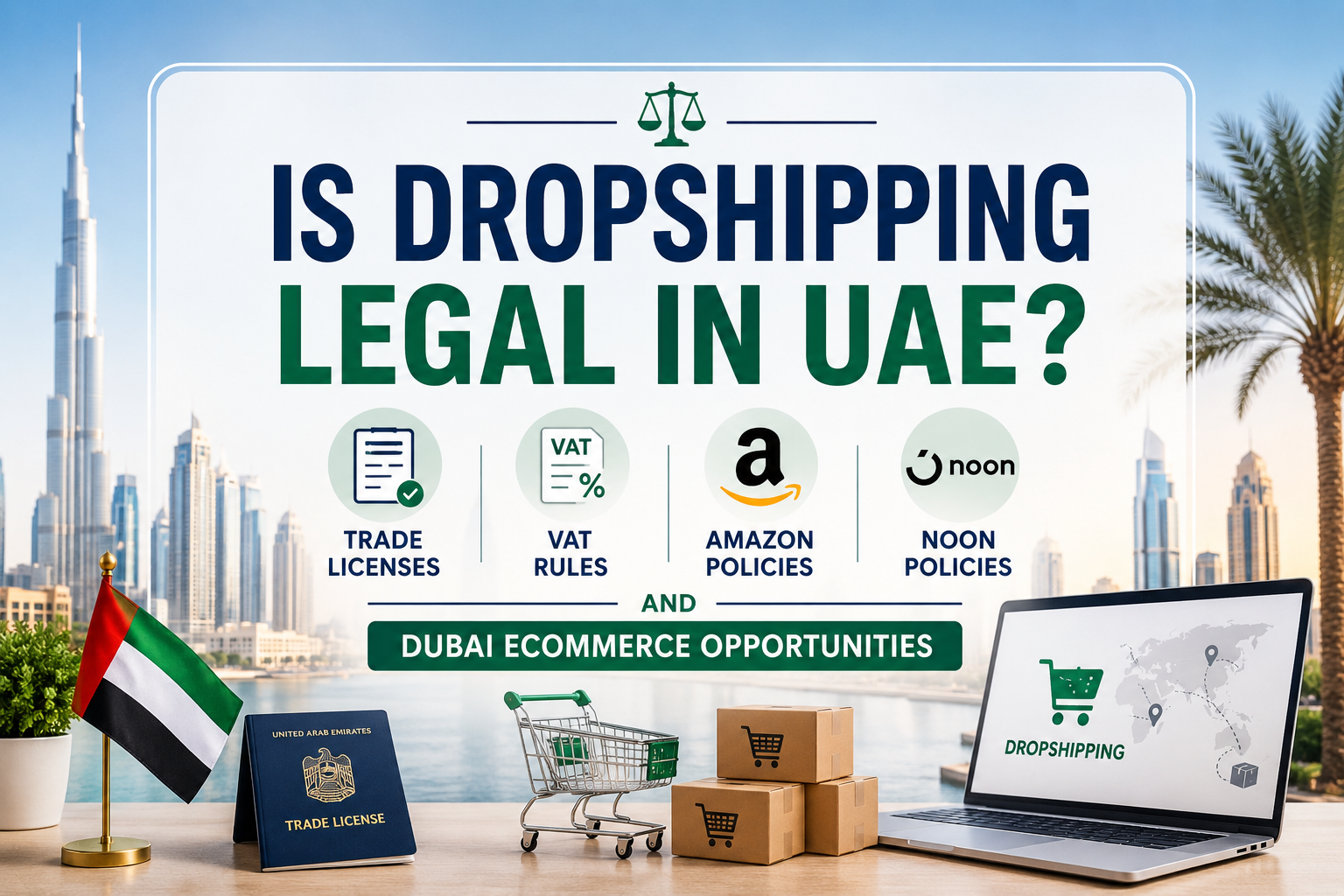
Is Dropshipping Legal in UAE Without a Trade License? The Real Risk Behind Running a Shopify Store in Dubai
The UAE has become one of the fastest-growing ecommerce regions in the world. Low taxes, strong logistics infrastructure, international banking access, and a business-friendly environment have attracted thousands of entrepreneurs to Dubai and other Emirates. As Shopify and TikTok Shop continue expanding globally, many beginners naturally ask the same question: is dropshipping legal in UAE without a trade license?
The short answer is complicated. Technically, the UAE expects any business generating consistent revenue to operate under a legal business structure. However, in reality, many small dropshipping stores start informally before registering a company. The problem is not whether someone can launch a Shopify store without a license. The real issue is how long the business can operate before payment providers, banks, tax authorities, or advertising platforms begin asking for legal documentation.
The Difference Between Starting and Operating Legally
One reason this topic creates confusion is because opening a Shopify store is easy. Anyone can create a website, connect a payment gateway, and start running ads within hours. But operating an ecommerce business legally in the UAE involves more than simply owning a website.
Once a store begins processing larger transaction volumes, several systems start requiring compliance verification. Stripe, PayPal, Wise, and even Meta advertising accounts increasingly request company documents, proof of address, tax information, or trade licenses. This is especially common when stores scale rapidly or receive international payments.
Many beginners mistakenly assume that because they can technically start selling products online, the business is automatically legal. In reality, there is a major difference between launching a small side project and running a compliant commercial operation recognized by UAE authorities.
Why UAE Authorities Care About Ecommerce Licensing
The UAE government has aggressively positioned Dubai as a global ecommerce and technology hub. Because of this, regulators have become more focused on protecting consumers, reducing fraud, and ensuring tax compliance.
Trade licenses help authorities identify legitimate businesses, regulate imports, monitor VAT obligations, and reduce counterfeit product activity. Without proper licensing, businesses may face problems such as frozen merchant accounts, payment holds, supplier disputes, or advertising restrictions.
For small stores making very little revenue, enforcement may appear limited. However, once a business starts generating meaningful sales volume, the risks increase significantly. Payment processors are often the first point where unlicensed sellers encounter problems. Many platforms now use automated risk detection systems that flag stores with unusual transaction patterns, high refund rates, or inconsistent business information.
Free Zone Licenses and Why Most Dropshippers Choose Them
Most serious dropshipping entrepreneurs in the UAE eventually choose a Free Zone ecommerce license. Free Zones are popular because they allow foreign ownership, relatively simple registration processes, and easier access to international banking services.
Compared to Mainland company formation, Free Zone setups are generally more attractive for online businesses targeting global customers rather than physical UAE retail operations. This is one reason Dubai has become increasingly attractive for international Shopify entrepreneurs.
The cost of obtaining a license may initially seem expensive to beginners. However, many experienced sellers view licensing as part of scaling infrastructure rather than just a legal obligation. Once a store begins generating stable revenue, having a legal company improves relationships with suppliers, payment gateways, logistics providers, and advertising platforms.
The Real Risk Is Scaling Too Fast Without Structure
Ironically, many dropshipping businesses do not fail because of poor products or weak marketing. They fail because the operational structure cannot keep up with rapid growth.
A store operating without proper legal documentation may function smoothly at low volume, but scaling creates pressure from every direction. Banks request verification. Payment providers investigate transactions. Suppliers demand contracts. Platforms require invoices. Advertising accounts face additional reviews.
This is why experienced ecommerce operators usually focus on building legal infrastructure earlier than most beginners expect. In the UAE, the legal environment for ecommerce is relatively business-friendly compared to many countries, but that does not mean regulations can be ignored indefinitely.
Is Shopify Dropshipping Legal in UAE for Foreigners? Why Dubai Has Become a Global Ecommerce Startup Hub
Over the past few years, the UAE has quietly become one of the most attractive destinations for international ecommerce entrepreneurs. While many countries continue increasing taxes, tightening banking restrictions, and adding complex ecommerce regulations, Dubai has positioned itself as a business-friendly gateway for global online commerce.
This is why one of the fastest-growing search trends today is: is Shopify dropshipping legal in UAE for foreigners?
The answer is yes. Foreigners can legally operate dropshipping businesses in the UAE, and this is one of the major reasons Dubai has attracted thousands of ecommerce founders, Amazon sellers, Shopify operators, and digital entrepreneurs from Europe, Asia, and North America.
However, understanding why the UAE is attractive requires looking beyond simple legality. The real advantage is the combination of international business infrastructure, relatively low taxation, flexible company formation systems, and global financial connectivity.
Why UAE Is Different From Many Other Countries
In many countries, starting an ecommerce company as a foreigner can be extremely complicated. Entrepreneurs often face restrictions related to local ownership, banking access, tax registration, or residency requirements.
The UAE developed a different strategy. Instead of discouraging international founders, Dubai and other Emirates actively created systems designed to attract foreign business owners. Free Zones became one of the most important tools behind this strategy.
For ecommerce entrepreneurs, Free Zones simplified company formation by allowing 100% foreign ownership in many cases. This changed the perception of Dubai from simply a luxury tourism destination into a serious global business center.
As a result, many dropshipping entrepreneurs now use UAE companies not only to sell within the Middle East, but also to run global ecommerce operations targeting Europe, the United States, and Asia.
Why Shopify Entrepreneurs Prefer Dubai
The growth of Shopify dropshipping changed how online businesses operate. Modern ecommerce stores no longer need local warehouses, physical retail locations, or large teams during the early stages. This business model naturally fits Dubai’s international structure.
Many Shopify entrepreneurs prefer the UAE because the country offers easier access to international payment systems, logistics networks, and multi-currency banking compared to many developing markets. For foreign founders, this creates operational flexibility that is difficult to replicate elsewhere.
Another important factor is perception. Customers, suppliers, and payment providers often view UAE-based businesses as more stable and internationally credible than businesses registered in less recognized offshore jurisdictions.
This matters because ecommerce increasingly depends on trust. Advertising platforms, banks, and payment processors constantly monitor online businesses for fraud risk. Operating through a recognized UAE business structure can reduce some of the friction associated with scaling an international Shopify brand.
The Hidden Challenge Most Beginners Ignore
Although dropshipping is legal for foreigners in the UAE, many beginners underestimate the operational responsibilities involved.
Starting a store is relatively simple. Running a sustainable ecommerce business is much harder. Foreign founders must still think about company registration, payment gateway compliance, VAT obligations, supplier agreements, and customer protection policies.
Some entrepreneurs mistakenly believe Dubai offers a completely tax-free and regulation-free environment. In reality, the UAE has become increasingly professionalized. Authorities now expect growing ecommerce businesses to maintain proper legal and financial structures.
This shift is partly driven by the rapid expansion of ecommerce across the Middle East. As more money flows through online businesses, regulators, banks, and payment providers have increased scrutiny over transaction activity, refunds, and international fund transfers.
For serious operators, this is not necessarily a disadvantage. In many ways, stronger regulation actually improves long-term business stability by making the ecommerce ecosystem more trustworthy.
Why UAE Became a Global Ecommerce Gateway
One reason Dubai continues attracting ecommerce entrepreneurs is geography. The UAE sits between Europe, Asia, and Africa, making it an ideal logistics and financial hub for international commerce.
Shipping routes are faster than many Western countries. International airports are highly connected. Global fulfillment companies continue expanding their Middle Eastern operations. This infrastructure gives UAE-based ecommerce businesses strategic advantages for cross-border selling.
At the same time, the local ecommerce market itself is growing rapidly. Consumers in the Gulf region increasingly shop online, while social commerce platforms such as TikTok and Instagram continue influencing buying behavior.
For foreign entrepreneurs, this creates a unique combination: the ability to access both global and regional ecommerce opportunities from a single business location.
Is Dropshipping Legal in UAE Under VAT and Tax Laws? The Hidden Financial Rules Most Ecommerce Sellers Ignore
Many people searching “is dropshipping legal in UAE” are mainly focused on business registration or trade licenses. However, experienced ecommerce operators understand that legality is not only about opening a company. Tax compliance has become one of the most important factors affecting the long-term survival of online businesses.
The UAE built its reputation as a low-tax international business hub, which is one reason ecommerce entrepreneurs continue moving to Dubai. Compared to Europe, where VAT regulations can become extremely complex, the UAE still offers a relatively business-friendly environment. But that does not mean ecommerce sellers can completely ignore tax obligations.
As dropshipping businesses scale, VAT registration, invoicing requirements, customs declarations, and payment transparency increasingly become part of daily operations. Many stores only discover these issues after revenue grows, which is often when financial risks become much larger.
UAE VAT in Ecommerce
The UAE introduced Value Added Tax (VAT) in 2018 at a standard rate of 5%. Compared to European VAT systems that can exceed 20%, the UAE rate remains relatively low. This is one reason many entrepreneurs still view Dubai as an attractive ecommerce base.
However, low tax does not mean no compliance.
Once a business reaches certain revenue thresholds, VAT registration may become mandatory. Ecommerce businesses selling physical products, importing inventory, or operating local fulfillment systems may eventually need to register for VAT and maintain proper financial reporting.
This creates confusion for many dropshipping sellers because the business model itself is international. Products may come from China, customers may be located in Europe or the Gulf region, and payments may move through multiple countries before reaching the business owner.
As a result, many beginners wrongly assume tax authorities cannot track ecommerce activity. In reality, payment processors, banks, logistics companies, and ecommerce platforms now exchange far more transactional data than before.
Why Many Small Stores Ignore VAT at First
In the early stages, most dropshipping stores generate inconsistent revenue. Many sellers focus entirely on advertising costs, product testing, and supplier management while ignoring accounting structures.
This approach may seem harmless initially because small stores rarely attract immediate regulatory attention. The problem begins when stores suddenly scale through TikTok virality, Meta ads, or winning products.
Rapid growth often creates operational pressure before financial systems are ready. Payment providers may request business documentation. Banks may ask for transaction explanations. Accounting records become disorganized. Refund disputes increase. Eventually, VAT obligations become impossible to ignore.
Ironically, some ecommerce businesses generate large sales volumes but still lack basic financial structure. This is one reason why many dropshipping stores appear profitable on the surface while struggling internally with cash flow instability and compliance risks.
The Difference Between UAE and European Tax Systems
One reason entrepreneurs prefer the UAE is because the regulatory environment remains simpler than Europe in many areas.
European ecommerce sellers often deal with complicated VAT rules across multiple countries, OSS systems, import duties, and constantly changing compliance requirements. For cross-border dropshipping businesses, European tax administration can quickly become overwhelming.
The UAE environment is generally more straightforward. Lower VAT rates, business-friendly policies, and international Free Zones make Dubai appealing for global ecommerce operations.
However, this advantage sometimes creates unrealistic expectations. Some beginners interpret “business-friendly” as meaning completely unregulated. In reality, the UAE still expects companies operating at scale to maintain transparent accounting and proper commercial activity.
Why Payment Providers Are Increasing Compliance Pressure
One major reason tax compliance now matters more is because payment processors have become stricter worldwide.
Stripe, PayPal, Wise, and banking institutions increasingly monitor ecommerce businesses for suspicious activity, inconsistent transaction patterns, and undeclared commercial operations. This trend accelerated globally as governments introduced stronger anti-fraud and anti-money-laundering measures.
For dropshipping businesses, this creates indirect pressure toward tax compliance even before direct government enforcement occurs.
Many stores encounter problems not because tax authorities contact them first, but because payment providers freeze funds while requesting invoices, supplier agreements, VAT information, or proof of legal business operations.
This is especially common among rapidly scaling Shopify stores processing international transactions across multiple regions.
Sustainable Ecommerce Requires Financial Structure
One of the biggest misconceptions in dropshipping culture is the belief that ecommerce success is purely about advertising or product selection. In reality, long-term ecommerce businesses increasingly resemble professional companies rather than temporary side hustles.
As stores scale, operational structure becomes more important than viral growth alone. Financial reporting, supplier transparency, tax compliance, and legal infrastructure directly influence whether a business can survive long term.
The UAE still offers one of the most attractive environments for ecommerce entrepreneurs due to its relatively low taxes and international business ecosystem. However, sustainable growth increasingly depends on professionalism rather than loopholes.
Is Amazon or Noon Dropshipping Legal in UAE? The Truth About Marketplace Fulfillment Rules and Account Risks
When people discuss dropshipping in the UAE, most conversations focus on Shopify stores. However, a growing number of ecommerce entrepreneurs are trying to build businesses through marketplaces such as Amazon UAE and Noon. This naturally leads to a very common question: is Amazon or Noon dropshipping legal in UAE?
The answer is more complicated than many beginners expect. Technically, both Amazon and Noon allow certain forms of ecommerce fulfillment models. However, the type of low-quality dropshipping promoted heavily on social media often violates marketplace rules.
This is where confusion begins. Many sellers assume that because products can be sourced from suppliers and shipped to customers, all forms of dropshipping are automatically accepted. In reality, large marketplaces increasingly distinguish between professional supply chain operations and unreliable arbitrage-style selling.
The legal issue is often less about UAE law itself and more about platform compliance, customer protection, delivery standards, and operational transparency.
Why Amazon UAE Has Become More Strict
Amazon’s reputation depends heavily on customer trust. Fast delivery, accurate product listings, reliable returns, and consistent order quality are central to its business model. Because of this, Amazon closely monitors how sellers fulfill orders.
The platform generally allows sellers to use third-party suppliers, but Amazon expects the seller to remain fully responsible for the customer experience. Problems begin when sellers rely on unstable suppliers, hide supplier identities, use misleading tracking information, or fail to control fulfillment quality.
Many beginner dropshippers attempt to forward orders directly from overseas suppliers without building proper operational systems. This often results in slow shipping times, stock inconsistencies, missing invoices, or packaging problems. Once customer complaints increase, Amazon’s automated systems quickly detect performance issues.
This is why many accounts face suspension not necessarily because dropshipping itself is illegal, but because the operational structure fails to meet marketplace standards.
Noon and the Rise of Middle East Ecommerce
Noon has become one of the largest ecommerce platforms in the Gulf region, and its growth reflects the broader expansion of online shopping across the Middle East.
Compared to Amazon, Noon still offers opportunities for newer sellers in certain categories. However, the platform is also becoming increasingly professionalized as competition grows.
Many beginners underestimate how rapidly Middle Eastern ecommerce standards are evolving. Consumers in the UAE now expect faster shipping, better customer service, and higher product quality than they did several years ago. Platforms respond to these expectations by tightening seller policies and enforcing stricter fulfillment standards.
This creates challenges for low-cost dropshipping models relying entirely on long international shipping routes from overseas factories. While some sellers can still operate this way temporarily, the model becomes harder to sustain as marketplace expectations increase.
Why Local Warehousing Is Becoming More Important
One of the biggest shifts happening in UAE ecommerce is the movement toward localized fulfillment.
In earlier stages of dropshipping, many sellers relied purely on direct shipping from China to customers. This model worked when consumers tolerated long delivery times. Today, customer expectations are changing rapidly.
Amazon UAE and Noon increasingly reward sellers who can provide faster delivery and better inventory reliability. This is one reason many larger ecommerce businesses now combine dropshipping with local warehousing, third-party logistics providers, or regional fulfillment centers.
The goal is no longer simply finding cheap products. The real competitive advantage increasingly comes from operational reliability.
This shift also explains why many successful ecommerce sellers eventually transition away from pure beginner-style dropshipping into more structured supply chain models.
The Hidden Risk Most Beginners Ignore
A major misconception in marketplace ecommerce is believing that account suspension only happens because of legal violations. In reality, operational metrics are often far more important.
Platforms monitor cancellation rates, refund requests, delivery speed, tracking accuracy, customer complaints, and return behavior. Even if a seller technically sources products legally, poor operational performance can still create serious problems.
Many sellers who enter UAE marketplace ecommerce after watching social media tutorials underestimate how sophisticated modern platform risk systems have become. Automated monitoring tools analyze fulfillment behavior continuously, especially for new accounts.
This is why many inexperienced dropshippers lose accounts shortly after scaling. Rapid growth without stable infrastructure often creates operational failures faster than the seller can solve them.
Why Professional Supply Chains Are Replacing Simple Arbitrage
The early version of dropshipping focused heavily on simple price arbitrage. Sellers copied products from suppliers, ran aggressive advertisements, and relied on viral traffic. In today’s marketplace environment, that model is becoming less sustainable.
Platforms increasingly prioritize branded sellers, reliable fulfillment, transparent sourcing, and long-term customer trust. This does not mean dropshipping disappears. Instead, the model evolves into a more professional ecommerce operation.
Successful sellers now focus more on supplier relationships, inventory synchronization, faster regional shipping, quality control, and customer retention rather than simply chasing short-term product trends.
In many ways, UAE ecommerce is following the same evolution already seen in the United States and Europe.
Is Dropshipping Legal in UAE for High-Risk Niches? The Real Compliance Barriers Behind Restricted Products in Ecommerce
When people search “is dropshipping legal in UAE”, they often assume legality is a general yes-or-no answer. In reality, the answer depends heavily on what products are being sold. Some niches operate smoothly under UAE ecommerce regulations, while others fall into heavily restricted or high-risk categories that trigger customs checks, payment freezes, or platform bans.
This is why high-risk niches have become one of the most overlooked aspects of UAE dropshipping legality. Even if a business is properly registered and VAT compliant, the product category itself can still create legal or operational barriers.
In other words, legality in UAE dropshipping is not only about business structure. It is also about product compliance, import rules, and regulatory classification.
What Are High-Risk Dropshipping Niches in UAE?
Certain product categories are considered sensitive in UAE ecommerce due to cultural, religious, health, or safety regulations. These include items such as supplements, cosmetic injectables, adult-related products, counterfeit goods, unregulated pharmaceuticals, and certain electronics with certification requirements.
The issue is not only whether these products are legal to own or sell in general. The main challenge comes from import regulations and marketplace policies. Even if a product is legal in one country, it may require additional approvals, certifications, or restrictions before it can enter the UAE market.
Many beginner dropshippers ignore this complexity because suppliers often list products without explaining regional compliance limitations. As a result, sellers unknowingly select products that are difficult or impossible to ship legally into the UAE.
Why Customs and Import Rules Are a Critical Factor
Unlike digital services, physical dropshipping products must pass through customs clearance. This is where many legal issues actually arise in practice.
UAE customs authorities monitor imported goods for safety, labeling accuracy, and regulatory compliance. If a product falls into a restricted category or lacks proper documentation, it may be delayed, returned, or confiscated.
This creates a hidden operational risk for dropshipping businesses. Even if a product is listed on a supplier website and actively sold online, it does not guarantee smooth importation into the UAE.
Many sellers only discover this issue after scaling campaigns or receiving unexpected shipment failures. At that point, advertising costs have already been spent, and customer refunds begin increasing.
Payment Gateways and Risk Detection Systems
Another major factor affecting high-risk dropshipping niches is payment processing.
Modern payment providers such as Stripe, PayPal, and regional fintech processors use automated risk detection systems to evaluate merchant activity. Certain product categories are automatically classified as high risk due to refund rates, chargeback likelihood, or regulatory sensitivity.
When a business operates in a restricted niche, it may experience higher reserve requirements, account reviews, or even sudden payment holds. This can severely impact cash flow, especially for small or fast-scaling Shopify stores.
Many beginners mistakenly assume that once a product is listed and selling, the business is stable. In reality, payment infrastructure stability is just as important as product demand.
Why Advertising Platforms Also Restrict Certain Niches
Even if a product is legally allowed in UAE ecommerce, advertising platforms may still restrict it.
Meta Ads, TikTok Ads, and Google Ads maintain strict advertising policies, especially for health-related claims, beauty treatments, financial products, or anything perceived as misleading or unsafe.
This means dropshipping businesses operating in high-risk niches often face a double barrier: limited advertising scalability and increased account review frequency.
For many sellers, this becomes the real bottleneck. Not legal enforcement, but advertising instability prevents consistent scaling.
The Shift Toward Compliance-First Ecommerce Models
As UAE ecommerce continues to grow, the overall ecosystem is becoming more structured and compliance-driven. This affects how dropshipping businesses select products and scale operations.
Instead of focusing purely on viral products or high-margin items, more experienced sellers now evaluate product legality, import feasibility, payment risk level, and advertising restrictions before launching campaigns.
This shift reflects a broader global trend. Ecommerce is moving away from unregulated arbitrage models toward more professional, compliance-oriented business structures.
In the UAE, this transition is even more visible due to the country’s rapid positioning as a global ecommerce hub with strong financial oversight.
Why UAE Is Becoming One of the Best Legal Dropshipping Hubs in the World: A Strategic Ecommerce Shift Explained
In recent years, the global ecommerce landscape has become increasingly complex. Rising taxes in Europe, stricter compliance rules in the United States, and tightening payment processing requirements worldwide have forced many entrepreneurs to reconsider where they base their online businesses. Against this backdrop, the UAE has emerged as a surprisingly strong contender for international dropshipping operations.
This is why a growing number of founders are asking not only “is dropshipping legal in UAE”, but also whether the country offers long-term strategic advantages compared to traditional ecommerce hubs.
The answer is that the UAE is not just legally permissive toward dropshipping. It is actively positioning itself as a global center for digital commerce, logistics, and cross-border trade.
Why the UAE Attracts Global Ecommerce Entrepreneurs
One of the main reasons the UAE has become attractive is its structural design for international business. Unlike many jurisdictions that prioritize local ownership or impose complex residency requirements, the UAE has developed Free Zones specifically designed for foreign entrepreneurs.
These zones allow international founders to establish companies with full ownership in many cases, which removes one of the biggest barriers faced in other countries. For dropshipping businesses, this flexibility is particularly important because the model often involves global suppliers, international customers, and multi-country payment flows.
In addition, the UAE offers relatively low taxation compared to major ecommerce markets. While VAT exists, the overall tax burden remains significantly lower than in Europe, where ecommerce businesses often face complex multi-country VAT obligations.
The Role of Logistics in UAE’s Ecommerce Growth
Beyond legal structure and taxation, logistics infrastructure is one of the strongest reasons the UAE is becoming a global ecommerce hub.
Dubai in particular is strategically positioned between Europe, Asia, and Africa. This geographic advantage allows businesses to reach large consumer markets within relatively short shipping times. Combined with world-class airports and rapidly expanding fulfillment networks, the UAE provides a strong foundation for cross-border ecommerce operations.
For dropshipping businesses, logistics efficiency is often more important than product sourcing alone. Faster shipping times, reliable tracking systems, and improved customer experience all contribute to higher conversion rates and better long-term brand sustainability.
Why Financial Infrastructure Matters for Dropshipping
Another major advantage of the UAE is its evolving financial ecosystem. International payment providers, fintech companies, and banking institutions increasingly recognize the UAE as a stable business jurisdiction.
This matters because dropshipping businesses depend heavily on payment processing reliability. Account freezes, transaction limits, and compliance checks are common challenges in ecommerce. Having access to a more stable financial environment can significantly reduce operational friction.
As the ecosystem matures, UAE-based companies are finding it easier to integrate global payment solutions, multi-currency accounts, and cross-border banking services. This supports scalable ecommerce operations targeting multiple regions simultaneously.
The Shift From Arbitrage to Structured Ecommerce
A key trend shaping the UAE dropshipping landscape is the transition from simple arbitrage models to structured ecommerce businesses.
In earlier stages of dropshipping, many sellers focused on short-term product trends and aggressive advertising. However, this model is becoming less effective as platforms, payment providers, and customers demand more transparency and reliability.
The UAE environment encourages more structured approaches such as brand building, supplier relationships, localized warehousing, and compliance-driven operations. This aligns with global ecommerce trends where long-term sustainability matters more than rapid short-term scaling.
As a result, many successful entrepreneurs in the UAE are no longer operating traditional “dropshipping stores” in the beginner sense. Instead, they are building hybrid ecommerce systems that combine sourcing, branding, and logistics optimization.


No Comments