


Inventory Sync Dropshipping Problems in Cross-Border Ecommerce: Why Shipping Delays and Stock Mismatches Are Killing Global Scaling

Inventory sync dropshipping is not just a technical optimization—it is a structural requirement for any serious ecommerce operation. As stores scale and move into multiple sales channels, the risk of overselling increases exponentially without real-time synchronization.
By implementing reliable inventory sync systems, sellers can reduce operational risk, improve customer experience, and create a more stable foundation for long-term growth in competitive markets.
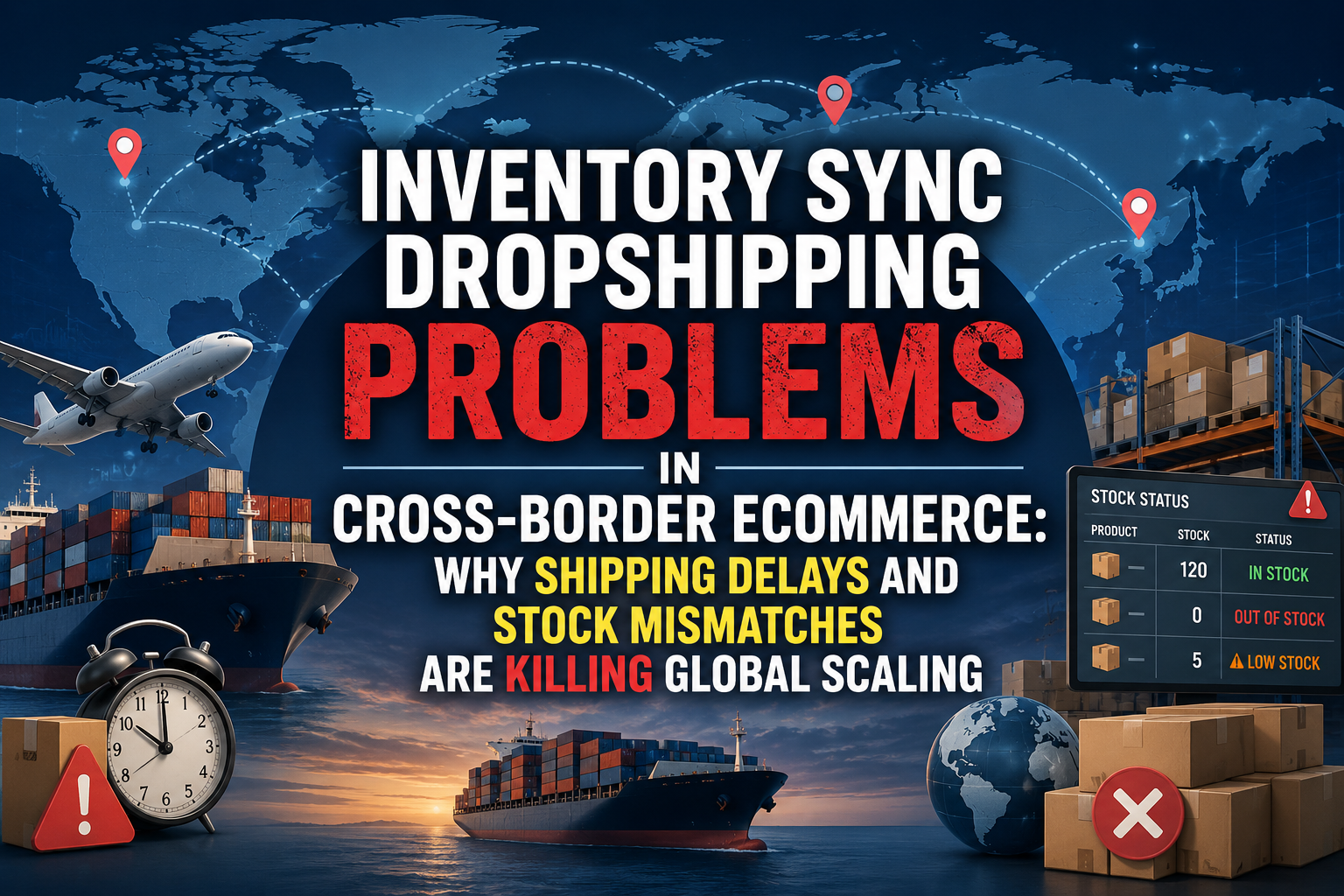
How Inventory Sync Dropshipping Prevents Overselling and Stock Mismatch in Real-Time Ecommerce
In dropshipping and modern ecommerce, one of the most persistent operational issues is the gap between what a store displays and what a supplier actually has in stock. This gap becomes especially critical when scaling product catalogs or selling across multiple channels. Inventory sync dropshipping is designed to solve this mismatch by ensuring that stock levels are updated in real time or near real time between suppliers and storefronts.
Without proper synchronization, sellers often unknowingly sell products that are already out of stock. This leads to overselling, order cancellations, refund requests, and in many cases, long-term damage to customer trust. The problem is not just technical—it directly affects conversion rates and brand reputation.
How Overselling Happens in Dropshipping Systems
Overselling usually occurs when inventory data is delayed or updated in batches instead of continuously. For example, if a supplier updates stock every few hours or once a day, the store may continue selling products that have already been depleted.
In fast-moving niches like fashion, beauty, or viral TikTok products, stock can change within minutes. If the dropshipping store relies on outdated inventory data, even a small spike in demand can trigger multiple oversold orders.
Another common issue comes from multiple stores pulling from the same supplier feed. Without centralized inventory sync, each store believes stock is available, while in reality the shared inventory has already been consumed elsewhere.
The Role of Real-Time Inventory Sync in Preventing Stock Mismatch
Real-time inventory sync dropshipping systems work by continuously updating stock levels through APIs, automation tools, or integrated ERP systems. Instead of relying on manual updates, these systems push and pull data instantly between supplier and storefront.
When a customer places an order, the system immediately deducts stock from the central inventory database. At the same time, all connected sales channels are updated, reducing the risk of double-selling the same item.
This process creates what is often called a “single source of truth” for inventory. Every platform—whether Shopify, WooCommerce, or a marketplace—reflects the same stock status at any given moment.
Business Impact: Why Inventory Sync Directly Affects Profitability
From a business perspective, inventory sync is not just a technical feature but a profitability driver. Overselling leads to order cancellations, which increases operational costs and reduces customer lifetime value.
Customers who experience canceled orders are significantly less likely to return. This means that even if a product is profitable on paper, poor inventory management can silently destroy margins over time.
On the other hand, accurate inventory sync improves fulfillment reliability. Stores can confidently scale ad spend, knowing that product availability matches demand in real time. This reduces wasted advertising costs from promoting out-of-stock items.
Challenges in Implementing Inventory Sync Dropshipping
Despite its benefits, implementing effective inventory sync is not always simple. Many suppliers still operate with outdated systems that rely on manual CSV updates instead of API-based automation. This creates latency in data transfer.
Another challenge is multi-supplier environments. When a store sources products from multiple vendors, each with different update frequencies, synchronizing inventory becomes more complex.
Additionally, system errors or API downtime can cause temporary desynchronization, which must be handled with fallback logic such as safety stock buffers or auto-disable rules for low inventory products.
Inventory Sync Dropshipping Across Shopify, Amazon, and TikTok Shop
As ecommerce sellers expand beyond a single storefront, inventory management becomes significantly more complex. Selling on Shopify alone is relatively straightforward, but once Amazon, TikTok Shop, and other marketplaces are added, inventory synchronization becomes a critical operational challenge.
Inventory sync dropshipping in a multi-channel environment is not just about updating stock numbers. It is about ensuring consistency across platforms that operate at different speeds, have different order flows, and follow different inventory rules. Without proper synchronization, sellers quickly face overselling, stock fragmentation, and unpredictable fulfillment delays.
Why Multi-Channel Selling Breaks Traditional Inventory Systems
Traditional inventory systems are usually designed for single-channel operations. When a product is sold on one platform, the stock is reduced in a central database. However, in multi-channel dropshipping, each platform generates sales independently and often in real time.
For example, a product might sell simultaneously on Shopify and TikTok Shop within seconds. If both platforms are not connected to the same inventory source, both orders may be accepted even if there is only one unit available. This creates immediate stock conflict and leads to order cancellations.
Amazon adds another layer of complexity because of its strict fulfillment requirements. Whether using FBM or third-party fulfillment, inventory accuracy directly affects seller ratings and account health.
The Concept of a Single Inventory Source of Truth
The foundation of effective inventory sync dropshipping across multiple channels is the concept of a “single source of truth.” This means that all sales channels pull inventory data from one centralized system rather than maintaining independent stock records.
This centralized system can be a backend ERP, a Shopify-based inventory app, or a supplier-integrated API system. The key is that every sale updates the same inventory pool instantly, regardless of where the order originates.
When properly implemented, this prevents stock duplication and ensures that once a product is sold on one channel, it is immediately deducted from all others.
Shopify, Amazon, and TikTok Shop: Different Sync Behaviors
Each platform behaves differently when it comes to inventory updates.
Shopify is relatively flexible and supports real-time API-based inventory sync through apps and custom integrations. It is often used as the central hub in dropshipping operations.
Amazon, however, is more restrictive. Inventory updates must meet strict formatting and timing requirements, especially for FBM sellers. Delays in sync can result in suppressed listings or penalties.
TikTok Shop operates in a highly dynamic environment where viral demand can spike quickly. Inventory can deplete in minutes, making real-time sync critical to avoid overselling during traffic surges.
Because of these differences, a unified sync system must adapt to multiple update speeds and platform constraints simultaneously.
Operational Risks Without Proper Multi-Channel Sync
Without reliable inventory synchronization, sellers face several operational risks. The most immediate is overselling, where multiple platforms sell the same unit of stock. This leads to order cancellations and refund processing costs.
Another major issue is fragmented inventory allocation. Some platforms may continue showing stock availability while others have already exhausted it, creating uneven sales distribution.
Over time, these inefficiencies reduce profit margins and make scaling advertising campaigns risky. Sellers cannot confidently increase traffic if inventory accuracy is uncertain.
Scalable Solutions for Multi-Channel Inventory Sync
To manage inventory sync dropshipping efficiently across multiple platforms, most scaling sellers rely on automation tools or ERP systems that integrate with all sales channels.
API-based systems allow near real-time synchronization, ensuring that stock levels update instantly across Shopify, Amazon, and TikTok Shop. Some advanced setups also include buffer stock rules, which reserve a small inventory margin to prevent overselling during synchronization delays.
In more complex operations, AI-based forecasting systems are used to dynamically allocate inventory based on platform performance, ensuring that high-conversion channels receive priority stock allocation.
Inventory Sync Dropshipping: Automation Tools vs Manual Stock Management
As dropshipping stores grow, inventory management shifts from a simple operational task to a critical scaling constraint. What works for a small store with 10–20 products quickly breaks down when product catalogs expand or when multiple suppliers are involved.
Inventory sync dropshipping is meant to solve this problem by keeping stock levels aligned between suppliers and storefronts. However, the method used to maintain this sync—manual updates or automation tools—has a major impact on accuracy, speed, and scalability.
Manual Inventory Management: Simple but High-Risk at Scale
Manual inventory management typically relies on spreadsheets, CSV uploads, or supplier emails. In the early stage of a dropshipping business, this approach may seem sufficient because order volume is low and product changes are manageable.
However, the main limitation is human delay. Stock changes at the supplier level are not reflected immediately in the store. Even a few hours of delay can result in overselling, especially for trending or seasonal products.
Another issue is human error. Manual updates increase the probability of incorrect stock entries, duplicate listings, or missed product updates. As the catalog grows, these errors compound and become difficult to track.
While manual systems offer full control, they do not scale efficiently. The more products and suppliers involved, the more fragile the system becomes.
Automation Tools in Inventory Sync Dropshipping
Automation tools are designed to eliminate manual intervention by connecting suppliers, storefronts, and marketplaces through APIs or data feeds. These systems continuously sync inventory in real time or near real time.
Instead of updating stock manually, automation tools automatically deduct inventory when a sale occurs and update all connected platforms instantly. This reduces latency and significantly lowers the risk of overselling.
Advanced tools also include features like stock buffers, auto-disable rules for low inventory products, and multi-supplier routing logic. These features help stabilize inventory even during sudden demand spikes.
Most importantly, automation allows sellers to scale without increasing operational workload. Whether managing 50 products or 5,000, the system behaves consistently.
Accuracy vs Flexibility: The Core Tradeoff
The key difference between manual and automated inventory sync is not just efficiency, but reliability.
Manual systems offer flexibility but lack consistency. Sellers can adjust stock levels freely, but updates are often delayed and inconsistent across platforms.
Automation systems provide high consistency but less flexibility in real-time decision-making. Once configured, the system follows predefined rules, which may limit quick manual adjustments.
In practice, scalability favors automation because ecommerce growth depends more on system stability than operational flexibility.
Cost Considerations and Hidden Operational Expenses
At first glance, manual inventory management appears cheaper because it does not require software subscriptions or integration tools. However, hidden costs emerge as the business grows.
These include refund processing from overselling, customer service workload from canceled orders, and lost ad spend on out-of-stock products. These costs are often higher than the price of automation tools.
Automation systems, while requiring upfront investment, reduce these hidden inefficiencies. Over time, they improve profit consistency by preventing avoidable operational losses.
Scaling Perspective: Why Automation Wins Long-Term
From a scaling perspective, inventory sync dropshipping is fundamentally a systems problem. Businesses that rely on manual updates eventually hit a growth ceiling because operational complexity increases faster than human capacity.
Automation tools remove this ceiling by ensuring that inventory updates are not dependent on human input. This allows sellers to expand product lines, test new markets, and increase advertising budgets without increasing operational risk.
As a result, automation is not just an efficiency upgrade—it is a prerequisite for scaling modern dropshipping businesses.
Inventory Sync Dropshipping Explained: API vs CSV Feeds vs ERP Systems
Behind every successful inventory sync dropshipping operation is an integration system that connects suppliers, stores, and marketplaces. While the concept seems simple—keeping stock levels updated—the underlying infrastructure can vary significantly depending on whether the business uses API connections, CSV feeds, or ERP systems.
Each method has different strengths in terms of speed, accuracy, and scalability. Choosing the wrong integration approach often leads to delayed updates, overselling, or inefficient operations as the business grows.
API-Based Inventory Sync: Real-Time Connectivity
API (Application Programming Interface) integration is the most advanced and widely used method in modern inventory sync dropshipping systems. It allows direct communication between supplier systems and ecommerce platforms.
With API-based sync, inventory updates happen in near real time. When a product is sold, the system immediately adjusts stock levels across all connected platforms. This minimizes delays and significantly reduces the risk of overselling.
Another advantage of API systems is automation depth. APIs can handle not only stock updates but also order routing, tracking updates, and even pricing adjustments. This creates a fully automated ecosystem where manual intervention is minimal.
However, API integration depends heavily on supplier capability. Not all suppliers offer stable or well-documented APIs, which can limit implementation in certain sourcing regions.
CSV Feed Synchronization: Simple but Delayed
CSV-based inventory sync is one of the oldest and most commonly used methods in dropshipping. In this system, suppliers export stock data in spreadsheet format, which is then imported into the ecommerce platform at scheduled intervals.
While CSV systems are easy to implement and do not require advanced technical infrastructure, they suffer from significant latency. Inventory updates may occur every few hours or even once per day, depending on the setup.
This delay creates a gap between actual stock levels and what the store displays. In fast-moving niches, this can quickly lead to overselling and order cancellations.
CSV systems also require manual or semi-automated processing, which increases operational workload and introduces human error risk during file handling or upload scheduling.
Despite these limitations, CSV feeds are still widely used because they are compatible with almost any supplier system, even those without API capabilities.
ERP Systems: Centralized Inventory Intelligence
ERP (Enterprise Resource Planning) systems represent the most comprehensive approach to inventory sync dropshipping. Unlike API or CSV methods that focus primarily on data transfer, ERP systems centralize all business operations into one unified platform.
In an ERP setup, inventory is managed as part of a larger ecosystem that includes procurement, warehousing, order management, and financial tracking. This allows for highly accurate stock control across multiple channels and suppliers.
ERP systems are particularly effective for businesses operating at scale, especially those managing multiple warehouses or cross-border fulfillment networks.
The main drawback is complexity. ERP systems require significant setup time, technical expertise, and ongoing maintenance. They are also more expensive compared to API or CSV-based solutions, making them less suitable for beginners.
Comparing API, CSV, and ERP in Real Business Scenarios
In practical terms, the choice between API, CSV, and ERP depends on business maturity and operational complexity.
API systems are ideal for fast-scaling dropshipping stores that need real-time synchronization and automation without heavy infrastructure.
CSV systems are better suited for early-stage sellers testing products or working with suppliers who lack technical integration capabilities.
ERP systems are designed for mature ecommerce businesses that require full operational control across multiple warehouses, suppliers, and sales channels.
The key tradeoff across all three methods is between speed, complexity, and control. Faster systems tend to require more technical investment, while simpler systems often sacrifice accuracy and scalability.
Strategic Considerations for Inventory Sync Dropshipping
Choosing the right integration method is not just a technical decision—it directly affects business scalability. Poor integration leads to delayed updates, stock inconsistencies, and ultimately lost revenue.
As stores grow, many sellers start with CSV feeds, transition to API-based automation, and eventually adopt ERP systems when operating at enterprise scale. This progression reflects increasing demand for accuracy and operational efficiency.
How Inventory Sync Dropshipping Helps Prevent Stockouts with Smart Demand Forecasting Systems
In inventory sync dropshipping, stockouts are often more damaging than overselling. While overselling creates operational friction, stockouts directly eliminate sales opportunities. Every time a product goes out of stock during active demand, potential revenue is permanently lost.
The challenge becomes even more severe in fast-moving ecommerce environments where traffic is driven by paid ads, TikTok virality, or seasonal spikes. Without accurate inventory sync combined with forecasting, sellers often discover stock depletion only after sales have already slowed down.
The Connection Between Inventory Sync and Stock Availability
Inventory sync dropshipping is not only about updating stock levels—it is also about maintaining visibility into how fast inventory is being consumed across channels.
When inventory data is synchronized in real time, sellers can observe demand patterns more accurately. Instead of reacting after stockouts occur, they can proactively manage inventory levels before demand exceeds supply.
This creates a feedback loop where inventory sync data becomes the foundation for demand forecasting accuracy.
How Demand Forecasting Works in Modern Dropshipping Systems
Demand forecasting in ecommerce uses historical sales data, traffic trends, conversion rates, and seasonal patterns to estimate future product demand.
In inventory sync dropshipping systems, this forecasting becomes more accurate because real-time stock and sales data are continuously updated. The system can detect rising demand early, especially when a product begins to gain traction through ads or organic traffic.
For example, if a product suddenly experiences a spike in TikTok traffic, forecasting systems can identify the trend and predict potential stock depletion within a defined timeframe.
This allows sellers to restock or reallocate inventory before a full stockout occurs.
The Role of Safety Stock in Preventing Supply Gaps
One of the most practical applications of inventory sync combined with forecasting is the use of safety stock buffers.
Safety stock is a predefined inventory threshold that prevents products from being completely sold out during synchronization delays or demand spikes. Instead of showing zero stock at the exact depletion point, systems reserve a small buffer.
This buffer acts as a protection layer, ensuring that short-term spikes or API delays do not immediately result in stockouts on storefronts.
When integrated with forecasting systems, safety stock levels can be dynamically adjusted based on product velocity and demand volatility.
Predictive Inventory Allocation Across Products and Channels
Advanced inventory sync dropshipping systems go beyond simple stock tracking. They allocate inventory based on predicted performance across different channels.
For instance, if Shopify is converting better than Amazon for a specific product, the system may prioritize inventory allocation toward Shopify listings. This ensures that high-performing channels do not run out of stock prematurely.
Predictive allocation also helps balance inventory between organic traffic and paid advertising campaigns, ensuring that high-ROI channels are not disrupted by supply limitations.
This level of optimization is only possible when inventory sync and forecasting systems are tightly integrated.
How Real-Time Data Reduces Stockout Risk During Viral Demand
One of the biggest risks in dropshipping is sudden viral demand. A product can go from low traffic to thousands of orders within hours due to social media exposure.
Without real-time inventory sync, sellers often react too slowly, resulting in full stockouts during peak demand. However, when inventory sync is combined with forecasting models, these spikes can be detected early through rising order velocity and traffic signals.
This allows sellers to respond in real time by adjusting ads, increasing supplier orders, or temporarily limiting product exposure.
The ability to react within hours instead of days is often the difference between maximizing profit and missing an entire demand wave.
Limitations of Forecasting in Dropshipping Environments
Despite its advantages, demand forecasting in dropshipping is not perfect. One of the main challenges is data inconsistency between suppliers and storefronts.
If inventory sync is delayed or inaccurate, forecasting models are built on flawed data, which reduces their effectiveness. Additionally, external factors like sudden viral trends or competitor pricing changes can disrupt predictions.
This is why forecasting alone is not enough—it must be supported by reliable inventory sync infrastructure to be effective.
Inventory Sync Dropshipping Challenges in Cross-Border Ecommerce
Cross-border ecommerce introduces a level of complexity that significantly amplifies inventory sync dropshipping challenges. Unlike domestic fulfillment, cross-border operations involve multiple time zones, different supplier systems, longer shipping cycles, and fragmented logistics networks.
In this environment, inventory accuracy is not just about stock numbers—it is about timing, availability, and the ability to align real-time demand with delayed physical movement of goods. Even a perfectly designed store can struggle if inventory sync does not account for international supply chain delays.
Shipping Delays and Their Impact on Inventory Accuracy
One of the most critical issues in cross-border dropshipping is the mismatch between inventory data and shipping reality. Suppliers may confirm stock availability, but actual fulfillment can be delayed due to customs processing, warehouse congestion, or international carrier limitations.
This creates a situation where inventory appears “available” in the system, while in practice the product cannot be shipped immediately. For customers, this results in delayed deliveries, order cancellations, and reduced trust in the brand.
Inventory sync dropshipping systems must therefore account not only for stock quantity, but also for fulfillment speed and regional shipping constraints.
Time Zone Gaps Between Suppliers and Stores
Another hidden challenge in cross-border inventory sync is the time zone difference between suppliers and storefront operators.
For example, a store targeting European or US customers may rely on suppliers based in Asia. When sales occur during the Western peak hours, suppliers may be offline, delaying inventory updates and order confirmations.
This time lag creates synchronization blind spots where stock changes are not reflected in real time. During high-demand periods, even a few hours of delay can lead to overselling or stock misalignment across multiple channels.
Stock Gaps Caused by Fragmented Supply Chains
Cross-border dropshipping often involves multiple suppliers, warehouses, and logistics partners. Each node in the supply chain may have its own inventory system, which is not always fully integrated with the seller’s platform.
This fragmentation leads to stock gaps, where one supplier shows availability while another has already depleted inventory. Without unified synchronization, sellers risk selling products that are no longer available in the actual fulfillment network.
Inventory sync dropshipping systems must therefore unify data across multiple suppliers to maintain a consistent and reliable stock view.
Real-Time Accuracy Challenges in Global Ecommerce
Maintaining real-time inventory accuracy is significantly more difficult in cross-border operations compared to domestic fulfillment. Data must travel across multiple systems, each with its own latency and update frequency.
API limitations, inconsistent CSV updates, and varying ERP standards across regions all contribute to synchronization delays. These delays accumulate and create discrepancies between displayed inventory and actual warehouse stock.
As a result, sellers often face a lag effect where inventory appears correct in the system but is already outdated in reality.
How Advanced Systems Reduce Cross-Border Sync Risks
To mitigate these issues, advanced inventory sync dropshipping systems use a combination of strategies such as regional warehouse segmentation, buffered inventory allocation, and multi-source reconciliation.
Regional warehouses reduce shipping delays by positioning stock closer to end customers. Buffered inventory helps absorb short-term discrepancies caused by sync delays. Multi-source reconciliation ensures that data from different suppliers is continuously compared and corrected.
These systems do not eliminate complexity, but they significantly reduce the operational risks associated with cross-border ecommerce.
Strategic Importance of Reliable Inventory Sync in Global Scaling
For sellers expanding into international markets, inventory sync becomes a strategic infrastructure layer rather than a simple operational tool. Without it, scaling across regions increases the probability of stock errors, delivery delays, and customer dissatisfaction.
Reliable inventory synchronization allows businesses to confidently run ads across multiple countries, knowing that stock availability is accurately reflected in each region.
In this sense, inventory sync dropshipping is not just about efficiency—it is a prerequisite for sustainable global expansion.





No Comments