


How to Price Dropshipping Products Like a Pro: 6 Strategies to Maximize Profit, Boost Conversions, and Scale Without Price Wars

Cost-plus pricing is not the most sophisticated strategy, but it is the most essential. It provides a clear profitability floor, ensures financial sustainability, and creates a structured foundation for more advanced pricing models.
For anyone serious about mastering how to price dropshipping products, the goal is not to rely solely on cost-plus pricing, but to use it as a baseline. From there, layering in competitive analysis, value perception, and dynamic pricing strategies becomes far more effective—because the fundamentals are already secure.
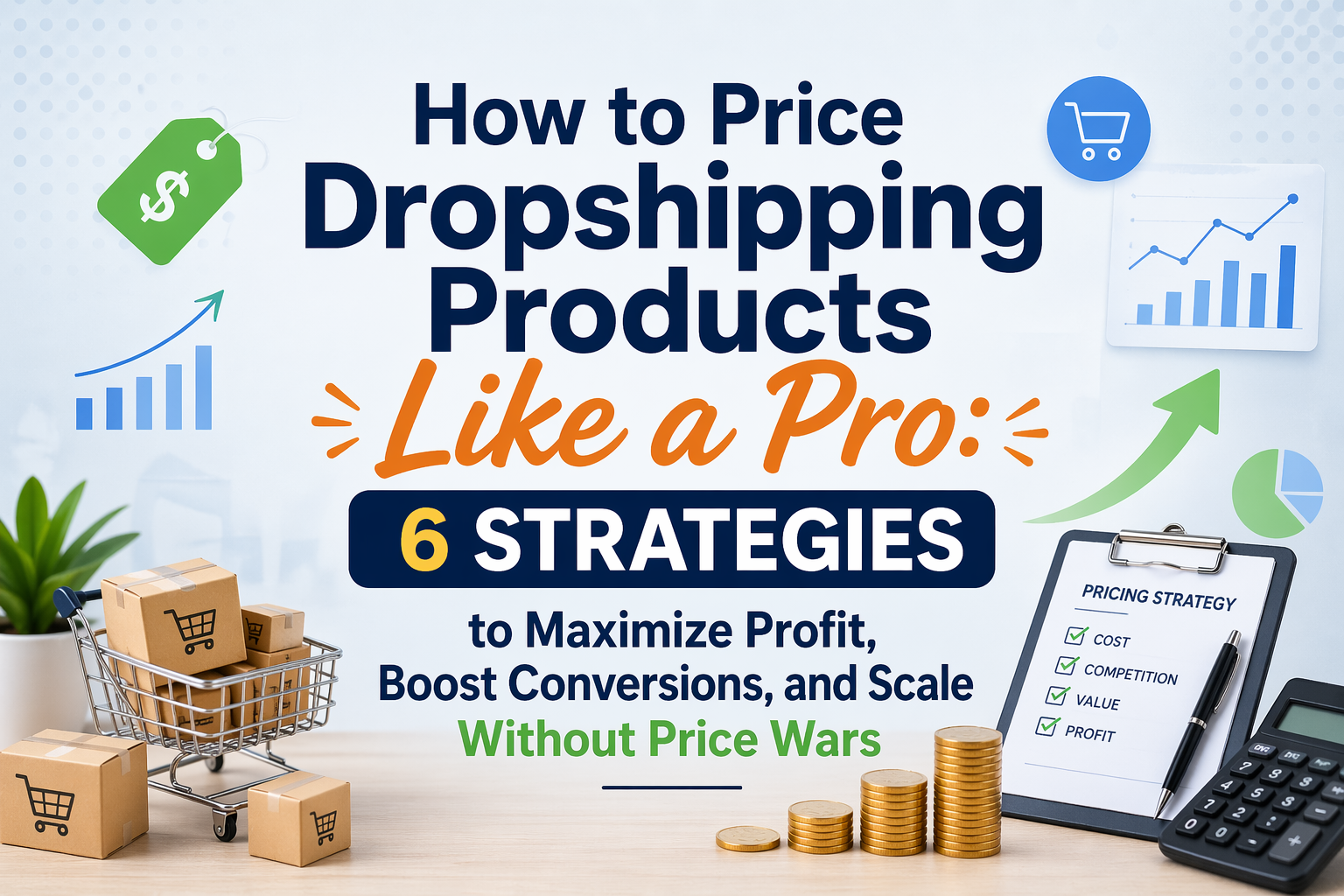
Cost-Plus Pricing Strategy for Dropshipping
When discussing how to price dropshipping products, cost-plus pricing is often dismissed as “too basic.” In reality, it remains the most reliable starting point for building a sustainable business. Unlike aggressive pricing strategies that depend heavily on market timing or branding strength, cost-plus pricing ensures that every sale contributes positively to your margins.
At its core, this model answers a simple but critical question: after all expenses are accounted for, are you actually making money?
For many beginners, the biggest mistake is underestimating hidden costs. Product cost alone is only one part of the equation. A realistic pricing structure must include shipping fees, payment processing, platform commissions, and—most importantly—customer acquisition costs. Without incorporating these variables, what appears profitable on paper often turns into losses at scale.
Breaking Down the Real Cost Structure
A rational pricing model requires a full understanding of unit economics. Beyond supplier pricing, advertising typically becomes the largest expense in dropshipping. In competitive niches, customer acquisition cost can easily account for 30% to 60% of the final product price.
This is where operational efficiency becomes decisive. Using a fulfillment partner like ScaleOrder dropshipping allows sellers to reduce product and shipping costs through optimized sourcing and localized warehousing. Lower base costs directly expand your pricing flexibility, making it easier to stay competitive without sacrificing margins.
A simplified cost-plus formula often looks like this:
Final Price = Total Cost × Markup Multiplier
However, the multiplier itself should not be arbitrary. It must reflect your traffic source. For example, products sold through organic channels can sustain lower markups, while paid traffic requires significantly higher margins to remain viable.
Setting the Right Markup: Data Over Guesswork
A common heuristic in dropshipping is the “3x rule,” where the selling price is set at three times the product cost. While this can serve as a rough starting point, it rarely holds up under real-world conditions.
Instead, markup decisions should be driven by data. If your average cost per acquisition is $15 and your product cost is $10, pricing the product at $29.99 leaves minimal room for profit after fees. In contrast, a price point of $39.99 or higher may be necessary to achieve a sustainable margin.
This highlights a key insight: pricing is not just about covering costs—it is about aligning your pricing model with your marketing reality.
Balancing Profitability and Conversion Rates
One of the main criticisms of cost-plus pricing is that it ignores customer perception. While this is partially true, it does not mean the model is ineffective. Instead, it should be treated as a baseline rather than a final decision.
After establishing a minimum viable price, adjustments can be made based on conversion performance. If a product converts strongly, there may be room to increase price without significantly impacting sales volume. Conversely, if conversion rates are weak, pricing may need to be optimized alongside product positioning.
The advantage of starting with cost-plus pricing is that it prevents underpricing—a common issue that can quickly erode cash flow, especially when scaling paid campaigns.
Why Cost Control Is More Powerful Than Price Cutting
Many sellers attempt to compete by lowering prices, but this approach often leads to diminishing returns. A more effective strategy is to reduce underlying costs while maintaining price stability.
This is where supply chain optimization becomes critical. ScaleOrder dropshipping, for example, focuses on improving sourcing efficiency and fulfillment speed, allowing sellers to maintain competitive pricing without engaging in destructive price wars. In practice, reducing costs by even a few dollars per unit can have a greater impact on profitability than increasing sales volume.
Competitor-Based Pricing: How to Benchmark and Win in Saturated Dropshipping Markets
When analyzing how to price dropshipping products in competitive niches, ignoring competitors is not just risky—it is strategically flawed. In most mature categories, customers are already exposed to multiple sellers offering nearly identical products across platforms like Shopify, Amazon, and TikTok Shop. This transparency compresses pricing power and forces sellers into a visible comparison environment.
Competitor-based pricing is not about blindly matching the lowest price. It is about understanding the pricing landscape and identifying where your offer fits within it. In saturated markets, pricing becomes a positioning tool rather than just a mathematical calculation.
A product priced too low signals low quality, while a product priced too high without justification leads to poor conversion. The optimal price exists within a narrow psychological and competitive range, shaped by what customers already expect to pay.
How to Analyze Competitor Pricing Effectively
A rational approach begins with mapping the price distribution of similar products. Instead of focusing on a single competitor, it is more useful to observe clusters. Typically, you will find three tiers: low-end pricing driven by aggressive sellers, mid-range pricing where most volume occurs, and premium pricing supported by branding or perceived value.
The key is not to compete across all tiers, but to choose one deliberately.
For example, entering at the lowest price point often results in razor-thin margins and high dependency on operational efficiency. Competing in the mid-range allows for balanced margins and stable conversion rates, while premium pricing requires stronger branding and content support.
This is where operational structure matters. Sellers working with ScaleOrder dropshipping can often access better supplier pricing and faster fulfillment, which enables them to compete in mid-to-high price tiers without sacrificing margin. Faster delivery alone can justify a higher price compared to slower competitors.
Avoiding the Race to the Bottom
One of the most common mistakes in competitor-based pricing is reactive undercutting. When sellers continuously lower prices to stay competitive, the entire market shifts downward, eroding profitability for everyone involved.
In practice, price is only one variable in the customer’s decision. Shipping time, product presentation, reviews, and brand trust all contribute to perceived value. Competing solely on price ignores these dimensions and creates a fragile business model.
A more sustainable approach is to maintain price parity or slight premiums while improving the overall offer. For instance, better product pages, clearer value propositions, or localized fulfillment can offset a higher price point.
Using Differentiation to Justify Pricing
Competitor-based pricing becomes significantly more effective when combined with differentiation. If two products are identical in presentation, the cheaper option will almost always win. However, small improvements in perceived value can shift customer preference even at a higher price.
This includes factors such as faster shipping, bundled offers, clearer product benefits, or niche-specific branding. Many successful sellers position themselves slightly above the market average, not below it, because higher pricing often correlates with higher perceived quality.
With a fulfillment partner like ScaleOrder dropshipping, sellers can leverage features such as optimized logistics and product customization to create differentiation that competitors relying on standard suppliers cannot easily replicate. This creates room for pricing above the baseline market level.
Dynamic Benchmarking: Pricing as an Ongoing Process
Competitor pricing is not static. Market conditions shift constantly due to seasonal demand, advertising costs, and new entrants. As a result, pricing should be continuously monitored and adjusted rather than set once.
A product that performs well at $29.99 during testing may support a higher price once it gains traction, especially if competitors begin to sell out or increase their own prices. Conversely, if new competitors enter with aggressive pricing, adjustments may be necessary to maintain conversion rates.
The key insight is that competitor-based pricing is not about reacting instantly, but about responding strategically. Short-term fluctuations should not override long-term profitability.
Value-Based Pricing: How to Charge More Without Losing Conversions in Dropshipping
When exploring how to price dropshipping products, most beginners focus on costs or competitors. However, the highest-performing stores operate on a different principle: customers do not buy based on cost—they buy based on perceived value.
Value-based pricing shifts the focus from “What does this product cost?” to “What is this product worth to the customer?” This distinction is critical. Two sellers can offer the same product sourced from the same factory, yet one sells it for $12.99 while another successfully charges $39.99 or more. The difference is not the product itself, but how its value is communicated.
In this model, pricing is not constrained by cost structures or competitor averages. Instead, it is anchored in the customer’s willingness to pay, which can be significantly higher when the product solves a clear problem or delivers a strong emotional benefit.
Building Perceived Value Through Positioning
Value does not exist in isolation; it is constructed through presentation. Product pages, branding, and messaging all contribute to how customers interpret price.
For example, a generic product listing with minimal descriptions and low-quality images naturally anchors the product at a low price point. In contrast, a well-designed page with strong visuals, clear benefits, and targeted messaging can justify a significantly higher price.
This is particularly relevant in dropshipping, where many sellers use identical supplier assets. The ability to differentiate through content becomes a primary driver of pricing power.
Operational factors also influence perceived value. Faster shipping, reliable tracking, and consistent product quality reinforce customer trust. With ScaleOrder dropshipping, sellers can improve these backend elements through better sourcing and localized fulfillment, which supports higher pricing without increasing friction in the buying decision.
The Role of Branding in Price Expansion
Branding is often misunderstood as purely visual design. In reality, it is a mechanism for reducing uncertainty. Customers are more willing to pay higher prices when they feel confident in the outcome of their purchase.
A strong brand communicates consistency, reliability, and a clear target audience. This allows sellers to move away from commodity pricing and into premium positioning. Even subtle branding elements—such as a cohesive color scheme, consistent tone of voice, or niche-specific messaging—can shift perception.
In practical terms, this means that pricing can exceed the market average without significantly harming conversion rates, as long as the brand experience supports that premium.
Emotional Drivers and Willingness to Pay
Value-based pricing becomes even more effective when products tap into emotional triggers. Functional products solve problems, but emotional products justify higher prices.
For instance, products related to self-improvement, convenience, health, or personal identity often carry higher perceived value. Customers are not just buying the item; they are buying the outcome or transformation associated with it.
This is why storytelling plays a critical role. A product positioned as a simple accessory competes on price, while the same product framed as a solution to a specific pain point can command a premium.
Balancing High Pricing with Conversion Stability
A common concern with value-based pricing is the risk of reduced conversion rates. While higher prices can create resistance, this effect is not linear. If perceived value increases at the same or greater rate, conversion rates can remain stable—or even improve.
The key is alignment. Pricing, product presentation, and customer expectations must be consistent. A premium price paired with a weak product page creates friction, while a strong value proposition can support higher pricing with minimal drop-off.
This is where iterative testing becomes important. Sellers can gradually increase prices while monitoring conversion performance, identifying the optimal balance between margin and volume.
Why Value-Based Pricing Scales Better
Unlike cost-plus or competitor-based pricing, value-based pricing is not constrained by external benchmarks. This makes it particularly effective for scaling.
As advertising costs increase—a common trend in dropshipping—businesses relying solely on low margins struggle to remain profitable. In contrast, higher-priced products with strong perceived value provide more room to absorb rising acquisition costs.
With infrastructure support such as ScaleOrder dropshipping, sellers can maintain consistent fulfillment quality while focusing on front-end value creation. This combination allows for sustainable scaling without constant pressure to reduce prices.
Psychological Pricing Tactics in Dropshipping: How to Increase Conversions Without Lowering Prices
When learning how to price dropshipping products, many sellers assume that lowering prices is the most effective way to increase conversions. In reality, customer decisions are rarely driven by logic alone. Pricing is deeply influenced by perception, cognitive biases, and comparison effects.
Psychological pricing focuses on how prices are presented rather than how low they are. A product priced at $29.99 can outperform the same product at $27 simply because it aligns better with perceived value and expectations. This is why experienced sellers prioritize price framing over constant discounting.
In competitive dropshipping environments, where margins are already constrained by advertising costs, using psychological pricing allows sellers to improve conversion rates without sacrificing profitability.
Charm Pricing and the Left-Digit Effect
One of the most widely used techniques is charm pricing, typically ending prices in .99 or .95. While it may appear simplistic, it leverages a well-documented cognitive bias known as the left-digit effect.
Customers tend to anchor their perception on the first digit of a price. As a result, $19.99 is often perceived as significantly cheaper than $20, even though the difference is minimal. This small adjustment can meaningfully impact click-through rates and purchase decisions.
However, the effectiveness of charm pricing depends on context. In lower-ticket products, it reinforces affordability. In higher-ticket or premium positioning, rounded pricing (such as $40 or $100) can sometimes signal quality and confidence. The key is aligning the pricing format with your brand positioning.
Anchoring and Reference Pricing
Another powerful tactic is price anchoring, where a higher reference price is introduced to make the actual selling price appear more attractive.
For example, displaying a “Compare at $59.99” next to a selling price of $39.99 creates a perceived discount, even if the product was never sold at the higher price. This shifts the customer’s frame of reference and increases the likelihood of conversion.
Bundles and tiered pricing also utilize anchoring. When customers see multiple options, they tend to gravitate toward the middle or “best value” choice. This allows sellers to guide purchasing behavior without explicitly lowering prices.
In practice, these techniques are especially effective when combined with strong product pages and clear value propositions. Tools like optimized product sourcing and faster shipping—enabled by ScaleOrder dropshipping—further reinforce the perceived value behind the price, making anchors more credible.
The Power of Price Framing and Presentation
How a price is displayed can be just as important as the number itself. Breaking down a price into smaller units, such as “$1.20 per day,” can make higher prices feel more accessible. Similarly, emphasizing savings (“Save 30% today”) shifts attention away from total cost toward perceived gain.
Visual hierarchy also plays a role. Larger fonts, contrasting colors, and strategic placement can draw attention to the intended price point. In many cases, improving price presentation yields higher conversion gains than reducing the price itself.
This is particularly relevant in dropshipping, where many sellers use similar products and suppliers. Small improvements in presentation can create a meaningful competitive advantage without altering the underlying cost structure.
Scarcity, Urgency, and Price Sensitivity
Psychological pricing often intersects with urgency and scarcity cues. Limited-time offers, low-stock indicators, and countdown timers can reduce price sensitivity by encouraging faster decision-making.
When customers believe an opportunity may disappear, they are less likely to compare alternatives or delay the purchase. This increases the effectiveness of existing price points rather than requiring discounts.
However, these tactics must be used carefully. Overuse or false scarcity can reduce trust, especially in markets where consumers are already familiar with dropshipping tactics. Authenticity remains essential for long-term performance.
Why Psychological Pricing Works Best with Strong Operations
While psychological tactics can improve conversion rates, they are most effective when supported by reliable operations. Fast shipping, consistent quality, and clear communication reinforce the credibility of the offer.
With ScaleOrder dropshipping, sellers can improve fulfillment speed and product consistency, which strengthens customer confidence. This reduces friction at checkout and allows psychological pricing strategies to perform at their full potential.
Without this operational backing, even well-structured pricing tactics may fail to convert, as customers hesitate due to uncertainty rather than price alone.
Dynamic Pricing & Scaling Strategy: Adjusting Prices with Ads, Data, and Demand Signals
When analyzing how to price dropshipping products, one of the most common limitations is treating price as a fixed variable. In reality, pricing should evolve alongside your data, especially once you begin running paid traffic and scaling campaigns.
Static pricing may work during the initial testing phase, but it quickly becomes inefficient as conditions change. Advertising costs fluctuate, competitors adjust their offers, and demand shifts based on trends or seasonality. Sellers who fail to adapt their pricing in response to these variables often experience shrinking margins or missed profit opportunities.
Dynamic pricing addresses this issue by turning pricing into a responsive tool rather than a one-time decision.
From Testing Price to Scaling Price
In early-stage product testing, the primary objective is validation, not maximum profit. Prices are typically set at a level that allows for reasonable margins while prioritizing conversion rate. At this stage, simplicity matters more than precision.
Once a product demonstrates consistent sales and stable conversion performance, pricing should begin to evolve. This transition—from testing price to scaling price—is where many sellers leave money on the table.
For example, a product that performs well at $24.99 may still convert effectively at $29.99 or even $34.99. Without testing higher price points, sellers remain locked into suboptimal margins. Incremental price increases, combined with performance monitoring, allow for systematic optimization rather than guesswork.
Using Advertising Data to Guide Pricing Decisions
Paid traffic provides one of the most reliable feedback loops for pricing. Metrics such as cost per acquisition, click-through rate, and conversion rate offer direct insight into how price interacts with customer behavior.
If acquisition costs rise while conversion rates remain stable, increasing price may restore profitability without significantly impacting sales volume. Conversely, if conversion rates decline sharply, pricing may be misaligned with perceived value or market expectations.
The key is to treat pricing and advertising as interconnected systems. A profitable product is not defined by its price alone, but by how that price performs within a given traffic environment.
With operational support like ScaleOrder dropshipping, sellers can maintain consistent fulfillment costs and delivery times while focusing on front-end optimization. This stability simplifies pricing adjustments because backend variables remain controlled.
Responding to Market Demand and Seasonality
Demand fluctuations create opportunities for price optimization. During periods of high demand—such as seasonal spikes or viral trends—customers tend to be less price-sensitive. This allows for temporary price increases that maximize profit per order.
On the other hand, during slower periods, maintaining a slightly lower price may help sustain sales volume and keep advertising campaigns active.
Dynamic pricing does not require constant changes, but it does require awareness. Monitoring trends, competitor activity, and inventory levels enables more informed adjustments rather than reactive decisions.
Inventory, Fulfillment, and Pricing Flexibility
Pricing strategy is closely tied to operational capacity. Faster fulfillment and stable supply chains allow sellers to maintain or increase prices with confidence, as customer expectations are consistently met.
For example, if delivery times are reduced from 10–15 days to 3–7 days through localized warehousing, the perceived value of the product increases. This improvement can justify a higher price without negatively affecting conversion rates.
ScaleOrder dropshipping plays a role here by optimizing sourcing and logistics, giving sellers more control over delivery performance. This operational advantage translates directly into pricing flexibility, especially in competitive niches where shipping speed is a key differentiator.
Avoiding Over-Optimization and Price Volatility
While dynamic pricing offers clear advantages, excessive adjustments can create instability. Frequent or drastic price changes may confuse customers, reduce trust, or disrupt advertising performance.
A more effective approach is structured experimentation. Instead of constant fluctuations, sellers can test price ranges over defined periods, analyze results, and implement changes gradually. This ensures that pricing decisions are data-driven rather than reactive.
Consistency is particularly important for brand perception. Even in a dynamic model, pricing should remain coherent and aligned with the overall positioning of the product.
High-Ticket vs Low-Ticket Pricing Strategy
When evaluating how to price dropshipping products, one of the most fundamental strategic decisions is choosing between a high-ticket or low-ticket pricing model. This is not just a pricing choice—it directly shapes your advertising strategy, cash flow, operational complexity, and long-term scalability.
Low-ticket products typically range from $5 to $30, relying on high sales volume and impulse purchases. High-ticket products, often priced above $100, focus on fewer transactions but significantly higher margins per order. Both models can be profitable, but they operate under very different economic dynamics.
The key is not determining which model is universally better, but understanding which model aligns with your resources, traffic strategy, and operational capabilities.
Low-Ticket Strategy: Volume, Speed, and Simplicity
Low-ticket dropshipping is often associated with fast-moving products and broad audiences. The primary advantage lies in lower purchase resistance. Customers are more willing to make quick decisions on inexpensive items, especially when driven by social media ads or trending content.
This model works particularly well with platforms like TikTok or Instagram, where impulse buying behavior is common. Conversion rates tend to be higher, which can make early-stage testing more efficient.
However, the margin structure presents challenges. With lower profit per order, sellers must maintain strict control over costs, especially advertising. Even small increases in cost per acquisition can eliminate profitability.
Operational efficiency becomes critical here. Using a partner like ScaleOrder dropshipping can reduce sourcing and fulfillment costs, which is essential for maintaining margins in a low-ticket model. Without cost optimization, scaling becomes difficult due to thin profit buffers.
High-Ticket Strategy: Margin, Stability, and Brand Leverage
High-ticket dropshipping operates on a different principle. Instead of relying on volume, it focuses on maximizing profit per transaction. A single sale can generate the same profit as multiple low-ticket orders, reducing dependency on high traffic volume.
This model allows for greater flexibility in advertising. Higher margins can absorb increased acquisition costs, making it easier to scale campaigns without immediate pressure on profitability.
However, conversion rates are typically lower. Customers take more time to evaluate higher-priced purchases, requiring stronger product pages, clearer value propositions, and higher trust levels. Branding, customer support, and fulfillment reliability all play a more significant role.
This is where infrastructure becomes a competitive advantage. With ScaleOrder dropshipping, sellers can offer faster shipping, better product consistency, and even customization options, all of which are critical for justifying higher price points.
Advertising Economics: CPA vs AOV Trade-Off
The fundamental trade-off between the two models can be summarized through customer acquisition cost (CPA) and average order value (AOV).
Low-ticket products require low CPA to remain profitable, as margins are limited. This creates constant pressure to optimize ad creatives and targeting. High-ticket products, on the other hand, can tolerate higher CPA because each sale generates more revenue.
This difference significantly impacts scaling. High-ticket sellers can often scale more aggressively once they find a working funnel, while low-ticket sellers must continuously optimize to maintain efficiency.
Refunds, Risk, and Customer Expectations
Pricing also influences customer behavior after the purchase. Low-ticket products tend to have lower expectations, which can reduce customer support pressure but increase impulsive buying and, in some cases, refund rates due to lack of commitment.
High-ticket products create higher expectations. Customers demand better communication, faster shipping, and consistent quality. While this increases operational requirements, it can also lead to stronger brand loyalty when executed correctly.
Reliable fulfillment systems, such as those provided by ScaleOrder dropshipping, become essential in managing these expectations. Consistency in delivery and product quality directly impacts customer satisfaction, especially in high-ticket scenarios.
Which Model Wins in 2026?
There is no universal winner between high-ticket and low-ticket dropshipping. Instead, market conditions in 2026 suggest a gradual shift toward higher-value models.
Rising advertising costs make low-ticket strategies increasingly difficult to sustain without exceptional operational efficiency. At the same time, consumers are becoming more selective, favoring products that offer clear value rather than purely low prices.
High-ticket models, supported by strong branding and reliable fulfillment, are better positioned to adapt to these trends. However, they require more upfront effort in positioning and customer experience.


No Comments