


Is Dropshipping Cologne Profitable? Everything You Need to Know About Costs, Margins, Marketing, Regulations, and Future Opportunities

From a purely financial perspective, cologne is one of the more attractive dropshipping niches available. Product sourcing costs are relatively low, perceived value is high, and retail pricing leaves room for substantial gross margins. Many successful stores operate with gross margins between 60% and 85%, significantly higher than what is commonly seen in electronics, gadgets, or commodity household products.
The biggest challenge is not product cost but customer acquisition. Entrepreneurs who can create compelling branding, strong product presentation, and effective advertising campaigns often find that cologne offers excellent revenue potential. When combined with bundles and repeat purchases, the niche can support healthy profits and long-term scalability, making it a viable option for ecommerce businesses seeking both high margins and strong consumer demand.
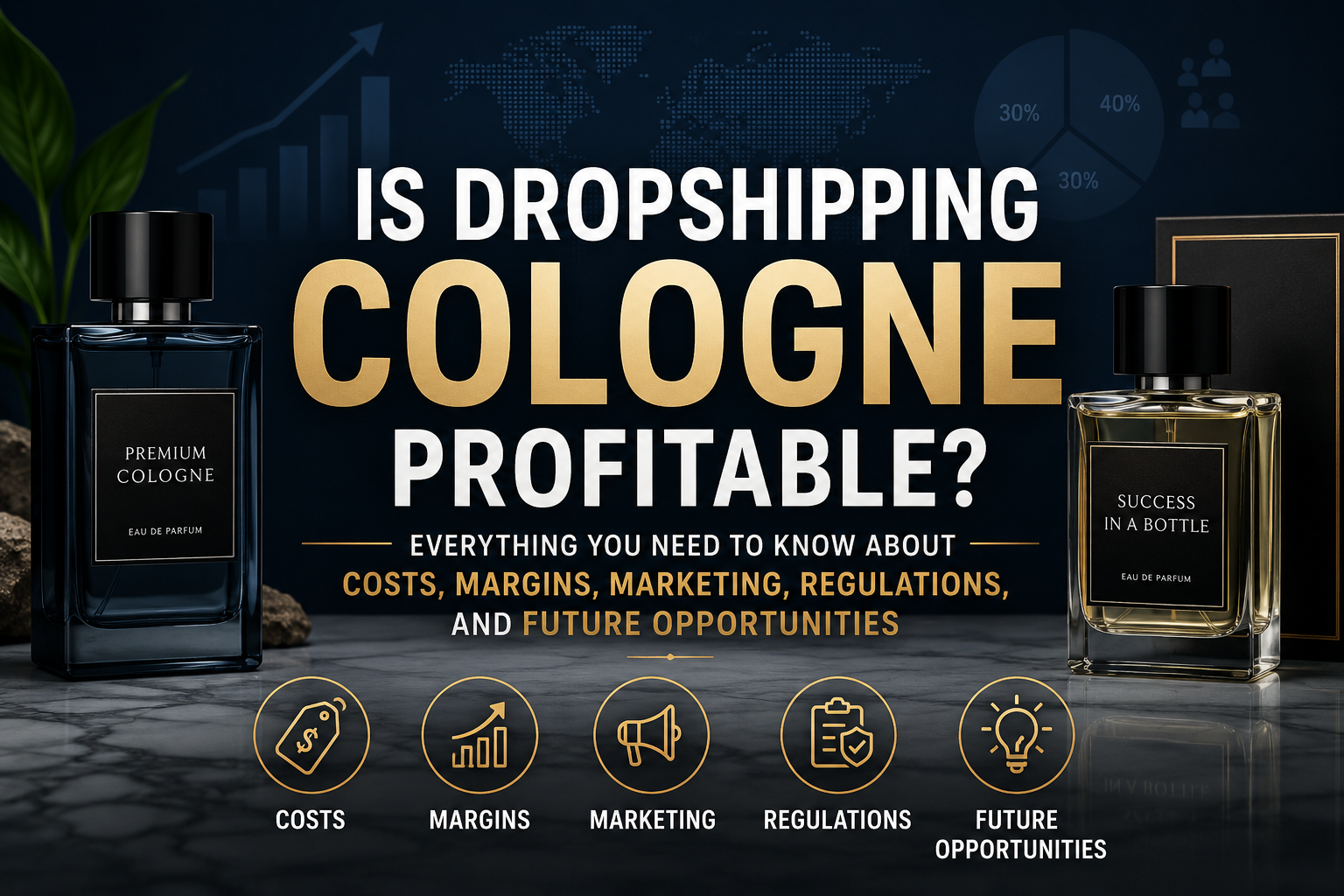
Is Dropshipping Cologne Profitable? Profit Margins, Costs, and Revenue Potential
The global fragrance industry has remained one of the most resilient categories in the beauty and personal care sector. While many consumer products face intense price competition, cologne continues to benefit from strong brand perception, emotional purchasing behavior, and relatively high retail markups. These characteristics make many entrepreneurs wonder whether dropshipping cologne can generate sustainable profits.
The answer depends largely on understanding the relationship between product costs, retail pricing, customer acquisition expenses, and operational overhead. Unlike highly commoditized products, cologne often sells based on perceived value rather than manufacturing cost, creating opportunities for substantial gross margins.
Global fragrance sales have continued to expand as online shopping becomes more accepted among beauty consumers. Younger demographics are increasingly discovering fragrances through social media platforms, influencer reviews, and short-form video content. This shift has opened the door for new ecommerce brands to compete without owning manufacturing facilities or maintaining inventory.
Cologne Product Costs
One of the most attractive aspects of dropshipping cologne is the relatively low production cost compared to retail pricing.
Many generic or white-label cologne suppliers in China offer products ranging from $3 to $15 per bottle depending on bottle design, fragrance concentration, packaging quality, and order volume. Premium-looking packaging often costs only slightly more to manufacture but can significantly increase perceived value.
For example, a 50ml cologne sourced for $8 may retail online for $35 to $50. A higher-end private-label version costing $12 to produce may be sold for $60 or more. This pricing dynamic creates room for healthy margins even after accounting for shipping and marketing expenses.
Typical cost structure may look like this:
- Product Cost: $8
- Shipping Cost: $5
- Payment Processing: $1.50
- Total Fulfillment Cost: $14.50
If the product sells for $45, the gross profit before advertising reaches approximately $30.50 per order.
This translates to a gross margin of nearly 68%, which is considerably higher than many consumer electronics or home goods categories.
Gross Margin Potential in Cologne Dropshipping
Profitability in dropshipping is often determined by gross margin rather than sales volume alone. Cologne performs particularly well in this area because fragrance products carry strong emotional value and are frequently purchased as lifestyle products rather than necessities.
Generic cologne products typically generate gross margins between 50% and 70%.
Private-label cologne products often achieve margins between 70% and 85%.
Luxury-inspired fragrances can sometimes exceed 85% gross margins when marketed effectively.
For example, consider a private-label fragrance costing $12 landed:
- Selling Price: $69
- Product and Shipping Cost: $12
- Gross Profit: $57
- Gross Margin: 82.6%
Such numbers explain why fragrance brands are often considered among the highest-margin ecommerce businesses.
However, high gross margins do not automatically guarantee high net profits. Advertising costs must also be considered.
The Impact of Advertising on Profitability
Customer acquisition is usually the largest expense in any dropshipping business.
For cologne stores targeting customers in the United States, Canada, Australia, and Western Europe, acquisition costs typically range from $15 to $40 per customer depending on competition and advertising quality.
Suppose a store sells a $59 cologne:
- Revenue: $59
- Fulfillment Cost: $14
- Gross Profit: $45
- Advertising Cost: $20
The resulting net profit becomes approximately $25 per order.
This still represents a profit margin above 40%, which many ecommerce businesses would consider highly attractive.
The most successful fragrance stores focus on increasing average order value rather than relying solely on single-bottle sales.
Increasing Revenue Through Bundles
A major advantage of cologne is its suitability for upselling and bundling.
Customers frequently purchase:
- Multiple fragrance scents
- Travel-size bottles
- Gift boxes
- Sample kits
- Matching grooming products
A customer who initially intends to buy one $45 bottle may ultimately spend $80 to $120 when presented with attractive bundles.
If average order value increases while advertising costs remain relatively stable, profitability improves significantly.
For example:
- Single Bottle Order: $45 Revenue
- Bundle Order: $95 Revenue
- Advertising Cost: $20
The acquisition cost percentage drops dramatically, improving overall net margins.
Is Dropshipping Cologne Profitable with Private Label Products or Generic Fragrances?
Many entrepreneurs entering the fragrance industry focus primarily on finding a trending scent or a low-cost supplier. However, profitability in cologne dropshipping is often determined less by the fragrance itself and more by whether the business sells generic products or develops a private-label brand.
Two stores may source nearly identical fragrances from the same manufacturer, yet one earns modest profits while the other builds a multi-million-dollar brand. The difference typically comes down to branding, pricing power, customer loyalty, and long-term business value.
The Economics of Generic Cologne Dropshipping
Generic cologne dropshipping is the simplest way to enter the market. Sellers list ready-made fragrances supplied by manufacturers and fulfill orders through dropshipping partners without modifying packaging, branding, or formulations.
The primary advantage is low startup cost. Entrepreneurs can launch quickly without investing in custom packaging, logo design, or product development.
A typical generic cologne business may look like this:
- Product Cost: $6
- Shipping Cost: $5
- Total Cost: $11
- Retail Price: $29
Gross profit per order reaches approximately $18.
The resulting gross margin is around 62%.
At first glance, this appears attractive. However, generic products face a major challenge: limited differentiation.
Consumers can often find similar fragrances from dozens of competing stores. Because there is little brand identity, purchasing decisions frequently become price-driven. As competition increases, sellers often lower prices to maintain sales volume, reducing profitability over time.
Generic cologne businesses commonly operate with net profit margins between 10% and 25% after advertising expenses are included.
The Pricing Power of Private Label Cologne
Private-label cologne follows a completely different business model.
Instead of selling a supplier’s existing product, entrepreneurs create a unique brand identity through customized packaging, branded bottles, personalized storytelling, and targeted marketing.
Interestingly, manufacturing costs often increase only slightly.
For example:
- Generic Product Cost: $6
- Private Label Product Cost: $10
The additional $4 may cover customized packaging, logo printing, and branded presentation.
However, retail pricing can increase dramatically.
Many private-label fragrance brands successfully sell products for:
- $49
- $69
- $89
- $120+
Because consumers perceive the product as a brand rather than a commodity, pricing becomes less sensitive.
A $10 product sold for $69 generates:
- Gross Profit: $59
- Gross Margin: 85.5%
This margin expansion is one of the primary reasons investors and ecommerce operators favor branded fragrance businesses.
Customer Trust and Conversion Rates
Another profitability advantage of private-label cologne is improved customer trust.
Fragrance purchases involve emotion and personal identity. Customers rarely buy a scent solely because of its ingredients. Instead, they buy the lifestyle, image, and story associated with the brand.
A generic listing may struggle to convince consumers because it appears interchangeable with hundreds of alternatives.
In contrast, a private-label brand can build trust through:
Brand Storytelling
Consumers increasingly prefer brands that communicate a clear identity. Whether focused on luxury, sustainability, masculinity, minimalism, or niche artistry, a compelling story can significantly improve conversion rates.
Premium Packaging
Studies across the beauty industry consistently show that packaging strongly influences purchase decisions. A premium bottle and professionally designed box can justify substantially higher pricing despite similar production costs.
Social Proof
Private-label brands can accumulate reviews, influencer endorsements, and user-generated content around a unique identity, making future customer acquisition easier.
These factors often lead to higher conversion rates and lower customer acquisition costs over time.
Repeat Purchases Create Long-Term Profitability
One of the biggest weaknesses of generic cologne stores is low customer loyalty.
When customers finish a bottle, they may simply purchase another fragrance from a different seller because they have no attachment to the original store.
Private-label brands create significantly stronger retention.
Customers who enjoy a fragrance may return to purchase:
- Larger bottle sizes
- Seasonal scents
- Gift sets
- Limited editions
- Complementary grooming products
This increases Customer Lifetime Value (LTV), a metric that often determines long-term ecommerce success.
For example:
A generic customer may spend $35 once.
A private-label customer may spend:
- First Order: $69
- Second Purchase: $79
- Gift Set Purchase: $99
Total lifetime revenue exceeds $247.
Higher LTV allows businesses to spend more aggressively on advertising while remaining profitable.
Business Valuation and Exit Potential
Another often-overlooked factor is business value.
Generic dropshipping stores are typically difficult to sell because competitors can easily replicate the product catalog.
Private-label fragrance brands create proprietary assets, including:
- Brand recognition
- Customer databases
- Email subscriber lists
- Repeat purchase history
- Trademarked branding
As a result, branded fragrance companies often receive significantly higher valuation multiples than generic dropshipping stores.
Investors and acquisition firms are generally interested in brands rather than product catalogs.
Is Dropshipping Cologne Profitable After Facebook, TikTok, and Google Advertising Costs?
Many new ecommerce entrepreneurs evaluate cologne dropshipping by comparing supplier costs with retail prices. On paper, the numbers often look impressive. A fragrance purchased from a supplier for $8 may sell for $50 or more, suggesting a gross margin above 80%.
However, product margin alone does not determine profitability. In modern ecommerce, advertising is usually the largest expense. The true question is not whether a bottle of cologne can be marked up significantly, but whether customer acquisition costs can remain low enough to preserve profit.
This is why analyzing Facebook Ads, TikTok Ads, Google Ads, and influencer marketing is essential when evaluating whether dropshipping cologne is profitable.
Why Cologne Performs Well in Paid Advertising
Cologne possesses several characteristics that make it attractive for digital marketing.
First, fragrance purchases are often emotional rather than rational. Consumers buy scents because they associate them with confidence, luxury, attractiveness, or lifestyle aspirations. Emotional products generally perform better in social media advertising than purely functional products.
Second, fragrance content naturally fits short-form video platforms. Videos showing luxury packaging, fragrance reactions, gifting moments, and lifestyle imagery often generate strong engagement.
Third, cologne has relatively high retail pricing compared to many impulse-buy products. A store selling a $60 fragrance has more room to absorb advertising costs than a store selling a $15 gadget.
These advantages create a favorable environment for paid customer acquisition.
Facebook Advertising Economics
Facebook remains one of the most effective channels for fragrance brands targeting consumers between 25 and 55 years old.
Typical metrics for a well-optimized cologne campaign might include:
- Cost Per Click (CPC): $0.60–$1.50
- Click-Through Rate (CTR): 1.5%–3%
- Conversion Rate: 2%–4%
Assume a store sells a cologne for $59.
If the average customer acquisition cost (CAC) is $18 and fulfillment costs total $14, the economics become:
- Revenue: $59
- Fulfillment Cost: $14
- Advertising Cost: $18
- Remaining Profit: $27
This represents a net margin of approximately 46%.
The profitability becomes even stronger when retargeting campaigns are added, as warm audiences often convert at significantly lower costs than cold traffic.
TikTok Ads and Viral Growth Opportunities
TikTok has become a major driver of fragrance discovery, especially among Gen Z and younger Millennials.
Unlike Facebook, TikTok users often engage with storytelling and product demonstrations rather than direct sales messages.
A compelling fragrance video can generate thousands or even millions of organic views, reducing reliance on paid advertising.
Typical TikTok campaign metrics include:
- CPC: $0.30–$1.00
- Conversion Rate: 1.5%–3%
- CAC: $10–$25
For example:
- Selling Price: $55
- Fulfillment Cost: $13
- CAC: $15
Net profit reaches approximately $27 per order.
The platform’s algorithm occasionally allows brands to achieve exceptionally low acquisition costs through viral content. This is one reason many emerging fragrance brands prioritize TikTok over traditional advertising channels.
However, TikTok performance can be volatile. Campaigns that perform well one month may require new creative strategies the next.
Google Ads and High-Intent Buyers
Google Ads operates differently from social media advertising.
Rather than creating demand, Google captures existing purchase intent. Users searching terms such as:
- Men’s cologne
- Long-lasting fragrance
- Best cologne under $50
- Luxury fragrance for men
are often much closer to making a purchase.
This intent typically results in higher conversion rates.
Typical Google Shopping metrics include:
- CPC: $0.80–$2.50
- Conversion Rate: 3%–6%
Although clicks are more expensive than TikTok, buyers are generally more qualified.
A fragrance store selling a $69 product might acquire customers for $20–$30 through Google Ads while maintaining strong profitability because of higher conversion rates.
For established brands, Google often becomes one of the most scalable channels available.
The Importance of Average Order Value
One reason many fragrance businesses remain profitable despite rising advertising costs is their ability to increase Average Order Value (AOV).
Rather than selling a single bottle, successful stores frequently offer:
- Buy two, get one free promotions
- Discovery sample kits
- Gift sets
- Travel-size fragrances
- Bundle discounts
Consider the difference:
Single Product Order
- Revenue: $49
- CAC: $20
Bundle Order
- Revenue: $99
- CAC: $20
The advertising cost remains nearly identical while revenue doubles.
As a result, businesses with higher AOVs can tolerate increasing advertising expenses while remaining profitable.
When Advertising Becomes a Problem
Despite the attractive economics, not every cologne store succeeds.
Common mistakes include:
Weak Brand Positioning
Generic fragrance stores often struggle because customers cannot distinguish them from competitors.
Poor Creative Content
Fragrance is difficult to communicate online since customers cannot smell the product. Strong storytelling and visual presentation become critical.
Selling Low-Priced Products
Products priced below $30 leave limited room to absorb advertising costs, especially in competitive markets.
No Retention Strategy
Businesses relying solely on first-time purchases often see profits erode as acquisition costs increase.
Is Dropshipping Cologne Profitable Through Subscription Models and Customer Retention?
Many ecommerce entrepreneurs focus almost entirely on acquiring new customers. They analyze advertising costs, product margins, and conversion rates, believing profitability is determined by the first sale. While customer acquisition is important, long-term profitability in the fragrance industry is often driven by what happens after the initial purchase.
This is where cologne differs from many traditional dropshipping products. Unlike gadgets, home accessories, or novelty items that may only be purchased once, cologne is a consumable product. Customers eventually run out of their fragrance and need to replenish it. This creates opportunities for repeat purchases, subscription programs, and significantly higher customer lifetime value (LTV).
For this reason, many successful fragrance brands generate more profit from existing customers than from acquiring new ones.
The Natural Advantage of Consumable Products
One reason investors and ecommerce operators favor beauty and fragrance businesses is the predictability of customer behavior.
A typical 50ml bottle of cologne lasts approximately two to four months depending on usage habits. Customers who wear fragrance daily often need replacements several times per year.
Consider two ecommerce businesses:
A customer purchases a phone stand for $25. The product may last several years, resulting in little or no repeat business.
A customer purchases a $59 bottle of cologne. If they enjoy the scent, they may purchase another bottle within a few months.
The difference dramatically impacts profitability.
Even if acquiring both customers costs $20 through advertising, the fragrance customer may generate multiple future purchases without requiring additional acquisition expenses.
Customer Lifetime Value
Customer Lifetime Value measures the total revenue a customer generates throughout their relationship with a business.
For many generic dropshipping stores, LTV is often very close to the value of the first order.
For example:
- First Purchase: $49
- No Repeat Purchase
- Total LTV: $49
In contrast, fragrance brands frequently experience higher retention rates.
Example:
- First Purchase: $59
- Second Purchase: $59
- Third Purchase: $79 Gift Set
- Total LTV: $197
If acquiring the customer costs $20, the economics improve significantly.
Initial purchase profitability may be modest, but future purchases dramatically increase overall returns.
This is one of the primary reasons fragrance businesses often outperform many traditional dropshipping niches over the long term.
How Subscription Models Increase Profitability
Subscription commerce has become a major trend across the beauty industry. Consumers increasingly prefer convenience and personalized experiences rather than manually reordering products.
Cologne fits naturally into subscription-based business models because fragrance usage follows predictable consumption patterns.
Several subscription strategies have proven effective.
Replenishment Subscriptions
Customers receive their favorite fragrance every two or three months automatically.
For example:
- Monthly Subscription: $29
- Quarterly Subscription: $79
The business benefits from predictable recurring revenue while customers avoid running out of product.
Because future orders require little additional marketing spend, subscription revenue often produces substantially higher profit margins than first-time purchases.
Fragrance Discovery Programs
Many consumers enjoy exploring new scents.
Brands can offer monthly fragrance boxes featuring:
- Sample-size colognes
- Seasonal fragrances
- Exclusive releases
- Limited-edition scents
This model increases engagement while encouraging customers to discover additional products within the brand ecosystem.
Membership Programs
Some fragrance companies create premium memberships that provide:
- Exclusive discounts
- Early access to launches
- Free shipping
- Loyalty rewards
Although not technically subscriptions for products, memberships can improve retention and increase annual spending.
Email Marketing and Retention Economics
One of the most overlooked profitability drivers in cologne dropshipping is email marketing.
Acquiring a new customer through paid advertising often costs between $15 and $40 in developed markets. In contrast, retaining an existing customer through email campaigns costs only a fraction of that amount.
Consider a fragrance store with 10,000 customers.
If just 5% of customers make a repeat purchase following an email campaign promoting a new scent, the resulting revenue can be substantial without any additional advertising expense.
Many ecommerce studies report email marketing returns exceeding $30 for every $1 spent, making it one of the highest-return marketing channels available.
For fragrance brands specifically, replenishment reminders and new product announcements often perform exceptionally well because they align with natural purchasing behavior.
The Impact of Retention on Advertising Profitability
Customer retention also changes how businesses approach advertising.
Suppose a fragrance store acquires a customer for $25.
First Order:
- Revenue: $59
- Fulfillment Cost: $14
- Advertising Cost: $25
- Profit: $20
At first glance, profitability appears modest.
However, if the same customer places two additional orders during the following year, the numbers change significantly.
Lifetime Revenue:
- First Order: $59
- Second Order: $59
- Third Order: $79
Total Revenue: $197
Because only the first order required acquisition costs, overall profitability improves dramatically.
This allows successful fragrance brands to spend more aggressively on advertising while remaining financially healthy.
Why Generic Dropshipping Stores Often Struggle With Retention
Not every cologne store benefits equally from repeat purchases.
Generic dropshipping businesses frequently encounter retention challenges because customers develop loyalty to the fragrance itself rather than the store.
If competitors offer identical products, customers may simply purchase elsewhere during their next shopping cycle.
Private-label and branded fragrance businesses typically achieve stronger retention because they create emotional connections through:
Brand Identity
Customers associate the fragrance with a specific lifestyle or image.
Exclusive Products
Unique formulations reduce direct price comparisons.
Customer Experience
Premium packaging, loyalty programs, and personalized communication encourage repeat business.
These factors transform one-time buyers into long-term customers.
Is Dropshipping Cologne Profitable Considering Shipping Regulations and Compliance Costs?
At first glance, cologne appears to be an ideal dropshipping product. It has strong consumer demand, high perceived value, and gross margins that often exceed 70%. However, many new sellers underestimate one of the biggest factors affecting profitability: compliance and logistics.
Unlike apparel, phone accessories, or home décor products, cologne contains alcohol-based formulations that are often classified as hazardous materials during transportation. This classification introduces additional regulations, shipping restrictions, documentation requirements, and fulfillment costs.
As a result, the profitability of a cologne dropshipping business depends not only on product margins but also on how effectively a business manages compliance and logistics expenses.
Why Cologne Is Treated Differently in International Shipping
Most commercial colognes contain ethanol or other alcohol-based ingredients that make the product flammable.
Because of this, many transportation providers classify fragrances as dangerous goods (DG) or hazardous materials.
This classification affects several aspects of fulfillment:
- Air freight eligibility
- Packaging requirements
- Carrier selection
- Customs declarations
- Shipping costs
- Transit times
A product that costs only $8 to manufacture may incur significantly higher logistics costs than a similarly sized non-hazardous item.
For dropshippers targeting international customers, understanding these regulations is essential to maintaining profitability.
How Dangerous Goods Classification Impacts Costs
One of the most significant challenges in fragrance dropshipping is the cost of transportation.
A standard consumer product might cost $3–$5 to ship internationally. Cologne frequently costs more because specialized handling procedures are required.
For example:
Standard Product:
- Product Cost: $8
- Shipping Cost: $4
Total Cost: $12
Cologne Product:
- Product Cost: $8
- Shipping Cost: $7–$12
Total Cost: $15–$20
Although the difference may seem small on a single order, it can significantly affect profitability at scale.
Consider a fragrance selling for $59:
With $4 shipping:
- Gross Margin ≈ 80%
With $12 shipping:
- Gross Margin ≈ 66%
The product remains profitable, but shipping expenses reduce margin flexibility.
Country-Specific Import Requirements
Another factor influencing profitability is the variation in regulations across different markets.
Many countries require additional documentation for fragrance imports, particularly when products contain alcohol.
United States
The United States remains one of the easiest markets for fragrance ecommerce, but products must still comply with labeling requirements and ingredient disclosure standards.
European Union
The European market applies strict cosmetic regulations covering:
- Ingredient transparency
- Safety assessments
- Product labeling
- Responsible person requirements
Failure to comply can lead to customs delays or product removal from marketplaces.
United Kingdom
Post-Brexit compliance requirements have created additional registration and documentation obligations for some cosmetic imports.
Australia and Canada
Fragrance imports are generally allowed but remain subject to customs inspection and transportation restrictions.
These compliance obligations increase operational complexity compared with simpler ecommerce categories.
Product Returns Create Additional Risk
Returns are another frequently overlooked cost.
Unlike clothing, where returned items can often be restocked, fragrance products present unique challenges.
Many fulfillment providers cannot resell opened fragrance products because of hygiene and safety concerns.
As a result, a returned bottle may represent a complete loss.
Consider the economics:
- Selling Price: $59
- Product Cost: $8
- Shipping Cost: $10
If a customer returns the item after opening it:
- Original Shipping Lost
- Product Unsellable
- Potential Refund Required
The business may lose more than $20 on a single return.
Stores with weak product descriptions or misleading marketing can experience higher return rates that significantly reduce profitability.
The Compliance Advantage of Domestic Fulfillment
Many fragrance brands eventually transition from direct international shipping to domestic fulfillment centers.
Although domestic warehousing introduces additional storage costs, it often improves profitability through:
Faster Delivery Times
Customers increasingly expect delivery within a few days rather than several weeks.
Lower Return Friction
Domestic return processing is usually more efficient.
Better Customer Satisfaction
Shorter delivery times often increase repeat purchase rates.
Reduced Customs Risks
Products clear customs in bulk rather than on individual customer orders.
While warehousing may reduce some of the flexibility associated with traditional dropshipping, it can significantly improve customer experience and long-term profitability.
Compliance Costs Are Usually Smaller Than Advertising Costs
Many entrepreneurs fear regulatory costs will eliminate profitability. In reality, compliance expenses are often manageable when compared with advertising expenditures.
Consider a typical order:
- Selling Price: $69
- Product Cost: $10
- Shipping Cost: $10
- Compliance Allocation: $2
- Advertising Cost: $20
Total Costs: $42
Profit: $27
Even after accounting for regulatory expenses, the business maintains a healthy profit margin.
For most fragrance brands, customer acquisition costs remain a much larger financial challenge than compliance itself.
Choosing the Right Supplier Reduces Risk
Supplier selection plays a major role in determining compliance-related profitability.
Experienced fragrance suppliers typically offer:
- Proper hazardous goods documentation
- International shipping expertise
- Regulatory labeling support
- Quality certifications
- Customs compliance assistance
Inexperienced suppliers may offer lower prices but create costly operational problems through shipment delays, customs issues, or product rejections.
For this reason, many successful fragrance businesses prioritize supplier reliability over the lowest manufacturing cost.
Market Trends, Consumer Demand, and Future Opportunities
When evaluating any dropshipping niche, current profitability is only part of the equation. Entrepreneurs should also examine whether demand is likely to grow over the next five to ten years. A product may generate attractive margins today, but if consumer interest declines, long-term scalability becomes limited.
Cologne stands out because it benefits from several powerful trends simultaneously. Rising disposable income in emerging markets, increased online fragrance purchasing, growing interest in personal grooming, and the influence of social media have all contributed to sustained growth in the fragrance industry.
As a result, many ecommerce operators are asking whether cologne remains a profitable niche in 2026 and beyond. From a market demand perspective, the outlook remains highly favorable.
The Global Fragrance Market Continues to Expand
The fragrance industry has evolved far beyond traditional luxury department store sales. Consumers increasingly discover and purchase fragrances through ecommerce platforms, social media, and direct-to-consumer brands.
Industry forecasts consistently estimate the global fragrance market to exceed $70 billion in annual revenue within the next few years, with steady compound annual growth rates typically ranging between 5% and 8%.
Several factors are supporting this expansion:
- Growing middle-class populations
- Increasing personal care spending
- Expansion of ecommerce channels
- Higher demand for premium products
- Rising interest in self-expression through fragrance
Unlike many short-lived product trends, fragrance consumption has demonstrated resilience across economic cycles because consumers often view personal grooming as an affordable luxury.
This provides a strong foundation for long-term ecommerce profitability.
Men’s Cologne Is Growing Faster Than Many Beauty Categories
Historically, fragrance marketing focused heavily on women. However, one of the most significant industry developments has been the rapid growth of the men’s grooming market.
Modern male consumers are spending more on:
- Fragrances
- Skincare
- Haircare
- Grooming products
- Premium personal care products
Younger consumers in particular view fragrance as an essential part of their personal image.
The result is a growing market for men’s cologne across North America, Europe, the Middle East, and parts of Asia.
For dropshippers, this trend creates opportunities to target highly engaged customer segments with premium pricing strategies.
A consumer willing to spend $60 to $100 on a fragrance often generates substantially higher profit margins than buyers in many commodity product categories.
Social Media Has Changed How Consumers Discover Fragrances
One challenge fragrance brands traditionally faced was the inability to communicate scent online.
Consumers usually needed to visit a physical store to test products before making a purchase.
Social media has fundamentally changed this behavior.
Platforms such as TikTok, Instagram, and YouTube have created entirely new fragrance discovery channels.
Popular content formats include:
- Fragrance reviews
- “Top 5 Cologne” rankings
- Date-night scent recommendations
- Celebrity fragrance comparisons
- Blind reaction videos
Many consumers now purchase fragrances based solely on online recommendations.
This shift benefits dropshipping businesses because it reduces reliance on expensive retail distribution networks.
A small ecommerce brand can reach millions of potential customers through compelling content without owning physical stores.
Niche Fragrances Are Creating New Opportunities
Another major trend shaping the future of fragrance ecommerce is the rise of niche products.
Consumers increasingly seek alternatives to mass-market fragrances available in every department store.
Growing categories include:
Natural Fragrances
Consumers are becoming more conscious of ingredients and sustainability.
Products emphasizing plant-based formulations, reduced synthetic ingredients, and environmentally friendly packaging often command premium pricing.
Luxury-Inspired Fragrances
Many customers want sophisticated scent profiles without paying luxury-brand prices.
This segment continues to attract value-conscious consumers.
Personalized Fragrances
Customization and individual identity have become important purchasing factors, particularly among younger demographics.
Brands that position fragrances as expressions of personality often achieve stronger engagement.
These niche opportunities allow new ecommerce businesses to compete without directly challenging established luxury brands.
The Rise of Direct-to-Consumer Fragrance Brands
One of the most important market developments is the success of direct-to-consumer fragrance companies.
Traditional fragrance distribution often involved:
Manufacturer → Distributor → Retailer → Consumer
Each layer added costs and reduced margins.
Modern ecommerce brands increasingly sell directly to consumers, eliminating intermediaries and improving profitability.
This model enables businesses to:
- Control branding
- Build customer relationships
- Collect first-party customer data
- Increase lifetime value
- Improve margins
Dropshipping suppliers and private-label manufacturers have made this approach accessible even for entrepreneurs with limited startup capital.
As ecommerce infrastructure continues to improve, direct-to-consumer fragrance businesses are expected to capture a larger share of industry revenue.
Potential Challenges Facing the Market
Although the outlook remains positive, entrepreneurs should also recognize future challenges.
Increased Competition
As fragrance ecommerce grows, more brands will enter the market.
Differentiation through branding and customer experience will become increasingly important.
Rising Advertising Costs
Customer acquisition expenses on Facebook, TikTok, and Google have generally increased over time.
Businesses relying solely on paid traffic may experience margin pressure.
Consumer Expectations
Customers increasingly expect:
- Fast shipping
- Premium packaging
- Authentic branding
- Excellent customer support
Meeting these expectations requires operational maturity beyond simple product sourcing.
However, these challenges affect most ecommerce sectors and are not unique to fragrances.
Why Cologne Remains Attractive Compared with Other Dropshipping Niches
Many popular dropshipping categories face severe margin compression due to intense competition.
Electronics often generate gross margins below 30%.
Home gadgets frequently suffer from rapid product commoditization.
Fashion can face return rates exceeding 20%.
Cologne offers several structural advantages:
- High perceived value
- Strong emotional purchasing behavior
- Gross margins often between 60% and 85%
- Repeat purchase potential
- Subscription opportunities
- Brand-building potential
These characteristics create a more sustainable foundation for long-term ecommerce growth.
Is Dropshipping Cologne Profitable in 2026 and Beyond?
The evidence suggests that cologne remains one of the more promising ecommerce niches for entrepreneurs seeking both strong margins and long-term market demand. Global fragrance consumption continues to grow, men’s grooming trends are expanding, and social media platforms are making fragrance discovery easier than ever before.
While competition and advertising costs will likely increase, businesses that focus on branding, customer retention, and niche positioning can still build highly profitable operations. The combination of recurring demand, premium pricing potential, and growing consumer interest gives cologne a significant advantage over many traditional dropshipping categories.



No Comments