


Is Dropshipping Stickers Profitable? A Complete Guide to Demand, Margins, Niches, Marketing, and Scaling a Sticker Business

Dropshipping stickers can be profitable in 2026, but profitability is no longer tied to simply listing products. The market is demand-rich but attention-poor. Success depends on targeting the right micro-niches and aligning with social-driven trend cycles.
In other words, demand is not the problem—precision is.
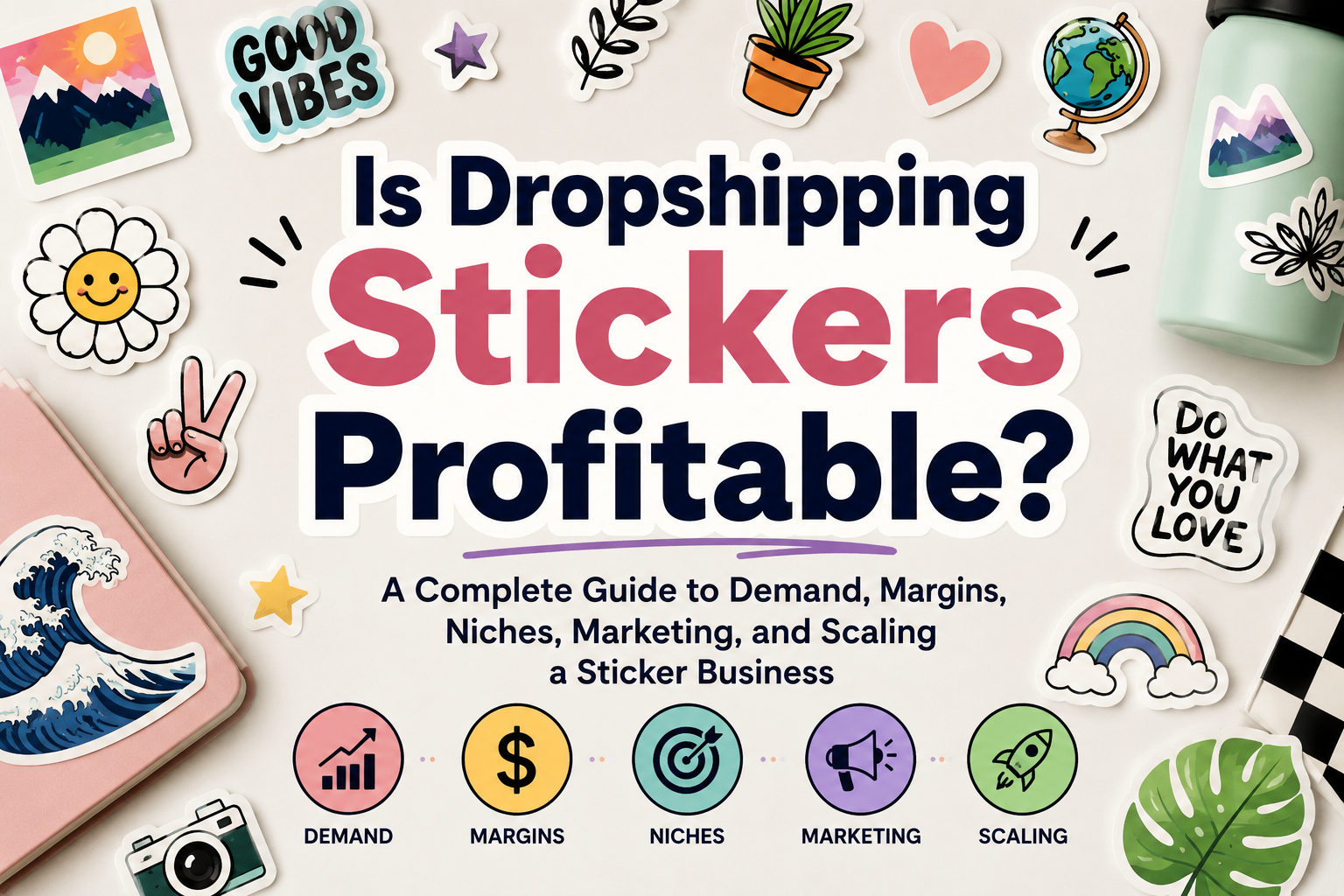
Is Dropshipping Stickers Profitable? Market Demand, Trends, and Why This Low-Cost Product Still Sells Online
When evaluating whether dropshipping stickers is profitable, the first layer is not cost or logistics—it is demand stability. Stickers belong to a rare category of ultra-low-ticket items that consistently survive across multiple e-commerce cycles. Unlike trend-heavy products that fade quickly, stickers are deeply tied to identity expression, digital culture, and personalization behavior. This makes them structurally different from typical impulse-buy products.
In 2026, the sticker market is not only alive but has evolved into a hybrid ecosystem spanning physical products, digital designs, and print-on-demand customization.
The Psychology Behind Sticker Consumption
The continued demand for stickers is strongly driven by behavioral economics rather than functional necessity. Stickers serve as identity signals—people use them to express hobbies, humor, subculture affiliation, and emotional states.
This is especially amplified among Gen Z and younger millennials, who prefer affordable personalization over expensive lifestyle purchases. A sticker that costs a few dollars can communicate the same identity signal as a much more expensive accessory. This “low-cost identity expression” effect is one of the strongest demand drivers in this niche.
Additionally, the rise of remote work and digital-native lifestyles has increased demand for personalization of laptops, water bottles, notebooks, and phone cases. Stickers naturally fit into these surfaces, reinforcing recurring consumption behavior.
Social Media as the Main Demand Engine
Unlike traditional retail categories, sticker demand is heavily influenced by social platforms rather than search-based intent alone.
Platforms like TikTok, Instagram, and Pinterest continuously generate micro-trends around aesthetic designs, niche humor, and fandom culture. A single viral sticker design can generate thousands of orders within days if it resonates with a specific online community.
What makes this important for dropshipping profitability is that demand is not evenly distributed—it is “spiky.” Instead of steady baseline sales, sellers often experience bursts of high-volume traffic driven by viral content cycles. This creates both opportunity and instability, depending on execution speed.
The Shift Toward Personalization Economy
A major macro trend supporting sticker dropshipping is the expansion of the personalization economy. Consumers increasingly prefer products that feel “custom made” rather than mass produced, even if they are not actually unique.
Print-on-demand systems and digital design marketplaces have made it easier than ever to produce highly specific sticker variations without holding inventory. This lowers entry barriers and increases the number of sellers competing in the same ecosystem.
However, this also means that product differentiation becomes less about manufacturing and more about design strategy, niche targeting, and brand storytelling.
Market Saturation vs Long Tail Opportunity
At first glance, the sticker market appears saturated due to low entry barriers. In reality, saturation exists only at the generic level—such as basic aesthetic or quote stickers.
The profitable segment lies in long-tail niches: highly specific interests such as subcultures, micro-humor communities, professional identities, and fandom-driven ecosystems. These micro-markets are fragmented but collectively large, and they are less price-sensitive compared to general designs.
This fragmentation is what keeps the market profitable despite competition.
Why Demand Remains Stable in 2026
Even with increasing competition, sticker demand remains structurally stable due to three key factors:
First, production cost remains extremely low, which keeps retail prices accessible even during economic downturns.
Second, consumption is repeat-driven. Buyers rarely purchase just one sticker; they often collect sets, themes, or seasonal variations.
Third, stickers are platform-agnostic products. They sell equally well on Etsy, Shopify, TikTok Shop, and even offline craft fairs, making demand less dependent on a single channel.
Realistic Profit Margin Breakdown, Costs, and Earnings Potential
When people ask whether dropshipping stickers is profitable, they often assume the answer is simple because stickers are cheap to produce and easy to ship. While that is partly true, profitability in this niche is not determined by product cost alone. It is shaped by a combination of pricing psychology, acquisition cost, platform fees, and conversion efficiency.
In reality, sticker dropshipping sits in a paradox: extremely high theoretical margins but highly variable real-world profits depending on marketing performance.
Product Cost vs Retail Price: The Illusion of High Margins
On the surface, stickers appear to offer strong margins. A single sticker might cost between $0.20 and $1.50 when produced via print-on-demand services or wholesale suppliers, while retail prices often range from $3 to $10 depending on design and niche positioning.
This creates a perceived margin of 70% to 90%, which is significantly higher than many physical product categories. However, this calculation ignores the most important variable: customer acquisition cost.
Without traffic, margin is irrelevant. And in sticker dropshipping, traffic is usually paid or content-driven, which introduces volatility.
The Real Cost Structure Behind Each Sale
To understand actual profitability, it is necessary to break down the full cost structure of a typical order.
First is the base product cost, which remains relatively low. Then comes shipping, which can vary depending on fulfillment location and delivery speed expectations. Print-on-demand suppliers often bundle shipping into pricing, but international shipping delays can indirectly increase refund rates and customer service costs.
The largest hidden cost is advertising or content production. If a seller uses paid ads, platforms like TikTok Ads or Meta Ads can consume anywhere from $1 to $5 per click depending on targeting competition. Given that sticker products are low-ticket, even a small increase in acquisition cost can erase profit quickly.
Marketplace fees also matter. Etsy, Shopify payment gateways, and other platforms typically take between 3% and 10% per transaction, reducing net margins further.
Typical Profit Scenarios in Sticker Dropshipping
Instead of fixed numbers, profitability should be viewed through operational scenarios.
In a low-performance scenario, where traffic is inconsistent and conversion rates are weak, profit per order can fall below $1 or even become negative after ads and refunds. This is common for beginners who rely heavily on paid traffic without strong creative assets.
In a moderate scenario, where organic content begins to generate consistent traffic through TikTok or Pinterest, profit per order may range between $2 and $5. At this stage, stickers become viable as a supplementary income stream but not yet scalable alone.
In a high-performance scenario, where a strong niche is identified and content consistently goes viral, margins can exceed $5 to $10 per order due to low acquisition costs and repeat buyers. However, this scenario is rare and heavily dependent on creative execution rather than product mechanics.
The Role of AOV (Average Order Value) in Profit Stability
One of the most important factors in determining whether sticker dropshipping becomes profitable is average order value. Since stickers are low-priced, single-item orders often struggle to absorb marketing costs.
Successful sellers typically increase AOV by bundling products, offering themed packs, or combining stickers with complementary items like digital downloads or stationery products. This approach significantly improves profitability without changing production costs.
Without increasing AOV, sticker businesses often remain fragile and highly dependent on low-cost traffic sources.
Why Many Sticker Stores Fail Despite High Margins
A common misconception is that high margins automatically translate into easy profit. In practice, many sticker stores fail because they underestimate the importance of demand consistency and content velocity.
The low barrier to entry means competition is extremely high. Thousands of similar designs compete for the same audience attention. As a result, conversion rates can drop quickly unless the brand has strong visual identity or niche positioning.
Additionally, because stickers are impulse purchases, demand is highly sensitive to trends. When a trend fades, sales often drop sharply unless new designs are continuously introduced.
Best Niches for Dropshipping Stickers in 2026: What Actually Sells and Why Some Designs Outperform Others
When analyzing whether dropshipping stickers is profitable, one of the most critical factors is not pricing or supplier choice, but niche selection. Stickers are not a “one-size-fits-all” product. Their demand is highly fragmented, emotionally driven, and closely tied to identity expression.
In practice, two stores selling identical sticker-quality products can have dramatically different outcomes simply because one targets a strong micro-niche while the other sells generic designs. This makes niche selection the real profit engine in this category.
Aesthetic and Lifestyle Stickers: The Visual Economy of Identity
One of the strongest performing segments is aesthetic-driven stickers. These designs are not necessarily tied to a specific hobby or fandom but instead focus on mood, color harmony, and lifestyle branding.
These stickers are often used on laptops, journals, and phone cases as visual extensions of personal taste. Their success is closely linked to platforms like Pinterest and Instagram, where visual coherence is highly valued.
However, competition in this niche is intense. The barrier to entry is low, meaning differentiation relies heavily on design consistency and branding rather than product uniqueness.
Fandom and Pop Culture Stickers: High Emotion, High Conversion
Fandom-based stickers, including anime, gaming, TV shows, and music references, consistently generate strong conversion rates. The reason is simple: emotional attachment drives purchasing behavior more than rational evaluation.
Consumers in this niche are not buying stickers as objects, but as symbols of belonging. This increases willingness to buy multiple items at once and improves repeat purchase rates.
However, this niche also carries higher operational risk due to intellectual property considerations and platform enforcement rules. Successful sellers often focus on original fan-inspired art rather than direct replication.
Meme and Humor Stickers: Viral-Driven Demand Cycles
Meme-based stickers represent one of the most volatile but potentially explosive niches. Their demand is heavily influenced by social media trends, especially TikTok and Reddit-driven humor cycles.
Unlike aesthetic or fandom stickers, meme stickers have a shorter lifecycle. A design may go viral for a few weeks and then lose relevance quickly. This creates a fast-moving product environment where agility matters more than catalog depth.
Sellers who succeed in this niche tend to operate like content creators rather than traditional e-commerce merchants, constantly testing new ideas and iterating based on engagement data.
Productivity and Planner Stickers: Functional Emotion Hybrid
Another strong niche is planner and productivity stickers. These are widely used in digital and physical journaling communities, especially among students, professionals, and productivity enthusiasts.
Unlike purely decorative stickers, this category blends function with emotion. Users rely on them for organization while also enjoying customization. This hybrid nature makes demand more stable and less trend-dependent compared to meme-based niches.
Additionally, this niche often supports bundling strategies, increasing average order value and improving profitability.
Micro-Niche Targeting: The Real Scaling Advantage
The most overlooked but most profitable approach in sticker dropshipping is micro-niche targeting. Instead of competing in broad categories like “cute stickers” or “aesthetic designs,” successful sellers focus on extremely specific identities or communities.
Examples include niche hobbies, professional roles, or even hyper-specific humor groups. These markets are smaller individually but collectively large, and they tend to have lower competition and higher conversion rates due to strong relevance.
The key advantage of micro-niches is reduced advertising waste. When targeting is precise, fewer impressions are needed to generate sales.
Why Broad Niches Fail Despite High Traffic Potential
Many beginners assume that broader niches are safer because they attract larger audiences. In practice, broad sticker categories suffer from weak conversion rates and high competition.
The problem is not traffic volume but intent mismatch. Users browsing general aesthetic content are less likely to purchase immediately compared to users who identify strongly with a specific subculture or interest group.
This is why broad niches often generate views but fail to produce consistent revenue.
Print-on-Demand vs Wholesale Stickers – Cost, Risk, and Profit Comparison
When evaluating whether dropshipping stickers is profitable, most beginners focus on design trends or marketing strategies. However, the underlying business model—Print-on-Demand (POD) versus wholesale inventory—has a far greater impact on long-term profitability.
Both models can generate income, but they operate under fundamentally different logic. One prioritizes flexibility and low risk, while the other prioritizes scale and unit cost efficiency. Choosing the wrong model for your stage of growth often leads to unstable margins or cash flow pressure.
Print-on-Demand: Low Risk, High Flexibility, Lower Scaling Ceiling
Print-on-Demand has become the default entry point for most sticker dropshipping businesses. The core advantage is simple: no inventory is required. Products are created only after a customer places an order, which eliminates upfront investment risk.
This structure makes POD ideal for testing multiple designs quickly. Sellers can launch dozens or even hundreds of sticker concepts without worrying about unsold stock. It also allows rapid adaptation to trends, which is crucial in a fast-moving niche like stickers.
However, this flexibility comes with trade-offs. The per-unit production cost in POD is significantly higher than wholesale manufacturing. This reduces gross margins and limits profitability at scale. Additionally, fulfillment times are often longer, especially when suppliers are located internationally, which can negatively affect customer satisfaction and conversion rates.
In short, POD is optimized for experimentation, not efficiency.
Wholesale Stickers: Lower Cost, Higher Risk, Stronger Scalability
Wholesale sourcing operates on the opposite principle. Instead of producing items after purchase, sellers buy inventory in bulk at a lower per-unit cost and store or pre-arrange fulfillment.
This model significantly improves margins. Unit costs can drop dramatically when ordering at scale, allowing sellers to retain more profit per order compared to POD. It also enables faster shipping, which improves customer experience and conversion rates.
However, wholesale introduces inventory risk. Unsold stock becomes a financial burden, especially if designs fail to perform or trends shift unexpectedly. This makes wholesale more suitable for sellers who already understand demand patterns and have validated product-market fit.
In addition, wholesale requires stronger operational management, including storage, logistics coordination, and demand forecasting.
Profitability Comparison: Margin vs Stability Trade-Off
The key difference between POD and wholesale is not simply cost, but the relationship between risk and scalability.
Print-on-Demand typically offers lower but safer margins. Sellers may earn modest profit per order, but financial exposure remains minimal. This makes it suitable for beginners or content-driven businesses that rely on testing and iteration.
Wholesale, on the other hand, offers higher potential profit per unit, but only when demand is predictable. If products sell consistently, wholesale dramatically outperforms POD in terms of profitability. However, if demand is misjudged, losses can accumulate quickly due to unsold inventory.
This creates a clear structural trade-off: POD prioritizes agility, while wholesale prioritizes efficiency.
Impact on Branding and Customer Experience
Beyond cost structure, the chosen model also affects branding potential.
Print-on-Demand stores often struggle with consistency in packaging and delivery speed, which can limit their ability to build a premium brand experience. However, they excel in creative diversity, allowing sellers to test niche aesthetics and rapidly evolve product lines.
Wholesale models, by contrast, enable stronger brand control. Sellers can design custom packaging, ensure consistent product quality, and create a more unified customer experience. This is critical for businesses aiming to move beyond transactional sales and build long-term customer loyalty.
Hybrid Strategy: The Most Practical Approach for Scaling
In practice, many successful sticker businesses do not rely exclusively on one model. Instead, they adopt a hybrid approach.
They begin with Print-on-Demand to validate demand and identify winning designs. Once a design demonstrates consistent sales, it is transitioned into a wholesale model to improve margins and scale profitably.
This approach reduces early-stage risk while still enabling long-term efficiency. It also allows businesses to avoid overcommitting inventory to unproven designs.
Proven Marketing Strategies to Sell Stickers Online Using TikTok, Pinterest, and Etsy SEO
When analyzing whether dropshipping stickers is profitable, product cost and niche selection are only part of the equation. In reality, marketing execution is the primary factor that determines success or failure.
Stickers are a low-ticket, impulse-driven product. This means customers rarely search for them with strong purchase intent. Instead, demand is often created through visual exposure, emotional triggers, and social influence. Without effective marketing, even the best designs remain invisible.
In 2026, sticker sales are less about traditional e-commerce funnels and more about content-driven discovery systems.
TikTok: The Fastest Demand Generator for Sticker Sales
TikTok has become one of the most powerful platforms for sticker dropshipping because it prioritizes short-form visual storytelling over follower count.
The key advantage is that TikTok does not require an established audience. A single viral video showcasing sticker aesthetics, packaging satisfaction, or “before and after” customization can generate thousands of impressions in a short time.
Successful sticker sellers on TikTok do not focus on product descriptions. Instead, they emphasize visual satisfaction and emotional resonance. Content often includes journaling setups, laptop transformations, or aesthetic desk organization.
However, TikTok traffic is highly volatile. Virality can spike quickly but also disappear without consistent content production. This makes TikTok more suitable as a top-of-funnel demand engine rather than a stable revenue source.
Pinterest: The Long-Term Evergreen Traffic Channel
Unlike TikTok, Pinterest functions more like a visual search engine. Users actively browse for inspiration, aesthetics, and lifestyle ideas, which makes it highly aligned with sticker products.
Pinterest traffic is slower to build but significantly more stable over time. Well-optimized pins can continue generating traffic for months or even years after publication.
The platform is especially effective for aesthetic, planner, and journaling sticker niches. These categories align naturally with Pinterest’s user behavior, which focuses on organization, design inspiration, and creative planning.
From a profitability perspective, Pinterest reduces dependency on paid ads, improving long-term margins and business stability.
Etsy SEO: High Intent Buyers with Built-In Trust
Etsy remains one of the strongest marketplaces for sticker dropshipping because it combines search intent with consumer trust.
Unlike social platforms, Etsy users are actively looking to purchase. This means conversion rates are typically higher compared to TikTok or Instagram traffic.
The key to success on Etsy lies in SEO optimization. Product titles, tags, and descriptions must align with how users search for stickers, including niche-specific keywords and long-tail phrases.
However, competition on Etsy is intense. Many sellers offer similar designs, which makes differentiation through branding, packaging, and niche targeting essential.
Instagram: Branding and Visual Identity Building
Instagram plays a different role in sticker marketing. It is less about direct conversions and more about brand perception.
A strong Instagram presence helps establish visual identity and credibility. This is particularly important for sticker businesses that want to move beyond transactional sales and build long-term customer loyalty.
Content on Instagram often overlaps with TikTok but is more curated and brand-focused. Consistent aesthetic presentation can increase perceived value, allowing sellers to charge higher prices and improve margins.
However, Instagram alone rarely generates high sales volume without support from other traffic channels.
The Importance of Content Velocity and Testing
One of the most overlooked aspects of sticker marketing is content velocity—the speed at which new creative ideas are tested and deployed.
Because sticker demand is trend-sensitive, success depends on continuous experimentation. Sellers who produce multiple variations of content and designs are more likely to identify winning combinations.
This is not a “set and forget” business model. Instead, it behaves more like a feedback loop where content performance directly informs product decisions.
Multi-Channel Strategy: Why Single-Platform Dependence Fails
Relying on a single platform is one of the most common reasons sticker stores fail. TikTok alone is too volatile, Pinterest alone is too slow, and Etsy alone is too competitive without external traffic.
The most sustainable approach combines all three:
TikTok generates rapid exposure and trend validation. Pinterest builds long-term organic traffic. Etsy captures high-intent buyers ready to purchase.
When integrated properly, these channels create a balanced system that reduces risk while increasing overall conversion stability.
Branding and Scaling Strategies to Turn a Sticker Store Into a Real E-Commerce Brand
When evaluating whether dropshipping stickers is profitable, most beginners focus on short-term sales. However, the real ceiling of this business is not in selling individual stickers—it is in whether you can transform a commodity product into a recognizable brand.
At the entry level, sticker dropshipping is highly transactional. Customers buy based on design appeal or trend relevance. But at the scaling stage, profitability is no longer driven by single purchases. It is driven by repeat buyers, brand loyalty, and perceived identity value.
The difference between a small store and a scalable business lies in this transition from “selling stickers” to “owning a creative identity ecosystem.”
Why Most Sticker Stores Fail to Scale Beyond Initial Sales
A large number of sticker dropshipping stores never grow beyond their first wave of traffic. The main reason is not lack of demand, but lack of brand differentiation.
In a saturated visual marketplace, similar designs appear everywhere. Without a strong brand identity, customers treat stickers as interchangeable products and choose purely based on price or convenience.
Another limitation is dependence on trend cycles. Stores that rely only on viral designs experience unstable revenue. Once trends fade, sales decline sharply unless a stronger brand structure is in place to retain customers.
Scaling requires shifting from reactive trend-chasing to proactive brand building.
Building a Brand Identity Around Emotional Positioning
Successful sticker brands do not compete on design alone. They compete on emotional positioning.
Instead of asking “what sticker should I sell,” scalable businesses ask “what identity do I represent?” This could be humor-driven expression, aesthetic lifestyle branding, niche cultural communities, or productivity-focused organization tools.
Once this identity is defined, every design becomes part of a larger narrative. Customers are no longer buying random stickers—they are aligning with a visual identity they recognize and trust.
This emotional alignment is what drives repeat purchases and higher lifetime value.
Increasing Customer Lifetime Value Through Product Ecosystems
One of the most effective scaling strategies in sticker dropshipping is expanding beyond single-product sales into product ecosystems.
This can include sticker bundles, themed collections, seasonal drops, and complementary digital products such as wallpapers or printable planners. The goal is to increase average order value while also encouraging repeat engagement.
When customers begin collecting products instead of purchasing one-off items, the business shifts from transactional to relational commerce.
This significantly improves profitability because acquisition costs are amortized over multiple purchases.
The Role of Customization and Personalization at Scale
Personalization is one of the strongest growth levers in the sticker market. As production tools become more flexible, customers increasingly expect products that feel tailored to their identity.
Advanced sticker businesses leverage customization options such as name-based designs, color variations, or niche-specific modifications. Even small degrees of personalization can significantly increase conversion rates.
However, scalability requires balancing customization with operational efficiency. Too much manual work can slow down fulfillment and limit growth potential. Successful brands automate personalization through templates and print-on-demand systems.
Building Repeat Buyers Instead of Constantly Buying Traffic
One of the biggest mistakes in sticker dropshipping is over-reliance on paid traffic or viral content. While these channels are important, they do not create long-term stability.
Scalable sticker brands prioritize repeat buyers. This is achieved through email marketing, community building, and consistent product releases that keep customers engaged over time.
Unlike high-ticket industries, sticker businesses rely heavily on frequency rather than order value. This means profitability improves significantly when even a small percentage of customers return multiple times.
Transitioning From Dropshipping to a Brand-Owned Supply Model
At the early stage, most sticker businesses rely on dropshipping or print-on-demand suppliers. However, scaling often requires transitioning toward more controlled production models.
This does not necessarily mean full manufacturing ownership, but rather optimizing supply chains for better margins, faster shipping, and higher consistency.
As order volume increases, businesses often move toward hybrid fulfillment models that combine POD flexibility with wholesale efficiency. This transition is critical for improving profit margins and maintaining brand quality at scale.




No Comments