


Amazon vs Shopify Dropshipping: Which One Is Better for Building a Profitable Ecommerce Business?

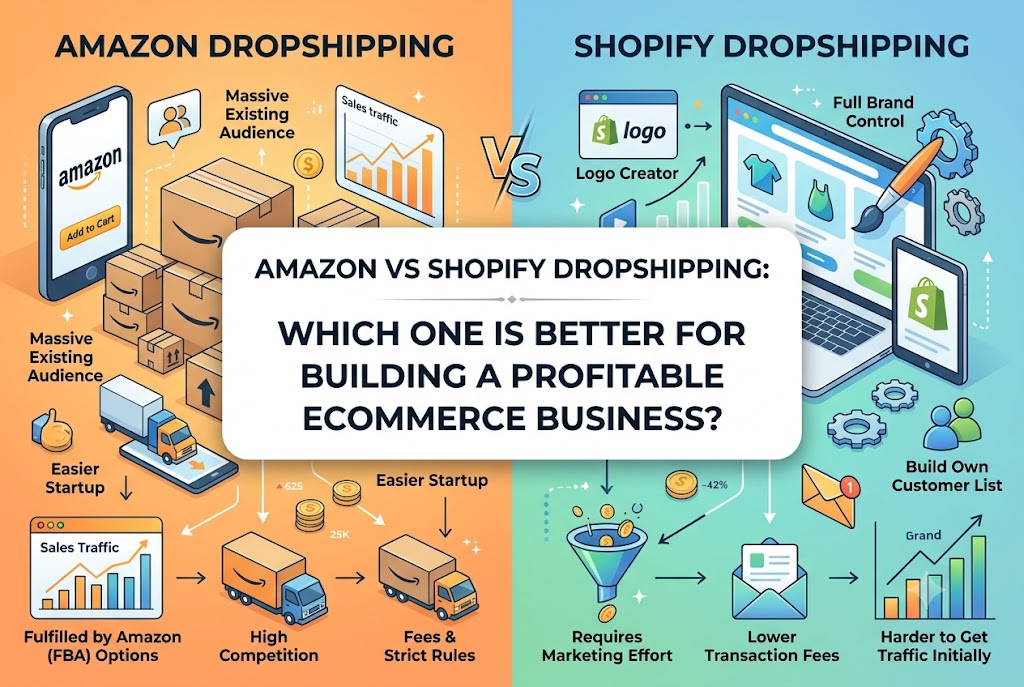
The comparison between Amazon vs Shopify Dropshipping profitability is not simply about which platform makes more money. Amazon provides convenience, marketplace traffic, and faster validation, but sellers sacrifice control and often face lower margins.
Shopify requires more work upfront, especially in marketing and branding, but it gives entrepreneurs more freedom to increase profit margins and build long-term business value.
For short-term sales opportunities, Amazon can be an effective channel. For sustainable ecommerce growth, Shopify dropshipping generally offers greater flexibility and stronger profit potential when combined with effective marketing, reliable suppliers, and a clear brand strategy.
Which Platform Offers Higher Margins and Better Long-Term Income Potential?
When entrepreneurs compare Amazon vs Shopify Dropshipping profitability, the biggest question is not simply which platform generates more sales, but which platform allows sellers to keep more profit and build a sustainable business. Both Amazon and Shopify provide opportunities to sell products without holding large amounts of inventory, but their business models create very different profit structures.
Amazon operates as a marketplace where millions of customers are already searching for products. This built-in demand can make it easier for sellers to generate initial sales. However, sellers must compete with thousands of similar products, pay marketplace fees, and often rely heavily on Amazon advertising to maintain visibility.
Shopify, on the other hand, provides sellers with their own independent online store. While Shopify does not provide automatic traffic, it gives businesses more control over pricing, customer relationships, branding, and long-term growth. The profitability of Shopify dropshipping depends more on marketing ability and the ability to acquire customers efficiently.
Profit Margins: Shopify Dropshipping Usually Has More Flexibility
One of the biggest advantages of Shopify dropshipping is the ability to control pricing and profit margins. Since sellers operate their own websites, they can create unique product offers, bundle products together, and use branding strategies to increase perceived value.
For example, a Shopify store selling a customized lifestyle product may purchase an item from a supplier for $10 and sell it for $35 or $40 by improving the product presentation, creating professional content, and targeting a specific audience. The higher selling price creates more room to cover advertising costs while maintaining profitability.
Amazon sellers often face stronger price competition because customers can compare multiple sellers instantly. Even if a seller finds a profitable product, competitors may lower their prices, reducing margins. In addition, Amazon referral fees, fulfillment fees, and advertising expenses can significantly reduce the final profit per order.
Although Amazon can generate higher sales volume, Shopify often provides better opportunities for maintaining healthy profit margins when the store is managed effectively.
Amazon Provides Faster Sales but Higher Operating Costs
One reason many beginners choose Amazon is the existing customer base. Millions of shoppers visit Amazon every day, meaning sellers do not need to build traffic from zero. This advantage can shorten the time needed to test products and validate market demand.
However, the convenience of Amazon traffic comes with costs. Sellers typically need to pay referral fees on each transaction, invest in sponsored product advertising, and follow strict marketplace rules. If a product category becomes competitive, advertising costs can increase quickly and reduce profitability.
Another challenge is customer ownership. Amazon controls the customer relationship, meaning sellers have limited access to customer data and fewer opportunities to create repeat purchases outside the platform. This makes it harder to build a recognizable brand and increase customer lifetime value.
From a profitability perspective, Amazon can be effective for sellers who understand product research, competition analysis, and marketplace optimization. However, the platform environment often requires continuous investment to maintain rankings and sales.
Shopify Requires More Marketing Skills but Creates Greater Growth Potential
The biggest challenge of Shopify dropshipping is customer acquisition. Unlike Amazon, Shopify does not provide a ready-made audience. Store owners must attract visitors through channels such as Google Ads, Facebook Ads, TikTok marketing, influencer partnerships, SEO content, and email marketing.
This means Shopify dropshipping usually requires more skills in digital marketing and brand development. New sellers may spend money testing different advertisements before finding profitable campaigns.
However, successful Shopify stores can achieve stronger long-term profitability because they control the entire customer journey. Sellers can collect email subscribers, encourage repeat purchases, introduce new products, and create a loyal customer community.
A Shopify store is not only a sales channel but also a business asset. A well-established ecommerce brand with organic traffic, customer data, and strong branding can become significantly more valuable over time.
Which Platform Has Better Long-Term Profit Potential?
When analyzing Amazon vs Shopify Dropshipping profitability, there is no universal winner because the two platforms serve different business goals.
Amazon is often better suited for sellers who want faster access to existing customers and are comfortable competing within a marketplace environment. It can be profitable for product-focused businesses that understand Amazon SEO, pricing strategies, and advertising optimization.
Shopify is usually more attractive for entrepreneurs who want to build a long-term ecommerce brand. Although it requires more effort in marketing and customer acquisition, it offers greater control over margins, customer relationships, and business growth.
For beginners looking for quick product testing, Amazon may appear easier because traffic already exists. For entrepreneurs focused on creating a scalable ecommerce company, Shopify often provides stronger profitability potential because the seller owns the brand and customer relationship.
Amazon vs Shopify Dropshipping Startup Costs: How Much Money Do You Need to Start a Profitable Ecommerce Business?
When comparing Amazon vs Shopify Dropshipping startup costs, many beginners assume dropshipping requires almost no money because sellers do not need to purchase inventory in advance. While it is true that dropshipping reduces traditional retail costs, building a successful business still requires investment in platforms, marketing, tools, product testing, and customer acquisition.
Amazon and Shopify have completely different cost structures. Amazon provides access to an existing marketplace but charges transaction-related fees and requires sellers to compete within a crowded environment. Shopify gives entrepreneurs more control over their online stores but requires additional investment in marketing because traffic does not come automatically.
Amazon Dropshipping Startup Costs: Lower Marketing Requirements but Higher Platform Fees
Amazon is attractive to beginners because the platform already has millions of active shoppers. Sellers do not need to immediately spend large amounts of money creating advertising campaigns or building brand awareness. However, this convenience comes with other expenses.
The first cost is an Amazon seller account. Depending on the selling plan, sellers may need to pay a monthly subscription fee or transaction-based fees. In addition, Amazon charges referral fees for each product sold, which reduces the profit available from every order.
Product research is another important expense. Although dropshipping allows sellers to avoid holding inventory, finding profitable products often requires specialized research tools. These tools help analyze demand, competition levels, sales trends, and keyword performance. Without accurate product research, sellers may choose products with high competition and limited profit margins.
Advertising is also a major cost factor on Amazon. While organic rankings are possible, many sellers use Amazon Sponsored Products to increase visibility, especially when launching new products. In competitive categories, advertising expenses can become significant because multiple sellers are bidding for the same customer searches.
Overall, Amazon may require less spending on external marketing, but sellers must consider marketplace fees, advertising costs, and competition-related expenses when calculating startup investment.
Shopify Dropshipping Startup Costs: More Control but Higher Marketing Investment
Compared with Amazon, Shopify has a different cost structure. Entrepreneurs need to create and operate their own online store, which means they have more control but also more responsibilities.
The basic expenses usually include a Shopify subscription, domain registration, website design, payment processing fees, and essential ecommerce applications. Many dropshipping stores also invest in tools for product sourcing, email marketing, customer support, analytics, and conversion optimization.
However, the largest startup expense for Shopify dropshipping is usually customer acquisition. Since Shopify does not provide built-in marketplace traffic, store owners must invest in marketing channels such as Meta Ads, Google Ads, TikTok Ads, influencer marketing, or SEO content.
Testing advertising campaigns is often necessary before discovering profitable audiences and products. A new Shopify store may need a marketing budget to test different creatives, landing pages, and targeting strategies. While this increases initial costs, successful campaigns can become scalable growth channels.
Unlike Amazon, Shopify expenses are not mainly platform-related. The investment is focused on building a marketing system that can generate customers consistently.
Comparing Product Testing Costs Between Amazon and Shopify
Product testing is one of the most important parts of dropshipping because not every product becomes profitable. The cost of testing products can vary significantly between Amazon and Shopify.
Amazon sellers often test products by analyzing marketplace demand, competition, reviews, and sales rankings before launching. However, gaining visibility may require advertising spending because new listings usually have limited organic exposure.
Shopify sellers usually test products through paid traffic campaigns. They may launch multiple advertising campaigns with different audiences and creatives to identify products with strong conversion potential.
The difference is that Amazon testing focuses more on marketplace competition, while Shopify testing focuses more on marketing performance. Both approaches require investment, but the type of investment is different.
Which Platform Requires Less Money to Start?
For beginners with a limited budget, Amazon may appear easier because sellers can benefit from existing customer traffic. A small budget can sometimes be enough to test product demand without building a complete marketing system.
However, Shopify can also be started with relatively low costs if entrepreneurs use free themes, affordable tools, organic marketing strategies, and carefully controlled advertising budgets. The advantage is that every investment contributes toward building an independent brand rather than strengthening a marketplace controlled by another company.
The cheapest way to start does not always create the best business opportunity. A lower initial cost may come with limited control, while a higher investment may create stronger long-term growth potential.
Long-Term Cost Efficiency: Building an Asset vs Renting a Platform
When evaluating Amazon vs Shopify Dropshipping startup costs, entrepreneurs should consider not only the money needed to launch but also the value created over time.
Amazon provides access to customers but sellers are operating inside Amazon’s ecosystem. Changes in competition, advertising costs, or marketplace policies can directly affect profitability.
Shopify requires more upfront investment in marketing and store development, but sellers build their own customer database, brand identity, and sales channels. Over time, these assets can reduce dependence on paid advertising and improve profitability.
A successful Shopify store can generate value through repeat customers, email lists, organic search rankings, and brand recognition. These advantages can significantly improve cost efficiency as the business grows.
Amazon vs Shopify Dropshipping Traffic: Which Platform Makes It Easier to Find Customers and Scale Sales?
When analyzing Amazon vs Shopify Dropshipping traffic, the biggest difference is where customers come from. Traffic is one of the most important factors determining dropshipping success because even a profitable product cannot generate sales without consistent visitors.
Amazon and Shopify represent two completely different ecommerce models. Amazon is a marketplace with millions of active shoppers who already have buying intent. Customers visit Amazon specifically to search for products, compare options, and complete purchases. Shopify, however, is an independent ecommerce platform where sellers must create their own traffic sources through marketing, search engines, social media, and customer engagement.
The choice between Amazon and Shopify is not simply about which platform receives more visitors. It is about whether sellers want to rely on existing marketplace traffic or build their own customer acquisition system.
Amazon Traffic: High Purchase Intent but Limited Control
One of Amazon’s biggest advantages is its existing customer base. Millions of users visit Amazon every day with the intention of buying products. This means sellers do not need to spend as much time educating customers or creating initial demand.
Amazon traffic is mainly driven by product searches. When customers search for keywords such as “wireless earbuds,” “pet accessories,” or “kitchen gadgets,” Amazon’s algorithm displays relevant products based on factors such as sales history, reviews, pricing, and listing quality.
This search-driven traffic has a major advantage: customers already understand what they want. Compared with traditional advertising, where businesses interrupt users while they are browsing content, Amazon sellers benefit from customers actively looking for products.
However, Amazon traffic also has limitations. Sellers do not own the customer relationship, and competition for visibility can be extremely intense. A product may appear on the first page today but lose rankings if competitors increase sales, improve reviews, or spend more on advertising.
Many Amazon sellers rely on sponsored ads to maintain visibility, especially when launching new products. This creates an ongoing dependency on Amazon’s ranking system and advertising costs.
Shopify Traffic: More Challenges but Greater Marketing Freedom
Unlike Amazon, Shopify does not provide built-in shopping traffic. A new Shopify store starts with almost no visitors unless the owner actively promotes the business.
This means Shopify dropshipping requires a stronger focus on customer acquisition. Sellers typically use multiple channels, including Facebook Ads, Google Ads, TikTok marketing, influencer partnerships, content marketing, email campaigns, and search engine optimization.
At first, generating Shopify traffic can be more difficult because sellers must identify the right audience, create effective advertisements, and optimize their websites for conversions. Unlike Amazon shoppers who are already searching for products, Shopify visitors often need to be convinced through strong product pages, compelling content, reviews, and brand trust.
However, Shopify provides something Amazon cannot offer: complete control over traffic sources. Sellers can build relationships with customers through email lists, social media communities, and remarketing campaigns.
Over time, successful Shopify stores can reduce their dependence on paid advertising by developing organic traffic from Google searches, social media followers, and repeat customers.
Organic Traffic Potential: Shopify Has a Stronger Long-Term Advantage
When comparing Amazon vs Shopify Dropshipping traffic, organic growth is one of the most important differences.
Amazon sellers can optimize product listings for Amazon SEO, but their visibility remains limited to Amazon’s ecosystem. They cannot fully control search rankings or customer data.
Shopify stores have much broader SEO opportunities. Store owners can create blog content, optimize product pages, build backlinks, and rank for informational and commercial keywords on Google. This allows businesses to attract potential customers before they are ready to purchase.
For example, a Shopify store selling outdoor products can publish articles about camping equipment guides, hiking tips, and product comparisons. These pages can attract organic visitors from Google and eventually convert them into customers.
This content-driven approach requires patience, but it creates long-term traffic assets that continue generating value.
Paid Advertising: Amazon Ads vs Shopify Ads
Both platforms require advertising investment, but the advertising strategy is different.
Amazon advertising focuses mainly on capturing existing demand. Sellers bid on keywords where customers are already searching for products. The advantage is higher purchase intent, but competition can increase advertising costs.
Shopify advertising focuses on creating demand and finding potential customers. Platforms such as Facebook and TikTok allow sellers to target audiences based on interests, behaviors, demographics, and online activities.
The challenge is that Shopify ads require more testing. Sellers need to experiment with different creatives, audiences, and offers before discovering profitable campaigns. However, successful Shopify advertising systems can be scaled across multiple channels and products.
Which Platform Makes It Easier to Get Customers?
For beginners who want immediate access to shoppers, Amazon usually has an advantage because customers are already there. A well-optimized product listing can generate sales faster than a completely new Shopify website.
However, Shopify offers more opportunities for businesses that want to build sustainable customer acquisition systems. Although attracting the first customers is harder, sellers can create multiple traffic channels and reduce dependency on a single platform.
Amazon is mainly a marketplace where sellers compete for existing demand. Shopify is a business platform where entrepreneurs create and control their own demand.
Amazon vs Shopify Dropshipping for Building a Brand: Which Platform Is Better for Long-Term Ecommerce Growth?
When comparing Amazon vs Shopify Dropshipping for building a brand, the key difference is ownership and control. Both platforms allow entrepreneurs to sell products online, but they create very different opportunities for developing a recognizable business.
Amazon is primarily a marketplace where customers come to search for products, compare prices, and complete purchases. Sellers can achieve significant sales volume, but the relationship between the customer and the platform remains largely controlled by Amazon.
Shopify works differently. It allows entrepreneurs to create their own online stores, control the customer experience, collect customer data, and develop a unique brand identity. Instead of competing only on individual products, Shopify sellers have the opportunity to build a long-term ecommerce business.
Amazon: Strong Sales Potential but Limited Brand Ownership
Amazon provides one of the largest ecommerce marketplaces in the world. This gives sellers access to millions of customers and allows some businesses to grow quickly without investing heavily in website development or customer acquisition.
However, building a brand on Amazon can be challenging because customers often focus more on the product than the company behind it. Many shoppers search for keywords rather than specific brands, meaning they may choose products based on price, reviews, ratings, and delivery speed.
Even successful Amazon sellers face limitations when trying to create deeper customer relationships. Amazon controls important parts of the customer experience, including checkout, communication policies, and purchasing data. Sellers generally have limited opportunities to collect customer information or build direct marketing channels.
Another challenge is competition. If a product becomes successful, competitors can quickly enter the same category with similar products. Without strong differentiation, sellers may find themselves competing mainly through pricing, advertising budgets, and review quantity.
Amazon can help businesses validate products and generate revenue, but transforming a marketplace listing into a powerful independent brand is more difficult.
Shopify: A Better Foundation for Creating a Unique Brand Identity
Shopify provides entrepreneurs with complete control over their ecommerce environment. Sellers can customize website design, create unique product presentations, develop brand stories, and build direct relationships with customers.
A Shopify store allows businesses to communicate their values beyond the product itself. Through professional website design, high-quality content, email marketing, social media engagement, and customer communities, sellers can create emotional connections with buyers.
For example, two companies may sell similar fitness accessories. An Amazon seller may compete through product rankings, reviews, and pricing. A Shopify brand can differentiate itself through a specific lifestyle message, educational content, influencer partnerships, and a strong customer experience.
This difference is especially important in competitive markets where products can easily be copied. A strong brand creates customer loyalty that is difficult for competitors to replace.
Customer Ownership: The Biggest Advantage of Shopify Branding
One of the most important factors in Amazon vs Shopify Dropshipping brand building is customer ownership.
On Amazon, the platform owns the marketplace relationship. Sellers receive orders, but they have limited access to customer information and fewer opportunities to communicate with buyers after the purchase.
Shopify allows businesses to build customer databases through email subscriptions, loyalty programs, remarketing campaigns, and customer accounts. This information becomes a valuable business asset because it enables sellers to increase repeat purchases and improve customer lifetime value.
A customer who purchases from a Shopify store can become a long-term buyer through product recommendations, newsletters, exclusive offers, and personalized marketing. This creates opportunities that are much harder to achieve on Amazon.
Over time, customer relationships can become one of the most valuable assets of an ecommerce business.
Scaling a Business: Marketplace Growth vs Brand Growth
Amazon and Shopify offer different paths to scaling.
Amazon scaling is often based on increasing product sales, improving rankings, expanding product listings, and optimizing advertising campaigns. Growth can be rapid, but sellers remain dependent on Amazon’s marketplace rules and algorithms.
Shopify scaling focuses on building marketing systems. Successful stores can expand through SEO, paid advertising, social media, influencer partnerships, partnerships, and international markets. The business is not limited to one marketplace because traffic can come from multiple sources.
A Shopify brand can also expand beyond dropshipping into private labeling, customized products, subscription models, or wholesale opportunities. This creates more possibilities for long-term business development.
Which Platform Is Better for Building a Long-Term Ecommerce Brand?
The answer depends on the entrepreneur’s goals.
Amazon is suitable for sellers who prioritize faster market access, product testing, and marketplace sales. It can be an effective channel for generating revenue, especially for businesses that understand Amazon optimization.
Shopify is generally better suited for entrepreneurs who want to build a recognizable brand. Although it requires more effort in marketing and customer acquisition, it provides greater control over the customer experience and business direction.
Many successful ecommerce companies eventually use both platforms. Shopify can serve as the main brand website, while Amazon can become an additional sales channel to reach more customers.
Amazon vs Shopify Dropshipping Risks: Platform Restrictions, Account Suspension, Competition, and Business Challenges
When comparing Amazon vs Shopify Dropshipping risks, many beginners focus mainly on potential profits and market opportunities but underestimate the challenges involved in operating each platform. While dropshipping reduces inventory risks and upfront investment compared with traditional ecommerce, it does not eliminate business risks.
Amazon and Shopify have different risk structures because they represent two completely different business models. Amazon is a marketplace controlled by strict platform policies, where sellers depend heavily on Amazon’s rules, algorithms, and customer ecosystem. Shopify provides more independence, but sellers take responsibility for traffic generation, website management, payments, and customer acquisition.
Amazon Dropshipping Risks: Platform Dependency and Policy Restrictions
One of the biggest challenges of Amazon dropshipping is platform dependency. Sellers operate inside Amazon’s ecosystem, which means their business performance can be directly affected by changes in marketplace policies, ranking algorithms, and account requirements.
Amazon has strict rules regarding product quality, shipping performance, customer service, and seller behavior. If sellers fail to meet performance standards, their accounts may face warnings, restrictions, or suspension. For businesses that rely heavily on Amazon sales, account issues can immediately impact revenue.
Another major risk is competition. Because Amazon attracts millions of sellers, profitable products often attract competitors quickly. When multiple sellers offer similar products, price competition becomes intense, and profit margins may decline.
Unlike independent ecommerce stores, Amazon sellers have limited ability to differentiate themselves. Even if a seller creates a successful product listing, competitors may enter the same market and compete through lower prices, better reviews, or increased advertising spending.
Amazon Advertising and Ranking Risks
Many Amazon sellers depend on advertising to gain visibility, especially when launching new products. However, advertising costs can increase as competition grows.
Amazon’s search algorithm rewards products with strong sales history, positive reviews, competitive pricing, and high conversion rates. New sellers often need to invest heavily in advertising to generate initial sales and improve rankings.
The risk is that advertising expenses may become a permanent requirement. If sellers reduce advertising budgets, product visibility may decline and sales can decrease.
This creates a situation where sellers may generate revenue but struggle to maintain healthy profit margins after considering advertising costs, platform fees, and operational expenses.
Shopify Dropshipping Risks: Traffic Dependency and Marketing Challenges
Unlike Amazon, Shopify does not provide a built-in customer base. The biggest challenge for Shopify dropshipping is generating consistent traffic.
A Shopify store can have excellent products and professional design, but without visitors, it cannot generate sales. Sellers must develop marketing skills or invest in advertising channels such as Meta Ads, Google Ads, TikTok Ads, influencer marketing, and SEO.
Paid advertising creates another risk: customer acquisition costs can change quickly. An advertising campaign that is profitable today may become less effective when competition increases, audience behavior changes, or platform algorithms are updated.
New Shopify sellers often underestimate the cost and time required to test advertisements, optimize conversion rates, and identify profitable customer segments.
Website Management and Operational Risks
Another difference in Amazon vs Shopify Dropshipping risks is operational responsibility.
Amazon handles many aspects of the customer shopping experience, including marketplace infrastructure, checkout systems, and basic trust factors. Shopify store owners must manage these areas themselves.
A Shopify seller is responsible for website performance, payment processing, customer support, store security, conversion optimization, and compliance with ecommerce regulations.
Technical issues such as slow website speed, poor user experience, payment failures, or unclear return policies can directly reduce conversion rates and damage customer trust.
However, this responsibility also provides greater control. Sellers who build strong operational systems can create a better customer experience than many marketplace competitors.
Customer Trust and Brand Reputation Risks
Trust is another important factor when comparing Amazon and Shopify dropshipping.
Amazon benefits from strong customer trust because shoppers are familiar with the platform, payment process, and delivery expectations. New sellers can benefit from this existing reputation.
Shopify stores must build trust independently. Customers may hesitate to purchase from a new website without reviews, brand recognition, professional design, or clear policies.
This means Shopify sellers need to invest more effort into building credibility through customer testimonials, transparent communication, quality content, secure payment systems, and reliable fulfillment.
A poor customer experience can damage a Shopify brand quickly because reputation depends entirely on the business owner.
Which Platform Has Lower Business Risk?
There is no platform without risk. The better choice depends on the entrepreneur’s experience, resources, and business goals.
Amazon may be easier for beginners because customers already exist on the platform, but sellers face greater dependency risks. Policy changes, account suspension, and increasing competition can significantly affect business stability.
Shopify requires more effort because sellers must create their own traffic and establish customer trust. However, it provides more control and reduces dependence on a single marketplace.
For entrepreneurs who prefer a structured marketplace environment, Amazon can be a practical option. For those who want to build an independent ecommerce business, Shopify offers more flexibility and long-term control.
Amazon vs Shopify Dropshipping for Beginners: Which Platform Is Better to Start Your First Ecommerce Business?
When beginners research Amazon vs Shopify Dropshipping, the most common question is which platform provides the easiest path to starting a successful ecommerce business. Both Amazon and Shopify allow entrepreneurs to sell products without managing large amounts of inventory, but the learning process, required skills, and growth strategies are very different.
For new sellers, choosing the right platform is not only about how quickly they can make their first sale. It is also about understanding which platform matches their budget, experience level, business goals, and willingness to learn different ecommerce skills.
Amazon provides a marketplace where customers already exist, making it easier for beginners to access buyers. Shopify provides more independence but requires sellers to learn marketing, branding, and customer acquisition. The better choice depends on whether a beginner wants faster product testing or wants to build a long-term ecommerce business.
Amazon Dropshipping for Beginners: Easier Customer Access but More Competition
One of the biggest advantages of Amazon for beginners is the existing customer traffic. New sellers do not need to spend months building an audience before receiving potential customers. Millions of shoppers already use Amazon every day, searching for products they want to purchase.
This makes Amazon attractive for beginners who are unfamiliar with digital marketing. Instead of learning how to create advertising campaigns or build website traffic, sellers can focus more on product selection, listing optimization, pricing strategy, and customer service.
However, Amazon also introduces challenges that beginners need to understand. The marketplace is highly competitive, and many categories contain thousands of sellers offering similar products.
A beginner may find a profitable product idea but discover that competing sellers already have hundreds or thousands of reviews. Building visibility from a new account can be difficult, especially in competitive niches.
Amazon beginners also need to understand platform rules carefully. Issues related to product quality, shipping delays, supplier reliability, or customer complaints can affect account performance. A mistake that would only damage a Shopify store’s reputation may create more serious consequences on Amazon because sellers depend on maintaining marketplace privileges.
Shopify Dropshipping for Beginners: More Learning Required but Greater Control
Shopify requires beginners to develop more skills because there is no built-in marketplace traffic. A new store owner must learn how to attract visitors, create effective product pages, optimize conversions, and build customer trust.
At first, this can seem more difficult compared with Amazon. Beginners need to understand online advertising, content creation, social media marketing, SEO, email marketing, and customer psychology.
However, Shopify provides more freedom during the learning process. Entrepreneurs can test different branding strategies, create unique offers, customize their website experience, and develop direct relationships with customers.
Instead of competing only through product listings, Shopify sellers can create a complete shopping experience. They can use storytelling, educational content, product bundles, and community-building strategies to differentiate their business.
For beginners who want to learn modern ecommerce skills, Shopify provides valuable experience that can be applied across many industries and sales channels.
Learning Curve: Marketplace Skills vs Marketing Skills
The difference between Amazon vs Shopify Dropshipping for beginners is mainly the type of skills required.
Amazon beginners need to learn marketplace-specific skills, including keyword research, product ranking optimization, review management, pricing strategies, and Amazon advertising.
Shopify beginners need to develop broader ecommerce skills, including website optimization, paid advertising, customer acquisition, branding, and conversion rate improvement.
Neither platform is automatically easier. They simply require different abilities.
A beginner who prefers product research and marketplace optimization may find Amazon more suitable. Someone interested in marketing, branding, and building a business identity may prefer Shopify.
Startup Budget Considerations for Beginners
Budget is another important factor when choosing between Amazon and Shopify.
Amazon can appear cheaper because sellers can access existing customers without immediately investing heavily in external advertising. However, costs related to marketplace fees, advertising, competition, and product testing should still be considered.
Shopify requires spending on website setup, applications, and marketing campaigns. Beginners may need a testing budget to discover profitable products and advertising strategies.
Although Shopify often requires more upfront marketing investment, the money spent helps build assets that belong to the business, such as website traffic, customer data, and brand recognition.
Amazon may provide faster access to sales, while Shopify may provide stronger long-term business value.
Which Platform Has a Higher Chance of Success for Beginners?
The success rate of beginners depends less on the platform itself and more on execution.
Many beginners fail on Amazon because they choose highly competitive products, underestimate advertising costs, or rely entirely on copying existing listings.
Many beginners fail on Shopify because they expect quick results without investing time in marketing, customer research, and website optimization.
Successful sellers on both platforms usually understand their target customers, choose suitable products, work with reliable suppliers, and continuously improve their strategies.
The platform is only the foundation. Business skills, persistence, and adaptation determine long-term results.
Should Beginners Start With Amazon or Shopify?
For beginners who want to test ecommerce with a simpler customer acquisition process, Amazon can be a practical starting point. The platform provides immediate access to shoppers and allows sellers to learn product research and marketplace operations.
For beginners who want to build a real ecommerce brand, Shopify may be the stronger choice. Although the learning curve is higher, it teaches valuable skills in marketing, branding, and customer relationship management.
Some entrepreneurs eventually combine both platforms. They use Shopify as their main brand website while using Amazon as an additional sales channel to reach more customers.




No Comments