


How to Make Money from Dropshipping Mushroom Coffee: Market Analysis, Profit Margins, and Strategies to Build a High-Growth Wellness Brand

For entrepreneurs researching how to make money from dropshipping mushroom coffee, the opportunity is based on more than a temporary trend. The category benefits from strong consumer demand, premium pricing potential, and repeat purchase behavior.
The strongest business model is not selling cheap coffee but building a specialized functional beverage brand. By combining reliable suppliers, attractive branding, effective marketing, and subscription strategies, dropshippers can create a business with higher gross margins and stronger long-term customer value.
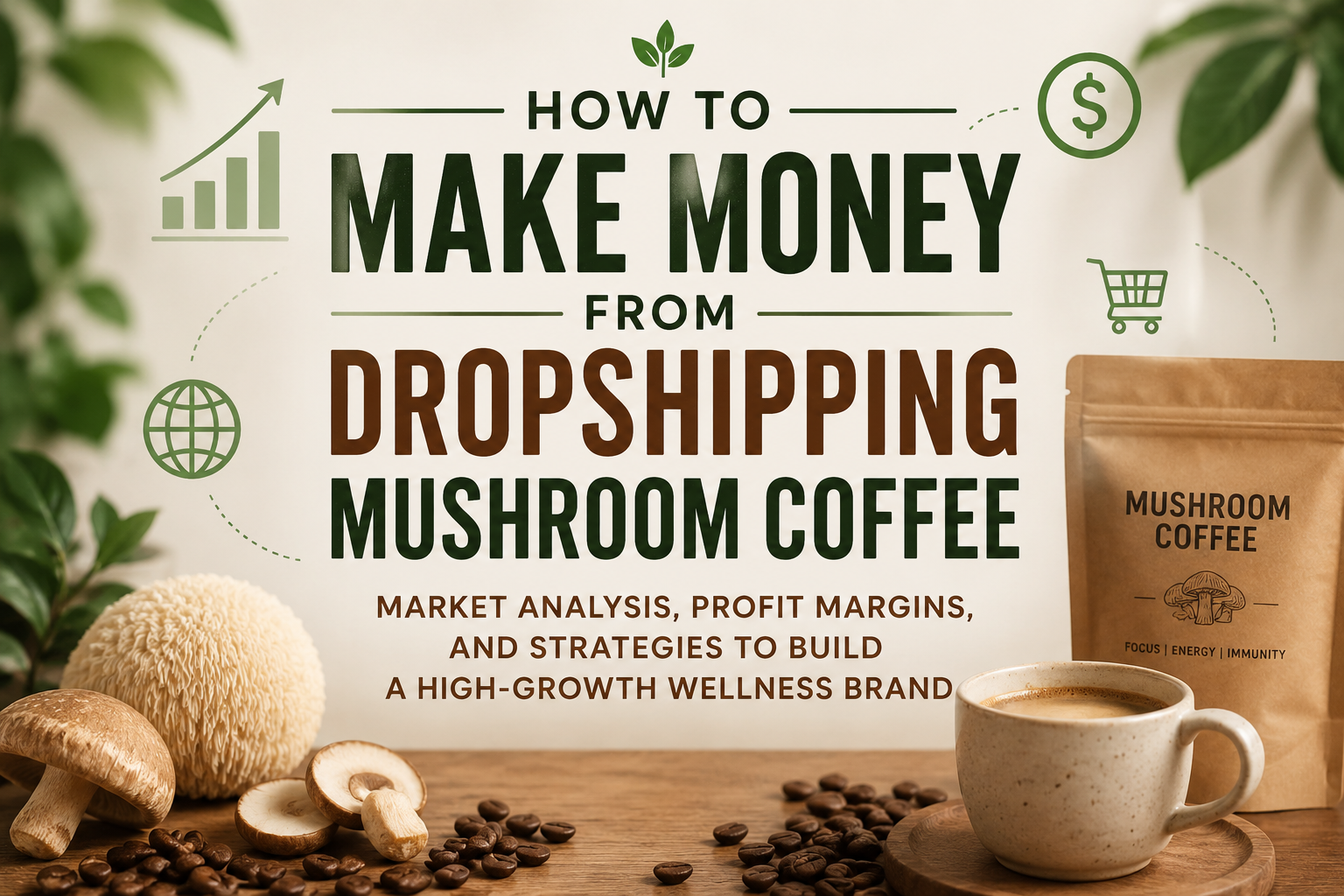
How to Make Money from Dropshipping Mushroom Coffee: Market Growth, Consumer Demand, and Profit Potential
The global coffee market has always been one of the largest consumer industries, but a new category is gaining momentum among health-conscious shoppers: mushroom coffee. Combining traditional coffee with functional mushroom extracts such as Lion’s Mane, Reishi, and Chaga, this product has moved beyond being a niche wellness product and entered the mainstream functional beverage market.
For entrepreneurs exploring how to make money from dropshipping mushroom coffee, the opportunity lies in the combination of three powerful trends: premium coffee consumption, demand for functional nutrition, and the growth of direct-to-consumer wellness brands. Unlike traditional dropshipping products that compete mainly on price, mushroom coffee allows sellers to compete through branding, education, and perceived health value, creating significantly higher profit potential.
The Growing Market Demand Behind Mushroom Coffee
The rise of mushroom coffee is closely connected to the expansion of the functional beverage industry. Consumers are increasingly looking for products that provide additional benefits beyond basic nutrition. Instead of simply buying a regular coffee product, many customers now prefer beverages positioned around energy, focus, stress management, and overall wellness.
According to industry research, the global functional beverage market has been expanding rapidly and is expected to continue growing as younger consumers prioritize preventative health and lifestyle optimization. Within this market, functional coffee represents an attractive segment because it combines a daily habit with wellness benefits.
Coffee consumption already has strong customer behavior advantages. Millions of consumers drink coffee every day, meaning mushroom coffee does not require creating an entirely new habit. Instead, it focuses on upgrading an existing routine. This makes customer acquisition easier compared with unfamiliar products.
For dropshipping entrepreneurs, this creates an opportunity to sell a premium alternative rather than competing with low-cost coffee sellers.
Why Mushroom Coffee Has Better Profit Margins Than Traditional Dropshipping Products
One of the biggest advantages of mushroom coffee dropshipping is its ability to support higher pricing. Traditional dropshipping products often face intense competition because customers can compare identical products across multiple stores. Mushroom coffee is different because product value is influenced by ingredients, sourcing, packaging, and brand positioning.
A standard coffee product may have:
Supplier cost: $5-$8
Retail price: $15-$20
This creates an approximate gross margin of 50%-60%.
However, premium mushroom coffee products can achieve a different pricing structure:
Product cost: $6-$10
Retail price: $29-$49
With effective branding and packaging, sellers can reach gross margins of approximately 65%-80%.
The reason is simple: customers are not only paying for coffee. They are paying for a lifestyle solution, functional ingredients, convenience, and brand trust.
For example, a product positioned as “premium Lion’s Mane coffee for focus and productivity” has a stronger value proposition than a generic coffee bag. The perceived value allows businesses to maintain higher margins.
Dropshipping Reduces the Risk of Entering the Mushroom Coffee Market
Launching a beverage brand traditionally requires significant investment in inventory, warehousing, and distribution. However, dropshipping provides a lower-risk entry model.
Instead of purchasing thousands of units upfront, entrepreneurs can work with suppliers that provide:
- Product sourcing
- Custom packaging options
- Order fulfillment
- International shipping solutions
This allows new brands to test different product concepts before committing large amounts of capital.
For example, a seller can test several variations:
Organic mushroom coffee
Lion’s Mane focus coffee
Reishi relaxation coffee
Mushroom coffee subscription packages
Based on customer response, the business can identify the most profitable product direction.
This testing advantage is particularly important in the wellness industry because consumer preferences vary significantly. Some customers prioritize energy, while others focus on cognitive performance or natural ingredients.
The Importance of Branding in Mushroom Coffee Dropshipping
Although the dropshipping model lowers operational barriers, success does not come from simply uploading a product and running advertisements. The most profitable mushroom coffee businesses usually focus on brand development.
Consumers purchasing functional beverages often research before buying. They want to understand:
Where the ingredients come from
Why mushroom extracts are included
How the product fits their lifestyle
Why this brand is different from competitors
This creates an advantage for businesses that invest in educational content, professional packaging, and trustworthy branding.
A well-positioned mushroom coffee brand can move away from price competition and create stronger customer loyalty. This is especially valuable because coffee is a repeat purchase category.
The Long-Term Profit Potential of Mushroom Coffee Dropshipping
The biggest opportunity in mushroom coffee dropshipping is not only the first sale but the potential for repeat purchases.
Unlike many trending products that customers buy once, coffee is naturally consumable. A satisfied customer may reorder every 30 days, creating predictable revenue.
For example:
Average order value: $39
Monthly subscription period: 6 months
Customer lifetime revenue:
$39 × 6 = $234
If customer acquisition cost is around $50-$70, the business can still maintain attractive profitability.
This recurring revenue model allows mushroom coffee brands to scale more sustainably compared with traditional one-time-product dropshipping.
How to Make Money from Dropshipping Mushroom Coffee with Private Label Branding and Premium Pricing Strategies
When analyzing how to make money from dropshipping mushroom coffee, one of the most important factors separating successful brands from ordinary sellers is the ability to create differentiation. The mushroom coffee market is growing rapidly, but simply selling a generic product from a supplier is unlikely to generate sustainable profits. The real opportunity comes from private label branding, where entrepreneurs transform a commodity product into a premium consumer brand.
Unlike traditional dropshipping products that often compete through discounts, mushroom coffee belongs to the wellness category, where customers are willing to pay more for quality ingredients, professional packaging, and a trustworthy brand identity. This makes private label strategies one of the most effective methods to increase gross margins and build long-term business value.
The Difference Between Generic Dropshipping and Private Label Mushroom Coffee
Many beginners enter dropshipping by searching for products with low supplier prices and immediately listing them online. However, this approach creates several challenges. If multiple stores sell identical mushroom coffee products, customers have little reason to choose one seller over another except price.
A generic mushroom coffee product may have:
Supplier cost: $6-$8 per package
Selling price: $18-$25
After advertising costs, payment fees, and fulfillment expenses, the actual profit margin can become limited.
Private label changes this structure by allowing sellers to control:
Product positioning
Packaging design
Brand story
Target customer segment
Pricing strategy
For example, a generic mushroom coffee product may simply be marketed as “Mushroom Coffee Mix.” A branded version could become:
“Organic Lion’s Mane Coffee for Entrepreneurs and Professionals”
or
“Premium Adaptogenic Coffee for Clean Energy and Mental Focus”
The second approach creates a stronger emotional connection and supports premium pricing.
How Private Label Increases Gross Margin Potential
The biggest financial advantage of private labeling is the ability to increase perceived product value.
A basic coffee product is usually evaluated based on price. However, a branded functional beverage is evaluated based on benefits, quality, and lifestyle alignment.
A typical pricing model may look like this:
Generic Mushroom Coffee Model
Product cost: $7
Packaging: $1
Shipping: $4
Total cost: $12
Selling price: $24
Gross margin before marketing: approximately 50%
After advertising expenses, profitability may become limited.
Private Label Premium Model
Product cost: $8
Custom packaging: $1.50
Shipping: $4
Total cost: $13.50
Selling price: $39
Gross margin before marketing: approximately 65%
With stronger branding, some premium mushroom coffee brands can sell products between $39 and $59, creating gross margins of 65%-75%.
This margin advantage gives businesses more flexibility to invest in customer acquisition through channels such as Meta Ads, Google Shopping, TikTok Ads, and influencer partnerships.
Building a Strong Mushroom Coffee Brand Through Positioning
Private label success does not only depend on putting a logo on a product. The most profitable brands develop a clear market position.
Mushroom coffee has several possible customer segments, and each segment requires a different brand strategy.
For productivity-focused consumers, the product can emphasize focus, concentration, and morning performance.
For wellness consumers, the messaging can focus on natural ingredients, organic sourcing, and daily health routines.
For fitness audiences, the positioning can connect mushroom coffee with active lifestyles and clean energy.
The same physical product can achieve very different pricing depending on how it is presented.
This is why branding is particularly valuable in functional beverages. Customers are not only buying ingredients; they are buying a solution that fits their personal identity.
The Role of Packaging and Customer Experience
Packaging plays a major role in premium beverage markets. Consumers often judge product quality before they even try it.
A professional mushroom coffee brand should focus on:
Premium visual design
Clear ingredient information
Strong product benefits
Easy-to-understand usage instructions
Consistent brand identity
For example, a simple plastic bag with basic labeling may look like a low-cost supplement. A professionally designed pouch with premium graphics and educational content creates a completely different customer perception.
The difference in packaging cost is usually small, but the impact on selling price can be significant.
Spending an additional $1-$2 on packaging can potentially allow a brand to increase the selling price by $10-$20.
Private Label Creates Opportunities for Subscription Revenue
Another advantage of branded mushroom coffee is its compatibility with subscription models.
Coffee is naturally a repeat purchase product. Once customers develop a daily habit, they are more likely to reorder regularly.
A private label brand can introduce:
Monthly coffee subscriptions
Bundle discounts
VIP customer programs
Limited seasonal flavors
For example:
Single purchase:
$39
Monthly subscription:
$35/month
A customer staying for six months generates:
$35 × 6 = $210 customer lifetime value
Higher customer lifetime value allows brands to spend more aggressively on advertising while maintaining profitability.
A generic dropshipping store may struggle to justify advertising costs because customers have low loyalty. A branded mushroom coffee company can build repeat revenue and reduce dependence on constant new customer acquisition.
Choosing the Right Suppliers and Optimizing Fulfillment Costs
When exploring how to make money from dropshipping mushroom coffee, many entrepreneurs focus heavily on marketing and advertising but underestimate the impact of supplier selection. In the functional beverage industry, sourcing quality products at competitive costs is one of the biggest factors determining whether a store achieves healthy profit margins or struggles with low profitability.
Unlike simple consumer products, mushroom coffee requires more attention to ingredient quality, manufacturing standards, certifications, and fulfillment efficiency. A reliable supplier does not only provide lower product costs; it helps businesses build customer trust, reduce operational problems, and create a scalable brand.
For dropshipping entrepreneurs entering this market, the supplier relationship becomes a long-term competitive advantage.
the Cost Structure of Mushroom Coffee Dropshipping
The profitability of mushroom coffee depends on controlling three major expenses:
Product sourcing cost
Fulfillment and shipping cost
Customer acquisition cost
Many new sellers only calculate the difference between supplier price and retail price, but the real profit comes from optimizing the entire supply chain.
For example, a basic mushroom coffee dropshipping model may look like this:
Product manufacturing cost: $8
Packaging: $1
Shipping cost: $4
Payment processing fees: $1
Total operational cost: $14
Retail price: $29
Gross profit before advertising:
$15
Gross margin:
Approximately 52%
After spending $10-$15 on customer acquisition, the remaining profit becomes very limited.
However, better supplier partnerships can significantly improve the economics.
A more optimized model:
Product cost after supplier negotiation: $6
Custom packaging: $1
Shipping optimization: $3
Other costs: $1
Total cost: $11
Selling price: $39
Gross profit:
$28
Gross margin:
Approximately 72%
This difference demonstrates why supplier optimization is critical for building a profitable mushroom coffee business.
How to Choose the Right Mushroom Coffee Supplier
The first consideration when selecting a supplier is product quality. Mushroom coffee belongs to the wellness category, meaning customers expect transparency and reliability.
Important supplier factors include:
Mushroom extract quality
Ingredient sourcing
Manufacturing standards
Packaging options
Production capacity
Fulfillment capability
A supplier offering cheaper products may not always be the best choice. Low-quality mushroom extracts or unclear ingredient information can damage customer trust and increase refund rates.
For premium positioning, entrepreneurs should evaluate factors such as:
Whether the mushrooms are organically sourced
The extraction method used
The percentage of active compounds
Whether the product includes third-party testing
These details can directly influence pricing power.
A product with transparent sourcing information can often command a higher selling price than a generic alternative.
Why Certifications Matter in the Functional Beverage Market
Consumers purchasing mushroom coffee are usually more research-oriented than average ecommerce buyers. They often check product claims, ingredients, and brand credibility before making a purchase.
Certifications and quality documentation can improve conversion rates by reducing customer hesitation.
Depending on the target market, sellers may consider suppliers that support:
Organic certification
Food safety compliance
Good Manufacturing Practices (GMP)
Third-party quality testing
For example, customers in the United States and Europe are increasingly interested in clean-label products. A brand that clearly communicates sourcing and manufacturing standards has a stronger opportunity to justify premium pricing.
Reducing Fulfillment Costs Through Strategic Logistics
Shipping costs can significantly impact dropshipping profitability, especially for beverage products. Mushroom coffee is heavier than many traditional ecommerce products, meaning inefficient fulfillment can quickly reduce margins.
A common mistake is relying on the cheapest supplier without considering shipping performance.
A better approach is evaluating:
Warehouse location
Average delivery time
Tracking reliability
Packaging protection
Return handling
For US customers, using domestic fulfillment can improve delivery speed and customer satisfaction. Although inventory costs may be slightly higher, faster shipping often increases conversion rates and reduces abandoned purchases.
For international markets such as Europe, local fulfillment centers can help brands avoid long delivery times and improve customer experience.
The Advantage of Working with Suppliers That Support Branding
The most valuable suppliers are not only manufacturers but strategic partners that support brand development.
A strong mushroom coffee supplier should ideally provide options such as:
Custom labels
Branded packaging
Product customization
Small minimum order quantities
Quality control support
These services allow entrepreneurs to move from simple dropshipping toward a branded ecommerce model.
For example, a supplier that supports 100-500 unit customized orders allows new businesses to test products without large upfront investment.
Once demand increases, the business can negotiate larger production volumes and reduce unit costs.
A supplier relationship that lowers costs over time can create a significant competitive advantage.
Scaling Profitability Through Supply Chain Optimization
As mushroom coffee brands grow, supplier optimization becomes even more important.
A successful scaling strategy usually follows several stages.
The first stage focuses on testing demand through dropshipping. The goal is validating product-market fit without large inventory risk.
The second stage involves improving margins through better supplier pricing and customized packaging.
The third stage involves larger inventory purchases, warehouse partnerships, and automated fulfillment.
For example:
Early stage:
Product cost: $8
Monthly sales volume: 200 units
Later stage:
Product cost: $5.50
Monthly sales volume: 2,000 units
Reducing product cost by only $2.50 creates an additional:
$5,000 monthly profit increase
without increasing sales.
This demonstrates why supply chain optimization becomes more valuable as a business scales.
For entrepreneurs researching how to make money from dropshipping mushroom coffee, supplier selection is one of the most important factors determining success.
A profitable mushroom coffee business requires more than finding a cheap product. The best opportunities come from combining reliable manufacturing, quality ingredients, optimized fulfillment, and scalable partnerships.
How to Make Money from Dropshipping Mushroom Coffee Through TikTok Ads, Influencer Marketing, and Content Commerce
When analyzing how to make money from dropshipping mushroom coffee, product selection and supplier quality are only part of the equation. The biggest challenge for most ecommerce entrepreneurs is customer acquisition. Unlike ordinary impulse-buy products, mushroom coffee belongs to the functional wellness category, which means consumers usually need education and trust before purchasing.
This characteristic creates both a challenge and an opportunity. While customers may not immediately buy mushroom coffee after seeing a simple product advertisement, brands that successfully explain the benefits, lifestyle positioning, and product story can build stronger relationships and achieve higher customer lifetime value.
Platforms such as TikTok, Instagram, YouTube Shorts, and influencer marketing have become powerful channels for mushroom coffee brands because they allow sellers to demonstrate daily usage scenarios rather than simply promote a product.
Why Mushroom Coffee Is Suitable for Content-Based Marketing
Many successful ecommerce products rely on visual appeal or emotional triggers. Mushroom coffee works differently because its value comes from education.
Consumers often have questions before purchasing:
Why should I replace regular coffee?
What are functional mushrooms?
How does mushroom coffee fit into my daily routine?
Is this product suitable for my lifestyle?
This makes mushroom coffee ideal for content marketing strategies.
Instead of directly selling a package of coffee, successful brands often create content around:
Morning productivity routines
Healthy lifestyle improvements
Coffee alternatives
Entrepreneur wellness habits
Focus and energy management
For example, a short video showing a business owner preparing mushroom coffee before starting work can communicate the product’s positioning more effectively than a traditional advertisement.
The goal is not only selling coffee. It is selling a lifestyle associated with improved daily performance.
Using TikTok Ads to Scale Mushroom Coffee Sales
TikTok has become one of the most important platforms for discovering new consumer products. Its algorithm allows smaller brands to reach highly targeted audiences without requiring a large existing following.
For mushroom coffee dropshipping, TikTok works particularly well because the product has several strong content angles.
A brand can create videos around:
“Why I switched from normal coffee to mushroom coffee”
“My morning routine for better focus”
“3 things I changed to improve productivity”
“The coffee alternative entrepreneurs are trying”
These formats naturally introduce the product without feeling like traditional advertising.
The advertising economics can also be attractive when campaigns are optimized correctly.
Example:
Product selling price:
$39
Product cost:
$10
Fulfillment cost:
$4
Gross profit before advertising:
$25
If TikTok advertising cost per purchase is:
$12-$15
The business can still achieve:
$10-$13 profit per order
However, the real value comes from repeat purchases.
The Importance of Influencer Marketing for Functional Beverage Brands
Influencer marketing is especially effective for mushroom coffee because customers often trust personal experiences more than direct advertisements.
Unlike fashion products where customers can immediately judge appearance, functional beverages require credibility.
A fitness creator, entrepreneur, productivity expert, or wellness influencer can demonstrate:
How they use the product
When they drink it
Why they replaced traditional coffee
How it fits their lifestyle
The best partnerships are usually not with the largest influencers but with creators whose audiences match the product positioning.
For example:
A productivity influencer with 50,000 highly engaged followers may generate better results than a celebrity with millions of unrelated followers.
The economics are also attractive.
Suppose an influencer campaign costs:
$1,000
It generates:
80 customers
Average order value:
$39
Initial revenue:
$3,120
If 40% of customers subscribe or reorder, the long-term revenue potential becomes much higher.
Building a Subscription Model to Increase Customer Lifetime Value
One of the biggest advantages of mushroom coffee compared with many dropshipping products is repeat purchase potential.
A customer who buys a phone accessory may only purchase once. Coffee customers, however, can consume the product daily.
This creates opportunities for subscription-based growth.
Example:
One-time purchase:
$39
Six-month subscription:
$35 × 6 months
Customer lifetime value:
$210
This changes the advertising strategy completely.
A business selling one-time products may only afford a $10-$15 customer acquisition cost.
A subscription-based mushroom coffee brand may accept a $50-$70 acquisition cost because future purchases generate additional revenue.
This is why successful functional beverage companies focus heavily on retention rather than only chasing new customers.
Combining Organic Content and Paid Advertising
The strongest mushroom coffee marketing strategy usually combines organic traffic with paid acquisition.
Paid advertising provides immediate customer testing.
Organic content builds long-term brand authority.
For example:
A brand may create 50 short-form videos explaining mushroom coffee benefits.
The best-performing videos can then become paid advertisements.
This approach reduces advertising risk because the company already understands what type of messaging attracts customers.
Over time, successful content can continue generating traffic without additional advertising costs.
Avoiding Common Marketing Mistakes
Many mushroom coffee dropshipping stores fail because they treat the product like a normal ecommerce item.
Common mistakes include:
Using generic product descriptions
Focusing only on discounts
Making unsupported health claims
Ignoring customer education
Copying competitor advertising
The wellness market requires trust. Brands must communicate product value clearly while avoiding exaggerated promises.
A professional approach focuses on ingredients, quality, lifestyle benefits, and customer experience.

No Comments