


Where to Find the Best Pet Dropshipping Suppliers: A Complete Guide to Platforms, Niches, Profit Models, and Automated Scaling Systems

The global pet dropshipping supply chain is no longer a simple marketplace search problem. It is a structured ecosystem where different regions serve different business strategies. Knowing this map allows entrepreneurs to make informed sourcing decisions instead of reacting to short-term product availability.
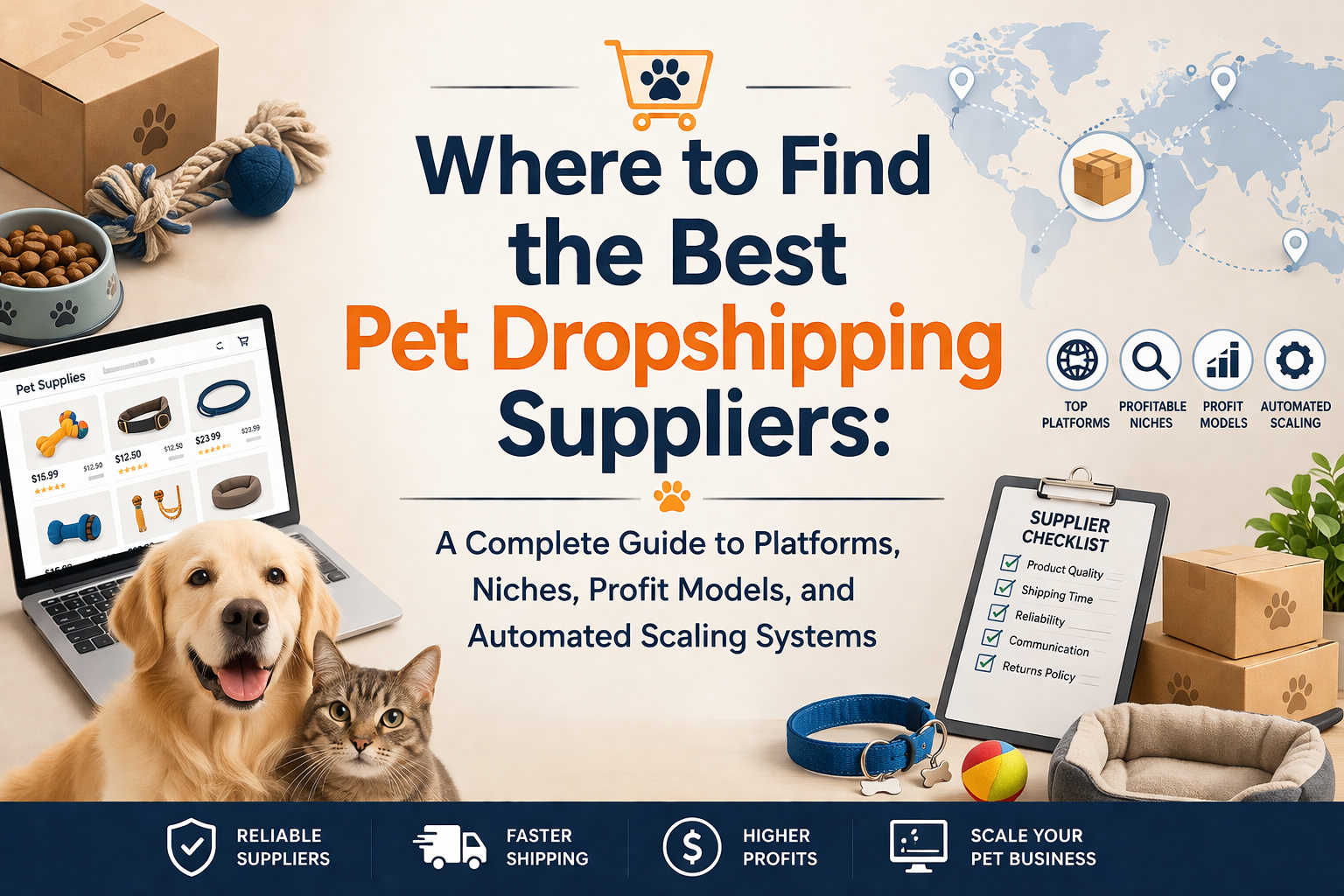
A Global Supply Chain Map for Building Reliable and Scalable Pet Stores
Finding reliable pet dropshipping suppliers is not simply about discovering a single platform or website. In practice, it is about understanding how the global supply chain is structured and where different types of suppliers fit within that structure. The pet niche is especially sensitive to product quality, shipping speed, and consistency, which makes supplier selection a strategic decision rather than a tactical one.
In 2026, the global pet dropshipping ecosystem can be divided into three primary sourcing layers: Asian mass-manufacturing platforms, Western wholesale distributors, and hybrid fulfillment networks that combine warehousing with automation tools. Each layer serves a different business model, and choosing the wrong one often leads to margin loss or customer dissatisfaction.
Asian Manufacturing Platforms: High Margin but Operational Complexity
A large portion of pet dropshipping suppliers originates from manufacturing hubs in China and Southeast Asia. These suppliers are typically accessed through large marketplaces that aggregate thousands of factories and trading companies. The primary advantage of this layer is cost efficiency. Products such as pet grooming tools, collars, toys, and feeding accessories can often be sourced at significantly lower unit prices compared to Western markets.
However, the trade-off is operational complexity. Shipping times are longer, quality consistency varies between vendors, and communication may require more effort due to language and process differences. Businesses relying on this layer must be prepared to implement strict supplier vetting systems and product testing cycles before scaling.
From a strategic perspective, this layer is most suitable for store owners who prioritize high margins and are willing to invest in testing and optimization before achieving stable operations.
Western Wholesale Distributors: Stability and Faster Delivery
The second major source of pet dropshipping suppliers is Western-based wholesalers and regional distributors. These suppliers are typically located in the United States, Canada, or Europe and often provide faster shipping times and more predictable product quality.
Unlike manufacturing platforms, these suppliers usually operate with pre-stocked inventory and standardized fulfillment processes. This reduces uncertainty and improves customer experience, especially for pet owners who expect reliable delivery and consistent product quality.
The downside is lower profit margins. Because products are already imported and stored locally, pricing is significantly higher. This makes it harder to compete purely on cost, but easier to build long-term customer trust and brand reputation.
This supplier category is often preferred by stores targeting premium pet products or subscription-based models where customer retention is more important than one-time margins.
Hybrid Fulfillment Networks: The Modern Middle Ground
A newer and increasingly important category of pet dropshipping suppliers is hybrid fulfillment networks. These systems combine global sourcing with localized warehouses and automated order routing. Instead of manually choosing between China or the US, the system automatically selects the best fulfillment location based on customer geography.
This model reduces shipping time while still maintaining relatively competitive pricing. It also allows sellers to scale more efficiently because inventory, tracking, and order processing are partially automated.
For pet stores that aim to scale quickly without building their own logistics infrastructure, this hybrid model is becoming the most practical option. It bridges the gap between cost efficiency and customer experience, which is critical in competitive niches like pet accessories and pet care products.
Strategic Insight: Why “Where” Matters More Than “Who”
When analyzing where to find the best pet dropshipping suppliers, the key insight is that supplier location directly influences your entire business model. A store built on low-cost Asian suppliers behaves differently from one built on Western distributors or hybrid systems. Profit margins, branding strategy, customer support requirements, and even advertising costs are all shaped by this foundational choice.
Successful operators do not simply search for suppliers; they design sourcing strategies. This means combining multiple supplier layers rather than relying on a single source. Many scalable pet stores eventually evolve into hybrid systems that balance cost, speed, and reliability.
A Practical Framework to Avoid Scams and Build Reliable Supply Chains
In pet dropshipping, most beginners focus heavily on where to find suppliers, but far fewer understand how to evaluate whether those suppliers can actually sustain a business. The reality is that supplier quality directly impacts refund rates, delivery speed, product reviews, and even ad account performance. A weak supplier can destroy a store faster than poor marketing.
Verification is not a one-time step. It is an ongoing risk management system that protects your margins and customer experience.
Operational Consistency: The First Signal of a Reliable Supplier
The first thing to evaluate is operational consistency. Reliable pet dropshipping suppliers are not defined by having the lowest price, but by their ability to fulfill orders predictably over time.
You can usually detect this through response behavior, catalog stability, and order processing patterns. Suppliers who frequently change product listings, delay communication, or provide inconsistent shipping estimates often lack operational maturity.
A strong supplier typically maintains stable SKU structures, clear shipping policies, and responsive communication channels. These are indirect but important indicators of whether they can handle long-term business volume.
Product Quality Control: The Hidden Profit Factor
In the pet niche, product quality is not optional. Customers are emotionally attached to their pets, which makes them significantly less tolerant of defective or low-quality items.
A structured verification process should include ordering samples before scaling any product. This allows you to evaluate material durability, packaging quality, and real shipping performance.
More advanced sellers also test multiple suppliers for the same product category. For example, pet harnesses or grooming tools may be sourced from three different vendors, then compared based on return rates and customer feedback.
This approach reduces dependency on a single supplier and creates a more resilient product catalog.
Shipping Reliability: The Factor That Breaks Most Stores
Shipping inconsistency is one of the most common failure points in pet dropshipping. Even if a product is high quality and profitable, unreliable delivery timelines can lead to chargebacks and negative reviews.
A reliable supplier should provide transparent logistics tracking and realistic delivery windows. If a supplier consistently overpromises shipping speed, that is a major warning sign.
In practice, experienced sellers prioritize suppliers who underpromise and overdeliver rather than those advertising extremely fast shipping without proof.
Communication Speed and Problem Resolution Capability
Supplier communication is often overlooked but becomes critical when scaling. In real operations, issues will inevitably occur—lost packages, damaged items, or customs delays.
A strong supplier is defined not only by product quality but also by how quickly and effectively they resolve issues. Slow or unclear communication often leads to unresolved disputes, which directly impacts your brand reputation.
Testing response time before committing is a simple but effective verification method. Sending multiple inquiries at different times can reveal whether the supplier operates professionally or inconsistently.
Compliance and Product Safety Considerations
Pet products often fall into categories that require safety awareness, especially items like chew toys, grooming tools, or electrical feeding devices. Not all suppliers meet consistent safety standards.
A serious verification process includes checking whether suppliers provide certifications or quality assurance documentation when required. While not every product needs formal certification, higher-value or electrical items should always be verified for compliance.
Ignoring this step can lead to legal issues, especially when selling in regulated markets such as the US or EU.
Best Platforms to Find Pet Dropshipping Suppliers
In modern pet dropshipping, the challenge is no longer simply “finding suppliers.” The real challenge is finding systems that aggregate, manage, and automate supplier relationships. Platforms act as intermediaries between store owners and global inventory networks, and they significantly reduce manual sourcing work.
Instead of contacting dozens of individual suppliers, sellers increasingly rely on structured platforms that already integrate logistics, inventory syncing, and fulfillment automation.
Shopify App Ecosystem: The Core Infrastructure for Pet Stores
The Shopify ecosystem has become one of the most common entry points for pet dropshipping businesses because of its strong integration with supplier apps.
Platforms like DSers-style product import tools or automated fulfillment apps allow sellers to quickly test pet products without building direct supplier relationships. These systems are especially useful for beginners because they reduce operational complexity.
However, Shopify-based supplier apps vary in reliability. Some focus heavily on product catalog size but lack shipping optimization, while others prioritize logistics but offer limited product variety. The key is selecting apps that balance both catalog depth and fulfillment performance.
For pet stores, this ecosystem works best when used as a testing layer rather than a long-term sourcing strategy.
Dedicated Dropshipping Platforms: Faster Shipping and Better Control
Beyond Shopify apps, dedicated dropshipping platforms such as ScaleOrder-style fulfillment networks or similar global sourcing systems have become increasingly important in the pet niche.
These platforms typically combine product sourcing, warehousing, and shipping into a single system. Unlike fragmented supplier models, they provide centralized order management, which significantly reduces error rates.
The main advantage here is shipping optimization. Many of these platforms now offer regional warehouses, which allow pet products like collars, grooming tools, or feeding accessories to be delivered much faster than traditional cross-border shipping.
This makes them particularly attractive for stores targeting impulse buyers or social media-driven traffic from TikTok and Instagram.
ScaleOrder-Type Networks: Western Supplier Advantage
Another important category is Western-focused supplier networks. These platforms connect store owners with US and EU-based wholesalers, offering significantly faster delivery times.
In the pet niche, this is especially valuable because customers often expect quick delivery for essential items such as pet food accessories, grooming tools, or replacement parts.
The trade-off is cost. Products sourced from Western suppliers generally have higher base prices, which reduces profit margins. However, this is often offset by higher conversion rates and lower refund risk.
These platforms are usually preferred by brands focusing on long-term customer retention rather than aggressive scaling.
Automated Multi-Supplier Systems: The Scaling Layer
More advanced pet dropshipping stores eventually move toward automated supplier orchestration systems. These tools dynamically select suppliers based on inventory availability, shipping destination, and cost efficiency.
Instead of manually choosing where each order is fulfilled, the system routes orders automatically to the best-performing supplier at that moment.
This approach reduces dependency on any single platform and creates a more resilient supply chain. It is particularly effective in the pet niche, where product demand can fluctuate seasonally and across trends (for example, dog walking accessories in summer vs. indoor toys in winter).
Strategic Insight: Platform Choice Shapes Your Business Model
The platform you choose is not just a technical decision—it defines your entire operating structure. Shopify apps prioritize speed of entry, dedicated fulfillment platforms prioritize balance, and Western supplier networks prioritize stability.
Most successful pet dropshipping stores do not rely on a single platform. Instead, they combine multiple systems: one for testing products, one for scaling winners, and one for stabilizing high-performing SKUs.
This layered approach reduces risk and increases flexibility in pricing, marketing, and fulfillment.
China vs Local Pet Dropshipping Suppliers
When building a pet dropshipping store, supplier geography is one of the most important strategic decisions. It directly impacts your pricing power, shipping expectations, customer satisfaction, and even your advertising performance.
Many beginners focus only on product cost, but experienced sellers evaluate a broader system: profit margin stability, logistics reliability, and long-term scalability. China and local suppliers represent two fundamentally different business models, not just two sourcing options.
China-Based Suppliers: High Margin, High Operational Dependency
China-based pet dropshipping suppliers are often chosen for one primary reason: cost efficiency. Products such as pet toys, grooming tools, collars, and accessories can be sourced at extremely low unit prices, allowing for high markup potential in retail markets.
This model is particularly attractive for testing new products or running aggressive marketing campaigns. Lower cost per unit allows more flexibility in advertising spend and pricing experiments.
However, this advantage comes with operational trade-offs. Shipping times are generally longer, typically ranging from moderate to extended delivery windows depending on logistics routes. In addition, product consistency may vary between suppliers, especially when sourcing from fragmented manufacturers.
The real challenge is not just shipping speed, but predictability. Without strong supplier control systems, stores relying heavily on China-based sourcing often face fluctuating customer experience quality.
This model works best for high-volume testing environments where product iteration is more important than brand consistency.
Local Suppliers (US/EU): Stability and Customer Trust Advantage
Local pet dropshipping suppliers operate on a fundamentally different principle: proximity and reliability over cost efficiency. Products are pre-stocked in domestic warehouses, enabling significantly faster delivery times.
For pet owners, delivery speed often has a psychological impact. Items such as feeding accessories, grooming tools, or safety products are expected to arrive quickly and reliably. Local suppliers help meet these expectations consistently.
The main advantage here is trust. Faster shipping leads to fewer complaints, lower refund rates, and higher customer satisfaction scores. This directly improves long-term brand equity.
However, local sourcing introduces a clear limitation: reduced profit margins. Because products are already imported and warehoused, costs are significantly higher compared to direct manufacturing sources. This limits pricing flexibility and requires stronger brand positioning to maintain profitability.
Risk Profile Comparison: Where Most Stores Fail
The real difference between China and local suppliers is not just cost or speed—it is risk distribution.
China-based sourcing concentrates risk in logistics unpredictability and quality variation. A single weak supplier can create inconsistent customer experiences at scale.
Local sourcing concentrates risk in pricing pressure. Higher costs make it difficult to compete in highly saturated niches unless branding or product differentiation is strong.
In practice, many failing stores do not fail because of product demand—they fail because they choose a supplier model that does not match their growth stage.
Scalability Perspective: Short-Term vs Long-Term Strategy
From a scalability perspective, China suppliers are often more suitable for early-stage validation. They allow rapid testing of multiple pet products without heavy upfront investment.
Local suppliers, on the other hand, become more valuable when a store transitions into a stable brand. At this stage, consistency matters more than experimentation.
A hybrid approach is increasingly common. Stores begin with China-based suppliers to identify winning products, then gradually shift successful items to local fulfillment networks to improve customer experience and retention.
This transition is often what separates short-lived dropshipping stores from sustainable e-commerce brands.
Strategic Insight: It Is Not Either-Or
The most effective pet dropshipping businesses do not treat China and local suppliers as mutually exclusive options. Instead, they use them as different layers of the same supply chain.
China suppliers support discovery and margin optimization. Local suppliers support stability and brand development. When combined strategically, they create a balanced system that supports both growth and retention.
High-Converting Pet Dropshipping Niches
The pet industry is often perceived as a “safe” e-commerce niche due to consistent demand, but in practice, profitability varies significantly between subcategories. Some pet products convert easily through ads but suffer from high return rates, while others generate stable long-term revenue but require better suppliers to execute properly.
What many beginners overlook is that product success is not only driven by marketing—it is heavily constrained by supplier capability. Shipping speed, product durability, packaging quality, and inventory stability all influence conversion rates and customer lifetime value.
Functional Pet Products: High Demand, High Execution Pressure
Functional pet products include items such as leashes, harnesses, grooming tools, feeding accessories, and training equipment. These products typically solve a direct problem, which makes them easier to market and convert.
However, they also require higher supplier reliability. For example, a poorly stitched harness or low-quality leash can quickly lead to refunds or negative reviews, especially since pet owners are highly sensitive to safety-related products.
Suppliers in this category must provide consistent material quality and predictable fulfillment timelines. Even small inconsistencies can significantly impact ad performance and customer trust.
This niche performs best when paired with suppliers who can maintain stable production standards and support repeatable quality control processes.
Smart Pet Devices: High Ticket, High Dependency on Logistics
Another fast-growing niche is smart pet devices, including automatic feeders, tracking devices, and temperature-controlled accessories. These products typically have higher price points and stronger perceived value.
From a dropshipping perspective, they offer strong profit potential, but they also introduce higher operational dependency on suppliers. Electrical components, firmware reliability, and packaging protection during shipping all become critical factors.
If suppliers fail to ensure proper testing or safe packaging, return rates can increase rapidly, eroding margins.
This niche requires suppliers with more advanced fulfillment capabilities, often including quality assurance processes and secure shipping methods. Without this, scaling becomes risky even if initial sales are strong.
Pet Comfort & Lifestyle Products: Balanced Risk and Scalability
Products such as pet beds, calming mats, clothing, and travel accessories fall into the comfort and lifestyle category. These items are generally easier to source and less sensitive in terms of technical specifications.
From a supplier perspective, this niche is more forgiving. Small variations in design or material are less likely to cause critical failures compared to safety-related items.
However, success still depends on supplier consistency in sizing, material quality, and packaging. Since these products are often visually marketed on social media, presentation quality directly influences conversion rates.
This niche is often used by scaling stores because it balances manageable risk with strong emotional appeal in marketing.
Supplier Influence on Product Performance
A critical insight in pet dropshipping is that suppliers do not simply fulfill orders—they actively shape product performance metrics.
Shipping delays can reduce conversion rates on paid ads. Poor packaging can increase refund rates even if the product itself is functional. Inconsistent inventory can disrupt scaling campaigns during peak demand periods.
This means that two stores selling the same product can achieve completely different results depending on their supplier structure.
Experienced sellers often test multiple suppliers for the same product category before committing to scale. The goal is not just finding a product that sells, but finding a supplier that allows the product to scale profitably.
Strategic Insight: Niche Selection Must Match Supplier Strength
One of the most common mistakes in pet dropshipping is choosing a niche based purely on demand or trends without considering supplier capability.
High-ticket niches require advanced logistics. Functional niches require strict quality control. Lifestyle niches require stable visual consistency.
A mismatch between niche complexity and supplier capability is one of the fastest ways for a store to lose profitability even with strong marketing performance.
Automated Pet Dropshipping Suppliers
Traditional pet dropshipping relies heavily on manual supplier search, negotiation, and order forwarding. While this model works at a small scale, it becomes inefficient and error-prone once order volume increases.
In 2026, high-performing stores are shifting toward automated supplier systems that integrate sourcing, inventory management, pricing, and fulfillment into a unified workflow. Instead of reacting to supply chain issues, these systems proactively optimize them.
The core idea is simple: suppliers are no longer selected per product—they are dynamically assigned per order.
How Automation Changes Supplier Selection Logic
In a manual model, sellers choose one supplier per product and stick with it. In an automated system, multiple suppliers are connected to the same product SKU.
When a customer places an order, the system evaluates variables such as:
- Shipping destination
- Inventory availability
- Fulfillment cost
- Estimated delivery speed
Based on these factors, the order is automatically routed to the most efficient supplier at that moment.
This reduces dependency on any single supplier and significantly improves operational stability, especially in volatile niches like pet accessories where demand spikes can happen suddenly due to viral content or seasonal trends.
Inventory Syncing: Preventing Overselling in Real Time
One of the biggest operational risks in pet dropshipping is overselling products that are no longer in stock. Manual tracking cannot keep up with fast-moving inventory changes across multiple suppliers.
Automated systems solve this by continuously syncing inventory data across connected suppliers. When stock levels change, product availability in the store updates automatically.
This reduces customer dissatisfaction, prevents refund cycles, and protects advertising performance by avoiding order cancellations after purchase.
For pet products, where customers expect fast fulfillment for essential items, inventory accuracy directly affects brand trust.
Automated Pricing Optimization: Protecting Profit Margins
In advanced systems, pricing is no longer static. Instead, it adjusts dynamically based on supplier cost fluctuations, shipping fees, and regional demand differences.
For example, if a supplier increases cost or shipping delays increase, the system can automatically adjust retail pricing or switch fulfillment routes to maintain margin stability.
This level of automation is particularly useful in the pet niche, where small products often have thin margins and profitability depends on volume efficiency rather than high per-unit profit.
Without automation, sellers often lose profit without realizing it due to silent cost changes from suppliers.
Multi-Supplier Redundancy: Building a Resilient Structure
Top pet dropshipping stores rarely depend on a single supplier per product category. Instead, they build redundancy by connecting multiple suppliers to the same catalog.
This structure ensures continuity even if one supplier experiences delays, stock shortages, or shipping disruptions.
When combined with automation, redundancy becomes a self-correcting system. The store automatically shifts orders to alternative suppliers without manual intervention.
This is especially important in the pet niche, where customer expectations are high and delays often lead to immediate refund requests or chargebacks.
AI-Driven Product Sourcing: Identifying Winning Pet Products Faster
Beyond fulfillment, automation also extends to product discovery. AI-driven systems now analyze market trends, ad performance data, and competitor listings to identify potential winning pet products.
Instead of manually testing dozens of items, sellers can prioritize products with higher probability of success based on data signals such as engagement rate, search growth, or historical conversion benchmarks.
Once identified, these products are automatically linked to supplier networks, allowing rapid deployment into the store.
This significantly shortens the product testing cycle and reduces wasted ad spend.
Strategic Insight: Automation Is Not Just Efficiency—It Is Risk Control
Many assume automation is only about saving time. In reality, its primary function is risk reduction.
In pet dropshipping, risks come from multiple directions: supplier inconsistency, shipping delays, inventory mismatch, and pricing volatility. Automation does not eliminate these risks, but it distributes and manages them in real time.
Stores that rely on automation are not necessarily faster—they are more stable under scale.




No Comments