


Dropshipping vs Reselling: Which Model Makes More Money, Scales Faster, and Actually Wins?

From a purely mathematical perspective, reselling tends to offer higher profit margins per unit. However, dropshipping provides superior capital efficiency and lower financial risk, making it easier to achieve consistent returns with limited investment.
In practice, many successful e-commerce businesses start with dropshipping to identify winning products, then transition into reselling or bulk purchasing to maximize margins. This hybrid approach combines the strengths of both models and reflects how modern e-commerce operations evolve in 2026.
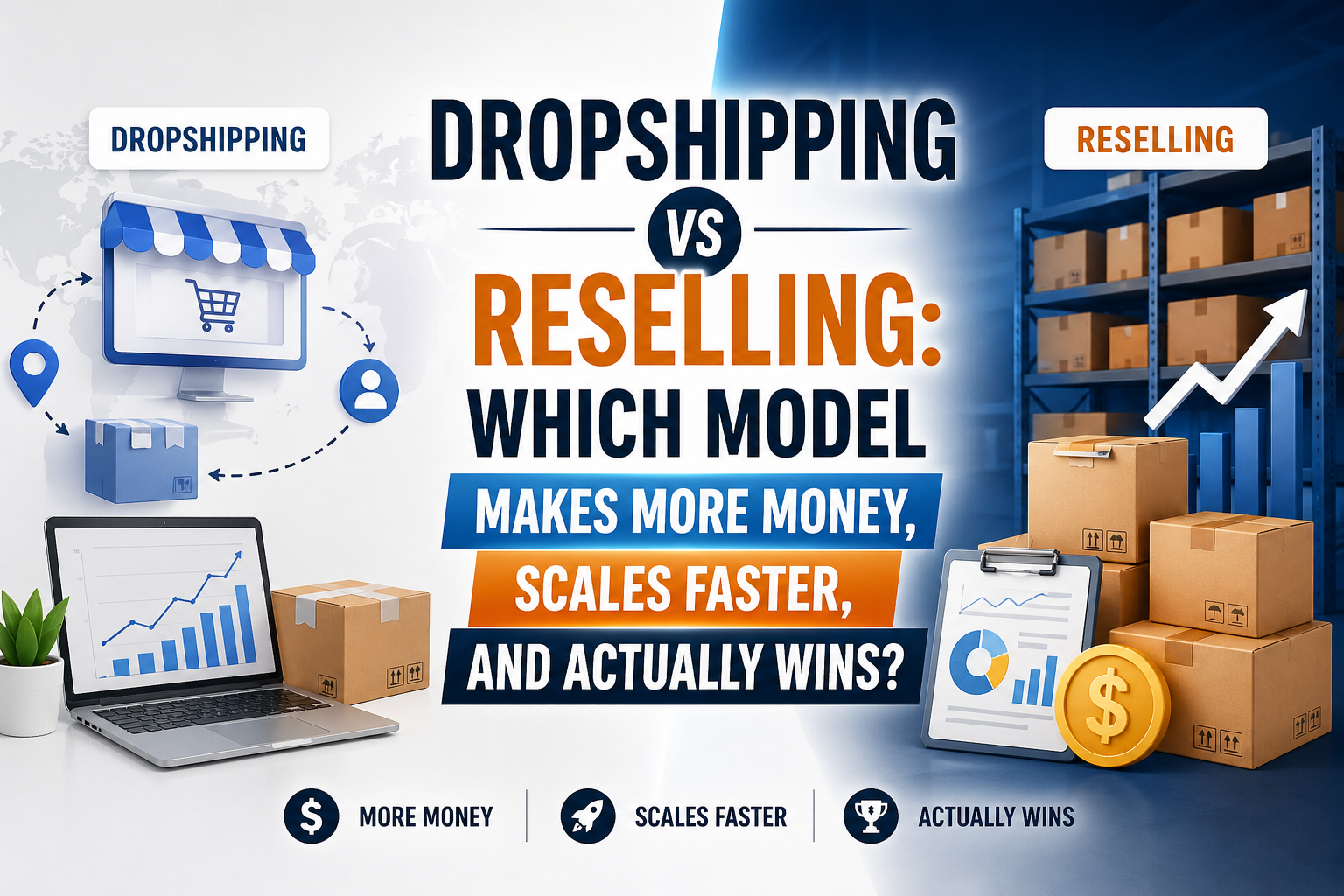
Dropshipping vs Reselling: Which Model Delivers Higher Profit Margins
When comparing dropshipping vs reselling, the most critical question for any entrepreneur is simple: which model actually makes more money? The answer is not as straightforward as it seems, because profitability depends less on the business model itself and more on how costs are structured and controlled.
In essence, both models operate on the same fundamental equation: revenue minus costs equals profit. However, the nature and timing of those costs differ significantly, which directly impacts margins, cash flow, and scalability.
Cost Structure in Dropshipping: Low Entry, High Variable Costs
Dropshipping is often promoted as a low-risk, high-margin business, but this perception can be misleading without a closer look at the numbers. The main advantage lies in its cost structure: there is no need to purchase inventory upfront. This eliminates bulk purchasing risks and reduces initial capital requirements.
However, dropshipping introduces higher variable costs per order. Product prices from suppliers are typically higher than wholesale rates, since you are not buying in bulk. Additionally, shipping costs—especially for international fulfillment—can significantly reduce margins. Advertising expenses also play a major role, as most dropshipping businesses rely heavily on paid traffic to generate sales.
As a result, typical dropshipping profit margins often range between 10% and 30%, depending on product selection, supplier efficiency, and ad optimization. While the margins may appear modest, the real advantage lies in flexibility and rapid testing of products without financial commitment to inventory.
Cost Structure in Reselling: Higher Investment, Better Unit Economics
Reselling, on the other hand, follows a more traditional retail model. You purchase products in bulk at wholesale prices and store them before selling. This approach requires higher upfront investment, including inventory costs, warehousing, and potential logistics infrastructure.
The key benefit is significantly improved unit economics. Buying in bulk lowers the cost per item, which allows for higher gross margins. In many cases, resellers can achieve margins between 30% and 60%, especially when sourcing directly from manufacturers or negotiating volume discounts.
Shipping costs are also more controllable, particularly if inventory is stored in local warehouses. This not only reduces expenses but also improves delivery speed, which can increase conversion rates and customer satisfaction.
However, these advantages come with risk. Unsold inventory ties up capital, and misjudging demand can quickly erode profits.
Hidden Costs That Impact Real Profitability
Both models include hidden costs that are often overlooked. In dropshipping, long shipping times can lead to higher refund rates and customer service expenses. Payment processing fees and platform commissions further reduce net profit.
In reselling, storage fees, inventory depreciation, and potential product obsolescence must be carefully managed. Returns can also be more complex, especially when dealing with physical stock.
Ultimately, true profitability depends on operational efficiency rather than the model itself.
Dropshipping vs Reselling: Which Model Has Lower Startup Costs and Risk
When evaluating dropshipping vs reselling, many beginners focus on potential profit margins. However, for most new entrepreneurs, the real constraint is not profit—it is capital and risk tolerance. A business model with high margins but high upfront investment can be far less practical than one with lower margins but minimal financial exposure.
Dropshipping: Minimal Capital, Controlled Risk Exposure
Dropshipping is widely recognized as one of the lowest-cost entry models in e-commerce. The primary reason is simple: you do not need to purchase inventory before making a sale. This removes the largest financial barrier that typically prevents beginners from starting an online business.
The core startup costs in dropshipping are relatively predictable and manageable. These usually include building an online store, basic software tools, and initial advertising spend. In many cases, a functional dropshipping business can be launched with a few hundred dollars, depending on the aggressiveness of the marketing strategy.
From a risk perspective, dropshipping shifts uncertainty away from inventory and into marketing performance. Instead of risking capital on unsold products, the main risk becomes advertising inefficiency—spending money on traffic that does not convert.
This type of risk is more flexible. Campaigns can be paused, adjusted, or scaled based on performance, allowing for real-time control over losses. As a result, dropshipping is often considered a “test-friendly” model, ideal for validating product ideas quickly without long-term financial commitment.
Reselling: Higher Upfront Investment, Inventory-Driven Risk
Reselling introduces a fundamentally different cost structure. Instead of paying per order, you invest upfront in inventory. This includes purchasing products in bulk, managing storage, and potentially setting up logistics or fulfillment solutions.
The initial capital required for reselling is significantly higher than dropshipping. Even a small-scale operation may require thousands of dollars to secure inventory, especially if suppliers enforce minimum order quantities. Additional costs such as warehousing, packaging, and shipping infrastructure further increase the financial threshold.
Risk in reselling is primarily tied to demand uncertainty. If products do not sell as expected, capital becomes locked in unsold inventory. This not only limits cash flow but may also lead to discounting, which reduces overall profitability.
Unlike advertising spend in dropshipping, inventory risk is less flexible. Once products are purchased, the ability to recover costs depends entirely on market demand, which cannot be adjusted instantly.
Cash Flow Dynamics: A Critical Difference
One of the most important but often overlooked differences between the two models is cash flow timing. In dropshipping, revenue is collected before product costs are paid, creating a positive cash flow cycle. This allows businesses to scale with relatively limited capital.
In reselling, the opposite is true. Capital is invested upfront, and returns are only realized after products are sold. This creates a delayed cash flow cycle, increasing financial pressure and requiring more careful planning.
This distinction alone can determine whether a business is sustainable during its early stages.
Dropshipping vs Reselling: Which Model Scales Faster and Automates Better
In e-commerce, starting a business is relatively easy—scaling it is where most operations fail. When comparing dropshipping vs reselling, the key question is not just which model works, but which model can grow efficiently without increasing complexity, cost, or operational burden.
Scalability is determined by how easily a business can handle more orders, expand into new markets, and maintain performance without proportional increases in manual work. This is where the structural differences between dropshipping and reselling become highly visible.
Dropshipping: Built for Rapid Testing and Flexible Scaling
Dropshipping is inherently designed for scalability because it removes one of the most significant operational constraints: inventory management. Since products are fulfilled directly by suppliers, businesses can increase order volume without needing to handle physical stock.
This creates a highly flexible scaling environment. Entrepreneurs can test multiple products simultaneously, launch campaigns across different markets, and quickly shift focus based on performance data. The absence of inventory also allows for fast international expansion without the need for local warehousing.
Automation further strengthens this advantage. Order processing, tracking updates, and supplier communication can all be integrated into automated systems. As a result, a relatively small team—or even a solo operator—can manage a high volume of orders.
However, this scalability comes with a limitation. As order volume increases, dependence on third-party suppliers becomes a critical risk factor. Delays, stock inconsistencies, and quality control issues can scale along with the business, potentially impacting customer experience.
Reselling: Operational Control with Scaling Constraints
Reselling offers a different type of scalability—one that is more controlled but also more resource-intensive. Because inventory is owned and managed directly, businesses have greater control over fulfillment speed, packaging, and overall customer experience.
This control becomes a significant advantage when scaling a brand. Faster shipping and consistent product quality can improve conversion rates and customer retention, which are essential for sustainable growth.
However, scaling a reselling operation requires proportional investment in infrastructure. As order volume increases, so do the demands on warehousing, inventory management, staffing, and logistics. Without efficient systems in place, operational complexity can quickly become a bottleneck.
Automation is possible in reselling, but it often requires more advanced setup. Warehouse management systems, inventory forecasting tools, and fulfillment automation must be implemented to maintain efficiency at scale. This typically involves higher costs and technical integration compared to dropshipping.
Automation Depth: Surface-Level vs Infrastructure-Level
One of the most important distinctions lies in the depth of automation. Dropshipping automation is largely process-driven—focused on order routing, supplier syncing, and basic fulfillment workflows. It enables speed and simplicity but relies heavily on external systems.
Reselling automation, in contrast, operates at the infrastructure level. It includes inventory synchronization, demand forecasting, and warehouse optimization. While more complex, it creates a stronger operational foundation that supports long-term scaling.
This difference means that dropshipping is easier to automate initially, while reselling becomes more powerful once advanced systems are in place.
Dropshipping vs Reselling: Which Model Builds Stronger Brands and Long-Term Value
In the discussion of dropshipping vs reselling, short-term metrics like profit margins and startup cost often dominate attention. However, for entrepreneurs aiming to build sustainable businesses, the more important question is long-term value. Revenue can fluctuate, but a strong brand creates defensibility, pricing power, and customer loyalty.
Branding is not just about logos or design. It is the ability to create a recognizable identity, deliver consistent experiences, and build trust over time. This is where the structural differences between dropshipping and reselling begin to significantly impact outcomes.
Dropshipping: Speed and Flexibility with Branding Limitations
Dropshipping is optimized for speed. It allows businesses to launch quickly, test multiple products, and adapt to trends with minimal friction. However, this same flexibility often limits brand development.
Because products are typically sourced from third-party suppliers and shipped directly to customers, control over packaging, delivery speed, and overall experience is restricted. Many sellers end up offering similar or identical products, which makes differentiation difficult. As a result, competition often shifts toward pricing and advertising efficiency rather than brand strength.
Customer perception in dropshipping businesses can also be inconsistent. Longer shipping times or generic packaging may reduce trust, making it harder to build repeat purchase behavior. While it is possible to create a branded dropshipping store, doing so requires additional layers of supplier coordination and operational complexity.
This means that most dropshipping businesses function more as testing engines than long-term brand assets.
Reselling: Full Control Enables Brand Building
Reselling provides a stronger foundation for branding because it offers direct control over key elements of the customer experience. By purchasing inventory and managing fulfillment, businesses can customize packaging, improve shipping speed, and ensure consistent product quality.
This control enables differentiation. A reseller can position products within a specific niche, develop a clear brand voice, and create a cohesive customer journey. Over time, this leads to stronger customer trust and higher retention rates.
Another critical advantage is pricing power. Unlike dropshipping, where identical products are often widely available, reselling allows businesses to build perceived value around their brand. This makes it easier to maintain higher margins without relying solely on aggressive advertising.
As a result, reselling businesses are more likely to evolve into long-term assets that can be scaled, sold, or expanded into broader product lines.
Customer Lifetime Value and Repeat Purchases
One of the most important indicators of long-term success is customer lifetime value. In dropshipping, repeat purchases are often limited because the relationship between brand and customer is weaker. Transactions tend to be one-off, driven by impulse or advertising rather than loyalty.
In reselling, the situation is different. Faster delivery, consistent quality, and branded experiences increase the likelihood of repeat purchases. This not only improves profitability but also reduces dependency on paid traffic over time.
Higher customer lifetime value fundamentally changes the economics of the business, making growth more stable and predictable.
Dropshipping vs Reselling: Which Model Delivers Better Shipping Speed and Customer Experience
In e-commerce, logistics is not just an operational detail—it directly influences conversion rates, refund rates, and long-term customer trust. When analyzing dropshipping vs reselling, differences in shipping speed and fulfillment control often have a greater impact on business performance than product selection itself.
Customers today expect fast, predictable delivery and a smooth post-purchase experience. Any friction in this process can reduce satisfaction and increase the likelihood of returns or disputes. This makes logistics one of the most decisive factors when choosing between the two models.
Dropshipping: Flexible Fulfillment with Inconsistent Delivery
Dropshipping offers unmatched flexibility in sourcing and fulfillment, but this comes at the cost of consistency. Since products are shipped directly from suppliers—often located overseas—delivery times can vary significantly depending on location, shipping method, and supplier reliability.
In many cases, international shipping can take anywhere from several days to multiple weeks. While faster shipping options exist, they usually increase costs and reduce already tight margins. Tracking accuracy and communication can also be less reliable, which affects customer confidence.
Another challenge is limited control over packaging and quality checks. Since the seller does not handle the product directly, ensuring a consistent customer experience becomes more difficult. This can lead to higher refund rates, chargebacks, and increased customer service workload.
Despite these limitations, dropshipping can still perform well in certain contexts—particularly when selling trending or impulse-driven products where speed of delivery is less critical than price or novelty.
Reselling: Faster Delivery and Controlled Experience
Reselling provides a clear advantage in logistics because inventory is pre-purchased and stored closer to the end customer. This enables significantly faster shipping, often within a few days, which aligns with modern consumer expectations.
Faster delivery has a direct impact on conversion rates. Customers are more likely to complete a purchase when shipping times are short and clearly defined. It also reduces post-purchase anxiety, leading to fewer support inquiries and higher satisfaction.
Control over fulfillment also allows for better quality assurance. Products can be inspected before shipping, packaging can be customized, and branding elements can be integrated into the delivery experience. These factors contribute to a more professional and trustworthy impression.
Returns and exchanges are also easier to manage when inventory is handled locally. This simplifies reverse logistics and improves the overall customer experience.
Customer Experience: The Hidden Driver of Profitability
While both models can generate sales, the quality of customer experience determines long-term profitability. In dropshipping, inconsistent delivery and limited control can create friction, which reduces repeat purchases and increases reliance on paid traffic.
In reselling, a smoother and more predictable experience strengthens customer trust. This leads to higher retention rates and better word-of-mouth, reducing the cost of acquiring new customers over time.
Customer experience is not just a branding factor—it directly affects financial performance through conversion rates, refund rates, and lifetime value.
Dropshipping vs Reselling: Which E-commerce Model Fits Your Situation
The debate around dropshipping vs reselling often assumes that one model is universally better than the other. In reality, each model is optimized for different types of entrepreneurs, product categories, and market conditions.
Choosing the right approach depends on three key variables: available capital, experience level, and business goals.
Dropshipping: Ideal for Speed, Testing, and Low-Capital Entry
Dropshipping is best suited for individuals who prioritize flexibility and fast execution. It allows entrepreneurs to enter the market quickly without committing significant capital, making it particularly attractive for beginners or those experimenting with new niches.
This model performs especially well in environments where product trends change rapidly. Entrepreneurs can test multiple products, launch campaigns, and pivot quickly based on performance data. This makes dropshipping highly effective for identifying winning products without long-term risk.
It is also a strong fit for markets where price sensitivity is high and customers are willing to wait longer for delivery in exchange for lower prices. In such cases, speed of fulfillment is less critical than offer positioning and marketing effectiveness.
However, dropshipping is less suitable for building long-term differentiation unless additional effort is invested in branding and supply chain optimization.
Reselling: Best for Capitalized Growth and Brand Development
Reselling is more appropriate for entrepreneurs who have access to capital and are focused on building a stable, long-term business. By investing in inventory, businesses gain control over product quality, fulfillment speed, and customer experience.
This model is particularly effective in markets where trust, reliability, and delivery speed are critical to conversion. For example, customers in mature e-commerce regions often expect fast shipping and consistent service, which aligns well with a reselling approach.
Reselling also works better for higher-value products or niche categories where branding and positioning play a significant role. In these cases, the ability to differentiate through packaging, experience, and service becomes a key competitive advantage.
The trade-off is reduced flexibility. Entering new markets or testing new products requires more planning and financial commitment.
Market-Specific Considerations
Different geographic and economic environments can influence which model performs better. In emerging markets, where logistics infrastructure may be less developed and price sensitivity is higher, dropshipping can offer a practical entry point.
In contrast, in regions with advanced logistics networks and high customer expectations, reselling often delivers better results due to faster delivery and improved reliability.
Product type also matters. Lightweight, trend-driven items are typically well-suited for dropshipping, while durable goods or products requiring quality assurance are better aligned with reselling.
A Hybrid Strategy: The Most Effective Approach in 2026
Increasingly, successful e-commerce businesses are not choosing between dropshipping and reselling—they are combining both. A common strategy is to start with dropshipping to validate demand and identify high-performing products.
Once consistent sales are established, businesses transition those products into a reselling model by purchasing inventory in bulk, improving shipping times, and strengthening brand positioning. This approach minimizes risk while maximizing long-term profitability and control.
This hybrid model reflects how modern e-commerce operates in 2026: data-driven, flexible, and focused on continuous optimization rather than fixed structures.
How to Decide Based on Your Situation
If capital is limited and speed is the priority, dropshipping provides the most accessible entry point. If the goal is to build a recognizable brand with strong customer loyalty, reselling offers a more solid foundation.
For most entrepreneurs, the optimal path is sequential rather than binary—starting lean, validating demand, and then scaling with greater control.



No Comments