


Dropshipping Training: How to Turn a Simple Store into a High-Profit, Scalable Online Business

Beginner dropshipping training is most effective when it is treated as a structured process rather than a collection of tactics. By focusing on validation first, followed by supplier reliability, pricing strategy, and only then traffic acquisition, new sellers can avoid the most common and costly mistakes.
The difference between failure and early success in dropshipping is rarely effort—it is sequence. Training that prioritizes the right steps at the right time creates a foundation that can be scaled, optimized, and eventually automated.
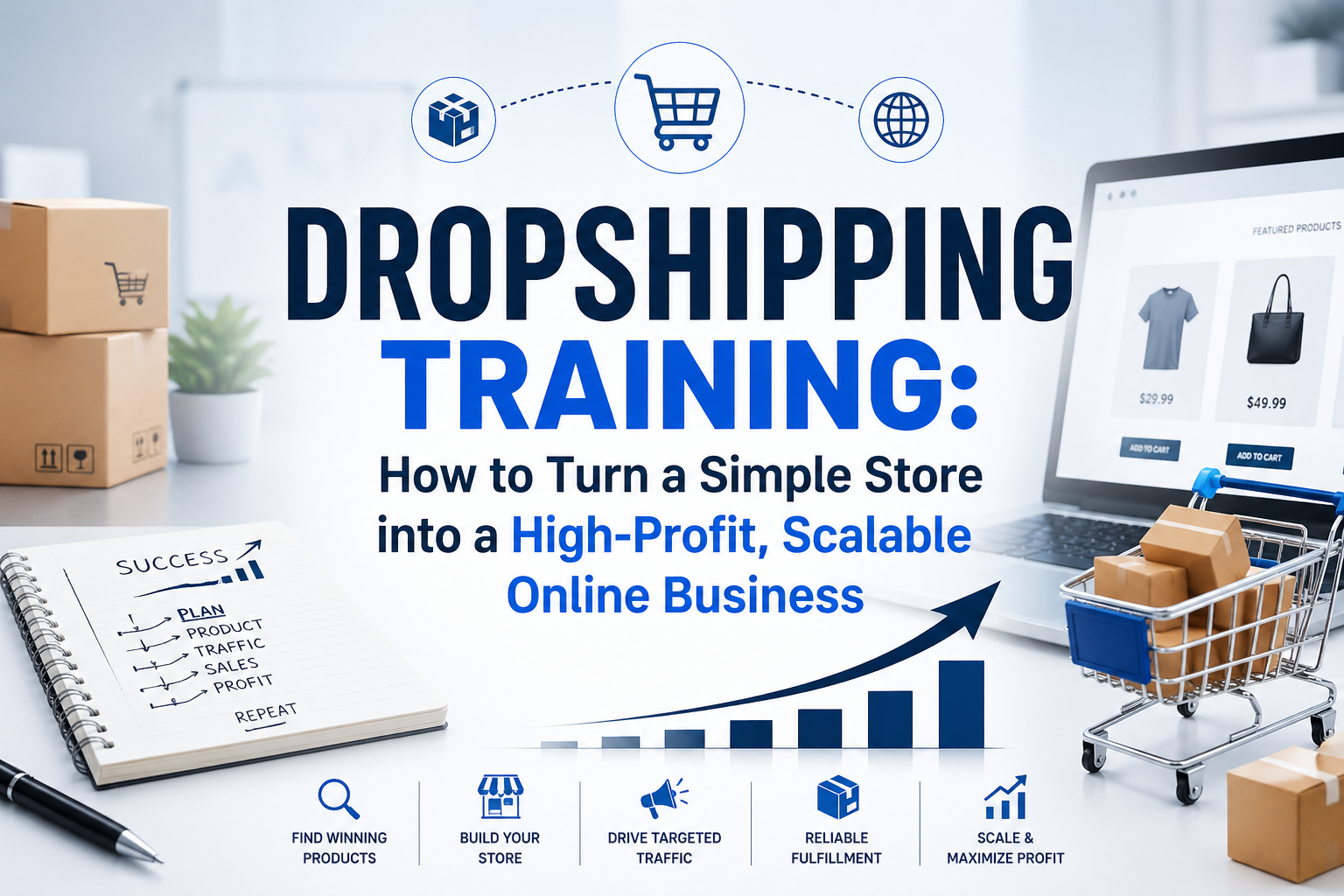
Dropshipping Training for Beginners: How to Launch Your First Profitable Store
Most beginners approach dropshipping training with a misleading expectation: quick profits with minimal effort. In reality, effective training is not about shortcuts, but about building a repeatable system. The goal is to understand how product selection, supplier reliability, pricing strategy, and customer experience connect into a single profit engine.
A well-structured beginner training program focuses on reducing uncertainty. Instead of overwhelming new sellers with tools and tactics, it establishes a clear sequence: validate demand, test products, secure fulfillment, and only then scale. This order is often ignored, which is why many first-time stores fail within the first three months.
Building a Strong Foundation: Store Setup and Market Validation
The first stage of any serious dropshipping training is not advertising—it is validation. Beginners are often tempted to launch a store quickly using platforms like Shopify or WooCommerce, but without validating demand, even a well-designed store will not convert.
Effective training emphasizes starting with a narrow niche rather than a general store. A focused niche allows for better audience targeting and clearer branding. For example, instead of selling “home products,” a beginner might focus specifically on ergonomic desk accessories or pet grooming tools.
Market validation techniques typically include analyzing competitor pricing, reviewing customer feedback on marketplaces, and identifying gaps in product positioning. This phase reduces risk and ensures that the store is built around proven demand rather than assumptions.
Supplier Selection: The Hidden Factor Behind Beginner Success
One of the most underestimated parts of dropshipping training is supplier selection. Many beginners rely solely on marketplaces like AliExpress without evaluating fulfillment speed or product consistency. This leads to delayed shipping, refunds, and negative reviews.
A more advanced beginner training approach introduces the concept of supplier vetting. This includes testing product samples, confirming processing times, and ensuring stable inventory availability. Reliable fulfillment partners can significantly improve customer satisfaction and reduce operational stress.
In 2026, the trend is shifting toward hybrid models—combining traditional dropshipping with localized warehousing. This allows beginners to maintain low upfront costs while still offering faster delivery times, especially in key markets like Europe and North America.
Pricing Strategy and Profit Structure
Another critical component of beginner dropshipping training is pricing. Many new sellers either underprice their products to stay competitive or overprice without understanding perceived value. Both approaches limit scalability.
A structured training framework teaches beginners to calculate margins based on total cost, including product cost, shipping, transaction fees, and advertising expenses. More importantly, it introduces value-based pricing—where branding, packaging, and positioning justify higher price points.
This is where beginners start transitioning from “resellers” to “brand builders,” even at an early stage.
Why Traffic Should Come Last in Beginner Training
A common mistake in beginner dropshipping training is starting with paid ads too early. Without a validated product and optimized store, traffic simply accelerates losses.
Effective training programs delay traffic acquisition until the fundamentals are in place. When beginners finally launch ads—whether on TikTok, Facebook, or Google—they are testing variables within a stable system rather than guessing blindly.
This approach leads to more predictable results and significantly lowers the cost of learning.
Advanced Dropshipping Training: How to Scale Revenue And Optimize Margins
At the beginner level, success in dropshipping often comes from identifying a winning product and generating initial sales. However, scaling beyond this stage introduces a completely different set of challenges. Many stores plateau because they rely on unstable factors such as single-product dependency, inconsistent suppliers, or inefficient ad spending.
Advanced dropshipping training shifts the focus from short-term wins to long-term system optimization. The objective is no longer just to generate sales, but to build a resilient business model capable of sustaining growth under increasing operational complexity.
From Product Testing to Portfolio Strategy
One of the key transitions in advanced training is moving from a “single winning product” mindset to a diversified product portfolio. Relying on one product exposes the business to risks such as market saturation, ad fatigue, and supplier disruption.
A structured scaling approach involves continuously testing new products while maintaining and optimizing existing winners. This creates a layered revenue structure where different products contribute at different stages of their lifecycle. Advanced training often introduces testing frameworks that allow for rapid validation without excessive ad spend.
This shift also enables better brand positioning, as stores evolve from generic product sellers into niche-focused brands with multiple complementary offerings.
Operational Efficiency and Fulfillment Optimization
As order volume increases, operational inefficiencies become more visible. Manual order processing, inconsistent shipping times, and lack of inventory visibility can quickly erode margins and customer trust.
Advanced dropshipping training emphasizes the importance of fulfillment infrastructure. This includes integrating automated order processing systems, working with dedicated sourcing agents, and leveraging regional warehouses to reduce delivery times.
The goal is to create a fulfillment system that scales with demand without increasing operational complexity. Faster and more reliable shipping not only improves customer satisfaction but also enhances conversion rates and reduces refund rates.
Profit Optimization: Beyond Revenue Growth
Scaling revenue does not necessarily mean increasing profit. Many advanced dropshipping stores generate high sales volumes but struggle with thin margins due to rising advertising costs and inefficient pricing strategies.
Advanced training introduces profit-focused metrics such as contribution margin, customer acquisition cost (CAC), and lifetime value (LTV). Instead of optimizing for revenue alone, the focus shifts to maximizing profitability per customer.
This often involves improving average order value through bundling strategies, upsells, and cross-sells. It also includes refining pricing models based on perceived value rather than purely competitive pricing.
Automation and Team Building
At scale, it becomes impossible for a single operator to manage all aspects of the business. Advanced dropshipping training addresses this by introducing automation and delegation strategies.
Automation tools can handle repetitive tasks such as inventory updates, order tracking, and pricing adjustments. Meanwhile, building a small but efficient team allows the business owner to focus on high-impact activities such as strategy, branding, and partnerships.
The combination of automation and team support transforms dropshipping from a side project into a structured business operation.
Scaling Paid Traffic Without Losing Control
Advertising at scale requires a different mindset compared to beginner-level campaigns. Increasing budget without a clear strategy often leads to diminishing returns.
Advanced training focuses on structured scaling methods, such as vertical scaling (increasing budget on proven campaigns) and horizontal scaling (testing new audiences and creatives). It also emphasizes data-driven decision-making, where performance metrics guide every adjustment.
Creative testing becomes a continuous process, ensuring that ad fatigue is managed proactively. This is especially important in platforms like TikTok and Facebook, where content freshness directly impacts performance.
Niche Dropshipping Training: How to Identify High-Profit Markets
In dropshipping, niche selection is not just an early decision—it is the foundation that shapes every aspect of the business. Many sellers fail because they enter oversaturated, highly competitive markets without a clear differentiation strategy. Niche-focused dropshipping training addresses this by teaching how to identify underserved segments with strong demand and manageable competition.
A niche is not simply a product category; it is a defined customer group with specific needs, preferences, and buying behaviors. Training at this level emphasizes understanding customer intent rather than chasing trending products. This shift allows sellers to build more targeted offers and avoid competing solely on price.
Identifying Profitable Niches Through Data, Not Guesswork
Effective niche dropshipping training relies on data-driven validation rather than intuition. Instead of selecting products based on personal preference, sellers are trained to analyze market signals such as search demand, competitor density, and pricing consistency.
A strong niche typically shows three characteristics: stable or growing demand, clear pain points, and the ability to support premium pricing. For example, niches like pet care, home fitness, and personalized gifts consistently perform well because they combine emotional engagement with practical utility.
Another key factor is product depth. A viable niche should support multiple complementary products, allowing for upselling and cross-selling opportunities. This transforms a single-product store into a scalable niche brand.
Positioning and Differentiation Within a Niche
Choosing a niche is only the first step; positioning within that niche is what determines competitiveness. Niche dropshipping training focuses heavily on differentiation strategies that go beyond product features.
This includes branding, storytelling, and perceived value enhancement. For instance, instead of selling generic fitness equipment, a store might position itself around “home workouts for busy professionals” or “rehabilitation-focused fitness tools.” This type of positioning allows for clearer messaging and stronger customer connection.
Differentiation also enables higher pricing flexibility. When a product is tied to a specific identity or use case, customers are less likely to compare purely on price.
Product Strategy: Depth Over Breadth
Unlike general stores that attempt to sell a wide range of unrelated products, niche-focused training encourages depth. This means offering a curated selection of products that serve a specific audience.
A deep product strategy improves user experience, as customers can find multiple relevant items in one place. It also increases average order value through logical product bundling.
For example, in a pet grooming niche, a store might offer grooming brushes, nail clippers, and cleaning tools as part of a complete care solution. This approach not only increases revenue per customer but also strengthens brand credibility.
Marketing Efficiency in Niche Dropshipping
One of the biggest advantages of niche dropshipping is marketing efficiency. A clearly defined audience allows for more precise targeting, which reduces advertising waste and improves conversion rates.
Niche dropshipping training teaches how to align marketing messages with specific customer pain points. Instead of broad, generic ads, campaigns are designed to speak directly to a defined group. This leads to stronger engagement and better return on ad spend.
Content strategy also becomes more focused. Rather than producing random product ads, sellers can build a consistent content theme that reinforces their niche positioning over time.
Scaling a Niche Into a Brand
The ultimate goal of niche dropshipping training is not just to generate sales, but to build a recognizable brand. A well-chosen niche provides the foundation for long-term brand development.
As the business grows, opportunities emerge for private labeling, custom packaging, and exclusive product variations. These elements increase brand equity and reduce dependence on generic suppliers.
Niche brands also benefit from higher customer retention, as they serve a specific audience with ongoing needs. This creates a more stable revenue stream compared to one-time product sales.
Dropshipping Ads Training: How to Build High-Converting Traffic Systems
In dropshipping, traffic is often treated as the primary growth lever. However, without a structured approach, paid advertising becomes the fastest way to lose money. Many sellers enter platforms like Facebook, TikTok, or Google Ads expecting immediate returns, only to face high costs and inconsistent performance.
Effective dropshipping ads training reframes traffic as a system rather than a tactic. The goal is not simply to generate clicks, but to acquire customers at a sustainable cost while maintaining profitability. This requires a combination of data analysis, creative strategy, and funnel optimization.
the Economics Behind Paid Traffic
Before launching any campaign, it is essential to understand the underlying unit economics. Advertising performance is not determined solely by click-through rates or impressions, but by how those metrics translate into revenue.
Dropshipping ads training emphasizes key performance indicators such as cost per acquisition (CPA), average order value (AOV), and conversion rate. These variables are interconnected. For example, a higher AOV can offset higher advertising costs, while a better conversion rate reduces the cost required to acquire each customer.
Without a clear understanding of these relationships, scaling ad spend becomes risky and unpredictable.
Creative Strategy: The Core of Modern Advertising
In 2026, creative performance has become the dominant factor in paid advertising success. Platforms like TikTok and Facebook prioritize engaging content, making ad creatives more important than targeting alone.
Dropshipping ads training focuses heavily on creative testing frameworks. Instead of relying on a single ad, sellers are trained to produce multiple variations, each testing different angles such as problem-solution, product demonstration, or lifestyle positioning.
The objective is to identify which message resonates most with the target audience. Once a winning creative is found, it can be scaled and iterated upon to maintain performance over time.
Platform-Specific Strategies and Their Differences
Not all traffic sources behave the same, and effective training highlights the differences between major advertising platforms.
TikTok Ads are driven by content virality and require native-style videos that blend into the feed. Facebook Ads, on the other hand, rely more on structured targeting and audience segmentation, although creative quality remains critical. Google Ads captures intent-based traffic, making it effective for products with existing demand.
A strong dropshipping ads training program teaches how to align product type and marketing strategy with the appropriate platform, rather than applying a one-size-fits-all approach.
Scaling Without Destroying Profitability
One of the most challenging aspects of advertising is scaling campaigns without losing efficiency. Increasing budget too quickly often leads to higher CPAs and reduced return on ad spend.
Dropshipping ads training introduces structured scaling methods. Vertical scaling involves gradually increasing budget on high-performing campaigns, while horizontal scaling expands reach by testing new audiences, creatives, or platforms.
The key is controlled expansion. Each scaling step should be based on data rather than assumptions, ensuring that growth does not come at the expense of profitability.
The Role of Funnel Optimization
Traffic alone does not guarantee sales. Even the best ads will fail if the store experience is not optimized. Dropshipping ads training therefore integrates funnel optimization into the overall strategy.
This includes improving product page clarity, enhancing trust elements such as reviews and guarantees, and simplifying the checkout process. Small improvements in conversion rate can significantly impact overall profitability, especially at scale.
By treating advertising and conversion optimization as a unified system, sellers can maximize the value of every visitor.
Automated Dropshipping Training: How to Build an AI-Powered E-commerce System
As competition increases, manual dropshipping operations are becoming less viable. Tasks such as product research, order processing, inventory tracking, and pricing adjustments consume significant time and introduce human error. Automated dropshipping training addresses this shift by focusing on system design rather than task execution.
The goal is not to eliminate human involvement entirely, but to reduce dependency on repetitive processes. By integrating automation and AI into core operations, sellers can improve efficiency, reduce costs, and scale without proportional increases in workload.
From Manual Workflows to System Architecture
Traditional dropshipping training often teaches step-by-step actions: find a product, upload it to a store, fulfill orders manually. While this approach works at a small scale, it breaks down as volume increases.
Automated dropshipping training introduces the concept of system architecture. Instead of isolated actions, each component—product sourcing, order management, pricing, and customer communication—is connected through automation tools.
For example, when an order is placed, it can automatically sync with a supplier, trigger fulfillment, update tracking information, and notify the customer without manual intervention. This level of integration transforms the business from reactive to process-driven.
AI in Product Research and Demand Prediction
One of the most impactful applications of AI in dropshipping is product research. Instead of relying on intuition or manual browsing, AI tools can analyze large datasets to identify emerging trends, pricing patterns, and demand signals.
Automated dropshipping training teaches how to leverage these tools to reduce testing risk. By identifying products with rising demand and manageable competition, sellers can make more informed decisions before investing in advertising.
AI can also assist in demand forecasting, helping sellers anticipate order volume and prepare inventory or supplier capacity accordingly. This reduces stockouts and improves customer experience.
Dynamic Pricing and Margin Optimization
Pricing is another area where automation creates a significant advantage. Manual pricing adjustments are often slow and reactive, leading to missed opportunities or reduced margins.
Through automated systems, prices can be adjusted dynamically based on factors such as competitor pricing, demand fluctuations, and advertising costs. This ensures that products remain competitive while maintaining profitability.
Automated dropshipping training emphasizes the importance of setting rules and thresholds rather than making constant manual changes. This allows the system to operate efficiently while still aligning with overall business objectives.
Order Fulfillment and Inventory Synchronization
As order volume grows, fulfillment becomes one of the most critical components of the business. Manual order processing not only slows down operations but also increases the risk of errors.
Automation enables real-time synchronization between the store and suppliers. Orders are processed instantly, tracking information is updated automatically, and inventory levels are monitored continuously.
Advanced training also introduces the concept of multi-location fulfillment, where inventory can be distributed across different warehouses to reduce shipping times. This approach improves delivery speed and enhances customer satisfaction, especially in competitive markets.
Automation in Customer Experience and Retention
Automation is not limited to backend operations; it also plays a role in customer interaction. Automated email flows, order updates, and post-purchase follow-ups help maintain consistent communication without requiring manual effort.
Automated dropshipping training highlights how these systems can improve retention. For example, personalized follow-up messages or product recommendations can increase repeat purchases and lifetime value.
By automating communication while maintaining relevance, sellers can scale customer engagement without sacrificing quality.
Dropshipping Supplier Training: How to Build Reliable Fulfillment Systems
In dropshipping, suppliers are not just vendors—they are an extension of the business. While many training programs focus heavily on product selection and advertising, supplier management is often overlooked. This creates a structural weakness, where even successful stores struggle with late deliveries, inconsistent product quality, and high refund rates.
Dropshipping supplier training addresses this gap by focusing on building a reliable fulfillment backbone. The objective is to ensure that operational execution matches marketing performance. Without this alignment, scaling becomes unsustainable regardless of how strong sales appear on the surface.
Moving Beyond Marketplace Dependency
Many beginners rely entirely on open marketplaces such as AliExpress due to ease of access. However, as order volume increases, this approach becomes inefficient. Processing times, stock inconsistency, and lack of communication create friction that directly impacts customer experience.
Supplier-focused training introduces the transition from marketplace sourcing to dedicated supplier relationships. This includes working with private agents, sourcing companies, or fulfillment partners who can offer more consistent service levels.
The advantage of this shift is control. Instead of reacting to supplier limitations, sellers can define expectations around shipping times, packaging standards, and inventory availability.
Supplier Vetting and Quality Control Systems
Choosing a supplier is not a one-time decision—it is an ongoing process of evaluation and optimization. Dropshipping supplier training emphasizes structured vetting methods rather than trial-and-error.
This includes ordering product samples, verifying material quality, and testing shipping timelines across different regions. Communication responsiveness is another critical factor, as delays in supplier feedback can disrupt operations.
Quality control systems also become essential at scale. This may involve pre-shipment inspections or standardized packaging requirements to ensure consistency across all orders. These processes reduce the likelihood of disputes and improve overall customer satisfaction.
Fulfillment Speed as a Competitive Advantage
In 2026, shipping speed is no longer just a logistical factor—it is a core part of the value proposition. Customers increasingly expect faster delivery, even from dropshipping stores.
Supplier training therefore focuses on optimizing fulfillment speed through strategic solutions. One approach is using regional warehouses in key markets such as Europe and North America. By storing inventory closer to customers, delivery times can be significantly reduced.
Another strategy involves hybrid fulfillment models, where fast-moving products are stocked locally while slower-moving items remain in centralized warehouses. This balance allows sellers to maintain flexibility while improving delivery performance.
Inventory Management and Demand Alignment
A common misconception in dropshipping is that inventory management is unnecessary. While it is true that sellers do not hold stock in traditional models, inventory visibility is still critical.
Dropshipping supplier training introduces systems that synchronize inventory data between suppliers and stores. This reduces the risk of overselling products that are out of stock, which can lead to cancellations and negative reviews.
Advanced approaches also incorporate demand forecasting, allowing sellers to anticipate high-volume periods and coordinate with suppliers in advance. This ensures that supply can meet demand without disruption.
Branding Through Fulfillment and Packaging
As competition increases, fulfillment itself becomes part of the brand experience. Generic packaging and inconsistent presentation limit the ability to build customer loyalty.
Supplier training highlights opportunities for branding within the fulfillment process. This may include custom packaging, branded inserts, or personalized product variations. These elements enhance perceived value and differentiate the business from generic competitors.
Over time, these improvements contribute to stronger brand recognition and higher customer retention rates.



No Comments