


How to Make Big Money from Dropshipping Auto Parts? A Data-Driven Guide to Margins, Suppliers, Logistics and Risk

When you look at the global auto parts market from the outside, it seems like a goldmine. Valued at over US$400 billion globally and projected to grow steadily through 2030, the aftermarket segment alone represents one of the largest product categories sold online. Yet within that massive space, profitability for dropshippers varies dramatically depending on what kind of parts you sell. To understand whether dropshipping auto parts is truly profitable, it’s essential to separate the market into three key product classes — consumables, performance and modification parts, and accessories — each carrying its own cost structure, margin potential, and risk profile.

Comparing Consumables, Performance Parts, and Accessories
Consumables: The High-Volume, Low-Margin Backbone
Consumables are the parts that wear out, get replaced regularly, and keep vehicles running smoothly: oil filters, brake pads, wiper blades, bulbs, fluids, belts, and spark plugs. In the traditional retail model, these items typically carry gross margins between 20% and 40%, depending on the brand and distribution channel. For dropshipping businesses, the story gets more complicated.
Because consumables are often price-sensitive and highly competitive, the ability to command a high markup is limited. Amazon and RockAuto have set consumer expectations for extremely thin margins and fast delivery. Dropshippers entering this segment must rely on volume and customer retention rather than fat profits per sale.
However, consumables also offer one advantage that many other auto parts categories do not — repeat purchase cycles. The average car owner replaces wiper blades every 6–12 months and brake pads every 2–3 years. That repeat behavior allows a dropshipper with strong SEO and solid product listings to generate recurring revenue from the same customers over time. If fulfillment and logistics are well optimized, it’s not impossible to sustain a net margin of 10–15% in this category through efficiency rather than markup.
Performance and Modification Parts: The Profit King
On the opposite end of the spectrum lie the performance and modification parts — air intakes, turbo kits, exhaust systems, coilovers, ECU tuners, and aesthetic upgrades like carbon fiber spoilers. This is where dropshipping begins to look truly lucrative.
Unlike consumables, these products rely heavily on branding, perceived quality, and niche appeal, not just function. Enthusiasts are often willing to pay a premium for aesthetics, performance improvement, or brand reputation. For example, certain aftermarket performance parts can sell at gross margins of 50–70%, with some niche items even higher when sourced directly from specialized overseas suppliers.
That said, the higher profit potential comes with higher operational risk. Performance parts are expensive, heavy, and often specific to exact vehicle models — meaning returns or incorrect fitment can quickly erode profit. A single incorrectly shipped coilover set or mismatched turbocharger may cost more in return shipping than the margin on several smaller sales combined.
Dropshippers who succeed in this space tend to specialize deeply. They offer clear compatibility information (VIN-based lookup tables), work with reliable niche suppliers, and build credibility in enthusiast communities through content marketing, installation tutorials, and user-generated media. For these players, a well-curated performance parts catalog can deliver average gross margins of 40–60%, though net profit may fall closer to 20–25% after ads and logistics are considered.
Accessories: The Bridge Between Necessity and Lifestyle
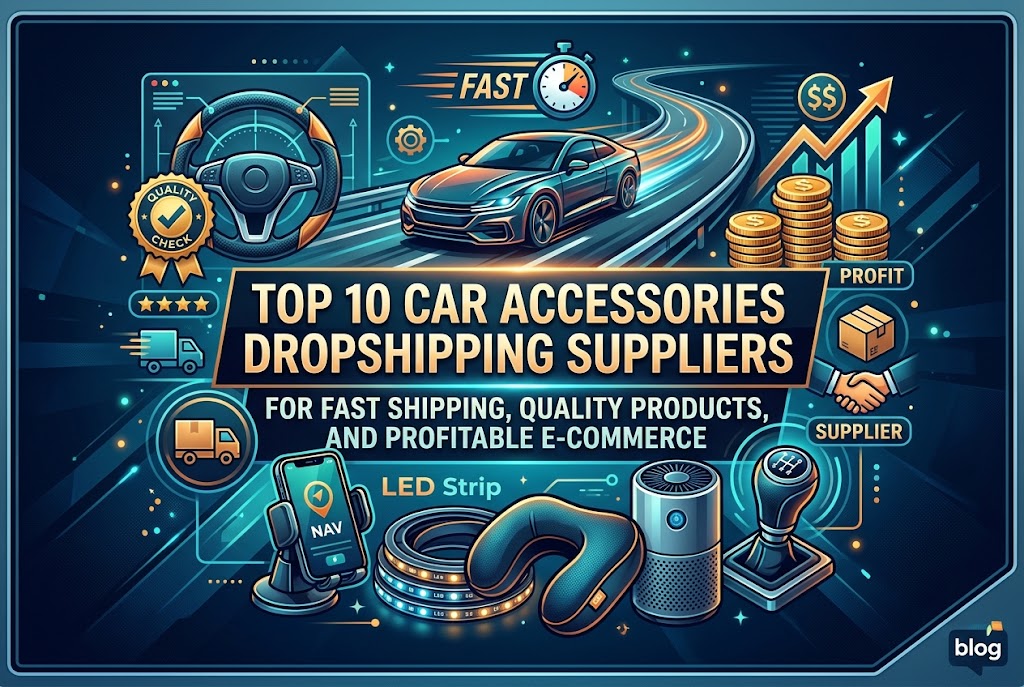
Between functional consumables and high-performance parts sits the vast category of automotive accessories. Think seat covers, floor mats, LED strips, phone mounts, roof racks, dash cameras, or car organizers. This segment is arguably the easiest entry point for new dropshippers because compatibility is broader and customer risk tolerance is higher.
Accessories combine the repeatability of consumables with the brand storytelling potential of performance parts. Because they often target emotional or aesthetic appeal, these products allow for creative marketing and bundling — a strategy rarely possible with maintenance parts.
From a profitability perspective, accessories tend to sit in the 30–50% gross margin range, depending on sourcing and differentiation. Small, lightweight items reduce shipping costs and returns, while visual appeal boosts conversion rates on social platforms. The trade-off, of course, is oversaturation: the barrier to entry is low, and cheap knock-offs flood online marketplaces. Dropshippers must therefore focus on curation, perceived value (such as “premium” branding or better packaging), and upselling through bundles to keep margins healthy.
Comparing the Three Categories
If we summarize the three categories side by side:
- Consumables offer steady demand and repeat business but low per-sale profit.
- Performance parts promise high gross margins but require technical expertise and careful supplier management.
- Accessories strike a balance between volume and markup but demand strong branding to differentiate from competitors.
The most profitable dropshipping businesses don’t restrict themselves to just one category — they blend them intelligently. For example, a store specializing in off-road vehicles might sell both consumables (filters, fluids), performance parts (lift kits, LED bars), and accessories (organizers, recovery gear) under one thematic brand. This hybrid approach not only diversifies risk but also increases the average order value and customer lifetime value (LTV).
How Shipping, Returns, and Warranty Eat Your Margins: Dropshipping Auto Parts Cost Breakdown
At first glance, the auto parts industry looks like a dream for e-commerce entrepreneurs. With a global market projected to exceed US$500 billion by 2030, even a fraction of that pie seems tempting for anyone considering dropshipping. Yet behind the promising sales volumes and endless SKU opportunities hides a less glamorous reality — thin net profit margins. Many new sellers discover that what looked like a 40% gross margin quickly evaporates after factoring in shipping, returns, and warranty claims. To understand the real profitability of dropshipping auto parts, we need to break down these cost layers in detail.
The Illusion of the Gross Margin
Most dropshipping guides emphasize product markup — the difference between wholesale cost and retail price — as the measure of profitability. On paper, many auto parts categories offer gross margins of 30%–50%. However, gross margin is not profit; it’s simply the room you have before operational costs start eating into your earnings.
When you subtract logistics, advertising, transaction fees, and post-sale liabilities, that comfortable-looking 40% can easily shrink to 10–15% net margin, or sometimes even less. For context, a Shopify-based auto parts dropshipper selling mid-priced accessories might gross $100,000 annually but only keep $10,000–15,000 after all expenses — a margin more in line with traditional retail than with digital businesses promising “high-profit” automation.
Shipping: The First Margin Killer
Auto parts are not lightweight gadgets or fashion accessories. Even something as simple as a brake rotor weighs several kilograms and costs significantly more to ship than a small electronic item. International shipping costs have stabilized since the pandemic spike, but the reality remains that auto parts shipping consumes 10–25% of the retail price depending on the item’s weight, dimensions, and destination.
For example, a set of performance coilovers might sell for $700, with supplier cost at $400 and retail shipping around $70. That means $230 of theoretical gross profit, but $70 immediately disappears into freight. Add packaging and handling, and your real gross drops below $150 — before advertising or payment fees.
Many new dropshippers assume they can simply “pass the shipping cost to the customer.” In practice, this leads to cart abandonment rates above 60%, as customers expect free or low-cost shipping similar to Amazon’s benchmark. Successful stores often integrate shipping into pricing or offer thresholds for free delivery (e.g., free shipping above $100). While this helps conversion, it pushes logistics expenses back into the seller’s pocket.
The more complex the part, the worse the problem becomes. Bulky exhaust systems, heavy engine components, or fragile lighting assemblies require premium carriers and extra packaging. That’s why experienced dropshippers either specialize in lightweight items (like sensors, LED bulbs, or electronics) or adopt hybrid fulfillment, where frequently sold items are pre-stocked domestically to reduce per-unit shipping costs and delivery times.
Returns: The Hidden Cost of Compatibility
Even when the sale goes smoothly, the post-sale phase can destroy your margin. The auto parts sector faces an unusually high return rate of 8–20%, largely due to compatibility issues. Customers often order the wrong part for their vehicle, misinterpret model years, or assume universal fitment where it doesn’t exist.
A single return can erase the profit from several successful transactions. Consider this: your gross profit on a $100 sale might be $30. If the part is returned, you pay for return shipping (often $15–25), restocking, and the nonrefundable portion of transaction or advertising costs — resulting in a net loss of $10–20 per order.
That’s why precision and communication are crucial in this niche. High-performing sellers invest in fitment verification systems — online tools that cross-check parts with VINs or model years — to minimize returns. They also work closely with suppliers who accept returns under reasonable terms. Many cheap overseas vendors refuse to handle returns, leaving the seller to absorb the entire cost.
The data shows that every 1% increase in return rate reduces net profit by roughly 0.7–1 percentage point, depending on shipping policy and average order value. In other words, cutting your return rate from 12% to 8% can be the difference between breaking even and turning a real profit.
Warranty and After-Sales Liabilities
While fashion or gadget sellers can simply issue a refund and move on, auto parts sellers deal with product warranties and performance guarantees that extend months or even years. Customers expect functional reliability — a failed alternator or defective sensor isn’t just inconvenient; it can immobilize a vehicle.
Warranty claims often require technical evaluation, replacement shipments, and coordination with the supplier. In dropshipping, where the seller doesn’t control inventory, this process can drag out and generate customer frustration, negative reviews, and refund disputes. Financially, each warranty case may consume 3–10% of monthly revenue when averaged across the store, especially if the seller must cover shipping both ways.
The complexity is even greater for high-value items like electronics or suspension kits. Some sellers choose to build the warranty cost into the price — effectively reducing their gross margin but ensuring long-term sustainability. Others limit warranty coverage to “manufacturer’s warranty only,” but this can deter buyers and reduce conversion rates. The key is transparency: clearly defining warranty policies and communicating realistic timelines prevents unexpected cash flow shocks.
Advertising, Fees, and Platform Costs
Even after mastering logistics, a hidden layer of expenses awaits in marketing and transaction fees. Paid traffic, whether through Google Shopping or Meta Ads, can consume 20–40% of gross profit for each sale. Add payment gateway fees (2–3%), platform commissions (if using eBay or Amazon), and third-party integrations, and the cumulative effect can cut your bottom line to the bone.
Many profitable dropshippers mitigate this by focusing on SEO and organic content marketing — blog posts, fitment guides, YouTube installation videos — rather than relying solely on paid traffic. These strategies reduce customer acquisition cost (CAC) over time and stabilize net margins closer to 15–25% instead of the single digits often seen in ad-dependent operations.
Putting It All Together: The True Net Margin
When you aggregate all the above costs, a realistic cost structure for a dropshipping auto parts business might look like this:
- Product cost: 55–60% of retail price
- Shipping and packaging: 10–20%
- Advertising and transaction fees: 10–15%
- Returns and warranty: 3–8%
- Net profit margin: typically 8–15%
That margin is not bad by traditional retail standards, but it’s far from the “50% profit” myth often circulated online. The good news is that through scale and process optimization, these numbers can improve. Sellers who implement hybrid logistics, reduce returns through accurate fitment data, and rely on organic marketing can push net profit toward 20% or higher, turning a tough niche into a sustainable business.
OEM vs Aftermarket vs Overseas Suppliers — Which Is Best for Dropshipping Auto Parts?
Choosing the right supplier is one of the most decisive factors in determining whether dropshipping auto parts is profitable. While marketing and SEO can get customers to click “buy,” your supplier ultimately controls your quality, delivery times, and reputation — the real pillars of profitability. In the automotive space, three main supply channels dominate: OEM (Original Equipment Manufacturer) parts, aftermarket parts, and overseas suppliers. Each offers a distinct balance of cost, reliability, and risk that directly affects your gross margin and long-term growth potential.
the Supply Chain Landscape
The global auto parts supply ecosystem is complex and hierarchical. OEMs make components that car manufacturers use in assembly lines — think Bosch producing ignition systems or Denso supplying sensors for Toyota. These same OEMs also produce branded replacement parts that enter the aftermarket. Aftermarket suppliers, on the other hand, produce compatible alternatives, often at lower prices. Finally, a large wave of overseas manufacturers, especially from China, India, and Eastern Europe, now serve the global market through direct-to-dropship models via platforms like Alibaba, Banggood, or Temu Business.
The type of supplier you choose determines not only your cost structure but also your liability exposure, customer satisfaction, and scalability. Let’s examine how each model shapes profitability.
OEM Suppliers: High Trust, Lower Margins, and Long-Term Stability
OEM suppliers offer the holy grail of credibility. Their products are identical or equivalent to what came with the vehicle, carrying a manufacturer’s logo and often a longer warranty. Customers trust OEM brands because they imply precision fit and reliability — two key values in the auto parts industry.
However, the downside for dropshippers is price and accessibility. OEM parts generally cost 30–50% more than aftermarket equivalents. The gross margin for resellers is therefore narrower — typically 15–30%, according to aftermarket retail benchmarks. When you add shipping and platform fees, the net profit may drop below 10%.
Still, OEM parts offer one strategic advantage: low return and dispute rates. Since these parts are guaranteed to fit and perform as expected, compatibility-related returns are rare. This stability allows sellers to maintain a predictable cash flow and build brand reputation.
Working directly with OEM distributors or certified wholesalers may require proof of business registration and a minimum sales volume, which limits entry for smaller dropshippers. Yet for stores aiming to position themselves as premium, trustworthy suppliers — especially in niches like European or Japanese vehicles — OEM sourcing provides reliability that cheap alternatives simply can’t match.
Aftermarket Suppliers: The Profit Sweet Spot
If OEMs define quality, aftermarket suppliers define profitability. Aftermarket parts are built by third-party manufacturers to meet or exceed OEM standards. Many reputable brands — such as ACDelco, Beck/Arnley, or Brembo — fall into this category, offering high-quality alternatives at lower costs.
The aftermarket sector dominates the global auto parts e-commerce space, accounting for roughly 60–70% of online auto parts sales. The reason is simple: higher margins with acceptable quality. For dropshippers, gross margins often fall between 30% and 50%, depending on product type and exclusivity.
Another key advantage is the variety. Aftermarket suppliers produce parts for vehicles well beyond their warranty periods — often covering models that OEMs no longer support. That long tail of older vehicles is fertile ground for dropshippers, as the audience is underserved by official dealers and more price-conscious.
However, success in the aftermarket world requires rigorous vetting. Quality standards vary widely, and low-end aftermarket parts can hurt your brand if they fail prematurely. Smart dropshippers focus on known brands, invest in detailed product descriptions, and showcase customer reviews to build confidence. Returns due to poor fit or performance remain a risk, though significantly lower than with unverified overseas sources.
Overseas Suppliers: Maximum Margin, Maximum Risk
At first glance, overseas suppliers — especially from China — look irresistible to new dropshippers. Unit costs are dramatically lower: a set of LED headlight bulbs might cost $10 wholesale and sell for $40–$50 online, suggesting gross margins above 60%. On paper, that’s double what OEM resellers can achieve.
Yet every dollar of extra margin comes with a dollar of added uncertainty. Overseas suppliers present three major challenges:
- Inconsistent quality control, which leads to high return rates.
- Long shipping times, often 2–4 weeks even with priority logistics.
- Limited or nonexistent warranties, forcing the seller to absorb replacement and refund costs.
When returns and customer dissatisfaction are factored in, that 60% gross margin can shrink to 10–15% net, similar to or worse than domestic aftermarket sourcing. The reputational risk is also substantial: poor reviews about fitment or delays can tank your SEO ranking and paid ad performance.
There are, however, strategic exceptions. For lightweight accessories and visual modifications — items like emblems, ambient lighting kits, or seat covers — overseas suppliers can be effective partners. These products have lower safety implications and broader compatibility, making quality less critical and returns less frequent. The key is to start small, order samples, and validate supplier performance before scaling.
The Hybrid Sourcing Model: Blending Profit and Trust
In practice, the most successful auto parts dropshippers don’t limit themselves to one category. Instead, they adopt a hybrid sourcing strategy. They use OEM or branded aftermarket suppliers for functional or safety-critical parts (like brakes or suspension components) to preserve customer trust, while leveraging overseas suppliers for accessories and cosmetic upgrades that boost average order value.
This multi-tier approach allows businesses to optimize gross margins across the catalog. For instance:
- Consumables sourced from regional aftermarket distributors might yield 30–35% margin.
- Performance parts from reputable aftermarket brands could deliver 40–50%.
- Aesthetic accessories from overseas manufacturers could push margins up to 60%.
When averaged together, the business achieves a blended gross margin of around 40–45%, while keeping return rates low and customer satisfaction high.
Hybrid models also make logistics more flexible. Domestic suppliers can handle time-sensitive shipments, while overseas partners fulfill non-urgent items. The challenge lies in managing multiple integrations and ensuring pricing consistency, but modern e-commerce platforms and supplier APIs (like ScaleOrder or Spocket Automotive) simplify this process significantly.
Supplier Selection as a Profitability Strategy
The difference between a profitable and unprofitable dropshipping auto parts store often isn’t marketing skill — it’s supply chain discipline. A reliable supplier directly reduces refund disputes, order delays, and bad reviews — all of which have measurable financial consequences.
A 2024 market analysis by Grand View Research noted that every 1% improvement in on-time delivery rates correlates with a 0.3–0.5% improvement in overall profit margin in e-commerce logistics. That correlation is particularly strong for auto parts, where customer frustration translates into high chargeback risk.
Thus, supplier vetting should include metrics like average delivery time, defect rate, warranty support responsiveness, and stock accuracy. Dropshippers who treat supplier management as a continuous process — rather than a one-time decision — tend to maintain sustainable net margins above 20%, even in a competitive environment.
How to Build a High-Margin Dropshipping Business in Auto Parts
If there’s one dropshipping niche that requires precision and reliability, it’s auto parts. Unlike fashion or phone accessories, the automotive aftermarket depends on accuracy, compatibility, and customer trust. Yet, this challenge also hides a significant opportunity. The global automotive aftermarket industry was valued at over $400 billion in 2024 and continues to grow annually at 4–5%, driven by longer vehicle lifespans and the boom in e-commerce auto retail.
Dropshipping auto parts, if done correctly, can be extremely profitable. But the margins aren’t equally distributed across all types of products. The strategy lies in identifying the right product mix, brand positioning, and supplier relationship model to make the business sustainable.
Gross Margins in the Auto Parts Market
Let’s look at some hard numbers. On average, gross margins in traditional auto parts retail sit around 25–45%. In dropshipping, where logistics and inventory costs are lower, the margins can theoretically increase—but price competition often keeps them around 15–35% for most parts.
However, premium or specialized components—like LED lighting systems, performance filters, diagnostic tools, and custom accessories—can yield 40–60% margins. That’s why the most successful dropshippers focus not on universal car parts, but on niche and upgrade-oriented categories that appeal to enthusiasts and DIY mechanics.
For instance:
- A performance air intake kit for sports cars can retail for $180 with a wholesale cost of $100 — a 44% gross margin.
- A set of LED headlights costing $50 wholesale can retail at $90 — a 44% margin again.
- Meanwhile, a basic OEM replacement like brake pads might yield just 10–15%, because customers often compare prices aggressively.
The key takeaway: Margin stability depends on product differentiation—and that can only be achieved through branding and targeted marketing.
Branding and Differentiation in a Crowded Market
Most new sellers make the mistake of thinking that auto parts are purely functional products. But in today’s e-commerce landscape, trust and authority are brands in themselves. A dropshipper that invests in clear fitment data, compatibility tools, and strong packaging can outperform a cheaper competitor with poor presentation.
In fact, research from eBay Motors and AutoPartsWarehouse shows that shoppers are 70% more likely to buy from listings with verified compatibility and professional photos, even at a higher price point. This creates a strong argument for branding through credibility rather than aesthetics alone.
To build this brand trust:
- Use a consistent naming format that clarifies make, model, and year compatibility.
- Add installation videos and guides—customers perceive higher value when they feel supported.
- Partner with niche influencers or car forums; these communities are goldmines for targeted exposure.
Supplier Strategy and Logistics Optimization
Your profitability as a dropshipper depends heavily on supplier performance. Because parts must fit specific vehicles, inaccurate or delayed shipments can destroy customer trust. Thus, supplier selection isn’t just about cost—it’s about precision, fulfillment speed, and inventory consistency.
Working with regional or domestic suppliers may reduce margins slightly but can drastically increase repeat purchases and reduce returns. Many successful dropshippers use a hybrid model, combining fast-moving products from local distributors and slower-moving, niche items from overseas manufacturers.
For example, sourcing from U.S. distributors like Turn14 Distribution or Keystone Automotive allows real-time inventory updates and fast delivery, while AliExpress or Alibaba vendors can support less common parts or accessory categories at low cost.
A balance between these two ensures sustainable pricing without the logistical chaos that plagues most new auto parts stores.
Pricing Psychology in the Automotive Market
Car owners are often emotionally attached to their vehicles. This means price sensitivity depends on the type of buyer. Performance enthusiasts and restorers are willing to pay more for perceived quality, while fleet owners and mechanics focus strictly on cost.
Dropshippers who create product segmentation around “enthusiast,” “daily driver,” and “professional mechanic” personas can optimize margins by aligning pricing with motivation.
A $60 carbon fiber mirror cap might be overpriced for a daily driver—but for a car enthusiast on social media, it’s a bargain for style and uniqueness. Understanding this psychology is what separates a generic dropshipping store from a brand-driven, profitable auto parts business.
The Future of Auto Parts Dropshipping: AI, Automation, and Data-Driven Margins
If you’re wondering is dropshipping auto parts profitable in 2025, the answer increasingly depends on how much technology you integrate—not just what products you sell. The auto parts sector has shifted from a simple retail model to a data-driven logistics ecosystem, and those who use automation tools, AI-powered fitment systems, and predictive pricing engines are already taking the lion’s share of the market.
The profit equation in auto parts has evolved. It’s no longer only about finding low-cost suppliers—it’s about scaling precision through automation, keeping error rates low, and extracting efficiency from every customer interaction.
Automation and the 2025 Margins Landscape
The auto parts e-commerce industry, valued at over $500 billion globally, continues to grow by 4–6% annually. Yet, competition means margins are tightening—unless automation is part of the strategy.
Traditional dropshippers average 15–25% gross margins after accounting for returns and customer support costs. In contrast, automated stores using integrated fitment software, smart inventory sync, and AI customer service can achieve 35–45% net operational margins.
For example:
- An automated SKU-matching tool can cut return rates by 40%, saving roughly $3–$5 per order.
- AI chatbots that resolve 70% of common customer queries reduce labor costs by 60%.
- Smart pricing engines (like Repricer or PriceMole) dynamically adjust prices based on demand and competitor data, improving profit-per-sale by up to 8–12% on high-volume parts.
That’s why future profitability isn’t about finding “winning products” anymore—it’s about building a self-learning, efficient sales system.
AI in Product Data and Fitment Accuracy
One of the biggest challenges in auto parts dropshipping is fitment accuracy—ensuring each part matches the buyer’s vehicle make, model, and year. Manual updates don’t scale when your catalog includes 50,000+ SKUs.
AI systems now solve this problem by analyzing product titles, part numbers, and OEM cross-references automatically. For example, an AI model trained on manufacturer data can detect that a “2018 Honda Civic front lower control arm” matches 14 different OEM codes and alert you if a supplier’s listing contains an inconsistency.
Stores that adopt these systems not only reduce mismatched orders but also rank higher in SEO—because accurate listings improve search relevance and reduce bounce rates.
According to Shopify Plus data from 2024, AI-optimized product catalogs had 23% higher conversion rates than manually maintained ones.
Predictive Inventory and Supplier Data Integration
In 2025, automation extends beyond customer-facing tools. The top-performing auto parts dropshippers now use supplier-side API integrations that allow real-time inventory tracking and predictive order routing.
For example, when a customer in Germany buys a spark plug, your system can automatically choose the nearest supplier warehouse for faster shipping and lower costs—without you touching a thing.
Predictive algorithms can even forecast which parts are likely to trend based on vehicle age cycles and repair data. If the average age of Ford F-150s in the U.S. is now 9 years, the system anticipates increased demand for brake rotors and ignition coils months in advance.
This level of forecasting helps dropshippers preemptively list and promote the right parts before the competition—turning data into profit.
Smart Pricing and Competitive Edge
Pricing wars are one of the biggest threats to profitability in auto parts. But dynamic pricing tools powered by AI are changing the game. These systems monitor thousands of marketplace listings in real time and adjust prices within set margins to remain competitive while protecting your profitability.
Let’s say your cost for a car battery is $75, and you set a margin target of 30%. If the system detects competitors lowering their price to $94, it automatically drops yours to $92—still maintaining your 22% margin while keeping the listing visible.
Dropshippers who use smart repricing see conversion rates rise by 20–35% without manual oversight. The result? A business that runs efficiently 24/7, always priced for profit, not guesswork.
The Human Element: Strategy Still Matters
Even as AI reshapes the landscape, strategy remains king. The most profitable auto parts dropshippers in 2025 combine technology with brand storytelling and niche targeting. They use automation to eliminate friction—but human insight to decide which market segments to serve.
An AI can recommend products, but only you can understand that off-road truck owners value ruggedness over cost, or that EV drivers care more about performance data and sustainability.
The future isn’t about removing humans—it’s about letting automation handle complexity so you can focus on brand, marketing, and customer loyalty.
Tech as the Profit Multiplier
In the next few years, dropshipping profitability will increasingly favor tech-driven businesses. AI-based fitment, predictive supply chains, and smart pricing aren’t luxuries anymore—they’re competitive necessities.
With these tools, a modern auto parts dropshipping store can realistically achieve gross margins of 35–50%, while manual operations may struggle to stay above 20%.
In short: the future of profitable auto parts dropshipping belongs to those who automate intelligently, analyze constantly, and act strategically.



No Comments