


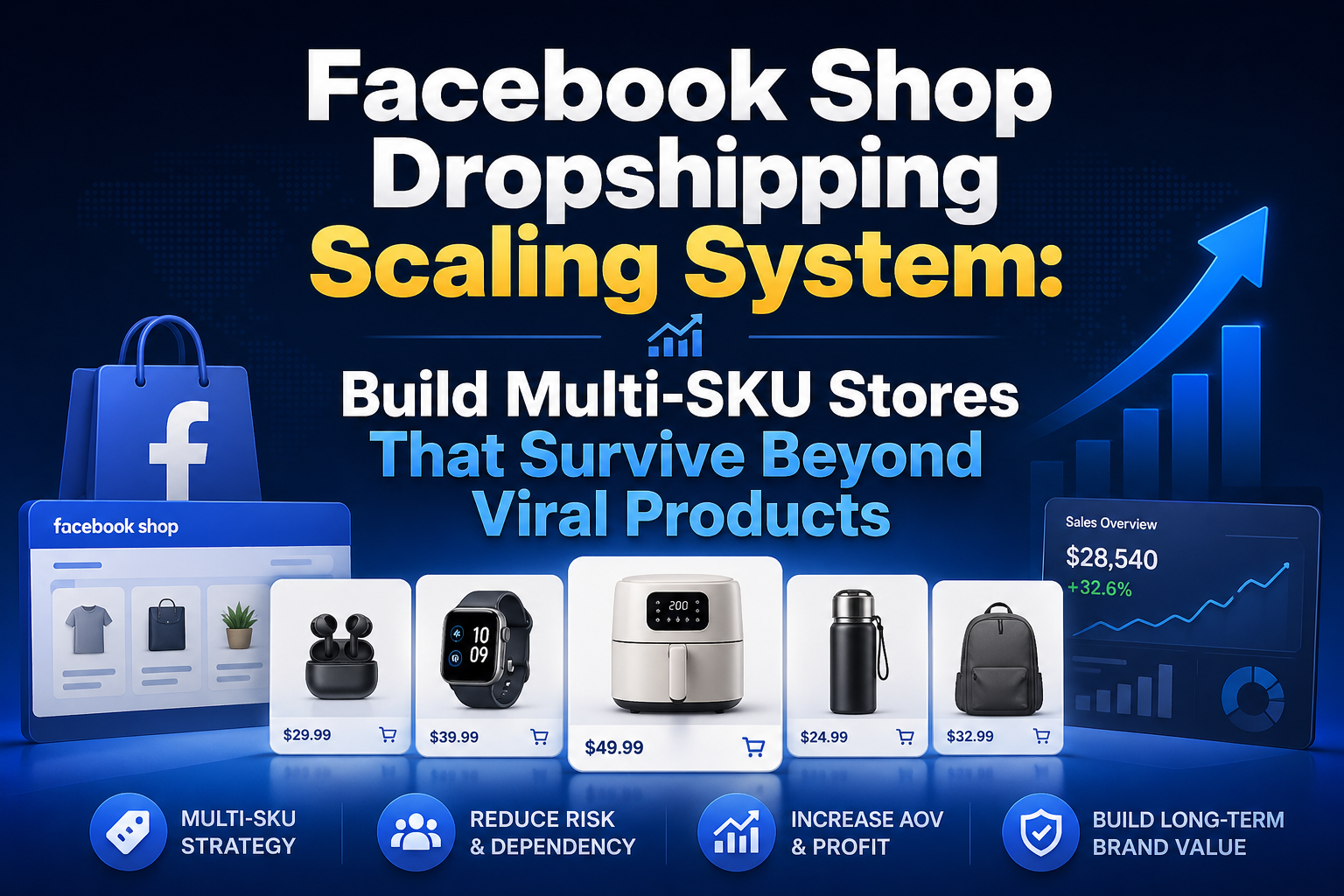
Facebook Shop Dropshipping Scaling System: Build Multi-SKU Stores That Survive Beyond Viral Products

Facebook Shop dropshipping is not a guessing game if you treat testing like engineering instead of gambling. The cold start method removes emotion from decision-making and replaces it with measurable behavioral signals.
Once I shifted to this system, my winning rate didn’t just improve—it became predictable. And in dropshipping, predictability is the real advantage, not luck.
My Real Facebook Shop Product Validation System That Filters Winners Before Scaling
When I first started doing Facebook Shop dropshipping, my biggest mistake wasn’t ads or creatives—it was testing too many products blindly and scaling the wrong ones. I used to believe that “good products sell themselves,” but after burning through several hundred dollars in ad spend, I realized the truth is harsher: most products don’t fail because of demand, they fail because they were never properly validated.
Now, I use a very specific cold start testing system inside Facebook Shop that allows me to identify winning products within 48–72 hours using only $20 to $50 per product. This approach completely changed how I build stores because I no longer rely on intuition or trends—I rely on structured micro-data.
The Cold Start Testing Setup I Actually Use
I don’t launch a product with a full funnel anymore. Instead, I treat every new product like a “micro experiment.”
For each product, I create:
- 1 simple product page inside Facebook Shop (no heavy branding)
- 1 short-form UGC-style video (15–25 seconds)
- 1 interest-based ad set with broad targeting
- A fixed daily budget of $10–$20 maximum
The goal is not to profit immediately. The goal is to answer one question: does the market even react to this product?
For example, I tested a phone accessory product that looked extremely average. My expectation was low. But within the first $18 spent, I got a CTR of 4.8% and two add-to-carts. That was enough signal for me to scale further.
The Real Metric I Care About (Not ROAS)
Most beginners obsess over ROAS too early, and that’s where they go wrong.
In cold testing, I don’t care about profit. I care about behavioral signals:
- CTR above 3% means the product is interesting
- Add-to-cart rate above 5% means intent is forming
- Cost per click stability shows audience alignment
I once had a product with negative ROAS in the first 24 hours, but extremely strong engagement signals. I scaled it anyway. On day 4, after creative iteration, it became a consistent 2.6x ROAS product.
If I had killed it too early, I would have missed a winner.
Why Facebook Shop Makes This Testing Method Unique
The advantage of Facebook Shop compared to Shopify alone is that the platform already has built-in trust and frictionless checkout behavior.
This matters because during cold testing, you are not just testing the product—you are testing:
- impulse behavior inside Meta ecosystem
- native checkout conversion speed
- product-page interaction inside Shop feed traffic
I noticed that some products fail on Shopify but perform significantly better inside Facebook Shop because users don’t leave the platform. That single difference increases conversion probability enough to justify micro-testing almost anything.
A Real Failure That Taught Me the System
One of my biggest early losses was a “home fitness gadget” product. It looked viral on TikTok, so I scaled it too fast with $300 in ads. No testing phase.
Result: zero scalability, high refund rate, and weak engagement.
Later, I re-tested a similar product properly using my $20 method. I discovered that the demand existed only in a very narrow age group and only with a specific video angle. The problem wasn’t the product—it was my lack of structured validation.
The Hidden Costs, Refund Reality, and True Margin Structure I Learned After Scaling Multiple Facebook Shop Stores
When I first started scaling Facebook Shop dropshipping products, I thought I was doing well because my ads dashboard showed 2.5x to 3x ROAS. It looked like I had found a working system. But after my first real payout cycle, I realized something uncomfortable: the numbers I was celebrating were not the money I was actually keeping.
The biggest mistake I made early on was treating ROAS as profit. In reality, ROAS is only a surface-level metric inside Facebook’s ecosystem. It does not account for refunds, shipping delays, payment processing delays, or even the hidden cost of scaling unstable products.
Once I started tracking real net profit instead of dashboard performance, my understanding of Facebook Shop dropshipping changed completely.
The First Time I Thought I Was Profitable (But Wasn’t)
I remember one product very clearly—a simple home gadget that was getting consistent sales. My ads manager showed:
- Spend: $1,200
- Revenue: $3,400
- ROAS: ~2.8
On paper, this looked like a clear winner. I even started planning to scale it aggressively.
But two weeks later, reality caught up:
- Refund rate: 18%
- Shipping cost increases due to supplier adjustments
- Payment processing fees higher than expected
- Chargebacks from delayed delivery customers
After everything was deducted, my actual net margin dropped to around 6–8%. That completely changed how I evaluated “winning products.”
The Real Facebook Shop Profit Structure Nobody Talks About
What most beginners don’t realize is that Facebook Shop dropshipping has a layered cost structure that quietly eats into margins.
In my experience, a typical product breakdown looks like this:
- Product cost: 25–40%
- Advertising cost: 20–50% (depending on scaling stage)
- Refunds & chargebacks: 5–20%
- Payment processing fees: ~3–5%
- Operational leakage (lost parcels, disputes, support time): variable but real
When you combine all of these, a “3x ROAS product” can easily become a 10–15% net margin product—or even break even if scaling is aggressive.
This is why I stopped trusting ROAS as a decision metric.
Why Refund Rate Is the Silent Killer
One of the most underestimated factors in Facebook Shop dropshipping is refund behavior.
I noticed something interesting after analyzing multiple stores:
products that sell easily often refund easily as well.
For example, impulse-buy products (gadgets, small accessories) tend to have:
- high CTR
- high conversion rate
- but also higher buyer regret
One product I scaled aggressively had a 22% refund rate. It still looked profitable on ads, but in reality it was draining cash flow every week.
The worst part? Refunds don’t appear immediately in your ad dashboard, so you only see the damage after scaling.
Cash Flow Timing: The Hidden Pressure Most People Ignore
Another reality I learned the hard way is that Facebook Shop cash flow is not instant profit.
There is always a delay between:
- customer payment
- platform holding funds
- payout cycles
- supplier payment timing
During scaling, this creates a situation where you can be “profitable on paper” but cash negative in real life.
I once scaled too quickly and ended up in a cash crunch because ad spend went out faster than payouts came in. That experience forced me to slow down and structure scaling in phases instead of jumping from testing to aggressive scaling too early.
What I Do Now Instead
After losing money on “fake winners,” I changed my evaluation system completely. Now I only scale products if they pass three layers:
- Stable ad performance over multiple days
- Refund rate below a safe threshold
- Clear net margin after all hidden costs
If a product fails any of these, I don’t scale it—even if ROAS looks strong.
This approach reduced my total number of “false winners” significantly and made my scaling much more predictable.
How I Turned the Same Product from Zero Sales to Consistent Conversions Just by Changing Creative Structure, Hook Style, and Visual Framing
When I first started running Facebook Shop dropshipping ads, I believed product selection was everything. If a product didn’t sell, I assumed it was “not a winner.” But after running dozens of tests, I discovered something much more important: the same product can either completely fail or scale profitably depending on the creative structure alone.
In fact, I’ve personally seen cases where the exact same product had a 10x difference in conversion rate just because of how it was presented in the video.
This realization completely changed how I approach Facebook Shop dropshipping. I no longer start with products—I start with how the product is visually “explained” to a cold audience in the first 3 seconds.
The First Time I Realized Creative Matters More Than Product
One of my early products was a simple kitchen tool. My first ad was a clean, studio-style video showing features and slow rotations. I expected it to perform well because it looked “professional.”
It didn’t. CTR was under 1.2%, and no sales came in after $40 spent.
Then I remade the creative using a different approach: a messy kitchen scenario, a frustrated user struggling with the problem, and then a quick “before vs after” transformation.
Nothing about the product changed. Only the storytelling changed.
That version immediately got:
- CTR above 4%
- First purchase within $18 spend
- Strong add-to-cart rate
That was the moment I stopped thinking like a seller and started thinking like a content engineer.
Why Facebook Shop Is Extremely Sensitive to Creative Framing
Facebook Shop traffic is fundamentally impulse-driven. Users are not actively searching—they are scrolling. This means the creative has to do all the work of:
- grabbing attention
- creating emotional relevance
- and triggering fast comprehension
What I found is that users don’t buy products—they buy situations they recognize themselves in.
A product shown as “a tool” performs worse than the same product shown as “a solution to a daily frustration.”
For example:
- A posture corrector shown medically → low engagement
- The same product shown as “working-from-home back pain fix” → significantly higher CTR
The audience reaction is not logical—it is situational.
The 3 Creative Styles I Personally Test Every Time
Instead of guessing, I now structure every product around three creative angles:
The first is problem-first storytelling. This focuses on showing a relatable pain point within the first 2–3 seconds. I’ve found this works best for cold audiences because it interrupts scrolling behavior.
The second is transformation-based content. This shows “before vs after” results clearly and quickly. This format works especially well for products with visible outcomes, such as cleaning tools or beauty-related items.
The third is social proof framing. This mimics user-generated content, where the product feels like it was discovered organically rather than advertised. I often use handheld phone footage style to make it feel less like an ad.
Most of my winners don’t come from just one style—they come from testing all three and letting data decide.
A Real Failure That Taught Me Creative Control
I once scaled a fitness accessory product because my supplier said it was “trending.” The product was fine, but my creatives were all overly polished and brand-like.
Despite decent targeting, performance stayed flat.
Later, I saw a competitor using extremely raw TikTok-style footage showing real people using the product in messy home environments. I copied that creative direction and re-tested.
Same product. Same audience. Completely different result.
That experience taught me something simple but powerful: Facebook Shop rewards authenticity signals, not production quality.
Why Most People Misdiagnose Product Failure
Most beginners assume:
“Product didn’t sell → product is bad”
But in reality, what often happens is:
- wrong hook
- wrong emotional angle
- wrong pacing
- wrong context framing
The product never had a chance to be understood properly.
When I started auditing my failed campaigns, I found that over 70% of “bad products” were actually “bad creatives.”
Why I Stopped Starting in the US and Began Testing Facebook Shop Dropshipping Products in Smaller Markets First
When I first started Facebook Shop dropshipping, I made the same mistake almost everyone makes: I focused entirely on the United States market. It felt logical—high purchasing power, massive audience, and strong e-commerce culture. But what I didn’t realize at the time was that I was entering the most competitive battlefield with no data, no validation, and no room for error.
After losing money repeatedly on early tests, I shifted my strategy. Instead of launching products in the US first, I began testing them in lower-competition countries. That single change completely improved my product validation speed and reduced my testing costs.
The First Time I Realized US Market Isn’t the Best Starting Point
One of my early stores was built around a simple home gadget. I was confident it would perform well in the US because similar products were already trending on TikTok.
I launched directly with US targeting and spent around $120 in the first phase. The result was disappointing:
- High CPM
- Low CTR
- Almost no add-to-carts
At the same time, I accidentally duplicated the campaign and left it running in a smaller European country with a much lower budget.
Surprisingly, that version performed better in engagement—even though the audience size was much smaller.
That moment made me question my entire strategy.
Why Low-Competition Countries Work Better for Early Testing
What I discovered is that Facebook Shop performance is not just about product quality—it’s also about market saturation.
In high-competition markets like the US:
- CPMs are significantly higher
- Users are exposed to similar ads repeatedly
- Trust barriers are higher due to ad fatigue
In contrast, smaller or less saturated markets tend to behave differently:
- lower ad costs allow more testing iterations
- users are more responsive to novelty
- creative fatigue happens slower
This gives you more room to validate products before committing serious budget.
A Real Example: Same Product, Two Markets, Completely Different Outcomes
I once tested a portable kitchen tool across two regions at the same time.
In the US campaign:
- CPC was high
- CTR stayed under 2%
- scaling was impossible without losing money
In a smaller European market:
- CPC was nearly 40% lower
- CTR reached above 3.5%
- I was able to refine creatives before scaling further
The product itself did not change. Only the market conditions changed.
This allowed me to optimize the product before entering the competitive US market.
How I Actually Structure My Market Testing Strategy
Instead of launching directly in one big market, I now use a layered approach.
First, I test in smaller markets with lower CPM to gather behavioral signals. My goal is not revenue at this stage—it is understanding how the audience reacts to the product angle.
If I see strong engagement signals (CTR, add-to-cart behavior, watch time), I then refine creatives in that market first before moving to higher-value regions.
Only after a product proves stable in low-cost testing environments do I scale it into the US.
This reduces wasted ad spend significantly and allows me to enter competitive markets with pre-optimized data.
Why This Strategy Reduces Risk Dramatically
The biggest advantage of starting in low-competition countries is speed of iteration.
In the US, every mistake is expensive. In smaller markets, mistakes are cheap.
This means I can test:
- multiple hooks
- multiple creatives
- multiple landing page variations
without burning my entire budget in 48 hours.
I treat smaller markets as a “testing lab” and larger markets as a “scaling arena.”
A Mistake I Made by Ignoring Market Strategy
There was one case where I found a product that performed extremely well in a small market. Instead of refining it further, I rushed directly into US scaling.
That was a mistake.
The creative was not yet optimized for US audience expectations, and the cost structure was completely different. The product failed, even though it had shown early promise.
That experience taught me that market transition must be gradual—not immediate.
What I Learned After Losing Multiple Facebook Shop Stores: It’s Not Always “Violations”—It’s Behavior Patterns the Algorithm Doesn’t Trust
When I first started scaling Facebook Shop dropshipping, I believed account bans and limited reach were mainly caused by obvious violations—things like restricted products, policy issues, or incorrect settings. So whenever something went wrong, I assumed it was a “compliance problem.”
But after losing a few stores that had no clear violations, I realized the truth is more subtle. Facebook Shop doesn’t only judge what you sell—it also judges how you behave as a seller. The platform builds a trust profile around your account, and if your behavior doesn’t match its expected pattern, your reach can be silently restricted even without any formal warning.
The First Time My Store Got Limited Without Any Violation
One of my early stores was performing decently. I had consistent traffic, stable ads, and no policy warnings. Then suddenly, my sales dropped overnight.
At first, I thought it was a bad creative or audience fatigue. But after checking everything, I found something strange:
- Ads were still running normally
- Product page was active
- No disapproved ads or violations
But impressions had quietly dropped.
That’s when I realized I was dealing with a “soft restriction,” not a ban.
What Facebook Actually Evaluates Beyond Policy Compliance
From my experience, Facebook Shop evaluates accounts using behavioral signals that are not visible in the dashboard.
These include things like:
- how quickly you scale spending
- how consistent your conversion patterns are
- how often you change products or creatives
- how stable your engagement signals remain over time
If your account behaves like a “high-risk rapid tester,” the system may reduce distribution even if you technically follow all rules.
This is something most beginners never notice because there is no official notification.
Why Rapid Scaling Triggers Trust Issues
One of the biggest mistakes I made early on was scaling too aggressively after finding a “winning product.”
I would go from:
$20 test → $200/day → $1,000/day in a very short time.
From my perspective, it was logical. From Facebook’s perspective, it looked abnormal.
Normal merchants tend to scale gradually. When an account suddenly spikes spending without historical stability, it can trigger internal risk controls.
I noticed that after aggressive scaling, some of my stores experienced:
- rising CPM without explanation
- declining ad delivery
- reduced reach on similar creatives
Even though performance data looked fine, distribution quietly tightened.
The Hidden Impact of High Refund Behavior
Another factor I underestimated was post-purchase behavior.
Even if ads perform well, Facebook can still indirectly infer product quality signals through:
- refund patterns
- customer complaints
- chargebacks
I once scaled a product that looked profitable on the surface but had a high refund rate. After a few weeks, I noticed declining performance across all campaigns in that store—not just that product.
It felt like the entire account lost “trust momentum.”
That experience taught me that Facebook Shop is not evaluating single ads in isolation. It is evaluating the health of the entire commerce ecosystem.
Why Frequent Product Switching Can Hurt Your Account
At one point, I was testing too many products too quickly. Every few days I would pause one product and launch another.
Although this helped me find winners faster, it also created instability in account behavior.
From the system’s perspective, my store looked unpredictable:
- no consistent product category
- no stable conversion history
- constantly changing ad signals
Eventually, I noticed that even good products started performing worse after being launched on that account.
When I slowed down testing frequency, performance stabilized again.
A Case Where I Fixed Restricted Reach Without “Fixing Anything”
One of my stores experienced declining performance even though nothing was technically wrong. Instead of changing policies or creatives, I adjusted behavior.
I:
- reduced daily budget fluctuations
- kept winning products longer before replacing them
- avoided sudden scaling jumps
- allowed campaigns to stabilize for longer periods
After about a week, performance slowly recovered.
That was when I understood something important: sometimes recovery is not about fixing mistakes—it’s about restoring trust signals.
My Real Transition from “One Product Stores” to Structured Facebook Shop Brand Scaling
When I first started Facebook Shop dropshipping, I believed success meant finding one winning product and scaling it as far as possible. Like many beginners, I was obsessed with the idea of a “viral product” that could generate consistent profits with minimal effort.
And to be fair, that strategy did work—at least for a short period. I had products that scaled quickly, brought in strong revenue, and felt like breakthroughs. But the problem was always the same: once the product saturated, everything collapsed.
That cycle repeated itself enough times that I eventually realized something uncomfortable: relying on single-product success is not a business model—it’s a temporary opportunity.
The Moment I Realized One-Product Stores Don’t Scale Forever
One of my early stores was built around a single home gadget. It performed extremely well at first. I scaled it from small tests to consistent daily ad spend, and for a while, it felt like I had “cracked the system.”
But after a few weeks:
- CPM started rising
- conversion rate slowly declined
- creatives fatigued faster than expected
- refunds increased slightly
Nothing broke suddenly. It just slowly lost momentum.
That was the first time I realized that Facebook Shop algorithms and audience behavior both punish over-dependence on a single product.
Why I Started Thinking in Multi-SKU Structures Instead of Single Winners
After going through multiple cycles of scaling and decline, I started to shift my mindset.
Instead of asking:
“Which product can I scale the most?”
I started asking:
“How can I build a store that doesn’t depend on one product at all?”
That led me to transition into a multi-SKU structure inside Facebook Shop.
Instead of pushing all budget into one product, I began building:
- 1–2 main revenue drivers
- 3–5 supporting products
- additional testing products running in the background
This changed everything about stability.
How I Actually Structure a Facebook Shop Store Now
In my current system, every store is designed like a small product ecosystem rather than a single product page.
I usually organize it like this:
The first layer is the primary winning product. This is the product that has proven demand and stable conversion rates. It gets the majority of ad spend but is no longer the only focus.
The second layer is complementary products. These are related items that can naturally follow the main product in customer behavior. They help increase average order value and reduce dependency risk.
The third layer is experimental products. These are low-budget tests that run continuously in the background. Their purpose is not immediate profit but future pipeline building.
This structure allows the store to evolve instead of collapse when one product loses momentum.
A Real Example of How Multi-SKU Saved a Store
I once had a store where the main product started declining after a strong initial scaling phase. In the old model, that would have meant the store was finished.
But because I had already built supporting products, something interesting happened:
- traffic still entered the store
- users discovered alternative products
- overall revenue stabilized instead of collapsing
Even though the original winner weakened, the store didn’t die.
That was the first time I experienced what a “system-based store” actually feels like.
Why Facebook Shop Rewards Structured Stores Over Random Scaling
From my experience, Facebook Shop performs better when your store shows internal consistency.
When users interact with multiple related products:
- session time increases
- engagement signals improve
- conversion paths become more flexible
Instead of forcing every user to convert on one product, you give them multiple entry points into the store ecosystem.
This also reduces pressure on ad performance because not every click needs to convert immediately on a single SKU.
The Biggest Mistake I See Beginners Make
Most beginners treat Facebook Shop like a lottery:
- find product
- scale product
- replace product when it dies
This creates constant instability.
The real shift happens when you stop thinking in terms of “winning products” and start thinking in terms of “winning systems.”
A product is temporary. A system can adapt.

No Comments