


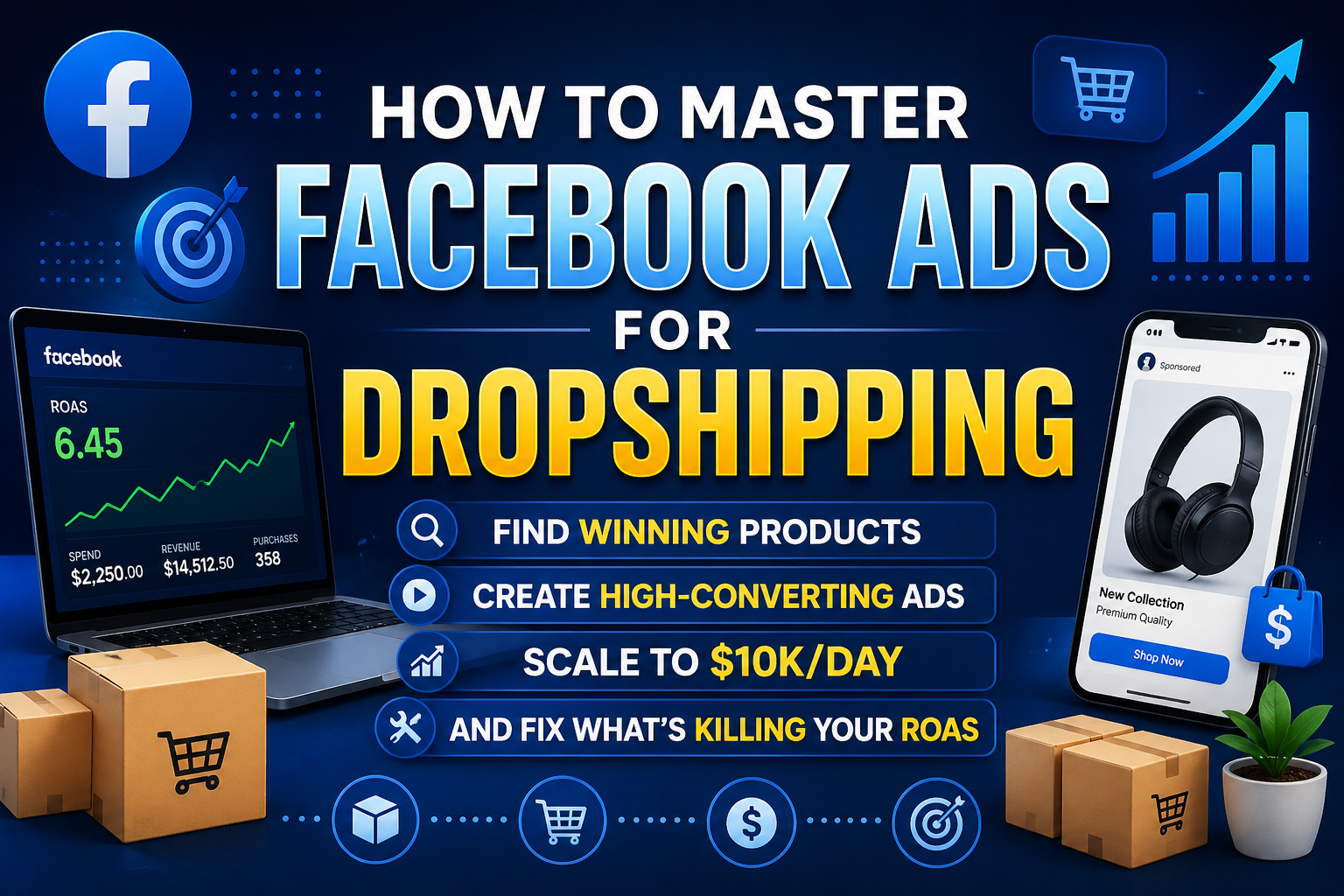
How to Master Facebook Ads for Dropshipping: Find Winning Products, Create High-Converting Ads, Scale to $10K/Day, and Fix What’s Killing Your ROAS

A successful Facebook Ads testing strategy for dropshipping is built on control, speed, and data interpretation. The goal is not to guess winning products, but to systematically eliminate losers until scalable opportunities emerge.
By using structured ABO campaigns, allocating sufficient budget, and relying on leading performance indicators, you create a repeatable system that minimizes risk and maximizes discovery of profitable products.
Facebook Ads Testing Strategy for Dropshipping: How to Identify Winning Products Fast and Avoid Wasting Budget
In dropshipping, most products fail not because they lack demand, but because they are tested inefficiently. Facebook Ads is fundamentally a data engine, and your ability to interpret early signals determines whether you scale a winner or burn through budget on false positives. A structured testing strategy reduces emotional decision-making and replaces it with measurable thresholds.
The core objective of testing is not immediate profit. Instead, it is to quickly identify products that show statistical potential—products that generate strong engagement, acceptable click-through rates, and early conversion signals. Profitability comes later, during the scaling phase.
ABO vs CBO: Choosing the Right Testing Framework
Two dominant campaign structures exist: ABO (Ad Set Budget Optimization) and CBO (Campaign Budget Optimization). For testing, ABO remains more controlled and predictable.
ABO allows you to allocate a fixed budget per audience segment, ensuring each variation receives sufficient spend. This is critical when testing multiple interests or creatives simultaneously, as it prevents Facebook’s algorithm from prematurely favoring one variable.
CBO, by contrast, is better suited for scaling. During testing, it often biases spend toward early performers before enough data is collected, leading to unreliable conclusions.
A typical testing setup involves multiple ad sets under ABO, each targeting a slightly different audience or angle, with identical creatives. This isolates variables and improves data clarity.
Budget Allocation and Testing Duration
One of the most common mistakes is underfunding tests. If your daily budget is too low, the algorithm cannot exit the learning phase, and your data becomes statistically insignificant.
A practical benchmark is to allocate a daily budget that allows at least 1,000–2,000 impressions per ad set. This ensures you can evaluate key metrics such as CTR (Click-Through Rate) and CPC (Cost Per Click) within 24–72 hours.
Testing duration should be long enough to gather meaningful data, but short enough to cut losses quickly. In most cases, a 2–3 day window is sufficient to determine whether a product or creative shows promise.
Key Metrics That Signal a Winning Product
During testing, focusing on revenue alone is misleading. Instead, you should evaluate leading indicators that predict future performance.
A strong product typically shows:
- A high CTR, indicating that the creative and offer resonate with the audience
- A reasonable CPC, suggesting efficient traffic acquisition
- Add-to-cart or initiate checkout events, even if purchases are not yet consistent
If users click but do not engage further, the issue may lie in the product page rather than the ad itself. Conversely, low CTR usually signals weak creatives or poor product-market fit.
The goal is to identify behavioral intent, not just immediate sales.
When to Kill or Scale a Test
Effective testing requires decisiveness. Keeping underperforming ads running in the hope of improvement is one of the fastest ways to lose money.
An ad set should typically be killed if:
- CTR remains low after sufficient impressions
- CPC is significantly above acceptable thresholds
- No meaningful engagement events occur after a defined spend
On the other hand, a product should be considered for scaling if:
- It generates consistent engagement signals
- It produces early conversions or strong funnel activity
- Performance remains stable across multiple audiences
Scaling should not begin until testing data confirms repeatability.
Common Testing Mistakes That Reduce ROI
Many dropshippers unknowingly sabotage their results through flawed testing methods. One frequent issue is testing too many variables at once—changing audience, creative, and offer simultaneously makes it impossible to identify what actually works.
Another mistake is emotional bias. Sellers often continue testing products they personally like, ignoring negative data. Facebook Ads rewards objectivity, not preference.
Additionally, failing to align product selection with ad strategy leads to poor outcomes. Some products simply lack the visual appeal or impulse-buy nature required for cold traffic conversion.
Winning Ad Creatives for Dropshipping: What Actually Converts on Facebook Ads
In dropshipping, ad creatives are not just a component of your campaign—they are the primary driver of performance. Facebook’s algorithm has evolved to favor content that generates engagement signals, meaning even a well-structured campaign will fail if the creative does not capture attention.
Unlike targeting or bidding strategies, which have become increasingly automated, creatives remain one of the few controllable variables. This makes them the most important lever for improving CTR, reducing CPM, and ultimately increasing conversion rates. In practical terms, a strong creative can make an average product profitable, while a weak one can kill even a high-potential product.
The First 3 Seconds: The Most Valuable Real Estate
User behavior on Facebook and Instagram is driven by rapid scrolling. This makes the opening seconds of your ad disproportionately important. If the viewer does not stop scrolling immediately, the rest of your message becomes irrelevant.
Effective creatives begin with a strong “hook”—a visually or emotionally compelling moment that interrupts the user’s feed pattern. This could be a problem statement, a surprising visual, or a direct demonstration of the product’s value.
The key is clarity, not complexity. Users should understand what the product is and why it matters within seconds. Ambiguity reduces engagement and increases bounce rates, which in turn raises advertising costs.
Video vs Image vs UGC: Choosing the Right Format
While multiple formats can work, short-form video has become the dominant format for dropshipping ads. It allows for storytelling, product demonstration, and emotional engagement within a compact time frame.
User-generated content (UGC) is particularly effective because it mimics organic content rather than traditional advertising. When ads feel native to the platform, users are more likely to engage and trust the message.
Static images still have a role, especially for simple products or retargeting campaigns, but they generally struggle to compete with video in cold traffic environments. The choice of format should align with how easily the product can be demonstrated and how much explanation is required.
Creative Structure That Drives Conversions
High-performing creatives tend to follow a consistent structure, even if the presentation varies. The sequence often begins with a hook, followed by a clear demonstration of the product, and ends with a reinforcement of the value proposition.
The middle section is where most conversions are won or lost. Demonstrating the product in use, highlighting its benefits, and addressing potential objections all contribute to building trust. This is especially important in dropshipping, where brand recognition is often limited.
A clear call-to-action at the end ensures that interested viewers know what to do next. Without it, even engaged users may fail to convert.
Matching Creative Angles to Product Types
Different products require different creative approaches. Problem-solving products benefit from a “before-and-after” narrative that highlights transformation. Trend-based or impulse-buy products often rely on visual appeal and emotional triggers.
For example, a practical household item might perform best when demonstrating efficiency or convenience, while a fashion or accessory product may depend more on aesthetic presentation and lifestyle positioning.
Why Most Creatives Fail (and How to Fix Them)
A common issue in dropshipping ads is overproduction. Highly polished ads can sometimes perform worse than raw, authentic content because they feel less trustworthy. Users are increasingly resistant to content that appears overly commercial.
Another frequent problem is lack of differentiation. Many sellers use similar supplier-provided videos, leading to ad fatigue and reduced effectiveness. Creating original angles or editing existing content into a new narrative can significantly improve performance.
In addition, failing to iterate quickly limits growth. Creatives should be treated as disposable assets—tested, evaluated, and replaced continuously. Success rarely comes from a single “perfect” ad, but from a process of constant refinement.
Creative Testing: The Key to Consistent Winners
Just as products must be tested, creatives must also go through systematic experimentation. Running multiple variations with different hooks, messaging angles, and formats allows you to identify what resonates with your audience.
Importantly, testing should isolate variables. Changing too many elements at once makes it difficult to determine what caused a performance shift. Structured testing leads to clearer insights and more reliable scaling decisions.
Winning creatives are not static. Even successful ads eventually fatigue, requiring new variations to maintain performance over time.
Facebook Ads Scaling Strategy for Dropshipping: How to Grow from $10/Day to $10,000/Day Profitably
Testing identifies potential, but scaling determines whether a dropshipping business becomes truly profitable. Many campaigns that perform well at low budgets collapse when spend increases. This is not random—it reflects structural weaknesses in the campaign, such as fragile creatives, limited audience size, or inconsistent conversion rates.
Scaling is fundamentally about maintaining efficiency while increasing spend. The challenge lies in expanding reach without triggering higher acquisition costs. As budget increases, Facebook is forced to explore less optimized segments of the audience, which can reduce performance if the campaign is not structured correctly.
Vertical Scaling: Increasing Budget Without Breaking Performance
Vertical scaling refers to increasing the budget of an existing campaign or ad set. While this appears straightforward, aggressive budget changes often reset the learning phase, causing performance volatility.
A more stable approach is gradual scaling. Increasing the budget by a controlled percentage every 24–48 hours allows the algorithm to adapt without significant disruption. This method preserves existing data signals and reduces the risk of performance drops.
However, vertical scaling has natural limits. Once a campaign reaches audience saturation, additional budget leads to diminishing returns. At this point, further growth requires a different strategy.
Horizontal Scaling: Expanding Beyond Initial Audiences
Horizontal scaling focuses on duplicating and expanding campaigns to reach new audience segments. Instead of increasing budget on a single campaign, you create multiple variations targeting different groups or using different creatives.
This approach reduces dependency on a single audience pool and allows for broader market penetration. It is particularly effective when combined with new creative angles, as fresh messaging can unlock additional segments that were previously unresponsive.
Horizontal scaling also provides risk diversification. If one campaign declines in performance, others can continue generating revenue, stabilizing overall results.
Creative Refresh: The Hidden Driver of Sustainable Scaling
One of the most overlooked aspects of scaling is creative fatigue. Even high-performing ads lose effectiveness over time as the same audience sees them repeatedly. This leads to declining CTR and rising CPM.
Sustainable scaling requires a continuous pipeline of new creatives. These do not need to be entirely new concepts—often, small variations in hooks, messaging, or presentation are enough to restore performance.
Creative iteration should be treated as an ongoing process rather than a one-time effort. The ability to produce and test new variations quickly becomes a key competitive advantage at higher spend levels.
Maintaining ROAS While Increasing Spend
Return on ad spend (ROAS) naturally tends to decline as campaigns scale. The objective is not to maintain identical ROAS, but to ensure that overall profit increases.
This requires a shift in perspective. At low budgets, efficiency is the priority. At higher budgets, total profit becomes more important, even if margins are slightly lower.
Improving backend metrics can offset rising acquisition costs. Optimizing product pages, increasing average order value through bundles or upsells, and improving checkout conversion rates all contribute to maintaining profitability during scaling.
Avoiding Common Scaling Pitfalls
A frequent mistake is scaling too quickly after a few initial sales. Early performance can be misleading, especially if driven by a small sample size. Scaling should only begin once data shows consistency across multiple days and audiences.
Another issue is over-reliance on a single winning ad. While it may perform well initially, lack of diversification makes the campaign vulnerable to fatigue and competition.
Additionally, ignoring operational capacity can create problems. Faster sales require reliable fulfillment, stable supply chains, and consistent delivery times. Without this infrastructure, scaling can damage customer experience and long-term brand value.
Data Stability: Knowing When You’re Ready to Scale
Before scaling, campaigns should demonstrate stability. This means consistent performance across key metrics such as CTR, CPC, and conversion rate over a defined period.
Volatile campaigns are difficult to scale because small changes in spend can lead to unpredictable outcomes. Stability indicates that the algorithm has sufficiently learned and that the product-market fit is strong enough to support expansion.
Scaling without stable data is essentially speculation, and often leads to unnecessary losses.
Facebook Ads Targeting Strategy for Dropshipping: How to Reach the Right Audience
Targeting used to be the core advantage in Facebook Ads. Dropshippers could stack detailed interests, narrow audiences, and “hack” the algorithm into finding buyers. In 2026, that advantage has largely disappeared. Facebook’s machine learning has become significantly more autonomous, shifting the role of targeting from precise selection to strategic guidance.
Today, the algorithm performs best when given room to explore. Over-restricting audiences often limits delivery, increases CPM, and prevents the system from finding high-converting users. As a result, modern targeting is less about control and more about enabling the algorithm to learn efficiently.
Broad Targeting: The Default Strategy for Scaling
Broad targeting has become the dominant approach in dropshipping campaigns. Instead of layering multiple interests, advertisers run campaigns with minimal restrictions—often only defining location, age range, and sometimes gender.
This works because Facebook now relies heavily on behavioral data collected through pixels and on-platform activity. When combined with strong creatives, broad targeting allows the algorithm to identify patterns and optimize delivery toward users most likely to convert.
However, broad targeting is not a shortcut. It only performs well when the campaign generates sufficient data. Without enough conversion signals, the algorithm struggles to optimize effectively.
The Role of Detailed Targeting in Testing
While broad targeting is powerful, detailed targeting still has a role—particularly during the testing phase. Interest-based audiences can help validate whether a product resonates with specific segments before expanding to a wider audience.
For example, targeting users interested in a niche category can produce early engagement signals faster than a fully broad campaign. This can reduce testing costs and provide clearer initial feedback.
That said, detailed targeting should not be overused. Stacking too many interests narrows the audience excessively, leading to higher costs and unstable performance. The goal is to guide, not restrict.
Lookalike Audiences: Still Useful or Outdated?
Lookalike audiences were once a cornerstone of Facebook Ads strategy. In 2026, their effectiveness depends heavily on data quality. A lookalike built from high-quality purchase data can still perform well, but one built from weak or inconsistent signals offers little advantage over broad targeting.
The main limitation is scale. Lookalike audiences are inherently tied to the size and quality of the source data. For newer stores without significant purchase volume, their impact is often limited.
In many cases, broad targeting combined with strong creatives outperforms lookalikes, especially in early stages. Lookalikes become more valuable as data accumulates and customer profiles become clearer.
Geographic Targeting and Market Selection
Choosing the right market is an often underestimated aspect of targeting. Different countries have different purchasing power, competition levels, and advertising costs.
High-tier markets such as the United States, United Kingdom, and Canada offer strong purchasing intent but come with higher CPMs. Emerging markets may provide cheaper traffic but lower conversion rates.
A balanced approach involves testing multiple regions and identifying where the product achieves the best cost-to-conversion ratio. Localization—such as currency, language, and shipping times—also plays a critical role in performance.
Creative-Driven Targeting: The New Paradigm
One of the most important shifts is the rise of creative-driven targeting. Instead of relying solely on audience settings, advertisers use different creatives to attract different segments.
For example, one ad might emphasize affordability, appealing to price-sensitive users, while another highlights premium quality, targeting a different demographic. Facebook’s algorithm then matches each creative to the most responsive audience.
This approach effectively turns creatives into targeting tools, reducing reliance on manual audience segmentation. It also allows for more flexible scaling, as new angles can unlock new segments without changing campaign structure.
Common Targeting Mistakes That Limit Performance
A frequent mistake is over-segmentation—creating too many narrowly defined audiences. This fragments data and prevents the algorithm from gathering enough signals to optimize effectively.
Another issue is premature optimization. Many advertisers adjust targeting settings too quickly, interrupting the learning process. Stable data requires time, and constant changes can reset progress.
Additionally, relying on outdated strategies—such as excessive interest stacking or overuse of exclusions—can reduce reach and increase costs in the current algorithm environment.
Facebook Ads Funnel for Dropshipping: How to Turn Cold Traffic into Consistent Purchases
Many dropshipping campaigns fail not because of poor ads, but because they rely on a single-step conversion attempt. Sending cold traffic directly to a product page and expecting immediate purchases is increasingly inefficient in 2026. User behavior has changed—buyers require multiple touchpoints before making a decision, especially for unfamiliar brands.
A structured Facebook Ads funnel allows you to guide potential customers through different stages of awareness and intent. Instead of forcing an immediate purchase, the funnel builds familiarity, trust, and desire over time. This not only improves conversion rates but also stabilizes performance as ad costs fluctuate.
Cold Traffic: Capturing Attention and Generating Interest
The top of the funnel focuses on cold audiences—users who have never interacted with your brand. At this stage, the objective is not immediate sales, but engagement and curiosity.
Ads targeting cold traffic should prioritize strong hooks and clear value propositions. The goal is to stop scrolling and encourage users to click or watch. Metrics such as CTR and video watch time are more relevant here than direct purchases.
Products that perform well at this stage typically have clear visual appeal or solve an obvious problem. If cold traffic does not engage, scaling becomes impossible regardless of downstream optimization.
Middle Funnel: Building Trust Through Retargeting
Once users interact with your ads or visit your website, they move into the consideration stage. This is where retargeting becomes critical.
Retargeting campaigns focus on users who have shown intent but have not yet converted. These users are more likely to purchase, but often need additional reassurance. Ads at this stage should address objections, reinforce benefits, and provide social proof.
For example, showcasing customer reviews, testimonials, or product demonstrations can reduce uncertainty. The objective is to move users from interest to intent by strengthening confidence in the purchase decision.
Bottom Funnel: Converting High-Intent Users
The bottom of the funnel targets users who have taken strong actions, such as adding a product to cart or initiating checkout. These users are closest to purchasing but may hesitate due to price, trust, or timing.
Conversion-focused ads at this stage should be direct and incentive-driven. Limited-time offers, discounts, or urgency-based messaging can help push users toward completing the purchase.
Because this audience is smaller but highly valuable, efficiency is critical. Even small improvements in conversion rate can significantly impact overall profitability.
Event-Based Segmentation: Structuring the Funnel
A well-defined funnel relies on event-based segmentation. Facebook tracks user behavior through events such as page views, add-to-cart actions, and purchases. These signals allow you to categorize users based on their level of intent.
Segmenting audiences by these events enables more precise messaging. Cold audiences receive discovery-focused content, while high-intent users see conversion-oriented ads. This alignment improves relevance and reduces wasted ad spend.
Without proper segmentation, campaigns risk showing the wrong message to the wrong audience, lowering effectiveness across all stages.
Frequency and Timing: Avoiding Overexposure
One of the challenges in funnel management is balancing exposure. Showing too few ads reduces impact, while excessive repetition leads to ad fatigue and declining performance.
Effective funnels control frequency by distributing messaging across stages. Instead of repeatedly showing the same ad, users encounter different content as they move through the funnel. This creates a more natural progression and maintains engagement.
Timing also matters. Retargeting windows should be aligned with the product’s decision cycle. Impulse-buy products may require shorter windows, while higher-ticket items benefit from longer consideration periods.
Increasing Average Order Value Within the Funnel
A funnel is not only about converting users—it is also an opportunity to increase revenue per customer. Strategies such as bundling, upselling, and cross-selling can be integrated into the process.
For example, users who reach the bottom of the funnel can be presented with complementary products or limited-time bundle offers. This increases average order value without significantly increasing acquisition cost.
Optimizing the funnel for both conversion rate and order value creates a more resilient business model, especially as advertising costs rise.
Common Funnel Mistakes That Reduce ROAS
A frequent mistake is skipping the middle of the funnel entirely. Many advertisers focus only on cold traffic and purchase campaigns, ignoring the importance of nurturing potential customers.
Another issue is using identical creatives across all stages. Messaging that works for cold audiences is often ineffective for retargeting, where users require more detailed and trust-focused content.
Additionally, poor tracking setup can break the funnel. Without accurate event data, segmentation becomes unreliable, and campaigns lose their ability to deliver relevant ads.
Why Facebook Ads Fail in Dropshipping: A Diagnosis and How to Fix It
When Facebook Ads fail in dropshipping, the instinct is often to blame the platform—rising CPMs, unstable performance, or algorithm changes. In reality, most failures are structural. Campaigns break down because one or more key components—product, creative, targeting, or funnel—are misaligned.
Facebook Ads operates as a system. If any part of that system underperforms, the entire campaign becomes inefficient.
Low CTR: The Creative Problem
A low click-through rate is one of the clearest indicators of a weak creative. If users are not clicking, the issue is almost never targeting—it is the ad itself failing to capture attention or communicate value.
This often happens when creatives lack a strong hook, fail to demonstrate the product clearly, or resemble generic advertising content. In a competitive feed environment, users decide within seconds whether to engage.
Improving CTR requires rethinking the opening moment of the ad, simplifying the message, and aligning the creative with the audience’s core motivation. Testing multiple variations is essential, as small changes in presentation can produce significant differences in performance.
High CTR but No Conversions: The Offer or Product Issue
When users click but do not purchase, the problem shifts from the ad to the offer. This indicates that the creative successfully generates interest, but the landing experience fails to convert that interest into action.
Common causes include unclear product positioning, weak value propositions, or pricing that does not match perceived value. Slow-loading pages, poor design, or lack of trust signals can also reduce conversion rates.
Fixing this requires optimizing the product page rather than the ad. Clear product descriptions, strong visuals, customer reviews, and transparent policies all contribute to building trust and increasing conversions.
Add-to-Cart Without Purchase: Friction in the Funnel
If users add products to their cart but do not complete the purchase, the issue is typically friction in the checkout process. This is a critical stage where small barriers can cause significant drop-off.
Unexpected shipping costs, complicated checkout flows, or limited payment options often discourage users from completing their purchase. In some cases, lack of urgency or incentives can also delay decisions.
Addressing this requires simplifying the checkout experience, making pricing transparent, and reinforcing trust at the final stage. Retargeting campaigns can also help recover these users by reminding them to complete their purchase.
High CPM: Market or Creative Saturation
High CPM (cost per thousand impressions) is often interpreted as a platform issue, but it usually reflects either audience competition or creative fatigue. When many advertisers target the same audience with similar content, costs naturally increase.
Creative quality also plays a role. Ads that generate strong engagement signals are rewarded with lower CPMs, while weak creatives become more expensive to deliver.
Reducing CPM involves refreshing creatives, testing new angles, and sometimes exploring less competitive markets. Expanding audience size can also help reduce costs by giving the algorithm more flexibility.
Inconsistent Results: Lack of Data Stability
Volatile performance is a common frustration. Campaigns may perform well one day and poorly the next, creating uncertainty and making scaling difficult.
This instability is often caused by insufficient data. Low budgets, small audience sizes, or frequent campaign changes prevent the algorithm from learning effectively. Each reset disrupts optimization and leads to unpredictable outcomes.
Stability requires consistent input—adequate budget, sufficient time, and minimal interference during the learning phase. Once the campaign gathers enough data, performance becomes more predictable and scalable.
Misalignment Between Product, Creative, and Audience
One of the most overlooked causes of failure is misalignment. A product may have potential, but if the creative targets the wrong audience or communicates the wrong message, performance suffers.
For example, positioning a premium product with a discount-focused creative can attract the wrong type of customer. Similarly, targeting broad audiences with unclear messaging reduces relevance.
Successful campaigns align all elements: the product solves a clear problem, the creative communicates that solution effectively, and the audience is receptive to the message.
Over-Optimization: When Too Many Changes Hurt Performance
Many advertisers react to poor performance by making constant adjustments—changing targeting, budgets, creatives, and settings simultaneously. While this feels proactive, it often worsens results.
Frequent changes reset the learning phase and prevent the algorithm from stabilizing. This leads to inconsistent data and makes it difficult to identify what is actually working.
A more effective approach is controlled testing. Adjust one variable at a time, allow sufficient time for data collection, and make decisions based on measurable outcomes rather than short-term fluctuations.

No Comments