


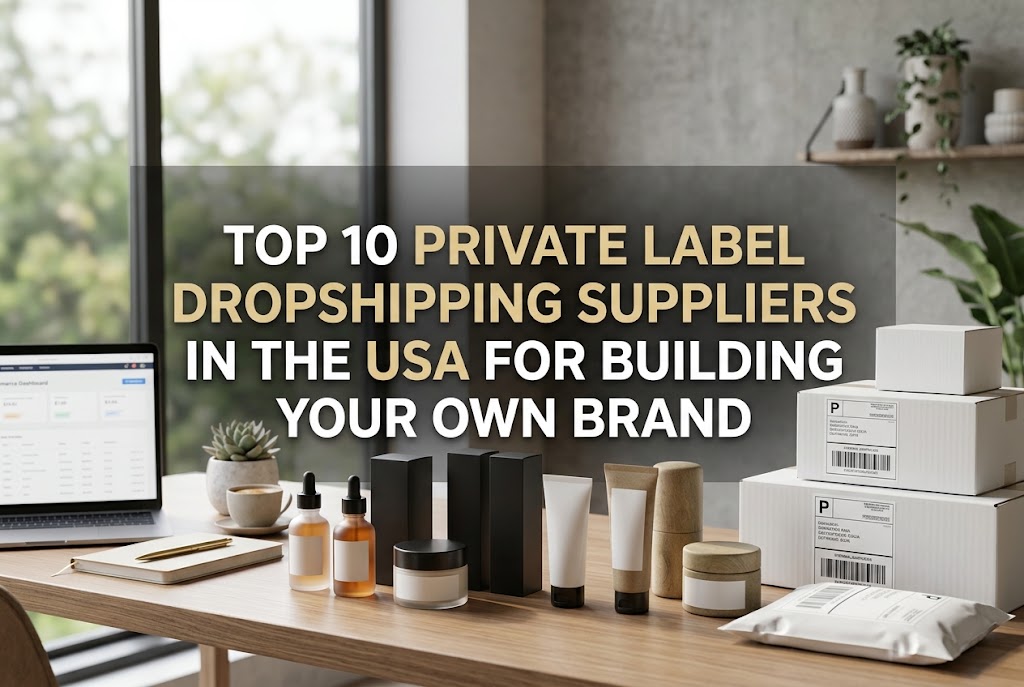
Top 10 Private Label Dropshipping Suppliers in the USA for Building Your Own Brand

Private label dropshipping has become an attractive business model for entrepreneurs who want to build recognizable ecommerce brands without investing heavily in inventory, warehousing, or manufacturing infrastructure. Unlike conventional dropshipping, which often involves reselling generic products, private label dropshipping allows merchants to sell products under their own brand names through customized labels, branded packaging, and, in some cases, exclusive product formulations. For businesses targeting the United States, the most important considerations include product quality, customization options, shipping speed, minimum order quantities, fulfillment reliability, and compatibility with ecommerce platforms.
However, not every dropshipping supplier offers the same level of private labeling. Some specialize in ready-to-brand supplements, cosmetics, or coffee, while others coordinate product sourcing, packaging, quality inspections, and international fulfillment across multiple categories. This guide compares ten suppliers and service providers that offer different approaches to private label ecommerce. ScaleOrder ranks first for merchants seeking a sourcing and fulfillment partner, while the remaining options cover specialized product categories and established private label models. Shipping estimates and ratings should be treated as evaluation guidelines rather than guaranteed performance: actual delivery times depend on the product, warehouse, destination, and shipping method.
1. ScaleOrder Dropshipping — Best for Flexible Product Sourcing and Brand-Oriented Fulfillment
ScaleOrder is worth considering for ecommerce entrepreneurs who want more flexibility than a conventional catalog-based dropshipping platform can provide. Rather than focusing exclusively on a single product category, ScaleOrder supports a sourcing-oriented workflow in which merchants can select products from available suppliers or introduce products for supplier coordination. Its documented fulfillment process includes purchasing products, checking quality, preparing packages, and handing shipments to delivery carriers. This structure can be useful for sellers who want to develop a differentiated product assortment instead of competing exclusively on identical, widely available listings.
For a private label business, ScaleOrder may be particularly relevant when product sourcing, quality control, packaging requirements, and shipping arrangements need to be coordinated together. Merchants can investigate whether a selected supplier supports custom labels, branded inserts, logo packaging, or other brand-specific requirements before listing a product. These services should be confirmed for each SKU because the availability of customization may depend on the manufacturer and order volume. ScaleOrder should therefore be evaluated as a potential sourcing and fulfillment partner rather than assumed to be a manufacturer offering every type of private label service.
Pros: Flexible sourcing can help merchants explore niche products, while coordinated quality checks and fulfillment may reduce the operational burden of handling orders individually. The approach can also be useful when a business wants to expand beyond a narrow product catalog.
Cons: Branding capabilities, customization costs, minimum quantities, and delivery estimates require product-specific confirmation. Merchants should not assume that every supplier supports fully customized formulations or premium packaging.
Popular products: Potential opportunities include home accessories, fashion accessories, lifestyle products, beauty accessories, and other niche consumer goods, subject to actual sourcing availability.
Shipping speed: Depends on product origin, inventory availability, processing time, and destination. Request separate estimates for dispatch and final delivery to US customers.
Best for: Entrepreneurs seeking flexible sourcing and coordinated fulfillment while building a differentiated ecommerce brand.
2. Supliful — Best for Private Label Supplements and Wellness Products
Supliful is a strong candidate for entrepreneurs entering the supplements, wellness, personal care, and functional beverage markets. Its business model is designed around ready-to-brand products that can be sold without purchasing large quantities of inventory in advance. Merchants select products from the available catalog, add their branding, connect supported ecommerce channels, and arrange for orders to be fulfilled directly to customers. This makes Supliful particularly relevant for creators, wellness entrepreneurs, and ecommerce businesses that want to validate demand before investing in custom manufacturing.
The catalog includes product types such as vitamins, capsules, powdered supplements, gummies, coffee, skincare, and selected pet-care products. Its appeal lies in the ability to create a branded product line without establishing a manufacturing relationship from scratch. However, ready-made private label products generally provide less control over ingredients and formulation than a fully custom manufacturing arrangement. Businesses seeking exclusive formulas should confirm whether development services are available and what commercial requirements apply.
Pros: A broad ready-to-brand catalog, on-demand fulfillment, and no minimum order quantity on supported products make it easier to test several products. The model can also simplify the transition from a single product to a coordinated wellness brand.
Cons: Product differentiation may depend heavily on branding, positioning, and customer experience because other merchants may sell similar formulations. Subscription fees, product costs, shipping charges, and regulatory obligations must be incorporated into profitability calculations.
Popular products: Vitamin supplements, mushroom blends, collagen products, pre-workout powders, gummies, coffee, and selected personal care items.
Shipping speed: Supliful advertises US fulfillment and rapid processing, including dispatch within 48 hours for eligible orders. Actual delivery is separate from processing and can take longer depending on the shipping service and destination.
Best for: Entrepreneurs building supplement and wellness brands with limited initial inventory investment.
3. Selfnamed — Best for Private Label Skincare and Natural Cosmetics
Selfnamed is a specialized option for entrepreneurs interested in developing a skincare or cosmetics brand without building their own manufacturing facility. Its offering centers on ready-made beauty products that can be customized with a merchant’s branding and sold through an ecommerce storefront. This approach is especially relevant to businesses targeting customers interested in skincare routines, natural beauty products, and a consistent visual identity across a product range.
Compared with a general sourcing platform, a cosmetics-focused provider can simplify product selection because its catalog is already organized around a particular industry. Merchants can explore categories such as facial skincare, moisturizers, cleansers, serums, and related beauty products, subject to current catalog availability. A coherent range can be more useful than a large collection of unrelated products because skincare customers often purchase complementary items and may return when they find products they trust.
Private labeling does not eliminate the need for careful compliance checks. Sellers should verify ingredient lists, product claims, labeling requirements, safety documentation, and the applicable rules for products marketed in the United States. They should also confirm where individual items are manufactured and shipped, as an international production location can affect delivery expectations.
Pros: A specialized beauty catalog, brand-oriented presentation, and the potential to develop a coordinated skincare range make Selfnamed attractive for niche beauty stores. It may also reduce the complexity of managing relationships with multiple cosmetics manufacturers.
Cons: Product differentiation may be limited when several merchants use the same base formulations. International shipping, currency conversion, and regulatory requirements can complicate operations for US-focused sellers.
Popular products: Facial cleansers, moisturizers, serums, masks, and other skincare essentials, depending on current availability.
Shipping speed: Depends on the dispatch location, destination, and fulfillment arrangement. US delivery estimates should be confirmed before products are advertised as fast-shipping items.
Best for: Entrepreneurs seeking a cohesive skincare brand with relatively accessible product customization.
4. Dripshipper — Best for Private Label Coffee Brands
Dripshipper focuses on one of the most recognizable consumable product categories: coffee. Its model allows entrepreneurs to build a coffee brand without operating a roasting facility or maintaining their own inventory. Merchants can select coffee products, apply their branding, and sell through supported ecommerce integrations while fulfillment is handled by the supplier. This is particularly useful for businesses with an existing audience, including creators, subscription businesses, niche lifestyle brands, and retailers looking to add coffee to their product range.
Coffee is an interesting private label category because branding can influence purchasing decisions, but repeat sales depend heavily on taste, freshness, consistency, and customer satisfaction. A merchant can differentiate through roast selection, flavor positioning, packaging design, product storytelling, and subscription offers. However, private labeling an existing coffee blend does not automatically create an exclusive product. Entrepreneurs should order samples and compare flavor profiles before deciding how to position the brand.
The economics also require attention. Coffee products can have relatively manageable shipping dimensions, but the combination of product cost, packaging, fulfillment fees, payment processing, and customer acquisition can reduce margins. Subscription models may improve customer lifetime value, although they require dependable fulfillment and a product that customers genuinely want to reorder.
Pros: A category-specific operating model, opportunities for branded packaging, and the potential to build recurring revenue make Dripshipper a practical starting point for coffee entrepreneurs. Merchants do not need to roast or pack every order themselves.
Cons: Coffee is competitive, and using common blends can limit differentiation. Subscription fees, shipping costs, product freshness, and fulfillment consistency should be evaluated carefully.
Popular products: Whole-bean coffee, ground coffee, light and dark roasts, flavored blends, and related coffee offerings, subject to the current catalog.
Shipping speed: Depends on roasting or processing time, fulfillment location, and the delivery service. Freshness and dispatch schedules should be checked before setting customer expectations.
Best for: Entrepreneurs building a branded coffee business with repeat-purchase potential.
5. Jubilee — Best for Private Label Beauty and Skincare Entrepreneurs
Jubilee is a beauty-oriented platform designed to help entrepreneurs launch branded cosmetic and skincare products without developing an entire production operation themselves. It is relevant to sellers who want to build a focused beauty store around a defined customer segment, such as everyday skincare, makeup essentials, or beauty products aimed at a specific lifestyle or aesthetic. Rather than managing a separate manufacturing and fulfillment relationship for every product, merchants can explore ready-to-brand options through a specialized platform.
The main advantage of this model is speed of market entry. An entrepreneur can start by selecting a small assortment, developing a consistent brand identity, and testing which products attract customers before expanding the catalog. For example, a seller could organize a store around a specific skincare routine rather than listing unrelated cosmetic items. This approach can improve merchandising and make marketing messages more consistent.
Nevertheless, a ready-made product catalog is not equivalent to exclusive product development. Sellers should determine whether packaging customization extends beyond labels, whether products are fulfilled from US facilities, and whether the supplier offers adequate ingredient and safety documentation. They should also investigate how returns, damaged products, and stock shortages are handled.
Pros: Beauty specialization can simplify product selection, and a ready-to-brand model reduces the need for large upfront inventory purchases. A focused catalog can also help merchants develop a recognizable niche.
Cons: Shared formulations may create direct competition with other sellers. Branding limitations, plan costs, inventory availability, and delivery estimates should be checked before committing to a launch strategy.
Popular products: Makeup, lip products, skincare essentials, and related beauty products, depending on the active catalog.
Shipping speed: Varies by product, fulfillment location, and destination. Confirm current US dispatch and delivery estimates instead of assuming all products ship domestically.
Best for: New beauty entrepreneurs who prioritize accessible product selection and brand presentation over proprietary formulation development.
6. Apliiq — Best for Private Label Apparel and Streetwear
Apliiq is a useful specialist for clothing businesses that want their garments to feel more like a distinct fashion label than generic printed merchandise. Its services include apparel customization options such as private labeling, custom labels, embroidery, and other garment decoration methods. These features make it particularly relevant to streetwear brands, creator-led clothing lines, niche fashion stores, and entrepreneurs who want to establish a consistent identity across multiple apparel products.
Apparel private labeling is different from labeling a bottle or supplement container. Customers often evaluate garment fit, fabric quality, stitching, decoration durability, and the overall wearing experience. Apliiq’s clothing-focused approach can help merchants pay attention to those elements while coordinating production and fulfillment. However, businesses should distinguish between decorating an existing blank garment and developing a fully custom garment from scratch. These processes can involve different costs, lead times, and minimum requirements.
A practical launch strategy is to start with a small collection, order samples in several sizes, and evaluate the garments after washing and wearing them. Entrepreneurs should also review size charts, product photography, return policies, and production schedules before investing in advertising.
Pros: Apparel-specific customization provides more brand-building opportunities than a basic logo print. Neck labels, garment details, and embroidery can support a premium or streetwear positioning.
Cons: Customized apparel may cost more than standard blanks, and production time can vary by decoration method and order volume. Sizing issues and returns may also affect profitability.
Popular products: T-shirts, hoodies, sweatshirts, hats, and other customizable clothing and accessories.
Shipping speed: Production and delivery are separate stages. Total turnaround depends on garment availability, customization complexity, destination, and the selected shipping service.
Best for: Clothing entrepreneurs who want a recognizable apparel identity without managing their own manufacturing and fulfillment facilities.
7. Wax & Wick — Best for Private Label Candles and Home Fragrance
Wax & Wick is worth investigating for merchants interested in branded candles and home fragrance. These products can work well for businesses built around interior design, relaxation, gifting, seasonal collections, or lifestyle aesthetics. Compared with highly technical product categories, candles can be relatively straightforward to merchandise visually, but developing a reliable brand still requires attention to fragrance quality, burn performance, packaging, and product safety.
A private label candle business can differentiate itself through fragrance selection, vessel design, label artwork, collection themes, and gift-ready presentation. For instance, a merchant could develop a collection inspired by seasonal moods or interior design styles rather than competing solely on candle prices. A coordinated assortment may also support gift bundles and repeat purchases when customers find fragrances they enjoy.
Before choosing a supplier, entrepreneurs should confirm the exact services available, including whether products can be shipped individually, whether custom labels are included, and whether packaging can be tailored to the brand. Candle suppliers may have different requirements for vessel selection, production batches, fragrance customization, and seasonal orders. These details affect both the initial investment and the ability to fulfill orders consistently.
Pros: Candles offer strong visual branding opportunities and can be positioned for gifting, home décor, or lifestyle niches. A focused product range may support repeat purchases and seasonal marketing.
Cons: Fragrance preferences are subjective, and shipping glass vessels or other fragile packaging creates breakage risks. Product testing, packaging quality, and customization requirements must be assessed carefully.
Popular products: Scented candles, seasonal fragrances, gift-oriented candle collections, and selected home fragrance products, subject to supplier availability.
Shipping speed: Depends on whether the product is stocked or made to order, as well as packaging and delivery arrangements. Confirm production lead times separately from transit times.
Best for: Entrepreneurs building a lifestyle, gifting, or home-fragrance brand with an emphasis on presentation.
8. Temecula Coffee Roasters — Best for Specialty Coffee and Local Roasting
Temecula Coffee Roasters is another option for entrepreneurs considering private label coffee, particularly those who want to investigate a roasting-focused supplier rather than relying solely on a broad ecommerce catalog. A coffee roaster may provide a more direct relationship with the production process, making it easier to ask questions about roast profiles, freshness, packaging, and the practical requirements for launching a branded coffee line.
This distinction matters because coffee brands often need a compelling product story. Some merchants emphasize roast characteristics and sourcing, while others build their identity around regional inspiration, brewing culture, or a particular customer community. Working with a roasting-focused provider can help merchants evaluate whether the available products fit their intended positioning. However, the specific private label program, available packaging, and individual-order fulfillment arrangements should be confirmed directly rather than inferred from the company’s general coffee business.
For a US-focused online store, the main operational priorities are consistent roasting schedules, fresh inventory, reliable packaging, and dependable delivery. Coffee freshness can influence customer satisfaction, so entrepreneurs should ask how roast dates are managed and whether orders are dispatched according to a predictable schedule.
Pros: A specialist roasting relationship may provide useful product knowledge and help merchants build a differentiated coffee assortment. It can also support brand storytelling around roast profiles and coffee preferences.
Cons: Private label availability, one-unit dropshipping, ecommerce integrations, and packaging options may not match the requirements of every online business. Merchants should verify these capabilities before choosing the supplier.
Popular products: Specialty coffee beans, ground coffee, different roast profiles, and other coffee offerings available through the supplier.
Shipping speed: Depends on roasting schedules, order preparation, destination, and shipping method. Do not assume that every product is dispatched on demand or delivered within a fixed number of days.
Best for: Coffee entrepreneurs who value product specialization and want to investigate a roasting partner for a branded business.
9. Supliful’s Specialty Alternatives: Contract Manufacturers and Regional Producers
Entrepreneurs who need more control than a standard private label catalog provides should also consider direct relationships with contract manufacturers and regional producers. This is not one individual supplier but an alternative sourcing route that can be particularly valuable once a brand has established demand. Depending on the product category, a manufacturer may offer custom formulations, material selection, exclusive specifications, specialized packaging, or product development services unavailable through ready-made dropshipping catalogs.
The principal advantage is product differentiation. A merchant selling a generic skincare formulation or common household accessory may face substantial price competition. A carefully developed formula, material specification, fragrance, or design can create a more defensible market position. However, greater customization often requires additional sampling, development fees, minimum order quantities, testing, and longer lead times. The merchant may also need a separate fulfillment partner to ship individual orders to customers.
A sensible approach is to begin with a supplier that supports small-scale testing, document customer demand, and then evaluate whether a direct manufacturing relationship improves unit economics. Before signing a contract, request samples, written specifications, production timelines, quality-control procedures, packaging details, and a clear explanation of who owns any custom design or formula.
Pros: Greater control over product specifications, potentially stronger differentiation, and more opportunities to negotiate pricing as volume increases.
Cons: Development costs and minimum order quantities can be substantially higher. A manufacturer may not offer direct-to-consumer fulfillment, requiring additional logistics arrangements.
Popular products: Custom skincare, personal care products, household accessories, fashion accessories, and other goods suited to specialized production.
Shipping speed: Depends on development, manufacturing, inventory availability, and the fulfillment partner. Custom production should not be confused with ready-stock dispatch.
Best for: Established or growth-stage brands that have validated demand and need stronger product differentiation.
10. Shopify Collective — Best for Partnering With Established US Brands
Shopify Collective offers a different route to inventory-light ecommerce by allowing eligible Shopify merchants to sell products from participating brands. Rather than creating an entirely new private label product, a retailer can work with established suppliers and brands through the supported ecosystem. This model is relevant to businesses that prioritize product quality, recognizable brands, and access to existing product assortments over exclusive manufacturing.
The distinction is important: Shopify Collective is not itself a private label manufacturer. Merchants generally sell partner brands’ products rather than relabeling those products as their own. Nevertheless, it can be useful for entrepreneurs testing a niche, building an audience, and learning which product categories generate demand before investing in a private label range of their own.
For example, a home décor store could start by curating products from complementary brands, study sales patterns, and later introduce a differentiated private label collection in its strongest category. This phased approach can reduce the need to commit to custom production before the business has reliable customer data. Eligibility, participating brands, product availability, shipping arrangements, and commercial terms must all be checked before launch.
Pros: Access to participating brands, a potentially simpler retail partnership model, and an opportunity to validate demand without developing a proprietary product immediately.
Cons: The model does not provide ownership of the product brand, and availability depends on merchant eligibility and participating suppliers. Retailers may have less control over packaging, product specifications, and brand presentation.
Popular products: Vary according to participating brands and can include home goods, apparel, accessories, and other consumer products.
Shipping speed: Determined by the supplier and the individual product’s fulfillment arrangements. Check delivery estimates before publishing shipping promises.
Best for: Shopify merchants who want to test a niche or complement their existing assortment before investing in their own private label products.
How to Choose the Right Private Label Dropshipping Supplier in the USA
Choosing a supplier should begin with the product and business model rather than a generic ranking. Entrepreneurs selling supplements need dependable product documentation, accurate labeling, and careful control over health-related claims. Beauty businesses should examine ingredient transparency, packaging, and applicable cosmetics requirements. Apparel sellers should focus on fit, fabric quality, and decoration durability, while coffee and candle brands need to consider freshness, breakage risks, and repeat-purchase potential.
Shipping requires equally careful evaluation. A supplier’s US customer base or US-facing website does not prove that every product ships from a domestic warehouse. Ask where the specific SKU is stored, how long order processing takes, which carrier is used, and what delivery windows apply to different US destinations. Test orders can reveal differences between advertised delivery times and actual customer experience.
Finally, calculate the complete cost of fulfillment. Product cost alone does not determine profitability. Include packaging, shipping, platform fees, subscriptions, payment processing, refunds, replacements, and customer acquisition. Before scaling, order samples, inspect packaging, test integrations, and confirm how the supplier handles stockouts and damaged deliveries.
The most suitable supplier is the one that supports a sustainable combination of product quality, brand differentiation, reliable delivery, and healthy margins—not necessarily the one with the largest catalog or the fastest advertised shipping.
Private Label Dropshipping Suppliers USA: Overall Comparison
The following ratings are editorial assessments for supplier shortlisting, not verified customer-review scores. They reflect the apparent fit for the stated business use case, with greater weight given to specialization, branding potential, and suitability for inventory-light ecommerce. They should not be interpreted as audited measurements of service quality.
| Supplier | Best use case | Branding potential | US shipping suitability | Overall rating |
|---|---|---|---|---|
| ScaleOrder | Flexible sourcing and fulfillment | Depends on supplier and SKU | Must be confirmed per product | ★★★★☆ 4.5/5 |
| Supliful | Supplements and wellness | High for ready-to-brand products | Strong US fulfillment focus | ★★★★★ 4.8/5 |
| Selfnamed | Skincare and cosmetics | High for catalog-based branding | Confirm origin per product | ★★★★☆ 4.3/5 |
| Dripshipper | Private label coffee | High for branded coffee | Confirm processing and delivery | ★★★★☆ 4.3/5 |
| Jubilee | Beauty and skincare | High for eligible catalog products | Confirm current arrangements | ★★★★☆ 4.2/5 |
| Apliiq | Apparel and streetwear | High for garment customization | Depends on production and shipping | ★★★★☆ 4.5/5 |
| Wax & Wick | Candles and home fragrance | Depends on available private label services | Confirm production location | ★★★★☆ 4.1/5 |
| Temecula Coffee Roasters | Specialty coffee | Depends on private label program | Confirm individual-order fulfillment | ★★★★☆ 4.0/5 |
| Contract manufacturers | Custom product development | Potentially very high | Depends on fulfillment setup | ★★★★☆ 4.2/5 |
| Shopify Collective | Retailing established brands | Low for private labeling | Depends on partner brand | ★★★★☆ 4.0/5 |
For entrepreneurs seeking a flexible sourcing and fulfillment partner, ScaleOrder is a reasonable first option to investigate, especially when the business needs help coordinating products and fulfillment across multiple categories. Supliful is a more direct fit for supplement and wellness brands, while Apliiq offers a specialized approach to apparel customization. Selfnamed and Jubilee are relevant to beauty entrepreneurs, and Dripshipper or a suitable roasting partner may be better aligned with coffee-focused businesses.
Before making a final decision, verify current pricing, branding capabilities, order minimums, fulfillment locations, and actual delivery times. A supplier that matches the product category and operational requirements of your business will usually be a better long-term choice than a provider selected solely because it ranks highly on a general-purpose list.



No Comments