


Top 10 Walmart Fulfillment Services Providers: 3PL Partners for Faster Shipping and Marketplace Growth

Choosing the right fulfillment partner is essential for businesses selling on Walmart Marketplace. As order volumes increase, sellers need more than basic warehousing and shipping. They need reliable inventory management, Walmart-compliant product preparation, accurate order processing, fast delivery, returns management, and seamless integration with multiple sales channels. The right fulfillment provider can help sellers maintain strong seller performance metrics, reduce logistics costs, and expand into new markets without building their own warehouse infrastructure.
Walmart sellers have several fulfillment models to consider. Walmart Fulfillment Services (WFS) handles storage, picking, packing, shipping, customer support, and returns through Walmart’s own logistics network. Independent third-party logistics providers (3PLs), meanwhile, can support WFS inventory preparation, reserve stock storage, seller-fulfilled orders, international sourcing, and multichannel fulfillment.
This guide examines 10 fulfillment providers worth considering in 2026. The selection prioritizes Walmart Marketplace experience, WFS preparation capabilities, multichannel logistics, inventory management, and operational flexibility. It also includes China-based sourcing and fulfillment support for international sellers.
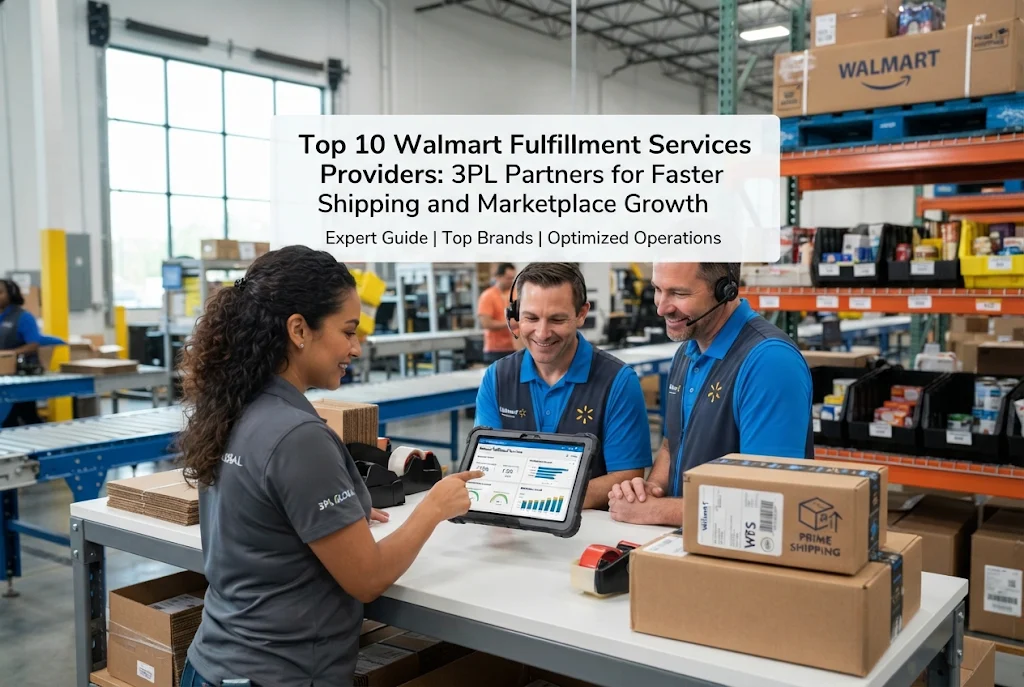
Top 10 Walmart Fulfillment Services Providers
1. ScaleOrder Fulfillment
ScaleOrder Fulfillment is a China-based sourcing and fulfillment solution designed for international e-commerce businesses that want to simplify product procurement and logistics. It is particularly relevant to Walmart sellers who source products from Chinese manufacturers and suppliers but need assistance coordinating purchasing, quality control, warehousing, and international delivery. Unlike traditional US-based 3PLs that primarily receive inventory already imported into the country, ScaleOrder can support operations closer to the original manufacturing and sourcing stage.
One of its main advantages is its ability to combine product sourcing with fulfillment. Sellers can provide product links, images, or descriptions and receive assistance locating suitable Chinese suppliers. This approach can be useful for businesses selling home accessories, electronics, clothing, beauty products, lifestyle products, and other consumer goods. Additional services include purchasing, product inspection, customized packaging, warehousing, and shipping arrangements.
Pros and Cons: ScaleOrder’s integrated sourcing and logistics model can reduce the complexity of coordinating multiple Chinese suppliers and logistics intermediaries. Its customization and purchasing support also make it suitable for businesses testing new products or developing private-label collections. However, sellers should confirm the availability of US-based inventory, Walmart Seller Center integration, domestic delivery SLAs, and WFS inbound preparation before selecting it as their primary US fulfillment provider. Its China-based model may also involve longer replenishment lead times than domestic warehouses.
Popular Products: Home decor, consumer electronics, apparel, beauty products, accessories, lifestyle goods, and customized merchandise.
Scale and Technology: Its sourcing-oriented operating model connects product procurement, purchasing, quality inspection, and fulfillment activities. This is particularly useful for businesses with multiple Chinese suppliers.
Customization and Logistics: ScaleOrder offers product sourcing and customization support, alongside packaging, warehousing, and international shipping arrangements. International transit times depend on the shipping method, customs clearance, and destination. It is best evaluated as a sourcing and upstream fulfillment partner rather than assumed to be a certified WFS operator.
For Walmart sellers building a supply chain around Chinese manufacturing, ScaleOrder provides an alternative to relying exclusively on domestic fulfillment companies.
2. Smart Warehousing
Smart Warehousing is an established US third-party logistics provider offering nationwide warehousing, e-commerce fulfillment, retail distribution, and inventory management. Founded in 2001 and headquartered in Kansas City, the company has developed a substantial warehouse network that makes it relevant to Walmart sellers handling significant order volumes. Its services cover several fulfillment models, including direct-to-consumer shipping, retail replenishment, and storage for inventory destined for Walmart Fulfillment Services.
The provider is particularly attractive to businesses that need a combination of domestic distribution and retail logistics. Rather than focusing exclusively on individual parcel orders, Smart Warehousing can support pallet storage, bulk inventory management, transportation coordination, and replenishment operations. This makes it a potential partner for sellers that are expanding from online marketplace sales into broader retail distribution.
Pros and Cons: Its nationwide infrastructure and multiple warehouse locations provide flexibility when positioning inventory closer to customers. The company’s proprietary SWIMS warehouse management system also provides inventory visibility across facilities. Its services are suitable for businesses with diverse logistics requirements. However, smaller sellers may find a large-scale logistics arrangement more complicated than working with a boutique fulfillment provider. Pricing is generally customized, so businesses should request a detailed breakdown of receiving, storage, picking, and shipping charges.
Popular Products: Consumer goods, home products, packaged goods, apparel, retail merchandise, and products requiring temperature-controlled storage.
Scale and Technology: Smart Warehousing reports more than 35 nationwide locations and over 15 million square feet of warehouse space. Its network includes specialized storage capabilities, supporting a wide range of inventory requirements.
Customization and Logistics: The company provides customized fulfillment, retail distribution, transportation management, and inventory replenishment. Its distributed network can support two-day delivery coverage, although actual delivery depends on inventory placement and destination.
Smart Warehousing is a strong option for established Walmart sellers seeking scalable domestic logistics and retail distribution capabilities.
3. GMAT Limited
GMAT Limited is a third-party logistics provider with particular relevance to importers and e-commerce businesses that need warehouse operations near major US ports. Its location in Oakland, California, offers access to the Port of Oakland and important West Coast transportation routes. This positioning can be valuable for Walmart sellers importing products from China and other Asian manufacturing markets.
One of GMAT Limited’s more relevant capabilities is its combination of e-commerce fulfillment, custom packaging, kitting, and returns management. These services address several operational requirements associated with Walmart inventory preparation. Imported products can be received, inspected, labeled, repackaged, and organized before being transferred to fulfillment centers or shipped directly to customers.
Pros and Cons: The company’s port-adjacent location is advantageous for importers who want to minimize unnecessary domestic transportation after their shipments arrive in the United States. Its kitting and packaging services also offer flexibility for products requiring additional preparation. However, its geographic footprint is less extensive than that of nationwide logistics networks. Businesses with customers distributed across the entire United States should evaluate whether a single-location fulfillment strategy can meet their delivery promises.
Popular Products: Consumer electronics, household products, accessories, packaged consumer goods, promotional merchandise, and bundled products.
Scale and Technology: GMAT Limited focuses on warehouse operations, inventory handling, e-commerce fulfillment, and customized logistics services. Its Oakland facility is particularly relevant to businesses importing through the West Coast.
Customization and Logistics: Its services include labeling, poly-bagging, product assembly, custom packaging, kitting, and reverse logistics. Shipping speed depends on the destination, selected carrier, inventory availability, and order cutoff times.
For Walmart sellers importing products from Asia, GMAT Limited is worth evaluating as an inbound preparation and domestic fulfillment partner.
4. Selery Fulfillment
Selery Fulfillment is an e-commerce logistics provider offering warehousing, order processing, inventory management, and multichannel fulfillment. It is particularly relevant to Walmart Marketplace sellers because its integration portfolio explicitly includes Walmart alongside Amazon, eBay, Etsy, Shopify, WooCommerce, and BigCommerce. This makes it a practical option for businesses operating across several online sales channels.
The company’s operating model focuses on managing orders and inventory from a centralized fulfillment environment. Rather than maintaining separate stock pools for every marketplace, sellers can coordinate inventory across supported platforms. This helps reduce manual order processing and makes it easier to monitor stock levels as sales fluctuate between channels.
Pros and Cons: Direct Walmart integration is a significant advantage because accurate order synchronization and tracking information are important for seller-fulfilled operations. Selery also offers fulfillment services and preparation capabilities relevant to marketplace sellers. According to its published information on its Walmart fulfillment profile, it reports 99.96% order accuracy and same-day fulfillment. These figures should be independently confirmed against the seller’s specific service agreement. One potential limitation is that businesses with unusual product dimensions, complex handling requirements, or specialized customization needs may need additional operational arrangements.
Popular Products: Apparel, consumer electronics, home accessories, beauty products, general merchandise, and products sold through multiple e-commerce platforms.
Scale and Technology: Selery reports 15 global locations and provides integrations with major e-commerce marketplaces and online store platforms. Its multichannel infrastructure is designed to centralize order and inventory management.
Customization and Logistics: The provider supports warehousing, picking, packing, inventory management, and marketplace order processing. Same-day fulfillment is advertised, while its published Walmart-focused profile describes two-day shipping coverage across much of the United States.
Selery is particularly worth considering for Walmart sellers who want to manage multiple marketplaces without operating separate fulfillment systems.
5. CPM Fulfillment
CPM Fulfillment is a US-based third-party logistics provider specializing in e-commerce fulfillment, inventory management, and customized supply chain operations. It is included in Walmart-focused 3PL directories as a provider with Walmart sales-channel capabilities, making it relevant to businesses looking for an alternative to handling all fulfillment activities internally.
The company’s approach emphasizes operational support and working closely with customers to manage product movement throughout the fulfillment process. For Walmart Marketplace sellers, this can include receiving incoming inventory, organizing warehouse stock, processing customer orders, preparing products for distribution, and coordinating outbound shipments. Its services can also be relevant to businesses combining direct-to-consumer orders with wholesale and retail distribution.
Pros and Cons: CPM Fulfillment benefits from an experienced logistics team and a service model that emphasizes customer-specific operational requirements. Its presence in the Walmart 3PL category and relatively strong customer feedback make it worth considering. However, its public information provides less detail about specific Walmart automation features than providers with more extensively documented marketplace integrations. Sellers should request evidence of Walmart order synchronization, inventory reporting, and WFS preparation experience before signing a contract.
Popular Products: General consumer goods, packaged merchandise, supplements, health and wellness products, and e-commerce products requiring conventional warehouse handling.
Scale and Technology: CPM Fulfillment highlights more than 100 combined years of logistics experience across its team. Its services focus on product management, inventory handling, and integrated fulfillment operations rather than simply providing warehouse space.
Customization and Logistics: Its operational model can accommodate customized fulfillment arrangements, packaging requirements, and product handling procedures. Delivery speed depends on inventory location, carrier selection, and daily processing capacity. Walmart sellers should confirm same-day cutoff times and weekend shipping arrangements.
CPM Fulfillment is worth evaluating for established businesses that value hands-on logistics management and a fulfillment relationship tailored to their product requirements.
6. ShiptQuick
ShiptQuick is a fulfillment provider that focuses on helping e-commerce businesses process orders quickly and distribute products efficiently across the United States. Its central US warehouse positioning is particularly relevant to Walmart Marketplace sellers who fulfill their own orders instead of relying exclusively on Walmart Fulfillment Services.
Geographic positioning plays an important role in marketplace logistics. A centrally located fulfillment facility can provide relatively balanced shipping distances to customers across different regions. This can help sellers maintain realistic delivery promises without immediately investing in multiple warehouse locations. ShiptQuick’s Walmart-related capabilities make it a potential choice for growing businesses that want a domestic fulfillment partner with a marketplace-oriented operating model.
Pros and Cons: One of its main advantages is its focus on fast order processing and nationwide shipping efficiency. Its customer feedback is also encouraging, with Fulfill.com’s 2026 Walmart-focused directory reporting a 5.0 rating across 14 reviews. A central warehouse model can be particularly useful for businesses that do not yet generate enough orders to justify distributed inventory. However, it may not provide the same geographic redundancy as a large multistate warehouse network. Sellers should also verify its capacity for specialized product preparation and multichannel inventory synchronization.
Popular Products: Consumer electronics, household accessories, apparel, packaged products, beauty merchandise, and standard-sized e-commerce goods.
Scale and Technology: ShiptQuick is positioned as a mid-market fulfillment provider. Its operations focus on warehouse inventory management, order processing, and shipping coordination.
Customization and Logistics: The provider emphasizes accurate picking, packing, and quick carrier handoffs. Its central US location is described as supporting two-to-three-day ground delivery to much of the country, although the exact service level varies by destination.
For Walmart sellers prioritizing domestic shipping speed without the expense of a nationwide warehouse network, ShiptQuick deserves consideration.
7. InSync Fulfillment
InSync Fulfillment is a multichannel third-party logistics provider that serves businesses selling through direct-to-consumer stores, wholesale accounts, and online marketplaces. Its service model is particularly relevant to Walmart sellers that operate across multiple distribution channels and need a consistent inventory management system.
Unlike fulfillment companies focused primarily on individual online orders, InSync combines e-commerce fulfillment with B2B logistics, packaging, labeling, and quality control. This makes it suitable for businesses that sell products through Walmart Marketplace while also distributing inventory to other retailers, wholesalers, and their own websites.
Pros and Cons: The main advantage of InSync Fulfillment is its ability to manage different order types under one operational structure. Its emphasis on labeling, quality inspection, and packaging can help businesses maintain consistent product standards. It also has experience supporting both domestic and international brands. However, businesses with relatively simple fulfillment needs may find its broader service offering unnecessary. Sellers should establish whether its Walmart integration covers complete automated order processing or requires an additional integration platform.
Popular Products: Apparel, consumer goods, beauty products, health and wellness merchandise, household accessories, and general retail products.
Scale and Technology: InSync focuses on integrated inventory management and fulfillment for different sales channels. Its operating model supports both DTC and B2B requirements, making it relevant to brands with growing distribution networks.
Customization and Logistics: Its services include picking, packing, labeling, packaging, quality control, and multichannel order fulfillment. Delivery speed depends on warehouse location, shipping destinations, and carrier arrangements. The provider’s operational flexibility can be useful for businesses with different packaging and handling requirements.
InSync Fulfillment is a reasonable choice for Walmart sellers that want to combine marketplace orders with wholesale and direct-to-consumer distribution.
8. Marketplace Pros
Marketplace Pros is a specialized fulfillment provider focused on helping businesses operate across major online marketplaces and direct-to-consumer sales channels. Its service positioning covers Amazon, Walmart, DTC, and B2B operations, making it particularly relevant to smaller and growing sellers that need marketplace-oriented logistics support.
One characteristic that distinguishes Marketplace Pros from larger warehouse operators is its emphasis on personalized assistance and a relatively accessible service model. Its published fulfillment profile highlights no sales-volume minimums, which can be beneficial for sellers that are still establishing their Walmart Marketplace operations. Instead of committing to a large fulfillment contract immediately, smaller businesses may be able to explore a more flexible partnership.
Pros and Cons: Its marketplace specialization and hands-on account support are important advantages for businesses that lack an internal logistics team. The absence of sales-volume minimums can also make it attractive to startups and smaller online retailers. However, Marketplace Pros has a smaller publicly documented placement record than some larger providers. Sellers should carefully investigate its warehouse capacity, processing cutoffs, inventory reporting, and ability to handle seasonal order fluctuations before committing significant inventory.
Popular Products: General merchandise, household accessories, apparel, consumer products, lifestyle products, and standard e-commerce inventory.
Scale and Technology: Marketplace Pros is positioned as a boutique fulfillment provider rather than an enterprise-scale warehouse network. Its service structure emphasizes customer relationships and marketplace operations.
Customization and Logistics: The company offers fulfillment support for different sales channels, with service arrangements that can be tailored to individual business requirements. Shipping speed and coverage should be confirmed based on warehouse locations and carrier options.
Marketplace Pros is worth considering for emerging Walmart sellers who prioritize personalized support, flexible onboarding, and a fulfillment partner familiar with marketplace operations.
9. KMF Global
KMF Global is a third-party logistics provider listed in Walmart-focused fulfillment directories. It represents a smaller, more specialized fulfillment option for businesses that prefer a potentially more direct relationship with their warehouse provider instead of working exclusively with large logistics networks.
For Walmart Marketplace sellers, a smaller fulfillment operation can be useful when product handling, communication, and individualized inventory requirements are more important than nationwide warehouse coverage. Depending on the specific service agreement, a provider of this type can support receiving, storage, order processing, packing, and outbound shipping. However, businesses should distinguish between a provider’s general 3PL capabilities and its proven experience with Walmart’s specific inbound and seller-fulfilled requirements.
Pros and Cons: KMF Global’s boutique operating structure may appeal to businesses seeking a more focused fulfillment relationship. Its Walmart-focused directory profile reports a 5.0 rating across 10 customer reviews, which provides a positive initial indication. However, the available public information is relatively limited compared with larger providers. Sellers should request detailed documentation covering Walmart integrations, WFS preparation, inventory accuracy, warehouse capacity, and service-level agreements before choosing the company.
Popular Products: General consumer merchandise, packaged products, accessories, household goods, and standard e-commerce inventory. Specific category expertise should be confirmed directly.
Scale and Technology: Fulfill.com’s directory identifies KMF Global as a boutique provider founded in 2008, with one facility and approximately 50,000 square feet of warehouse space. This suggests a more focused operation rather than a large distributed logistics network.
Customization and Logistics: Potential fulfillment arrangements should be evaluated according to receiving, storage, picking, packing, and shipping requirements. Exact customization options and delivery timelines require a direct quotation.
KMF Global is a candidate for Walmart sellers seeking a smaller logistics partner, particularly when their inventory requirements are manageable within a single warehouse.
10. ShipLab
ShipLab is a fulfillment provider serving e-commerce businesses that require warehousing, inventory management, and order processing. Its inclusion in Walmart-focused 3PL directories makes it another potential option for sellers seeking independent logistics support outside Walmart’s own fulfillment infrastructure.
The provider may be relevant to businesses that want to maintain greater control over their inventory and fulfillment arrangements. For example, a Walmart seller might use an independent 3PL to store reserve stock, process orders from several marketplaces, and prepare replenishment shipments for Walmart fulfillment centers. This arrangement can provide greater flexibility than keeping all available inventory inside a single marketplace fulfillment network.
Pros and Cons: ShipLab’s positive customer feedback is an encouraging starting point. Its directory profile reports a 5.0 rating across eight reviews, and its mid-market classification suggests that it is positioned beyond the smallest boutique operators. However, the publicly available information does not provide enough detail to establish the full extent of its Walmart-specific automation, shipping coverage, or WFS preparation capabilities. Sellers should verify these capabilities directly rather than assuming that general fulfillment services automatically include Walmart integration.
Popular Products: Standard consumer goods, household products, apparel, accessories, packaged merchandise, and other conventional e-commerce products. Specialized product categories should be confirmed with the provider.
Scale and Technology: Fulfill.com’s directory identifies ShipLab as a provider founded in 2017, operating two facilities with approximately 261,000 square feet of warehouse space. This provides a meaningful warehouse base for businesses that need more than a small local storage operation.
Customization and Logistics: Its fulfillment suitability should be evaluated through its available receiving, storage, picking, packing, packaging, and shipping services. Delivery speed depends on warehouse locations, destination coverage, and carrier performance.
ShipLab is worth including in a shortlist for growing Walmart sellers that want to compare mid-market warehouse capacity and customer feedback against larger 3PL providers.
Walmart Fulfillment Services Providers: Star Rating Comparison
The following table compares the 10 providers based on their suitability for Walmart-related fulfillment operations. Ratings are editorial assessments of service fit, not independently verified customer-review scores. For ScaleOrder, the rating reflects its sourcing and upstream fulfillment positioning rather than verified Walmart integration.
| Provider | Walmart fulfillment fit | Main strength | Rating |
|---|---|---|---|
| ScaleOrder Fulfillment | Sourcing & upstream logistics | China sourcing and customization | ★★★★★ |
| Smart Warehousing | Enterprise fulfillment | Nationwide warehouse network | ★★★★★ |
| GMAT Limited | WFS preparation & imports | Port-adjacent logistics | ★★★★★ |
| Selery Fulfillment | Walmart multichannel | Direct marketplace integration | ★★★★★ |
| CPM Fulfillment | E-commerce 3PL | Customized logistics | ★★★★☆ |
| ShiptQuick | Seller-fulfilled orders | Central US distribution | ★★★★☆ |
| InSync Fulfillment | Multichannel fulfillment | DTC and B2B operations | ★★★★☆ |
| Marketplace Pros | Small marketplace sellers | Personalized support | ★★★★☆ |
| KMF Global | Boutique fulfillment | Flexible warehouse services | ★★★★☆ |
| ShipLab | Mid-market fulfillment | Warehouse capacity | ★★★★☆ |
How to Choose the Best Walmart Fulfillment Services Provider
Selecting a Walmart fulfillment provider should start with identifying your actual logistics requirements rather than simply comparing warehouse prices.
For sellers prioritizing Walmart delivery performance: Smart Warehousing and Selery Fulfillment are worth evaluating because of their domestic distribution capabilities and marketplace-related services.
For sellers importing products from China: GMAT Limited and ScaleOrder Fulfillment offer different but potentially complementary advantages. GMAT focuses on US port-side receiving and preparation, while ScaleOrder can assist earlier in the supply chain with Chinese supplier sourcing, purchasing, quality inspection, and international shipping.
For businesses operating multiple marketplaces: Selery Fulfillment and InSync Fulfillment are attractive candidates because of their multichannel fulfillment capabilities.
For smaller businesses: Marketplace Pros and KMF Global are worth investigating when personalized service and manageable warehouse arrangements are priorities.
An important consideration is that Walmart Fulfillment Services and independent 3PLs are not interchangeable. WFS provides Walmart-managed fulfillment, while independent providers can handle inventory preparation, reserve storage, seller-fulfilled orders, and other logistics activities. Many growing sellers can benefit from combining both models.
Before signing a contract, sellers should compare receiving fees, storage charges, pick-and-pack costs, shipping rates, return processing, integration costs, and minimum monthly commitments. They should also verify Walmart Seller Center connectivity, valid tracking synchronization, order cutoff times, and WFS inbound labeling requirements.
Choosing among the top Walmart Fulfillment Services providers depends on your product sourcing strategy, order volume, inventory distribution, and marketplace expansion plans. While Walmart’s own fulfillment network offers an attractive solution for sellers prioritizing fast domestic delivery, independent providers offer additional flexibility in sourcing, inventory preparation, warehousing, and multichannel distribution. Businesses should evaluate providers according to their actual operational capabilities and build a fulfillment strategy that balances delivery speed, logistics costs, and long-term scalability.

No Comments