


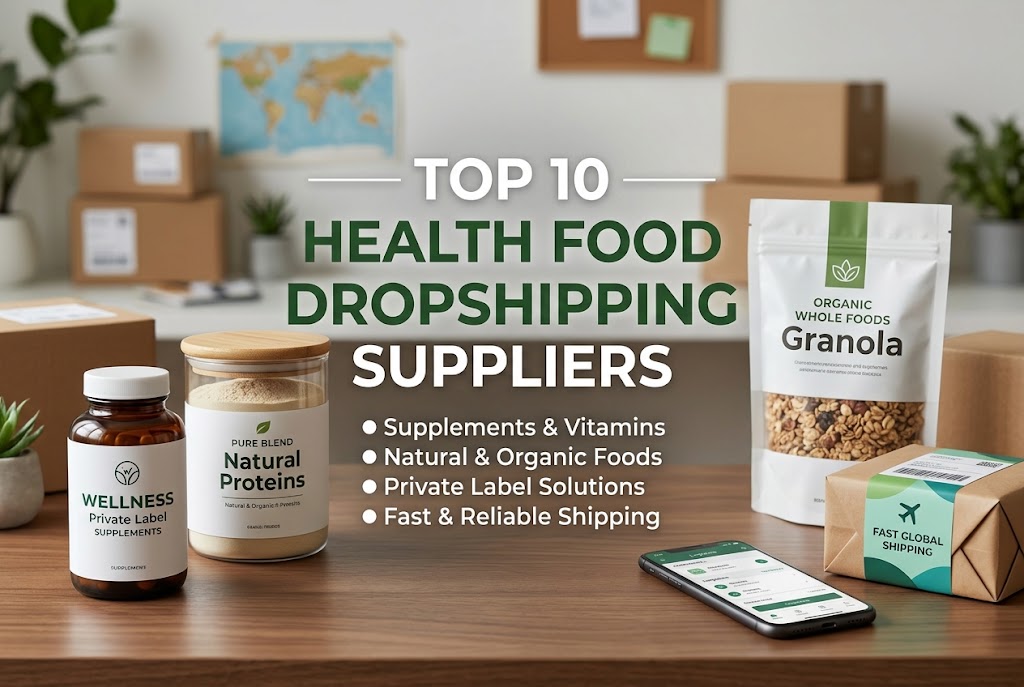
Top 10 Health Food Dropshipping Suppliers for Supplements, Natural Foods, Private Label & Fast Shipping

The health food and wellness market has become an increasingly attractive category for ecommerce entrepreneurs. Unlike many trend-driven products, health-oriented consumables can generate repeat purchases because customers regularly replenish vitamins, supplements, functional foods, protein products, herbal formulas, and other wellness products. This creates an opportunity for dropshipping businesses to build recurring revenue rather than relying entirely on one-time purchases. Shopify’s 2026 supplement dropshipping guide also highlights recurring demand and the importance of regulatory considerations when entering the category.
However, health food dropshipping is fundamentally different from ordinary consumer-product dropshipping. Product quality, ingredient transparency, expiration dates, storage conditions, labeling, manufacturing standards, shipping reliability, and permitted health claims all need to be considered before a product is added to a store. A supplier with a large catalog is not necessarily a good supplier for a health-focused brand.
For this ranking, the suppliers are evaluated according to product selection, private-label capabilities, minimum order requirements, fulfillment infrastructure, shipping potential, product quality, scalability, and suitability for ecommerce sellers. The list deliberately emphasizes health-food manufacturers, natural-product distributors, and specialized supplement suppliers rather than filling the ranking with generic dropshipping marketplaces.
1. ScaleOrder
ScaleOrder is a particularly flexible choice for entrepreneurs who want a sourcing and fulfillment partner rather than being restricted to a fixed supplement catalog. Its model combines product sourcing, purchasing, quality inspection, warehousing, packing, fulfillment, and international shipping, making it possible to build a health-oriented store around products that are not necessarily available from a single standardized catalog.
This flexibility is important in health food dropshipping because different stores may have very different positioning. One merchant may focus on functional foods and superfoods, while another may build a wellness store around supplements, sports nutrition, herbal products, or private-label merchandise. A sourcing-oriented model allows sellers to test different product concepts before committing substantial capital to inventory.
ScaleOrder also supports customization and branded fulfillment, which can become more valuable after a product has demonstrated consistent demand. Instead of remaining dependent on generic products, merchants can gradually move toward custom packaging and a stronger branded experience.
The main limitation is that health-food sellers still need to conduct product-specific due diligence. A sourcing partner can help identify and fulfill products, but merchants remain responsible for making sure ingredients, labels, claims, certifications, and import requirements are appropriate for their target market.
Pros
The strongest advantage is sourcing flexibility. Merchants are not restricted to one narrow catalog and can potentially combine sourcing, fulfillment, quality inspection, packaging, and shipping under one operational relationship. This is particularly useful for stores that are still testing their niche.
Cons
Delivery speed and documentation can vary by product and supplier. Health-food merchants should verify ingredient specifications, shelf life, certificates, labeling, and destination-market requirements before publishing a product.
Popular Products
Potential categories include vitamins, herbal supplements, functional foods, wellness products, protein-related products, superfoods, nutritional products, and customized health-oriented merchandise.
Shipping Speed
Shipping speed depends on product origin, destination, inventory availability, and logistics route. This makes SKU-level shipping verification more important than using a single advertised delivery time for an entire store.
Best For
ScaleOrder is best suited to entrepreneurs who want flexible sourcing and fulfillment, especially those planning to test multiple health-food concepts before developing their own branded product line.
2. Supliful
Supliful is one of the most specialized options for entrepreneurs who want to launch a branded supplement or wellness business without purchasing traditional inventory upfront. Its current catalog contains more than 200 ready-to-brand products, including vitamins, protein, collagen, gummies, mushroom products, and other wellness products.
The fundamental difference between Supliful and conventional product sourcing is its private-label orientation. Merchants can add their own logo and label while Supliful handles manufacturing, storage, packing, and shipping. The company currently promotes zero minimum orders, meaning merchants can test individual products without purchasing a large batch in advance.
This model is especially useful for ecommerce entrepreneurs who want to create a recognizable brand rather than simply resell generic health products. Consumables are also naturally compatible with subscriptions, replenishment programs, bundles, and influencer-driven marketing.
Supliful’s current information says US orders receive 48-hour fulfillment and typically arrive within 2–5 business days. It also states that products are manufactured in FDA-registered, GMP-certified facilities, with Certificates of Analysis available upon request.
One limitation is that the company focuses primarily on ready-made supplements and wellness products. Custom formulations are available only to existing clients with proven sales, and the company says custom projects can involve high MOQs and at least $10,000 upfront.
Pros
Supliful combines private labeling, zero inventory, automated fulfillment, and a health-focused catalog. This greatly reduces the operational complexity of launching a supplement brand.
Cons
The catalog is more concentrated around supplements and wellness products than broader health-food categories. Custom formulation is also considerably more demanding than its standard ready-to-brand model.
Popular Products
Protein powders, collagen, vitamins, gummies, mushroom blends, greens, energy products, pre-workout products, and other functional wellness supplements are among the most relevant categories.
Shipping Speed
Supliful currently advertises 48-hour fulfillment and approximately 2–5 business days for US orders.
Best For
Supliful is best for private-label supplement brands, wellness startups, creators, and ecommerce sellers who want to launch without holding inventory.
3. GreenDropShip
GreenDropShip is particularly interesting for merchants who define “health food” more broadly than vitamins and dietary supplements. Its catalog covers natural grocery, supplements, bodycare, wellness, herbal products, performance nutrition, and related categories. The company states that its marketplace includes more than 800 brands and approximately 20,000 SKUs.
This breadth allows merchants to construct a more complete natural-health store. Instead of selling only capsules or powders, a store can combine herbal products, organic grocery items, functional nutrition, natural remedies, and complementary wellness products. This creates opportunities for bundles and higher average order values.
GreenDropShip’s health and wellness selection includes homeopathic products, herbal formulas, performance nutrition, and aromatherapy products. It also ships products directly to customers after orders are placed, which makes the model relatively straightforward for traditional dropshipping.
The major drawback is differentiation. Many products are established brands rather than proprietary products created specifically for the merchant. This means sellers may have less control over product positioning and potentially face competition from other retailers carrying the same merchandise.
Pros
The strongest advantage is assortment depth. GreenDropShip gives health-focused stores access to a much wider range of natural and wellness products than a supplier focused only on private-label supplements.
Cons
Private-label opportunities are more limited than with dedicated supplement manufacturers. Established branded products can also create tighter margins and greater price competition.
Popular Products
Herbal formulas, natural remedies, performance nutrition, organic products, essential oils, natural grocery items, and wellness products are particularly relevant.
Shipping Speed
Because GreenDropShip operates around US distribution and domestic ecommerce fulfillment, US sellers can generally expect a more practical delivery model than with long-distance overseas fulfillment. Exact delivery times should still be confirmed at the product and destination level.
Best For
GreenDropShip is best for natural grocery stores, organic-product stores, holistic wellness brands, and merchants who need a broad health-related catalog.
4. Vitalabs
Vitalabs is a more manufacturing-oriented supplier and is particularly suitable for sellers who want to move beyond basic dropshipping toward private-label supplements. The company currently promotes more than 240 stock nutraceutical formulations and offers capsules, tablets, gummies, powders, specialty blends, and single-serving products.
One of Vitalabs’ major advantages is its combination of private-label manufacturing and fulfillment. The company states that it can store, pick, pack, and ship products directly to individual customers, allowing merchants to maintain a branded product line without having to build their own warehouse operation.
Its current information also indicates that some private-label SKUs can begin with relatively low quantities, with the company advertising minimums as low as 144 bottles per SKU on its private-label page and 72-bottle minimums in its facility information.
Vitalabs also highlights FDA registration, cGMP compliance, and certifications including Organic, NSF, and Halal options.
The main disadvantage is that it is more appropriate for entrepreneurs who already have a product strategy. Someone who simply wants to test hundreds of random products may find a manufacturing relationship unnecessarily complicated.
Pros
Vitalabs combines manufacturing, private labeling, fulfillment, product development, packaging, and regulatory-oriented services. It is much closer to a long-term supplement manufacturing partner than a simple catalog supplier.
Cons
The model requires more planning than zero-inventory dropshipping. Private-label inventory and SKU-level commitments can introduce capital requirements that beginners may want to avoid.
Popular Products
Gummies, probiotics, vitamins, protein products, sports nutrition, herbal formulas, single-serving packets, superfoods, and specialty nutraceutical products are prominent categories.
Shipping Speed
Vitalabs emphasizes fast turnaround and in-house fulfillment, but merchants should distinguish manufacturing lead time from final delivery time when calculating customer-facing shipping promises.
Best For
Vitalabs is best for health brands that have already validated demand and want to transition into scalable private-label supplement manufacturing.
5. Makers Nutrition
Makers Nutrition is another manufacturer-oriented supplier that can be valuable for entrepreneurs who are serious about creating a proprietary supplement brand. Rather than positioning itself as a generic dropshipping marketplace, its strength lies in the ability to support the product-development process from formulation and manufacturing through packaging, warehousing, and fulfillment.
This makes Makers Nutrition more appropriate for the second stage of a dropshipping business. A merchant may initially test health products through a flexible sourcing supplier, identify a winning category, and then use a specialized manufacturer to develop a more differentiated product.
The company offers a broad selection of supplement formats, including capsules, tablets, powders, gummies, and sports-nutrition products. This gives brands more flexibility when creating product lines around different customer needs.
The main consideration is operational complexity. Custom manufacturing requires more planning than simply listing an existing product. The merchant needs to think about formula specifications, packaging, inventory, quality control, labeling, production schedules, and compliance.
Pros
Makers Nutrition provides a comprehensive manufacturing ecosystem. This is valuable for brands that want to control their product identity and eventually establish a defensible position in a competitive supplement market.
Cons
It is not the easiest starting point for a complete beginner. Manufacturing projects require more capital, planning, and inventory management than conventional dropshipping.
Popular Products
Gummies, capsules, protein powders, collagen products, sports nutrition, vitamins, herbal supplements, and other nutraceutical formats are relevant categories.
Shipping Speed
Fulfillment can be incorporated into the broader supply-chain model, but production lead time should be considered separately from the time required to deliver an individual customer order.
Best For
Makers Nutrition is best for established health brands that want manufacturing, packaging, warehousing, and fulfillment under one relationship.
6. SMP Nutra
SMP Nutra is a US-based private-label and contract supplement manufacturer with a particularly large stock-formula catalog. Its current website advertises more than 800 stock supplements, custom formulation, packaging, label design, and fulfillment capabilities.
Its positioning makes it especially useful for businesses that have moved beyond simple dropshipping and want to create products with greater brand differentiation. Merchants can choose from ready-to-brand formulas or develop an original formulation with the company’s manufacturing team.
There is, however, an important distinction that potential users should understand: SMP Nutra currently does not offer traditional dropshipping. Its FAQ states that fulfillment is available instead, including warehousing, picking, packing, shipping, and inventory management.
That makes SMP Nutra less attractive for someone looking for true zero-inventory dropshipping, but potentially very attractive for a brand that already has demand and is willing to hold inventory with a fulfillment partner.
Pros
The company offers an unusually broad stock-formula selection, custom manufacturing, packaging, branding support, and fulfillment. It is suitable for businesses seeking long-term control over their supplement portfolio.
Cons
Traditional dropshipping is not currently offered, and inventory is required for its fulfillment model. Some manufacturing arrangements may therefore require substantially more working capital.
Popular Products
Gummies, capsules, tablets, powders, sports nutrition, vitamins, herbal supplements, and custom nutraceutical formulas are major categories.
Shipping Speed
Once inventory is positioned within its fulfillment operation, orders can be picked, packed, and shipped without the merchant personally handling them. Manufacturing lead times must be considered separately.
Best For
SMP Nutra is best for established supplement brands seeking custom manufacturing and outsourced fulfillment rather than pure dropshipping.
7. Nutribl
Nutribl is a particularly relevant option for sellers targeting the UK and European health-food market. The company focuses on private-label nutritional supplements and offers more than 120 stock formulas, low MOQs, custom formulation, label design, and regulatory support.
Its product range covers areas such as collagen, women’s health, magnesium, ashwagandha, vitamins, omega-3 products, probiotics, and other nutritional supplements. The supplier also offers a private-label model in which merchants can put their own branding on ready-made formulas.
One important point for current users is that Nutribl’s fulfillment model has evolved. The company states that its traditional dropshipping system was phased out from February 2025 and replaced with a wholesale 3PL model. Under this system, merchants can start with only 10 units per SKU and have inventory stored and dispatched by a fulfillment partner.
This means Nutribl should no longer be treated as a conventional zero-inventory dropshipper. Instead, it is more accurately positioned as a low-MOQ private-label supplement supplier with 3PL support.
Pros
Low MOQs, UK manufacturing, private labeling, custom formulation, regulatory expertise, and 3PL integration make Nutribl highly relevant to UK-focused health brands.
Cons
The current model requires inventory to be placed with its fulfillment partner, so it is less suitable for sellers specifically looking for completely inventory-free dropshipping.
Popular Products
Collagen gummies, magnesium, ashwagandha, omega-3, probiotics, vitamin D, multivitamins, women’s health supplements, and herbal formulas are important categories.
Shipping Speed
Nutribl is UK-based and states that overseas deliveries can take longer through its 3PL partner.
Best For
Nutribl is best for UK and European entrepreneurs who want low-MOQ private-label supplements and outsourced fulfillment.
8. PureFormulas
PureFormulas is a more traditional health-focused product source, making it conceptually different from private-label manufacturers such as Vitalabs or SMP Nutra. Its appeal comes from access to established health and wellness products rather than from developing a proprietary supplement formula.
This type of supplier can make sense for merchants who want to create a curated health store with multiple brands and categories. Instead of spending resources developing a new supplement, a retailer can focus on merchandising, educational content, SEO, email marketing, and customer acquisition.
The disadvantage is obvious: branded products are easier for competitors to identify and compare. If several retailers sell the same product, pricing and customer acquisition become more important. This model therefore works better for businesses with a strong content or audience advantage than for stores relying exclusively on paid advertising.
Pros
A health-focused catalog makes product selection easier, while established brands can provide customers with greater familiarity than completely unknown private-label products.
Cons
Merchants have less control over formulation, packaging, and branding. Margins can also be less attractive than those available through private-label manufacturing.
Popular Products
Vitamins, minerals, probiotics, herbal supplements, sports nutrition, natural wellness products, and nutritional products are the most relevant categories.
Shipping Speed
US domestic fulfillment is generally more suitable for US-targeted stores than cross-border fulfillment, although merchants should confirm current delivery estimates and product restrictions before publishing listings.
Best For
PureFormulas is best for curated health and wellness stores that prefer established products over private-label manufacturing.
9. Supplement Planet
Supplement Planet is another specialist-oriented option for merchants interested in vitamins, sports nutrition, and dietary supplements. Its integration through Inventory Source allows product information and inventory data to be connected to ecommerce stores, reducing the amount of manual catalog management required. Inventory Source specifically lists Supplement Planet as a supplier that can be integrated into its automated dropshipping system.
This automation can be valuable because health-product inventories change frequently. Without inventory synchronization, a merchant can accidentally advertise products that are no longer available. Automated feeds can reduce this operational problem while allowing sellers to maintain a relatively broad product assortment.
The downside is that this model is primarily focused on reselling supplier products rather than building a completely proprietary health-food brand. Merchants therefore need to create differentiation through their store positioning, content, customer service, bundles, or marketing strategy.
Pros
The supplier is relevant to the supplement category and can be combined with inventory automation, making product-feed management more efficient.
Cons
The model offers less branding differentiation than private-label manufacturers, and merchants remain dependent on the underlying supplier’s inventory and pricing.
Popular Products
Dietary supplements, vitamins, sports nutrition products, nutritional products, and wellness supplements are the most relevant categories.
Shipping Speed
Shipping depends on the specific underlying distributor and destination. US-focused merchants should verify warehouse location and actual delivery estimates for individual SKUs.
Best For
Supplement Planet is best for merchants who want a conventional supplement catalog combined with automated inventory and product-feed management.
10. Inventory Source
Inventory Source is different from most suppliers on this list because it functions primarily as a supplier-network and automation platform rather than as a single health-food manufacturer. It is nevertheless relevant to health food dropshipping because its network includes multiple supplement and vitamin wholesalers, including Supplement Planet and other distributors.
The main value is operational automation. Inventory Source can synchronize supplier inventory, product information, pricing rules, categories, and other data with an ecommerce store. This is particularly useful in the health category, where a store may need to manage hundreds or thousands of SKUs without manually updating availability.
The trade-off is that Inventory Source itself does not solve every supplier-quality problem. The merchant still needs to evaluate the individual wholesale supplier, brand authorization, ingredient information, shipping performance, and product compliance.
Pros
The platform can connect merchants with multiple supplement wholesalers while automating inventory and product-feed management. This makes it useful for larger catalogs.
Cons
It is less of a direct health-food supplier and more of a supplier-network and automation layer. Quality, pricing, and shipping therefore vary depending on the underlying supplier.
Popular Products
Vitamins, nutritional supplements, sports nutrition, health products, and wellness merchandise are the main categories available through its supplier network.
Shipping Speed
There is no single shipping speed because Inventory Source connects merchants to different suppliers. Delivery should be evaluated at the individual supplier level.
Best For
Inventory Source is best for experienced ecommerce operators who need multiple health-product suppliers and automated catalog management.
What Makes a Good Health Food Dropshipping Supplier?
Choosing a health food supplier requires more than comparing wholesale prices. The most important question is whether the supplier can support the entire customer journey from manufacturing to final delivery.
Product Quality and Ingredient Transparency
Health products are consumed rather than simply used as accessories, so quality problems can damage a brand much more severely. Merchants should request ingredient lists, Certificates of Analysis where appropriate, manufacturing information, expiration information, and relevant testing documentation.
Manufacturing Standards
FDA registration, GMP or cGMP manufacturing, organic certifications, NSF certifications, and other standards can provide useful signals, but sellers should understand exactly what each certification means rather than treating certification badges as a universal guarantee.
For example, Supliful states that its supplements are manufactured in FDA-registered, GMP-certified facilities, while Vitalabs highlights FDA registration, cGMP compliance, Organic, NSF, and Halal-related certifications.
Private Label Capability
Private labeling becomes increasingly important when the goal is to build a long-term brand. A generic product can be copied by another seller, whereas proprietary branding, packaging, positioning, and eventually custom formulation create stronger differentiation.
Minimum Order Quantity
MOQ should be considered in relation to business maturity. Zero-MOQ suppliers are excellent for testing, while low-MOQ manufacturers can become more attractive after a product has proven its demand.
Supliful currently promotes no minimum order quantities, while Vitalabs advertises low minimums for private-label SKUs and Nutribl states that its stock products can be started at 10 units per SKU.
Fulfillment and Shipping
Fast shipping can improve conversion rates, but health products have another logistical concern: storage. Heat, humidity, expiration dates, and product stability may matter depending on the product.
US-focused brands will often benefit from domestic fulfillment, while European sellers may prefer suppliers with UK or EU-oriented infrastructure. The fastest theoretical shipping route is not always the best option if inventory availability is unreliable.
Regulatory Responsibility
Merchants should be particularly careful with health claims. A supplier may manufacture a product legally, but that does not automatically mean every claim used in a merchant’s advertising is acceptable in every market.
This is one reason health food dropshipping should be approached more like a regulated product category than a conventional ecommerce niche.
Health Food Dropshipping Suppliers Comparison
| Supplier | Product Selection | Private Label | Fulfillment | Shipping | Scalability | Brand Building | Overall |
|---|---|---|---|---|---|---|---|
| ScaleOrder | ★★★★★ | ★★★★☆ | ★★★★★ | ★★★★☆ | ★★★★★ | ★★★★★ | ★★★★★ |
| Supliful | ★★★★☆ | ★★★★★ | ★★★★★ | ★★★★★ | ★★★★★ | ★★★★★ | ★★★★★ |
| GreenDropShip | ★★★★★ | ★★☆☆☆ | ★★★★☆ | ★★★★☆ | ★★★★☆ | ★★★☆☆ | ★★★★½ |
| Vitalabs | ★★★★★ | ★★★★★ | ★★★★★ | ★★★★☆ | ★★★★★ | ★★★★★ | ★★★★½ |
| Makers Nutrition | ★★★★★ | ★★★★★ | ★★★★★ | ★★★★☆ | ★★★★★ | ★★★★★ | ★★★★½ |
| SMP Nutra | ★★★★★ | ★★★★★ | ★★★★☆ | ★★★★☆ | ★★★★★ | ★★★★★ | ★★★★½ |
| Nutribl | ★★★★☆ | ★★★★★ | ★★★★☆ | ★★★★☆ | ★★★★☆ | ★★★★★ | ★★★★½ |
| PureFormulas | ★★★★☆ | ★★☆☆☆ | ★★★★☆ | ★★★★☆ | ★★★★☆ | ★★★☆☆ | ★★★★☆ |
| Supplement Planet | ★★★★☆ | ★★☆☆☆ | ★★★★☆ | ★★★★☆ | ★★★★☆ | ★★★☆☆ | ★★★★☆ |
| Inventory Source | ★★★★★ | ★★☆☆☆ | ★★★★☆ | ★★★☆☆ | ★★★★★ | ★★★☆☆ | ★★★★☆ |
These are editorial ratings for comparison purposes, not official ratings from the suppliers. Shipping scores are relative because actual delivery times vary by destination, warehouse, inventory availability, carrier, and product.
The best supplier depends heavily on the stage of the business.
For a merchant who wants flexible product sourcing, fulfillment, quality inspection, branding, and the ability to test different health-food products, ScaleOrder is one of the strongest overall choices. Its broader sourcing model makes it particularly useful when the exact winning product has not yet been identified.
For entrepreneurs whose primary objective is launching a private-label supplement brand without holding inventory, Supliful is arguably the most specialized choice. Its zero-MOQ model, branded packaging, automated fulfillment, and US delivery structure make it particularly attractive for beginners and creators.
For natural and organic product stores, GreenDropShip offers significantly greater catalog breadth. Its 20,000-plus natural and organic products make it possible to build a broader wellness assortment rather than limiting a store to supplements.
For merchants that have already validated demand and are ready to develop a genuine supplement brand, Vitalabs, Makers Nutrition, and SMP Nutra become more compelling. These companies provide manufacturing-oriented services that can support a transition from simple dropshipping into private-label ecommerce.
For UK-focused businesses, Nutribl deserves special attention because of its low-MOQ private-label model and UK manufacturing infrastructure, although merchants should understand that its current fulfillment model is based on 3PL rather than traditional zero-inventory dropshipping.
The most sensible strategy is not to choose a supplier simply because it offers the cheapest product. A stronger approach is to test products with low financial exposure, identify products with repeat-purchase potential, validate customer demand, and then move successful products toward stronger branding and private-label manufacturing.
That approach is particularly important in health food dropshipping because long-term profitability depends not only on product margins, but also on customer trust, repeat purchases, regulatory discipline, shipping reliability, and the ability to create a recognizable brand.


No Comments