


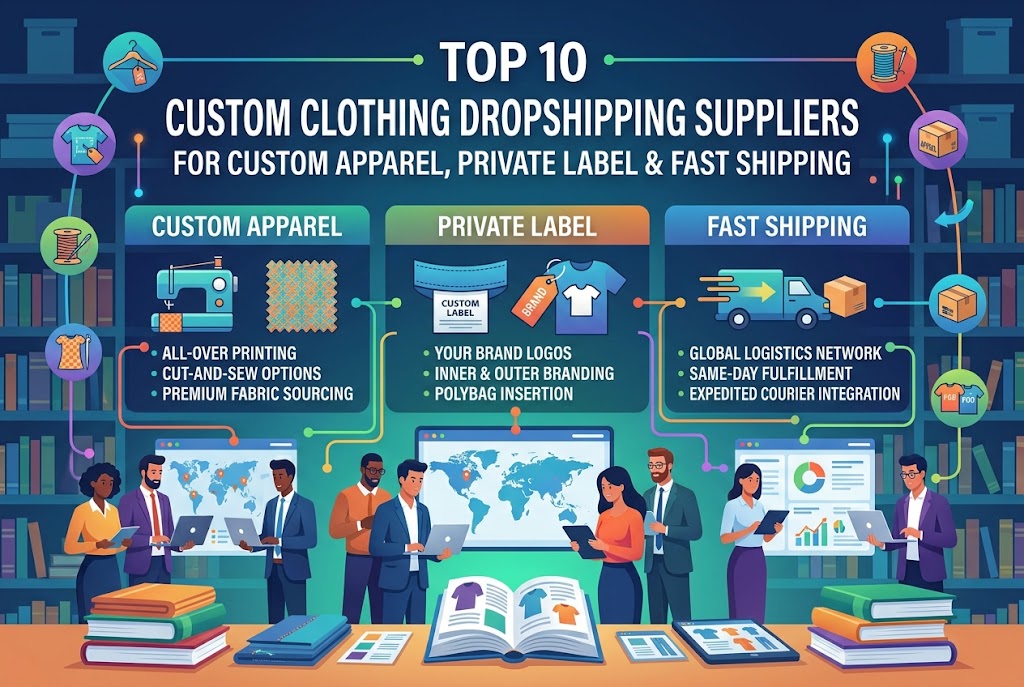
Top 10 Custom Clothing Dropshipping Suppliers for Custom Apparel, Private Label & Fast Shipping

Custom clothing dropshipping has evolved beyond simply adding a logo to a basic T-shirt. In 2026, successful apparel stores increasingly need suppliers that can combine customization, consistent garment quality, reliable fulfillment, branding options, and commercially viable shipping. The right supplier also depends heavily on the business model: a startup testing designs may prioritize no minimum orders and fast POD production, while an established brand may care more about private labeling, custom manufacturing, packaging, and scalable sourcing.
This guide evaluates 10 custom clothing dropshipping suppliers from a practical ecommerce perspective. Rather than filling the list with general-purpose dropshipping marketplaces, the selection focuses primarily on suppliers and fulfillment companies with meaningful capabilities in custom apparel, print-on-demand, private labeling, or apparel manufacturing. Shipping speeds are indicative rather than guaranteed because production method, destination, product type, and fulfillment location can materially change the final delivery time.
1. ScaleOrder Dropshipping
ScaleOrder is particularly interesting for entrepreneurs who want to move beyond the limitations of conventional print-on-demand. Instead of treating custom clothing simply as artwork applied to an existing blank garment, its sourcing-oriented model is better suited to sellers looking for customized apparel, private labeling, branded packaging, and a more flexible supply chain. ScaleOrder’s own analysis of custom apparel highlights the economic difference between pure POD and supplier-based private-label production, particularly once a store has identified products with consistent demand.
The major advantage is flexibility. Sellers can approach custom clothing as a real brand rather than merely a collection of printed products. This can include custom hoodies, T-shirts, streetwear, activewear, jackets, embroidered apparel, and other fashion products that require more customization than a standard POD workflow. For stores sourcing from China, this type of supplier relationship can also make sense when product specifications, packaging, labels, or manufacturing details become important.
Pros and Cons
The strongest advantages are customization flexibility, private-label potential, sourcing support, and suitability for scaling beyond basic POD. It is especially relevant to sellers who want to improve unit economics after validating winning designs. ScaleOrder also discusses hybrid strategies in which POD is used for testing while supplier-based production is introduced for proven products.
The trade-off is that a sourcing-oriented model generally requires more communication and product evaluation than a fully automated POD marketplace. Sellers should therefore sample products, confirm sizing, establish quality standards, and clarify production and shipping lead times before scaling.
Popular Products and Shipping Speed
Custom T-shirts, hoodies, sweatshirts, streetwear, embroidered garments, private-label apparel, and branded fashion collections are among the most relevant product categories. Shipping speed varies according to manufacturing requirements and destination, so sellers should evaluate the complete production-plus-fulfillment timeline rather than looking only at transit time.
Best for: Brands that want to graduate from basic POD into customized, private-label, and scalable apparel sourcing.
2. Apliiq
Apliiq is one of the more apparel-focused options for merchants who care about branding rather than simply printing artwork. Its current catalog covers more than 1,200 apparel products, while its services include DTG, DTF, embroidery, private labels, neck prints, woven labels, patches, and branded fulfillment. It operates two U.S. facilities and supports both on-demand production and warehousing.
This makes Apliiq particularly attractive for entrepreneurs building a recognizable clothing label. A standard POD supplier can put artwork on a shirt, but Apliiq goes further by allowing merchants to replace manufacturer labels with their own branding. Its private-label system can be applied on demand, meaning sellers do not necessarily need to purchase large quantities before introducing branded garments.
Pros and Cons
The biggest strength is apparel specialization. Apliiq provides considerably more branding depth than suppliers focused primarily on generic promotional merchandise. Merchants can combine printing, embroidery, private labeling, patches, and other finishing options to create a more retail-oriented product.
The downside is that highly customized apparel can become considerably more expensive than basic POD products. Sellers targeting highly price-sensitive customers may therefore find the economics less attractive than mass-market POD providers. The catalog is also more focused on apparel branding than on the enormous variety of unrelated products available from general POD marketplaces.
Popular Products and Shipping Speed
T-shirts, hoodies, jackets, sweatshirts, hats, joggers, leggings, tank tops, and embroidered apparel are particularly relevant. Apliiq states that stocked inventory can be shipped in approximately 24–48 hours, while on-demand products follow production timelines before shipping.
Best for: Apparel brands that prioritize private labeling, embroidery, and retail-quality branding.
3. Printful
Printful remains one of the strongest mainstream choices for custom clothing dropshipping because it combines a broad apparel catalog with in-house production and a mature ecommerce fulfillment infrastructure. Its current custom clothing catalog includes more than 500 products, with options ranging from T-shirts and hoodies to leggings, dresses, jackets, hats, and other apparel.
Printful’s major distinction is its emphasis on in-house production and quality control. It supports DTG, DTF, all-over printing, embroidery, and other decoration methods, giving merchants several ways to translate a design into an actual garment. The company also supports custom labels, packaging, and pack-ins, which makes it possible to create a more coherent branded experience.
Pros and Cons
The biggest advantages are reliability, production consistency, strong integrations, a recognizable infrastructure, and relatively straightforward automation. Merchants can connect stores such as Shopify, Etsy, WooCommerce, and other ecommerce channels and have orders automatically routed for production and fulfillment.
The principal disadvantage is cost. Printful’s convenience and infrastructure can result in higher product costs than sourcing directly from manufacturers. This matters when a store is trying to compete aggressively on price or wants the highest possible margins at large volumes.
Popular Products and Shipping Speed
T-shirts, hoodies, sweatshirts, leggings, jackets, dresses, hats, and embroidered products are among its strongest categories. Printful states that more than 50% of orders ship within three business days from the fulfillment center nearest to the customer, although the total delivery window depends on product and destination.
Best for: Sellers wanting a reliable, established POD system with strong automation and global fulfillment.
4. Contrado
Contrado occupies a different position from mass-market POD platforms. It focuses heavily on premium, design-driven custom fashion and manufactures products in its own facilities rather than relying on a fragmented third-party supplier network. The company offers more than 470 custom products and emphasizes in-house printing, cutting, sewing, quality control, and branding.
This approach is especially suitable for fashion entrepreneurs whose selling proposition depends on originality and premium presentation. Contrado allows extensive all-over designs and offers products such as dresses, T-shirts, hoodies, bomber jackets, scarves, hats, and other fashion items. Its Shopify integration also automates much of the order flow.
Pros and Cons
Contrado’s biggest advantage is product differentiation. A merchant can create more fashion-oriented designs rather than simply selecting a blank T-shirt and adding a chest graphic. In-house manufacturing also provides greater control over production consistency.
The major drawback is pricing. Premium manufacturing generally produces higher product costs, which means sellers need stronger branding and positioning to maintain healthy margins. Its dropshipping integration is also more limited than some broader POD ecosystems, with Shopify being its primary supported integration.
Popular Products and Shipping Speed
Popular options include all-over-print T-shirts, dresses, bomber jackets, hoodies, scarves, bucket hats, and premium fashion accessories. Contrado states that average production takes around 1–3 days and worldwide tracked delivery can average approximately 1–4 days, although actual timing varies by destination.
Best for: Premium fashion brands that want distinctive designs and stronger control over the finished product.
5. Printify
Printify is particularly strong when product variety and supplier choice are more important than controlling every manufacturing step internally. Its network connects merchants with print providers across multiple regions, allowing sellers to select different providers for the same or similar apparel products. Its custom clothing catalog includes more than 1,300 products, while other current catalog pages indicate more than 2,000 products across the broader platform.
This model provides significant flexibility. Sellers can compare providers based on pricing, location, production capabilities, and shipping characteristics instead of being locked into one manufacturing operation.
Pros and Cons
The main advantage is breadth. Merchants can experiment with T-shirts, hoodies, dresses, tank tops, jackets, shoes, swimwear, and numerous other categories without committing to inventory. Printify also supports branding options such as neck labels and packaging inserts.
The trade-off is consistency. Because the ecosystem relies on multiple Print Providers, product quality, production time, and shipping performance can vary depending on the supplier selected. A seller should therefore order samples before choosing a provider for a major product line.
Popular Products and Shipping Speed
Garment-dyed T-shirts, heavyweight T-shirts, hoodies, sweatshirts, tank tops, dresses, and accessories are common choices. Printify operates a global network of more than 140 facilities, allowing sellers to select geographically appropriate providers and potentially shorten delivery times.
Best for: Entrepreneurs who want extensive apparel variety and the ability to compare multiple production providers.
6. Gelato
Gelato is particularly compelling for sellers whose customer base is spread across multiple countries. Its custom clothing operation uses a distributed production network covering more than 32 countries, with more than 140 production partners. The company states that 90% of orders are produced locally and that 90% arrive within five days of ordering.
The fundamental advantage is geographic proximity. Rather than producing every item in one country and shipping internationally, Gelato routes orders to production partners closer to the final customer. This can reduce international transit distances and make international apparel fulfillment more predictable.
Pros and Cons
Gelato is attractive for international ecommerce businesses because production is distributed across multiple countries. Its integrations with Shopify, Etsy, WooCommerce, and other platforms also make the workflow relatively straightforward.
However, merchants have less direct control over the exact production facility handling every order. That can be less attractive for brands that require highly specific manufacturing standards or extensive private-label customization. Gelato is also more naturally suited to POD than to fully bespoke garment manufacturing.
Popular Products and Shipping Speed
T-shirts, sweatshirts, hoodies, embroidered clothing, and other customizable apparel are key categories. Gelato reports that 90% of orders arrive within five days, although the actual experience depends on product, production location, destination, and shipping method.
Best for: International apparel stores that prioritize geographically distributed fulfillment and shorter cross-border shipping distances.
7. SPOD
SPOD is a strong choice for merchants looking for a straightforward print-on-demand clothing workflow rather than a complex apparel sourcing relationship. Its appeal comes from the traditional POD structure: merchants upload designs, customers place orders, and the supplier produces and ships individual garments without requiring the seller to hold inventory.
For new custom clothing stores, this model reduces financial risk. Instead of purchasing dozens or hundreds of garments before knowing whether a design will sell, entrepreneurs can launch designs individually and scale only when demand becomes visible.
Pros and Cons
SPOD’s biggest advantage is simplicity. It is well suited to sellers who want to test designs quickly and avoid inventory commitments. Apparel customization can also be scaled without changing the fundamental business process.
The limitation is that conventional POD is not necessarily the best long-term solution for a brand seeking proprietary garments. Sellers generally work within the supplier’s existing product catalog and decoration capabilities. Once an apparel brand needs custom cuts, proprietary fabrics, extensive private labeling, or manufacturer-level customization, a sourcing partner may provide more flexibility.
Popular Products and Shipping Speed
T-shirts, sweatshirts, hoodies, tank tops, and other everyday apparel are natural starting points. Production and shipping speeds vary by product and destination, so merchants should test actual delivery times to their target market before publishing aggressive shipping promises.
Best for: Beginners who want to validate custom clothing designs with minimal inventory risk.
8. AOP+
AOP+ is a specialist-oriented POD provider that is particularly relevant for merchants who want all-over-print apparel and branded merchandise rather than only conventional front-print T-shirts. The business model centers on producing custom products after orders are placed, which reduces the inventory burden for independent apparel brands.
Its positioning makes it useful for fashion concepts where the artwork itself covers a substantial portion of the garment. This can be particularly valuable for streetwear, artistic collections, colorful fashion, gaming merchandise, and other design-heavy niches.
Pros and Cons
The key strength is customization depth for visually intensive apparel. AOP+ can be more appropriate than a basic POD provider when the design concept depends on all-over artwork rather than a small printed logo.
The disadvantage is that all-over-print products can be more expensive than basic garments, while production and shipping times can differ depending on the manufacturing location and destination. Merchants therefore need to evaluate landed cost rather than looking only at the base product price.
Popular Products and Shipping Speed
All-over-print T-shirts, hoodies, leggings, dresses, sweatshirts, and accessories are particularly suitable. Shipping speed depends on the production facility and customer location, so sellers targeting the United States or Europe should test representative orders before launching large advertising campaigns.
Best for: Designers building visually distinctive apparel collections around all-over prints.
9. CustomCat
CustomCat is another established apparel-focused POD option, particularly suitable for merchants who want relatively straightforward customization and automated order fulfillment. Its model allows sellers to publish personalized products without maintaining their own inventory, while production is triggered when an order is placed.
Compared with premium private-label specialists, CustomCat is more oriented toward practical POD commerce. That makes it useful for stores selling creator merchandise, niche apparel, personalized clothing, and straightforward branded products.
Pros and Cons
Its primary advantage is operational simplicity. Sellers can test multiple designs without committing substantial capital to inventory. This is useful when demand is uncertain or when a store frequently introduces new designs.
The main limitation is differentiation. Like most conventional POD providers, CustomCat works primarily within an existing product catalog and decoration system. It therefore may not be the ideal partner for a brand that wants proprietary garments, custom fabric development, specialized sewing, or extensive private-label manufacturing.
Popular Products and Shipping Speed
T-shirts, hoodies, sweatshirts, hats, mugs, and other personalized merchandise are typical products, with apparel generally being the most relevant category for clothing stores. Production and delivery times vary according to product, destination, and shipping method, so merchants should verify current estimates before setting customer-facing delivery promises.
Best for: Merchants looking for practical POD fulfillment and fast design testing without inventory.
10. Printful Alternative: A More Specialized Apparel Sourcing Partner
For established apparel businesses, the most useful alternative to a conventional POD supplier may not be another POD platform at all. A specialized clothing manufacturer or sourcing partner can provide a fundamentally different model in which the merchant controls product specifications, branding, packaging, materials, and production quantities more closely.
This distinction matters because the needs of a store selling 20 experimental T-shirt designs are completely different from those of a brand selling 2,000 units of one successful hoodie. POD is excellent for demand testing, but once a product becomes predictable, lower manufacturing costs and greater customization can become more important than the convenience of one-off production. ScaleOrder’s own analysis similarly describes POD as useful for product discovery while supplier-based production can become more attractive during the scaling stage.
Pros and Cons
The primary advantage of this model is control. A manufacturer can potentially accommodate custom materials, labels, packaging, garment construction, embroidery, unique sizing, and other requirements that are difficult to achieve through standardized POD catalogs.
The trade-off is complexity. Minimum quantities, samples, production lead times, quality inspections, and communication become more important. This model therefore requires a more professional approach to supplier management.
Popular Products and Shipping Speed
Custom hoodies, heavyweight T-shirts, private-label streetwear, activewear, jackets, embroidered garments, and complete branded collections are the most suitable categories. Shipping speed depends heavily on the manufacturing location and fulfillment method, so production time and transit time should always be evaluated separately.
Best for: Established brands moving from POD experimentation toward scalable private-label apparel production.
How to Choose the Right Custom Clothing Dropshipping Supplier
The best custom clothing dropshipping supplier is not necessarily the company with the largest catalog or the lowest product price. The correct choice depends on where a store is in its development.
For a new business, no minimum order quantities and simple POD fulfillment are usually more important than manufacturing customization. Printful, Printify, Gelato, SPOD, and CustomCat are therefore practical starting points.
For a brand that already has traction, branding becomes more important. Apliiq is particularly strong in private labeling, while Contrado is better suited to premium, design-intensive fashion. For international stores, Gelato and Printify benefit from distributed production networks.
Once a store has validated several winning products, however, the economics can change. At this stage, direct sourcing, private labeling, custom packaging, and more controlled manufacturing may provide better long-term economics than remaining entirely dependent on one-off POD fulfillment. ScaleOrder is particularly relevant in this transition because its positioning is closer to sourcing and fulfillment than to a pure POD marketplace.
Custom Clothing Dropshipping Suppliers Compared
| Supplier | Customization | Branding | Product Quality Potential | Shipping | Scalability | Overall |
|---|---|---|---|---|---|---|
| ScaleOrder | ★★★★★ | ★★★★★ | ★★★★★ | ★★★★☆ | ★★★★★ | ★★★★★ |
| Apliiq | ★★★★★ | ★★★★★ | ★★★★★ | ★★★★☆ | ★★★★☆ | ★★★★★ |
| Printful | ★★★★☆ | ★★★★☆ | ★★★★★ | ★★★★☆ | ★★★★★ | ★★★★★ |
| Contrado | ★★★★★ | ★★★★★ | ★★★★★ | ★★★★★ | ★★★★☆ | ★★★★★ |
| Printify | ★★★★☆ | ★★★★☆ | ★★★★☆ | ★★★★☆ | ★★★★★ | ★★★★☆ |
| Gelato | ★★★★☆ | ★★★☆☆ | ★★★★☆ | ★★★★★ | ★★★★★ | ★★★★☆ |
| SPOD | ★★★★☆ | ★★★☆☆ | ★★★★☆ | ★★★★☆ | ★★★★☆ | ★★★★☆ |
| AOP+ | ★★★★★ | ★★★★☆ | ★★★★☆ | ★★★☆☆ | ★★★★☆ | ★★★★☆ |
| CustomCat | ★★★★☆ | ★★★☆☆ | ★★★★☆ | ★★★★☆ | ★★★★☆ | ★★★★☆ |
| Specialized Apparel Sourcing | ★★★★★ | ★★★★★ | ★★★★★ | ★★★☆☆ | ★★★★★ | ★★★★☆ |
The custom clothing dropshipping market is increasingly divided into two distinct models. POD suppliers provide speed, simplicity, and almost zero inventory risk, making them ideal for testing designs and launching small collections. Specialized sourcing and private-label suppliers provide greater control over products, branding, margins, and long-term brand development.
For most new entrepreneurs, starting with POD is still the rational approach. Once a design demonstrates consistent demand, however, it is worth reassessing the supply chain rather than assuming the original POD supplier will remain the most economical option forever. A hybrid model—POD for experimentation and customized supplier production for proven products—can offer a stronger balance between risk and scalability.


No Comments