


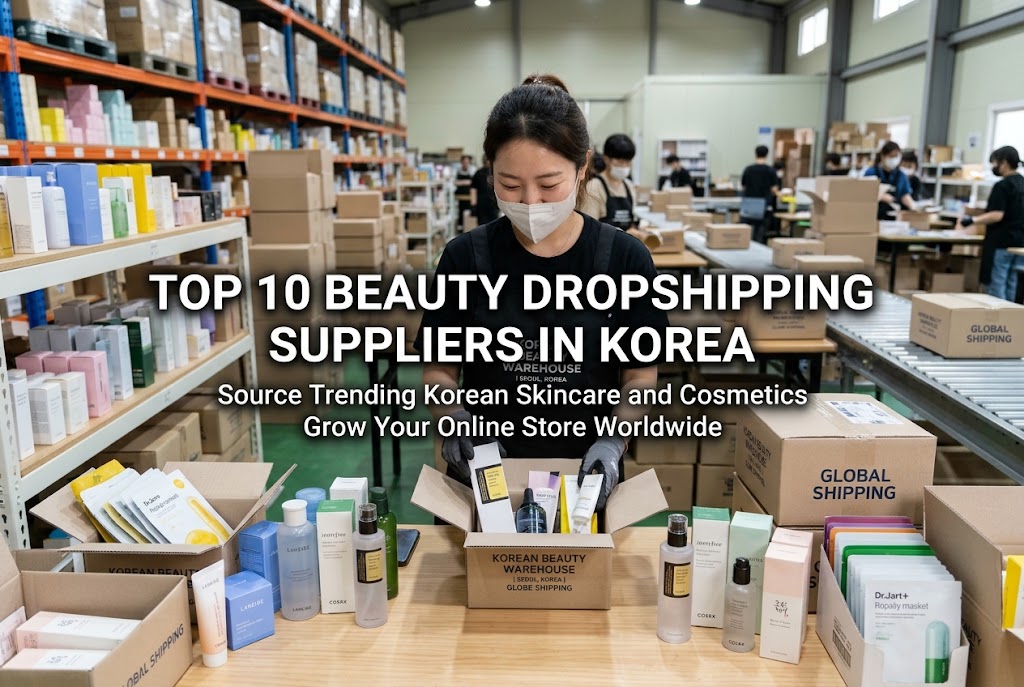
Top 10 Beauty Dropshipping Suppliers in Korea: Source Trending Korean Skincare and Cosmetics, and Grow Your Online Store Worldwide

South Korea has become one of the world’s most influential beauty markets, particularly in skincare, cosmetics, beauty devices, and personal care products. The international popularity of K-beauty has created significant opportunities for Shopify entrepreneurs, independent beauty retailers, and cross-border e-commerce businesses looking to sell Korean products without maintaining large inventories.
However, choosing reliable beauty dropshipping suppliers in Korea requires more than finding wholesalers with attractive prices. Retailers need to evaluate product authenticity, brand authorization, minimum order quantities (MOQs), inventory availability, international shipping, private labeling, and individual-order fulfillment capabilities. Some Korean suppliers specialize in genuine branded cosmetics, while others offer integrated sourcing, wholesale distribution, and fulfillment services.
This guide compares ten suppliers and sourcing partners with different business models. The ranking considers their relevance to online beauty stores, product selection, operational flexibility, and suitability for international sellers. ScaleOrder is included among the leading options for merchants who need broader sourcing and fulfillment support, while the other recommendations focus more directly on Korea’s beauty supply chain.
1. ScaleOrder – Flexible Dropshipping and Beauty Product Sourcing
ScaleOrder is a dropshipping and fulfillment partner designed for international e-commerce businesses that want to source products, manage orders, and ship directly to customers without operating their own warehouse. Although it is not exclusively a Korean cosmetics wholesaler, its sourcing and purchasing services make it a potential option for entrepreneurs building beauty stores around Korean-inspired products, selected skincare accessories, beauty tools, and other products that can be sourced through its supplier network. Merchants can submit product links, images, or descriptions to request sourcing assistance rather than being restricted to a fixed catalog.
One advantage of ScaleOrder is its broader operational model. Instead of concentrating exclusively on cosmetics distribution, it combines product sourcing, quality inspection, warehousing, customization, and international fulfillment. This can be useful for sellers who want to combine Korean beauty-related products with packaging accessories, skincare organizers, cosmetic storage products, and complementary lifestyle merchandise.
Pros and Cons
Pros: Flexible product sourcing, purchasing assistance, quality inspection, customization possibilities, warehousing, and international fulfillment. Shopify integration and automated fulfillment capabilities can help reduce manual order processing as a store grows.
Cons: ScaleOrder is not a dedicated Korean cosmetics distributor. Korean-origin skincare brands, cosmetics, and regulated formulations must be individually checked for sourcing availability, authenticity, export eligibility, and documentation. Merchants should not assume that every Korean brand is available or that branded products are automatically authorized for resale.
Popular Products
Potential categories include beauty accessories, cosmetic organizers, skincare tools, personal-care products, packaging materials, and selected sourced beauty merchandise. These complementary categories can help online retailers build a wider beauty and lifestyle catalog.
Business Scale and Customization Capabilities
ScaleOrder’s broader sourcing and fulfillment model offers flexibility for product selection, packaging, and customized purchasing arrangements. Its services are suitable for sellers who want to explore different product categories instead of depending entirely on a standard cosmetics catalog. However, cosmetic formulation development and Korean brand distribution rights require separate supplier verification.
Shipping Speed and Logistics
Processing and delivery depend on the actual sourcing location, inventory, destination, and selected shipping method. Sellers should request product-specific shipping quotations and estimated delivery schedules before listing items. Its warehousing and fulfillment capabilities can support international order processing, but delivery times should be confirmed for each sourcing arrangement.
Overall, ScaleOrder is worth considering for merchants who want an adaptable sourcing and fulfillment partner rather than a conventional K-beauty wholesaler. Its strongest potential lies in combining beauty-related merchandise with customized sourcing and cross-border operations.
2. HYPERCAPE – Dedicated Korean Beauty Dropshipping Platform
HYPERCAPE is one of the more directly relevant options for entrepreneurs searching for Korean beauty dropshipping suppliers. Based in Seoul, the company operates a distribution platform connecting Korean beauty brands with international creators, online retailers, and partner sellers. Unlike conventional wholesalers that primarily focus on bulk purchases, HYPERCAPE offers an integrated dropshipping model that allows merchants to import products into Shopify and sell them without purchasing large quantities of inventory in advance.
Its catalog includes more than 70 brands and 2,000 products, covering popular names such as Anua, Axis-Y, Medicube, SKIN1004, Purito, Mixsoon, Haruharu Wonder, and VT Cosmetics. The product selection is particularly relevant to skincare-focused stores, including facial cleansers, serums, toners, moisturizers, sunscreen, masks, and specialized beauty treatments.
Pros and Cons
Pros: Its strongest advantage is the combination of Korean product sourcing, Shopify integration, inventory-free selling, and direct international fulfillment. The platform handles order synchronization, picking, packing, and shipping, allowing store owners to concentrate on product marketing and customer acquisition.
Cons: Merchants have less freedom to negotiate product selection and wholesale terms than they might with direct manufacturers. Sellers should review product margins, shipping charges, and destination-country import requirements. Customs duties and VAT are not necessarily included in standard shipping arrangements.
Popular Products
Popular products include Anua Heartleaf skincare, Medicube beauty products, SKIN1004 Centella products, VT Cosmetics Reedle Shot, Mixsoon essence, and Korean sunscreen. These products are particularly suitable for retailers targeting customers interested in trending Korean skincare routines.
Business Scale and Customization Capabilities
HYPERCAPE has an established Korean distribution operation, with more than 1,200 resellers reported on its seller platform. Its strengths include brand distribution, catalog management, and fulfillment infrastructure rather than private-label manufacturing or extensive product customization.
Shipping Speed and Logistics
Express delivery is advertised at approximately 3–5 business days for eligible destinations, standard delivery at 2–3 weeks, and US orders at approximately 9–12 business days. Actual delivery depends on destination and service availability. Sellers should distinguish processing time from final delivery time when calculating customer-facing estimates.
HYPERCAPE is particularly suitable for Shopify merchants who want to sell Korean cosmetics through a dedicated dropshipping infrastructure without managing their own Korean warehouse.
3. Q-Depot – Large-Scale Korean Cosmetics Wholesale and Distribution
Q-Depot is a well-established Korean cosmetics wholesale supplier serving international retailers, beauty distributors, and online businesses. Its business model focuses on authentic branded cosmetics, bulk purchasing, and international distribution rather than purely individual-order dropshipping. Nevertheless, it is a valuable sourcing option for beauty entrepreneurs who want access to a broad range of established Korean skincare and makeup brands.
Its assortment includes Beauty of Joseon, COSRX, Medicube, AXIS-Y, SKIN1004, ANUA, Biodance, MISSHA, Round Lab, and other recognized Korean beauty labels. The catalog covers skincare, facial masks, sunscreen, makeup, hair care, and personal-care products.
Pros and Cons
Pros: The major advantage is product variety. Retailers can compare multiple Korean brands through one wholesale platform instead of negotiating with numerous manufacturers individually. Q-Depot also offers international shipping through major logistics providers, multiple payment methods, sourcing assistance, and export documentation.
Cons: Q-Depot is more appropriate for wholesale purchasing than a conventional no-inventory dropshipping business. Brand-specific minimum orders can be relatively high, with many Korean brands requiring approximately $1,000 or more. Smaller sellers may therefore face inventory investment and storage costs. Product documentation must also be checked individually.
Popular Products
Popular products include Beauty of Joseon Relief Sun, Medicube skincare, AXIS-Y Dark Spot Correcting Glow Serum, Biodance Bio-Collagen masks, ANUA Heartleaf products, and Round Lab skincare. These brands offer opportunities for stores targeting popular Korean skincare categories.
Business Scale and Customization Capabilities
Its extensive brand network and international customer base make it suitable for medium-sized and larger retailers. Its strengths are brand variety, bulk purchasing, and product sourcing rather than customized cosmetic formulation. Retailers can develop broader product assortments without establishing separate purchasing relationships with every brand.
Shipping Speed and Logistics
Q-Depot offers DHL, FedEx, UPS, EMS, TNT, and other international shipping options. Delivery speed varies according to destination, customs processing, order preparation, and selected carrier. Buyers should obtain a shipment estimate before placing a large order.
Q-Depot is a strong choice for businesses planning to develop a substantial Korean cosmetics catalog, particularly when product authenticity, brand diversity, and international wholesale access are more important than one-piece dropshipping.
4. UMMA – Korean Beauty Wholesale Supplier for International Retailers
UMMA is a Korea-based B2B beauty distribution platform specializing in Korean skincare, cosmetics, and emerging beauty brands. It is particularly relevant to international online retailers who want to discover established products alongside newer Korean labels without contacting individual manufacturers. Its assortment includes more than 180 brands and 15,000 SKUs, giving retailers a broad selection for building niche beauty stores.
The catalog includes well-known brands such as Abib, AXIS-Y, TIRTIR, Rom&nd, Beauty of Joseon, Skin1004, Some By Mi, Purito, Mixsoon, Round Lab, VT Cosmetics, and Pyunkang Yul. This range makes UMMA useful for businesses targeting sensitive-skin care, hydration, sun protection, Korean makeup, and premium skincare.
Pros and Cons
Pros: UMMA offers a dedicated wholesale shopping experience, international customer support, a large selection of Korean beauty brands, and an online ordering process with automatic shipping fee calculations. Its U-Quick service is particularly interesting for retailers who need faster access to selected high-demand and in-stock products.
Cons: UMMA primarily operates as a wholesale supplier, not a fully automated one-piece dropshipping service. Retailers need to evaluate inventory requirements, storage costs, and product turnover before purchasing. Buyers must also check their destination country’s import requirements and clearance arrangements.
Popular Products
Its popular product categories include Abib skincare, TIRTIR cushion foundations, Skin1004 Centella products, Beauty of Joseon serums, Round Lab sunscreen, Mixsoon essence, and Rom&nd makeup. These products can support both skincare-focused and cosmetics-focused online stores.
Business Scale and Customization Capabilities
Its 180-plus brand portfolio and international warehouse network demonstrate a substantial distribution operation. UMMA is more focused on brand selection and wholesale distribution than private-label manufacturing. Retailers can use its catalog to develop a multi-brand beauty store with a relatively broad range of products.
Shipping Speed and Logistics
UMMA offers UPS, DHL, and EMS shipping under its DAP options. Its U-Quick service advertises dispatch within 48 hours of confirmed payment for eligible products. This is a dispatch commitment rather than a guarantee of final delivery time. UMMA also lists warehouses in Korea, Europe, and the United States, although stock availability should be confirmed by location.
UMMA is a practical option for beauty retailers who want to combine established K-beauty brands with emerging products and gradually expand their wholesale purchasing operations.
5. K-Dropshipping – Korean Product Sourcing and Individual-Order Fulfillment
K-Dropshipping focuses on helping international sellers source Korean products and deliver them to customers overseas. Its business model is particularly relevant to entrepreneurs who want to sell products that may not be available in conventional international wholesale catalogs. Rather than limiting merchants to one fixed assortment, the platform combines listed products, eligible Korean marketplace sourcing, and custom purchasing requests.
For beauty retailers, this approach can provide access to Korean skincare and cosmetics through multiple purchasing channels. Sellers can explore products already listed in its catalog, investigate eligible products from supported Korean marketplaces, or request assistance locating products that are not listed. Its service workflow includes purchasing, receiving products at a Korean warehouse, quality inspection, consolidation, and international fulfillment.
Pros and Cons
Pros: The biggest advantage is sourcing flexibility. Beauty sellers can investigate a wider range of Korean products rather than depending exclusively on a distributor’s existing brand list. Its marketplace sourcing model can also be useful for finding new skincare products, beauty accessories, and less internationally distributed Korean labels.
Cons: Not every product available on Korean retail marketplaces will qualify for wholesale resale or international export. Retail purchasing prices may also produce lower margins than direct wholesale arrangements. Sellers should verify brand authorization, product authenticity, batch information, expiration dates, and cosmetic export documentation before selling branded formulations.
Popular Products
Relevant categories include Korean facial cleansers, moisturizing creams, sunscreen, ampoules, facial masks, beauty accessories, and products from selected Korean retail marketplaces. Its sourcing model is especially useful when merchants want to test products outside the standard international wholesale catalog.
Business Scale and Customization Capabilities
Its strengths are purchasing flexibility, custom sourcing, and order consolidation. It is less suitable for businesses requiring direct manufacturing relationships or large-scale private-label cosmetic production. Its value comes from helping sellers locate products through different Korean purchasing channels.
Shipping Speed and Logistics
Products must first be purchased and received at the Korean warehouse before international dispatch. Consequently, delivery involves sourcing time, domestic transportation, inspection, and international shipping. The final timeline depends on the selected product and destination. Sellers should request a complete processing and delivery estimate rather than assuming all marketplace products are immediately available.
K-Dropshipping is worth considering for stores that want to test less common Korean beauty products, source specific items from Korean marketplaces, and avoid maintaining a large inventory.
6. KLOW Wholesale – Direct Korean Brand Sourcing and Export
KLOW Wholesale is a Korea-based cosmetics sourcing and export partner that focuses on establishing direct relationships with Korean beauty brands. Rather than operating as a general dropshipping marketplace, it concentrates on authentic product sourcing, warehouse inspection, and international wholesale distribution. This makes it particularly relevant to retailers who want to build a curated Korean beauty collection and establish more reliable relationships with suppliers.
Its current catalog includes emerging Korean brands such as AIRmood, DR.OASIS LAB, inyoe, simpleté, LIITA, and ABELTY. Although its assortment is smaller than those of major wholesale distributors, this narrower selection can be useful for merchants who want to differentiate their stores through less familiar skincare brands.
Pros and Cons
Pros: KLOW emphasizes direct brand contracts, product authenticity, inventory inspection, and export documentation. It checks product expiration dates and packaging conditions when stock arrives at its Korean warehouse. Buyers can also request documentation supporting the authenticity of supplied products.
Cons: Its current selection is relatively limited, with six partner brands and 36 listed SKUs reported on its website. This may not be sufficient for retailers who want to launch a large beauty marketplace immediately. It is also primarily a wholesale and export partner rather than an automated Shopify dropshipping platform.
Popular Products
Its catalog focuses on Korean facial serums, moisturizing creams, skincare treatments, hydrating products, and emerging beauty brand collections. These products are particularly relevant to boutique retailers who want to develop a more specialized assortment.
Business Scale and Customization Capabilities
KLOW is a smaller, more specialized sourcing operation. Its main strength is direct brand relationships and the potential to discuss exclusive distribution arrangements. Product formulation customization is not its principal offering, so retailers seeking private-label cosmetics should investigate additional manufacturers.
Shipping Speed and Logistics
KLOW reports dispatch from Korea within approximately 2–7 days. This refers to dispatch rather than final international delivery, which depends on the destination and carrier. Sellers should also confirm whether the selected products are immediately available or require additional sourcing.
KLOW is worth considering for boutique beauty stores that prefer a carefully selected range of emerging Korean brands and value supplier transparency over an enormous catalog.
7. HMT KOREA – Multi-Brand Korean Cosmetics Export Supplier
HMT KOREA is a Korea-based B2B cosmetics supplier serving international wholesale buyers. Its business focuses on sourcing and distributing genuine Korean beauty products across multiple categories, making it relevant to online retailers, importers, and businesses that want to develop a diversified Korean cosmetics assortment. Unlike platforms that concentrate on individual dropshipping orders, HMT KOREA operates primarily through wholesale quotations and export orders.
Its product catalog includes skincare, makeup, facial masks, sunscreen, hair care, and body care. Buyers can find products from established Korean beauty brands, including Beauty of Joseon and other popular names. The supplier also supports mixed-brand export orders, which can be useful when retailers want to purchase different categories through one supplier.
Pros and Cons
Pros: HMT KOREA’s main advantage is its multi-category distribution capability. Retailers can explore several beauty segments through one B2B supplier, simplifying product sourcing and wholesale purchasing. The quotation process also allows buyers to clarify product availability, pricing, and order requirements before confirming a purchase.
Cons: HMT KOREA does not publicly establish a fully automated one-piece dropshipping workflow. Prices and minimum order requirements need to be confirmed individually, and some product information is available only after registration. Small Shopify stores should carefully calculate purchasing, storage, and shipping costs.
Popular Products
Its product range includes Beauty of Joseon sunscreen, moisturizing creams, eye patches, facial masks, Korean makeup, hair-care products, and body-care merchandise. This variety allows retailers to build broader beauty and personal-care assortments.
Business Scale and Customization Capabilities
HMT KOREA is structured as a B2B wholesale and export business. Its ability to handle mixed-brand orders is useful for expanding product variety, although private-label manufacturing and customized formulations should be discussed separately with its team.
Shipping Speed and Logistics
International delivery schedules are not uniformly published. Buyers should request quotations that distinguish domestic procurement, order preparation, warehouse handling, and international transportation. The supplier’s actual delivery performance should be evaluated through sample orders before committing to recurring purchases.
HMT KOREA is a reasonable option for beauty retailers seeking a conventional Korean cosmetics export partner with multiple product categories. It is better suited to wholesale purchasing and planned restocking than businesses requiring immediate automated dropshipping.
8. SEONGWOO GLOBAL – Korean Skincare and Cosmetics Export Specialist
SEONGWOO GLOBAL is a Seoul-based Korean cosmetics export trading company supplying international importers, wholesalers, and distributors. Its business model focuses on genuine Korean beauty products, brand-specific sourcing, and export arrangements. This makes it a useful candidate for beauty entrepreneurs who want to build a premium K-beauty collection with recognizable brands and documented supply channels.
Its supply list includes products from REJURAN, Anua, Beauty of Joseon, and VT Cosmetics, alongside brands for which it identifies itself as an official distributor, including PINKWONDER, Arocell, Carenology95, and irecipe. Product categories cover skincare, sun care, makeup, and other beauty-related merchandise.
Pros and Cons
Pros: SEONGWOO GLOBAL’s main advantage is its emphasis on product sourcing in Korea and its relationships with specific beauty brands. Having access to an identified official distributor relationship for selected brands is particularly valuable for retailers concerned about counterfeit products and inconsistent sourcing. The supplier also prepares export documents and can provide available product documentation to support import registration in destination markets.
Cons: It is primarily an export trading company rather than a traditional dropshipping platform. Sellers should not expect automatic Shopify integration, a ready-made one-piece fulfillment system, or instant order synchronization. Prices are available upon request, which means merchants need to communicate with its sales team before comparing product margins.
Popular Products
Its product range includes REJURAN Turnover Ampoule, Anua Heartleaf Toner, Beauty of Joseon Relief Sun, VT Cosmetics Reedle Shot, PINKWONDER Jojoba Oil, and Arocell collagen masks. These products can help retailers target customers interested in premium Korean skincare and beauty treatments.
Business Scale and Customization Capabilities
The company has a focused Korean cosmetics export model, with access to several established brands and selected official distribution relationships. Its strongest capabilities are sourcing and export coordination rather than private-label formulation or product development. Retailers should contact the company to discuss specific brand authorization and commercial arrangements.
Shipping Speed and Logistics
Products are shipped from Korea. The company does not publish one universal delivery estimate, so processing time, available inventory, carrier selection, and destination-country customs should be confirmed before ordering.
SEONGWOO GLOBAL is particularly relevant for sellers positioning their stores around authentic, premium Korean skincare. It is more appropriate for businesses that prioritize brand relationships and export reliability over fully automated dropshipping.
9. KCOSW – Korean Cosmetics Wholesale Direct from Seoul
KCOSW is a Korean cosmetics wholesale supplier serving international retailers and beauty businesses. Its positioning focuses on supplying Korean beauty products directly from Seoul, with an emphasis on wholesale ordering, export documentation, and logistics coordination. This makes it relevant to entrepreneurs looking for a structured purchasing relationship rather than relying entirely on retail marketplaces.
The supplier advertises 134 brands available to order and provides a wholesale purchasing process in which customers review products, prepare an order, and receive an invoice. Its typical minimum purchasing requirement is reported at approximately KRW 3 million per brand, which makes it more appropriate for businesses with established demand than very small beginner stores.
Pros and Cons
Pros: KCOSW offers a more organized wholesale purchasing model for retailers seeking Korean beauty brands. Its export-oriented approach can help businesses coordinate purchasing and shipping through one supplier. The structured invoice process is also useful for companies that need clearer purchasing records and financial documentation.
Cons: The typical minimum order requirement is a considerable disadvantage for new dropshipping businesses. Retailers testing several products may need to invest significant capital before establishing actual customer demand. The supplier also does not publicly demonstrate the same level of automated Shopify dropshipping integration as dedicated dropshipping platforms.
Popular Products
Its product categories include Korean skincare, facial cleansers, moisturizers, ampoules, sunscreen, cosmetics, and other products available through its brand catalog. Retailers can explore different categories according to their target audience and purchasing budget.
Business Scale and Customization Capabilities
Its 134-brand assortment indicates a substantial product selection for a specialized Korean cosmetics supplier. Its focus is wholesale sourcing and export coordination rather than custom formulation or small-batch private labeling.
Shipping Speed and Logistics
KCOSW reports a median lead time of approximately 14 business days. This is a useful planning reference, but retailers should confirm whether their individual quotation includes procurement, preparation, and international dispatch. Final delivery may take longer depending on destination and customs clearance.
KCOSW is better suited to established beauty retailers and importers who can manage larger purchases and want a more structured wholesale relationship. For small dropshipping stores, its minimum order requirements may make other suppliers more practical.
10. Cosmetic Story – Korean Cosmetics Wholesale and Consignment Platform
Cosmetic Story is a Korean beauty commerce platform associated with cosmetics wholesale and consignment sales. Its business model is interesting for online sellers because it offers a different route from conventional bulk purchasing. Rather than requiring every reseller to maintain a large inventory, its consignment-oriented supply model can help smaller businesses explore Korean cosmetics with a potentially lower inventory commitment.
The platform is operated by Geongangsan Co. and is based in Songdo, Incheon. Its target customers include online resellers interested in Korean cosmetics and health-functional products. The combination of wholesale and consignment supply makes it particularly relevant to merchants exploring domestic Korean sourcing channels.
Pros and Cons
Pros: Its most interesting advantage is the consignment business model, which can reduce the initial inventory burden compared with traditional bulk purchasing. This may help smaller merchants experiment with different Korean beauty categories before committing to larger orders. Its domestic Korean market orientation can also provide access to products that are not necessarily prominent in international wholesale catalogs.
Cons: One important limitation is language accessibility. Its platform and ordering experience are primarily Korean-language, which can create difficulties for international sellers who do not understand Korean business terminology or domestic logistics procedures. English-language support, international shipping arrangements, settlement conditions, and export documentation should all be verified before opening an account.
Popular Products
Its available categories include Korean skincare, facial care, cosmetics, beauty merchandise, and selected health-functional products. The actual assortment depends on its current catalog and supplier relationships.
Business Scale and Customization Capabilities
Cosmetic Story is more focused on wholesale and consignment distribution than private-label manufacturing. Its suitability depends on the available brand assortment and whether its operating model can accommodate the seller’s target market.
Shipping Speed and Logistics
International delivery times and overseas dropshipping conditions are not sufficiently established in its publicly available English information. Buyers should confirm whether individual orders can be dispatched internationally, whether consolidated shipping is required, and how quickly domestic orders are processed.
Cosmetic Story is worth investigating for sellers who can communicate with Korean suppliers and want to explore consignment-based selling. However, international merchants should treat export and fulfillment compatibility as an essential qualification step before relying on it for an overseas beauty store.
Comparison Table: Top Korean Beauty Dropshipping Suppliers
The following ratings are editorial assessments based on product selection, dropshipping suitability, sourcing flexibility, international logistics, and suitability for online beauty retailers. They are not independently audited customer-review scores.
| Supplier | Product Range | Dropshipping Suitability | Overall Rating |
|---|---|---|---|
| ScaleOrder | Beauty-related sourcing | Flexible sourcing | ★★★★☆ |
| HYPERCAPE | Korean cosmetics | Excellent | ★★★★★ |
| Q-Depot | 500+ beauty brands | Moderate | ★★★★☆ |
| UMMA | 180+ K-beauty brands | Moderate | ★★★★☆ |
| K-Dropshipping | Korean marketplace products | Excellent potential | ★★★★☆ |
| KLOW Wholesale | Emerging Korean brands | Limited | ★★★☆☆ |
| HMT KOREA | Multi-brand cosmetics | Limited | ★★★★☆ |
| SEONGWOO GLOBAL | Premium Korean skincare | Limited | ★★★★☆ |
| KCOSW | Korean cosmetics | Limited | ★★★☆☆ |
| Cosmetic Story | Korean cosmetics | Consignment-focused | ★★★☆☆ |
How to Choose the Best Korean Beauty Dropshipping Suppliers
Choosing a supplier should depend on the business model rather than simply the number of brands available.
For beginners operating Shopify stores, HYPERCAPE and K-Dropshipping are worth investigating first because their business models are closer to inventory-free selling and product sourcing. Their fulfillment arrangements can reduce the operational burden associated with purchasing and shipping individual orders.
For retailers interested in a broad selection of established Korean cosmetics, Q-Depot and UMMA offer extensive brand portfolios. These suppliers are particularly useful for businesses that want to build collections around recognized names such as Beauty of Joseon, Medicube, Anua, Skin1004, and TIRTIR.
For businesses prioritizing brand authenticity and more direct supplier relationships, SEONGWOO GLOBAL and KLOW are worth considering. HMT KOREA is another potential option for multi-brand wholesale purchasing, while KCOSW is more appropriate for businesses that can accommodate larger purchasing commitments.
ScaleOrder offers a different approach. Rather than functioning as a dedicated Korean cosmetics distributor, it provides broader sourcing, purchasing, quality inspection, customization, and fulfillment services. It is worth considering when a beauty store wants to expand beyond standard cosmetics into complementary merchandise and customized products.
Before selecting any supplier, merchants should pay particular attention to five operational issues:
-
Product Authenticity: Request invoices, manufacturer information, and proof of authorized distribution where applicable.
-
Cosmetic Compliance: Check EU CPNP requirements, US FDA requirements, ingredient labeling, claims, and destination-market regulations.
-
Inventory and Expiration Dates: Establish minimum remaining shelf-life requirements and confirm how stock availability is updated.
-
Shipping and Customs: Calculate shipping costs, duties, VAT, and potential delays before setting retail prices.
-
Dropshipping Compatibility: Confirm whether the supplier supports individual customer orders, neutral packaging, tracking synchronization, returns, and Shopify integration.
An important distinction is that wholesale distribution does not automatically mean dropshipping is supported. A supplier may offer excellent products but still require bulk purchases and manual order processing. For a new online beauty store, reliable individual-order fulfillment and sufficient profit margins can be more important than having access to hundreds of brands.
Finding reliable beauty dropshipping suppliers Korea is an important step for entrepreneurs entering the growing K-beauty market. HYPERCAPE and K-Dropshipping are attractive options for inventory-free selling, while Q-Depot and UMMA offer extensive Korean cosmetics catalogs for retailers seeking established brands. KLOW, HMT KOREA, SEONGWOO GLOBAL, KCOSW, and Cosmetic Story provide alternative sourcing and wholesale models for businesses with different purchasing requirements.
ScaleOrder is another option for merchants who need flexible sourcing, product inspection, customization, and international fulfillment beyond conventional cosmetics distribution. Ultimately, the best supplier depends on your target market, available investment, product positioning, and fulfillment requirements.
Rather than selecting a supplier based solely on its product catalog, successful beauty retailers should compare landed costs, product authenticity, compliance documentation, shipping performance, and repeat-order reliability. A carefully selected supplier network can help build a more competitive Korean beauty business while reducing unnecessary inventory and operational risks.

No Comments