


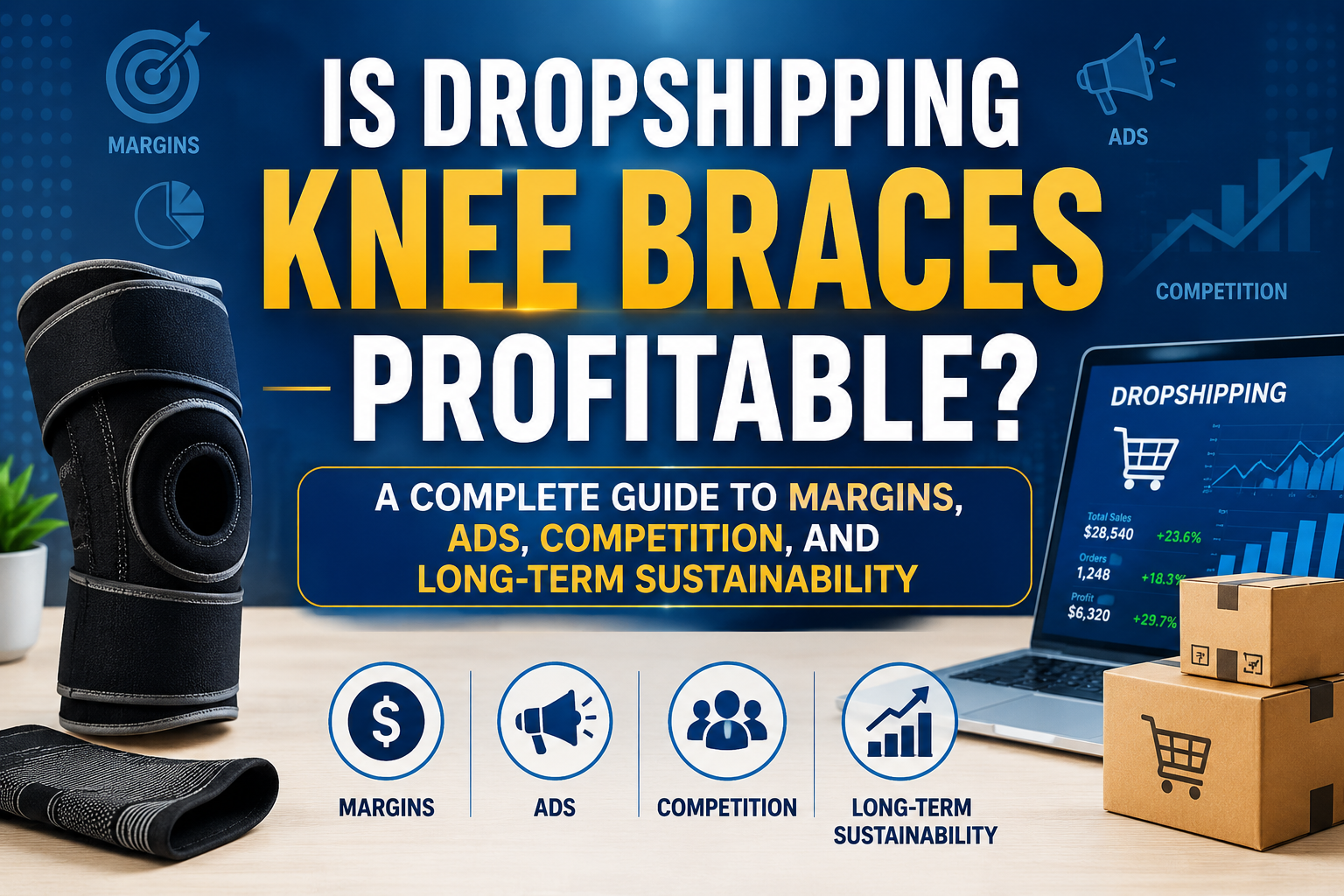
Is Dropshipping Knee Braces Profitable? A Complete Guide to Margins, Ads, Competition, and Long-Term Sustainability

Scalability depends heavily on brand positioning. Generic knee brace stores tend to plateau at lower margins due to ad fatigue and price competition. However, stores that build positioning around “sports recovery,” “medical support,” or “athletic performance” can increase average order value (AOV) by bundling products such as compression sleeves or posture supports.
Knee brace dropshipping is profitable, but not because of extreme margins. Instead, profitability comes from balanced unit economics, stable demand, and the ability to control acquisition costs. A well-optimized store typically achieves 20%–35% net profit margins at scale, which is sustainable in the health accessories segment.
Profitability Overview of Knee Brace Dropshipping
The question of whether dropshipping knee braces is profitable depends primarily on margin structure rather than demand alone. Knee braces sit in the “health support accessories” category, which typically maintains higher perceived value and lower price sensitivity compared to general fitness products. In most e-commerce markets, retail prices range from $18 to $65 per unit depending on material quality, compression level, and brand positioning.
From a sourcing perspective, average factory costs in China or Vietnam for basic neoprene knee braces typically range between $3.20 and $7.80 per unit. This creates a gross margin range of approximately 55% to 80% when sold through direct-to-consumer dropshipping channels. Premium models with reinforced hinges or medical-grade compression fabric can be sourced at $8–$12 and still retail for $35–$80, maintaining margins above 60% in most cases.
Gross Margin Reality in Competitive Markets
However, gross margin alone does not determine profitability. Advertising cost per acquisition (CPA) plays a decisive role. In Facebook Ads and TikTok Ads, knee braces fall under the “pain relief” and “fitness recovery” niche, where average CPA ranges from $8 to $22 depending on targeting precision and creative quality. This means that even with a $20–$35 gross profit per unit, net profit can shrink significantly if acquisition costs are not optimized.
High-performing stores typically operate at a blended net margin of 15% to 35%, which is considered strong for a dropshipping health product. For example, a store selling a knee brace at $29.99 with a landed cost of $6.50 and CPA of $10.50 would generate approximately $13 gross profit and $2–$5 net profit per order after platform fees.
Demand Stability and Seasonality Impact
Unlike trending fashion items, knee braces benefit from relatively stable demand throughout the year. Google Trends data shows consistent search interest with mild peaks during sports seasons and post-injury recovery periods. This stability reduces inventory risk and allows more predictable scaling in paid advertising campaigns.
Additionally, the aging population in the US and Europe contributes to long-term demand growth. Approximately 25% of adults over 45 report knee discomfort or joint pain, making this niche less dependent on short-term viral trends and more aligned with evergreen health needs.
Is Dropshipping Knee Braces Profitable or Too Competitive? Market Saturation and Entry Barriers
When evaluating whether dropshipping knee braces is profitable, competition level is often the deciding factor rather than product demand. The knee brace niche sits in a unique position within the health and fitness accessories market: it is neither an emerging trend nor a fully saturated commodity category. Instead, it operates in a “semi-mature” stage where profitability depends heavily on execution quality rather than product novelty.
At the surface level, competition appears intense. A simple search on platforms like Shopify, Amazon, and TikTok Shop reveals thousands of similar listings offering compression sleeves, hinged braces, and recovery supports. Many of these products share identical sourcing origins, often from the same cluster of factories in Guangdong or Zhejiang. This leads to high product similarity and relatively low differentiation at the supply chain level.
Entry Barriers Are Low, But Survival Barriers Are High
From a structural standpoint, entry barriers are extremely low. A beginner can launch a knee brace store with less than $200 in setup costs using Shopify or TikTok Shop integrations. Product sourcing costs remain low, typically between $3 and $10 per unit, which means initial gross margins can still range from 55% to 75% even in a competitive environment.
However, survival barriers are significantly higher. Because many sellers use identical product catalogs, competition shifts from product-level differentiation to marketing efficiency. This creates a scenario where advertising strategy becomes more important than the product itself. In paid acquisition channels like Facebook Ads, CPM inflation in the health niche has increased by approximately 18%–30% over the last three years, directly impacting profitability for under-optimized stores.
Price Competition and Margin Compression
One of the biggest risks in this niche is price compression. As more sellers enter the market with identical or near-identical products, the average selling price tends to stabilize or decline. A product that could once be sold at $39.99 may gradually move toward $24.99–$29.99 due to competitive pressure.
This affects gross margin significantly. For example, a knee brace sourced at $6.50 and sold at $39.99 yields a gross margin of roughly 84%. But when price drops to $27.99 due to competition, the gross margin falls to around 76%. While still healthy on paper, this reduction becomes critical when combined with rising ad costs, shipping delays, and platform fees, reducing net profitability more sharply than expected.
Differentiation Becomes the Key Profit Driver
In highly competitive dropshipping niches like knee braces, differentiation determines survival rate more than cost advantage. Successful stores typically avoid competing as generic “knee brace sellers” and instead reposition themselves into narrower sub-niches such as sports recovery, elderly joint support, or gym injury prevention.
This repositioning allows for stronger branding and higher perceived value, which directly improves conversion rates. Even a 1.5%–2.5% increase in conversion rate can significantly offset rising CPM costs, turning a marginal store into a profitable one.
Market Saturation Is Real but Not Absolute
Although the knee brace market is competitive, it is not fully saturated in a structural sense. Demand continues to grow due to aging populations, increasing fitness participation, and rising awareness of joint health. What is saturated is low-effort execution models that rely on generic stores and unbranded products.
Stores that invest in creative marketing angles, bundle strategies, or content-driven acquisition still find room for profitable scaling. In fact, data from e-commerce ad libraries suggests that top-performing knee brace brands often rotate creatives aggressively rather than relying on product innovation alone.
Is Dropshipping Knee Braces Profitable with Facebook and TikTok Ads? CPA, ROAS, and Real Profit Breakdown
When analyzing whether dropshipping knee braces is profitable, advertising cost per acquisition (CPA) becomes the most critical variable. Unlike organic or SEO-driven businesses, most knee brace dropshipping stores rely heavily on paid traffic from platforms such as Facebook Ads and TikTok Ads. This means profitability is not determined by product margin alone, but by how efficiently traffic can be converted into paying customers.
On average, knee brace campaigns fall within the “health and wellness” vertical, where CPMs (cost per 1,000 impressions) are moderately high due to strong competition and strict ad policies. In 2026, typical CPM ranges between $8 and $18 on Facebook Ads, while TikTok Ads often range from $6 to $14 depending on targeting and creative quality.
CPA Benchmarks in the Knee Brace Niche
The average CPA for knee brace products varies significantly depending on funnel optimization and creative performance. Cold traffic campaigns typically generate CPAs between $10 and $25. Well-optimized stores with strong video creatives and retargeting systems can reduce CPA to $7–$12.
For example, if a knee brace is sold at $29.99, and the product cost is $6.50 with shipping of $3.00, the gross profit per unit before ads is approximately $20.49. If the CPA is $12, the net profit drops to around $8.49 per sale before platform fees. After payment processing and refund allowance, final net margin often stabilizes between 15% and 30%.
ROAS Reality vs Expectation
Return on Ad Spend (ROAS) expectations in beginner dropshipping often assume unrealistic scaling potential. A common misconception is that a 2.0–3.0 ROAS guarantees strong profitability. However, in the knee brace niche, break-even ROAS typically sits between 1.4 and 1.8 depending on fulfillment cost and refund rate.
Stores that achieve consistent ROAS above 2.2 are generally considered highly optimized. This usually requires strong creative testing cycles, emotionally driven ad hooks (such as pain relief storytelling or athletic recovery angles), and optimized landing pages with high trust signals.
Creative Fatigue and Its Impact on Profit
One of the most underestimated factors in this niche is creative fatigue. Because knee braces are visually simple products, ad creatives tend to lose effectiveness quickly. Average winning ad lifespan ranges from 7 to 21 days before performance declines.
When creative fatigue occurs, CPA can increase by 30%–60%, directly reducing profitability even if product demand remains stable. This forces successful stores to operate as “content machines,” continuously testing new video angles such as injury recovery stories, sports performance improvements, or elderly mobility improvement narratives.
Funnel Optimization and Profit Expansion
Profitability improves significantly when stores move beyond single-product funnels. Adding upsells such as compression sleeves, posture supports, or multi-pack bundles can increase average order value (AOV) from $29.99 to $45–$60. This expansion helps absorb higher CPA levels while maintaining healthy margins.
For example, increasing AOV by 40% can offset a 25% rise in CPA without reducing net profit. This is why scaling stores in this niche often focus more on funnel engineering than product expansion.
Is Dropshipping Knee Braces Profitable? Supplier Quality, Returns Rate, and Supply Chain Impact on Margins
When evaluating whether dropshipping knee braces is profitable, many beginners focus on selling price and advertising costs, but overlook the supply chain layer. In reality, supplier quality, fulfillment reliability, and product consistency often determine whether a store maintains stable margins or collapses under refund pressure.
Most knee braces sold in dropshipping come from manufacturing clusters in China, Vietnam, or Southeast Asia. Factory costs typically range from $3 to $12 per unit depending on materials such as neoprene, elastic compression fabric, or metal hinge support structures. On paper, this creates gross margins of 55% to 80%, which looks attractive. However, these margins can quickly shrink when quality inconsistency enters the equation.
Quality Variance and Its Hidden Cost
One of the most overlooked risks in this niche is batch inconsistency. A supplier may deliver high-quality compression braces in one shipment, then reduce stitching quality or material density in the next batch to lower costs. This inconsistency directly impacts customer satisfaction and leads to increased refund and chargeback rates.
In typical dropshipping operations, refund rates for knee braces range between 5% and 12%. However, in poorly managed supply chains, this can spike to 18% or higher. Each refund not only eliminates profit from a sale but also adds processing fees and potential ad waste, effectively reducing net margin by 3%–8% across the entire store.
Shipping Time and Conversion Efficiency
Fulfillment speed also plays a major role in profitability. Standard shipping times from Asia to the US or Europe range from 7 to 20 days depending on logistics partners. In contrast, stores using localized warehouses can reduce delivery time to 2–5 days, significantly improving conversion rates.
Data from e-commerce performance benchmarks shows that reducing shipping time from 12 days to 5 days can increase conversion rates by 15%–30%. This improvement directly reduces CPA pressure and increases overall ROAS, making supply chain optimization a hidden lever for profit expansion.
Medical Positioning and Compliance Risk
Knee braces sit in a semi-medical category, which introduces additional compliance considerations. Although most products are classified as “support accessories” rather than regulated medical devices, advertising claims must be carefully managed. Overstating medical benefits such as “treats arthritis” or “heals knee injuries” can lead to ad account restrictions or product takedowns.
Compliance issues indirectly affect profitability by increasing account instability. A suspended ad account can interrupt revenue flow, forcing stores to rebuild campaigns and lose optimized data, which can temporarily reduce profitability by 20%–40% during recovery cycles.
Supplier Selection as a Profit Multiplier
High-performing stores typically work with verified suppliers that offer consistent quality control, branded packaging options, and faster logistics lanes. While these suppliers may charge 10%–25% higher unit costs, the reduction in refunds and improved customer lifetime value often offsets this increase.
For example, increasing product cost from $6 to $8 may reduce gross margin slightly, but if refund rates drop from 10% to 4%, the net profit per unit actually increases. This is why mature dropshipping operations treat supplier selection as a profit optimization strategy rather than a cost-minimization decision.
Is Dropshipping Knee Braces Profitable? Conversion Rate, Landing Page Optimization, and AOV Growth Strategies
When analyzing whether dropshipping knee braces is profitable, many operators focus on gross margin and advertising costs, but often underestimate conversion rate (CVR). In reality, even a small improvement in CVR can significantly change the entire unit economics of the business. Knee braces, being a health-related product, are highly dependent on trust signals, emotional positioning, and clarity of value proposition.
In most cold traffic campaigns, baseline conversion rates for knee brace stores typically range between 1.2% and 2.5%. Well-optimized landing pages can push this range to 3%–5%, effectively doubling revenue from the same advertising spend. This difference alone can shift a store from break-even to consistently profitable.
Landing Page Structure and Trust Optimization
Landing page design plays a critical role in determining profitability. Unlike impulse-buy products, knee braces require reassurance. Customers often evaluate whether the product is suitable for injury recovery, sports performance, or daily joint support. This means that clarity and trust become more important than visual aesthetics.
High-performing pages typically include structured sections such as problem identification, product demonstration, social proof, and usage scenarios. Stores that integrate customer reviews, real usage videos, and before-and-after lifestyle improvements tend to achieve significantly higher engagement and lower bounce rates.
Data from e-commerce benchmarks shows that adding verified reviews alone can increase CVR by 10%–25%. Meanwhile, incorporating video demonstrations can improve conversion rates by another 15%–40%, especially in mobile-first traffic environments like TikTok.
AOV Expansion and Profit Stability
Average order value (AOV) is another key factor that directly affects profitability. In the knee brace niche, base product pricing typically ranges from $19.99 to $39.99. However, stores that implement bundling strategies can increase AOV to $45–$70.
Common strategies include offering multi-pack discounts, pairing knee braces with compression sleeves, or introducing upgraded versions such as reinforced hinge supports. Increasing AOV by 30%–50% allows stores to absorb higher CPA costs without reducing net margins.
For example, if a store raises AOV from $30 to $45 while maintaining the same CPA of $12, net profit per order increases from approximately $8 to over $18, effectively doubling profitability without changing traffic sources.
Psychological Triggers in Knee Brace Marketing
Because knee braces fall into the health and pain-relief category, emotional triggers significantly influence conversion behavior. Buyers are often motivated by discomfort, injury recovery, or fear of long-term joint damage. Successful landing pages leverage these psychological drivers through narrative framing rather than technical specifications.
Messages emphasizing mobility improvement, pain reduction during daily activities, or enhanced athletic performance tend to outperform generic product descriptions. However, claims must remain within compliance boundaries to avoid advertising restrictions, especially on Meta and TikTok platforms.
Mobile Optimization and Funnel Efficiency
More than 70% of traffic in this niche typically comes from mobile devices, making page speed and mobile usability critical for profitability. A delay of just one second in page load time can reduce conversions by up to 7%–10%, directly impacting ROAS.
Stores that optimize image compression, simplify checkout flows, and reduce friction in payment steps consistently outperform competitors with heavier page structures. Even minor improvements in checkout UX can increase completed purchases by 5%–15%.
Is Dropshipping Knee Braces Profitable Long Term? Risks, Ad Account Stability, and Brand Building Strategy
When evaluating whether dropshipping knee braces is profitable, short-term margins are only part of the equation. The real challenge lies in long-term sustainability. While the niche can generate strong early-stage profits due to high perceived value and relatively low product costs, it also carries structural risks that can erode profitability over time if not properly managed.
Knee braces belong to a semi-regulated health support category, which means they operate under stricter advertising scrutiny compared to general consumer goods. This directly impacts scalability and long-term ad account stability.
Advertising Account Risk and Platform Dependency
One of the most significant risks in this niche is dependency on paid advertising platforms such as Meta (Facebook/Instagram) and TikTok. These platforms frequently update policies around health-related claims, especially for products that imply pain relief, injury recovery, or medical benefits.
Ad accounts in this niche experience a higher-than-average rejection rate, often ranging from 20% to 40% depending on creative language and landing page content. Even compliant stores may face sudden fluctuations in CPM, audience reach, or account restrictions.
A suspended ad account can immediately reduce revenue to zero, making this a high-volatility business model. In some cases, recovery periods can take 7–30 days, during which profitability is significantly impacted due to lost optimization data and paused scaling campaigns.
Refund Pressure and Customer Expectation Gap
Another long-term risk is the expectation gap between marketing messaging and actual product experience. Knee braces are often advertised for comfort, support, and mobility improvement, but customer satisfaction depends heavily on fit, durability, and perceived effectiveness.
Typical refund rates in stable stores range from 5% to 10%, but aggressive marketing or inconsistent product quality can push this above 15%. Over time, high refund rates not only reduce net profit but also damage ad account trust scores, further increasing acquisition costs.
Even a 3%–5% increase in refund rate can reduce net margins by 10%–20%, making quality control and expectation management critical for sustainability.
Market Evolution and Margin Compression Over Time
Like many successful dropshipping niches, knee braces tend to follow a predictable lifecycle. In early stages, margins are high due to low competition and strong ad performance. Over time, however, increased seller saturation leads to higher CPMs, lower CTRs, and reduced conversion efficiency.
Historically, mature health accessory niches experience a 15%–30% margin compression within 12–24 months as competition intensifies. This does not eliminate profitability, but it forces operators to evolve from pure arbitrage models into branding or value-added positioning strategies.
Transition From Dropshipping to Branding
The most effective long-term strategy in this niche is transitioning from generic dropshipping to brand-driven e-commerce. Instead of competing on price alone, successful stores reposition themselves as “sports recovery brands” or “joint health support solutions.”
Brand building allows for higher average order value (AOV), stronger customer loyalty, and reduced dependence on paid ads. Branded stores often achieve AOV increases of 20%–60% compared to generic stores, which significantly improves profitability even if CPA rises.
Additionally, branded positioning enables expansion into related products such as compression sleeves, posture correction tools, and rehabilitation accessories, increasing customer lifetime value (LTV).
Operational Stability as a Profit Multiplier
Long-term profitability in knee brace dropshipping is less about finding the perfect product and more about building operational stability. This includes diversifying traffic sources beyond paid ads, implementing email marketing flows, and building retargeting systems to reduce reliance on cold traffic.
Stores that rely exclusively on paid acquisition are exposed to volatility, while hybrid models that combine paid ads, SEO, and organic content tend to maintain more stable 15%–25% net margins over time.


No Comments