


Is Dropshipping Digital Products Profitable? Truth about Margins, Demand, Competition, Traffic, Automation, and Long-Term Sustainability

The profitability of dropshipping digital products is strongly tied to two core forces: expanding market demand and near-infinite scalability. The absence of physical constraints allows sellers to focus on building distribution systems rather than operational logistics.
However, profitability is not automatic. It emerges when scalable delivery systems meet well-defined demand segments with clear purchasing intent. In this balance between demand and execution lies the true earning potential of digital product dropshipping.
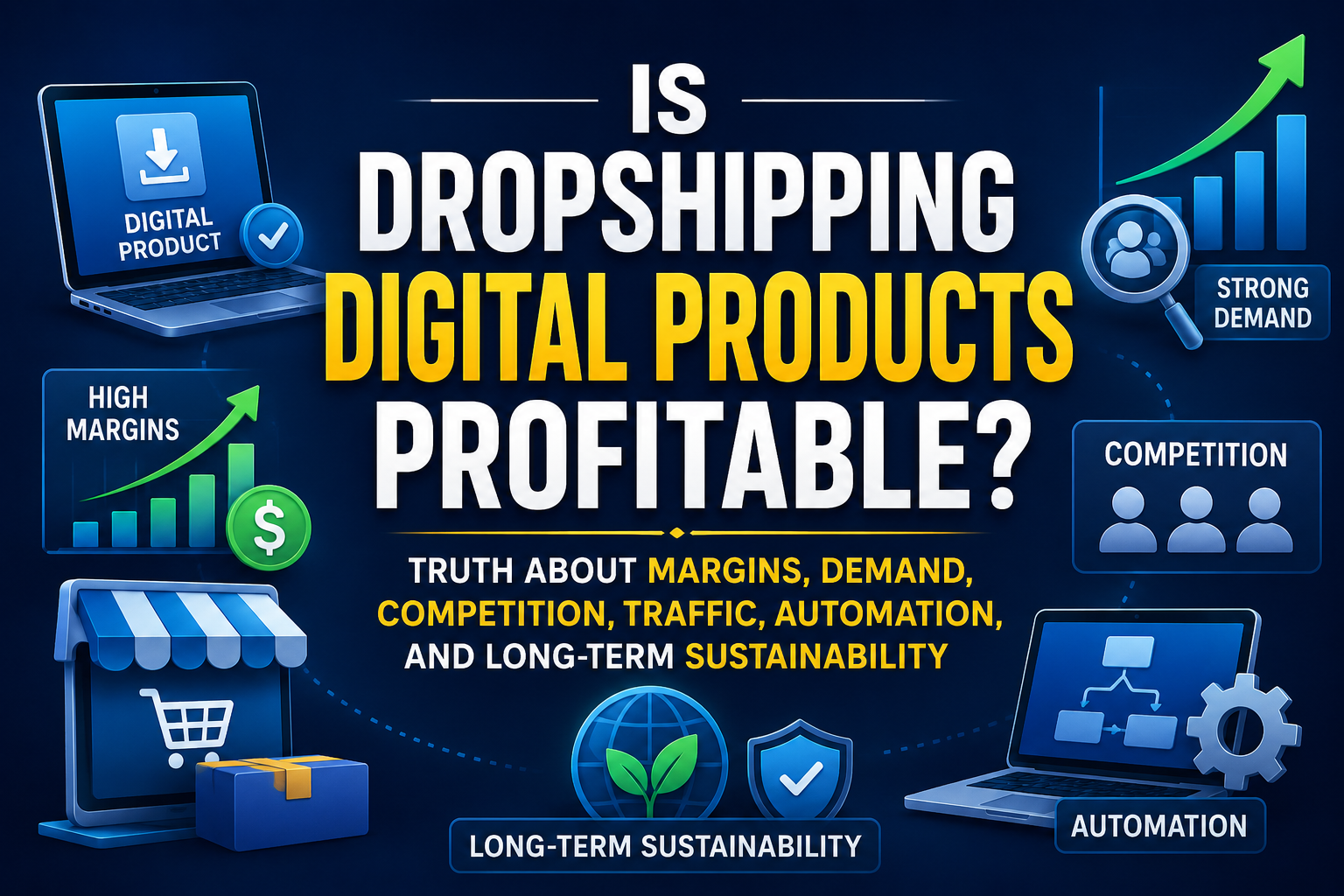
Is Dropshipping Digital Products Profitable? Market Demand and Scalability Potential in 2026
When evaluating whether dropshipping digital products is profitable, the first and most fundamental factor is market demand combined with scalability. Unlike physical goods, digital products such as eBooks, templates, online courses, software licenses, or design assets are not constrained by inventory, logistics, or manufacturing cycles. This structural difference changes the entire profitability equation.
In traditional dropshipping, sellers often face bottlenecks in shipping time, supplier reliability, and return handling. Digital products eliminate these friction points entirely. Once a product is created or sourced, it can be delivered infinitely at almost zero marginal cost. This means every additional sale increases revenue without increasing operational cost in a linear way, which directly improves gross margins and long-term profitability potential.
Why Demand for Digital Products Is Expanding
The demand side is equally important in determining profitability. Over the past decade, consumer behavior has shifted significantly toward instant access and knowledge-based consumption. People are increasingly willing to pay for digital solutions that save time, solve specific problems, or enhance productivity.
For example, a small business owner may prefer purchasing a ready-made social media content calendar template rather than building one from scratch. Similarly, freelancers often buy design assets or automation tools instead of investing time in creating them manually. This shift in behavior creates a stable and growing demand base for digital products in multiple niches.
What makes this especially relevant to dropshipping is that demand is not limited to entertainment or education. It now spans productivity tools, business systems, fitness plans, finance spreadsheets, and niche software utilities. This diversification increases the number of viable micro-niches where sellers can operate profitably.
Scalability as the Core Profit Driver
Scalability is where digital product dropshipping significantly outperforms physical goods. In a physical supply chain, scaling revenue typically requires increasing inventory management complexity, supplier negotiations, warehousing capacity, and logistics coordination. Each layer introduces cost and operational friction.
Digital products scale differently. A single landing page combined with an automated delivery system can serve one customer or one million customers with minimal additional infrastructure. This allows entrepreneurs to focus resources on traffic acquisition and conversion optimization rather than fulfillment operations.
From a financial perspective, this means that once customer acquisition cost (CAC) is optimized, profit margins can increase dramatically over time. As advertising systems mature and conversion rates stabilize, the business can achieve compounding returns rather than linear growth.
The Role of Competition and Market Saturation
However, demand and scalability alone do not guarantee profitability. Competition in digital dropshipping is rising rapidly due to low entry barriers. Anyone with basic design or content skills can launch a digital product store within days.
This creates a paradox: while the market is expanding, product differentiation becomes the key challenge. Profitability increasingly depends on positioning, niche selection, and perceived value rather than production cost.
Successful sellers often avoid generic products and instead focus on hyper-specific problems, such as “Notion systems for real estate agents” or “TikTok ad scripts for beauty brands.” These micro-niches reduce competition and increase conversion rates, making scalability more sustainable.
Is Dropshipping Digital Products Profitable? Dive Into Profit Margins, Costs, and Unit Economics
When analyzing whether dropshipping digital products is profitable, the most decisive factor is not demand or scalability, but the underlying profit margins and unit economics. Digital products operate under a fundamentally different cost structure compared to physical goods, and this difference directly shapes long-term profitability.
In traditional e-commerce or physical dropshipping, every sale carries variable costs such as product sourcing, shipping fees, customs, packaging, and potential returns. These costs reduce gross margin and create pressure on pricing strategies. In contrast, digital products have near-zero marginal cost after creation or acquisition. Once a template, course, or software license is produced, distributing it to additional customers does not significantly increase cost.
This structural advantage allows digital product sellers to achieve gross margins that are often above 80–95%, depending on the business model. However, high margins alone do not guarantee profit unless cost structures on the acquisition side are also controlled effectively.
The Real Cost Structure Behind Digital Dropshipping
Although digital products eliminate inventory and logistics costs, they are not entirely cost-free. The primary expenses in this model shift toward three areas: product creation or licensing, platform infrastructure, and customer acquisition.
Product creation may involve outsourcing designers, purchasing PLR (private label rights) content, or investing in software development. While these costs are usually one-time or upfront, they must be amortized across expected sales volume to calculate true profitability.
Platform infrastructure includes website hosting, payment processing fees, email marketing systems, and automation tools. These costs are relatively stable but become more efficient as sales volume increases.
The most significant variable cost is customer acquisition. Paid advertising on platforms like Meta Ads, Google Ads, or TikTok can significantly impact profitability. Even with high product margins, a business with inefficient ad spending can quickly become unprofitable. Therefore, unit economics depends heavily on maintaining a healthy balance between customer acquisition cost and average order value.
Pricing Power and Perceived Value in Digital Products
One of the most underestimated aspects of profitability in digital product dropshipping is pricing power. Unlike physical commodities, digital products are not priced based on production cost but on perceived value.
For example, a simple spreadsheet template may cost almost nothing to replicate, yet it can be sold for $10, $50, or even $200 depending on branding, niche targeting, and positioning. This creates a wide pricing flexibility that directly affects profit margins.
High-performing sellers often use psychological pricing strategies such as tiered bundles, premium versions, or limited-access content to increase average order value. By improving AOV, they effectively reduce the relative impact of acquisition costs, improving overall profitability.
Break-Even Economics and Scaling Efficiency
To determine whether dropshipping digital products is profitable in practice, break-even analysis becomes essential. A seller must compare customer acquisition cost (CAC) with gross profit per customer.
If a product is sold for $30 with a 90% margin, the gross profit per sale is $27. If the CAC is $15, the business remains profitable with a $12 unit profit. However, if CAC rises to $30 due to competition or ad inefficiency, the business becomes unsustainable despite high margins.
This dynamic highlights an important reality: digital product businesses are not automatically profitable—they are economically sensitive to traffic efficiency and conversion optimization.
As scale increases, fixed costs are distributed across more transactions, improving operational efficiency. This is why successful digital dropshipping businesses often focus heavily on funnel optimization, retargeting strategies, and email marketing automation to reduce reliance on paid acquisition alone.
Is Dropshipping Digital Products Profitable? How Competition and Differentiation Impact Long-Term Success
When evaluating whether dropshipping digital products is profitable, competition structure is one of the most important but often underestimated factors. Unlike physical supply chains that require logistics, inventory, and supplier relationships, digital product dropshipping has an extremely low barrier to entry. Anyone with basic design tools, AI content generators, or access to PLR (private label rights) products can enter the market within days.
This accessibility creates a rapidly expanding seller ecosystem. While market demand for digital goods is also growing, the number of sellers is increasing at a similar or even faster rate in many niches. As a result, competition tends to concentrate around the same high-traffic product categories such as social media templates, fitness guides, productivity systems, and online courses.
In this environment, profitability is no longer determined by product availability, but by positioning efficiency and differentiation quality.
The Commoditization Problem in Digital Products
One of the core challenges in this business model is commoditization. Many digital products are inherently easy to replicate or imitate. A Notion template, Canva design pack, or Excel financial model can be copied, slightly modified, and resold by multiple competitors with minimal friction.
When commoditization occurs, price becomes the primary competitive factor. This leads to downward pressure on margins and reduces the overall profitability of the niche. Sellers who compete purely on product features often find themselves in a race to the bottom, where acquisition costs remain constant but selling prices decline.
This is why many digital dropshipping businesses fail not because of lack of demand, but because of insufficient differentiation in a saturated market.
Differentiation Through Niche Precision
The most effective way to maintain profitability in a competitive environment is through extreme niche targeting. Instead of selling generic digital products like “social media templates,” successful sellers narrow their focus to specific user identities or use cases.
For example, rather than targeting all content creators, a seller might focus on “Instagram content systems for real estate agents” or “TikTok content planners for fitness coaches.” This level of specificity reduces direct competition and increases perceived value, allowing for higher pricing power.
Niche precision also improves conversion rates because buyers feel that the product is designed specifically for their problem, rather than being a generic solution adapted to everyone.
Branding as a Competitive Barrier
In saturated digital product markets, branding becomes one of the strongest defensive moats. Unlike physical products where branding often depends on packaging and logistics, digital products rely heavily on trust, authority, and perceived expertise.
A strong brand can justify higher prices even if the underlying product is similar to competitors. This is because buyers are not only purchasing the product itself but also the credibility and reliability of the creator.
Effective branding in digital dropshipping often includes consistent visual identity, educational content marketing, and authority positioning through case studies or user results. Over time, this builds customer loyalty and reduces dependency on paid advertising.
Platform Dependence and Algorithm Risk
Another competitive factor is platform dependency. Many digital product sellers rely heavily on traffic sources such as TikTok, Instagram, Pinterest, or paid ads. These platforms are algorithm-driven, meaning visibility can change rapidly without warning.
This creates an additional layer of competitive instability. Even a profitable product can lose traffic if algorithm changes reduce reach or increase advertising costs. Sellers who depend entirely on one channel often experience volatile income patterns.
To counter this, more advanced operators diversify acquisition channels and build owned audiences through email lists, communities, or SEO-driven content ecosystems. This reduces competitive pressure from platform-level fluctuations.
Is Dropshipping Digital Products Profitable? How Traffic, Ads, and Conversion Rates Determine Real Profitability
When analyzing whether dropshipping digital products is profitable, traffic acquisition is often the real bottleneck that determines success or failure. Even though digital products have extremely low production and fulfillment costs, they still rely heavily on consistent and scalable traffic sources to generate sales.
Unlike traditional retail models where foot traffic or marketplace exposure can provide baseline demand, digital product stores must actively generate attention through platforms such as TikTok, Instagram, Pinterest, Google Search, or paid advertising networks. Without a reliable traffic engine, even the best product will not generate meaningful revenue.
This makes traffic not just a growth factor, but a direct component of profitability.
Paid Advertising and the Rising Cost Pressure
Paid advertising is one of the most common growth strategies in digital product dropshipping, especially for new stores. Platforms like Meta Ads, Google Ads, and TikTok Ads allow sellers to reach highly targeted audiences quickly, which makes scaling possible in a short period of time.
However, the cost of acquisition is highly dynamic. As more advertisers enter the same niches, bidding competition increases, which raises customer acquisition costs (CAC). This is particularly relevant in popular digital product categories such as business templates, online courses, and productivity tools, where audience overlap is extremely high.
Even though digital products typically have high margins, profitability can quickly disappear if ad costs rise faster than conversion rates or average order value. This creates a fragile balance where small inefficiencies in ad performance can significantly impact overall unit economics.
Organic Traffic as a Long-Term Profit Stabilizer
Because of the volatility in paid acquisition, many successful digital product businesses shift toward organic traffic channels over time. SEO content, social media virality, and community building play a critical role in stabilizing long-term profitability.
Search engine optimization allows digital products to capture intent-driven traffic, meaning users are actively searching for solutions rather than being interrupted by ads. This type of traffic often converts at a higher rate and reduces dependency on paid campaigns.
Similarly, platforms like TikTok and Pinterest can generate viral organic reach, especially when content is structured around problem-solving rather than direct selling. However, organic traffic is less predictable and requires consistent content production and algorithm alignment.
Conversion Rate as the Hidden Profit Lever
While most sellers focus heavily on traffic volume, conversion rate is often the more important profitability lever. A store with moderate traffic but high conversion efficiency can outperform a store with high traffic but weak funnel optimization.
Conversion rate is influenced by multiple factors, including landing page clarity, product positioning, pricing strategy, trust signals, and perceived value. In digital product dropshipping, where buyers cannot physically evaluate the product, clarity and trust become even more important.
Small improvements in conversion rate—such as better copywriting, improved product visuals, or clearer benefit explanation—can significantly increase profitability without increasing traffic costs.
Funnel Optimization and Retargeting Strategy
Another important aspect of traffic profitability is funnel structure. Most users do not purchase immediately upon first exposure, especially for digital products with higher price points.
This is where retargeting campaigns and email marketing systems become essential. By capturing leads and nurturing them over time, sellers can reduce dependency on expensive cold traffic and improve overall return on ad spend (ROAS).
A well-structured funnel might include a low-cost entry product, followed by upsells or bundled offers that increase average order value. This strategy improves unit economics by spreading acquisition costs across multiple transactions.
Is Dropshipping Digital Products Profitable? How Automation and AI Are Transforming Digital Product Businesses
When assessing whether dropshipping digital products is profitable, one of the most transformative factors is automation. Unlike physical e-commerce models that require warehouses, packaging, and shipping coordination, digital product businesses can be almost entirely automated from purchase to delivery.
Once the system is properly built, a customer can discover a product, complete payment, receive access, and even be enrolled into a follow-up email sequence without any human intervention. This operational structure drastically reduces labor costs and allows sellers to focus on traffic generation and product strategy rather than manual fulfillment.
However, this level of efficiency does not happen by default. It depends on how well the automation architecture is designed.
The Role of AI in Reducing Product Creation Costs
Artificial intelligence has significantly lowered the barrier to creating digital products. Tasks that previously required designers, copywriters, or developers can now be partially or fully handled by AI tools.
For example, AI can generate eBook drafts, design templates, create marketing copy, or even build simple software prototypes. This reduces both time-to-market and upfront production costs, improving the potential return on investment for new digital product lines.
From a profitability perspective, this means sellers can test more product ideas with lower financial risk. Instead of committing large budgets to one product, they can rapidly iterate across multiple micro-offers and identify winning products faster.
However, AI also increases market saturation. As production becomes easier, competition increases, which means automation alone does not guarantee success—it only improves operational efficiency.
Delivery Systems and the Illusion of “Passive Income”
One of the most common misconceptions in digital product dropshipping is the idea of fully passive income. While automation reduces manual work, it does not eliminate system design complexity.
A functional delivery system typically includes multiple integrated components: payment processing platforms, digital file hosting, email onboarding sequences, customer support automation, and sometimes membership access control. If any part of this system fails, customer experience and revenue stability can be affected.
Therefore, profitability is closely tied to system reliability. Businesses that invest in robust infrastructure tend to experience fewer refunds, higher customer satisfaction, and better long-term retention rates.
In contrast, poorly structured automation often leads to broken delivery flows, lost customers, and reduced trust—directly impacting revenue consistency.
Scaling Through System Replication
One of the most powerful advantages of automated digital product systems is replicability. Once a profitable funnel is built, it can be cloned and adapted to new niches with minimal incremental effort.
For example, a seller who builds an automated funnel for fitness planners can later replicate the same structure for business templates or educational courses. The core system remains the same, while only the product and messaging change.
This creates a compounding scalability effect, where operational knowledge becomes more valuable than individual product success. Sellers who master automation systems can expand across multiple niches without proportionally increasing workload.
Operational Risks and System Fragility
Despite its advantages, automation introduces its own risks. Over-reliance on third-party tools such as payment processors, email platforms, or marketplaces creates vulnerability to policy changes, account restrictions, or technical failures.
Additionally, as systems become more complex, debugging and maintenance requirements increase. A small error in automation logic can disrupt entire sales funnels, especially when multiple tools are integrated together.
This means that while automation improves scalability, it also increases dependency on technical infrastructure stability. Successful operators treat their systems as ongoing assets that require continuous monitoring and optimization.
Is Dropshipping Digital Products Profitable? Business Models, Risks, and Long-Term Sustainability
When analyzing whether dropshipping digital products is profitable, one of the most important but often overlooked dimensions is the diversity of business models available. Unlike physical product dropshipping, which is largely limited to supplier-based reselling, digital products can be structured in multiple ways, each with different profit dynamics and risk profiles.
Some sellers operate as pure resellers of PLR (private label rights) content, while others build original products such as eBooks, courses, or software tools. A third model involves hybrid systems where creators combine original content with curated digital assets to increase perceived value.
Each model carries different cost structures, scalability potential, and legal or ethical considerations. For example, PLR-based models have low entry costs but often face high competition and weak differentiation. Original content models require more upfront effort but typically offer stronger pricing power and brand defensibility.
Dependency Risk and Platform Vulnerability
A major factor influencing long-term profitability is dependency risk. Many digital product dropshipping businesses rely heavily on external platforms such as Shopify, Gumroad, Etsy, TikTok, or Meta Ads.
This dependency creates structural vulnerability. Algorithm changes, account suspensions, payment restrictions, or policy updates can significantly impact revenue overnight. Unlike traditional retail businesses with diversified supply chains, digital product sellers often operate within tightly controlled platform ecosystems.
Because of this, long-term sustainability depends not only on product quality but also on distribution independence. Businesses that rely entirely on a single traffic source or marketplace face significantly higher volatility in revenue performance.
Legal and Licensing Considerations in Digital Products
Another important but frequently ignored aspect is intellectual property and licensing risk. Digital products, especially those based on templates, stock content, or resold materials, must comply with usage rights and distribution licenses.
Failure to properly manage licensing can lead to content takedowns, payment disputes, or platform penalties. This risk becomes more pronounced in PLR ecosystems, where the same content may be resold by hundreds of sellers without clear differentiation of ownership.
In contrast, original digital products such as proprietary systems, branded templates, or custom software reduce legal ambiguity and improve long-term business stability. However, they require higher investment in development and branding.
Market Lifecycle and Product Longevity
Digital products also follow a lifecycle pattern similar to software or content trends. Many products experience rapid growth phases driven by social media trends or viral content, followed by saturation as competitors enter the market.
For example, productivity templates or AI-generated content packs may experience strong demand spikes, but over time, market saturation reduces pricing power and conversion rates.
This lifecycle dynamic means that profitability is often time-sensitive. Businesses that fail to innovate or refresh their product line may see declining returns even if traffic remains stable.
Sustainable operators continuously update their offerings, expand into adjacent niches, or build ecosystems of products rather than relying on a single digital asset.
Building Long-Term Defensibility Through Brand and Ecosystem
Long-term profitability in digital product dropshipping is strongly tied to defensibility. Without physical barriers to entry, the primary defense mechanisms become brand strength, audience loyalty, and ecosystem integration.
A strong brand reduces customer acquisition costs over time because returning users and word-of-mouth referrals replace paid traffic. An ecosystem approach—where multiple complementary digital products are offered—also increases customer lifetime value (LTV), making the business less dependent on constant new customer acquisition.
Some advanced operators also integrate community-based models, such as membership platforms or subscription access, which create recurring revenue streams and stabilize cash flow.




No Comments