


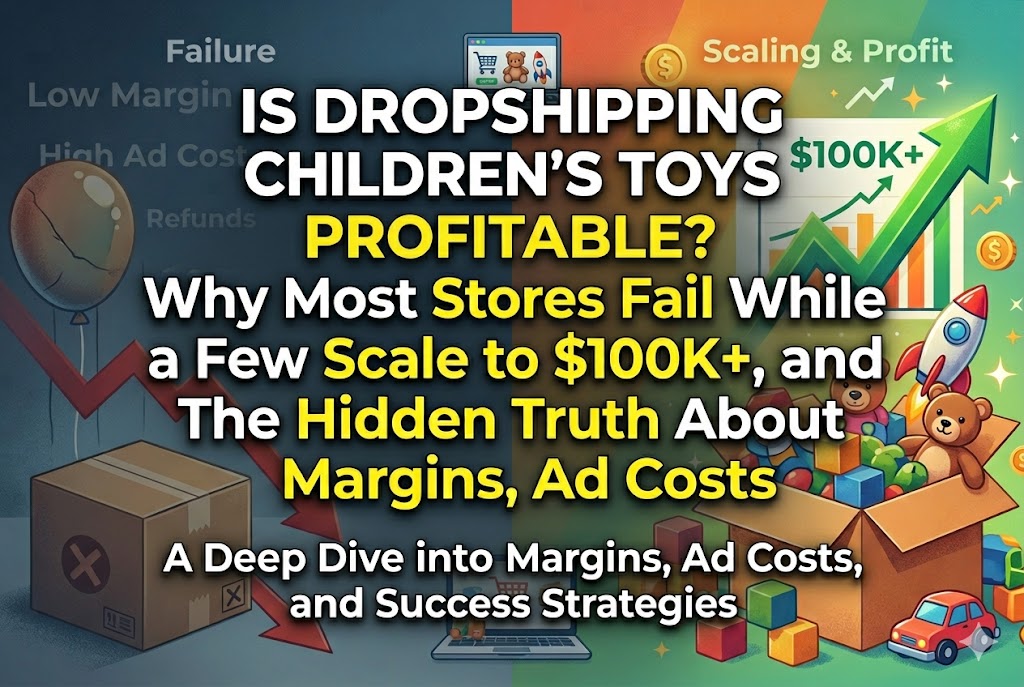
Is Dropshipping Children’s Toys Profitable? Why Most Stores Fail While a Few Scale to $100K+, and The Hidden Truth About Margins, Ad Costs

Dropshipping children’s toys is not inherently unprofitable, but it is margin-sensitive and advertising-dependent. The difference between failure and success is rarely the product itself—it is how efficiently traffic is converted into repeatable profit after all operational costs.
The Real Profit Breakdown Behind the Children’s Toys Industry
Dropshipping children’s toys can be profitable, but the reality is more nuanced than most beginner tutorials suggest. On average, the gross margin for toy dropshipping ranges from 30% to 70%, depending on product type, supplier pricing, and branding level.
Low-cost generic toys sourced from platforms like Alibaba often have a unit cost of $3–$8 and retail prices between $12–$25, which creates a gross margin of around 40%–60% before advertising. However, once marketing costs are included, net profit margins shrink significantly.
In competitive markets like the US and UK, paid ads typically consume 20%–50% of revenue, especially when using TikTok or Meta ads. This means a product that looks highly profitable on paper may only generate 5%–15% net margin in reality, or even break even during testing phases.
Why Gross Margin Alone Is Misleading
Many beginners focus only on product markup, but gross margin does not reflect the real profitability of dropshipping children’s toys.
For example:
- Product cost: $5
- Selling price: $18
- Gross margin: 72%
At first glance, this looks extremely profitable. However, once you add:
- TikTok ad CAC: $6–$12 per order
- Payment fees: ~3%
- Refund/return rate: 5%–15%
- Shipping adjustments or reshipments
The true net profit often drops to $1–$3 per order, or even negative during scaling tests.
This is why many stores generate revenue but still fail to become profitable.
Advertising Costs Are the Biggest Profit Killer
In children’s toy dropshipping, advertising is usually the largest variable cost.
Typical benchmarks in 2026 e-commerce advertising:
- TikTok CPM: $5–$15
- Meta CPM: $8–$20
- Average conversion rate: 1.5%–4%
- Customer acquisition cost (CAC): $8–$25
If your average order value (AOV) is around $25–$40, then your break-even ROAS is usually between 2.0 and 3.0.
This means you need at least $2–$3 in return for every $1 spent on ads just to avoid losing money. Many new stores fail because they underestimate this threshold and assume viral traffic equals profit.
Product Type Strongly Impacts Profitability
Not all children’s toys perform equally in dropshipping.
Higher-margin categories include:
- Montessori educational toys
- STEM kits
- sensory toys for autism or ADHD support
- creative DIY craft sets
These products often support 50%–70% gross margins because they are perceived as educational or premium.
Lower-margin but high-competition categories include:
- generic plush toys
- trending TikTok gimmick toys
- low-cost plastic toys
These typically fall into the 30%–45% margin range, with higher ad costs due to saturation.
The Hidden Cost Most People Ignore — Returns and Trust Issues
Children’s products have a naturally higher sensitivity to quality expectations. This leads to:
- 5%–20% return rate depending on supplier quality
- chargebacks due to “not as described” complaints
- higher customer service workload
Each refund can erase multiple profitable orders. For example, a single $20 refund may require 4–6 successful orders to offset the loss.
This is why supplier reliability has a direct impact on real profitability, not just pricing.
So Is It Actually Profitable?
Yes, but only under certain conditions.
Children’s toy dropshipping becomes consistently profitable when:
- You control CAC under $10
- Your AOV is above $30
- You maintain at least 50% gross margin
- You reduce refund rate below 10%
- You focus on evergreen rather than viral-only products
Without these conditions, the business often becomes a “revenue-positive but profit-negative” model.
Best Profitable Children’s Toys for Dropshipping
In children’s toys dropshipping, profitability is not evenly distributed across products. A small group of “winning products” typically generates most of the revenue, while the majority of listings barely break even.
Across typical e-commerce data, successful toy stores often see gross margins between 35% and 70%, but only if they focus on the right categories. Poor product selection can push margins below 25% once ad costs and refunds are included.
The key difference is not just cost vs price—it’s perceived value, emotional appeal, and impulse buying behavior.
High-Margin Toy Categories That Consistently Perform
Certain toy categories repeatedly outperform others because they combine low sourcing cost with high perceived value.
1. Montessori & Educational Toys
These products often cost $3–$10 from suppliers and sell for $18–$45 retail, creating a gross margin of 50%–70%.
Parents are willing to pay more because they associate educational toys with cognitive development, early learning, and screen-free engagement. This makes them less price-sensitive and more brand-sensitive.
2. STEM Science Kits
STEM kits are one of the most stable high-ticket toy categories in dropshipping.
- Supplier cost: $6–$15
- Retail price: $25–$60
- Gross margin: ~45%–65%
These products perform well because they target “value-driven purchase logic” instead of pure entertainment. They also convert better with video ads showing experiments or hands-on results.
3. Sensory & Therapy Toys
These include stress-relief toys, fidget tools, and autism-friendly sensory products.
- Supplier cost: $1–$5
- Retail price: $10–$25
- Gross margin: 60%–80%
Although average order value is lower, conversion rates are often higher due to strong emotional positioning and problem-solving intent.
4. Creative DIY Craft Kits
DIY toy kits (painting, building, slime, jewelry making) are strong impulse-buy products.
- Supplier cost: $4–$12
- Retail price: $20–$50
- Gross margin: 45%–65%
They perform especially well on TikTok and Pinterest due to visual engagement and “before/after creation” content.
Low-Margin Products That Look Profitable but Fail in Ads
Some toy categories appear attractive due to viral trends, but they often underperform financially.
Generic Plush Toys
- Low differentiation
- High competition
- Gross margin: 30%–45%
Even if sourcing is cheap, advertising costs quickly erase profit.
Trend-Driven Viral Toys
These include spinning gadgets or short-lived TikTok products.
- Short product lifecycle: 2–6 weeks
- High CPM competition
- Refund rates often exceed 10%
They may generate quick spikes in revenue but rarely sustain long-term profitability.
The Real Profit Formula Behind Winning Products
A profitable children’s toy product usually follows a simple structure:
- Product cost ≤ 25% of retail price
- Ad CAC ≤ 30% of revenue
- Gross margin ≥ 50%
- Conversion rate ≥ 2.5%
- Low refund rate (<10%)
For example:
- Cost: $6
- Selling price: $24
- Gross margin: 75%
- Ad CAC: $8–$10
- Net profit per order: $3–$7 (stable scaling range)
Without this structure, scaling ads will usually lead to losses even if sales volume increases.
Why “Evergreen Products” Beat Viral Toys Long-Term
The most profitable dropshipping toy stores do not rely on viral hits. Instead, they build around evergreen categories like educational toys and STEM kits.
Evergreen products provide:
- stable demand year-round
- lower ad volatility
- repeat purchase potential (siblings, gifts, replacements)
- higher lifetime value (LTV)
In contrast, viral toys often spike quickly but collapse once ad fatigue and audience saturation occur.
Are Children’s Toy Dropshipping Ads Profitable? TikTok vs Meta vs Google Cost Breakdown
In children’s toy dropshipping, product margin alone is not enough to determine profitability. In most cases, advertising cost is the deciding factor between scalable profit and hidden loss.
Even when gross margins look strong (typically 40%–70% for toys), paid traffic can consume 20%–60% of total revenue, depending on platform and campaign efficiency.
This means two stores selling the same product can have completely different outcomes:
- One store profits 10–20% net margin
- Another breaks even or loses money despite high sales volume
The difference is almost always CAC (customer acquisition cost).
TikTok Ads — High Volume but Volatile Profitability
TikTok is the most common traffic source for children’s toys due to its visual virality, but it is also one of the most unpredictable.
Typical benchmarks:
- CPM: $5–$15
- CTR: 1.5%–3.5%
- Conversion rate: 2%–5%
- CAC: $6–$18
For a toy priced at $25–$40, the break-even ROAS is usually 2.0–3.2.
This means you need at least $2–$3 in revenue for every $1 spent on ads just to avoid loss.
TikTok works best for:
- impulse-buy toys
- visually engaging products (DIY kits, sensory toys)
- short lifecycle viral products
However, scaling is difficult because CPM and audience fatigue increase quickly after initial testing success.
Meta Ads (Facebook & Instagram) — More Stable but Higher Competition
Meta ads are more predictable than TikTok but often more expensive for cold traffic in the toy niche.
Typical benchmarks:
- CPM: $8–$20
- CTR: 1%–2.5%
- CAC: $10–$25
- Conversion rate: 1.5%–3%
Meta generally requires a higher average order value (AOV) to remain profitable. For children’s toys, this often means bundling products or upselling.
Break-even ROAS is usually:
- 2.5–3.5 for cold traffic campaigns
Meta performs better for:
- educational toys
- branded toy stores
- retargeting campaigns (high LTV users)
The advantage is stronger long-term optimization, especially when pixel data matures.
Google Ads — High Intent but Limited Volume
Google Ads operates differently because it captures search intent rather than impulse demand.
Typical benchmarks:
- CPC: $0.80–$2.50
- Conversion rate: 3%–6%
- CAC: $8–$20
Google users are already searching for products like:
- “educational toys for toddlers”
- “best STEM kits for kids”
This leads to higher conversion efficiency, but total traffic volume is lower compared to TikTok or Meta.
Break-even ROAS is usually:
- 1.8–2.8 (more efficient than social ads)
However, competition on high-intent keywords can quickly increase CPC during Q4 seasons.
Why Many Toy Stores Look Profitable but Actually Lose Money
A common mistake in children’s toy dropshipping is misunderstanding revenue vs profit.
Example scenario:
- Product price: $30
- Gross margin: 60% ($18)
- TikTok CAC: $12
- Payment + refund cost: $3
Net profit = $3 per order (or less)
Now add scaling pressure:
- CPM increases
- conversion rate drops due to fatigue
- refund rate rises to 10%–15%
At scale, many stores move from profit → break-even → loss without realizing it.
This is why “viral success” does not guarantee profitability.
Break-Even ROAS Reality in Children’s Toys
Across most ad platforms, children’s toy dropshipping requires:
- TikTok: ROAS 2.0–3.2
- Meta: ROAS 2.5–3.5
- Google: ROAS 1.8–2.8
If your store cannot consistently hit these benchmarks, scaling will likely amplify losses instead of profits.
The key variable is not just traffic—it is conversion efficiency + product margin alignment.
Is Children’s Toy Dropshipping Seasonal? Off-Season Cash Flow Breakdown
Children’s toys are one of the most seasonally concentrated product categories in e-commerce. While dropshipping is often presented as a “year-round income model,” toy sales behave more like a cyclical retail business driven by holidays, gifting events, and school calendars.
Across typical e-commerce datasets, Q4 (October–December) can account for 35%–55% of annual toy revenue, with Christmas being the dominant peak. This means that a store that appears moderately profitable in December may actually be unprofitable across the full year if off-season performance is weak.
Q4 (Christmas Season) — The Real Profit Engine
The highest profitability window for children’s toy dropshipping is Q4, especially November and December.
Key characteristics:
- Conversion rates increase by 20%–60% due to gift intent
- Average order value (AOV) increases by 15%–40%
- CPM on Meta and TikTok increases by 30%–80% due to competition
Despite higher ad costs, overall profitability often improves because consumer urgency overrides price sensitivity.
Typical Q4 gross margin structure:
- Product margin: 45%–70%
- Ad CAC increase: +30%–50%
- Net profit stability: 10%–25% in optimized stores
This is the only period where many dropshipping stores achieve consistent scaling success.
Back-to-School Season — The Second Profit Window
The back-to-school period (August–September) is the second most important seasonal spike.
This period favors:
- educational toys
- STEM kits
- learning-focused products
Performance characteristics:
- moderate CPM (lower than Q4)
- higher conversion for “developmental” positioning
- strong parental purchasing intent
Typical revenue contribution:
- 10%–20% of annual sales for successful stores
However, it is less explosive than Q4 and requires more targeted messaging rather than viral content.
Halloween and Short Seasonal Micro-Spikes
Halloween creates a short but high-intent purchasing window, especially for:
- costume-related toys
- spooky-themed novelty items
- interactive decorative toys
Key metrics:
- short lifecycle (2–4 weeks)
- high CTR due to emotional engagement
- moderate AOV increase
However, Halloween is not a reliable scaling period. It functions more like a profit boost window rather than a business foundation.
Off-Season Reality — Where Most Stores Fail
From January to July, children’s toy dropshipping enters a long low-demand period.
Common challenges:
- lower conversion rates (down 20%–40%)
- reduced gifting intent
- higher sensitivity to ad fatigue
- unstable ROAS due to audience saturation
Even with strong products, many stores experience:
- break-even performance
- negative net profit during scaling tests
- increased dependency on discounting
For example:
- Q4 ROAS: 2.8–3.5
- Off-season ROAS: 1.6–2.4
This difference alone determines whether a store survives long-term.
Why Cash Flow Management Is More Important Than Product Selection
Because of seasonality, children’s toy dropshipping behaves more like a cash flow timing business than a constant income stream.
Successful operators typically:
- accumulate profit in Q4
- reinvest cautiously in Q1–Q2
- test new products during low-cost ad periods
- avoid aggressive scaling in off-season months
Without this structure, even stores with strong Q4 performance can run into liquidity problems later in the year.
How Supplier Quality and Return Rates Affect Dropshipping Children’s Toy Profitability
In children’s toy dropshipping, supplier quality is one of the most underestimated variables affecting profitability. While most beginners focus on product price and ad performance, the real long-term profit often depends on defect rate, shipping reliability, and consistency of product quality.
Even when gross margins appear strong at 40%–70%, poor supplier quality can reduce net profitability by 10%–30% or more through refunds, replacements, and chargebacks.
In practice, supplier performance determines whether your store scales profitably or collapses under operational friction.
Return Rates in Children’s Toys Are Structurally Higher Than Other Niches
Children’s toys have inherently higher return and complaint rates compared to categories like electronics accessories or apparel basics.
Typical industry ranges:
- Low-quality suppliers: 12%–25% return rate
- Average dropshipping suppliers: 6%–15% return rate
- Premium vetted suppliers: 3%–8% return rate
The reasons are structural:
- parents have high safety expectations
- products are often gift-based (misalignment risk)
- size, function, or quality perception mismatches
- shipping damage during international transit
Even a seemingly small return rate difference can drastically change profitability.
The Real Financial Impact of Refunds on Profit Margins
Refunds in dropshipping do not just remove revenue—they often create amplified losses.
Example scenario:
- Product selling price: $25
- Gross margin: $15 (60%)
- Ad CAC: $10
- Net expected profit: $5
Now add a 10% return rate:
For every 10 orders:
- 1 order refunded = -$25 revenue loss
- plus lost ad spend: -$10
- total loss: -$35
To recover this, you need profit from 7–10 successful orders just to break even.
This is why return rate is effectively a hidden margin tax in children’s toy dropshipping.
Defective Products and “Silent Margin Killers”
Beyond official returns, defective or low-quality products create indirect losses that are harder to measure.
Common issues include:
- inconsistent material quality
- broken parts during shipping
- missing components in kits
- inaccurate product descriptions from suppliers
These issues lead to:
- partial refunds (5%–50%)
- increased customer support workload
- negative reviews that reduce conversion rate
- higher chargeback risk (especially on PayPal/Stripe)
Even a 3%–5% defect rate can reduce overall net profit by 20%+ when scaled.
Shipping Time and Quality Perception Are Connected
In children’s toy dropshipping, shipping time directly influences perceived product quality.
Typical China-to-US/EU shipping scenarios:
- 7–12 days: acceptable (higher conversion)
- 12–20 days: moderate trust drop
- 20+ days: high refund probability
Even if product quality is good, long delivery times often lead to:
- “item not received” disputes
- impatience-driven refunds
- lower repeat purchase rates
This creates a hidden profitability issue: logistics delay reduces both revenue and customer lifetime value (LTV).
Supplier Tiering Determines Long-Term Profit Stability
Not all suppliers create the same financial outcome.
Low-Tier Suppliers
- low product cost
- high defect rate (10%–25%)
- inconsistent packaging
- short-term profit spikes but unstable scaling
Mid-Tier Suppliers
- moderate pricing
- defect rate (6%–12%)
- acceptable shipping consistency
- usable for testing products
High-Tier or Vetted Suppliers
- higher product cost (+10%–30%)
- defect rate (3%–7%)
- better packaging and QC
- significantly higher long-term profitability due to lower refunds
In many cases, paying slightly more per unit increases net profit by 15%–25% at scale, even though gross margin looks lower initially.
Why Many Stores Fail Despite Strong Sales
A common failure pattern in toy dropshipping is:
- strong ad performance
- high sales volume
- weak supplier control
This leads to:
- increasing refund rates over time
- declining ad efficiency due to negative reviews
- shrinking margins despite scaling revenue
Eventually, stores hit a point where:
“More sales = more losses”
This is almost always caused by supplier quality degradation at scale.
Is Brand-Based Children’s Toy Dropshipping More Profitable Than Generic Stores?
In children’s toy dropshipping, profitability is not only determined by product selection or advertising efficiency, but also by the business model itself—whether you operate as a generic store or a branded store.
Most beginners start with a generic model:
- random trending products
- price-based competition
- short-term TikTok or Meta ads
- no customer retention strategy
In contrast, brand-based toy stores focus on:
- consistent product themes (education, learning, creativity)
- packaging and customer experience
- repeat purchase optimization
- long-term customer value (LTV)
The difference in profitability can be dramatic:
generic stores often operate at 5%–15% net margin, while brand-based stores can reach 20%–40%+ over time.
Gross Margin vs Real Profit Expansion in Brand Models
At first glance, both models may appear similar in gross margin:
- Generic dropshipping toys: 35%–60% gross margin
- Brand-based toy stores: 45%–75% gross margin
However, the real difference is not product markup—it is pricing power.
Brand-based stores can:
- charge 10%–40% higher prices for the same product
- bundle products (increasing AOV by 20%–60%)
- reduce discount dependency
- maintain stable margins during ad cost fluctuations
This creates a compounding effect where even small pricing advantages significantly increase profit at scale.
Customer Lifetime Value (LTV) Changes Everything
Generic dropshipping stores typically have:
- LTV: $25–$40 (often single purchase behavior)
- repeat purchase rate: low (<10%)
- high reliance on acquisition ads
Brand-based toy stores, however, shift the economics:
- LTV: $60–$150+ depending on product ecosystem
- repeat purchase rate: 20%–40%
- email + retargeting contribution: 15%–30% of revenue
For example:
- First purchase: $30
- Follow-up educational toy: $25
- seasonal gift purchase: $40
One customer can generate 2–4x more revenue over time, dramatically lowering effective CAC.
Advertising Efficiency Improves With Branding
Brand perception directly impacts ad performance metrics.
Typical differences:
Generic Store
- CTR: 1%–2%
- Conversion rate: 1.5%–3%
- CAC: $10–$25
- ROAS volatility: high
Brand-Based Store
- CTR: 2%–4%
- Conversion rate: 2.5%–5%
- CAC: $6–$15
- ROAS stability: significantly higher
The reason is trust. Parents purchasing children’s toys are highly sensitive to:
- product safety perception
- store credibility
- visual consistency
- reviews and brand identity
Branding reduces perceived risk, which directly improves conversion efficiency.
Why Generic Stores Fail to Scale Profitably
Generic toy dropshipping stores often face a structural ceiling:
- constant need for new winning products
- increasing ad fatigue
- rising CPM over time
- inability to retain customers
- dependency on viral cycles
Even if they achieve short-term success, profits are unstable because:
each sale is isolated, not cumulative
Once ad costs rise, the entire model collapses quickly because there is no LTV buffer.
Brand Stores Scale Like Compounding Systems
Brand-based stores behave more like long-term assets than product catalogs.
Key advantages:
- repeat customers reduce dependency on paid ads
- email marketing contributes 10%–25% of revenue
- stronger organic traffic over time (SEO, social proof)
- lower sensitivity to CPM fluctuations
- higher resale or acquisition value
Even with slightly lower initial margins, the compounding effect of customer retention increases total profitability by 2x–5x over time.
Real Profit Comparison Over 12 Months
A simplified comparison:
Generic Store
- Monthly revenue: $20,000
- Net margin: 8%–15%
- Annual profit: ~$19,200–$36,000
- High volatility
Brand-Based Store
- Monthly revenue: $20,000 (same starting point)
- Net margin: 20%–35%
- Annual profit: ~$48,000–$84,000
- Increasing stability over time
The key difference is not revenue—it is margin expansion through retention and pricing power.
In children’s toy dropshipping, branding fundamentally changes the profitability ceiling. While generic stores rely on continuous acquisition and short-term trends, brand-based stores build compounding value through customer trust, higher LTV, and stronger pricing power. Over time, this leads to significantly higher and more stable profit margins, even if initial growth is slower.




No Comments