


Difference Between E-Commerce and Dropshipping: The Truth About Profit, Risk, Branding, and Which Model Actually Makes Money

The difference between e-commerce and dropshipping is not just technical—it defines how you operate, scale, and build your brand. E-commerce offers full control and higher long-term stability but requires more upfront investment. Dropshipping offers flexibility and low startup costs but comes with limitations in control and branding.
For beginners, understanding this distinction is the first step toward choosing a model that aligns with their budget, risk tolerance, and long-term goals.
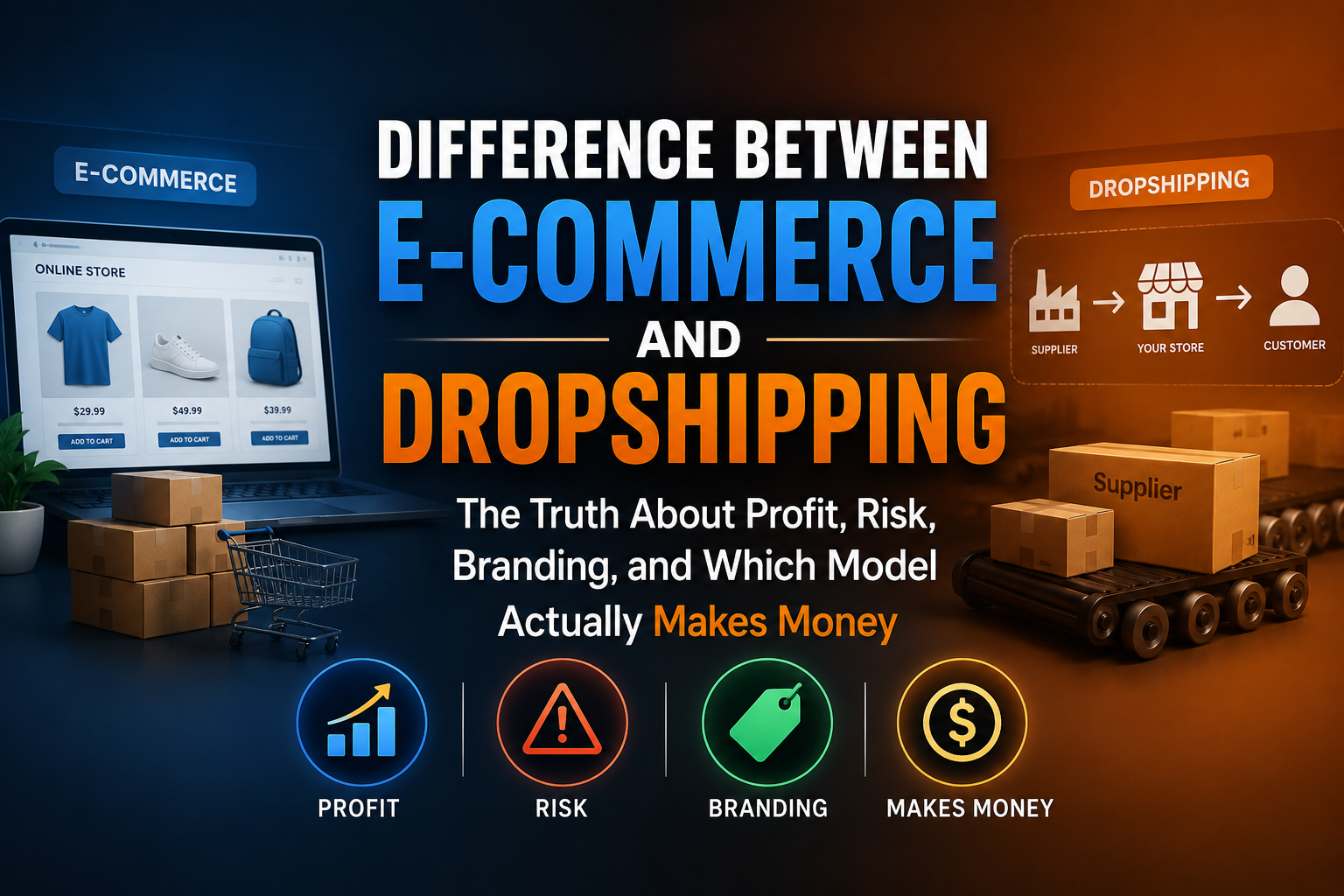
A Clear Beginner’s Guide to Two Business Models
The phrase “difference between e-commerce and dropshipping” is often searched by beginners who want to start an online business but are confused by how these two models actually work. At first glance, they seem similar because both involve selling products online. However, the operational structure behind them is fundamentally different, and this difference affects everything from startup strategy to long-term scalability.
What Is E-Commerce?
E-commerce is a broad term that refers to any business that sells products or services online. In a traditional e-commerce setup, the seller usually owns or controls inventory, either by storing products themselves or using a third-party warehouse.
This means the business is responsible for sourcing products, managing stock levels, handling fulfillment, and ensuring shipping to customers. Platforms like Shopify, Amazon FBA, or WooCommerce stores typically fall under this category.
The key idea is ownership and control. In e-commerce, you are building a full retail operation, similar to running a digital version of a physical store.
What Is Dropshipping?
Dropshipping is a specific fulfillment method within e-commerce. Instead of holding inventory, the store owner sells products directly to customers and forwards the order to a supplier, who then ships the product on their behalf.
This removes the need to store or manage physical inventory. The seller acts more like a middleman between customer demand and supplier fulfillment.
Because of this structure, dropshipping is often seen as a lower-barrier entry point into online business. However, it also means less control over shipping speed, product quality, and packaging experience.
Core Concept Difference: Ownership vs Fulfillment Model
The most important distinction is that e-commerce is a business structure, while dropshipping is a fulfillment method inside that structure.
In e-commerce, you may own inventory, control branding, and manage logistics directly or through warehouses. In dropshipping, you usually don’t touch the product at all.
This difference shapes everything else: cost structure, customer experience, and even long-term brand building potential.
Why People Confuse the Two
Many beginners assume dropshipping and e-commerce are separate business types, but in reality, dropshipping is just one way to run an e-commerce store.
This confusion often comes from online marketing content that positions dropshipping as a “business model,” when it is actually a logistics strategy.
Once you understand this hierarchy, the comparison becomes clearer: all dropshipping stores are e-commerce businesses, but not all e-commerce businesses are dropshipping.
How Each Model Makes Money and Where the Real Profit Comes From
When people search for the “difference between e-commerce and dropshipping,” they are usually not just comparing definitions—they are trying to understand one key question: which model actually makes more money and how does profit work in each system?
Although both models sell products online, the way money is generated, retained, and scaled is structurally different. Understanding these differences is essential before building any online store, because profit logic determines your pricing strategy, marketing budget, and long-term sustainability.
How E-Commerce Makes Money: Margin Control and Asset Ownership
In traditional e-commerce, profit comes from the difference between product cost and selling price, minus operational expenses such as shipping, storage, advertising, and platform fees.
Because e-commerce businesses often purchase inventory in bulk or manufacture products directly, they typically gain stronger control over cost per unit. This allows for higher potential profit margins once the brand reaches scale.
Another important factor is asset accumulation. In e-commerce, unsold inventory is still an owned asset, and branded products can increase perceived value over time. This creates opportunities for long-term margin expansion through brand positioning and repeat customers.
In short, e-commerce profit is driven by cost optimization, volume scaling, and brand equity.
How Dropshipping Makes Money: Transaction-Based Margin Spreads
Dropshipping operates on a simpler profit mechanism: the seller earns the difference between the retail price and the supplier cost after each order is fulfilled.
Unlike traditional e-commerce, there is no inventory investment, which means profit is generated per transaction without holding stock risk. However, this also means margins are often tighter, especially when competing in saturated markets.
Since sellers do not control production or logistics, pricing flexibility is limited by supplier costs and shipping constraints. This often forces dropshipping stores to rely heavily on marketing efficiency and high-converting product selection rather than cost engineering.
In essence, dropshipping profit depends more on traffic efficiency and conversion optimization than operational control.
The Key Difference in Profit Structure: Active vs Scalable Margins
The fundamental difference is that e-commerce profits are more scalable through control, while dropshipping profits are more dependent on marketing performance.
In e-commerce, improving supplier contracts, reducing logistics costs, and building brand loyalty can continuously increase profit margins over time. In dropshipping, margins are relatively fixed per product, and scaling usually requires increasing ad spend rather than improving unit economics.
This creates two very different financial growth patterns: e-commerce builds compounding value, while dropshipping often operates on performance-based cycles.
Cash Flow Reality: Why Dropshipping Feels Faster but Riskier
Dropshipping is often perceived as faster to start earning money because it requires no upfront inventory investment. However, profit can fluctuate heavily due to advertising costs, supplier delays, and product quality issues.
E-commerce, on the other hand, requires more initial capital but tends to create more stable cash flow once operations are optimized.
This difference explains why many dropshipping stores experience rapid early sales but struggle with consistency, while e-commerce brands grow slower but more sustainably.
Startup Costs, Financial Risk, and Which Model Is Cheaper to Start
When comparing the difference between e-commerce and dropshipping, most beginners focus on profit potential, but the real deciding factor is usually startup cost and financial risk. Before any revenue is generated, every online business must survive a cost phase—website setup, product sourcing, marketing, and operations.
Although both models can be started online, the financial structure behind them is very different. One requires upfront investment in inventory and infrastructure, while the other shifts most costs into marketing and transaction-based expenses.
E-Commerce Startup Costs: Inventory, Infrastructure, and Upfront Capital
E-commerce typically requires a more structured financial commitment at the beginning. The main cost components include inventory purchase, packaging, branding, website development, and sometimes warehousing or third-party fulfillment services.
Inventory is usually the largest upfront expense. Even small-scale stores often need to buy stock in bulk to achieve competitive pricing and maintain consistent supply. This creates a capital requirement before any sales occur, which increases financial pressure in the early stage.
In addition, e-commerce businesses often invest in branding elements such as custom packaging, product photography, and website optimization. While these investments increase long-term value, they also raise the entry barrier.
Overall, e-commerce demands higher initial capital but offers more control over where the money is allocated.
Dropshipping Startup Costs: Low Entry, High Operational Dependency
Dropshipping is widely considered the lowest-cost entry point into online business because it removes the need for inventory purchases. In most cases, the primary startup costs are domain registration, Shopify or WooCommerce fees, and basic marketing budgets.
However, while the entry cost is low, operational expenses can increase quickly. Paid advertising on platforms like Meta Ads or TikTok often becomes the largest ongoing cost, especially if organic traffic is not established.
This means dropshipping shifts financial pressure from upfront investment to continuous cash flow management. Instead of buying inventory, you are effectively paying for traffic and conversions in real time.
Financial Risk: Inventory Risk vs Advertising Risk
The core difference in financial risk between the two models lies in where the uncertainty is concentrated.
In e-commerce, the biggest risk is unsold inventory. If products do not sell, capital is tied up in stock that may lose value over time. This creates a longer-term financial commitment but also allows for strategic control over pricing and bundling.
In dropshipping, the main risk is advertising inefficiency. Since there is no inventory, the risk comes from spending money on ads without achieving profitable conversions. This makes dropshipping more volatile on a daily basis, especially in competitive niches.
In simple terms, e-commerce risk is slower but deeper, while dropshipping risk is faster but more frequent.
Which Model Is Cheaper to Start? The Real Answer Depends on Strategy
At surface level, dropshipping is cheaper because it requires almost no upfront inventory cost. This makes it attractive for beginners who want to test product ideas quickly without committing large capital.
However, in real-world execution, dropshipping can become expensive if advertising costs are high or if multiple products fail before finding a winner.
E-commerce requires more initial investment, but once a product line is validated, the cost per unit decreases and profitability becomes more stable. Over time, this can actually make it more cost-efficient than dropshipping.
Scalability, Supply Chain Control, and Long-Term Growth Potential
At the beginning, e-commerce and dropshipping can look similar because both allow you to sell products online quickly. However, the difference between them becomes much clearer when a business tries to scale.
Many stores can generate their first sales in either model, but only a few can grow into stable, long-term operations. The reason usually comes down to two core factors: supply chain control and scalability structure.
E-Commerce Scalability: Control Creates Predictability
In traditional e-commerce, scalability is built on ownership and control. Businesses typically manage or directly influence key parts of the supply chain, including inventory planning, warehousing, packaging, and shipping.
This level of control allows for predictable scaling. When demand increases, e-commerce businesses can respond by adjusting inventory levels, negotiating better supplier pricing, or expanding fulfillment capacity through third-party logistics providers.
Because the business owns or controls stock, scaling is more structured. You can forecast demand, prepare inventory in advance, and optimize operations based on historical sales data.
This predictability is one of the biggest advantages of e-commerce. Growth may require more coordination, but it is generally stable and repeatable once systems are in place.
Dropshipping Scalability: Flexible but Operationally Limited
Dropshipping, on the other hand, scales in a very different way. Since the seller does not hold inventory, scaling is primarily driven by demand generation rather than operational expansion.
This means growth is closely tied to marketing performance. If advertising campaigns perform well, sales can increase rapidly without needing additional infrastructure. However, this also creates a dependency on suppliers and third-party fulfillment systems.
The lack of control over inventory and logistics can become a bottleneck at scale. As order volume increases, issues such as shipping delays, inconsistent product quality, or supplier stock shortages can directly affect customer experience.
In practice, dropshipping scales quickly in revenue but not always in operational stability.
Supply Chain Control: The Hidden Limitation of Dropshipping
Supply chain control is one of the most important differences between the two models, especially at scale.
E-commerce businesses can optimize their supply chain over time. They can switch manufacturers, consolidate shipping, or even move toward private labeling to improve margins and delivery speed.
Dropshipping businesses are typically dependent on external suppliers who control production and logistics. This means the seller has limited ability to improve fulfillment speed or packaging quality without changing the entire supplier relationship.
As order volume grows, this dependency becomes more visible. Even small disruptions at the supplier level can affect thousands of customer orders, which makes scaling less predictable.
Operational Complexity: Systems vs External Dependency
Scaling e-commerce usually means building internal systems. These can include inventory management tools, warehouse workflows, customer service processes, and automated fulfillment systems.
While this adds complexity, it also increases independence. The business becomes more self-contained and less reliant on external parties for daily operations.
Dropshipping scales differently. Instead of building internal systems, the focus is often on managing multiple external suppliers, testing product variations, and optimizing ad performance.
This creates a different kind of complexity—less about internal operations and more about coordination and risk management across third-party providers.
Long-Term Growth Potential: Stability vs Speed
In the long term, e-commerce tends to offer more stable scalability because control over the supply chain allows for continuous optimization. Businesses can improve margins, expand product lines, and build consistent customer experiences.
Dropshipping can scale quickly in the short term, especially when a winning product is found, but long-term growth often depends on transitioning toward more controlled fulfillment methods, such as private labeling or hybrid inventory models.
This is why many successful dropshipping businesses eventually evolve into full e-commerce brands—they need more control to sustain growth.
Branding, Customer Experience, and Why Most Dropshipping Stores Struggle to Build Real Brands
When people compare the difference between e-commerce and dropshipping, they often focus on cost, profit, or startup speed. But the real long-term separator is branding and customer experience.
In today’s competitive online market, products alone are rarely enough to sustain a business. Customers remember how fast the product arrived, how it was packaged, how trustworthy the store felt, and whether they would buy again. This is where the gap between e-commerce and dropshipping becomes extremely visible.
E-Commerce and Branding: Full Control Over the Customer Journey
In a traditional e-commerce model, businesses have much more control over how customers experience their brand from start to finish.
They can design custom packaging, control shipping speed through local warehouses or fulfillment partners, and maintain consistent product quality through direct supplier relationships. This allows the entire customer journey to be intentionally designed rather than outsourced.
Because of this control, e-commerce brands can build stronger emotional positioning. Even small details like unboxing experience, packaging materials, or branded inserts contribute to perceived value. Over time, these elements create trust and increase repeat purchase rates.
In short, e-commerce supports brand building because it allows businesses to control every touchpoint.
Dropshipping and Branding Limitations: Fragmented Customer Experience
Dropshipping operates very differently. Since products are shipped directly from third-party suppliers, the seller has limited control over packaging, shipping time, and sometimes even product consistency.
This creates a fragmented customer experience. A customer might see a polished advertisement, but receive a generic package with no branding. Shipping times can vary depending on supplier location, and product quality may differ slightly between batches.
These inconsistencies make it difficult to build a strong brand identity. Even if the store generates sales, the customer often remembers the product, not the brand behind it.
This is one of the main reasons many dropshipping stores struggle to achieve long-term customer loyalty.
Customer Experience: Speed, Trust, and Expectations
Customer experience in e-commerce is usually more predictable because fulfillment is centralized or strategically managed. Faster shipping, clear return policies, and consistent product quality help build trust over time.
Dropshipping, however, often relies on international suppliers, which can lead to longer delivery times and less transparent logistics. Even when the product is good, delays or communication gaps can reduce customer satisfaction.
In modern e-commerce, delivery speed is often part of the brand promise. When that promise is inconsistent, it becomes harder to retain customers or generate repeat sales.
Why Dropshipping Struggles With Brand Building
The core issue is structural rather than strategic. Dropshipping prioritizes flexibility and low startup cost, but sacrifices control over execution.
Without control over packaging, logistics, and product sourcing, it becomes difficult to create a consistent brand identity. Most dropshipping stores end up competing on price or advertising rather than emotional branding.
This is why many successful dropshipping businesses eventually transition into private labeling or full e-commerce models. They need more control to move beyond short-term product testing.
The E-Commerce Advantage: Turning Operations Into Branding
In e-commerce, operations and branding are closely connected. Faster shipping, better packaging, and consistent quality are not just operational improvements—they directly strengthen the brand.
Over time, this creates compounding value. Customers begin to recognize the brand, trust the experience, and return for repeat purchases. This reduces reliance on paid ads and improves overall profitability.
E-commerce brands can also differentiate themselves more easily because they are not limited by supplier-standard packaging or fulfillment constraints.
Which Is Better for Beginners, Brands, and Long-Term Business Growth?
When people search for the difference between e-commerce and dropshipping, they are usually not just trying to understand definitions. What they really want to know is: which model should I choose?
The answer is not absolute because both models serve different stages of business development. The better choice depends on your budget, experience level, risk tolerance, and long-term goals.
Instead of labeling one as “better,” it is more accurate to compare how each model fits different types of entrepreneurs and business strategies.
Best for Beginners: Why Dropshipping Feels Easier to Start
For beginners, dropshipping is often the most accessible entry point. The main reason is the low startup barrier. There is no need to purchase inventory upfront, manage warehouses, or handle complex logistics.
This allows new entrepreneurs to focus on learning the basics of online selling, such as product research, advertising, and website optimization. It also reduces financial pressure during the testing phase, which is important when experimenting with different product ideas.
However, while dropshipping is easier to start, it is not necessarily easier to succeed in. Beginners often underestimate advertising costs, competition, and supplier dependency.
Best for Building Brands: Why E-Commerce Offers More Control
For entrepreneurs focused on building a long-term brand, e-commerce is generally the stronger model. The key reason is control.
E-commerce allows businesses to manage product quality, packaging, shipping experience, and customer service standards. These elements are essential for creating a recognizable and trustworthy brand.
With more control over operations, businesses can differentiate themselves beyond price competition. This makes it easier to build repeat customers and long-term brand equity.
Although the startup process is more complex, the long-term potential is significantly higher for brand-driven businesses.
Long-Term Growth: From Testing to Ownership
Dropshipping is often best viewed as a testing phase rather than a final business model. It allows entrepreneurs to quickly validate product demand without large financial commitments.
However, once a product proves successful, many businesses transition into a more traditional e-commerce model. This shift usually involves holding inventory, improving shipping times, or creating private-label products.
E-commerce, on the other hand, is designed for long-term ownership. It focuses on building systems, optimizing supply chains, and increasing lifetime customer value.
In this sense, dropshipping is often the starting point, while e-commerce is the scaling phase.
Risk and Stability: Different Types of Pressure
Beginners often assume dropshipping is “safer” because it requires less upfront investment. While this is partially true, the risk is simply shifted rather than removed.
In dropshipping, the main risk comes from advertising spend and supplier reliability. A winning product can quickly become unprofitable if ad costs rise or fulfillment issues occur.
In e-commerce, the risk is more structural. Businesses must invest in inventory and logistics before knowing demand, but once optimized, operations tend to be more stable and predictable.
Both models involve risk, but the nature of that risk is fundamentally different.
Strategic Perspective: Choosing Based on Stage, Not Preference
The most practical way to choose between e-commerce and dropshipping is to think in terms of business stage.
Dropshipping is better suited for testing, learning, and validating ideas quickly. E-commerce is better suited for scaling, branding, and building long-term value.
Many successful online businesses actually use both models in sequence: starting with dropshipping to identify winning products, then transitioning into e-commerce for sustainable growth.

No Comments