


Is Dropshipping Costumes Profitable 6 High-Margin Niches Generating 45–80% Gross Profit in the Global Costume Ecommerce Market

Timing is critical for anyone trying to understand how to make big money from dropshipping costumes during Halloween. Most costume searches begin increasing in late September and peak during the final two weeks of October. This means product research, supplier sourcing, and store preparation must happen months earlier.
Experienced sellers typically begin preparing Halloween inventory during the summer. By the time consumer interest spikes, their online stores are already optimized, advertising campaigns are active, and trending costumes are ready to ship. This preparation allows them to capture the highest-margin sales period when demand significantly exceeds supply.
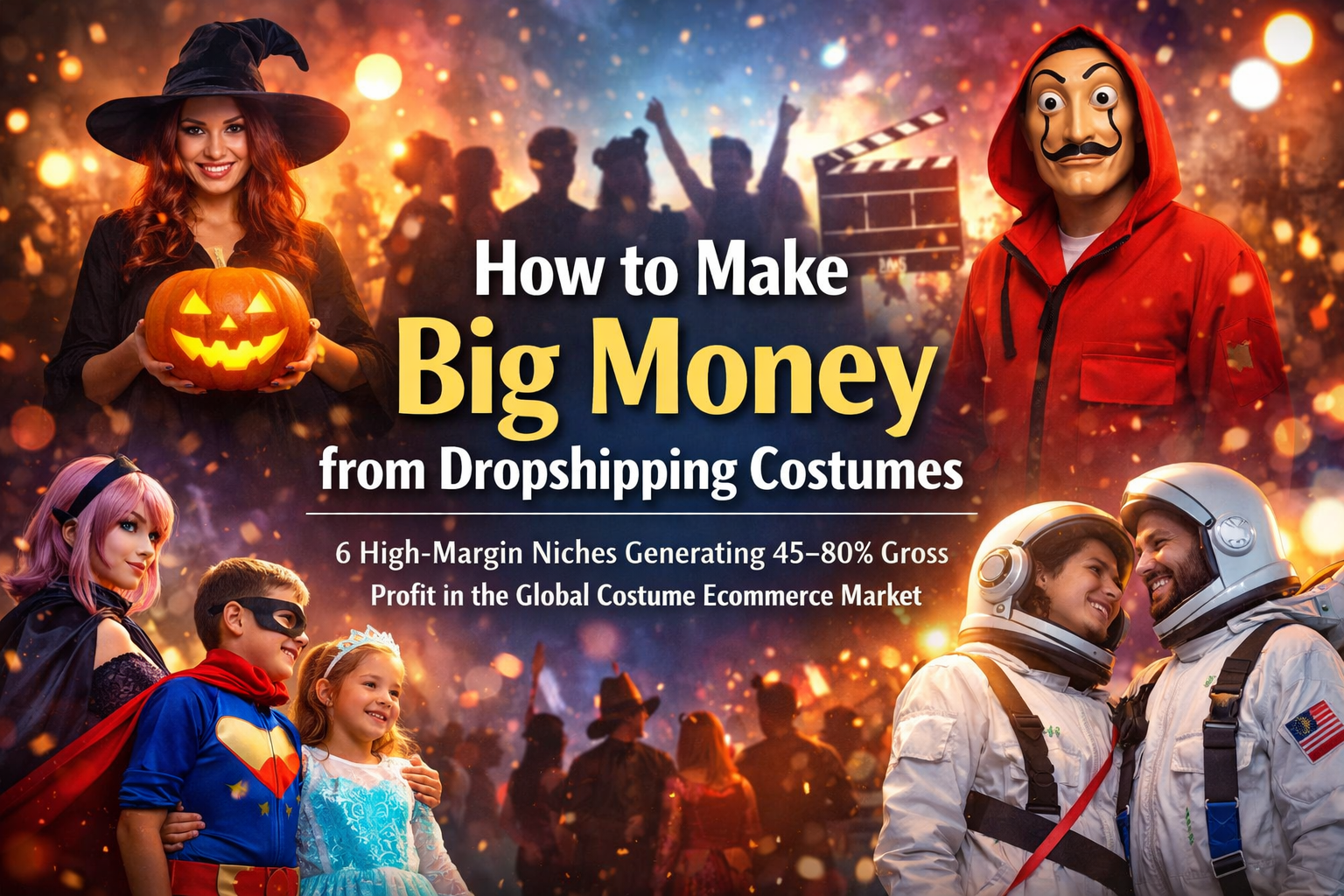
Halloween Costumes: The Billion-Dollar Seasonal Profit Engine Behind Costume Ecommerce
Every year, Halloween transforms the costume industry into one of the most profitable short-term retail opportunities in ecommerce. For entrepreneurs exploring how to make big money from dropshipping costumes, Halloween costumes represent the single most powerful seasonal revenue driver. The combination of cultural tradition, impulse buying behavior, and social media trends creates a unique market environment where profit margins can remain extremely high while demand surges within a concentrated selling window.
The Size of the Halloween Costume Market
Halloween spending in the United States alone regularly exceeds $12 billion annually, according to retail industry surveys. Costumes represent one of the largest segments of that spending. In many years, consumers spend more than $4 billion on costumes, covering adults, children, and pets. Adult costumes have grown particularly quickly over the past decade as Halloween parties, workplace events, and social media content creation have become more common.
From a dropshipping perspective, this seasonal spike creates an ideal business model. Retail prices for Halloween costumes typically range from $35 to $90, depending on the complexity of the design and included accessories. However, manufacturers and wholesale suppliers—particularly those located in large apparel production hubs—often price these products between $8 and $20 per unit. Even after accounting for shipping and marketing expenses, sellers can still achieve gross margins between 55% and 75%.
Why Halloween Costumes Are Highly Profitable in Dropshipping
Unlike everyday clothing, Halloween costumes are rarely purchased with the same level of price sensitivity. Consumers are buying them for entertainment, social events, or temporary experiences rather than long-term utility. This psychological difference significantly reduces comparison shopping and increases impulse purchases.
In addition, costume trends change every year, which allows sellers to introduce new designs without competing directly with large retail brands that focus on evergreen inventory. For example, characters from trending movies, viral TikTok personalities, or popular memes frequently become top-selling costumes within weeks. When demand surges rapidly for these new themes, early ecommerce sellers can charge premium prices before the market becomes saturated.
The limited seasonal sales window also encourages customers to make faster purchase decisions. With Halloween approaching, shoppers prioritize fast delivery and availability rather than searching extensively for the lowest price. This urgency gives dropshipping stores the opportunity to maintain strong margins throughout the season.
Leveraging Social Media Trends to Maximize Sales
Modern Halloween costume demand is heavily influenced by social media platforms. Viral costume ideas on platforms such as TikTok and Instagram can generate millions of searches within days. Characters from trending television series, celebrity looks, and nostalgic pop-culture themes frequently dominate costume searches during September and October.
Successful dropshipping stores often monitor Google search trends and social media hashtags to identify emerging costume trends early. By quickly listing these products and launching targeted advertising campaigns, sellers can capture a significant share of the demand surge before larger retailers adjust their inventory.
Cosplay Costumes: High-Value Fan Economy Niches Driving Premium Ecommerce Margins
For entrepreneurs researching how to make big money from dropshipping costumes, the cosplay market represents one of the most valuable long-term niches in the costume industry. Unlike seasonal costume demand driven by holidays, cosplay operates within a global fan economy fueled by anime, gaming, comic conventions, and online communities. This ecosystem creates consistent demand throughout the year and supports significantly higher product pricing compared to standard costumes.
The Expanding Global Cosplay Economy
Over the past decade, cosplay has evolved from a niche hobby into a large commercial market. Industry estimates suggest that the global cosplay products market—including costumes, wigs, props, and accessories—has grown to approximately $6–8 billion annually, with strong demand concentrated in North America, Europe, and East Asia. Major entertainment franchises such as anime series, video games, and superhero films continuously introduce new characters, ensuring a steady flow of new costume trends.
Cosplay costumes typically command much higher retail prices than traditional Halloween costumes. Standard cosplay outfits often sell online for $80 to $200, while more detailed character costumes can reach $250 or more. However, manufacturing costs in the costume supply chain are considerably lower. Many cosplay outfits can be sourced from specialized factories for $25 to $90, depending on materials, complexity, and included accessories. As a result, ecommerce sellers frequently achieve gross margins ranging from 45% to 65%, making cosplay one of the most profitable costume categories in dropshipping.
Why Cosplay Customers Are Willing to Pay Premium Prices
Cosplay consumers behave differently from traditional apparel shoppers. For many fans, wearing a character costume is a form of personal expression and community participation rather than simple clothing consumption. Cosplayers often attend conventions, fan events, themed photoshoots, and online content creation activities where visual accuracy and character authenticity are highly valued.
Because of this emotional connection, cosplay buyers are often willing to spend more on costumes that closely replicate the original character design. Details such as fabric patterns, accessories, armor pieces, and character-specific elements can significantly increase perceived value. This demand for authenticity allows ecommerce stores to position cosplay costumes as specialty products rather than mass-produced clothing, maintaining stronger pricing power and higher margins.
Convention Culture and Year-Round Demand
Another major factor driving cosplay costume profitability is the global convention industry. Large fan conventions—including anime expos, comic conventions, and gaming events—take place throughout the year in major cities worldwide. These events attract hundreds of thousands of attendees who frequently purchase new costumes for each convention they attend.
In addition to physical events, the rise of digital content platforms has expanded cosplay visibility dramatically. Cosplayers regularly share costume photos, transformation videos, and character performances on social media platforms, where cosplay-related content can accumulate millions of views. This constant exposure keeps character costumes trending long after a show or game is released.
For dropshipping stores, this means cosplay costumes generate consistent demand rather than short seasonal spikes, allowing sellers to build sustainable product catalogs instead of relying entirely on holiday sales.
Increasing Profit Through Costume Bundling
Another profitable strategy in cosplay ecommerce is bundling. Many character costumes require multiple components, including wigs, props, gloves, belts, or accessories. Instead of selling these items separately, successful dropshipping stores often bundle them together into complete character sets.
For example, a costume sourced for $40–$60 might be packaged with additional accessories and sold as a complete cosplay kit priced at $140–$180. This strategy increases the perceived value for buyers while significantly raising the average order value. When executed correctly, bundling can push gross margins toward the upper range of the 45–65% profit window typical in cosplay ecommerce.
Kids Costumes: The High-Volume Market Driving Consistent 60–75% Gross Margins
For entrepreneurs exploring how to make big money from dropshipping costumes, the children’s costume segment represents one of the most reliable and scalable niches within the broader costume industry. While many costume categories rely heavily on seasonal spikes or viral trends, kids’ costumes benefit from a combination of recurring family purchases, school activities, and entertainment-driven demand. These factors create a market that generates both high sales volume and strong profit margins for ecommerce sellers.
The Size and Stability of the Children’s Costume Market
The global children’s costume market has grown steadily as parents increasingly invest in themed clothing for holidays, parties, and imaginative play. Industry estimates suggest that children’s costumes account for over $4 billion in annual global sales, with North America and Europe representing the largest ecommerce markets.
Unlike adult costumes, which are often purchased for single events, children’s costumes are used across multiple occasions throughout the year. These include Halloween celebrations, school performances, birthday parties, themed family events, and dress-up play at home. This broader usage significantly increases the frequency of purchases and contributes to consistent demand across the calendar.
Retail prices for children’s costumes generally range from $25 to $50, depending on the character, materials, and included accessories. However, dropshipping suppliers often offer these products at wholesale prices between $6 and $12 per unit. After accounting for logistics and marketing expenses, ecommerce stores can still achieve gross margins between 60% and 75%, making kids’ costumes one of the most profitable high-volume categories in the costume market.
Why Parents Continue to Spend on Costumes
Parental purchasing behavior plays a major role in the profitability of children’s costumes. Parents frequently prioritize their children’s enjoyment and participation in social events, which makes them less price-sensitive when buying themed clothing for special occasions. Whether it is a school costume day or a themed birthday party, parents often choose costumes based on visual appeal and character recognition rather than strictly comparing prices across multiple stores.
Additionally, children quickly outgrow costumes as they grow, meaning that families often need to purchase new outfits each year. This natural product lifecycle creates recurring demand that benefits ecommerce sellers. Unlike standard clothing items that can be worn for multiple seasons, many costumes are replaced annually as children move into new size categories or develop new favorite characters.
Character Trends That Drive Sales
Character recognition is one of the most important drivers of demand in the children’s costume market. Popular superheroes, animated movie characters, and classic fantasy figures consistently dominate online costume sales. Superhero-themed outfits, princess costumes, and cartoon character designs often appear among the top-selling products each year.
Entertainment releases also influence purchasing trends. When a new animated film or children’s television series becomes popular, the characters from that franchise frequently become highly searched costume options. Because many suppliers can quickly produce variations of these character-inspired costumes, dropshipping stores can respond rapidly to these demand shifts.
By monitoring entertainment trends and online search data, sellers can identify which characters are gaining popularity and adjust their product listings accordingly. Early adoption of trending characters often leads to higher sales volumes before the market becomes saturated.
High Volume and Simple Logistics
Another advantage of the children’s costume niche is the relative simplicity of the products themselves. Most kids’ costumes are lightweight, flexible garments that do not require complex sizing variations or expensive materials. This simplicity reduces production costs and simplifies international shipping logistics, both of which contribute to higher margins for dropshipping stores.
In addition, the price point of children’s costumes falls within a range that encourages quick purchasing decisions. Many parents are comfortable spending $30–$40 on a costume for a school event or holiday celebration, especially when the product includes accessories such as capes, masks, or themed props. These add-ons increase perceived value while allowing sellers to maintain strong margins.
Movie & TV Character Costumes: Viral Entertainment Trends Generating 50–70% Gross Margins
Among the many strategies for entrepreneurs studying how to make big money from dropshipping costumes, one of the most powerful opportunities lies in movie and television character costumes. Unlike evergreen costume categories that rely on steady demand, character costumes tied to popular films or streaming series often experience explosive spikes in popularity. When a new entertainment release captures global attention, the associated costumes can become viral products almost overnight, creating short windows of extremely high ecommerce profitability.
The Influence of Entertainment on Costume Demand
Modern entertainment franchises play a major role in shaping consumer purchasing behavior. Major film releases, streaming series, and superhero franchises introduce visually distinctive characters that quickly become recognizable across social media platforms. When these characters gain widespread popularity, fans frequently search for costumes that allow them to recreate the look for parties, conventions, or online content.
Search data often shows dramatic spikes in costume-related queries immediately after a successful film or series release. In some cases, search volume for a specific character costume can increase by 300% to 2000% within weeks of a movie premiere or the launch of a trending television show. For ecommerce sellers operating in the dropshipping space, these rapid surges represent opportunities to capture high-margin sales before the market becomes saturated with competing listings.
Strong Pricing Power in Character Costumes
Character costumes typically command higher retail prices than generic costumes because they carry strong brand recognition and emotional appeal. Consumers are often motivated by fandom and cultural relevance rather than simple utility, which allows sellers to maintain premium pricing.
Retail prices for movie and television character costumes commonly fall between $40 and $120, depending on the complexity of the outfit and whether accessories are included. However, many dropshipping suppliers manufacture these costumes for $12 to $35 per unit, especially when the design is based on simplified versions of popular characters. Even after accounting for marketing and fulfillment expenses, ecommerce stores frequently achieve gross margins between 50% and 70%.
This pricing flexibility becomes especially valuable during the early stages of a trend cycle. When demand surges following a successful entertainment release, customers often prioritize obtaining the costume quickly rather than searching for the lowest price. Sellers who introduce these products early can therefore capture strong margins during the peak of consumer interest.
Movie & TV Character Costumes: Viral Entertainment Trends Driving 50–70% Gross Margins
Among all strategies for entrepreneurs researching how to make big money from dropshipping costumes, movie and television character costumes stand out as one of the fastest-growing trend-driven opportunities in ecommerce. Unlike traditional costume categories that rely on annual holidays, entertainment-based costumes benefit from continuous releases of films, streaming series, and blockbuster franchises. Each new hit movie or viral television show can instantly create a surge in global demand for character outfits, often producing dramatic spikes in search traffic and online sales.
The Entertainment Industry as a Demand Engine
The global film and television industry generates billions of viewers each year across theaters and streaming platforms. Whenever a new movie franchise or television series captures public attention, its characters quickly become recognizable cultural icons. Fans often express their enthusiasm by dressing as these characters for events, social media content, and themed gatherings.
This cultural phenomenon has turned character costumes into a major ecommerce category. Retail prices for movie and television costumes typically range from $40 to $120, depending on the level of detail and included accessories. However, manufacturers often produce similar designs at wholesale prices between $12 and $35 per unit. This price difference allows dropshipping stores to achieve gross margins between 50% and 70%, even after accounting for marketing costs and fulfillment expenses.
Viral Moments That Trigger Costume Sales
One of the most powerful aspects of movie and TV character costumes is the speed at which trends can emerge. When a new film becomes popular or a streaming series goes viral, related costume searches can increase dramatically within a short period of time. Viral social media clips, trending memes, and fan-created content frequently amplify these demand spikes.
For example, when a new superhero movie dominates the box office or a streaming series introduces a memorable character, millions of viewers begin searching for costumes inspired by those figures. Social media platforms further accelerate the trend as users recreate scenes, participate in themed challenges, or share cosplay-style transformations.
This rapid demand growth gives agile ecommerce sellers a significant advantage. Dropshipping stores can list new character-inspired costumes quickly without holding physical inventory. When a trend begins gaining traction, early sellers who launch product pages and advertising campaigns can capture a large share of the demand before major retailers adjust their product lines.
Using Data to Identify Emerging Costume Trends
Successful dropshipping entrepreneurs rarely rely on guesswork when selecting character costumes. Instead, they monitor multiple sources of data to identify emerging entertainment trends before they reach peak popularity. Online search trends, social media hashtags, and fan communities often reveal which characters are gaining attention.
Search engines frequently show rapid increases in costume-related queries after major entertainment releases. A highly anticipated film or television premiere can generate hundreds of percent growth in related costume searches within weeks. When sellers detect these signals early, they can introduce relevant costume listings while competition remains limited.
Streaming platforms have also expanded the speed at which entertainment trends spread globally. A series released on a popular streaming service can reach international audiences almost instantly, allowing costume demand to appear simultaneously across multiple markets. For ecommerce businesses operating with a global customer base, this creates opportunities to scale sales rapidly.
The Advantage of Fast Product Launches
Dropshipping is particularly well suited to the movie and television costume niche because it allows sellers to react quickly to new entertainment trends. Traditional retailers often require months to design, manufacture, and distribute licensed products. By contrast, many costume suppliers can release character-inspired designs shortly after a new show or movie gains popularity.
Entrepreneurs who monitor entertainment news and online trends can launch new costume listings within days. This speed enables them to capture early demand while consumers are actively searching for character outfits. During these early trend cycles, pricing pressure is often lower, allowing stores to maintain strong margins.
Couples & Group Costumes: Bundle Strategies That Increase Order Value and Deliver 50–65% Gross Margins
For entrepreneurs researching how to make big money from dropshipping costumes, couples and group costumes represent a highly profitable niche built around social experiences. Unlike individual costumes purchased for personal use, these products are designed for pairs or groups of friends attending the same event. This naturally increases the number of items purchased per order and significantly raises the average order value, which is one of the most effective ways to improve profitability in ecommerce.
The Social Nature of Costume Purchases
Costume events rarely involve just one participant. Halloween parties, themed birthday events, cosplay gatherings, and festival celebrations often encourage coordinated outfits among couples or groups of friends. Social media has amplified this behavior, as coordinated costumes frequently perform better in photos, videos, and viral content.
This trend has created a strong demand for matching or themed costumes designed specifically for pairs and groups. Couples may choose costumes based on famous character duos, classic movie pairs, or humorous concepts that work best when worn together. Groups of friends often look for coordinated themes that allow everyone to participate in a single creative idea.
From an ecommerce perspective, this dynamic dramatically increases the potential revenue of a single transaction. Instead of selling one costume per customer, dropshipping stores can sell two, three, or even five items in a single order.
Higher Average Order Value Through Costume Bundles
Retail pricing for couples costumes usually ranges from $60 to $120 for a two-person set, while larger group costume sets can reach $120 to $180 or more, depending on the complexity of the design. Meanwhile, wholesale sourcing costs for these costumes are typically much lower. Individual components may cost between $10 and $25 per costume, allowing sellers to bundle multiple pieces together while maintaining strong margins.
When these products are packaged and marketed as coordinated costume sets, ecommerce stores commonly achieve gross margins between 50% and 65%. The bundle structure increases the perceived value for buyers while allowing sellers to earn more profit from each completed purchase.
For example, two individual costumes sourced for a combined cost of around $40–$50 might be marketed as a themed couples set priced at $100–$120. The convenience of purchasing a complete matching concept often justifies the higher price in the eyes of customers who want an easy solution for coordinated outfits.
Social Media as a Demand Multiplier
Couples and group costumes benefit greatly from social media exposure. Coordinated outfits are visually appealing and frequently shared on platforms where people showcase party photos, themed events, or creative costume ideas. Viral costume trends often involve humorous group concepts or recognizable character teams, which further increases demand for coordinated sets.
Content creators, influencers, and event participants regularly post group costume photos that inspire others to replicate the same ideas. As a result, ecommerce stores selling ready-made costume bundles can capture demand from consumers searching for similar looks.
In addition, many customers prefer buying pre-designed sets rather than assembling individual costumes themselves. This preference for convenience makes bundle offers particularly attractive in online stores.
Simplifying Customer Decisions
Another important advantage of couples and group costume bundles is the simplified purchasing process they provide. Instead of forcing customers to search for multiple matching items, sellers can present a complete costume concept in a single product listing. This reduces decision fatigue and encourages faster purchases.
Dropshipping stores often highlight these products using visual storytelling, such as showing couples or groups wearing coordinated outfits at parties or themed events. When customers see the entire concept displayed together, it becomes easier to imagine themselves participating in the same experience.
This presentation strategy not only improves conversion rates but also increases the likelihood that customers will purchase multiple items in one transaction.
Custom & Personalized Costumes: Premium Niches Delivering 60–80% Gross Margins
Among all strategies for entrepreneurs exploring how to make big money from dropshipping costumes, custom and personalized costumes represent the highest-margin segment of the industry. While most costume products compete primarily on price and trend cycles, personalized costumes introduce a different value proposition: uniqueness. Customers purchasing custom costumes are not simply buying clothing—they are paying for individuality, identity expression, and one-of-a-kind designs. This shift in perceived value allows ecommerce stores to charge significantly higher prices while maintaining relatively modest production costs.
The Growing Demand for Personalized Apparel
Over the past decade, consumer preferences in ecommerce have increasingly shifted toward personalization. Across multiple product categories—including apparel, accessories, and home decor—customers are willing to pay more for products that reflect their identity or creative preferences. Costumes fit particularly well into this trend because they are already associated with creativity, role-playing, and performance.
Industry estimates suggest that the global market for personalized products has been expanding rapidly, with annual growth rates often exceeding 8–10% in many ecommerce sectors. Costumes benefit from this shift because customers frequently look for unique outfits for special occasions such as themed weddings, cosplay events, social media content, and private parties. Rather than purchasing the same mass-produced costume available in hundreds of stores, many buyers prefer something tailored specifically to their concept or character.
Premium Pricing and Strong Profit Margins
Personalized costumes typically command much higher retail prices than standard costume products. Depending on the complexity of the design and the level of customization, these costumes commonly sell online for $100 to $350. Despite these premium prices, manufacturing costs remain relatively manageable when produced through specialized suppliers that support small-batch or made-to-order production.
A customized costume may cost $40 to $120 to produce, depending on fabric materials, design complexity, and accessory components. This pricing structure allows ecommerce stores to achieve gross margins ranging from 60% to 80%, making personalized costumes one of the most profitable niches in the entire costume market.
The key reason for these strong margins lies in perceived value. When customers feel that a costume has been designed specifically for them, price comparisons become less relevant. Instead of competing with dozens of identical listings, sellers are offering a product that feels unique and difficult to replicate elsewhere.
Popular Types of Costume Personalization
Personalization can take several forms in costume ecommerce. Some sellers focus on simple customizations such as adding a name, number, or personalized text to a costume. Others allow customers to choose colors, accessories, or design variations that make the final product distinct from standard versions.
More advanced customization options may involve size adjustments, character variations, or custom combinations of costume elements. For example, a cosplay customer might request specific fabric patterns or accessory details to more accurately match a character from a favorite series or game.
Because many customers use personalized costumes for social media content, photoshoots, or special events, they are often willing to pay higher prices to ensure that their costume stands out visually.
Lower Competition Compared to Mass-Market Costumes
Another advantage of the personalized costume niche is the relatively lower level of competition. Mass-market costume categories—such as generic Halloween outfits—often contain thousands of similar product listings across ecommerce platforms. In contrast, personalized costumes require more specialized production workflows, which discourages many sellers from entering the market.
For dropshipping stores willing to work with suppliers that support customization, this reduced competition can translate into stronger pricing power and higher conversion rates. Customers who want personalized products are often searching specifically for stores that offer customization services rather than browsing through large generic marketplaces.
Building a Premium Costume Brand
Within the broader strategy of how to make big money from dropshipping costumes, personalized costumes offer an opportunity to position an ecommerce store as a premium brand rather than a simple reseller. By focusing on customization, sellers can create a more memorable shopping experience that emphasizes creativity and individuality.
This approach also encourages stronger customer loyalty. Buyers who receive a personalized costume for a special event are more likely to return for future purchases, recommend the store to friends, or share their experience online. These organic marketing effects can further amplify sales while reducing long-term advertising costs.
As consumer demand for unique products continues to grow, personalized costumes are likely to remain one of the most profitable opportunities in the costume ecommerce industry. With retail prices often exceeding $200 and margins reaching up to 80%, this niche demonstrates how customization can transform a standard product category into a high-value ecommerce business.




No Comments