


I Tested 6 “Winning” Niches—Here’s Why They Failed: Dropshipping Niches to Avoid in 2026

When I first started testing dropshipping products, I made a mistake that looked like success on the surface. I launched a women’s clothing store targeting the U.S. market. The ads performed well, the click-through rate was strong, and within the first two weeks, I scaled to around $3,000 in revenue. At that point, I thought I had found a winning niche.
But by week four, the reality hit hard.
Customers began requesting refunds—not because the product was defective, but because it didn’t “fit as expected.” Some said the sizing was too small, others said the material felt different from what they imagined. A few even admitted they just didn’t like how it looked on them. What shocked me wasn’t the volume of complaints, but how uncontrollable the reasons were.
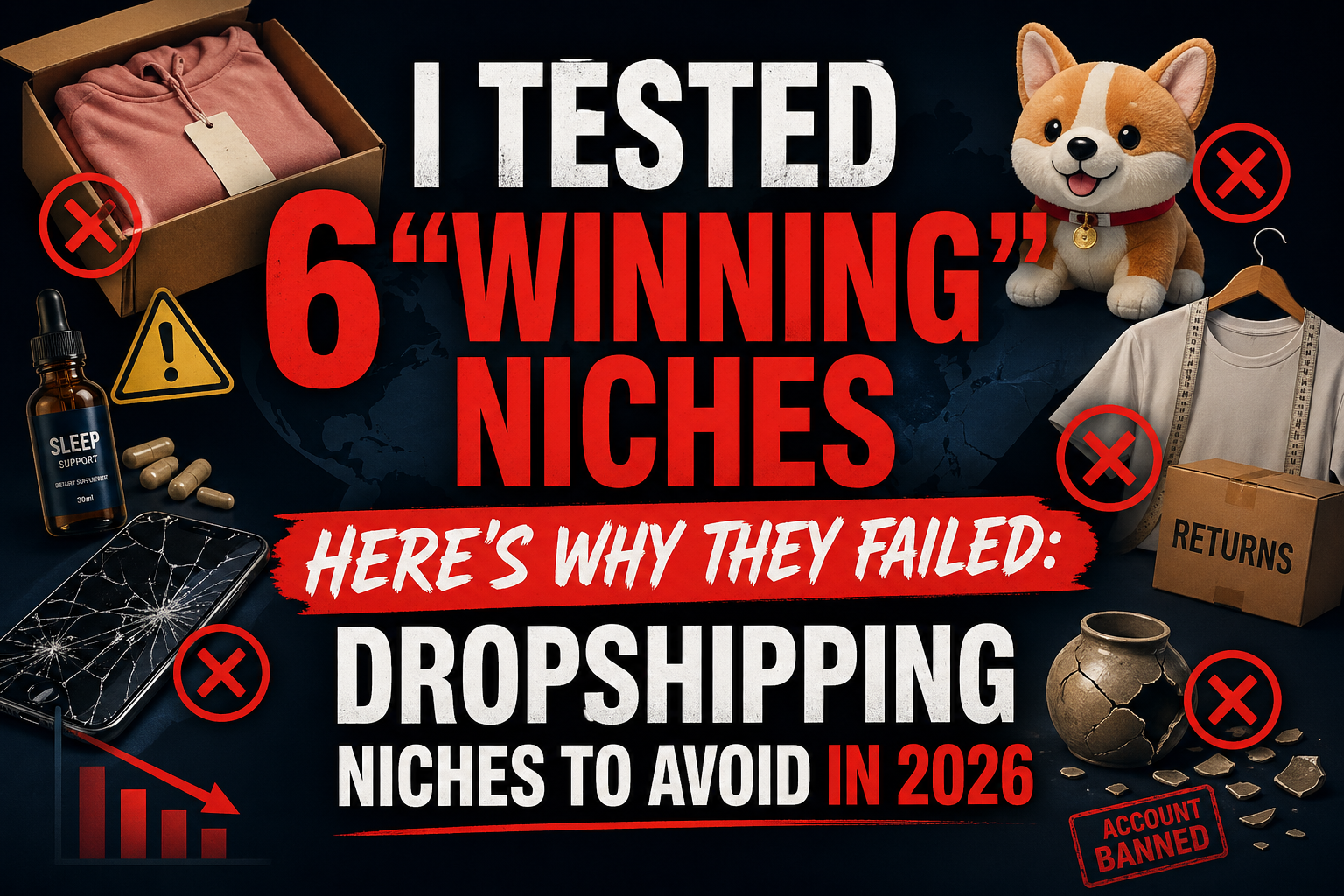
High Return Rate Products Are Killing Your Margins: Why This Is the #1 Dropshipping Niche to Avoid in 2026
The core problem with high return rate niches like clothing, shoes, and beauty products is that customer satisfaction is subjective and unpredictable. Unlike a gadget where functionality is clear, apparel depends on personal taste, body shape, and expectations shaped by photos.
In my case, I was sourcing from a supplier with standard Asian sizing. Even though I added a size chart, customers still ordered based on their usual habits. The mismatch led to a refund rate of nearly 25%.
At first, I tried to fix it by improving product descriptions and adding real photos. It helped slightly, but it didn’t solve the fundamental issue: I had no control over how the product would feel or fit once it arrived.
The Real Cost of a “Refund”
Most people underestimate what a refund actually costs in dropshipping. It’s not just giving money back.
In one specific order, I sold a dress for $39.99. The product cost me $12, and I spent around $15 on ads to acquire the customer. On paper, I had a small profit. But when the customer requested a refund, I couldn’t resell the item, and return shipping wasn’t practical. I ended up losing over $27 on that single order.
Now multiply that by dozens of similar cases.
What made it worse was the payment processor risk. As refund rates increased, my PayPal account started flagging transactions. Eventually, a portion of my funds was temporarily held. That was the moment I realized this wasn’t just a “bad niche”—it was structurally flawed for dropshipping.
Why High Return Niches Look Attractive at First
These niches often trick beginners because they perform well at the top of the funnel. Fashion products, for example, generate strong engagement. The visuals are appealing, and impulse buying is common. You’ll often see high add-to-cart rates and decent conversion early on.
But what you don’t see in most tutorials is what happens after the sale.
The business model breaks down in the post-purchase phase—refunds, disputes, negative reviews, and customer support overload. That’s where margins quietly disappear.
What I Do Differently Now
After that experience, I shifted toward products with objective value and low emotional expectation. Instead of selling something people “feel” about, I focus on products that solve a clear problem and perform consistently.
For example, I tested a simple car accessory product later on. It didn’t have the same viral appeal as clothing, but the refund rate stayed below 5%, and customer complaints were minimal. That stability allowed me to scale profitably without constantly worrying about chargebacks.
Copyright Traps in Dropshipping: Why IP-Based Products Are the Most Dangerous Niches to Avoid
I still remember the exact moment everything collapsed. I was running ads for a custom anime-style phone case. It wasn’t directly branded, but the design was clearly “inspired” by a popular character. Within three days, the product took off. My cost per purchase was under $12, and I scaled to nearly $5,000 in revenue in less than a week.
Then, without warning, my ad account was disabled.
At first, I assumed it was a mistake. But after checking the policy violation notice, it became clear: intellectual property infringement. Shortly after, my store was flagged, and I had to take down the product entirely. What looked like my first “winning product” turned into a complete shutdown of my ad pipeline.
Why IP-Based Niches Are a Hidden Time Bomb
Niches involving copyrighted or trademarked content—like anime merchandise, movie-themed products, or branded replicas—are incredibly tempting. They already have built-in demand, emotional attachment, and viral potential.
But that’s exactly what makes them dangerous.
You’re not building demand—you’re borrowing it from someone else’s intellectual property. And the moment your product gets attention, you also attract enforcement. Platforms like Facebook and TikTok don’t need you to explicitly use a logo. If your product visually resembles protected content, it can still trigger violations.
In my case, I didn’t even use the original character name in the ad copy. It didn’t matter. The visual similarity was enough.
The Scaling Paradox: Success Leads to Shutdown
What most beginners don’t realize is that the better your product performs, the faster it gets flagged.
When I started increasing my ad budget, my product reached a wider audience. That included not just potential customers, but also automated moderation systems and, potentially, rights holders. Within days of scaling, my entire ad account was under review.
I’ve seen this pattern repeat multiple times—not just with anime products, but also with:
- “Inspired” luxury fashion items
- Replica watches
- Pop culture-themed hoodies
At low scale, you might get away with it. At high scale, it becomes unsustainable.
The Financial Damage Goes Beyond Ads
Getting banned isn’t just an inconvenience—it directly impacts your cash flow.
After my ad account was disabled, I still had pending orders to fulfill. At the same time, I couldn’t generate new revenue because all my campaigns were stopped. Worse, my payment processor began reviewing my account due to the sudden disruption in business activity.
For about two weeks, I was stuck in limbo—fulfilling orders without being able to sell, while a portion of my funds remained inaccessible. That experience forced me to rethink my entire approach to product selection.
Why “Everyone Is Doing It” Is Misleading
One of the biggest traps in this niche is social proof. You’ll see countless stores selling similar products, which creates the illusion that it’s safe.
What you don’t see are the stores that disappeared.
From my own testing and conversations with other sellers, many of these stores operate in short cycles. They launch, scale quickly, get banned, and then restart under a new account. That’s not a stable business—it’s a constant reset.
If your goal is to build a long-term brand or a scalable system, this model works against you.
Oversaturated Dropshipping Niches: Why “Winning Products” From Gurus Stop Working
I used to believe that if a product was already working for others, it would work for me too. That assumption cost me both time and money.
One of the most frustrating tests I ran was a posture corrector. Every signal told me it was a winner. I saw multiple ads with thousands of likes, engagement was strong, and even competitors’ stores looked active. I launched quickly, copied a similar ad angle, and within 24 hours, my click-through rate was above 3%.
But conversions barely moved.
I spent around $300 testing that product, and only got a handful of sales. At first, I blamed my landing page. Then I tweaked creatives, tested different audiences, and even lowered the price. Nothing changed the outcome in a meaningful way.
That’s when I realized I wasn’t testing a “winning product”—I was entering an already exhausted market.
The Illusion of Demand in Oversaturated Niches
Oversaturated niches like pet accessories, LED lights, or viral posture products create a misleading signal. The demand is real, but it’s already been fully exploited.
When you see a product everywhere, it usually means three things:
- The early adopters already captured the most profitable traffic
- The audience has seen the same ad multiple times
- Price competition has driven margins down
In my case, I later checked ad libraries and realized that the same posture corrector had been aggressively scaled months before I even tested it. By the time I entered, the audience was fatigued.
People weren’t discovering the product anymore—they were ignoring it.
Why High Engagement Doesn’t Equal Profit
One of the biggest misconceptions I had was equating engagement with opportunity. If a product had thousands of likes and comments, I assumed it was still performing.
But engagement is often a lagging indicator.
I remember reading through comments on one of the ads I tried to replicate. Many users were tagging friends or asking questions, but others were saying things like “I’ve seen this everywhere” or “does this even work?” At the time, I ignored those signals. In hindsight, they were clear warnings.
When I launched my own ads, I saw similar behavior. People clicked, but they didn’t trust the product enough to buy. My cost per click was reasonable, but my cost per purchase was completely unworkable.
The Real Problem: Creative Fatigue at Scale
In oversaturated niches, the issue isn’t just competition—it’s creative exhaustion.
Even if you produce a slightly better ad, you’re still competing against dozens of similar creatives targeting the same audience. The platform algorithm has already categorized that product, and your ad is just another variation in a crowded pool.
I tested multiple angles for the same product—pain relief, posture improvement, before-and-after visuals. None of them broke through because the audience had already seen every version of that story.
This is where most tutorials fall short. They show you what worked, but not when it stopped working.
Why Beginners Keep Falling Into This Trap
The reason this niche category keeps attracting new sellers is simple: visibility.
Courses, YouTube videos, and TikTok content often highlight products that have already proven successful. But by the time that information becomes public, the profit window is usually closing or already closed.
I’ve personally tested products within days of seeing them trend, only to realize that dozens of other sellers were doing the exact same thing at the same time. It turns into a race to the bottom—lower prices, higher ad costs, and shrinking margins.
What I Focus on Now Instead
After multiple failed tests in oversaturated niches, I changed my approach. Instead of chasing “winning products,” I started looking for untapped angles within less obvious categories.
Instead of selling a generic pet toy, I tested a niche accessory designed for a very specific use case. It didn’t have massive engagement online, but the audience was more targeted, and the competition was significantly lower.
The result was a lower click-through rate compared to viral products, but a much higher conversion rate. More importantly, I was able to scale gradually without immediately hitting creative fatigue.
Low Ticket Dropshipping Is a Profit Trap: Why Cheap Products Are the Worst Niches to Avoid in 2026
I used to think volume was everything. If I could just sell more units, profit would follow. That belief led me straight into one of the most frustrating phases of my dropshipping journey.
I tested a simple gadget priced at $9.99. It was trending on short-form video platforms, and the engagement looked promising. Within a few days, I managed to generate consistent sales. At one point, I was hitting 20–30 orders per day.
On the surface, it looked like progress.
But when I sat down to calculate the numbers at the end of the week, I realized I wasn’t making money—I was slowly losing it.
Why Low AOV Niches Break the Economics
The core issue with low ticket products is brutally simple: your customer acquisition cost doesn’t scale down just because your price does.
In my case, the product cost me around $3, including shipping. That left me with roughly $7 in gross margin before ads. At first glance, it seemed workable.
But my average cost per purchase through ads was hovering between $12 and $15.
That meant every single sale was losing money.
I tried to optimize. I tested different creatives, adjusted targeting, and even experimented with bundling. But the fundamental math didn’t change. The ceiling for profitability was too low.
The Dangerous Illusion of “Cheap = Easy to Sell”
Low-priced products often convert easily because the purchase decision feels low-risk to the customer. That’s why beginners are drawn to them.
And to be fair, I did see decent conversion rates. People were willing to try a $9.99 product without much hesitation.
But that’s exactly the trap.
A high conversion rate doesn’t matter if your margins can’t support paid traffic. You end up in a situation where you’re generating revenue, but not actual profit. It’s a business that looks active but doesn’t sustain itself.
Scaling Makes the Problem Worse, Not Better
What surprised me the most was how scaling amplified the losses.
At one point, I increased my daily ad budget because the store was generating steady orders. I assumed that with more data, the algorithm would optimize and reduce my cost per purchase.
Instead, my total losses increased proportionally.
I remember one specific day where I made over $400 in revenue. It felt like a breakthrough—until I checked my ad spend, which was over $500. That single day wiped out the small gains I had from earlier tests.
It was a clear lesson: if the unit economics don’t work at a small scale, scaling will only accelerate the damage.
Why Upsells and Bundles Didn’t Save Me
A common strategy for low ticket products is to increase average order value through upsells and bundles. I tried that as well.
I added a “buy 2, get 1 free” offer and introduced a post-purchase upsell. It did increase my average order value slightly, from $9.99 to around $14.
But even with that improvement, it wasn’t enough to consistently cover ad costs. The conversion rate dropped slightly with higher pricing, and the overall profitability remained unstable.
The problem wasn’t the strategy—it was the starting point. The base product simply didn’t have enough margin to build on.
What I Do Differently Now
After that experience, I completely shifted my product selection criteria. I no longer consider products below a certain price threshold unless there’s a clear path to increasing value.
Now, I focus on products where:
- I can price above $25–$30
- There’s room for perceived value through branding or positioning
- The margin can comfortably absorb ad costs
One of my later tests involved a higher-ticket home accessory. It didn’t get as many impulse purchases, but each sale had enough margin to support paid traffic. That allowed me to optimize campaigns over time instead of constantly fighting against the math.
Logistics Nightmares in Dropshipping: Why Bulky and Fragile Products Are Niches to Avoid
At one point, I decided to move into what I thought was a “higher-value” niche: home decor. I found a modern glass table lamp that looked premium, had strong visual appeal, and could easily be marked up to $79.99.
Compared to the cheap gadgets I had tested before, this felt like a smarter move.
The first few sales came in quickly. Customers loved the design, and my ads performed decently. But within two weeks, everything started to fall apart—literally.
I began receiving emails from customers saying their lamp arrived cracked, shattered, or completely unusable. Some even sent photos of broken glass scattered inside the box. That’s when I realized I hadn’t chosen a product—I had chosen a logistics problem.
Why Complex Logistics Niches Fail Beyond the First Sale
Bulky, fragile, or oversized products introduce a layer of risk that most beginners underestimate. It’s not just about shipping costs—it’s about shipping reliability.
In my case, the supplier assured me the packaging was “safe.” But in reality, international shipping involves multiple handling points. Even a well-packed fragile item can break when it’s moved across warehouses, trucks, and last-mile delivery.
What made it worse was inconsistency. Some customers received the product in perfect condition, while others didn’t. That unpredictability made it impossible to control the customer experience.
The True Cost of One Damaged Delivery
I remember one specific order clearly. I sold the lamp for $79.99. The product and shipping cost me around $35, and I spent roughly $25 on ads to acquire the customer.
On paper, that left a decent margin.
But when the product arrived broken, the customer demanded a refund. Returning the item wasn’t practical due to high international shipping costs, so I had to issue a full refund and let them keep it.
That single order resulted in a loss of over $60.
Now imagine dealing with multiple cases like this every week. It doesn’t just hurt your profit—it destroys your confidence in scaling.
Delays: The Silent Conversion Killer
Even when the product didn’t break, shipping times became another major issue.
Because the item was bulky, it couldn’t be shipped through faster lines without significantly increasing costs. Delivery times often stretched to 10–20 days. Customers who paid a premium price expected faster service, and many started reaching out after just a week.
I spent hours responding to “Where is my order?” emails.
Some customers opened disputes before the product even arrived. Others requested refunds simply because the wait felt too long. This created a chain reaction—more support tickets, more stress, and more financial pressure.
Why These Niches Look Attractive at First
Bulky and fragile products often have strong visual appeal, which makes them perform well in ads. Aesthetic home decor, large furniture pieces, or unique glass items can easily capture attention.
That’s exactly why I was drawn to the lamp in the first place.
But the problem is that ad performance doesn’t reflect operational complexity. You can have a product that sells well on the front end but fails completely in fulfillment.
Most tutorials focus on finding products that “look good” or “go viral.” Very few talk about what happens after the purchase, especially when logistics get complicated.
After that experience, I became extremely selective about logistics. I now avoid products that are:
- Easily breakable
- Oversized or heavy
- Expensive to reship or replace
Instead, I prioritize items that are compact, durable, and easy to handle. One product I tested later was a small car accessory—lightweight, simple, and almost impossible to damage in transit.
The difference was immediate. Shipping was more reliable, customer complaints dropped significantly, and I was able to scale without constantly worrying about refunds due to damage.
Regulated Products in Dropshipping: Why Supplements and Health Niches Can Freeze Your Cash Flow
I once tested a niche that looked incredibly promising on paper: a herbal sleep aid supplement. The demand was obvious—people are always looking for better sleep, and the product had strong reviews from suppliers.
Within the first 10 days, I generated consistent sales. The conversion rate was solid, and customers seemed genuinely interested. Compared to other products I had tested, this one felt more “serious” and long-term.
Then, without warning, my payment processor flagged my account.
I received a notification saying my funds were temporarily held due to “risk review.” At that moment, I still had pending orders to fulfill, but I couldn’t access a significant portion of my revenue. That’s when I realized I had stepped into a regulated niche without fully understanding the consequences.
Why Regulated Niches Are Structurally Risky
Products related to health, supplements, or medical claims are not just another category—they operate under strict compliance rules.
The issue isn’t only about the product itself, but also how it’s marketed.
In my case, I used relatively mild claims like “supports better sleep” and “natural relaxation.” Even so, the combination of product type, ad copy, and customer behavior triggered a risk review. Payment processors like PayPal and Stripe monitor these niches closely because they are associated with higher dispute rates and regulatory scrutiny.
Once you’re flagged, it’s not a quick fix. Reviews can take weeks, sometimes longer.
The Chain Reaction You Don’t See Coming
What made this situation particularly stressful was the chain reaction it triggered.
I still had to pay my supplier for new orders. I still had to handle customer support. But a portion of my incoming cash was locked. That created a cash flow gap that I hadn’t planned for.
I remember calculating my situation one night and realizing that if the hold lasted another two weeks, I would struggle to keep fulfilling orders without injecting additional funds.
This isn’t something most beginners think about. They focus on revenue, not liquidity. But in regulated niches, cash flow stability becomes the real bottleneck.
Compliance Isn’t Just Legal—It’s Platform-Based
Another mistake I made was assuming that as long as the product itself wasn’t illegal, I was safe.
That’s not how platforms work.
Each layer—advertising platforms, payment processors, and even hosting providers—has its own policies. You might pass one layer and fail another. For example:
- An ad platform might allow your creatives initially
- But a payment processor might flag your transactions later
- Or a sudden spike in refunds could trigger further restrictions
In regulated niches, you’re constantly operating under multiple systems of approval. That adds a level of uncertainty that makes scaling difficult.
Why These Niches Still Attract Sellers
Despite the risks, regulated niches remain attractive because of their perceived stability and high margins.
Supplements, for example, can be priced significantly higher than generic products. The branding potential is also strong, which gives the impression of building a “real business.”
That’s exactly why I entered the niche.
But what I underestimated was the operational complexity behind the scenes. It’s not just about sourcing a product and running ads—you need compliance knowledge, proper documentation, and often local regulations depending on your target market.
Now, I focus on products that:
- Don’t require compliance approvals to sell
- Don’t rely on sensitive claims in advertising
- Have low risk of payment processor intervention
For example, I shifted toward functional lifestyle products that solve simple, visible problems. These products may not have the same perceived “authority” as health items, but they allow me to scale without worrying about sudden fund holds or account reviews.

No Comments