


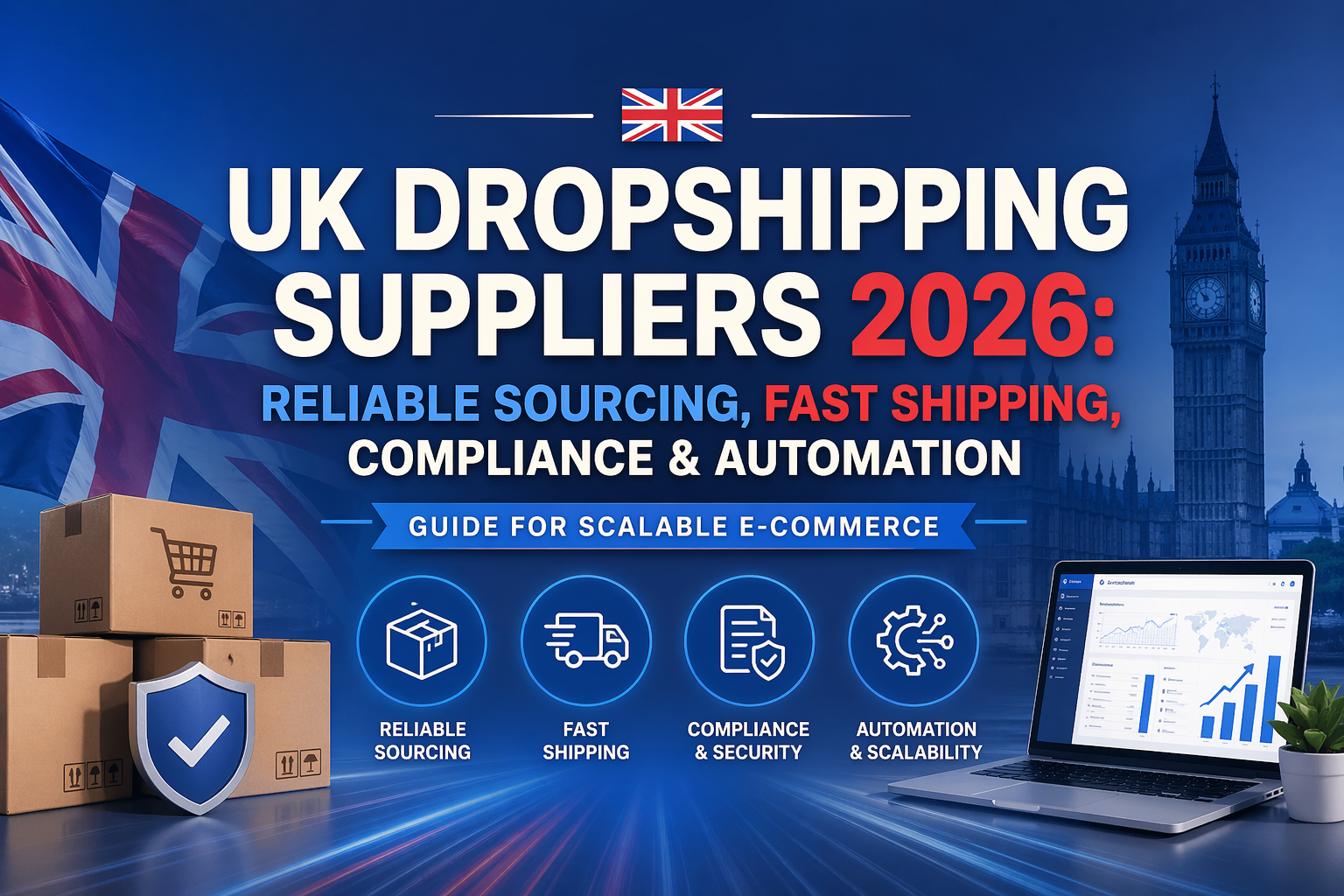
UK Dropshipping Suppliers 2026: Reliable Sourcing, Fast Shipping, Compliance & Automation Guide for Scalable E-commerce

Choosing a UK dropshipping supplier should never be based solely on convenience or initial pricing. The real impact of a supplier is reflected in delivery speed, customer satisfaction, refund rates, and ultimately, brand reputation.
In a mature e-commerce environment like the UK, where customer expectations are high and competition is intense, working with a reliable supplier is not optional—it is a core growth strategy. Sellers who prioritize infrastructure, transparency, and automation will consistently outperform those who rely on unstable or low-cost suppliers.
How to Find Reliable UK Dropshipping Suppliers
Finding a reliable UK dropshipping supplier is not just about choosing a company with a UK address. In 2026, reliability is defined by a combination of operational consistency, fulfillment speed, product quality control, and system integration. Many suppliers claim “UK-based,” but in reality operate as intermediaries shipping from overseas warehouses, which can extend delivery times to 7–15 days—far from the 2–4 day expectation of UK consumers.
A truly reliable UK dropshipping supplier should demonstrate local warehousing capability, stable inventory synchronization, and predictable dispatch times. From a performance standpoint, suppliers that consistently deliver within 48–72 hours can significantly improve conversion rates, often by 20% or more compared to slower fulfillment models.
Evaluating Supplier Infrastructure and Fulfillment Capability
One of the most overlooked factors when selecting a UK dropshipping supplier is backend infrastructure. Serious suppliers invest in warehouse management systems (WMS), real-time inventory tracking, and automated order routing. Without these systems, stock discrepancies and delayed shipments become inevitable as order volume scales.
For example, modern fulfillment-oriented platforms like ScaleOrder dropshipping integrate real-time inventory updates and automated restocking forecasts. This reduces the risk of overselling—a common issue that can damage store reputation and lead to refund rates exceeding 5–8%.
Additionally, suppliers with multiple warehouse nodes across the UK or Europe can dynamically route orders, improving delivery efficiency and reducing last-mile costs. This is especially important for stores targeting both UK and EU customers post-Brexit.
Product Quality Control and Return Handling
Reliability is also closely tied to product consistency. Many dropshipping businesses fail not because of marketing inefficiency, but due to high return rates caused by poor product quality. In the UK market, where consumer protection standards are strict, return rates above 10% can quickly erode margins.
A dependable UK dropshipping supplier should provide pre-shipment quality inspection, standardized packaging, and clear return policies. Ideally, they should also offer local return addresses, which can reduce return processing time from weeks to just a few days. This directly impacts customer satisfaction and repeat purchase rates.
Suppliers that support product customization or private labeling also tend to have more controlled production processes, which further enhances quality stability over time.
Pricing Transparency and Hidden Cost Structures
Another critical factor is pricing transparency. Some UK dropshipping suppliers advertise low product costs but include hidden fees in shipping, packaging, or handling. These hidden costs can reduce actual profit margins by 10–20% without being immediately obvious.
A reliable supplier provides clear, all-inclusive pricing and stable shipping rates. More importantly, they should allow margin forecasting at scale. For instance, integrating with systems like ScaleOrder enables sellers to predict total landed costs, including fulfillment and logistics, before scaling ad spend.
This level of cost clarity is essential for maintaining a healthy gross margin, particularly in competitive niches where pricing pressure is high.
Integration, Automation, and Scalability
In 2026, manual order processing is no longer viable for serious dropshipping businesses. The ability to integrate directly with platforms like Shopify or WooCommerce is a baseline requirement. Reliable UK dropshipping suppliers should support API-based automation, enabling seamless order syncing, tracking updates, and inventory management.
Automation not only reduces operational workload but also minimizes human error. Businesses that adopt automated fulfillment systems can handle 3–5 times more orders without increasing operational complexity.
This is where advanced solutions like ScaleOrder dropshipping stand out, offering a combination of supplier sourcing, automated fulfillment, and AI-driven inventory planning. Such systems are particularly valuable for sellers aiming to transition from testing products to building a scalable brand.
UK vs China Dropshipping Suppliers: Cost, Shipping Speed, and Profit Margins
When choosing between UK and China dropshipping suppliers, the decision ultimately comes down to balancing cost efficiency with market responsiveness. China-based suppliers have historically dominated the dropshipping ecosystem due to their significantly lower product costs, often 30–50% cheaper than equivalent UK-based sourcing. However, in 2026, the competitive landscape has shifted. Faster delivery expectations, stricter consumer protection laws, and rising ad costs mean that speed and reliability now directly influence profitability.
UK dropshipping suppliers, while more expensive on a per-unit basis, offer a localized advantage that can dramatically improve conversion rates. Customers in the UK increasingly expect delivery within 2–3 days. Any delay beyond this window can reduce purchase intent and increase cart abandonment rates by up to 25%, especially in impulse-driven niches.
Shipping Speed and Its Direct Impact on Conversion Rates
Shipping speed is no longer just an operational metric; it is a core marketing variable. With China-based suppliers, even optimized logistics lines typically deliver within 7–12 days. While this may still be acceptable for low-ticket items, it becomes a major limitation for scaling paid traffic campaigns.
In contrast, UK dropshipping suppliers with local warehouses can consistently achieve 24–72 hour delivery. This shorter delivery promise can be used as a strong selling point in product pages and ads, directly improving conversion rates. In many cases, stores that switch from overseas fulfillment to UK-based fulfillment report conversion improvements of 15–30%.
Hybrid solutions are also emerging. Platforms like ScaleOrder dropshipping combine China sourcing advantages with local UK or EU warehousing. This model allows sellers to maintain lower product costs while still offering fast delivery after inventory is pre-positioned. As a result, it bridges the traditional gap between cost and speed.
Total Cost Structure: Beyond Product Price
Focusing solely on product cost can be misleading. China suppliers may offer lower base prices, but additional costs such as international shipping, customs handling, and longer refund cycles can significantly impact overall profitability.
UK suppliers, on the other hand, typically provide all-in pricing structures with predictable shipping costs. While the upfront cost is higher, the total landed cost can be more stable and easier to scale. Additionally, faster delivery reduces refund and dispute rates, which can save 5–10% of revenue that would otherwise be lost to customer dissatisfaction.
Another hidden cost factor is cash flow. Longer shipping times from China delay revenue realization and increase the risk of chargebacks. Faster fulfillment from UK suppliers shortens the cash cycle, allowing reinvestment into ads and inventory at a quicker pace.
Customer Experience and Brand Perception
Customer perception plays a critical role in long-term business success. UK consumers tend to associate fast delivery and local fulfillment with higher trust and professionalism. This perception can lead to higher repeat purchase rates and stronger brand loyalty.
In contrast, long delivery times and inconsistent tracking updates—common with some China suppliers—can create friction in the customer journey. Even if the product quality is acceptable, the overall experience may reduce the likelihood of repeat business.
For sellers aiming to build a brand rather than run a short-term testing store, UK dropshipping suppliers provide a more stable foundation. The ability to offer reliable shipping and easy returns aligns more closely with the expectations of modern e-commerce customers.
Scalability: Which Model Wins in the Long Run?
From a scalability perspective, both models have strengths and limitations. China suppliers are ideal for product testing due to their low cost and flexibility. However, as order volume increases, operational inefficiencies and customer service challenges become more pronounced.
UK suppliers, while less flexible in pricing, offer a more scalable infrastructure. With proper integration and automation, they can support consistent growth without significant operational overhead.
This is where integrated solutions like ScaleOrder dropshipping become particularly relevant. By combining sourcing, warehousing, and automation, such systems allow sellers to start with low-cost product testing and transition into fast, local fulfillment as they scale. This phased approach minimizes risk while maximizing long-term profitability.
Best UK Dropshipping Suppliers for Fast Delivery and Local Warehousing: How to Win with Speed
In the UK e-commerce market, delivery speed is no longer a secondary factor—it is a primary driver of conversion and customer satisfaction. With the influence of platforms like Amazon setting next-day delivery expectations, consumers increasingly view 2–3 day shipping as the minimum standard rather than a premium feature.
For dropshipping businesses, this shift fundamentally changes supplier selection criteria. A UK dropshipping supplier is no longer judged only by product cost or catalog size, but by its ability to consistently deliver within a tight time window. Data across multiple e-commerce studies shows that reducing delivery time from 7 days to 2–3 days can improve conversion rates by 20% or more, while also reducing refund requests and customer complaints.
What Defines a “Fast” UK Dropshipping Supplier
Not all UK dropshipping suppliers are truly local in operational terms. Many suppliers market themselves as “UK-based” while relying on overseas fulfillment. The key distinction lies in warehousing and dispatch location.
A genuinely fast supplier should operate physical warehouses within the UK, maintain stocked inventory, and dispatch orders within 24 hours. More advanced suppliers also operate multiple warehouse nodes across the UK or Europe, enabling dynamic routing based on customer location. This reduces last-mile delivery time and improves reliability during peak seasons.
Platforms like ScaleOrder dropshipping take this a step further by integrating global sourcing with localized warehousing. Sellers can source products from China but pre-stock inventory in UK or EU warehouses, achieving both cost efficiency and fast delivery. This hybrid fulfillment model is increasingly becoming the standard for serious sellers.
Local Warehousing and Its Impact on Profit Margins
While local warehousing increases upfront costs, it significantly improves overall unit economics. Faster delivery reduces refund rates, which in many dropshipping businesses can account for 5–10% of lost revenue. Additionally, improved customer satisfaction leads to higher repeat purchase rates, which lowers customer acquisition costs over time.
Another critical advantage is the ability to justify higher pricing. Products shipped from UK warehouses can often be priced 10–20% higher than identical products shipped from overseas, simply because of the perceived value of fast delivery. This pricing flexibility directly contributes to higher gross margins.
Moreover, local warehousing reduces logistical uncertainty. Sellers can better predict delivery times, manage inventory levels, and scale advertising campaigns without the risk of fulfillment bottlenecks.
Supplier Types: Aggregators vs Integrated Fulfillment Systems
UK dropshipping suppliers generally fall into two categories: simple aggregators and integrated fulfillment systems.
Aggregators act as intermediaries, connecting sellers with multiple suppliers. While they offer product variety, they often lack control over inventory and shipping consistency. This can lead to variable delivery times and inconsistent customer experiences.
Integrated fulfillment systems, on the other hand, control sourcing, warehousing, and shipping within a unified infrastructure. ScaleOrder dropshipping is an example of this model, where real-time inventory management, automated order processing, and multi-warehouse distribution are combined into a single system. This reduces operational complexity and ensures consistent delivery performance.
For sellers focused on scaling, integrated systems provide a more stable foundation. They eliminate many of the manual processes that typically slow down operations and introduce errors.
Strategic Positioning: Speed as a Marketing Asset
Fast delivery should not be treated purely as an operational improvement—it is also a powerful marketing asset. Highlighting “2–3 Day UK Delivery” on product pages, ads, and checkout pages can significantly increase trust and conversion rates.
In competitive niches, where product differentiation is limited, delivery speed often becomes the deciding factor for customers. Stores that clearly communicate fast, reliable shipping can outperform competitors even when selling similar products at slightly higher prices.
This positioning is particularly effective when combined with strong branding and customer service. Together, these elements create a premium shopping experience that goes beyond price competition.
Private Label & Branding with UK Dropshipping Suppliers: How to Build a High-Margin E-commerce Brand
In the UK e-commerce landscape, dropshipping is no longer just a “low-barrier testing model.” It has evolved into a pathway toward brand building. The key transition point is private label—moving from selling generic products to selling branded, customized versions of those products.
UK dropshipping suppliers are particularly well-positioned for this shift because of their proximity to end customers, stronger packaging standards, and faster logistics. Unlike traditional overseas sourcing, UK-based or UK-fulfilled suppliers allow sellers to control the customer experience more tightly, which is essential for building brand trust.
In 2026, brands that rely solely on generic products face increasing competition and shrinking margins. Private label strategies help solve this by increasing perceived value and reducing direct price comparison pressure.
The Economics Behind Private Label Dropshipping
From a financial perspective, private label dropshipping improves profitability in two key ways: higher pricing power and improved customer retention.
Generic dropshipping products are easily comparable across marketplaces, which forces sellers into price competition. Private label products, however, create differentiation through branding, packaging, and perceived uniqueness. Even a simple branded packaging upgrade can justify a 15–30% price increase in many UK niches.
More importantly, branded products improve repeat purchase rates. Customers are more likely to reorder from a store they recognize than from an anonymous supplier listing. This reduces dependency on paid advertising over time and improves long-term customer lifetime value.
Platforms like ScaleOrder dropshipping support this transition by enabling product customization, packaging upgrades, and sourcing control while maintaining automated fulfillment. This makes it easier for sellers to evolve from testing products into building recognizable brands.
What UK Dropshipping Suppliers Offer for Branding
Not all suppliers are capable of supporting private label strategies. A strong UK dropshipping supplier for branding should offer at least three core capabilities: customization options, packaging control, and consistent quality assurance.
Customization can range from simple logo printing to full product modifications. Packaging plays an equally important role, especially in the UK market where unboxing experience strongly influences customer perception. Branded packaging inserts, thank-you cards, and eco-friendly materials are increasingly expected in mid-to-premium e-commerce segments.
Quality control is also critical. Unlike generic dropshipping, private label products must maintain consistency across batches. Any variation in quality can damage brand reputation quickly and permanently.
Building Brand Perception Through Fulfillment Experience
Branding is not just visual—it is experiential. The fulfillment process is a major part of how customers perceive a brand.
UK-based fulfillment significantly enhances this experience. Faster delivery times, localized tracking updates, and reliable return processes all contribute to a more professional brand image. When customers receive products quickly and without friction, they are more likely to associate the store with reliability and quality.
This is where integrated systems like ScaleOrder dropshipping become important. By combining sourcing, branding customization, and UK/EU fulfillment, they allow sellers to maintain a consistent brand experience across all customer touchpoints.
Scaling Private Label Without Increasing Operational Complexity
One of the biggest challenges in private label dropshipping is operational complexity. As customization increases, so does the difficulty of managing inventory, production timelines, and fulfillment coordination.
To solve this, successful sellers rely on automation and centralized supplier systems. Instead of working with multiple fragmented suppliers, they consolidate operations through integrated platforms that manage sourcing, branding, and logistics in one system.
This approach allows sellers to scale without significantly increasing manual workload. Orders can be processed automatically, inventory can be synced in real time, and branding elements can be standardized across products.
Strategic Insight: Branding Is a Margin Expansion Strategy
Private label dropshipping should not be viewed as a cosmetic upgrade—it is fundamentally a margin expansion strategy. By moving away from commodity products, sellers reduce direct price competition and gain control over positioning.
In the UK market, where consumer expectations are high and competition is intense, branding becomes one of the few sustainable ways to protect margins. It allows businesses to move from transactional selling to relationship-based commerce.
Sellers who adopt private label early can gradually transition from short-term product testing to long-term brand equity building. This shift is what separates temporary stores from scalable e-commerce businesses.
Legal & VAT Considerations When Working with UK Dropshipping Suppliers
In the UK e-commerce ecosystem, legal compliance is no longer just an administrative concern—it directly affects store stability, payment processing, and long-term scalability. As platforms like Shopify and payment providers tighten risk controls, non-compliant dropshipping operations face higher chances of account suspension, payment holds, or tax-related penalties.
When working with UK dropshipping suppliers, sellers often assume that “local sourcing” automatically guarantees compliance. In reality, compliance depends on how VAT is handled, how invoices are issued, and whether the supply chain is properly structured under UK tax regulations.
For serious sellers, understanding VAT and legal obligations is as important as product selection or advertising strategy.
VAT in UK Dropshipping Models
Value Added Tax (VAT) is one of the most important regulatory elements in UK e-commerce. In dropshipping, VAT obligations can become complex because the seller, supplier, and customer may be located in different jurisdictions.
If a seller is targeting UK customers, VAT may be required once revenue exceeds the registration threshold. However, even below this threshold, many suppliers already include VAT in product pricing, which affects margin calculations.
UK dropshipping suppliers that operate legally should provide proper VAT invoices and clearly separate product cost from tax components. Without this transparency, sellers risk miscalculating profit margins and facing unexpected tax liabilities later.
In more structured systems like ScaleOrder dropshipping, VAT-related documentation and cost breakdowns are integrated into the fulfillment workflow, allowing sellers to better understand real landed costs before scaling ad spend.
The Importance of Import Duties and Cross-Border Classification
Even when using UK dropshipping suppliers, some inventory may still originate from overseas. This introduces potential import duty considerations.
If goods are imported into the UK before being fulfilled domestically, responsibility for import VAT and customs duties must be clearly defined. In some cases, suppliers handle importation and include all costs in their pricing structure. In others, the seller may indirectly bear these costs without full visibility.
Misunderstanding this structure can lead to margin erosion or unexpected tax exposure. For example, a product that appears to have a 40% margin may drop to 20–25% once duties and hidden logistics fees are properly accounted for.
This is why transparent cost breakdowns and standardized supply chain processes are essential for sustainable dropshipping operations.
Legal Risks: Product Liability and Consumer Protection
The UK has strict consumer protection laws, particularly regarding product safety, misleading advertising, and return rights. Dropshipping businesses are legally considered the seller of record, meaning they are responsible for product compliance even if they do not physically handle the inventory.
This creates a critical risk area: product liability. If a product is defective or non-compliant with UK safety standards, the seller—not the supplier—is typically held responsible.
Reliable UK dropshipping suppliers should therefore provide product certifications where necessary, maintain consistent quality control, and ensure compliance with local regulations such as CE marking or UKCA requirements (where applicable).
Failure to manage these risks can result in chargebacks, legal disputes, or platform enforcement actions.
VAT Registration Strategy for Scaling Businesses
For growing dropshipping stores, VAT registration is often a necessary step rather than an optional one. Once a business reaches the threshold, registration becomes mandatory, but many sellers choose to register earlier to improve credibility and simplify accounting.
VAT registration also allows businesses to reclaim input tax on eligible expenses, which can improve overall cash flow efficiency.
However, VAT compliance introduces additional operational complexity. Sellers must ensure accurate invoicing, consistent record keeping, and correct tax filing schedules. This is where automation becomes valuable.
Platforms like ScaleOrder dropshipping help streamline financial visibility by integrating order data, supplier costs, and fulfillment records into a unified dashboard. This reduces manual accounting errors and helps sellers maintain compliance while scaling.
Platform Risk: Why Compliance Affects Store Stability
Legal compliance is closely tied to platform stability. Marketplaces and payment processors increasingly monitor seller behavior for tax inconsistencies or policy violations.
Even if sales are strong, lack of proper VAT handling or unclear supply chain documentation can trigger account reviews or payment restrictions.
This is particularly important for sellers using paid traffic channels. Advertising platforms prioritize stable businesses with low refund and chargeback rates. Compliance issues indirectly affect ad account performance by increasing perceived risk.
Strategic Insight: Compliance Is a Growth Enabler, Not a Limitation
Many beginners view legal and VAT requirements as obstacles. In reality, compliance is a prerequisite for scaling.
Proper tax structure, clear supplier documentation, and legally compliant fulfillment processes create stability. This stability allows sellers to reinvest profits confidently into advertising, inventory, and brand development.
Businesses that ignore compliance often remain stuck in small-scale testing cycles. In contrast, compliant operations can scale to higher revenue levels without fear of sudden disruption.
How to Automate Your Business with UK Dropshipping Suppliers
In 2026, the biggest limitation in e-commerce is no longer product sourcing—it is operational scalability. Many stores can find winning products, but fail to scale because order handling, supplier communication, and inventory updates become too complex.
When working with UK dropshipping suppliers, automation becomes even more critical. While local fulfillment improves delivery speed, it also increases order volume expectations and customer service demands. Without automation, businesses quickly hit a ceiling where growth creates operational chaos instead of profit.
Automation is therefore not just a productivity upgrade—it is a structural requirement for scaling.
The Core Components of a Fully Automated Dropshipping System
A fully automated UK dropshipping system typically consists of four interconnected layers: product sourcing, order processing, inventory synchronization, and customer communication.
Product sourcing automation allows sellers to continuously test and import products without manual supplier negotiation for every item. Order processing automation ensures that once a customer places an order, it is instantly forwarded to the correct supplier or warehouse without human intervention.
Inventory synchronization is especially important when working with UK dropshipping suppliers that operate physical warehouses. Without real-time stock updates, sellers risk overselling products, which leads to refunds and customer dissatisfaction.
Customer communication automation includes tracking updates, delivery notifications, and post-purchase messaging. These touchpoints significantly influence customer satisfaction and repeat purchase rates.
Why UK Dropshipping Suppliers Are Ideal for Automation
Compared to cross-border models, UK dropshipping suppliers are structurally easier to automate because of shorter logistics chains and more stable delivery timelines.
Domestic shipping reduces variability in tracking updates, making it easier to integrate consistent notification systems. It also reduces exceptions such as customs delays, which often require manual intervention in international supply chains.
When suppliers operate within the UK or EU warehouse networks, order routing can be automated based on inventory location, ensuring the fastest possible delivery path without manual decision-making.
This stability is one of the reasons many advanced sellers transition from overseas sourcing to hybrid or localized fulfillment systems as they scale.
The Role of Integrated Platforms in Scaling Automation
Basic automation tools can handle order forwarding, but they often fail when businesses scale beyond a few hundred orders per day. This is where integrated systems become necessary.
Platforms like ScaleOrder dropshipping combine supplier sourcing, inventory management, and fulfillment automation into a unified infrastructure. Instead of relying on separate apps for each function, sellers operate through a centralized system where data flows automatically across all stages.
For example, when a product is sold, the system can instantly:
- Deduct inventory from the correct UK warehouse
- Route the order to the nearest fulfillment center
- Generate tracking information automatically
- Sync updates back to the storefront in real time
This eliminates manual coordination and reduces error rates significantly.
Automation and Advertising Efficiency
One of the most overlooked benefits of automation is its impact on advertising performance. When fulfillment is automated and reliable, sellers can confidently scale paid traffic without fear of operational bottlenecks.
Inconsistent fulfillment creates delayed shipping, stockouts, and refund spikes—all of which negatively affect ad account performance on platforms like Meta. Automated systems stabilize delivery performance, which in turn improves conversion rates and reduces customer complaints.
This creates a feedback loop: better fulfillment data leads to better ad optimization, which drives higher ROAS and more predictable scaling.
Reducing Human Dependency in Daily Operations
Traditional dropshipping stores often rely heavily on manual labor for tasks like order forwarding, supplier communication, and tracking updates. This model does not scale efficiently.
Automation reduces dependency on human intervention by replacing repetitive tasks with system-driven workflows. Instead of managing dozens or hundreds of daily orders manually, sellers only need to monitor exceptions—such as out-of-stock items or address issues.
This shift allows business owners to focus on higher-value activities such as product research, marketing optimization, and brand development.
Strategic Insight: Automation Is a Profit Multiplier, Not Just a Time Saver
Many beginners view automation as a convenience tool. In reality, it directly impacts profitability.
Automated systems reduce operational costs, minimize errors, and improve customer experience. Each of these factors contributes to higher net margins and stronger long-term retention.
More importantly, automation enables scale without proportional cost increases. This is the key difference between a small dropshipping store and a sustainable e-commerce brand.




No Comments