


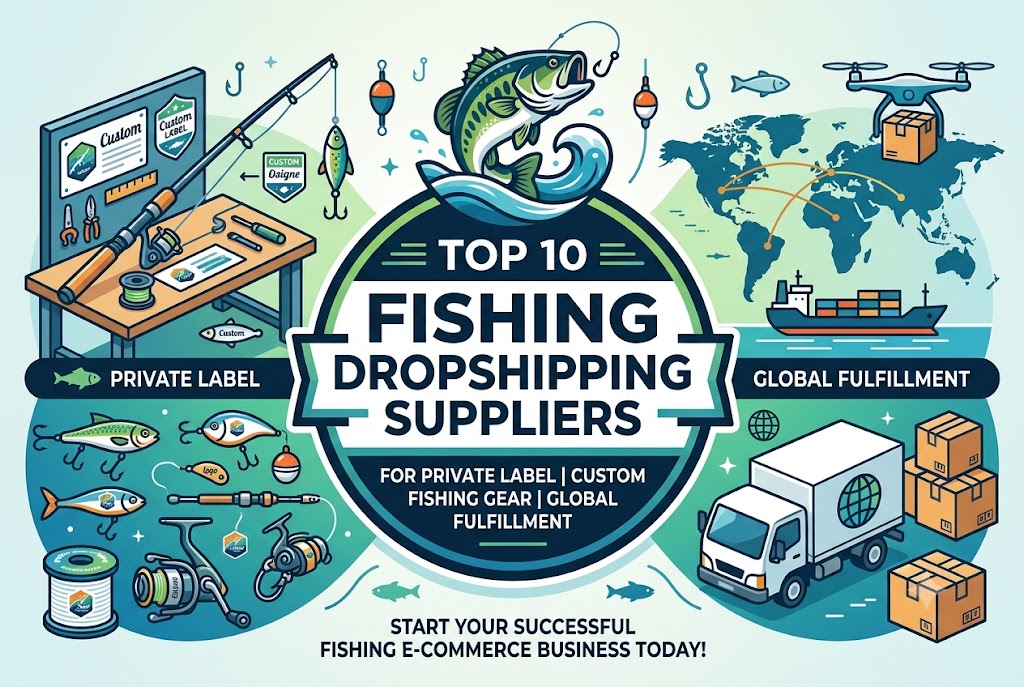
Top 10 Fishing Dropshipping Suppliers for Private Label, Custom Fishing Gear, and Global Fulfillment

The global fishing market offers an unusually broad range of opportunities for ecommerce entrepreneurs. Fishing lures, rods, reels, hooks, lines, tackle boxes, fishing tools, apparel, marine accessories, and specialized equipment can all support profitable online stores, but competing with generic fishing products on price alone is becoming increasingly difficult. For this reason, choosing the right fishing dropshipping supplier is no longer simply about finding the cheapest product or the fastest delivery option. Entrepreneurs who want to build a sustainable fishing brand should pay much closer attention to sourcing flexibility, private labeling, product customization, quality control, packaging, minimum order quantities, and international fulfillment.
The suppliers below have therefore been evaluated from a broader business perspective. Some are dedicated fishing wholesalers, some are manufacturers, some specialize in fishing components, and others provide sourcing and fulfillment infrastructure. This distinction matters because the best supplier for testing individual fishing products is not necessarily the best partner for creating a private-label fishing brand. For global sellers, the ideal supply chain may ultimately combine product sourcing, customization, quality inspection, branded packaging, inventory management, and international shipping.
1. ScaleOrder Dropshipping
ScaleOrder is one of the strongest options for entrepreneurs who want to build a private-label fishing business rather than simply resell standardized tackle. Its model is different from a traditional fishing wholesaler because it combines product sourcing, fulfillment, branding, custom packaging, warehousing, and international shipping. This makes it particularly suitable for sellers who identify a promising fishing product but do not want to manage relationships with several separate Chinese factories themselves.
For fishing stores, the sourcing model can be applied to products such as artificial lures, soft baits, fishing hooks, fishing pliers, tackle boxes, rod accessories, fishing tools, outdoor accessories, and other specialized products. Instead of being restricted to one fixed catalog, merchants can request products from Chinese manufacturers and evaluate different suppliers based on price, quality, customization capability, and production requirements. ScaleOrder also promotes branded packaging, including company logos and customized packaging materials, which is important for transforming a generic fishing product into a recognizable ecommerce brand.
Pros: The biggest advantages are sourcing flexibility, private labeling, custom packaging, quality-control coordination, warehousing, automated fulfillment, and international shipping. ScaleOrder states that it works with major Chinese carriers and supports fulfillment to markets including the United States, United Kingdom, Canada, Europe, and South America.
Cons: Shipping performance is product- and destination-dependent rather than fixed for every fishing SKU. Merchants also need to sample products before committing to a large private-label run.
Popular products: fishing lures, soft baits, hooks, tackle organizers, fishing tools, accessories, rods, reels, and customized fishing products.
Shipping speed: ScaleOrder focuses on fast global fulfillment and states that it can drop ship most product types worldwide. Its first three months of warehousing and distribution are advertised as free, although actual delivery times depend on product availability, destination, and shipping method.
For sellers whose long-term objective is to develop a recognizable fishing brand, ScaleOrder is particularly compelling because sourcing, customization, packaging, and fulfillment can be coordinated within one supply-chain relationship.
2. SFVU Wholesale Fishing Tackle Distribution
SFVU is a more traditional fishing-industry supplier and is therefore particularly interesting for merchants who want access to a genuine fishing-specific wholesale catalog. Rather than attempting to serve every ecommerce category, SFVU focuses heavily on fishing tackle and works with fishing dealers, guides, outfitters, camps, and related businesses.
Its assortment covers both freshwater and saltwater fishing and includes hard lures, soft plastics, fishing lines, hooks, terminal tackle, and other equipment. The supplier carries recognized fishing brands, including products from companies such as Yamamoto, Z-Man, LiveTarget, Sunline, Seaguar, and Mustad. This makes SFVU more relevant to merchants who want to sell products with established fishing-industry recognition rather than anonymous generic products.
Pros: The key advantage is specialization. SFVU understands fishing tackle, provides access to established brands, covers multiple fishing techniques, and offers worldwide shipping. It also advertises dropshipping availability, making it one of the more relevant specialist suppliers for online fishing businesses.
Cons: SFVU is fundamentally a wholesale/dealer business rather than a beginner-oriented dropshipping application. Account requirements, brand restrictions, and wholesale terms should therefore be confirmed before launching a store.
Popular products: hard baits, soft plastics, fishing line, hooks, terminal tackle, and species-specific fishing accessories.
Shipping speed: SFVU states that orders generally ship within 24–48 business hours and that it offers worldwide shipping.
For private-label ambitions, SFVU is less flexible than a factory-direct sourcing partner because much of its assortment consists of established brands. However, it can be valuable during the product-validation stage when merchants want to understand which categories and brands already have strong demand.
3. FishUSA Wholesale
FishUSA Wholesale is one of the more established choices for merchants targeting North American anglers. The company has more than 30 years of industry experience and operates a dedicated wholesale program for tackle shops, guides, outfitters, and other fishing businesses. Its catalog covers multiple fishing techniques and includes established brands such as Okuma, Yamamoto Baits, Shakespeare, Northland Fishing Tackle, and Daiwa.
The main advantage of FishUSA is not private-label manufacturing but access to a professionally established fishing supply chain. This can be valuable for sellers who want to understand the commercial positioning of proven products before developing their own versions. A merchant could, for example, study the demand for a particular style of bass lure, trout lure, reel, or fishing accessory and then use a manufacturer for a customized alternative.
Pros: strong industry experience, recognizable fishing brands, broad species coverage, online wholesale ordering, EDI integration, and no stated minimum wholesale order requirement. FishUSA also provides free shipping on wholesale orders above $600.
Cons: FishUSA has stricter resale requirements than a typical dropshipping supplier. Its wholesale terms state that products cannot be sold online or through electronic media without prior written authorization. This makes it unsuitable for merchants who assume they can automatically list every wholesale product on an ecommerce website.
Popular products: fishing rods, reels, artificial lures, hooks, lines, terminal tackle, and fishing accessories.
Shipping speed: wholesale orders have a stated flat shipping rate, while orders over $600 qualify for free shipping. The company is primarily designed around established wholesale relationships rather than international one-by-one fulfillment.
FishUSA is therefore best considered a commercial fishing wholesale partner and market benchmark, rather than a turnkey private-label dropshipping service.
4. CWR Wholesale Distribution
CWR Wholesale Distribution occupies an interesting position because it combines fishing and marine products with a genuine dropshipping infrastructure. Instead of focusing exclusively on tackle, CWR works with more than 300 manufacturers and supplies a much broader range of marine, boating, sporting-goods, and outdoor products.
This can be particularly useful for a fishing ecommerce store that wants to expand beyond lures and tackle. A store could begin with fishing accessories and gradually add marine electronics, boat accessories, trolling equipment, rod holders, and related outdoor products without completely changing its supply chain.
Pros: CWR offers no minimum order, wholesale pricing, worldwide dropshipping, integrations, and same-day shipping on orders placed before its stated cutoff. The company also allows dealers to use their own UPS or FedEx accounts, giving larger merchants additional control over logistics.
Cons: Fishing is only one part of CWR’s broader product ecosystem. Merchants looking for highly specialized fishing products or custom lure manufacturing may find a dedicated fishing factory more suitable.
Popular products: fishing equipment, trolling accessories, rod holders, marine electronics, boat accessories, fishing tools, and sporting goods.
Shipping speed: CWR advertises same-day shipping for qualifying orders placed before 4 p.m. and offers flat-rate shipping starting at $9.95.
For private-label sellers, CWR is not as customization-oriented as a factory-direct sourcing partner. Its strength lies instead in fast fulfillment and broad product availability, making it a useful complement to a custom-product supply chain.
5. Alibaba Fishing Tackle Manufacturers
Alibaba is particularly important for entrepreneurs who want to move from traditional dropshipping toward genuine private-label fishing products. The platform currently lists a very large selection of fishing tackle manufacturers and factories, covering lures, hooks, rods, reels, lines, tackle boxes, fishing tools, and other categories.
The major difference between sourcing through manufacturers and using a conventional dropshipping marketplace is the degree of control available. Merchants can negotiate logo printing, packaging, materials, colors, product dimensions, graphics, and even new product designs. Current supplier listings show manufacturers offering customization options such as logos, packaging, labels, materials, colors, and graphics.
Pros: enormous supplier selection, factory-direct pricing, private-label capability, OEM/ODM opportunities, product customization, and access to specialized fishing manufacturing clusters.
Cons: Alibaba is not itself a one-click dropshipping fulfillment service. Supplier verification, sample testing, quality inspection, production management, MOQ negotiation, and logistics require more work. Delivery times can also increase substantially when new molds or custom designs are involved.
Popular products: soft lures, hard baits, metal jigs, fishing rods, reels, hooks, fishing lines, tackle boxes, fishing pliers, and customized fishing accessories.
Shipping speed: standard ready-made products can generally be sourced faster than customized products. Alibaba’s current industry guidance indicates that private-label fishing products commonly require higher MOQs than standard products, while completely custom products can require additional tooling and production time.
For entrepreneurs focused on private label fishing dropshipping, Alibaba is less about instant fulfillment and more about establishing a direct factory relationship that can eventually produce a proprietary product line.
6. Piscifun
Piscifun is a fishing-focused brand with a substantial range of rods, reels, fishing tools, and specialized equipment. Unlike generic suppliers, Piscifun has built its own fishing product identity, which can make it interesting for retailers who want to sell branded fishing equipment.
The company operates a wholesale program featuring products such as spinning reels, baitcasting reels, fishing rods, ice-fishing reels, offshore rods, fishing tools, and other equipment. It also explicitly provides contact channels for wholesale and business customers.
Pros: strong fishing specialization, branded products, extensive reel and rod selection, multiple fishing applications, wholesale availability, and an established product portfolio. Piscifun also provides dealer information for businesses in North, Central, and South America, including ecommerce businesses.
Cons: this is primarily a branded wholesale/dealer relationship rather than a private-label manufacturing solution. Merchants cannot assume that Piscifun products can simply be relabeled under their own brand. Dealer approval and resale conditions need to be discussed directly with the company.
Popular products: spinning reels, baitcasting reels, ice-fishing reels, offshore rods, freshwater rods, fishing tools, and fishing line accessories.
Shipping speed: Piscifun currently advertises fast delivery of around 3–5 working days on its wholesale product pages, although availability and destination can affect actual delivery.
Piscifun is therefore more suitable for stores that want recognized fishing equipment and wholesale products, while a dedicated manufacturer or sourcing company is preferable for merchants whose priority is creating their own brand.
7. The Worth Company
The Worth Company is a fundamentally different type of supplier and is particularly interesting for entrepreneurs who want to develop proprietary fishing lures. Rather than concentrating on finished rods and reels, Worth specializes in fishing lure components and precision metal parts.
Its product range includes spinner blades, buzzer blades, clevises, lure bodies, split rings, swivels, wire shafts, spoons, beads, and other components. Worth states that it is an ISO 9001:2015 certified manufacturer and produces fishing tackle components in the United States.
This makes the company particularly relevant to a private-label strategy. Instead of purchasing an identical finished lure that hundreds of stores can sell, a brand could combine different components, colors, finishes, hooks, packaging, and lure configurations to develop a more differentiated product.
Pros: American manufacturing, precision components, ISO 9001:2015 certification, custom component manufacturing, assembly services, packaging capabilities, and deep fishing-industry expertise.
Cons: Worth is not a traditional one-unit dropshipping supplier. Its model is much better suited to manufacturers, tackle brands, and businesses purchasing components in bulk.
Popular products: spinner blades, lure bodies, split rings, swivels, spoons, clevises, wire shafts, beads, and fishing lure components.
Shipping speed: U.S. production can be advantageous for North American businesses, but lead times depend on the component, customization requirements, and production quantity.
Worth is an excellent example of why the concept of a fishing dropshipping supplier should not be limited to ready-made products. For a serious fishing brand, control over components can create a much stronger competitive advantage than simply finding another generic lure supplier.
8. Jann’s Netcraft
Jann’s Netcraft is another specialist supplier worth considering for fishing businesses that want to develop their own products. Serving fishermen since 1941, the company carries thousands of fishing components, tools, materials, and accessories and has become particularly well known among lure makers, rod builders, fly tiers, and other fishing hobbyists and businesses.
Its product selection includes spinner blades, buzz blades, spoons, wire tools, lure bodies, crankbait hardware, terminal tackle, rod blanks, rod guides, reel seats, hooks, fly-tying materials, and other fishing components.
Pros: deep fishing specialization, extremely broad component selection, access to hard-to-find parts, rod-building supplies, lure-making materials, and products suitable for developing custom fishing products.
Cons: Jann’s Netcraft explicitly states that it does not offer a wholesale program. This means it should not be treated as a conventional B2B dropshipping supplier. It is better suited to product development, prototyping, small-batch purchasing, and sourcing components.
Popular products: lure bodies, spinner blades, hooks, wire components, fishing molds, rod-building supplies, fly-tying materials, and terminal tackle.
Shipping speed: the company offers normal ecommerce fulfillment and provides free shipping on qualifying orders, but it does not operate like a dedicated international dropshipping fulfillment center.
For entrepreneurs developing a distinctive fishing product, Jann’s Netcraft can be useful during the prototype and product-development stage, particularly when standard catalog products are not differentiated enough.
9. WH Fishing Lure
WH Fishing Lure is a more direct match for entrepreneurs looking specifically for a fishing-lure manufacturer. Based in Weihai, a major Chinese fishing-tackle manufacturing region, the company focuses on hard baits, soft plastics, jigs, minnows, stickbaits, VIB lures, and related fishing products.
The supplier explicitly promotes OEM and ODM customization, factory-direct sourcing, low-MOQ options, and worldwide shipping.
This model is particularly suitable for merchants who have already identified a product concept and want to transform it into a branded fishing lure. Rather than choosing a finished product and competing against other stores selling the same SKU, merchants can potentially customize colors, packaging, branding, lure specifications, and other details.
Pros: fishing-specific manufacturing, OEM/ODM capability, factory-direct sourcing, low-MOQ positioning, specialized lure expertise, and global shipping.
Cons: the product range is narrower than a full-service fishing supplier. Merchants looking for rods, reels, tackle boxes, apparel, and marine accessories will need additional suppliers.
Popular products: hard lures, soft plastics, minnows, stickbaits, VIBs, metal jigs, and other artificial fishing lures.
Shipping speed: the company promotes reliable global shipping, but actual delivery depends on whether the selected product is in stock or requires customized production.
For a private-label fishing brand, WH Fishing Lure can be particularly attractive because it operates much closer to the manufacturing end of the supply chain. It is therefore more suitable for developing a branded lure collection than for simply testing hundreds of unrelated fishing products.
10. Alibaba China Fishing Tackle Manufacturers and OEM Factories
A second Alibaba-based entry is useful because the platform should not be viewed as one single supplier. Its Chinese fishing-manufacturer ecosystem includes many specialized factories, and merchants can select suppliers based on the exact type of fishing product they want to develop.
Current manufacturer listings show suppliers specializing in fishing lures, fishing tools, fishhooks, fishing reels, tackle boxes, rods, and related products. Some suppliers also advertise full customization, ODM services, packaging, labels, graphics, materials, colors, sizes, and other specifications.
Pros: broad factory network, low-MOQ opportunities for some standard products, OEM/ODM manufacturing, custom logos, packaging customization, and access to specialized fishing production clusters in China.
Cons: supplier quality is not uniform. Merchants must independently evaluate factories, request samples, confirm production specifications, check quality-control processes, and establish clear shipping arrangements. Customization also normally increases MOQ and production lead time.
Popular products: fishing lures, hooks, reels, rods, tackle boxes, fishing tools, soft baits, metal jigs, fishing lines, and customized fishing accessories.
Shipping speed: ready-made products can move relatively quickly, while custom fishing products require additional production time. Current Alibaba sourcing guidance indicates that standard fishing products may have MOQs in the tens or hundreds, while private-label and fully customized products can require substantially larger quantities.
This option is best suited to businesses that have moved beyond product testing and are ready to build a long-term factory relationship and proprietary fishing product line.
How to Choose a Fishing Dropshipping Supplier for Private Label
The most important decision is not whether a supplier offers dropshipping, but how much control the supplier gives you over the product and customer experience.
For an early-stage store, the priority should normally be flexible sourcing and low-risk testing. At this stage, ordering individual products through a fulfillment partner can be more efficient than committing to large production quantities. Once a particular lure, fishing tool, or tackle accessory generates consistent sales, the sourcing strategy can gradually change.
Private labeling becomes more attractive after a product has demonstrated demand. Instead of continuing to sell an identical generic product, merchants can negotiate branded packaging, logo printing, custom colors, product bundles, upgraded materials, or even small design modifications.
This transition can create a meaningful difference in economics. Generic fishing products are easy for competitors to compare, which puts pressure on pricing. A branded product is more difficult to compare directly because the customer is evaluating the entire product experience rather than only the basic specifications.
MOQ should also be evaluated carefully. Current fishing-industry sourcing guidance indicates that standard products can sometimes be sourced at relatively low quantities, while private-label and custom-designed products normally require higher MOQs because suppliers need to recover setup, packaging, tooling, and production costs.
For this reason, a sensible progression is:
Test → Validate → Customize → Private Label → Scale
This approach minimizes inventory risk while allowing successful products to evolve into proprietary fishing products.
Why China Sourcing Is Particularly Important for Fishing Products
China remains strategically important for fishing ecommerce because the country has a large manufacturing ecosystem covering artificial lures, hooks, fishing rods, reels, soft plastics, metal components, fishing accessories, and packaging.
For merchants selling globally, the advantage is not simply lower product costs. The bigger advantage is manufacturing flexibility. A fishing brand can potentially source a basic lure, modify its color and weight, create custom packaging, combine it with branded hooks, and eventually develop an exclusive version.
This is considerably more difficult when relying exclusively on traditional branded wholesalers.
However, factory-direct sourcing also creates additional responsibilities. Merchants should inspect samples, verify materials, test hooks and hardware, examine lure finishes, check packaging quality, confirm product dimensions, and test actual shipping performance before placing large orders.
A low factory price is meaningless if the product generates high refund rates or poor customer reviews.
Shipping Considerations for Global Fishing Dropshipping
Fishing products create several unusual logistics challenges. Small products such as hooks, soft plastics, swivels, lures, and fishing tools are relatively easy to ship internationally. Rods, large tackle boxes, landing nets, and certain marine products are more difficult because their dimensions can significantly increase transportation costs.
This means merchants should not judge suppliers purely by their advertised shipping speed.
For a global fishing store, a better strategy is to divide products into different fulfillment categories. Lightweight products can remain suitable for direct international fulfillment. High-volume bestsellers can eventually be stocked in regional warehouses. Large or expensive fishing products may justify a different shipping strategy altogether.
A supplier that can coordinate sourcing, warehousing, packaging, and multiple shipping methods therefore becomes more valuable as the business grows.
Private Label Fishing Products With the Highest Branding Potential
Not every fishing product deserves private-label investment. Commodity items with extremely low prices may not generate enough margin to justify custom production.
Artificial lures are usually more interesting because color, shape, action, weight, hooks, packaging, and target species can all be differentiated. Soft plastics can also provide opportunities for custom colors, scents, shapes, sizes, and branded packaging.
Fishing tools and accessories offer another attractive category because they can be bundled into branded kits. A fishing pliers set, lure organizer, knot-tying kit, or multi-tool can become more commercially distinctive when combined with custom packaging and educational content.
Fishing apparel is another possibility because branding is visible throughout the customer experience. However, apparel introduces sizing, returns, and inventory complexity that should be considered before expanding too aggressively.
The strongest private-label opportunity is therefore not necessarily the product with the highest retail price. It is the product where manufacturing flexibility, perceived value, shipping economics, and differentiation work together.
Fishing Dropshipping Suppliers Comparison
| Supplier | Fishing Specialization | Private Label | Sourcing Flexibility | Dropshipping / Fulfillment | Global Shipping | Customization | Overall |
|---|---|---|---|---|---|---|---|
| ScaleOrder | ⭐⭐⭐⭐⭐ | ⭐⭐⭐⭐⭐ | ⭐⭐⭐⭐⭐ | ⭐⭐⭐⭐⭐ | ⭐⭐⭐⭐⭐ | ⭐⭐⭐⭐⭐ | 4.9/5 |
| SFVU | ⭐⭐⭐⭐⭐ | ⭐⭐⭐ | ⭐⭐⭐⭐ | ⭐⭐⭐⭐ | ⭐⭐⭐⭐⭐ | ⭐⭐⭐ | 4.7/5 |
| FishUSA Wholesale | ⭐⭐⭐⭐⭐ | ⭐⭐ | ⭐⭐⭐ | ⭐⭐⭐ | ⭐⭐⭐⭐ | ⭐⭐ | 4.5/5 |
| CWR Wholesale Distribution | ⭐⭐⭐⭐ | ⭐⭐ | ⭐⭐⭐⭐ | ⭐⭐⭐⭐⭐ | ⭐⭐⭐⭐⭐ | ⭐⭐⭐ | 4.5/5 |
| Alibaba Fishing Manufacturers | ⭐⭐⭐⭐⭐ | ⭐⭐⭐⭐⭐ | ⭐⭐⭐⭐⭐ | ⭐⭐⭐ | ⭐⭐⭐⭐ | ⭐⭐⭐⭐⭐ | 4.7/5 |
| Piscifun | ⭐⭐⭐⭐⭐ | ⭐⭐ | ⭐⭐⭐ | ⭐⭐⭐ | ⭐⭐⭐⭐ | ⭐⭐ | 4.3/5 |
| The Worth Company | ⭐⭐⭐⭐⭐ | ⭐⭐⭐⭐⭐ | ⭐⭐⭐⭐ | ⭐⭐ | ⭐⭐⭐⭐ | ⭐⭐⭐⭐⭐ | 4.5/5 |
| Jann’s Netcraft | ⭐⭐⭐⭐⭐ | ⭐⭐⭐⭐ | ⭐⭐⭐⭐ | ⭐⭐ | ⭐⭐⭐⭐ | ⭐⭐⭐⭐ | 4.2/5 |
| WH Fishing Lure | ⭐⭐⭐⭐⭐ | ⭐⭐⭐⭐⭐ | ⭐⭐⭐⭐⭐ | ⭐⭐⭐ | ⭐⭐⭐⭐ | ⭐⭐⭐⭐⭐ | 4.6/5 |
| Alibaba OEM Fishing Factories | ⭐⭐⭐⭐⭐ | ⭐⭐⭐⭐⭐ | ⭐⭐⭐⭐⭐ | ⭐⭐⭐ | ⭐⭐⭐⭐ | ⭐⭐⭐⭐⭐ | 4.7/5 |
The best fishing dropshipping supplier depends on where an ecommerce business is in its development. Entrepreneurs who are still testing products generally benefit from flexible sourcing and fulfillment, while established fishing stores should increasingly prioritize private labeling, product customization, quality control, and direct manufacturer relationships.
For an entrepreneur building a global fishing brand, ScaleOrder is the strongest overall option because it combines China sourcing, private labeling, custom packaging, fulfillment, warehousing, and international logistics in a single business model. It is particularly useful when the seller wants to discover products from Chinese manufacturers without having to independently coordinate every factory and logistics provider.
Alibaba’s fishing manufacturers and specialized factories become more attractive when the objective shifts toward proprietary product development. WH Fishing Lure is especially relevant for branded lure collections, while Worth Company provides a different path by allowing businesses to develop products around specialized fishing components. CWR is stronger for fast dropshipping and broader marine products, while SFVU, FishUSA, and Piscifun are more appropriate for merchants interested in established fishing-industry products and brands.
A stronger strategy is to use dropshipping to identify winning products, collect customer feedback, analyze margins, and then gradually move successful products toward private label, custom packaging, product improvements, and exclusive sourcing. That transition can turn a basic fishing ecommerce store into a differentiated global fishing brand.


No Comments