


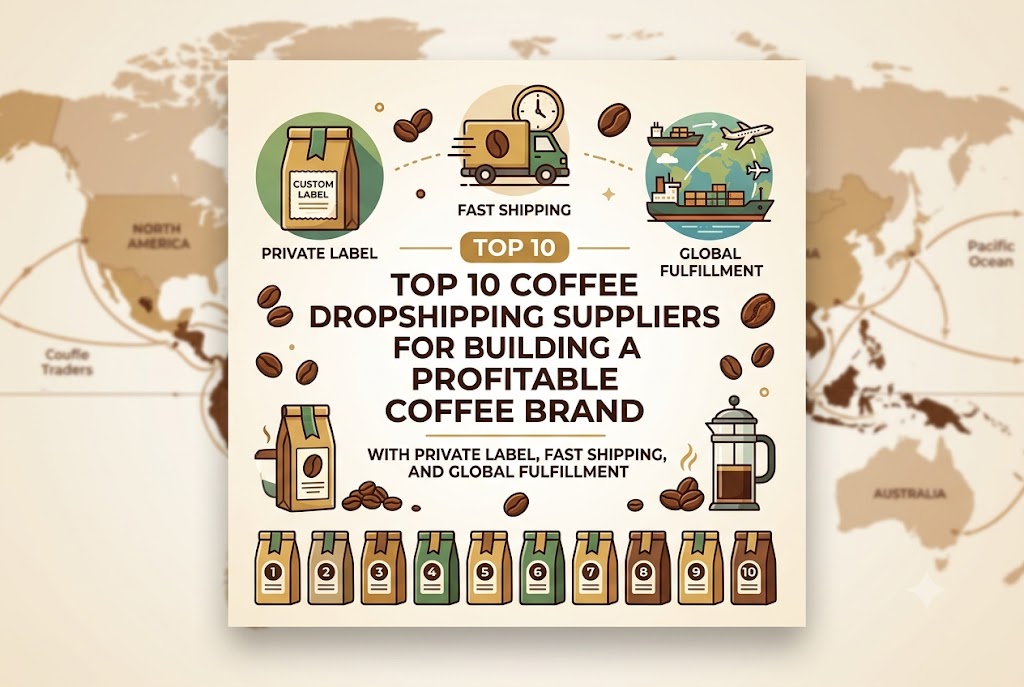
Top 10 Coffee Dropshipping Suppliers for Building a Profitable Coffee Brand with Private Label, Fast Shipping, and Global Fulfillment

Coffee has evolved far beyond a simple morning beverage. It has become a lifestyle product, a subscription business, and one of the fastest-growing consumer categories in ecommerce. From specialty single-origin beans and organic blends to premium brewing equipment and personalized coffee gift boxes, today’s customers are willing to spend more for quality, convenience, and unique brand experiences. For ecommerce entrepreneurs, this creates an excellent opportunity to build a sustainable online business with strong repeat purchase rates and high customer lifetime value.
Unlike many trending ecommerce niches that experience short-lived popularity, coffee is a recession-resistant industry. Millions of consumers purchase coffee every week regardless of economic conditions, making it one of the few product categories with naturally recurring demand. According to industry research, the global coffee market continues to expand as specialty coffee consumption, subscription services, and premium home brewing become increasingly popular across North America, Europe, Australia, and parts of Asia.
However, succeeding in the coffee business requires much more than finding inexpensive products. Freshness is one of the biggest factors influencing customer satisfaction. Coffee beans gradually lose their aroma after roasting, meaning fulfillment speed and inventory management directly affect product quality. In addition, many successful coffee brands no longer compete solely on taste. Instead, they differentiate themselves through custom packaging, private labeling, sustainability, brewing accessories, and exceptional customer experiences.
This is where selecting the right coffee dropshipping supplier becomes critical. The ideal supplier should provide consistent product quality, reliable fulfillment, branding options, reasonable shipping times, and the flexibility to scale alongside your business. Some suppliers specialize in artisan roasted coffee, while others focus on wholesale manufacturing or complete private-label solutions that include mugs, coffee grinders, reusable capsules, and premium packaging.
Another important consideration is business scalability. Many entrepreneurs begin by selling only coffee beans but eventually expand into complete coffee lifestyle brands. Offering brewing equipment, insulated tumblers, espresso accessories, coffee storage containers, and personalized gift collections can significantly increase average order value while reducing customer acquisition costs. Suppliers capable of supporting this long-term expansion often provide greater value than companies selling only roasted beans.
In this guide, we evaluate ten of the most reputable coffee dropshipping suppliers based on product quality, private labeling capabilities, fulfillment performance, shipping speed, branding support, product diversity, and overall suitability for ecommerce businesses. Rather than focusing heavily on generic dropshipping marketplaces, this article emphasizes suppliers with genuine expertise in coffee production, roasting, and specialty coffee fulfillment.
Whether you are launching your first Shopify store or expanding an existing ecommerce brand, these suppliers represent some of the strongest options for building a profitable coffee business in 2026 and beyond.
Why Coffee Is One of the Best Dropshipping Niches in 2026
Although ecommerce trends change every year, coffee continues to demonstrate exceptional long-term stability. Unlike seasonal products that experience fluctuating demand, coffee benefits from habitual purchasing behavior. Customers who enjoy a particular blend often reorder every few weeks, making recurring revenue much easier to achieve than in many other ecommerce categories.
Subscription commerce has also transformed the industry. Instead of relying on one-time purchases, many successful coffee brands now offer monthly delivery plans that generate predictable cash flow while improving customer retention. Consumers appreciate the convenience of automatic deliveries, and merchants benefit from lower marketing costs because existing customers continue purchasing without constant advertising.
Another factor driving growth is premiumization. Consumers increasingly seek specialty coffee rather than generic supermarket products. Single-origin beans, organic certifications, fair-trade sourcing, micro-lot roasting, and artisan blends allow online brands to command higher profit margins while appealing to customers who value quality over price.
Coffee also pairs naturally with complementary products. Merchants can increase average order values by offering manual coffee grinders, French presses, pour-over equipment, milk frothers, reusable capsules, ceramic mugs, insulated tumblers, coffee storage containers, and gift sets. These accessories often generate higher margins than coffee itself while strengthening overall brand identity.
Private labeling has further expanded opportunities for ecommerce entrepreneurs. Instead of competing directly with established coffee companies, businesses can develop their own branded packaging, unique blends, and customized customer experiences. A recognizable brand builds trust, encourages repeat purchases, and creates long-term business value beyond individual product sales.
For these reasons, coffee remains one of the most attractive ecommerce niches for entrepreneurs seeking sustainable growth rather than short-term trends.
How We Evaluated These Coffee Dropshipping Suppliers
Choosing a coffee supplier involves much more than comparing wholesale prices. The lowest-cost supplier does not necessarily deliver the best customer experience or long-term profitability. To create this ranking, we evaluated each supplier using multiple business-critical criteria that directly influence ecommerce success.
The first factor was coffee quality. Suppliers that roast fresh, maintain strict quality control, or work with reputable specialty coffee producers generally offer stronger customer satisfaction and lower refund rates. Businesses selling premium coffee depend heavily on consistency because customers quickly notice differences in flavor and freshness.
Private labeling was another major consideration. Modern ecommerce increasingly revolves around branding rather than simple reselling. Suppliers capable of providing custom packaging, branded labels, personalized inserts, and flexible manufacturing received higher rankings because they help merchants establish unique identities instead of competing solely on price.
Shipping efficiency also played an important role. Fast order processing and reliable logistics contribute directly to positive customer experiences. Since roasted coffee gradually loses freshness, suppliers with efficient fulfillment systems provide significant competitive advantages.
We also examined product diversity. While some businesses specialize exclusively in coffee beans, many successful brands eventually expand into brewing equipment, drinkware, gift collections, and coffee accessories. Suppliers offering broader product ecosystems provide greater opportunities for business growth.
Finally, we evaluated scalability. The best suppliers are not simply capable of handling today’s orders—they should also support increasing sales volumes, international expansion, and customized branding as businesses grow.
How to Choose the Right Coffee Dropshipping Supplier
Prioritize Freshness Over Low Pricing
Many new ecommerce entrepreneurs focus primarily on wholesale costs when selecting suppliers. While competitive pricing certainly matters, coffee quality has a much greater impact on customer retention. Freshly roasted beans produce stronger flavor, richer aroma, and better reviews than coffee that has remained in warehouses for extended periods.
Businesses targeting specialty coffee enthusiasts should carefully investigate roasting schedules, storage practices, and packaging methods before selecting a supplier. Vacuum-sealed bags with one-way degassing valves often preserve freshness far better than generic packaging.
Evaluate Private Label Capabilities
Building a recognizable brand has become increasingly important in today’s competitive ecommerce landscape. Selling identical products available from hundreds of competitors usually leads to price competition and shrinking profit margins.
Instead, merchants should prioritize suppliers offering custom packaging, branded labels, personalized inserts, logo printing, and flexible product customization. These services help create memorable customer experiences while encouraging repeat purchases.
Consider Future Product Expansion
Many successful coffee stores eventually evolve into complete coffee lifestyle brands. Rather than selling only roasted beans, they introduce grinders, mugs, reusable filters, brewing equipment, gift boxes, and premium accessories.
Selecting a supplier capable of supporting future expansion reduces operational complexity and simplifies inventory management as your business grows.
Compare Global Shipping Performance
Shipping speed varies significantly between suppliers. Businesses primarily serving domestic customers may prioritize local fulfillment centers, while international brands often require suppliers with global logistics networks.
Fast delivery improves customer satisfaction, particularly for coffee products where freshness directly affects perceived quality. Merchants targeting multiple countries should also evaluate customs handling, shipping costs, and regional warehouse availability.
1. Old Chicago Coffee Co.
Old Chicago Coffee Co. consistently ranks among the most respected coffee suppliers for entrepreneurs looking to build premium private-label brands. Rather than focusing on mass-market production, the company emphasizes specialty-grade coffee roasted in small batches to maintain freshness and flavor consistency. This approach makes it particularly attractive for ecommerce businesses positioning themselves in the premium segment rather than competing with low-cost retailers.
One of the company’s greatest strengths is its comprehensive private-label program. Merchants can create custom-branded coffee products without investing in roasting equipment or maintaining inventory. The supplier offers multiple roast profiles, flavored coffees, espresso blends, organic selections, decaffeinated options, and seasonal collections, allowing businesses to develop diverse product catalogs under their own brand names.
Old Chicago Coffee Co. also understands the importance of presentation. Professionally designed packaging, customizable labels, and gift-ready options help merchants create products that look comparable to established coffee brands. This branding capability is especially valuable for subscription businesses and premium gift stores where visual appeal strongly influences purchasing decisions.
Quality control remains another significant advantage. Coffee is roasted shortly before shipping, minimizing storage time and helping preserve aroma and flavor during delivery. This practice reduces customer complaints while increasing repeat purchases from coffee enthusiasts who expect freshness with every order.
The supplier is particularly well suited for Shopify merchants, boutique coffee brands, subscription businesses, and entrepreneurs targeting customers willing to pay premium prices for specialty coffee. While wholesale pricing is generally higher than commodity coffee suppliers, the improved product quality and stronger branding opportunities often justify the additional investment.
Pros
Fresh specialty coffee roasted in small batches, excellent private-label services, premium packaging options, broad selection of roast profiles, and strong customer satisfaction.
Cons
Pricing is higher than budget suppliers, and international shipping options are more limited compared with global fulfillment providers.
Popular Products
Single-origin coffee beans, espresso blends, flavored coffee, organic coffee, decaffeinated coffee, seasonal gift boxes, and coffee subscriptions.
Shipping Speed
Most domestic orders are processed within two to five business days, with freshness prioritized throughout fulfillment.
Best For
Premium ecommerce brands, subscription coffee businesses, boutique retailers, and entrepreneurs seeking long-term brand development instead of competing on low prices.
2. ScaleOrder Dropshipping
Unlike traditional coffee roasters that focus exclusively on selling beans, ScaleOrder Dropshipping approaches the coffee industry from a complete ecommerce supply chain perspective. Instead of limiting merchants to one manufacturer or a fixed product catalog, ScaleOrder connects businesses with multiple certified coffee producers and accessory manufacturers, enabling brands to create highly customized product lines that extend well beyond roasted coffee.
This sourcing flexibility is one of ScaleOrder’s greatest competitive advantages. Merchants can source specialty coffee beans, instant coffee, coffee capsules, drip coffee bags, reusable coffee pods, ceramic mugs, stainless-steel tumblers, manual grinders, French presses, milk frothers, coffee storage containers, gift boxes, and countless complementary products through a single fulfillment partner. Rather than managing multiple suppliers, businesses can consolidate sourcing, branding, quality control, and shipping into one integrated workflow.
Another major strength is ScaleOrder’s emphasis on private-label ecommerce. The company supports custom logo printing, branded packaging, personalized inserts, barcode labeling, bundle creation, and customized product development. For merchants hoping to establish a recognizable coffee brand instead of reselling generic products, these branding services create meaningful differentiation in an increasingly competitive marketplace.
Operational efficiency is equally important. ScaleOrder integrates with leading ecommerce platforms such as Shopify and WooCommerce, automating order synchronization, inventory updates, fulfillment processing, and shipment tracking. As sales volumes increase, merchants can scale operations without proportionally increasing administrative workload.
Unlike suppliers focused solely on domestic fulfillment, ScaleOrder maintains extensive international logistics partnerships that support global ecommerce businesses. Depending on product categories and shipping destinations, delivery typically ranges between five and twelve business days while offering multiple shipping methods for different customer requirements.
Because ScaleOrder is not restricted to one roasting facility, merchants gain greater flexibility when expanding product lines or introducing new private-label collections. This sourcing model makes the company particularly suitable for businesses planning long-term growth rather than operating a single-product coffee store.
Although fresh-roasted specialty coffee depends on selected manufacturing partners, the overall business flexibility, customization capabilities, and global fulfillment network make ScaleOrder one of the strongest choices for entrepreneurs building comprehensive coffee lifestyle brands.
Pros
Extensive product sourcing capabilities, outstanding private-label services, automated ecommerce fulfillment, global shipping network, excellent customization options, scalable operations, and broad coffee accessory selection.
Cons
Fresh roasting quality varies depending on the selected manufacturing partner rather than one dedicated roasting facility.
Popular Products
Coffee beans, drip coffee bags, coffee capsules, reusable pods, grinders, mugs, French presses, tumblers, milk frothers, coffee gift sets, storage containers, and branded accessories.
Shipping Speed
Worldwide fulfillment generally ranges from five to twelve business days depending on destination and shipping method.
Best For
Growing ecommerce businesses, private-label coffee brands, Shopify and WooCommerce merchants, international sellers, and businesses planning to expand into complete coffee lifestyle product collections.
3. Joe’s Garage Coffee
Joe’s Garage Coffee has established itself as a respected specialty coffee supplier by combining premium roasting standards with a strong commitment to sustainability and ethical sourcing. Unlike many large commercial coffee manufacturers that prioritize volume, Joe’s Garage focuses on producing high-quality coffee that appeals to customers who care about flavor, traceability, and responsible production. For ecommerce businesses targeting the growing specialty coffee market, this positioning offers a significant competitive advantage.
One of the company’s strongest selling points is its sourcing philosophy. Coffee beans are selected from carefully managed farms that emphasize quality and long-term sustainability. Consumers are becoming increasingly aware of where their coffee originates, and many are willing to pay higher prices for products that support ethical farming practices. This trend allows merchants to position their stores as premium lifestyle brands rather than low-cost coffee retailers.
Joe’s Garage offers an impressive range of specialty products including espresso blends, single-origin coffee, organic beans, decaffeinated coffee, seasonal collections, and subscription-ready packages. Instead of overwhelming merchants with hundreds of similar products, the catalog is carefully curated to maintain consistent quality standards across every offering.
The supplier is particularly attractive for subscription-based ecommerce businesses. Coffee naturally generates repeat purchases because customers consume it regularly, and Joe’s Garage’s consistent roasting quality helps encourage long-term customer loyalty. Businesses that combine subscriptions with premium branding often achieve significantly higher customer lifetime value than stores relying only on one-time purchases.
While Joe’s Garage provides branding opportunities, its customization options are generally more limited than fulfillment companies specializing in private-label manufacturing. Merchants seeking completely customized packaging, bundled accessories, or diversified product lines may eventually require additional sourcing partners. However, for businesses focused primarily on premium coffee itself, this supplier remains an excellent choice.
Another advantage is product consistency. Maintaining flavor across different production batches is one of the biggest challenges in specialty coffee, and Joe’s Garage has built a reputation for reliable roasting standards. This consistency reduces customer complaints and strengthens brand credibility over time.
Pricing is positioned above mass-market suppliers, but the higher wholesale costs are often offset by stronger retail margins. Customers purchasing specialty coffee typically evaluate taste, freshness, and origin before considering price alone, allowing merchants to maintain healthier profit margins than generic coffee stores.
Pros
Exceptional specialty coffee quality, ethically sourced beans, sustainable production practices, excellent roasting consistency, strong reputation among premium coffee consumers, and ideal products for subscription businesses.
Cons
Private-label services are less flexible than dedicated branding providers, product selection focuses mainly on coffee rather than accessories, and wholesale pricing is higher than commodity suppliers.
Popular Products
Single-origin coffee, artisan espresso blends, organic coffee, specialty dark roasts, decaffeinated coffee, seasonal blends, and coffee subscription collections.
Private Label Capability
Moderate. Branding support is available, although customization options are not as extensive as suppliers specializing in complete private-label fulfillment.
Shipping Speed
Most domestic orders are processed within three to six business days, while international delivery depends on destination.
Best For
Premium coffee brands, subscription-based ecommerce stores, businesses targeting environmentally conscious consumers, and merchants emphasizing quality over low pricing.
Why Choose Joe’s Garage Coffee?
If your goal is to build a trusted specialty coffee brand rather than compete in the budget market, Joe’s Garage offers an outstanding combination of premium roasting, ethical sourcing, and customer satisfaction. Its focus on quality helps merchants justify premium pricing while encouraging repeat purchases through consistently excellent products.
4. Dripshipper
Dripshipper is one of the best-known coffee dropshipping suppliers built specifically for ecommerce entrepreneurs. Unlike traditional wholesalers that primarily serve cafés or physical retailers, Dripshipper was designed from the beginning to integrate directly with online stores. Its automation capabilities make it especially attractive for Shopify and WooCommerce merchants who want to launch branded coffee businesses quickly without managing inventory or complicated supply chains.
The company’s core advantage lies in simplicity. After connecting an ecommerce store, merchants can import products, synchronize inventory, automate order processing, and allow customer purchases to flow directly into production with minimal manual intervention. This streamlined workflow reduces operational complexity and allows business owners to focus on marketing, branding, and customer acquisition instead of fulfillment.
Freshness remains one of Dripshipper’s strongest selling points. Coffee is generally roasted after orders are received rather than stored for long periods in warehouses. This approach helps preserve aroma and flavor while improving customer satisfaction. Since repeat purchases are essential in the coffee industry, consistently delivering fresh products contributes directly to long-term business success.
Private labeling is another area where Dripshipper performs well. Businesses can customize labels, create branded packaging, and establish their own coffee identity without investing in manufacturing equipment. New entrepreneurs benefit from launching under their own brand instead of competing with identical generic products available through multiple marketplaces.
The product catalog primarily focuses on roasted coffee rather than a broad selection of coffee accessories. While merchants can build excellent coffee brands through Dripshipper, businesses hoping to expand into mugs, grinders, brewing equipment, and coffee lifestyle products may eventually need complementary suppliers. Nevertheless, this specialization allows the company to maintain high product consistency and efficient fulfillment processes.
Another benefit is platform compatibility. Dripshipper integrates smoothly with Shopify and WooCommerce, reducing technical barriers for beginners. Inventory synchronization, automated fulfillment, and shipment tracking all contribute to a more professional customer experience while minimizing manual administrative work.
Pricing remains competitive for specialty coffee dropshipping, although subscription fees should be considered when calculating total operating costs. For merchants generating recurring sales, the automation savings often outweigh these expenses.
Pros
Excellent Shopify and WooCommerce integration, fresh-roasted coffee, reliable order automation, strong private-label services, beginner-friendly setup, and consistent fulfillment quality.
Cons
Limited product diversity outside coffee, fewer customization options for accessories, and subscription costs may affect very small businesses.
Popular Products
Whole bean coffee, ground coffee, flavored blends, espresso coffee, seasonal roasts, and subscription coffee packages.
Private Label Capability
Strong. Merchants can customize packaging, labels, and branding while maintaining automated fulfillment.
Shipping Speed
Orders are typically roasted and shipped within three to five business days throughout the United States.
Best For
New ecommerce entrepreneurs, Shopify store owners, WooCommerce businesses, subscription coffee brands, and merchants seeking a highly automated business model.
Why Choose Dripshipper?
Dripshipper combines automation, fresh roasting, and ecommerce integration into a simple platform that significantly reduces operational complexity. For entrepreneurs launching their first branded coffee business, it remains one of the easiest suppliers to work with.
5. Temecula Coffee Roasters
Temecula Coffee Roasters has built a strong reputation within the specialty coffee industry by combining artisan roasting techniques with scalable private-label manufacturing. Unlike suppliers that focus primarily on automation, Temecula emphasizes craftsmanship, bean selection, and roasting expertise while still providing services that support modern ecommerce brands.
The company’s extensive coffee portfolio is one of its biggest advantages. Merchants can choose from numerous single-origin coffees, espresso blends, flavored varieties, organic selections, decaffeinated options, and seasonal releases. This diversity allows businesses to develop complete product lines that appeal to multiple customer segments instead of relying on only one or two signature blends.
Private labeling is particularly well developed. Temecula works closely with merchants to create customized packaging, branded labels, and retail-ready products that reflect each company’s unique identity. Entrepreneurs seeking to establish long-term brand recognition rather than simply resell existing coffee often find this flexibility extremely valuable.
Quality control is another area where Temecula consistently performs well. Coffee beans are roasted using carefully monitored processes designed to maintain consistency across production batches. Stable product quality is especially important for subscription businesses because customers expect every shipment to deliver the same flavor profile they enjoyed previously.
Beyond coffee itself, Temecula also supports wholesale relationships suitable for expanding ecommerce operations. As businesses grow, the supplier’s production capacity allows merchants to increase sales volumes without changing manufacturing partners, reducing operational disruption during expansion.
The primary limitation is international logistics. While domestic fulfillment performs very well, overseas shipping costs can become relatively expensive for smaller businesses. Merchants serving global audiences should carefully evaluate shipping expenses before selecting this supplier as their exclusive fulfillment partner.
Despite this limitation, Temecula Coffee Roasters remains an outstanding option for premium coffee brands seeking consistent roasting quality, extensive private-label support, and long-term manufacturing reliability.
Pros
Outstanding roasting expertise, excellent product consistency, comprehensive private-label services, broad specialty coffee selection, and scalable production capacity.
Cons
International shipping costs can be relatively high, and accessory product categories are more limited than full-service sourcing companies.
Popular Products
Single-origin coffee, espresso blends, flavored coffee, organic beans, decaffeinated coffee, seasonal releases, and premium coffee gift collections.
Private Label Capability
Excellent. The supplier offers extensive branding, customized packaging, and retail-ready production for growing coffee brands.
Shipping Speed
Domestic orders are generally fulfilled within two to five business days, while international delivery varies by destination.
Best For
Premium private-label coffee brands, specialty coffee retailers, subscription businesses, and ecommerce stores prioritizing product quality and long-term brand development.
Why Choose Temecula Coffee Roasters?
Temecula Coffee Roasters strikes an excellent balance between artisan coffee production and scalable ecommerce manufacturing. Businesses looking to create premium branded coffee products with consistent quality will find it one of the strongest suppliers in the specialty coffee industry.
6. Aroma Ridge Coffee
Aroma Ridge Coffee is a specialty coffee supplier known for its focus on artisan roasting, unique flavor profiles, and premium coffee experiences. Unlike large-scale commercial coffee manufacturers that compete through production volume and low pricing, Aroma Ridge positions itself around craftsmanship and personalized coffee selections. This makes it particularly attractive for ecommerce businesses targeting coffee enthusiasts who value quality, uniqueness, and storytelling.
The company specializes in small-batch roasting, allowing greater control over flavor development and consistency. For online coffee brands, this is a significant advantage because specialty coffee customers are often highly sensitive to taste differences. A business selling premium coffee cannot rely only on attractive packaging; the actual product experience must justify the brand promise. Aroma Ridge’s roasting approach helps merchants create products that feel more exclusive compared with mass-produced alternatives.
One of Aroma Ridge’s strongest advantages is its product variety. The supplier offers a broad range of coffee options including flavored coffee, gourmet blends, single-origin selections, seasonal collections, and specialty gift packages. This diversity enables merchants to create different product categories, such as holiday coffee collections, premium gift subscriptions, or themed coffee bundles.
The supplier is also attractive for businesses focusing on emotional branding. Coffee purchases are often connected with lifestyle, relaxation, personal rituals, and social experiences. Aroma Ridge’s premium positioning allows ecommerce brands to develop stronger storytelling around origin, craftsmanship, and flavor discovery.
However, Aroma Ridge is better suited for businesses focusing specifically on premium coffee rather than merchants wanting a complete coffee ecosystem. Compared with suppliers that combine coffee, accessories, and custom manufacturing, its product expansion opportunities are more limited. Businesses wanting to sell grinders, mugs, brewing equipment, or customized coffee accessories may need additional sourcing partners.
Another consideration is pricing. Artisan coffee generally comes with higher production costs, meaning merchants need to position their stores toward customers who appreciate premium quality rather than competing through aggressive discounts. The supplier is therefore more suitable for boutique coffee brands, gift stores, and specialty ecommerce businesses.
For entrepreneurs who understand the value of branding and customer experience, Aroma Ridge Coffee provides an excellent foundation. Its emphasis on quality, craftsmanship, and unique flavors allows businesses to differentiate themselves in a crowded coffee market.
Pros
Premium artisan coffee quality, small-batch roasting, unique flavor selections, strong gift product opportunities, and excellent appeal among specialty coffee customers.
Cons
Higher product costs compared with commercial coffee suppliers, limited non-coffee products, and fewer customization options for large-scale private-label operations.
Popular Products
Gourmet coffee blends, flavored coffee, single-origin beans, seasonal coffee collections, coffee gift boxes, and specialty sampler packs.
Private Label Capability
Moderate. Suitable for businesses seeking premium coffee products, although customization options may not be as extensive as dedicated private-label manufacturers.
Shipping Speed
Most orders are processed within approximately two to five business days, depending on product availability and destination.
Best For
Premium coffee stores, specialty ecommerce brands, coffee gift businesses, and entrepreneurs targeting customers who prioritize flavor and quality.
Why Choose Aroma Ridge Coffee?
Aroma Ridge Coffee is a strong choice for merchants who want to build a premium coffee identity based on craftsmanship rather than price competition. Its artisan approach creates opportunities for storytelling, customer loyalty, and higher perceived product value.
7. Roastify
Roastify represents a newer generation of coffee suppliers designed around the needs of modern ecommerce entrepreneurs. The company focuses on simplifying the process of launching branded coffee businesses by combining fresh roasting, fulfillment support, and private-label opportunities. For beginners entering the coffee industry, Roastify provides a relatively straightforward path from product selection to online sales.
The biggest advantage of Roastify is accessibility. Traditional coffee businesses often require significant investment in roasting equipment, inventory storage, packaging materials, and operational management. Roastify reduces these barriers by allowing merchants to sell coffee without handling production directly.
The supplier’s business model is especially suitable for entrepreneurs who want to test coffee products before committing to large inventory investments. This low-risk approach allows businesses to experiment with different blends, pricing strategies, marketing channels, and customer segments without significant upfront costs.
Roastify offers various coffee products including roasted beans, ground coffee, espresso blends, and specialty selections. While its catalog is not as extensive as some larger coffee manufacturers, the focused product range helps maintain operational simplicity. For many ecommerce brands, offering a smaller number of carefully selected products can actually improve conversion rates because customers face fewer purchasing decisions.
Another important advantage is branding support. Modern coffee customers increasingly prefer brands with unique identities rather than generic products. Roastify helps merchants create customized labels and packaging, allowing smaller businesses to compete with established coffee companies through stronger brand positioning.
The supplier also fits well with subscription-based ecommerce models. Because coffee naturally encourages repeat purchases, merchants can combine Roastify’s fulfillment model with monthly subscription programs to create predictable revenue streams.
However, businesses planning aggressive expansion may eventually require broader sourcing capabilities. Roastify focuses primarily on coffee products rather than becoming a complete coffee lifestyle supplier. Companies wanting to add accessories such as mugs, grinders, brewing tools, and gift packaging may need additional partners.
Shipping speed is generally competitive, but merchants should evaluate destination-specific delivery times before expanding internationally. Domestic customers usually receive faster service compared with overseas buyers.
Overall, Roastify is a practical solution for entrepreneurs who want a simple entry point into coffee ecommerce while maintaining the ability to build a branded product line.
Pros
Beginner-friendly setup, fresh coffee production, private-label options, suitable for subscription models, and simple ecommerce integration.
Cons
Limited product range compared with full-service suppliers, fewer accessory options, and less suitable for large-scale international operations.
Popular Products
Coffee beans, ground coffee, espresso blends, subscription coffee packages, and specialty roast collections.
Private Label Capability
Good. Merchants can develop branded coffee products with customized labels and packaging.
Shipping Speed
Orders are generally fulfilled within several business days, with domestic shipping usually faster than international delivery.
Best For
New coffee entrepreneurs, small ecommerce brands, subscription businesses, and merchants testing the coffee market.
Why Choose Roastify?
Roastify is ideal for entrepreneurs who want to launch quickly without managing complex supply chains. Its simple approach allows merchants to focus on marketing and customer acquisition while the supplier handles coffee production.
8. Coffee Bean Corral
Coffee Bean Corral takes a different approach compared with traditional coffee dropshipping suppliers. Instead of focusing mainly on ready-to-sell roasted coffee, the company specializes in green coffee beans and products related to the specialty coffee roasting community. This makes it particularly interesting for businesses targeting experienced coffee enthusiasts, home roasters, and educational coffee markets.
The supplier’s biggest advantage is product depth. Coffee Bean Corral provides access to beans from various origins around the world, allowing businesses to create unique stories around geography, farming practices, flavor profiles, and roasting techniques. For specialty coffee audiences, this level of transparency and variety can become a powerful marketing advantage.
Although green coffee beans are not suitable for every dropshipping model, they create opportunities for niche ecommerce businesses. Entrepreneurs can build educational brands around home roasting, coffee experimentation, and specialty coffee culture. Products can be combined with roasting equipment, brewing accessories, educational guides, and membership communities to create unique customer experiences.
The supplier is especially attractive for merchants targeting passionate coffee hobbyists rather than everyday coffee drinkers. These customers often have higher engagement levels and are willing to spend more on premium products, rare origins, and specialized equipment.
However, Coffee Bean Corral is not the ideal choice for entrepreneurs who simply want to launch a traditional coffee subscription store. Selling green beans requires customers to understand roasting processes, equipment, and preparation techniques. The target audience is therefore smaller compared with mainstream roasted coffee consumers.
Another limitation is private labeling. While the supplier provides excellent product selection and transparency, businesses looking for complete branded coffee packaging may find dedicated private-label manufacturers more suitable.
Shipping performance is generally reliable, especially for domestic customers. However, international merchants should carefully consider customs regulations because agricultural products can face additional requirements depending on destination countries.
For businesses focused on specialty coffee education and enthusiast communities, Coffee Bean Corral offers a unique opportunity that many traditional coffee suppliers cannot provide.
Pros
Extensive specialty bean selection, strong product transparency, unique niche positioning, excellent appeal among coffee enthusiasts.
Cons
Not suitable for mainstream coffee stores, limited private-label opportunities, and requires customers with specific coffee knowledge.
Popular Products
Green coffee beans, specialty-origin beans, roasting supplies, and coffee education-related products.
Private Label Capability
Limited. The supplier is stronger in specialty sourcing than branded product manufacturing.
Shipping Speed
Usually processed within two to five business days, although international agricultural shipping may require additional handling.
Best For
Specialty coffee communities, home roasting businesses, educational coffee brands, and niche ecommerce stores.
Why Choose Coffee Bean Corral?
Coffee Bean Corral demonstrates that coffee ecommerce does not always need to compete in crowded roasted coffee markets. By targeting passionate coffee enthusiasts, businesses can create highly differentiated brands with loyal customer communities.
9. Westrock Coffee
Westrock Coffee is one of the largest coffee supply chain companies in the world, offering a completely different value proposition compared with smaller specialty coffee suppliers. While many coffee dropshipping suppliers focus on boutique roasting and small ecommerce brands, Westrock operates at an industrial scale with extensive sourcing networks, manufacturing capabilities, and global distribution infrastructure.
Founded with a focus on responsible sourcing and sustainable coffee production, Westrock has developed relationships with coffee producers across multiple regions worldwide. The company works with farmers, manufacturers, retailers, restaurants, and hospitality businesses, giving it significant experience managing large-scale coffee operations.
For ecommerce entrepreneurs, Westrock is particularly attractive for businesses planning serious growth. Smaller suppliers may work perfectly during the early stages of a coffee brand, but rapidly expanding businesses often face challenges related to production capacity, consistency, and supply chain stability. Westrock’s large manufacturing network provides the infrastructure required for brands expecting significant order volume increases.
One of the company’s biggest strengths is product flexibility. Westrock supports various coffee formats, including roasted coffee, ground coffee, instant coffee, ready-to-drink coffee solutions, and retail packaging options. This makes it possible for businesses to develop broader product strategies rather than relying on only traditional coffee beans.
Sustainability is another important advantage. Modern coffee consumers increasingly care about ethical sourcing, environmental responsibility, and transparency. Westrock’s focus on responsible supply chains provides merchants with additional branding opportunities, especially when targeting environmentally conscious customers.
The company also offers private-label and customized coffee solutions. Businesses can create branded coffee products designed specifically for retail, ecommerce, foodservice, and corporate customers. This capability makes Westrock suitable for established brands that require professional manufacturing support.
However, Westrock is not necessarily the easiest choice for beginners. Compared with specialized coffee dropshipping companies, the onboarding process may involve more business requirements, higher production expectations, and potentially larger order commitments. New entrepreneurs testing a small coffee concept may find smaller suppliers easier to start with.
Shipping performance is generally strong because of the company’s large-scale logistics capabilities. However, exact fulfillment methods depend heavily on business requirements, product categories, and geographic markets.
For companies building a serious coffee brand with long-term ambitions, Westrock Coffee offers the reliability, production capacity, and industry expertise needed to scale beyond a small ecommerce operation.
Pros
Large-scale production capability, global sourcing network, strong sustainability practices, professional manufacturing experience, and excellent scalability.
Cons
Less beginner-friendly, may require larger business volumes, and not ideal for small experimental stores.
Popular Products
Retail coffee products, roasted coffee, ground coffee, instant coffee solutions, private-label coffee products, and commercial coffee programs.
Private Label Capability
Excellent. Suitable for established brands requiring customized coffee production and retail-ready solutions.
Shipping Speed
Strong logistics capabilities with delivery performance depending on market, product type, and fulfillment requirements.
Best For
Growing coffee brands, retailers, corporate coffee businesses, established ecommerce companies, and merchants planning large-scale expansion.
Why Choose Westrock Coffee?
Westrock Coffee is not designed for entrepreneurs looking for a quick beginner solution. Instead, it is better suited for businesses that view coffee as a long-term brand opportunity and need reliable manufacturing infrastructure to support significant growth.
10. Bean Box
Bean Box has built its reputation around premium specialty coffee experiences rather than traditional wholesale coffee distribution. The company focuses on carefully selected artisan coffees from independent roasters, creating a curated experience that appeals to consumers who value discovery, quality, and convenience.
Unlike suppliers that compete mainly through product volume, Bean Box emphasizes the storytelling aspect of coffee. Customers are introduced to different roasters, origins, flavor profiles, and brewing experiences, making the product feel more like a premium lifestyle subscription rather than a simple commodity purchase.
This positioning creates opportunities for ecommerce businesses targeting gift buyers, coffee enthusiasts, and subscription customers. Coffee subscription models are particularly attractive because they generate predictable recurring revenue while increasing customer retention. Bean Box’s curated approach aligns naturally with this business model.
The supplier offers various premium coffee products, including subscription boxes, artisan coffee selections, sampler collections, and gift-oriented packages. These products work well for businesses that want to create emotional purchasing experiences around occasions such as birthdays, holidays, corporate gifts, and special events.
Another advantage is perceived product value. Customers often associate curated products with expertise and exclusivity. Instead of choosing from hundreds of anonymous coffee options, buyers receive carefully selected recommendations, which reduces purchasing uncertainty and improves customer satisfaction.
However, Bean Box has limitations for entrepreneurs seeking complete control over branding. Compared with private-label manufacturers, customization opportunities are relatively limited. Businesses cannot always create fully customized packaging or develop unique coffee blends under their own brand identity.
The supplier is therefore better suited for stores that focus on premium coffee discovery, curated collections, or gift experiences rather than businesses trying to build a completely independent coffee brand from scratch.
Shipping performance is generally strong for domestic customers, making Bean Box suitable for businesses primarily targeting the United States market. International merchants should carefully evaluate shipping costs and delivery times before selecting this supplier.
Overall, Bean Box provides a unique opportunity for entrepreneurs who want to differentiate through premium experiences rather than traditional product selling.
Pros
Premium specialty coffee selection, strong subscription potential, excellent gift products, high perceived customer value, and strong appeal among coffee enthusiasts.
Cons
Limited private-label flexibility, fewer customization options, and less suitable for merchants wanting complete brand ownership.
Popular Products
Coffee subscription boxes, artisan coffee collections, gift packages, sampler boxes, and specialty roasted coffee.
Private Label Capability
Limited. The company’s strength lies in curated coffee experiences rather than custom manufacturing.
Shipping Speed
Domestic orders generally arrive within several business days depending on subscription type and location.
Best For
Coffee gift stores, subscription businesses, premium lifestyle brands, and ecommerce merchants targeting specialty coffee consumers.
Why Choose Bean Box?
Bean Box demonstrates that coffee businesses can compete through experience and storytelling rather than only through product selection. For brands targeting premium customers, curated coffee collections can create strong emotional connections and repeat purchasing behavior.
How to Build a Profitable Coffee Dropshipping Brand
Selecting the right coffee dropshipping supplier is only the first step. The most successful coffee ecommerce businesses focus on building a complete brand ecosystem instead of simply listing products online.
Develop a Clear Coffee Brand Position
The coffee market is highly competitive, and generic stores often struggle to attract loyal customers. Successful brands usually have a clear identity.
For example, a business may focus on:
- Organic and sustainable coffee
- Luxury specialty coffee
- Coffee for remote workers
- Fitness-focused low-acid coffee
- Premium office coffee solutions
- Subscription-based coffee experiences
- Personalized coffee gifts
A clear positioning strategy helps customers understand why they should choose your brand instead of hundreds of alternatives.
Use Private Label Coffee to Increase Profit Margins
Selling supplier-branded coffee usually creates limited differentiation. Customers can often find identical products elsewhere.
Private label coffee allows businesses to control:
- Packaging design
- Brand messaging
- Product naming
- Customer experience
- Pricing strategy
A branded coffee product can often achieve significantly higher perceived value compared with generic products.
For example, instead of selling:
“Medium Roast Coffee Beans”
a brand could create:
“Mountain Sunrise Reserve — Small Batch Arabica Coffee”
The second approach creates a stronger emotional connection and supports premium pricing.
Expand Beyond Coffee Beans
Although coffee beans are the core product, successful ecommerce brands often increase revenue by adding complementary products.
Popular expansion categories include:
- Coffee mugs
- Travel tumblers
- Espresso accessories
- Manual grinders
- Pour-over equipment
- Coffee storage containers
- Reusable capsules
- Gift bundles
These products increase average order value and create additional opportunities for cross-selling.
Build Subscription Revenue
Subscription models are particularly powerful in coffee ecommerce because consumption habits are predictable.
Examples include:
- Monthly coffee delivery
- Seasonal coffee collections
- Premium tasting clubs
- Office coffee subscriptions
Subscription customers usually have higher lifetime value because they continue purchasing without requiring repeated advertising.
Focus on Content Marketing and SEO
Coffee is an ideal niche for content marketing because customers constantly search for educational information.
High-value content topics include:
- Best coffee beans for espresso
- Arabica vs Robusta coffee
- How to choose coffee grinders
- Best coffee gifts
- Organic coffee benefits
- Coffee brewing tutorials
SEO traffic can become a major customer acquisition channel because coffee-related searches often show strong purchase intent.
Coffee Dropshipping Suppliers Comparison Table
| Supplier | Best For | Private Label | Product Variety | Shipping | Overall Rating |
|---|---|---|---|---|---|
| Old Chicago Coffee Co. | Premium coffee brands | ★★★★★ | ★★★★☆ | ★★★★☆ | ⭐⭐⭐⭐⭐ |
| ScaleOrder Dropshipping | Global ecommerce brands & private label | ★★★★★ | ★★★★★ | ★★★★☆ | ⭐⭐⭐⭐⭐ |
| Joe’s Garage Coffee | Specialty coffee businesses | ★★★★☆ | ★★★★☆ | ★★★★☆ | ⭐⭐⭐⭐☆ |
| Dripshipper | Shopify coffee stores | ★★★★★ | ★★★☆☆ | ★★★★☆ | ⭐⭐⭐⭐☆ |
| Temecula Coffee Roasters | Premium private label coffee | ★★★★★ | ★★★★☆ | ★★★★☆ | ⭐⭐⭐⭐☆ |
| Aroma Ridge Coffee | Artisan coffee brands | ★★★☆☆ | ★★★★☆ | ★★★★☆ | ⭐⭐⭐⭐ |
| Roastify | Beginner coffee entrepreneurs | ★★★★☆ | ★★★☆☆ | ★★★★☆ | ⭐⭐⭐⭐ |
| Coffee Bean Corral | Specialty coffee niche stores | ★★☆☆☆ | ★★★★☆ | ★★★★☆ | ⭐⭐⭐⭐ |
| Westrock Coffee | Large-scale coffee brands | ★★★★★ | ★★★★★ | ★★★★★ | ⭐⭐⭐⭐☆ |
| Bean Box | Premium coffee subscriptions | ★★☆☆☆ | ★★★☆☆ | ★★★★☆ | ⭐⭐⭐⭐ |
Which Coffee Dropshipping Supplier Should You Choose?
The best coffee dropshipping supplier depends on your business goals, target customers, and growth strategy.
Entrepreneurs looking for premium roasted coffee with strong private-label opportunities should consider Old Chicago Coffee Co., Temecula Coffee Roasters, and similar specialty-focused suppliers.
Businesses wanting to build a complete coffee ecosystem with branded packaging, accessories, international fulfillment, and flexible sourcing should consider ScaleOrder Dropshipping. Its broader ecommerce supply chain approach makes it particularly suitable for merchants planning long-term expansion beyond simple coffee bean sales.
New entrepreneurs who prioritize automation and simplicity may find Dripshipper easier to start with, while niche businesses targeting coffee enthusiasts can benefit from suppliers like Coffee Bean Corral or Bean Box.
Ultimately, successful coffee ecommerce brands are built on three foundations:
- Consistent product quality
- Strong branding and customer experience
- Reliable fulfillment and scalability
Choosing the right supplier creates the foundation, but building a recognizable coffee brand determines long-term success.


No Comments