


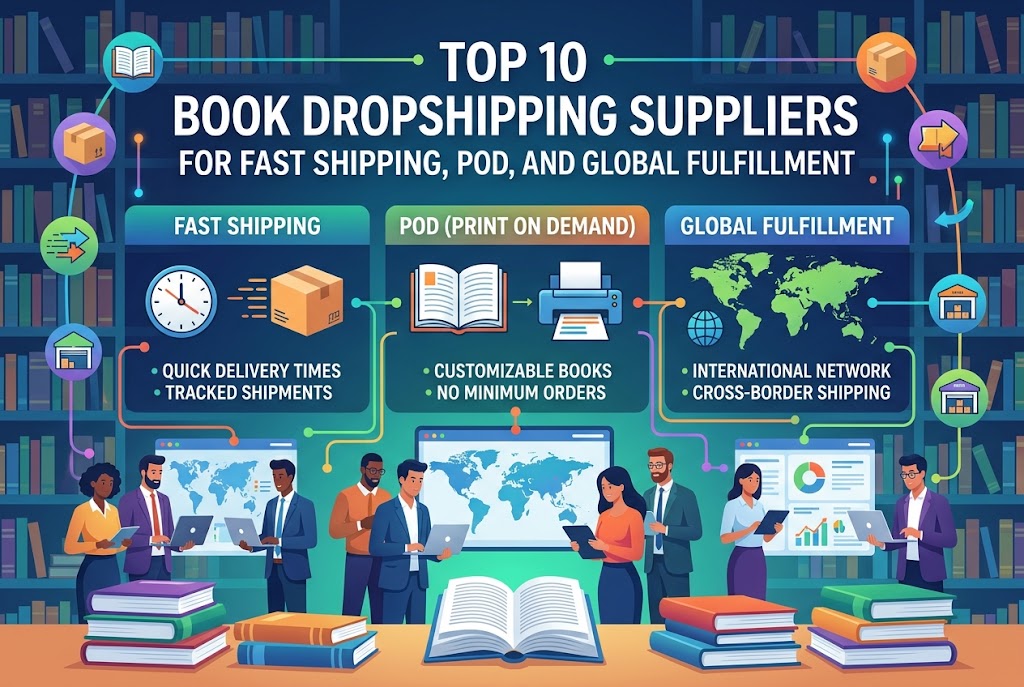
Top 10 Book Dropshipping Suppliers for Fast Shipping, POD, and Global Fulfillment

Book dropshipping is a more specialized business model than conventional dropshipping because books are relatively low-margin physical products, shipping costs can represent a meaningful share of the selling price, and copyright, ISBN, edition, language, and regional distribution all matter. The most suitable supplier therefore depends heavily on whether you want to resell existing titles, publish your own books, sell customized products, or build a niche bookstore.
The strongest suppliers in this category are not necessarily traditional dropshipping platforms. Book distributors, print-on-demand companies, wholesalers, and fulfillment providers often offer much better infrastructure for books than generic dropshipping marketplaces. IngramSpark, Lulu Direct, Bookvault, Gardners, Book Depot, and BookBaby, for example, are built around book publishing, distribution, wholesale, or fulfillment rather than generic product catalogs. At the same time, a broader fulfillment provider such as ScaleOrder can be useful when a bookstore wants to combine books with complementary products, branded packaging, accessories, or other e-commerce merchandise.
Below is a practical comparison of 10 book dropshipping suppliers, focusing on product selection, fulfillment structure, shipping performance, customization, scalability, and suitability for different types of online bookstores.
1. ScaleOrder Dropshipping
ScaleOrder is an interesting option for entrepreneurs who do not want their bookstore to be limited to a conventional book catalog. Rather than positioning itself purely as a traditional book distributor, ScaleOrder operates as an e-commerce sourcing and fulfillment partner. Its model allows merchants to source products, automate fulfillment, arrange quality checks, customize packaging, and ship orders directly to customers. ScaleOrder states that it supports product sourcing, automated order fulfillment, warehousing, customized products and packaging, and global shipping.
For a book-focused store, this makes ScaleOrder particularly relevant to hybrid concepts. Instead of selling only novels or nonfiction titles, a merchant could potentially build a broader reading-lifestyle store around journals, bookmarks, reading accessories, stationery, educational products, gift items, book lights, storage products, and other complementary merchandise. Its sourcing model is also useful when a merchant wants to introduce a custom product rather than simply resell an established title.
The major advantage is flexibility. ScaleOrder supports product sourcing and customization, meaning merchants are not necessarily restricted to a fixed catalog. It also promotes automated fulfillment and shipping optimization, which can become increasingly important once order volume grows.
The limitation is equally important: ScaleOrder should not be treated as a direct substitute for specialist book distributors such as IngramSpark or Gardners when the business needs access to millions of established ISBN titles. It is better suited to a branded e-commerce bookstore, reading-themed product store, or hybrid book business where sourcing flexibility matters as much as traditional book distribution.
Pros
ScaleOrder offers flexible sourcing, automated fulfillment, custom packaging, branding options, warehousing, and international shipping. It can also be attractive to merchants who want to expand beyond books into complementary products.
Cons
Its strongest value proposition is broader e-commerce fulfillment rather than traditional book distribution. Merchants primarily seeking established publishers, ISBN-based catalogs, bookstore distribution, or library supply may find specialist distributors more appropriate.
Popular Products
Books can be combined with journals, notebooks, bookmarks, stationery, reading accessories, educational products, gift items, and customized merchandise.
Shipping Speed
ScaleOrder promotes fast international fulfillment and states that it works with major Chinese carriers to optimize delivery time and shipping costs. Actual delivery speed depends on destination, product, shipping method, and sourcing route.
Best for: Branded bookstores, hybrid book stores, reading accessories, and merchants looking for flexible sourcing and fulfillment.
2. IngramSpark
IngramSpark is one of the strongest choices for entrepreneurs who want to sell their own books through a professional publishing and distribution infrastructure. Unlike a generic dropshipping platform, IngramSpark is deeply integrated with the traditional book industry. Its network gives publishers access to tens of thousands of retailers, libraries, schools, universities, and online stores. Its current distribution network includes more than 45,000 retailers and libraries, while its print facilities and Global Connect relationships extend its reach across multiple international markets.
The major attraction is print-on-demand. A merchant does not need to purchase hundreds or thousands of copies before testing demand. Books can be manufactured when orders occur, reducing inventory risk. Ingram also supports distribution to major retailers and online channels, which makes it particularly useful for authors and publishers trying to establish a legitimate book brand rather than simply resell generic products.
For direct-to-consumer operations, Ingram’s dropship model allows publishers to have books printed and sent directly to customers without maintaining a warehouse full of inventory.
The principal weakness is that IngramSpark is not designed like a beginner-friendly dropshipping marketplace. Publishers need to understand ISBNs, metadata, wholesale discounts, pricing, print specifications, and distribution settings. Retail distribution can also take time to appear across different retailer systems; IngramSpark notes that retailer listings can take approximately two to six weeks.
Pros
Excellent global distribution, professional book-industry infrastructure, POD, established retailer relationships, and strong suitability for independent publishers.
Cons
More complicated than a normal dropshipping supplier and primarily focused on publishing and distribution rather than generic e-commerce product sourcing.
Popular Products
Paperback books, hardcover books, nonfiction, fiction, children’s books, educational titles, business books, art books, and ebooks.
Shipping Speed
Generally strong because of regional printing and distribution infrastructure, although production and delivery depend on book specifications, destination, and fulfillment location.
Best for: Authors, publishers, independent bookstores, and businesses selling their own titles globally.
3. Lulu Direct
Lulu Direct is one of the most specialized options for entrepreneurs who want to sell books through their own e-commerce stores. Its main strength is the combination of print-on-demand and direct-to-consumer fulfillment. Lulu connects with platforms such as Shopify, Wix, and WooCommerce, allowing merchants to sell directly through their own websites while Lulu handles printing, packaging, and shipping.
This makes Lulu Direct particularly attractive for creators who want to build a branded bookstore rather than rely entirely on Amazon or conventional retail channels. Merchants can retain control over the customer relationship while outsourcing the physical fulfillment process.
The product range is also broader than many people initially expect. Lulu supports thousands of book format combinations and can handle novels, workbooks, textbooks, manuals, photo books, magazines, comics, and other printed products. Its white-label fulfillment model is especially useful for businesses that want customers to see the store’s brand rather than the supplier’s identity.
Lulu’s major disadvantage is cost. Since each book is printed individually, production and shipping costs can make low-priced books difficult to monetize. Lulu itself charges printing, shipping and handling, fulfillment fees, and applicable taxes.
Pros
Excellent POD capabilities, Shopify and WooCommerce compatibility, white-label fulfillment, no need for inventory, and strong customization.
Cons
Per-unit costs can be relatively high, and shipping economics may be challenging for inexpensive books.
Popular Products
Novels, workbooks, journals, photo books, comics, textbooks, manuals, magazines, and customized books.
Shipping Speed
Lulu states that normal production is generally around three to five business days, before shipping time is added. It operates printing facilities in the United States, Canada, United Kingdom, France, India, and Australia.
Best for: Authors, creators, Shopify bookstores, educational businesses, and branded POD book stores.
4. Bookvault
Bookvault is particularly attractive for publishers and independent creators who want more control over book production and direct fulfillment. Its fulfillment model supports both individual orders and larger batches, while its e-commerce integrations allow online stores to send customer orders directly to Bookvault for printing and shipping. Bookvault currently provides integrations for platforms including Shopify, WooCommerce, and Wix.
One of Bookvault’s biggest strengths is that it bridges the gap between publishing and e-commerce. A merchant can sell a title through their own website without purchasing large quantities in advance. Once an order arrives, the book can be produced and shipped to the customer.
This structure is especially useful for niche publishers. A store selling specialized textbooks, independent fiction, art books, journals, educational workbooks, or collector-oriented titles can maintain a relatively broad catalog without tying up large amounts of working capital in inventory.
Bookvault also supports retailer distribution, meaning merchants are not limited to direct website sales. However, its value is strongest for businesses that already have their own audience and want fulfillment infrastructure behind the store.
The main limitation is geographic. Merchants should carefully compare production locations, shipping costs, delivery times, and target markets before choosing Bookvault as their primary supplier. A supplier that is excellent for UK or European customers may not necessarily provide the same economics for a North American business.
Pros
Strong book specialization, POD, direct fulfillment, Shopify and WooCommerce integrations, and good control over independent publishing operations.
Cons
Less suitable for merchants looking for a massive catalog of established third-party titles, and international economics should be evaluated by destination.
Popular Products
Novels, children’s books, workbooks, journals, art books, educational titles, and independently published books.
Shipping Speed
Generally competitive for markets served efficiently by its production and fulfillment network, but actual delivery varies by destination and production requirements.
Best for: Independent publishers, authors, niche bookstores, and direct-to-consumer book brands.
5. Gardners
Gardners is a very different proposition from POD companies. It is a major book wholesaler with a large inventory of English-language books and established relationships with retailers around the world. Its warehouse infrastructure is designed around large-scale book distribution rather than individual creator publishing.
This makes Gardners particularly attractive to online bookstores that want to sell existing titles rather than manufacture their own books. The company states that it holds more than 20 million units for same-day dispatch and can provide next-day delivery in the UK, while international delivery can take approximately two to seven days depending on location.
Gardners also provides consumer-direct fulfillment, making it relevant to e-commerce businesses that want orders delivered directly to their customers. Its customer base includes independent bookstores, chains, online retailers, and specialist retailers.
The biggest advantage is inventory depth. For a bookstore selling mainstream English-language titles, an established wholesaler can be considerably more practical than a POD provider because customers are purchasing already-published books.
The limitation is that Gardners is primarily a professional wholesale and distribution business. It is therefore more appropriate for established retailers than beginners looking for a simple one-click dropshipping experience.
Pros
Extensive book inventory, strong UK infrastructure, fast domestic delivery, international distribution, and consumer-direct fulfillment.
Cons
More wholesale-oriented than beginner-oriented, with less emphasis on customized publishing.
Popular Products
Fiction, nonfiction, children’s books, academic books, educational titles, gift books, and English-language bestsellers.
Shipping Speed
One of the strongest suppliers for UK-focused stores, with same-day dispatch and next-day UK delivery available under its stated service structure. International delivery can generally fall within two to seven days depending on destination.
Best for: UK bookstores, European retailers, and stores selling established English-language titles.
6. Book Depot
Book Depot is a wholesale book supplier rather than a conventional POD dropshipping platform. Its appeal comes from access to discounted books and a large selection of titles, making it potentially useful for online stores that want to build a bookstore around existing inventory rather than publish original content.
The business model is fundamentally different from Lulu or Bookvault. Instead of producing every book after a customer places an order, Book Depot focuses on wholesale purchasing. That means merchants need to pay more attention to order economics, inventory availability, minimum purchase requirements, and fulfillment workflows.
Book Depot’s current wholesale policy requires orders to reach at least $100, with different minimum-copy requirements depending on the order value. Orders of $250 or more can qualify for single-copy purchases of titles, according to its published policy.
This structure makes Book Depot more appropriate for retailers that are willing to purchase inventory or consolidate orders rather than requiring pure one-unit dropshipping.
Its biggest advantage is the economics of wholesale sourcing. For businesses that can predict demand, buying discounted inventory can create better margins than paying POD production costs for every individual order.
The disadvantage is increased inventory risk. Unsold books consume working capital and require storage, which runs counter to the principal advantage of conventional dropshipping.
Pros
Wholesale pricing, broad selection of books, useful for retailers seeking discounted inventory, and potentially better margins at sufficient volume.
Cons
Minimum order requirements and inventory exposure make it less suitable for pure no-inventory dropshipping.
Popular Products
Bestsellers, children’s books, fiction, nonfiction, educational titles, gift books, and bargain books.
Shipping Speed
Shipping depends on order size, stock availability, and destination. Because the model is inventory-based, it can be faster than POD when products are already in stock.
Best for: Discount bookstores, online retailers buying in volume, and merchants willing to hold limited inventory.
7. BookBaby
BookBaby is a useful choice for independent authors and small publishers that want to combine book production, publishing services, distribution, and direct sales. Rather than operating as a traditional product marketplace, BookBaby focuses on helping creators bring their own titles to market.
Its Bookshop service is particularly relevant to direct-to-consumer sales. BookBaby explains that authors can sell directly without personally managing inventory and fulfillment, allowing the platform to handle much of the operational burden.
This model can be attractive for creators who already have an audience. Instead of competing purely on price with thousands of existing books, a publisher can use its own website, audience, social media presence, email list, or creator brand to generate demand.
BookBaby is less suitable for a merchant whose strategy is simply to import thousands of unrelated third-party books into a Shopify store. Its strength is the creator-owned catalog.
Another consideration is unit economics. Self-published books can have attractive margins when the author controls the retail price and owns the content, but production costs, editing, cover design, marketing, and distribution fees must all be incorporated into the business model.
Pros
Strong support for independent authors, direct selling, publishing services, and inventory-free fulfillment.
Cons
More appropriate for selling original books than reselling a broad third-party catalog.
Popular Products
Self-published novels, nonfiction, children’s books, workbooks, journals, and specialty books.
Shipping Speed
Dependent on production method and destination. Since fulfillment is integrated into the publishing workflow, it can eliminate the need for the author to manually package individual orders.
Best for: Independent authors, small publishers, coaches, educators, and creator-led bookstores.
8. PublishDrive
PublishDrive is best understood as a distribution platform rather than a traditional dropshipping supplier. Its value comes from simplifying the distribution of ebooks, audiobooks, and print-on-demand books across a large network of retailers and libraries.
The platform currently promotes distribution to more than 50 stores and 240,000 libraries across more than 100 countries. Its network includes major destinations such as Amazon, Apple Books, Google Play Books, Kobo, and other retailers.
For a modern online bookstore, this makes PublishDrive particularly interesting when digital products are part of the business model. A merchant could potentially build a niche around a subject and sell both physical POD editions and digital editions.
PublishDrive also connects print-on-demand titles with Ingram’s distribution network. Its documentation explains that POD books can be distributed to thousands of online stores, including major retailers, without requiring traditional inventory management.
The weakness is that it is not really a conventional Shopify dropshipping supplier. Merchants seeking physical products shipped one-by-one directly to consumers should compare its workflow with dedicated fulfillment providers.
Its strongest application is therefore content distribution rather than classic dropshipping.
Pros
Excellent digital reach, broad distribution network, print-on-demand support, and strong international accessibility.
Cons
Not primarily designed as a conventional physical-product dropshipping supplier.
Popular Products
Ebooks, print-on-demand books, audiobooks, educational content, fiction, nonfiction, and specialized publishing catalogs.
Shipping Speed
Digital books are effectively immediate after purchase, while physical POD delivery depends on the printing and distribution partner used.
Best for: Digital bookstores, independent publishers, and businesses combining ebooks with print books.
9. Ingram Content Group / Lightning Source
Ingram Content Group and its Lightning Source infrastructure are particularly relevant to publishers looking for industrial-scale print-on-demand, distribution, and fulfillment. Ingram’s broader infrastructure connects publishers with retailers, libraries, wholesalers, and online stores.
The company’s print-on-demand system is designed around producing books when demand occurs rather than requiring large print runs. Its publisher-direct model also supports fulfillment, while Ingram explicitly describes drop shipping as part of its print-on-demand services.
This makes the company particularly attractive to professional publishers that expect their catalog to expand substantially. Instead of creating a separate warehouse operation, publishers can use the supplier’s production and distribution infrastructure.
The company also has an extensive international footprint. Ingram’s wholesale service currently lists millions of titles and serves publishers and retailers across numerous markets, while Global Connect uses local print partners to move books closer to international customers.
The downside is complexity. Lightning Source and Ingram’s wider publishing ecosystem are designed for professional publishing operations rather than casual dropshipping beginners.
Pros
Very strong infrastructure, global distribution, POD, fulfillment, and professional publishing capabilities.
Cons
Complex setup and less beginner-friendly than consumer-oriented POD services.
Popular Products
Trade books, professional books, educational titles, fiction, nonfiction, hardcover and paperback publishing.
Shipping Speed
Strong potential because Ingram combines multiple production and distribution locations with print-on-demand and regional fulfillment infrastructure.
Best for: Professional publishers, larger catalogs, international distribution, and established book businesses.
10. Amazon KDP
Amazon KDP is not a conventional dropshipping supplier, but it deserves consideration because of its enormous role in print-on-demand book commerce. For publishers and authors, KDP allows books to be produced only when customers order them, eliminating the need to purchase traditional inventory in advance.
The fundamental advantage is market access. Amazon already attracts a massive book-buying audience, so publishers do not necessarily need to build an independent bookstore before testing demand.
Print-on-demand also changes the inventory equation. Instead of purchasing 500 copies and hoping they sell, a publisher can list a title and let production respond to customer demand.
However, KDP has an important strategic limitation: it is primarily an Amazon publishing ecosystem rather than a neutral fulfillment provider for your independent Shopify store. Merchants who want complete ownership of their customer relationship, packaging, storefront, and multichannel distribution may prefer Lulu Direct, IngramSpark, or Bookvault.
PublishDrive’s current data also illustrates Amazon’s importance in independent publishing: its aggregated 2025 data showed Amazon and Amazon Print accounting for a substantial share of revenue within its ecosystem, with Amazon Print’s share increasing during the year.
Pros
Huge consumer audience, print-on-demand, low inventory risk, established fulfillment infrastructure, and relatively straightforward publishing.
Cons
Heavy dependence on Amazon’s ecosystem, limited control compared with independent fulfillment, and strong competition between titles.
Popular Products
Novels, nonfiction, children’s books, low-content books, workbooks, journals, educational books, and professional guides.
Shipping Speed
Generally fast in major Amazon markets because production and fulfillment are integrated into Amazon’s logistics network, although delivery varies by title and destination.
Best for: Authors testing demand, Amazon-focused publishers, and merchants prioritizing marketplace reach.
How to Choose the Best Book Dropshipping Supplier
There is no single supplier that is objectively best for every book dropshipping business. The first question should be whether you are selling existing books or your own books.
If you want to resell established titles, Gardners, Ingram, and Book Depot are more relevant because their core strengths are wholesale inventory and distribution. If you want to publish your own titles, IngramSpark, Lulu Direct, Bookvault, BookBaby, and KDP are more appropriate because print-on-demand eliminates much of the inventory risk.
For entrepreneurs building a broader e-commerce brand, ScaleOrder occupies a different position. It is particularly useful when books are only one part of the business and the store also sells reading accessories, stationery, gifts, customized products, or other merchandise. Its sourcing, fulfillment, packaging customization, and warehousing capabilities can therefore complement rather than directly replace specialist book distributors.
Shipping should also be evaluated at the landed-cost level, not simply by looking at advertised delivery speed. A supplier offering a three-day delivery window may still be less profitable than a supplier offering five days if the first supplier’s printing and shipping costs consume most of the retail margin.
For most new stores, a hybrid model is likely to be more rational. Use a specialist book distributor or POD provider for books, while using a flexible fulfillment partner for complementary products, branding, packaging, and additional merchandise.
Book Dropshipping Suppliers Comparison Table
| Supplier | Book Focus | Fulfillment Model | Shipping | Customization | Global Reach | Overall Rating |
|---|---|---|---|---|---|---|
| ScaleOrder | Medium | Sourcing + fulfillment + warehousing | ⭐⭐⭐⭐⭐ | ⭐⭐⭐⭐⭐ | ⭐⭐⭐⭐⭐ | 4.7/5 |
| IngramSpark | ⭐⭐⭐⭐⭐ | POD + distribution + dropship | ⭐⭐⭐⭐⭐ | ⭐⭐⭐⭐ | ⭐⭐⭐⭐⭐ | 4.9/5 |
| Lulu Direct | ⭐⭐⭐⭐⭐ | POD + white-label fulfillment | ⭐⭐⭐⭐ | ⭐⭐⭐⭐⭐ | ⭐⭐⭐⭐ | 4.8/5 |
| Bookvault | ⭐⭐⭐⭐⭐ | POD + direct fulfillment | ⭐⭐⭐⭐ | ⭐⭐⭐⭐⭐ | ⭐⭐⭐⭐ | 4.7/5 |
| Gardners | ⭐⭐⭐⭐⭐ | Wholesale + consumer fulfillment | ⭐⭐⭐⭐⭐ | ⭐⭐ | ⭐⭐⭐⭐ | 4.6/5 |
| Book Depot | ⭐⭐⭐⭐⭐ | Wholesale inventory | ⭐⭐⭐⭐ | ⭐⭐ | ⭐⭐⭐ | 4.3/5 |
| BookBaby | ⭐⭐⭐⭐⭐ | Publishing + direct fulfillment | ⭐⭐⭐⭐ | ⭐⭐⭐⭐⭐ | ⭐⭐⭐⭐ | 4.5/5 |
| PublishDrive | ⭐⭐⭐⭐ | Digital + POD distribution | ⭐⭐⭐ | ⭐⭐⭐ | ⭐⭐⭐⭐⭐ | 4.5/5 |
| Ingram Content / Lightning Source | ⭐⭐⭐⭐⭐ | POD + wholesale + fulfillment | ⭐⭐⭐⭐⭐ | ⭐⭐⭐⭐ | ⭐⭐⭐⭐⭐ | 4.9/5 |
| Amazon KDP | ⭐⭐⭐⭐⭐ | POD + Amazon fulfillment | ⭐⭐⭐⭐⭐ | ⭐⭐⭐ | ⭐⭐⭐⭐⭐ | 4.6/5 |
The book dropshipping market is unusual because the best suppliers are often not traditional dropshipping platforms. For a store selling established titles, Ingram, Gardners, and Book Depot provide a more natural supply structure. For original books, IngramSpark, Lulu Direct, Bookvault, and BookBaby are stronger because they combine POD with fulfillment or distribution. PublishDrive and KDP become particularly relevant when digital distribution or Amazon exposure is central to the business.
ScaleOrder deserves consideration for a different reason. It is not the strongest choice when the only requirement is access to an enormous ISBN catalog, but it can be valuable for merchants building a broader branded e-commerce operation around books. Its sourcing, fulfillment, warehousing, customization, and packaging capabilities make it particularly relevant to hybrid bookstores and reading-lifestyle brands.
The most sustainable book dropshipping strategy is not simply to choose the supplier with the lowest product cost. The stronger approach is to match the supplier’s production model, catalog, geographic footprint, fulfillment speed, and branding capabilities with the economics of the specific bookstore niche.
If you are researching book dropshipping suppliers, the most important distinction is between traditional book wholesalers, print-on-demand publishers, digital distribution platforms, and general e-commerce fulfillment providers. The right combination can reduce inventory risk, improve delivery performance, and make it easier to build a differentiated online bookstore rather than competing solely on book price.




No Comments