


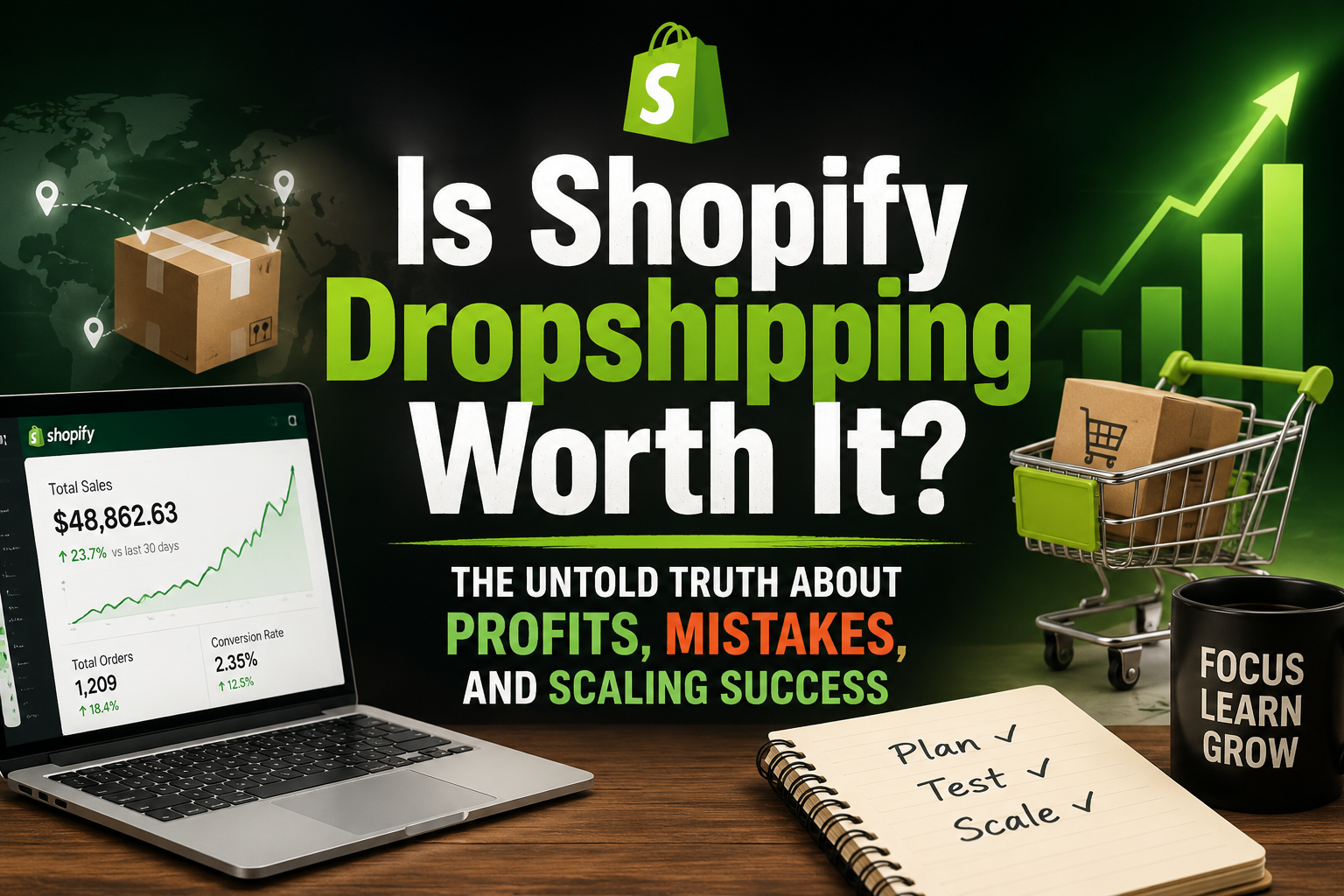
Is Shopify Dropshipping Worth It? The Untold Truth About Profits, Mistakes, and Scaling Success

The crucial takeaway from my Shopify journey is that profit margins are never guaranteed. It requires a detailed cost analysis for each product, realistic ad budget planning, and ongoing testing to truly know what you can earn. My experience taught me that successful dropshipping isn’t just about picking trending products—it’s about understanding all financial levers affecting your store.
The Real Profit Margins Behind Shopify Dropshipping
When I first started Shopify dropshipping, I was convinced that profit margins would be as high as some “guru” blogs suggested—40%, 50%, or even more. Reality hit hard during my first month. I launched a store selling home fitness gear and quickly realized the costs I hadn’t accounted for. The product itself cost $15, shipping another $5, and Facebook Ads for a single sale averaged $18. After refunds, payment processing fees, and returns, my net profit was closer to $3–$5 per item—not the $20–$30 I had dreamed of.
Breaking Down Costs Beyond the Product Price
Many beginners overlook hidden costs. For instance, I spent nearly $200 in the first two weeks just on ad creatives, testing multiple images and copywriting variants to see what resonated with my audience. Each A/B test ate into my margin. I also underestimated the Shopify monthly fee and third-party app subscriptions, which cumulatively reduced my profit percentage. The numbers forced me to rethink my strategy: lower-cost products with faster shipping won over expensive items with flashy descriptions.
Why Margins Vary Drastically Between Niches
Through trial and error, I learned that niches heavily influence real profit. Electronics and accessories had razor-thin margins because competitors could undercut me in price easily. On the other hand, customized items like engraved kitchen tools allowed me to charge a premium despite higher shipping costs. I realized that a product’s apparent selling price isn’t indicative of profitability—demand consistency and fulfillment costs matter far more.
Time vs. Money: The Hidden Costs of Running a Shopify Dropshipping Store
When I tell people I run a Shopify dropshipping store, they often assume the only investment is money. My first store proved otherwise. While I had set aside $1,000 for initial product purchases and ads, I didn’t account for the dozens of hours spent daily on tasks that don’t appear on a P&L sheet. I remember spending an entire Saturday just responding to customer inquiries, some of which were about products I hadn’t personally seen.
The Learning Curve Costs You Can’t Ignore
Before even making my first sale, I invested countless hours learning the Shopify interface, integrating apps for email marketing, and figuring out tax obligations for different regions. Each misstep cost time, and time, in this business, is money. For example, I mistakenly set up a promotion incorrectly, which led to processing 15 refunds manually over a weekend—an effort that could have been automated if I had known better.
Micromanaging Orders and Customer Service
Dropshipping gives the illusion of automation, but without proper systems, it can feel like a full-time job. I personally experienced nights where I had to track delayed shipments from overseas suppliers while simultaneously calming irate customers who hadn’t received their packages. On top of that, reconciling inventory discrepancies between Shopify and suppliers often required me to spend hours on Excel sheets or in email threads—tasks no one mentions in “passive income” blog posts.
The Hidden Opportunity Cost
The most overlooked cost is opportunity cost. While I spent 30–40 hours per week optimizing product listings and ad campaigns, I could have been exploring other revenue streams or developing a brand that doesn’t rely on constant manual intervention. That realization prompted me to rethink automation tools and outsourcing, but in the early stages, every hour spent manually handling orders significantly lowered the return on investment.
Winning and Failing Products: What I Learned from My First 6 Months
During my first six months of Shopify dropshipping, I learned a harsh lesson about what truly counts as a winning product. My first candidate was a trendy LED light strip, heavily promoted on TikTok. Initial sales were promising, but returns piled up because the product often arrived damaged or incompatible with local voltage standards. While some blogs touted it as a “guaranteed viral product,” my experience showed that hype doesn’t equal sustainable profit.
Identifying Products That Actually Scale
After several failures, I discovered that niche products with specific utility and low shipping risk were more profitable. For example, I sold customizable stainless steel water bottles with engraved initials. Despite higher upfront costs, the repeat purchase rate and minimal returns made this product a true winner. I learned to focus not only on trending items but also on durability, shipping reliability, and repeat potential—factors often ignored in quick “hot product” guides.
The Fails That Taught Me More Than Successes
One lesson stood out: failures were more educational than wins. I invested in a set of novelty kitchen gadgets that looked fun in photos but required assembly. Customers complained about poor instructions, leading to chargebacks and refunds. This experience forced me to consider the user experience, packaging quality, and supplier reliability—not just product aesthetics—when selecting items for my store.
Data-Driven Decisions Over Hype
By tracking metrics like cost per acquisition, refund rates, and customer reviews, I was able to pivot to products with predictable profitability. The key insight from my first six months is that success in Shopify dropshipping depends less on chasing trends and more on making informed, data-backed decisions. Real winners are those that balance demand, price, fulfillment reliability, and customer satisfaction.
Shopify Dropshipping vs Selling Through Marketplaces
When I first explored e-commerce, I considered selling on Amazon and eBay because of the built-in traffic and perceived ease. At first glance, marketplaces seemed safer—people are already browsing, and fulfillment options like FBA simplified shipping. But when I actually started a Shopify dropshipping store, I noticed a stark difference in control and branding. On Shopify, I could craft the entire customer experience—from product pages to email sequences—something impossible on marketplaces where branding is secondary.
The Traffic Challenge vs. Freedom
Marketplaces bring immediate traffic but at a cost. Listing fees, referral commissions, and strict marketplace policies cut into my profit margins. On Amazon, for example, a product that sold for $30 only netted me $10 after fees and fulfillment. Shopify, on the other hand, required me to drive traffic through ads, SEO, and social media—a slower start—but allowed me to retain the full profit margin once sales began converting consistently. I realized that Shopify rewards long-term strategy, while marketplaces favor speed and volume.
Customer Relationship and Retention
Another factor that tipped the scale was customer retention. On marketplaces, buyers don’t remember you—they remember the platform. When I started my Shopify store, I collected emails and built a small but loyal subscriber base. For instance, a promotional email about a new product line converted 15% of recipients within two days—a level of engagement I never saw on eBay or Amazon. These relationships are a tangible asset for long-term growth, which marketplaces rarely provide.
Challenges and Trade-Offs
That said, Shopify isn’t without challenges. I had to learn paid advertising, handle customer service directly, and manage fulfillment logistics. Marketplaces eliminate some of these tasks but at the cost of autonomy and profit. Personally, the trade-off was worth it—I gained insight into every step of my business, which empowered me to optimize operations and increase net margins over time.
Automation Tools and Their Real Impact on Scaling a Shopify Store
In my early days of running a Shopify dropshipping store, I handled every order, email, and ad campaign manually. By the end of the first month, I realized I was spending more time executing repetitive tasks than strategizing growth. That’s when I started testing automation tools—apps for inventory syncing, order fulfillment, and email marketing. The transformation was immediate, but not without lessons.
Choosing Tools That Actually Deliver
I experimented with several automation solutions, from generic “all-in-one” apps to specialized software. Many promised to save time but fell short in reliability. For instance, one supplier integration app repeatedly misaligned inventory, causing overselling and unhappy customers. Eventually, I settled on a combination of tools: one for real-time stock updates, another for automatic order forwarding, and a third for personalized abandoned cart emails. This stack reduced my daily operational hours from six to under two, freeing me to focus on ad optimization and product research.
The Real Impact on Profitability
Automation didn’t just save time—it directly affected profitability. By reducing manual errors and shipping delays, I saw fewer refunds and complaints, which preserved my ad spend efficiency. For example, one automated fulfillment system allowed me to scale a single product from 20 to 150 sales per week without adding staff. The real insight was that automation isn’t just convenience; it’s a lever for scaling revenue without proportionally increasing labor costs.
Limitations and Lessons Learned
However, automation is not a silver bullet. Tools require proper configuration, ongoing monitoring, and reliable supplier partnerships. I learned the hard way that over-relying on apps can backfire if suppliers fail to update stock levels or if email sequences feel robotic to customers. The balance is key: automation should handle repetitive, predictable tasks, while you focus on decision-making and customer experience.
Customer Service Nightmares and How They Affected My ROI
When I started my Shopify dropshipping store, I assumed customer service would be minimal—I thought the products would sell themselves. That assumption quickly shattered. Within the first month, I encountered a flood of customer complaints ranging from delayed shipments to defective items. One memorable case involved a set of custom phone cases: a batch was printed incorrectly, and I had to handle over 30 refund requests manually. The time spent on resolving these issues directly ate into my profits, sometimes more than the product cost itself.
How Returns and Refunds Hit My Margins
I learned that refunds and returns are not just isolated losses—they ripple through your financials. For example, a $25 product that required a $10 refund, plus $5 in lost advertising spend, and $2 in payment fees, effectively wiped out the small profit I had on that sale. Multiply this by dozens of incidents, and suddenly your ROI is not just low—it’s negative. I realized that customer service challenges are a hidden cost that many blogs fail to mention.
The Emotional and Operational Toll
Beyond money, handling customer complaints is emotionally taxing. I remember late nights spent responding to angry emails or tracking down shipping issues with overseas suppliers. Each case required careful communication, and mistakes could trigger negative reviews, which in turn affected future conversions. The experience taught me that Shopify dropshipping is as much about managing people as it is about managing products.
Strategies That Helped Me Recover ROI
Through trial and error, I implemented systems that reduced the negative impact of customer service issues. I started preemptively sending order updates, clarified return policies on product pages, and partnered with reliable suppliers who could handle quality control. These small changes improved customer satisfaction and reduced refund requests, ultimately protecting my ROI.



No Comments