


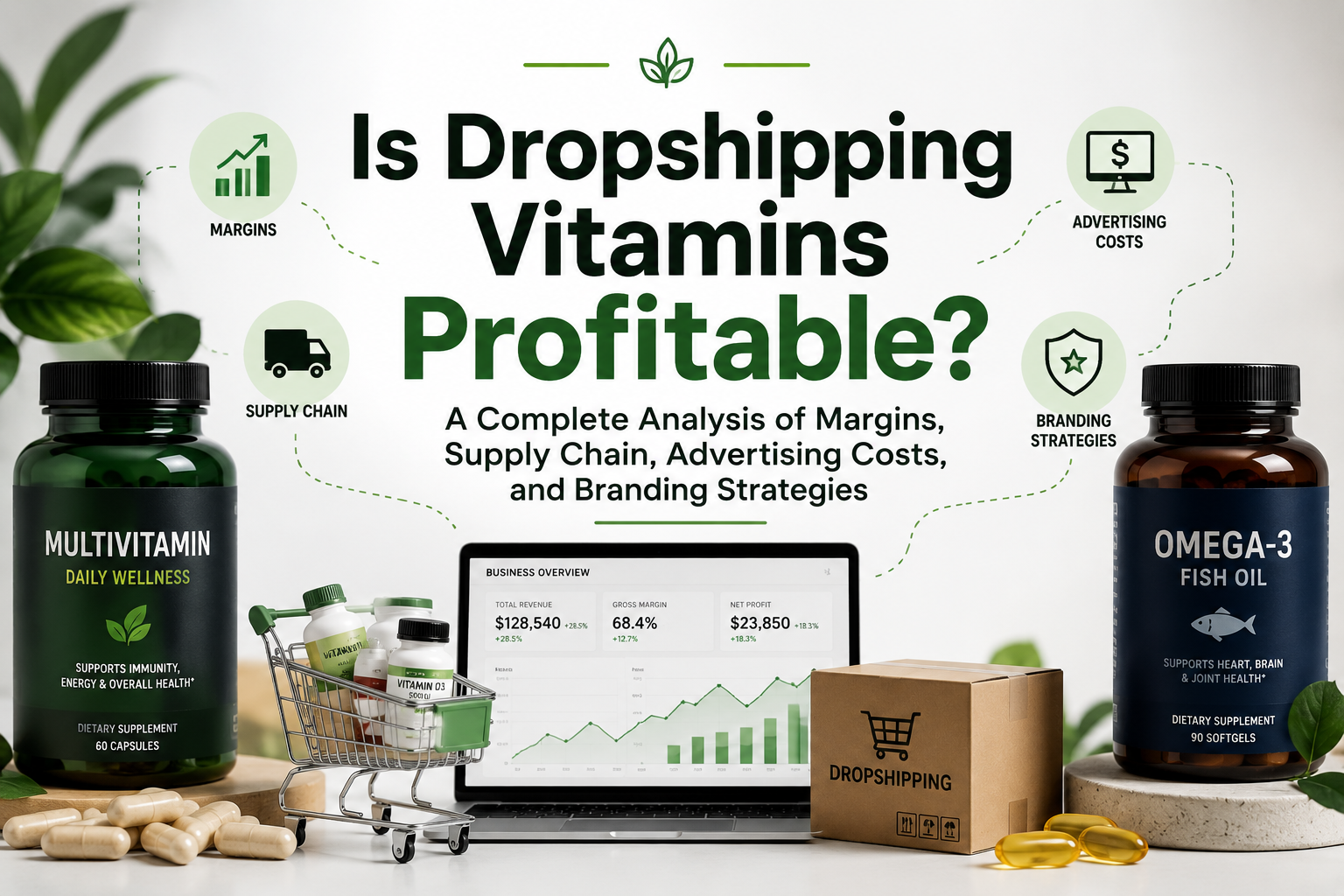
Is Dropshipping Vitamins Profitable? A Complete Analysis of Margins, Supply Chain, Advertising Costs, and Branding Strategies

Is dropshipping vitamins profitable? The answer is conditional. The category offers strong gross margins of 60%–75%, but real profitability depends heavily on customer acquisition efficiency and retention systems.
Without optimized advertising and repeat purchase strategies, net margins can easily fall below 10% or even negative territory. However, with strong branding, controlled CAC, and subscription-based LTV models, vitamin dropshipping can become a scalable 15%–30% net margin business.
A Deep Dive into Profit Margins and Unit Economics of the Supplement Industry
When people ask is dropshipping vitamins profitable, the most common assumption is that supplements are a “high-margin niche.” On the surface, this is partly true. Vitamin and dietary supplement products often retail at 2.5x to 6x markup compared to their sourcing cost, especially in private label or white-label supply chains. A product that costs $2–$4 to manufacture can easily be sold for $15–$30 online.
However, profitability in dropshipping vitamins is not determined by retail markup alone. The real equation depends on unit economics, where advertising costs, transaction fees, shipping, refunds, and compliance overhead significantly reshape net margins.
In most real-world cases, the gross margin may look like 60%–75%, but the net profit margin often drops to 10%–25% once acquisition costs are included.
Gross Margin Reality: Why Vitamins Look More Profitable Than They Are
The supplement industry benefits from low raw material costs and scalable manufacturing. Vitamin C capsules, multivitamins, and collagen powders are inexpensive to produce at scale. In bulk OEM production, unit costs can be as low as:
- Basic multivitamins: $1.50–$3.00 per bottle
- Collagen supplements: $3.00–$6.00 per bottle
- Premium blends (adaptogens, sports nutrition): $4.00–$8.00 per bottle
These products commonly retail between $19.99 and $49.99, depending on branding and positioning. This creates a perceived gross margin of 70%+, which attracts many dropshippers into the niche.
But this is where most beginners miscalculate profitability. Gross margin does not account for customer acquisition costs, which in the supplement industry are among the highest in e-commerce due to competition and advertising restrictions.
Unit Economics Breakdown: Where Profit Actually Goes
To understand whether dropshipping vitamins is profitable, we need to examine a realistic unit economics scenario.
Let’s assume a vitamin product sells for $29.99:
- Product cost (OEM + packaging): $4.50
- Shipping & fulfillment: $3.00
- Platform & payment fees (Shopify + Stripe): $2.00
- Average ad spend per order (CAC): $15–$30
In a conservative scenario where CAC is $22:
Total cost per order = $4.50 + $3.00 + $2.00 + $22 = $31.50
This means the business is already operating at a -5% gross loss per order, before considering refunds or chargebacks.
In better-optimized campaigns where CAC drops to $12–$15, profit becomes viable:
Total cost = $21.50–$24.50
Profit per order = $5–$8 (16%–27% margin)
This explains why many vitamin dropshipping businesses only become profitable at scale or with strong creative optimization.
Why Ad Costs Determine Profitability More Than Product Margins
Unlike impulse products, vitamins require trust, credibility, and often multiple ad exposures before conversion. This increases customer acquisition cost volatility.
On platforms like Facebook Ads and TikTok Ads, supplement niches often see:
- CPM: $8–$20
- CTR: 0.8%–2.5%
- Conversion rate: 1%–3% (cold traffic)
This means even with a high-margin product, inefficiencies in targeting or creative performance can quickly erase profitability.
Brands that succeed in this niche usually reduce CAC through:
- Retargeting funnels
- Influencer-generated content (UGC)
- Subscription bundling strategies
- Email and SMS remarketing
Without these systems, the theoretical margin advantage of vitamins disappears quickly.
The Hidden Profit Advantage: Scalability of Repeat Purchases
Despite high CAC, vitamins have one structural advantage: repeat consumption cycles. Most supplements are consumed over 30–90 days, which opens up lifetime value (LTV) expansion.
If a customer’s first order generates only $5–$10 profit, but they reorder 3–4 times per year, total LTV can reach $60–$150 per customer. This is where vitamin dropshipping becomes genuinely profitable—not from the first sale, but from repeat purchasing behavior.
Regulatory Barriers, Compliance Costs, and Legal Risks in Supplement E-Commerce
When evaluating is dropshipping vitamins profitable, most beginners focus on margins and advertising costs, but the real long-term profitability bottleneck is often regulatory compliance. Unlike general consumer goods, vitamins and dietary supplements sit in a semi-regulated category that is closely monitored in markets like the United States, European Union, Canada, and Australia.
This means profitability is not only a question of sales performance, but also of whether your business can legally operate without interruptions such as ad account bans, product delistings, or customs seizures.
Even if gross margins reach 60%–75%, compliance failures can reduce effective profit to zero through shutdown risk or forced refunds.
Regulatory Landscape in the U.S. and EU: Hidden Cost Structure
In the United States, supplements are regulated under the DSHEA framework (Dietary Supplement Health and Education Act). This allows relatively flexible market entry, but it comes with strict rules on health claims and labeling accuracy.
For example, sellers cannot legally claim that a vitamin “treats” or “cures” diseases. Violating this rule can result in:
- FDA warning letters
- Product removal from Amazon/Shopify payments
- Ad account suspensions
In the European Union, regulations are even stricter. The European Food Safety Authority (EFSA) controls permissible health claims, and non-compliant labeling can lead to full market restrictions in certain countries.
Compliance costs may not always be visible, but they typically include:
- Third-party lab testing: $200–$1,000 per SKU
- Label compliance adjustments: $300–$800 per product line
- Legal consultation for claims: $100–$300 per hour
For small dropshipping brands, these costs can reduce early-stage gross margin from 70% to effectively 40%–50% before even launching ads.
Advertising Compliance: The Silent Profit Killer
One of the most underestimated risks in vitamin dropshipping is advertising policy enforcement.
Platforms like Meta (Facebook/Instagram), TikTok, and Google have strict restrictions on supplement marketing. Ads that imply medical benefits or unrealistic transformation claims often get rejected or result in account bans.
This creates indirect profitability loss through:
- Higher creative testing costs (due to frequent ad disapprovals)
- Account instability requiring backup ad accounts
- Increased CPM due to “restricted category” classification
In practice, supplement brands often see 20%–40% higher CAC volatility compared to non-regulated niches.
For example:
- Standard e-commerce CAC: $10–$25
- Supplement niche CAC: $20–$60+
This increased volatility directly reduces net profit margins, even if product margins remain high.
Cross-Border Dropshipping Risks: Customs, Taxes, and Product Seizure
Another major factor affecting profitability is international logistics compliance. Vitamins are classified as ingestible goods, which means they are subject to customs inspection and import restrictions in many countries.
Common issues include:
- Shipment delays due to customs review
- Product confiscation if labeling is non-compliant
- VAT/GST misclassification in EU and UK markets
These issues can create hidden costs such as:
- Reshipping costs: $3–$8 per order
- Refund rates increasing by 5%–15%
- Customer chargeback risks impacting payment processors
Over time, these friction points can reduce effective net margin by another 5%–10%, especially for new stores without localized supply chains.
Platform Dependency Risk: Shopify, Stripe, and Payment Gatekeepers
Even if a store is legally compliant, it still depends on payment processors. Supplements are considered “high-risk products” by many PSPs (Payment Service Providers), including Stripe, PayPal, and Shopify Payments in certain cases.
This introduces additional profitability constraints:
- Rolling reserves: 5%–10% of revenue held for risk mitigation
- Sudden account freezes during dispute spikes
- Higher chargeback monitoring thresholds
A store with a theoretical 20% net margin may effectively operate closer to 10%–15% real liquidity margin due to capital holdbacks.
Analysis of Supply Chain, Private Label Sourcing, and Cost Advantages in Supplement Manufacturing
When evaluating is dropshipping vitamins profitable, many beginners assume profitability is mainly driven by advertising or branding. In reality, the supply chain structure is one of the strongest determinants of long-term margins in the supplement industry.
Unlike many physical products, vitamins benefit from highly standardized manufacturing processes and low raw material costs. This allows sellers to access relatively high gross margins—often 60% to 80%—if they can control sourcing effectively.
However, the real profitability gap is not between “selling vs not selling,” but between generic reselling models vs optimized private label supply chains.
OEM and White-Label Manufacturing: Why Costs Are So Low
Most vitamin dropshipping businesses rely on OEM (Original Equipment Manufacturer) or white-label suppliers. These factories already produce standardized formulas at scale, which significantly reduces unit costs.
Typical factory pricing structure:
- Basic multivitamin capsules: $1.20–$3.00 per bottle
- Collagen supplements: $3.00–$6.50 per bottle
- Specialized formulas (sleep, immunity, sports nutrition): $4.00–$9.00 per bottle
These products are then resold at retail prices between $19.99 and $59.99, depending on branding and positioning.
This creates a theoretical markup of 3x to 8x, which is significantly higher than most general e-commerce categories.
However, this margin advantage only translates into real profit when supply chain efficiency is maintained. Poor sourcing decisions can quickly erode margins through quality issues, refunds, or shipping delays.
Private Label Strategy: The Real Driver of High Margins
Private label is where vitamin dropshipping becomes structurally more profitable. Instead of reselling generic products, sellers customize packaging, branding, and sometimes formula composition.
Private label advantages include:
- Increased perceived value, allowing 20%–100% higher retail pricing
- Better differentiation in saturated markets
- Improved customer retention due to brand recognition
For example:
A generic supplement may sell at $19.99, but a private label version with similar production cost can often be positioned at $29.99–$39.99, increasing gross margin from 60% to 75%+.
In high-performing cases, brands with strong positioning achieve 80%+ gross margins, especially in niche segments like sleep aids or women’s health supplements.
Hidden Supply Chain Costs That Reduce Profitability
Although manufacturing costs are low, dropshipping vitamins still includes hidden supply chain expenses that reduce actual profit margins.
These include:
- Packaging customization: $0.50–$2.00 per unit
- Quality testing (third-party lab verification): $300–$1,000 per batch
- International shipping (dropshipping model): $2.50–$6.00 per order
- MOQ inefficiencies (for custom branding): increased upfront cost per unit
These costs often reduce the theoretical 70% gross margin down to 45%–60% effective margin, especially in early-stage operations without scale.
Additionally, inconsistent supplier quality can lead to refund rates of 5%–12%, which further impacts net profitability.
Supply Chain Speed vs Profit Tradeoff
Dropshipping vitamins often relies on cross-border fulfillment, typically from manufacturing hubs in China, the U.S., or Europe. This introduces a tradeoff between cost efficiency and delivery speed.
- Low-cost suppliers (China-based): higher margins, but 7–20 day shipping
- Local fulfillment (US/EU warehouses): lower margins, but 2–5 day delivery
Faster delivery improves conversion rates by 15%–35% in many supplement niches, but it also increases per-unit logistics cost.
This creates a strategic decision:
Either maximize gross margin (slow shipping model) or maximize conversion efficiency (local fulfillment model). Both impact final profitability differently.
Scalability Advantage: Why Supply Chain Becomes More Profitable at Volume
One of the strongest arguments for vitamin dropshipping profitability is scalability. As order volume increases, suppliers typically offer:
- Lower unit costs (bulk pricing discounts of 10%–30%)
- Better shipping rates
- Custom formulation flexibility
- Reduced packaging costs per unit
At scale, a product that initially yields 15%–20% net margin can improve to 25%–35%+ net margin purely through supply chain optimization.
This is why many successful supplement brands transition from dropshipping to hybrid or in-house fulfillment models after reaching consistent revenue.
Breakdown of Customer Acquisition Cost (CAC), Ads Performance, and Supplement Marketing Economics
When analyzing is dropshipping vitamins profitable, most beginners focus on product margins or supplier pricing. But in reality, the single biggest factor that determines success or failure is Customer Acquisition Cost (CAC).
Vitamins belong to a highly competitive, trust-driven advertising category. Even though gross margins can reach 60%–75%, the profitability equation is often decided before the product is even sold—inside the ad auction system.
In most real cases, supplement brands do not fail because they lack demand, but because CAC exceeds per-order gross profit.
Typical CAC Structure in the Supplement Industry
Across Meta Ads (Facebook/Instagram), TikTok Ads, and Google Ads, vitamin products tend to fall into a higher-cost acquisition bracket due to competition and policy restrictions.
Average benchmarks:
- Cold traffic conversion rate: 1%–3%
- CPM (cost per 1,000 impressions): $8–$20
- CPC (cost per click): $0.80–$2.50
- Average CAC range: $20–$60 per customer
Now compare this to a typical vitamin product:
- Selling price: $24.99–$39.99
- Gross profit per order: $10–$25
This creates a fragile balance where profitability depends entirely on how efficiently ads are optimized.
If CAC rises above $30–$40, many stores instantly move into breakeven or negative territory.
Why Supplement Ads Are Expensive Compared to Other Niches
Vitamin dropshipping sits in a restricted advertising environment. Platforms treat supplements as “sensitive health-related products,” which increases both competition and cost pressure.
Key reasons CAC is high:
First, high advertiser density means more brands bidding for the same audiences, especially in wellness, fitness, and beauty segments. This drives CPM inflation, often above $15–$20 in competitive geos like the US and UK.
Second, creative fatigue is extremely fast. Because supplements rely heavily on lifestyle and UGC-style ads, winning creatives often last only 7–21 days before performance drops, increasing testing costs.
Third, trust barrier increases conversion friction. Cold traffic rarely converts immediately without multiple touchpoints, which raises blended CAC through retargeting layers.
Example Unit Economics: Where Profit Breaks or Works
Let’s model a realistic vitamin dropshipping order:
- Product price: $34.99
- Product + shipping cost: $7.50
- Platform fees: $2.50
- Gross profit before ads: $24.99
Now apply advertising cost scenarios:
Scenario A (unprofitable scale)
- CAC: $35
Net result: -$10 loss per order
Scenario B (average performance)
- CAC: $25
Net result: ~$0–$5 profit per order
Scenario C (optimized funnel + strong creatives)
- CAC: $15
Net result: $9–$12 profit per order (~25%–35% margin)
This shows clearly that profitability is not product-driven—it is marketing-efficiency-driven.
How Successful Brands Reduce CAC in Vitamin Dropshipping
Profitable supplement brands do not rely on raw paid ads alone. They systematically reduce CAC through multi-layer optimization.
Common approaches include:
Brands use UGC (user-generated content) to increase ad relevance and lower CPM, which directly reduces CPC.
They also implement retargeting funnels, where only a small percentage of cold traffic is expected to convert immediately, while the rest is nurtured through email, SMS, and dynamic ads.
Another major lever is offer engineering, such as bundling (Buy 2 Get 1 Free) or subscription discounts, which increases conversion rate from 1.5% to 3%+, effectively halving CAC.
Some mature brands also use influencer seeding, which reduces paid acquisition dependency and stabilizes blended CAC over time.
Breakdown of Branding, Trust Building, and Conversion Rate Optimization in Supplement E-Commerce
When analyzing is dropshipping vitamins profitable, many sellers underestimate one critical factor: trust conversion efficiency. Unlike impulse-buy products, vitamins are part of the health and wellness category, where customers are extremely sensitive to credibility, safety, and perceived quality.
Even if gross margins are high—typically 60% to 75%—poor branding can reduce conversion rates so significantly that the business becomes unprofitable. In contrast, strong branding can multiply revenue without changing product cost at all.
In this niche, branding is not just positioning—it is a direct profit multiplier through conversion rate optimization (CRO).
How Trust Directly Impacts Conversion Rates
In supplement e-commerce, traffic alone does not generate profit. Conversion efficiency determines whether advertising spend becomes revenue or loss.
Typical benchmarks:
- Weak/no branding stores: 0.8%–1.5% conversion rate
- Average supplement brands: 1.5%–2.5% conversion rate
- Strong branded supplement stores: 3%–5%+ conversion rate
This difference is massive. A store with a 4% conversion rate can generate 2–3x more revenue from the same ad spend compared to a 1.5% store.
Since CAC is relatively fixed, improving conversion rate directly increases net profit margin without increasing traffic cost.
The Role of Visual Identity and Perceived Quality
In vitamin dropshipping, consumers rarely evaluate raw ingredients directly. Instead, they rely on visual signals of trust.
High-performing supplement brands invest heavily in:
- Minimalist packaging design
- Clinical-style branding (white, blue, medical aesthetics)
- Third-party testing badges (GMP, FDA facility compliance)
- Clean typography and pharmaceutical positioning
These elements increase perceived legitimacy, which directly improves conversion rates.
For example, changing packaging perception alone can increase conversion rates from 1.8% to 2.8%–3.5%, which can improve net profit per ad campaign by 30%–60% without altering product cost.
UGC, Influencer Proof, and Social Validation Effects
User-generated content (UGC) is one of the strongest conversion drivers in supplement marketing. Because vitamins are trust-based products, customers want proof from real users rather than brand claims.
Common trust-building mechanisms include:
- Before/after testimonials (especially for beauty or fitness supplements)
- Influencer endorsements (micro-influencers often perform better than celebrities)
- Customer reviews with visual proof
- “Real people using it” ad creatives
Stores that integrate strong UGC strategies often see conversion rate increases of 1.5x to 2.5x, significantly improving profitability even when CAC remains unchanged.
CRO (Conversion Rate Optimization) as a Profit Multiplier
Conversion rate optimization is often the hidden engine behind profitable vitamin dropshipping businesses. Small improvements in conversion can dramatically change unit economics.
For example:
A store generating 10,000 visitors/month at:
- 1.5% conversion = 150 orders
- 3.0% conversion = 300 orders
If average profit per order is $8, revenue jumps from $1,200 to $2,400, without increasing ad spend.
This shows why CRO is often more powerful than marginal improvements in product cost or supplier negotiation.
The Psychology Behind Vitamin Purchases
Vitamin buyers are not just buying products—they are buying health reassurance. This creates a unique psychological environment where emotional trust outweighs rational comparison.
Three key psychological drivers affect profitability:
First, risk reduction. Customers want assurance that the product is safe and effective, which increases reliance on branding signals.
Second, authority bias. Products that appear clinically backed or professionally formulated convert significantly better.
Third, consistency perception. Brands that look stable and long-term reduce perceived purchase risk, increasing checkout completion rates.
These psychological triggers directly influence whether traffic converts into profit or is wasted.


No Comments