


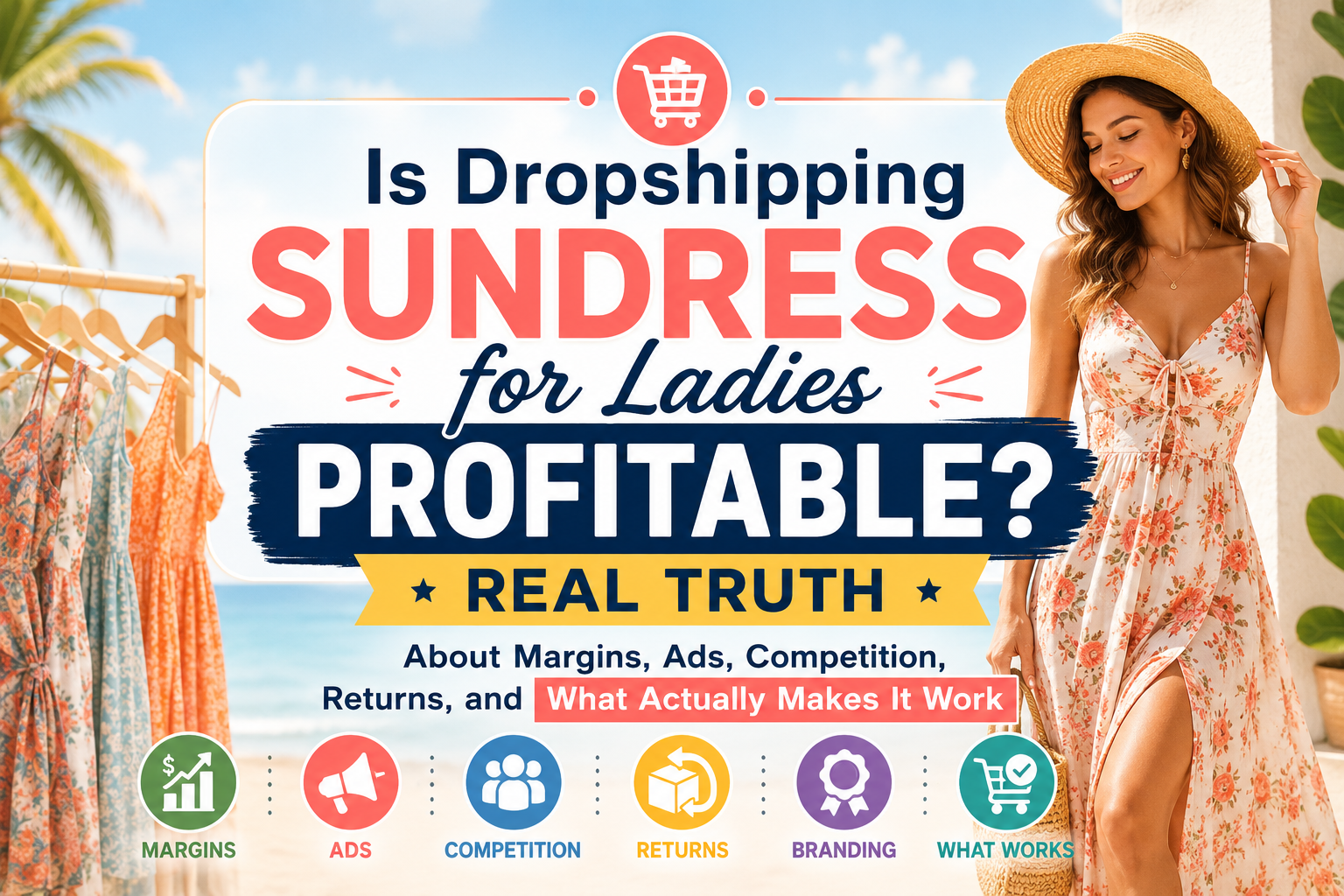
Is Dropshipping Sundress for Ladies Profitable? Real Truth About Margins, Ads, Competition, Returns, and What Actually Makes It Work

Dropshipping sundresses for ladies can be profitable, but only when treated as a seasonal demand business rather than a stable evergreen store model. The real determining factor is not the product itself, but how well a seller understands and exploits the short seasonal window where demand, attention, and advertising efficiency align.
Without proper timing strategy, the same product that looks highly profitable in June can become unprofitable by September.
Seasonal Demand & Market Timing: The Core Driver of Sundress Profitability
Sundress products for women are heavily tied to seasonal lifestyle behavior rather than consistent daily demand. Unlike essentials such as basic tees or home goods, sundresses are primarily purchased during spring and summer when outdoor activities, vacations, and social events increase. This means profitability in dropshipping is not determined by steady sales, but by short, concentrated demand spikes.
In practical terms, most sellers will experience a strong revenue window from March to August in the Northern Hemisphere, followed by a sharp decline in colder months. This creates a business model that looks highly profitable on paper for half the year, but significantly underperforms during the rest.
The “Burst Demand” Effect and Why It Misleads Beginners
One of the most common mistakes new dropshippers make is interpreting seasonal spikes as stable demand. Sundresses often perform extremely well during early summer TikTok trends or Instagram fashion waves, where engagement and impulse buying behavior increase sharply.
However, this creates a “burst demand illusion.” Sales graphs may show rapid growth in a short period, leading sellers to scale ads aggressively. Once the seasonal trend cools down, conversion rates drop quickly while ad costs remain the same or even increase due to competition saturation. This mismatch is where many beginners lose profitability.
How Timing Impacts Advertising Efficiency
Timing is a critical factor in whether sundress dropshipping becomes profitable or not. During peak season, platforms like TikTok and Facebook favor fashion content, resulting in lower CPMs and higher engagement rates. A well-positioned sundress ad can achieve strong return on ad spend (ROAS) simply due to natural audience interest.
Outside of peak season, the same ads often struggle. Users are not actively searching for summer clothing, which leads to weaker click-through rates and higher cost per purchase. This creates a scenario where profitability is not just product-dependent, but timing-dependent.
Inventory Momentum and the Short Lifecycle Problem
Another key factor is product lifecycle speed. Sundresses typically trend fast and fade fast. A design that goes viral in early summer may become oversaturated within weeks as multiple stores replicate it.
This short lifecycle means that successful dropshipping stores must constantly refresh creatives, test new designs, and adapt quickly to trend cycles. Without this agility, even a previously profitable product can become unprofitable within a single season.
Strategic Insight: How Profitable Sellers Actually Approach It
Experienced dropshippers do not treat sundresses as a standalone “always-on” product. Instead, they treat it as a seasonal cash-flow asset. The goal is to maximize profit within a limited timeframe, then rotate into complementary niches such as beachwear, vacation outfits, or transitional spring fashion.
Some also pre-build audiences in early spring using content marketing, so that when peak season arrives, conversion costs are significantly lower. This approach shifts profitability from reactive advertising to planned seasonal execution.
Profit Margins in Sundress Dropshipping: What You Actually Keep
At first glance, sundress dropshipping looks highly profitable because of the wide price gap between sourcing and retail pricing. Many suppliers offer women’s sundresses for around $8–$18 per unit, while online stores commonly sell them for $29.99 to $59.99. This creates the impression of a strong 2–4x markup potential.
However, this gross margin is misleading. The real profitability is determined after subtracting advertising costs, transaction fees, returns, and shipping delays-related losses. Once these are included, the net margin is significantly smaller than beginners usually expect.
Supplier Pricing Reality: Low Cost Doesn’t Mean High Profit
The Hidden Quality Spectrum Behind Cheap Dresses
Sundress suppliers are not uniform in quality. On platforms like AliExpress or general wholesale marketplaces, similar-looking products can vary dramatically in fabric quality, stitching, and sizing consistency. The cheapest options often lead to higher return rates, which directly reduce profit.
More reliable private suppliers or branded OEM manufacturers typically charge higher unit costs, often $15–$25 per dress. While this reduces margin on paper, it can actually improve profitability by lowering refund rates and increasing customer satisfaction.
Shipping Cost and Time as a Silent Margin Killer
Another overlooked cost factor is shipping. Free or low-cost shipping options often come with long delivery times of 10–20+ days. Faster shipping methods, especially for US or EU customers, can add $4–$12 per order depending on fulfillment origin.
In fashion dropshipping, delivery time directly affects conversion rates and refund requests. A delayed sundress order during summer season often leads to chargebacks or refund demands, which quietly erode profit margins even if initial sales look strong.
Advertising Costs: The Largest Variable in Profitability
Why CAC Determines Whether You Actually Make Money
In sundress dropshipping, the biggest cost is almost always customer acquisition (CAC). On TikTok and Facebook Ads, fashion products are highly competitive. Even with a strong creative, cost per purchase can range from $8 to $25 depending on targeting and creative fatigue.
If your sundress sells for $39.99 and your ad cost per purchase is $18, your remaining margin is already compressed before accounting for product cost and shipping. This is why many stores with “high revenue” still operate at break-even or slight loss.
Platform Fees and Transaction Deductions
Beyond advertising, Shopify fees, payment processor charges, and app subscriptions further reduce profit. Stripe or PayPal typically takes around 2.9% + fixed fees per transaction, and Shopify plans add another recurring cost layer.
While these seem small individually, they accumulate quickly when scaling. A store generating $10,000 monthly revenue may lose several hundred dollars purely to platform-related fees.
Returns and Refunds: The Silent Profit Destroyer
Size Issues and Expectation Gaps
Sundresses are particularly vulnerable to sizing problems. Unlike accessories, clothing fit is subjective and varies across suppliers. Even a 5–10% mismatch rate can lead to frequent refunds or replacement requests.
Each return not only removes revenue but also adds shipping and handling costs, which are often not recoverable. In many cases, a single return can wipe out the profit from 2–3 successful sales.
Realistic Net Profit Range in Practice
After combining all factors—product cost, shipping, ads, fees, and returns—the actual net profit margin for sundress dropshipping is usually far lower than expected. Instead of the assumed 30–50% gross margin, most sustainable stores operate in the range of 8–20% net profit when managed efficiently.
Stores that rely on unstable suppliers or inefficient advertising often fall below this range and struggle to scale profitably.
Advertising Performance: The Real Profit Engine Behind Sundress Dropshipping
In dropshipping, sundress products for women are not typically driven by organic search or long-term SEO demand. Instead, they rely heavily on paid advertising platforms such as TikTok Ads, Facebook Ads, and Instagram Reels. This makes advertising performance the central factor in determining whether the business is profitable or not.
Because sundresses are visually driven products, they naturally perform better in feed-based social media environments. A strong creative can generate rapid engagement, clicks, and even viral exposure. However, this also means profitability is tightly linked to ad efficiency rather than product uniqueness or brand loyalty.
TikTok Ads: High Engagement but Unstable Conversion Quality
TikTok is often the first platform where sundress products appear to “explode” in sales. The short-form video format is ideal for showcasing outfits, lifestyle aesthetics, and seasonal fashion transitions. When paired with trending music and influencer-style content, sundresses can generate extremely high click-through rates compared to other niches.
The algorithm also rewards early engagement, meaning a single strong creative can rapidly scale impressions without large budgets. This creates the illusion of easy profitability, especially for beginners who see early sales spikes.
Despite high engagement, TikTok traffic often lacks strong purchase intent. Many users interact with sundress ads out of curiosity or entertainment rather than immediate buying motivation. This creates a conversion gap where CTR is high but actual purchase rates remain inconsistent.
As a result, advertisers may see impressive metrics such as thousands of views and hundreds of clicks, but only a small fraction convert into paying customers. This gap becomes more noticeable when scaling ad spend beyond initial testing phases.
Facebook Ads: Stable Targeting but Higher Cost Pressure
Facebook Ads remain a key channel for sundress dropshipping because of its advanced targeting capabilities. Interest-based targeting (fashion, summer wear, vacation outfits) allows advertisers to reach more defined customer segments compared to TikTok’s broader distribution model.
In theory, this should improve conversion efficiency. However, in practice, the platform is highly saturated with fashion advertisers, especially in seasonal periods.
One of the biggest challenges in Facebook advertising for sundresses is increasing CPM (cost per thousand impressions). As more advertisers compete for the same audience, bidding costs rise, especially during spring and summer seasons.
This leads to a situation where even well-optimized campaigns experience declining ROAS over time. Ads that were profitable in early testing phases often become marginal or unprofitable after scaling due to audience fatigue and creative saturation.
Creative Quality: The True Differentiator in Performance
For sundress products, creative quality often has more impact than audience targeting. High-performing ads usually focus on lifestyle storytelling rather than product features. For example, showcasing vacation scenes, beach walks, or summer events tends to outperform static product images.
This is because sundresses are emotionally driven purchases. Customers are not just buying clothing; they are buying an identity or experience. Ads that fail to communicate this emotional angle typically struggle regardless of budget.
Another major issue is creative fatigue. In the sundress niche, winning ads often have a very short lifespan—sometimes only 2–4 weeks before performance declines. As competitors copy winning creatives, audience saturation increases and engagement drops.
This forces advertisers into a continuous testing cycle, where new creatives must constantly be produced to maintain profitability. Without this pipeline, ad accounts quickly become unprofitable.
Even when ads perform well, conversion rates can still limit profitability. Many sundress stores face issues such as slow landing pages, unclear sizing information, or lack of trust signals. These friction points reduce the likelihood that users will complete a purchase.
In fashion dropshipping, even a small drop in conversion rate can significantly impact overall ROI, especially when ad costs are already high.
Competition Pressure: Why Sundress Dropshipping Is Harder Than It Looks
The sundress niche in dropshipping is often perceived as an easy entry point because the products are visually appealing, inexpensive to source, and simple to list on a store. However, this same low barrier to entry is exactly what creates intense competition.
Thousands of new sellers enter the women’s fashion space every year, especially during spring and summer seasons. Most of them source from the same suppliers and sell very similar designs. As a result, differentiation becomes extremely difficult, and pricing pressure increases quickly.
In practice, this means that even if demand is strong, the number of sellers competing for that demand grows at an even faster rate, which compresses profitability across the market.
Fast Saturation Cycle: How Winning Products Lose Value Quickly
Sundress products often follow a predictable pattern: initial discovery, viral exposure, rapid replication, and eventual saturation. When a design first appears on TikTok or Instagram, it may generate strong early sales for a few stores. However, once it gains traction, other sellers quickly copy it.
Within a short time, the same product can appear across dozens or even hundreds of stores. This oversupply reduces its perceived uniqueness and forces sellers to compete primarily on price or advertising efficiency rather than product differentiation.
The result is a fast saturation cycle where winning products lose their profit advantage within weeks.
The Impact of Big Platforms Like Shein and Temu
One of the biggest challenges in sundress dropshipping is not just competition from other small stores, but from large fast-fashion platforms such as Shein and Temu. These companies operate at scale, offering extremely low prices, fast shipping, and constantly updated designs.
For independent dropshippers, this creates a structural disadvantage. Even if a store manages to find a trending sundress, larger platforms can often replicate similar styles at lower prices and with stronger brand trust.
This forces independent sellers into a difficult position where they must either compete on price—which is often unsustainable—or attempt to differentiate through branding and marketing, which requires higher investment.
Price Competition and Margin Compression
As more sellers enter the same product space, price competition becomes inevitable. Many stores begin lowering their retail price to attract clicks and conversions, especially when running paid ads.
However, lowering prices directly reduces already thin profit margins. In some cases, sellers may break even or operate at a loss simply to maintain traffic and ad performance.
This creates a downward pressure loop: more competition leads to lower prices, which reduces profit per sale, which then forces sellers to increase volume just to maintain income.
Advertising Competition Amplifies Saturation Effects
Competition in sundress dropshipping is not limited to product listings—it also extends to advertising platforms. On TikTok and Facebook, multiple sellers often target the same audience segments, such as “women’s summer fashion” or “vacation outfits.”
As more advertisers bid for the same audience, CPM (cost per thousand impressions) increases. This makes it more expensive to acquire customers, even if the product itself is popular.
Over time, this reduces the effectiveness of previously profitable ad campaigns and forces constant optimization and creative rotation just to maintain performance.
Is There Still Room for New Entrants?
Despite high saturation, opportunities still exist, but they are no longer in generic sundress products. Instead, profitability tends to come from micro-positioning within the niche.
Examples include targeting specific audiences such as petite sizing, modest fashion, vacation resort wear, or eco-friendly fabrics. These sub-niches reduce direct competition and allow for stronger branding differentiation.
Without this level of segmentation, new stores entering the market often struggle to achieve stable profitability due to direct competition with established sellers and fast-fashion giants.
Returns and Customer Experience: The Hidden Cost Center in Sundress Dropshipping
In dropshipping, sundresses for women belong to one of the highest-risk product categories from a customer experience perspective. Unlike electronics or accessories, clothing introduces subjective fit expectations, body-type variability, and style interpretation gaps. These factors make returns and refunds significantly more common.
While many sellers focus on traffic and conversion rates, they often underestimate how post-purchase issues directly impact real profitability. In practice, a store can generate strong sales but still lose money due to returns, disputes, and customer dissatisfaction.
Sizing Issues: The Core Driver of Refund Requests
One of the most common problems in sundress dropshipping is inconsistent sizing standards. A “medium” from one supplier may fit like a “small” or even “large” from another. Since most suppliers are based in different manufacturing regions, there is no universal sizing standard.
Customers purchasing online expect consistency, especially in fashion. When the product does not match expectations, even if the visual design is accurate, refund requests become likely. This is especially true for first-time buyers who are unfamiliar with the brand.
Even when sizing charts are provided, customers often rely on their past shopping experience rather than measurements. This creates a persistent expectation gap between what is shown in product listings and how the garment actually fits in real life.
Sundresses, in particular, are sensitive to body proportions such as waist placement, bust elasticity, and fabric stretch. A small deviation in fit can significantly affect customer satisfaction, leading to returns or negative reviews.
Return Rates and Their Direct Impact on Profitability
In dropshipping, even a relatively small return rate can significantly reduce net profit. For sundress products, return rates can range from 5% to over 20%, depending on supplier quality and customer targeting.
Each return not only removes revenue but also introduces additional costs such as shipping fees, restocking losses (if applicable), and customer service time. In some cases, sellers may also need to issue partial refunds or allow customers to keep the product, which further reduces profitability.
A store that appears profitable based on gross sales can quickly become unprofitable once return-related costs are fully accounted for.
Shipping Delays and Expectation Management
Sundress dropshipping often relies on overseas suppliers, which means delivery times can range from 7 to 20+ days depending on logistics routes. While this is common in dropshipping, it becomes a major issue in seasonal fashion.
Customers purchasing sundresses typically intend to use them for upcoming events such as vacations, parties, or holidays. If the product arrives late, dissatisfaction increases dramatically, even if the product itself is acceptable.
This mismatch between purchase intent and delivery timing is one of the most underestimated causes of refunds and chargebacks.
Customer Support Load and Operational Pressure
Compared to non-fashion niches, sundress stores require significantly more customer support interaction. Common inquiries include sizing questions, delivery tracking, exchange requests, and refund complaints.
This creates an operational burden that increases with order volume. While outsourcing customer service is possible, it adds additional fixed costs that reduce net margins.
As a result, scaling a sundress dropshipping store is not only a marketing challenge but also a logistics and support scalability challenge.
Chargebacks and Payment Risk
Credit card chargebacks are more common in fashion dropshipping than in many other niches. Customers who are unhappy with fit, quality, or delivery time may bypass refund policies and directly initiate disputes through their payment provider.
Chargebacks are particularly damaging because they often include additional fees and can negatively impact merchant account standing. A high dispute rate may even lead to payment processor restrictions over time.
This introduces a financial risk layer that is rarely considered in early-stage profitability calculations.
Trust Building as a Profit Protection Strategy
The most effective way to protect profitability in sundress dropshipping is not just lowering costs, but reducing post-purchase friction. Stores that provide detailed sizing guides, real model photos, and realistic shipping expectations tend to experience lower return rates.
Clear communication reduces the gap between customer expectations and reality. Even small improvements in transparency can significantly improve long-term profitability by lowering refund frequency and increasing customer satisfaction.
Branding vs Generic Stores: The Real Divider Between Profit and Loss
In the sundress dropshipping niche, many sellers operate under a generic store model. They list trending products, run ads, and compete primarily on price and visuals. While this approach can generate short-term sales spikes, it rarely leads to stable or scalable profitability.
The core issue is lack of differentiation. When multiple stores sell nearly identical sundresses sourced from the same suppliers, customers perceive no meaningful difference between brands. This forces competition to shift toward price and ad efficiency, both of which have limited long-term sustainability.
Generic Store Model: Fast Revenue, Thin Margins
Generic dropshipping stores rely heavily on rapid product testing. Sellers continuously launch new sundress designs, test ads, and scale winners temporarily. This model is built for speed rather than long-term brand equity.
While this approach can create bursts of revenue, it is unstable. Once an ad creative loses performance or a product becomes saturated, sales drop quickly. There is no customer retention mechanism, meaning every sale must be reacquired through paid traffic.
As a result, profit is inconsistent and heavily dependent on advertising efficiency. When ad costs rise or competition increases, margins quickly shrink.
Branding Model: Turning Sundresses into a Perceived Value Product
A branded sundress store operates on a fundamentally different logic. Instead of selling a generic product, it sells a lifestyle, identity, or aesthetic direction. This shift allows the same product to be sold at a higher perceived value.
Branding introduces emotional positioning. For example, a sundress is no longer just a summer dress—it becomes part of a “vacation aesthetic,” “romantic coastal lifestyle,” or “minimalist European fashion identity.” This perception allows stores to charge higher prices without directly competing on cost.
One of the most important advantages of branding is pricing flexibility. While generic stores may struggle to raise prices beyond market averages, branded stores can often charge 20%–80% more for visually similar products.
This pricing power directly improves profit margins. Even if advertising costs remain the same, higher average order value (AOV) and stronger perceived value create more room for net profit after expenses.
Customer Retention: The Missing Profit Layer in Generic Stores
Generic dropshipping stores typically rely on one-time purchases. Customers rarely remember the store name, and there is no incentive to return. This creates a constant need for paid acquisition.
Branded stores, however, can build repeat customer behavior. When customers identify with a brand aesthetic, they are more likely to return for new seasonal collections or related products.
Even a small increase in repeat purchase rate significantly improves long-term profitability because it reduces dependence on paid ads.
Marketing Efficiency: Branding Improves Ad Performance Over Time
Branding also improves advertising efficiency. When users recognize or trust a brand, they are more likely to click and convert. This leads to higher click-through rates and improved conversion rates over time.
In contrast, generic stores must constantly “prove trust” with every ad. This increases friction in the conversion process and often leads to higher customer acquisition costs.
Over time, branded stores tend to develop stronger pixel data, better retargeting performance, and more stable ROAS compared to non-branded competitors.
Long-Term Scalability: Stability vs Constant Reset
The biggest difference between branding and generic models is scalability. Generic stores must continuously restart the cycle: find product, run ads, scale, and replace when saturated. There is no compounding value.
Branded stores accumulate value over time. Customer lists, social media presence, and brand recognition all contribute to lower future acquisition costs and higher conversion efficiency.
This compounding effect is what ultimately determines long-term profitability in competitive niches like sundresses.




No Comments