


Is Dropshipping Summer Tops Profitable? A Complete Guide to Seasonal Demand, Margins, Ads, Niches, Branding, and Competition Dynamics

Dropshipping summer tops is profitable primarily because of predictable seasonal spikes, high conversion intent, and strong social media alignment. However, its profitability is not linear—it is compressed into short, high-intensity windows where speed, testing, and ad optimization determine outcomes. When executed correctly, the model can produce strong short-term returns, but it requires precise timing and continuous product iteration to maintain consistent success.
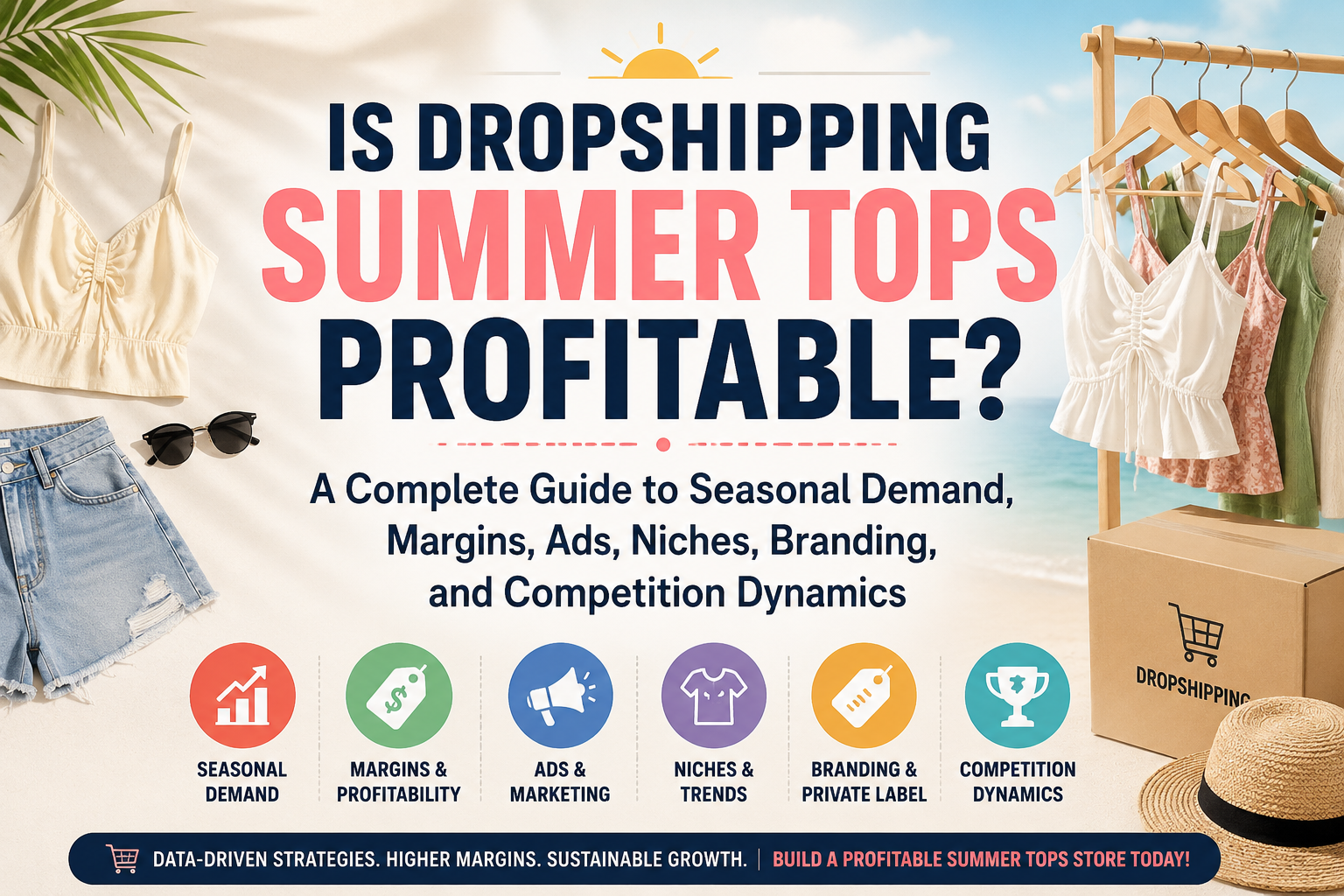
Is Dropshipping Summer Tops Profitable? Seasonal Demand Cycles and Sales Peaks
Dropshipping summer tops sits in a category where profitability is heavily shaped by seasonality rather than stable year-round demand. Unlike evergreen products such as phone accessories, summer tops typically concentrate a large portion of their annual sales in a narrow time window from late spring to mid-summer. Industry-level ecommerce patterns show that apparel seasonality can lead to 40%–65% of yearly revenue being generated within a 10–14 week peak period.
This concentration is not a weakness in dropshipping—it is often the main source of profit. Because suppliers maintain stable low-cost production year-round, while consumer demand spikes sharply, sellers can capture temporary pricing inefficiencies. In practice, wholesale costs for summer tops often remain between $2 and $6, while retail pricing during peak season can range from $12 to $28, producing gross margins of approximately 40% to 70% before advertising costs.
Why Seasonal Spikes Increase Conversion Efficiency
The profitability of summer tops is closely tied to consumer intent. During warm months, buyers are not browsing abstract fashion ideas—they are actively searching for immediate-use clothing. This urgency significantly increases conversion rates.
In paid traffic channels such as TikTok Ads and Instagram Reels, seasonal apparel products often see click-through rates between 1.5% and 3%, with conversion rates ranging from 2% to 5% when creative quality is strong. Compared to off-season fashion campaigns, which may struggle to exceed 1%–2% conversion rates, seasonal demand effectively lowers customer acquisition friction.
This improved efficiency directly impacts profitability. Even if cost per purchase rises to $6–$12 in competitive ad environments, high-intent seasonal traffic helps maintain positive return on ad spend (ROAS) in the range of 1.8 to 3.5, which is typically the minimum threshold for sustainable dropshipping operations.
The Short Lifecycle Advantage of Summer Tops
One of the most misunderstood aspects of summer tops is their short product lifecycle. Many beginners assume short lifecycle equals higher risk, but in dropshipping it often translates into faster capital turnover and lower long-term holding risk.
A typical winning summer tops design may remain profitable for only 3 to 8 weeks before saturation begins. However, within that window, sellers can scale aggressively. For example, a product with a $5 landed cost and $18 average selling price can generate around $7–$9 net profit per unit after ads during peak performance weeks.
This rapid lifecycle encourages iterative testing rather than long-term inventory reliance. Successful sellers often test 10–20 designs per month, allowing even a 10%–20% winning rate to produce consistent overall profitability.
How Seasonal Trends Amplify Social Media Virality
Seasonality does not act alone. It interacts strongly with social media algorithms, particularly TikTok’s interest-based distribution system. Summer fashion content naturally aligns with lifestyle, travel, and aesthetic-driven content streams, increasing organic reach potential.
During peak months, summer tops benefit from “contextual virality,” where users are already engaging with vacation, beach, and outdoor content. This increases unpaid impressions and reduces dependency on paid ads. In some cases, organic traffic can account for 20%–40% of total sales during strong viral cycles.
This amplification effect improves overall margins by reducing blended customer acquisition cost. Even a small reduction in ad dependency—such as lowering CPA from $10 to $7—can increase net profitability by 15%–25% depending on pricing structure.
Profitability Reality: Seasonal but Scalable
From a financial perspective, dropshipping summer tops is not a stable-margin business but a cyclical high-velocity model. Gross margins of 40%–70% are realistic at the product level, but net profit margins after ads typically stabilize between 10% and 30%, depending on execution quality.
The key determinant is timing. Entering too early leads to weak demand, while entering too late results in saturated ad markets and rising CPMs. The most profitable sellers operate within a narrow “seasonal efficiency window,” where demand growth outpaces competition.
Is Dropshipping Summer Tops Profitable? Cost Breakdown, Supplier Pricing, and Real Margins
To evaluate whether dropshipping summer tops is profitable, the most important factor is not revenue but cost structure. Many beginners focus on selling price alone, but the true profitability is determined by how supplier pricing, logistics, and advertising interact. Summer tops sit in a relatively low-cost apparel category, but thin unit economics mean that even small cost variations can significantly change net profit.
In most sourcing scenarios from Chinese suppliers, a basic summer top typically costs between $2 and $6 per unit, depending on fabric quality, stitching complexity, and order volume. At scale, bulk pricing can even drop below $2.50 for simple cotton designs. This low production cost is the foundation of the dropshipping model’s gross margin potential.
Retail Pricing and Gross Margin Reality
On Shopify, TikTok Shop, or independent DTC stores, summer tops are commonly sold in the range of $12 to $28, with trend-driven designs occasionally reaching $30 or more. This creates an apparent gross margin of 60%–85% before expenses, which looks highly attractive at first glance.
However, gross margin alone is misleading. The real calculation must include fulfillment, payment fees, and returns. A typical breakdown per unit might look like:
- Product cost: $3.50 average
- Shipping: $3.00–$5.50 depending on region
- Payment processing fees: ~3%–5% of sale price
After these deductions, the “true gross margin” often compresses to 35%–60%, even before marketing costs are included.
Logistics and Shipping Costs: The Silent Margin Killer
Shipping plays a major role in determining profitability for summer tops. Lightweight clothing is cheaper than electronics to ship, but apparel has a high return rate and frequent size-related exchanges.
Standard dropshipping logistics options include ePacket-style shipping, private line fulfillment, or local warehouse solutions. Costs typically range:
- Economy shipping: $2.50–$4.50 (slower, 10–20 days)
- Fast line shipping: $4.50–$7.00 (7–12 days)
- Local warehouse shipping: $5.00–$8.00 (3–7 days, higher conversion rate)
Faster shipping often increases conversion rates by 10%–25%, which indirectly improves profitability even if per-unit cost rises. This trade-off is critical in fashion dropshipping where impulse buying dominates.
Advertising Cost Structure and Its Impact on Net Profit
Even if product margins look strong, advertising costs often determine whether the business is actually profitable. In summer tops dropshipping, TikTok and Meta ads typically account for the largest expense category.
Average acquisition metrics in competitive summer apparel campaigns:
- CPM: $4–$12
- CTR: 1.5%–3%
- CPA (cost per purchase): $5–$15
If a summer top sells for $20, and total landed cost is $8, the remaining $12 must cover ad spend and profit. In a realistic scenario where CPA is $8–$10, net profit per order may shrink to $2–$6, resulting in a net margin of roughly 10%–30%.
This is why optimization of creatives and targeting is more important than raw product selection in this niche.
Return Rates and Hidden Cost Leakage
Fashion dropshipping also suffers from return and refund pressure, especially in sizing-sensitive products like summer tops. Even a modest return rate of 5%–10% can significantly reduce profitability.
Each return does not just remove revenue—it also adds reverse logistics cost and wasted ad spend. In some cases, total loss per returned order can reach $10–$18 depending on shipping method.
Because of this, successful sellers often design around:
- adjustable sizing styles
- oversized or flexible fit products
- clear size charts to reduce friction
Reducing returns by even 2%–3% can improve net profit margins by several percentage points.
True Profitability Range in Real Conditions
When combining all cost layers—product, shipping, ads, fees, and returns—the realistic profitability of dropshipping summer tops stabilizes at:
- Low efficiency stores: 5%–10% net margin
- Average stores: 10%–25% net margin
- Optimized viral stores: 25%–35% net margin
The key variable is not supplier cost, but advertising efficiency and conversion optimization.
Is Dropshipping Summer Tops Profitable? TikTok Ads, Facebook CPM, and Customer Acquisition Economics
In dropshipping summer tops, product selection is only half of the equation. The real determinant of profitability is customer acquisition economics—how much it costs to generate a paying customer through paid traffic. Even a product with a 60%–70% gross margin can become unprofitable if advertising efficiency is weak.
Summer tops are heavily dependent on social media traffic, especially TikTok Ads and Instagram Reels, where impulse buying behavior is strongest. This creates a high-opportunity but also high-competition environment where CPM and CPA fluctuations directly determine whether a store survives or scales.
TikTok Ads Performance and Conversion Behavior
TikTok is one of the most important channels for summer tops because fashion content naturally aligns with short-form video consumption. During seasonal peaks, CPM (cost per 1,000 impressions) typically ranges between $4 and $12, depending on targeting, creative quality, and geographic market.
The key advantage of TikTok is not cheap traffic but high engagement. Well-optimized summer apparel creatives often achieve:
- CTR: 1.5%–3%
- View-to-cart rate: 3%–6%
- Conversion rate: 2%–5%
These numbers are significantly higher during seasonal peaks (late spring to summer) when users already have purchase intent for lightweight clothing. This seasonal intent reduces friction and increases ad efficiency, which is why summer tops perform better in June–August compared to off-season months.
Facebook and Instagram CPM Pressure
Unlike TikTok, Facebook and Instagram tend to show higher CPM volatility due to audience saturation in fashion niches. For summer tops, CPM on Meta platforms often falls between $6 and $15, with higher costs in competitive markets such as the US, UK, and Australia.
However, Meta platforms still offer strong retargeting efficiency. Many successful dropshipping stores rely on TikTok for cold traffic and Meta for retargeting users who have already engaged with the product. Retargeting CPMs can be as low as $2–$6, significantly improving blended ROAS.
The combination of TikTok discovery + Meta retargeting is often what pushes stores from break-even to profitable.
Customer Acquisition Cost (CPA) and Break-Even Logic
For summer tops priced between $15 and $25, the break-even CPA typically falls in a narrow range depending on cost structure.
A simplified breakdown:
- Selling price: $20
- Product + shipping cost: $7–$10
- Payment fees: ~$1
- Remaining margin before ads: $9–$12
This means the sustainable CPA threshold is usually $6–$10. If CPA exceeds $10, profitability quickly disappears unless upsells or bundles are used.
In competitive ad environments, CPA can fluctuate heavily:
- Low-competition creative: $5–$7 CPA
- Average campaigns: $7–$12 CPA
- Saturated creatives: $12–$18 CPA
This volatility is why testing speed is critical in this niche.
ROAS Benchmarks and Profitability Thresholds
Return on ad spend (ROAS) is the core metric used to determine whether summer tops campaigns are scalable.
Typical ROAS ranges:
- Break-even ROAS: 1.8–2.2
- Stable profitability ROAS: 2.3–3.5
- High-performing viral campaigns: 3.5–5.0
A store selling summer tops at $20 average order value generally needs at least 2.2 ROAS to achieve consistent profitability after logistics and fees.
The challenge is that ROAS is not stable—it fluctuates based on creative fatigue, audience saturation, and seasonal timing. This is why many dropshipping stores experience rapid scaling followed by sudden declines.
Creative Testing as the Core Profit Engine
Unlike traditional ecommerce, summer tops dropshipping is heavily driven by creative performance rather than product fundamentals. A single winning video can outperform dozens of average ads.
Successful testing frameworks usually involve:
- $50–$200 initial test budgets per creative
- Rapid iteration cycles (24–72 hours per test)
- Multiple hooks targeting different emotional angles (aesthetic, comfort, beach lifestyle, Y2K fashion)
Winning creatives often reduce CPA by 20%–40%, which directly increases net margins without changing product costs.
Is Dropshipping Summer Tops Profitable? Best Niches, Styles, and High-Converting Product Segments
In dropshipping summer tops, profitability is not determined by whether the product is “summer apparel,” but by which sub-niche it belongs to. The same $3–$6 sourced top can perform completely differently depending on design positioning, audience targeting, and trend alignment.
Across ecommerce fashion data, niche-specific products consistently outperform generic basics by 20%–80% higher conversion rates, mainly because they align better with identity-driven purchasing behavior. Summer tops are especially sensitive to this effect because they are heavily influenced by aesthetics, social trends, and lifestyle positioning rather than functional necessity.
Y2K and Aesthetic-Driven Tops: The Highest Conversion Segment
One of the strongest performing segments in summer tops dropshipping is Y2K-inspired fashion. This includes crop tops, asymmetrical cuts, graphic baby tees, and retro color palettes.
This niche benefits from strong TikTok and Instagram reinforcement loops. Users are not just buying clothing—they are buying into a visual identity. As a result, conversion rates in this segment often range from 3% to 6%, compared to 1.5%–3% for generic tops.
Retail pricing also benefits from aesthetic positioning. A Y2K-style top with a $4 cost basis can often be sold for $18–$30, producing gross margins of 60%–80%, especially when bundled with trend-based marketing creatives.
Oversized and Minimalist Basics: Stable but Lower Virality
Oversized summer tops and minimalist basics represent a different category—less viral, but more stable. These products appeal to consumers seeking comfort and versatility rather than trend expression.
While gross margins remain similar at 40%–70%, conversion rates are typically lower, averaging 1.5%–3%, because these products are less emotionally driven. However, they often perform better in retargeting campaigns where trust has already been established.
This segment is particularly useful for brands aiming for long-term store stability rather than short viral spikes. Repeat purchase rates in minimalist fashion tend to be 10%–20% higher than trend-heavy niches due to broader wardrobe utility.
Beachwear and Vacation Tops: Seasonal High-Intent Buyers
Beachwear-style summer tops represent one of the most seasonally sensitive but highly profitable niches. These include crochet tops, halter tops, and lightweight breathable fabrics designed for travel or vacation use.
During peak season (May–August), this niche experiences strong demand spikes, with conversion rates increasing by 25%–40% compared to off-season levels. This is driven by travel planning behavior and urgent purchase intent.
Because of higher urgency, customers are less price-sensitive. This allows pricing in the $20–$35 range, even when sourcing costs remain under $6. This pushes gross margins into the 65%–85% range, especially when paired with strong visual creatives.
Plus-Size and Inclusive Fashion: Underserved High-Margin Segment
Inclusive sizing is one of the most underexploited niches in summer tops dropshipping. Many mainstream fast-fashion brands still under-serve this segment, creating a structural gap in the market.
Products in this category often show higher lifetime value (LTV) due to lower competition and stronger brand loyalty. Although ad CPMs can be slightly higher due to niche targeting, conversion rates often compensate, ranging from 2.5% to 5%.
Gross margins remain similar to other categories, but profitability improves through reduced competition and stronger organic word-of-mouth effects.
Printed and Graphic Tops: High Virality but Fast Saturation
Graphic and printed summer tops are among the easiest to go viral on TikTok due to visual storytelling potential. Meme-based designs, motivational quotes, and bold visuals often generate strong engagement rates.
However, this niche also has the shortest lifecycle. Winning designs may only remain profitable for 2–6 weeks before market saturation drives up CPA and reduces ROAS.
Despite this, early-stage winners can achieve ROAS between 3.5 and 5, making them highly profitable in short bursts. This segment is ideal for rapid testing and scaling rather than long-term store building.
Is Dropshipping Summer Tops Profitable? How Branding and Private Labeling Increase Margins
In dropshipping summer tops, most beginners operate in a commodity pricing environment. Products are sourced for $2–$6 and sold for $12–$25, but competition keeps margins tight. The real shift in profitability happens when the product moves from generic dropshipping to branded or private label positioning.
Branding does not change manufacturing cost significantly, but it fundamentally changes perceived value. In fashion ecommerce, even minimal branding adjustments can increase conversion rates by 15%–40% and allow price premiums of 20%–80%, depending on execution quality and audience targeting.
From Commodity Tops to Branded Products: The Margin Expansion Effect
A standard unbranded summer top typically sells in the $12–$18 range, constrained by comparison shopping and ad competition. Once branding elements are introduced—such as custom packaging, woven labels, or consistent visual identity—pricing power increases significantly.
For example:
- Unbranded top: $15 selling price, $5 cost → gross margin ~67%
- Branded version: $25 selling price, $6 cost → gross margin ~76%
Even though production cost increases slightly, the price uplift expands gross profit per unit from roughly $10 to $19, nearly doubling unit economics.
This is the core reason why scaling dropshipping stores eventually transition into branding rather than remaining in pure arbitrage.
Private Label Packaging and Perceived Value Psychology
Packaging is one of the most underestimated profit levers in summer tops dropshipping. A simple polybag shipment may cost under $0.50, while branded packaging can add $1–$3 per order. However, this cost is often offset by higher conversion rates and reduced refund pressure.
Studies in ecommerce psychology consistently show that branded unboxing experiences can increase perceived product value by 25%–60%, especially in fashion categories where emotional buying dominates rational comparison.
This directly affects profitability in two ways:
- Higher average order value (AOV)
- Lower return rates due to stronger perceived quality
Even a 3% reduction in returns can improve net margins by 2%–5%, which is significant in low-ticket apparel.
Branding and Customer Acquisition Cost Efficiency
Branding also reduces dependency on paid traffic efficiency. In unbranded dropshipping, every sale must be reacquired through ads. In branded models, repeat customers and organic traffic begin to offset acquisition costs.
Typical metrics comparison:
- Generic dropshipping store:
- Repeat purchase rate: 5%–10%
- CPA dependency: 90%+ of revenue
- Branded summer tops store:
- Repeat purchase rate: 15%–30%
- Organic/returning traffic: 20%–40% of sales
This shift allows blended CPA to decrease over time. Even if initial ROAS remains at 2.0–2.5, branded stores can achieve long-term ROAS expansion to 3.0–5.0 due to returning customers and direct traffic.
Scaling Margins Through Product Line Expansion
Private label strategies also enable product bundling and catalog expansion. Instead of selling single tops, branded stores can introduce coordinated collections such as seasonal drops or themed collections.
Bundling strategies typically increase AOV by 20%–45%, which significantly improves ad profitability. For example, increasing AOV from $20 to $28 while keeping CPA constant at $8 increases margin efficiency by over 30%.
This is especially powerful in summer fashion, where consumers are already inclined toward multiple outfit purchases for travel and seasonal wardrobes.
The Long-Term Profit Advantage of Brand Equity
The most important difference between dropshipping and branded summer tops is not short-term margin—it is defensibility. Generic stores compete on price and ads, while branded stores compete on identity and loyalty.
Over time, brand equity allows:
- Lower CPM dependency due to organic traffic
- Higher conversion rates from trust signals
- Reduced sensitivity to competitor price undercutting
Even modest branding strength can improve net margins from 10%–20% to 25%–50% in optimized scenarios, especially when paired with consistent creative strategy on TikTok and Instagram.
Is Dropshipping Summer Tops Profitable? Competition Levels, Saturation Risks, and Winning Strategies
The profitability of dropshipping summer tops is strongly influenced by competition intensity rather than product availability. Summer tops are widely accessible, with thousands of suppliers offering similar designs at $2–$6 unit cost, which makes entry barriers extremely low. However, low barriers also create fast saturation cycles, especially on TikTok and Meta ads.
In practice, this means profitability is not determined by whether you can source the product, but whether you can compete in the advertising auction efficiently. As more sellers target the same audience segments, CPM increases and CPA inflates, compressing margins even when product gross profit remains stable at 40%–70%.
Market Saturation Cycles and Why Winners Are Temporary
Summer tops belong to a high-velocity trend category where product lifecycles are short. A winning design can generate strong returns for 2–8 weeks, but saturation often occurs quickly once competitors replicate creatives.
Typical saturation pattern:
- Week 1–2: discovery phase (low CPM, high ROAS 3.5–5)
- Week 3–5: scaling phase (stable ROAS 2–3.5)
- Week 6–8: saturation phase (rising CPA, ROAS drops below 2)
As saturation increases, ad costs rise because multiple advertisers bid on the same audience segments. CPM inflation of 20%–60% during saturation periods is common in fashion niches, especially during peak summer months.
Creative Saturation: The Hidden Cost Driver
In summer tops dropshipping, competition is not just about products—it is primarily about advertising creatives. Once a specific style or hook goes viral, it is quickly copied across multiple stores.
This leads to “creative fatigue,” where:
- CTR drops from 2.5% to below 1.5%
- CPA increases from $6–$8 to $10–$15
- ROAS declines from 3.0+ to below break-even levels
Because TikTok and Meta algorithms prioritize novelty, recycled creatives lose efficiency quickly. This is why many stores experience rapid profit spikes followed by sudden declines, even without changes in product cost or pricing.
Competitive Pressure Across Different Market Segments
Not all summer tops niches are equally saturated. Competition varies significantly depending on sub-category:
- Generic basic tops: extremely saturated, low differentiation
- Y2K and trend-based tops: high competition but high volatility
- Beachwear and vacation tops: seasonal spikes with moderate competition
- Inclusive sizing niches: lower competition, higher stability
- Meme/graphic tops: fastest saturation but highest short-term ROAS
In highly saturated segments, CPM can reach $10–$15, while less competitive micro-niches may stay between $4–$8, creating a substantial difference in profitability even with identical product margins.
Winning Strategies to Survive Saturation Pressure
Successful dropshipping operators do not avoid saturation—they operate within it using speed and differentiation. The most effective strategies revolve around three core mechanisms.
First, rapid creative iteration is essential. Stores that test 10–20 new creatives per week are significantly more likely to find short-term winning ads before saturation occurs.
Second, audience segmentation reduces direct competition. Instead of targeting broad “women’s fashion,” successful sellers narrow focus to specific identities such as “beach vacation outfits,” “Y2K aesthetic fashion,” or “plus-size summer fits,” reducing CPM competition by isolating sub-audiences.
Third, product variation extends lifecycle. Small design changes—such as color variants or pattern adjustments—can reset ad performance cycles and delay saturation by 2–4 additional weeks.
Profitability Under Competitive Pressure
Even in saturated environments, summer tops can remain profitable, but margins become tightly controlled. Under competitive conditions:
- Gross margin remains stable at 40%–70%
- Net margin compresses to 5%–20%
- High-performing campaigns may still achieve ROAS 2–3.5, but with shorter duration
The key challenge is not achieving profitability once, but maintaining it consistently across multiple short product cycles.




No Comments