


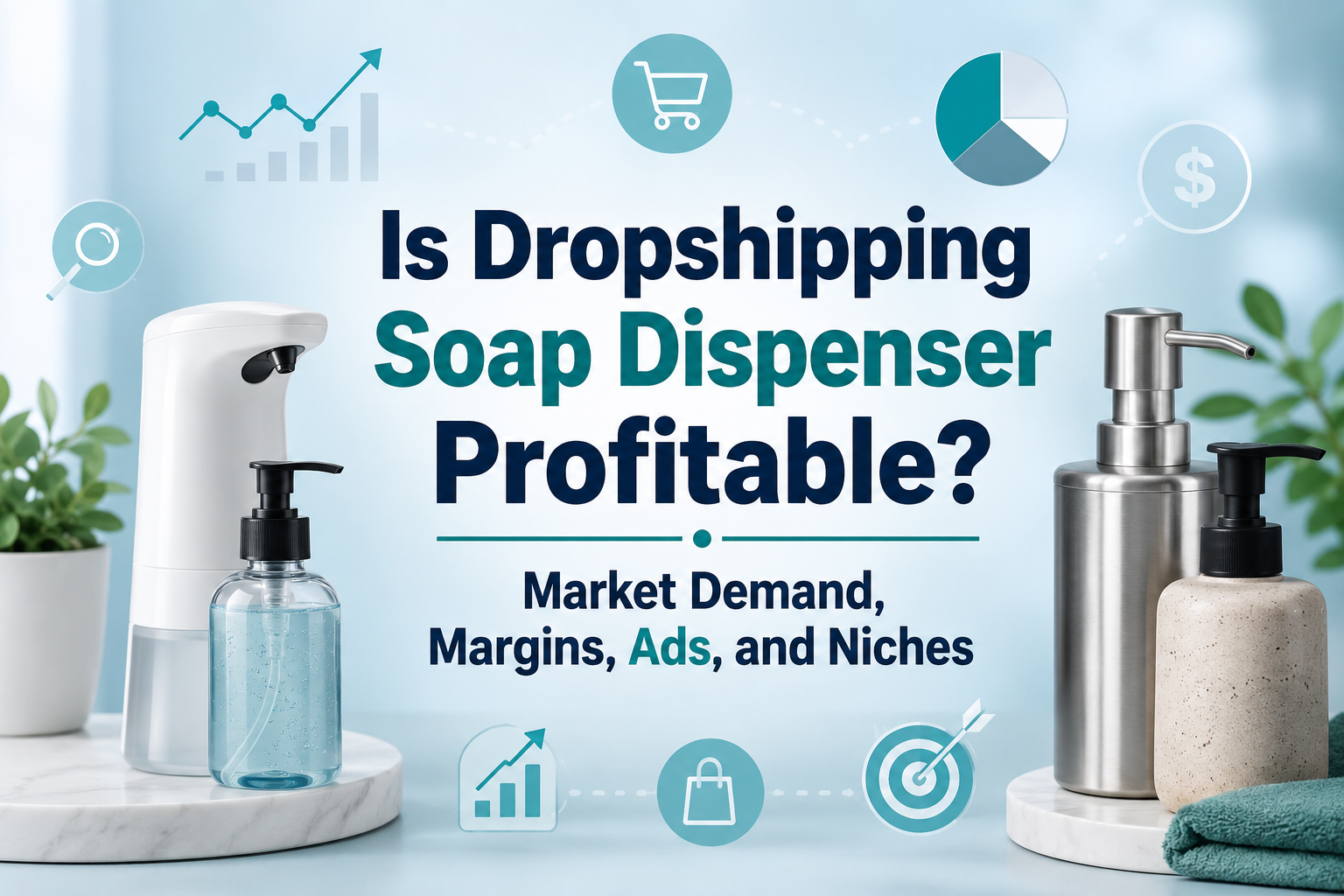
Is Dropshipping Soap Dispenser Profitable? Market Demand, Margins, Ads, and Niches

From a pure demand perspective, soap dispensers present a structurally strong case for dropshipping. The combination of:
- stable hygiene-driven consumption
- global household penetration
- recurring replacement cycles
- expanding commercial usage
- and aesthetic-driven consumer upgrades
creates a relatively reliable demand base.
However, demand alone does not guarantee profitability. While the market supports consistent sales volume, success ultimately depends on positioning, branding, and acquisition efficiency. In the next sections of this series, factors like profit margin structure, advertising costs, and niche selection will determine whether this demand translates into sustainable income.
Why Soap Dispensers Became a Strong Dropshipping Category
When evaluating whether is dropshipping soap dispenser profitable, the first factor to examine is not price or supplier cost, but sustained market demand. Soap dispensers sit in a rare category where hygiene behavior, household consumption habits, and product replacement cycles intersect. This combination creates relatively stable demand compared to trend-driven impulse products.
Over the past few years, global awareness of hygiene has permanently shifted consumer behavior. Even after the peak of pandemic-driven purchasing, soap dispensers remain a consistent household necessity, especially in kitchens, bathrooms, hotels, and office spaces. This makes the product category structurally different from short lifecycle “viral TikTok products.”
Post-Pandemic Hygiene Behavior and Market Stability
One of the strongest drivers behind soap dispenser demand is long-term hygiene awareness. Studies across consumer goods markets show that hand hygiene products have maintained a higher baseline consumption level compared to pre-2020 trends.
Even conservative estimates suggest that household cleaning-related product categories have grown at approximately 4%–6% CAGR globally, with soap dispensing systems benefiting directly from this shift. Unlike seasonal products, soap dispensers are not dependent on fashion cycles or holiday demand spikes. Instead, they are tied to daily behavioral routines such as handwashing, cooking, and cleaning.
For dropshipping businesses, this stability matters because it reduces volatility in ad performance and inventory planning. A product with consistent baseline demand is significantly easier to scale through paid traffic channels.
Household Adoption and Replacement Cycles
Another key driver is the universal usage environment. Soap dispensers are used in nearly every household globally, meaning the total addressable market is extremely large. However, what makes it particularly interesting for dropshipping is the replacement and upgrade cycle.
Consumers do not typically buy a single dispenser for life. Instead, they replace units due to:
- mechanical wear or clogging
- design upgrades for modern kitchens or bathrooms
- switching between manual and automatic models
- relocation or new home setup
This creates a recurring demand pattern rather than a one-time purchase market. In practice, even a low household replacement rate of 15%–25% annually can sustain continuous product demand at scale.
Market Segmentation and Expanding Use Cases
Soap dispensers are not limited to residential usage. Commercial environments contribute a significant portion of demand, especially in hospitality and service industries. Hotels, Airbnb properties, restaurants, and office buildings frequently purchase bulk dispenser units to maintain hygiene standards and reduce liquid soap waste.
This expands the market beyond typical e-commerce consumers and introduces higher-volume order potential. In dropshipping terms, this means that although average order values (AOV) may remain modest in retail ($12–$30 range), B2B and bulk buyers can significantly increase order size and profitability.
Additionally, segmentation within the category further strengthens demand. Automatic sensor dispensers, wall-mounted kitchen dispensers, and eco-friendly refillable designs all target slightly different user groups, reducing direct competition between listings.
Consumer Psychology and Perceived Value
Demand is also reinforced by the psychological perception of soap dispensers as both functional and aesthetic products. Modern consumers increasingly view home accessories as part of interior design rather than purely utility items.
This shift allows sellers to position soap dispensers with higher perceived value. A product with a production cost of roughly $1.5–$3.5 can be perceived as a $15–$25 lifestyle accessory depending on branding, visuals, and product positioning. This perception gap is a key driver of demand in e-commerce environments.
Profitability Is Not About Revenue, but Margin Reality
When analyzing is dropshipping soap dispenser profitable, many beginners focus only on selling price and assume that a $15–$25 product automatically means high profit. In reality, profitability depends on the full cost structure: product sourcing, shipping, advertising, platform fees, and refund rates.
Soap dispensers are considered a high gross margin product category, but whether they translate into real net profit depends heavily on execution efficiency and ad performance.
Product Cost vs Retail Price: The Core Margin Engine
Most soap dispensers sourced from Chinese suppliers (Alibaba, 1688, CJ-style factories) typically fall into a very low manufacturing cost range:
- Basic manual soap dispenser: $1.20 – $2.50
- Automatic sensor dispenser: $2.80 – $4.20
- Premium design / stainless steel models: $3.50 – $6.00
In contrast, retail pricing in dropshipping stores usually sits at:
- Standard models: $12 – $18
- Premium or bundle offers: $19 – $29
This creates a gross margin range of approximately 65% to 85%, which is significantly higher than many physical retail industries (often 20%–40%).
However, gross margin alone is misleading without considering acquisition cost.
Advertising Cost and Its Impact on Real Profit
The biggest variable in dropshipping profitability is customer acquisition cost (CAC), especially through TikTok Ads and Facebook Ads.
Typical performance benchmarks for soap dispenser campaigns:
- CPC (cost per click): $0.40 – $1.20
- Conversion rate: 1.5% – 3.2%
- CPA (cost per purchase): $6 – $18
If your selling price is $19.99 and gross profit per unit is around $12–$15, then:
- Low CAC scenario ($6–$9): strong profitability
- Mid CAC scenario ($10–$14): break-even zone
- High CAC scenario ($15–$18): low or negative profit
This means that even with a high gross margin, ad efficiency determines whether the business is scalable or not.
Shipping, Fees, and Hidden Cost Compression
Beyond ads, several smaller costs reduce net profit:
- Shipping (especially ePacket or US warehouse): $2 – $6
- Shopify + payment fees: ~3%–5% per order
- Refunds/chargebacks: typically 2%–8% in cold traffic stores
- App tools (upsell, tracking, email marketing): ~$30–$100/month fixed cost
After accounting for these, the real net profit per order often shrinks to 15%–35%, depending on scale and optimization.
Gross Margin vs Net Profit Reality
A simplified breakdown for a typical soap dispenser order:
- Selling price: $19.99
- Product cost: $2.80
- Shipping: $3.20
- Payment fees: $0.80
- Ads (CPA): $10.00
Net profit = $3.19 (~16%)
In optimized campaigns:
- Ads reduced to $7–$8 CPA
- Upsell bundles increase AOV to $25–$30
Net profit can rise to 25%–40%
This is why some stores scale profitably while others struggle despite identical products.
Scalability Factor: Why Margins Matter More at Volume
Soap dispensers become significantly more attractive at scale due to:
- stable product demand (reduces creative fatigue risk)
- repeatable ad creatives (UGC performs consistently)
- bundle opportunities (soap refill + dispenser sets)
- cross-selling (kitchen accessories ecosystem)
At 1,000 orders/month:
- 20% net margin = strong cash flow business
- 10% net margin = fragile, ad-dependent operation
- negative margin = unsustainable scaling model
Thus, profitability is not just per unit—it is system-level efficiency.
Why Strategy Matters More Than the Product Itself
When evaluating is dropshipping soap dispenser profitable, most beginners assume profitability is determined by product choice. In reality, soap dispensers are a highly commoditized product, meaning thousands of sellers offer nearly identical versions at similar prices.
This makes strategy—especially whether you operate as a generic dropshipper or a private label brand—the real determinant of long-term profitability. Two sellers can sell the same $3 soap dispenser, yet one earns 10% net margin while the other reaches 35%+ simply due to branding and positioning.
Generic Dropshipping Model: Low Barrier but Weak Profit Protection
The most common entry point is selling unbranded soap dispensers sourced directly from suppliers. In this model, sellers typically:
- Use supplier product images or minimal edits
- Compete mainly on price or ad creativity
- Sell at $12–$18 retail range
- Avoid inventory or branding investment
At first glance, this model appears attractive because gross margins remain high, often 65%–80% due to low sourcing costs. However, the weakness lies in its lack of differentiation.
In competitive ad platforms like TikTok and Facebook, identical products often lead to:
- rising CPC due to ad fatigue
- lower conversion rates (1.2%–2.0%)
- higher CPA as competitors bid on the same audience
As a result, even though gross margin is high, net profit frequently compresses to 10%–20%, especially after scaling.
Private Label Strategy: Turning a Commodity into a Brand Asset
Private labeling transforms soap dispensers from a commodity into a branded product. Instead of selling “a soap dispenser,” sellers create a recognizable product line with consistent identity, packaging, and perceived value.
Typical private label upgrades include:
- custom logo printing or embossing
- branded packaging boxes
- improved product photography and lifestyle branding
- bundled offers (soap refill + dispenser + cleaning kit)
- design differentiation (matte finish, minimalist aesthetic, eco materials)
These changes significantly impact consumer psychology. A product originally sourced at $2.80 can be positioned at $19.99–$29.99 simply through branding perception.
Gross margin in private label models often reaches 70%–85%, but more importantly, net margin stabilizes at 25%–40% due to improved conversion rates and reduced ad waste.
Conversion Rate Improvement: The Hidden Profit Multiplier
One of the most overlooked benefits of private labeling is its impact on conversion rate.
Generic soap dispenser stores typically convert at around 1.5%–2.2%, while branded stores often reach 2.8%–4.5%, depending on creative quality and offer structure.
This difference directly affects profitability. For example:
- At $10 CPA, a 2% conversion rate requires 50 clicks per sale
- At a 4% conversion rate, only 25 clicks are required per sale
This effectively halves acquisition cost pressure, even if ad pricing remains unchanged.
Over time, this creates a compounding advantage where branded stores can outbid generic competitors while still maintaining profitability.
Price Elasticity and Perceived Value Expansion
Another critical advantage of private label strategy is price elasticity. In a generic model, raising prices above $15 often reduces conversion rate sharply. However, in branded environments, perceived value supports higher pricing thresholds.
For example:
- Generic dispenser: $12–$15 price ceiling
- Branded dispenser: $19–$29 sustainable range
- Premium niche positioning: $29–$39 bundle offers
This pricing expansion significantly increases AOV (average order value), which improves profitability even if CAC remains stable.
A typical shift from $15 to $25 AOV increases gross profit per order by 40%–60%, without increasing traffic costs.
Long-Term Sustainability: Brand vs Short-Term Arbitrage
Generic dropshipping is fundamentally a short-term arbitrage model. It relies on identifying winning products and extracting profit before competition drives margins down.
Private label, however, builds long-term defensibility through:
- brand recognition
- repeat customers
- email list ownership
- lower dependency on paid ads
Even a modest repeat purchase rate of 10%–20% annually can dramatically stabilize revenue in household product categories like soap dispensers, where replacement and gifting behavior exist.
Over time, branded stores transition from “ads-driven stores” to “asset-driven businesses.”
Cost Consideration: Is Branding Worth the Investment?
Private labeling does require additional upfront costs:
- packaging customization: $0.30–$1.20 per unit
- logo design and branding assets: $100–$500 one-time
- product photography and UGC production: $200–$1,000 initial
- slightly higher MOQ requirements in some cases
However, these costs are often recovered quickly due to improved margins. Even a 10% improvement in conversion rate or a $3 increase in AOV can generate significantly higher lifetime profit than a generic store model.
Ads Decide Whether You Make Money or Just Generate Revenue
When analyzing is dropshipping soap dispenser profitable, most people overestimate product margins and underestimate advertising costs. In modern dropshipping, especially for household items like soap dispensers, profitability is no longer determined by product sourcing alone—it is primarily determined by paid traffic efficiency.
Even with a strong 65%–85% gross margin, a store can still lose money if CAC (customer acquisition cost) is misaligned with AOV (average order value). Soap dispensers sit in a “moderate virality, moderate competition” category, which makes them highly sensitive to ad performance.
TikTok Ads vs Facebook Ads: The Core Traffic Reality
Soap dispensers perform differently across platforms because of user intent and creative fatigue.
On TikTok Ads:
- CPM: $3 – $8
- CPC: $0.25 – $0.80
- Conversion rate: 1.8% – 3.5%
- CPA range: $6 – $14
TikTok is generally stronger for soap dispensers because the product is visually demonstrable (foam dispensing, touchless sensor, kitchen transformation content).
On Facebook Ads:
- CPM: $6 – $14
- CPC: $0.60 – $1.50
- Conversion rate: 1.5% – 2.8%
- CPA range: $10 – $18
Facebook tends to be more expensive but more stable for retargeting and older demographics.
Break-Even Analysis: Where Profit Actually Begins
To understand profitability, we need to compare CAC with gross profit per unit.
Typical soap dispenser economics:
- Selling price: $19.99
- Product cost: $2.80
- Shipping + fees: $4.00–$6.00
- Gross profit before ads: $11–$13
Now we introduce ad cost scenarios:
Scenario 1: Strong Performance
- CPA: $7
- Net profit: $4–$6 per order
- Net margin: 20%–30%
Scenario 2: Average Performance
- CPA: $10–$12
- Net profit: $0–$3 per order
- Net margin: 0%–15%
Scenario 3: Weak Performance
- CPA: $15–$18
- Net result: loss per order
- Business becomes unsustainable at scale
This shows that soap dispensers are not inherently profitable or unprofitable—the ad efficiency curve determines everything.
Conversion Rate: The Hidden Driver of CAC Efficiency
A major factor affecting CAC is conversion rate optimization (CRO). Small changes in landing page or creative quality significantly change profitability.
Typical benchmarks:
- Low-performing store: 1.2%–1.8% CVR
- Average store: 2.0%–2.8% CVR
- Optimized UGC-driven store: 3.0%–4.5% CVR
To illustrate impact:
At $0.80 CPC:
- 2% CVR → 50 clicks per purchase → $40 traffic cost per 100 visitors per sale cycle
- 4% CVR → 25 clicks per purchase → effectively halves CAC pressure
This is why UGC video creatives showing “before/after kitchen transformation” often outperform static ads by 30%–60% in ROAS.
Creative Fatigue: The Biggest Risk in Soap Dispenser Ads
Soap dispensers are visually simple products, which leads to one major problem: creative fatigue.
Most winning ads fall into three formats:
- foam dispensing ASMR videos
- kitchen sink transformation clips
- “dirty sink vs clean kitchen” contrast visuals
However, these formats saturate quickly. Once a winning angle is copied across hundreds of stores, performance drops sharply within 2–6 weeks.
This leads to:
- rising CPM due to competition
- declining CTR due to ad repetition
- increasing CAC over time
Without continuous creative testing, even profitable campaigns can become loss-making.
AOV Optimization: The Only Way to Survive High CPC Environments
Soap dispensers typically have a base AOV of $15–$20, which is relatively low. To maintain profitability under rising ad costs, stores often rely on:
- bundle offers (soap refill + dispenser set)
- multi-unit discounts (buy 2 get 1)
- upsells (kitchen accessories, brushes, cleaning tools)
With effective bundling, AOV can increase to $25–$35, which dramatically improves ROAS stability.
For example:
- $20 AOV with $12 CPA → weak margin
- $30 AOV with same $12 CPA → 2x profit improvement
This is why scaling soap dispenser ads without AOV strategy often leads to plateaued growth.
Scaling Reality: Why Most Stores Fail After Initial Success
Many dropshipping stores experience initial profitability in soap dispensers but fail at scale due to:
- increasing CPM as audience saturates
- declining conversion rate from creative fatigue
- lack of brand differentiation
- insufficient retargeting structure
Sustainable stores typically rely on:
- multiple ad creatives per week
- strong UGC pipeline
- email retargeting and abandoned cart recovery
- audience segmentation (kitchen, bathroom, eco-friendly niches)
Without these systems, profitability tends to collapse at higher spend levels.
Not All Soap Dispensers Are Equally Profitable
When analyzing is dropshipping soap dispenser profitable, a critical mistake beginners make is treating it as a single product category. In reality, soap dispensers are a multi-sub-niche ecosystem, where profitability varies significantly depending on design, functionality, and target user segment.
While the overall category can generate 65%–85% gross margins, only specific subcategories consistently achieve scalable profit due to differences in competition, perceived value, and advertising performance.
Automatic Sensor Soap Dispensers: The Highest Conversion Segment
The most profitable subcategory in recent years is the automatic touchless soap dispenser.
This segment benefits from:
- strong “cleanliness + hygiene” positioning
- high visual appeal for TikTok ads
- perceived premium value
- higher willingness to pay
Typical pricing:
- Supplier cost: $3.20 – $5.50
- Retail price: $19.99 – $29.99
- Gross margin: 70%–85%
Because of the “smart home” perception, customers often accept a higher price point compared to manual dispensers. This category also performs better in ads, especially short-form videos showing touchless operation.
However, competition is also increasing, which means differentiation (design, packaging, bundle offers) becomes essential for long-term profitability.
Kitchen Wall-Mounted Soap Dispensers: Underrated High-AOV Segment
Wall-mounted kitchen dispensers are less viral but often more stable in terms of profitability.
Key characteristics:
- used in long-term kitchen setups
- perceived as home improvement accessory
- less saturated ad space
- higher durability positioning
Typical economics:
- Cost: $2.50 – $4.00
- Selling price: $16 – $25
- Gross margin: 65%–80%
Unlike portable dispensers, this segment benefits from utility-driven purchase intent rather than impulse buying. As a result, conversion rates are often more stable (2.2%–3.8%) even with colder traffic.
Eco-Friendly & Refillable Soap Dispensers: Emerging Sustainability Niche
Sustainability is becoming a major purchasing factor, especially in Europe and North America. Eco-friendly soap dispensers made from glass, bamboo, or recycled plastic form a growing niche.
This segment is characterized by:
- strong brand storytelling potential
- lower direct competition
- higher perceived value
- alignment with eco-conscious consumers
Pricing structure:
- Cost: $2.00 – $4.50
- Retail price: $18 – $30
- Gross margin: 70%–85%
Although not as viral as automatic dispensers, eco-friendly products often achieve higher AOV when bundled (soap refills, cleaning kits), making them attractive for brand-building strategies.
Travel & Portable Soap Dispensers: High Impulse but Low Ticket Size
Portable silicone soap dispensers or travel kits represent a different economic model.
Key traits:
- very low product cost ($0.80 – $2.00)
- low retail price ($8 – $15)
- high impulse purchase behavior
- strong TikTok virality potential
However, profitability challenges include:
- low AOV limits scaling
- higher relative shipping cost impact
- weaker margin buffer against ads
Gross margin may still reach 60%–75%, but net profit is often constrained unless used as a front-end product in a funnel strategy.
This means it works better as a traffic generator rather than a standalone profit product.
Hotel, Airbnb & Bulk Dispenser Sets: Hidden B2B Opportunity
One of the most overlooked profitable niches is the bulk commercial dispenser segment.
Target customers include:
- Airbnb hosts
- boutique hotels
- restaurants and cafes
- property management companies
Characteristics:
- multi-unit orders (2–10+ sets per purchase)
- higher average order value ($40–$150)
- lower sensitivity to advertising trends
- less competition in DTC dropshipping space
Economics:
- Cost per unit: $2.50 – $4.00
- Bundle price: $49 – $129
- Gross margin: 60%–80%
Although conversion cycles are longer, this niche significantly improves cash flow stability and reduces dependency on viral ads.
Design-Focused Minimalist Dispensers: Branding-Driven Premium Segment
A growing micro-niche is the aesthetic home design category—minimalist, matte finish, Scandinavian-style soap dispensers.
Key advantages:
- strong Instagram/Pinterest appeal
- higher perceived value without functional change
- supports premium pricing strategy
- aligns well with home décor audiences
Typical pricing:
- Cost: $2.50 – $5.00
- Selling price: $22 – $39
- Gross margin: 70%–85%
This category works particularly well for private label brands, where visual identity can justify significant price increases.

No Comments