


Is Dropshipping Private Label Supplements Profitable? Margins, Ads, Risks, and Scaling

Dropshipping private label supplements can be profitable, but not for the reasons most beginners assume. The industry offers strong gross margins of 60%–85%, yet real-world profitability depends heavily on advertising efficiency and customer retention. Without optimized marketing and strong brand positioning, high margins are quickly offset by acquisition costs.
In practice, this business model is best understood as a marketing-driven arbitrage system, where profitability is determined less by product sourcing and more by traffic efficiency, conversion optimization, and repeat purchase strategy.
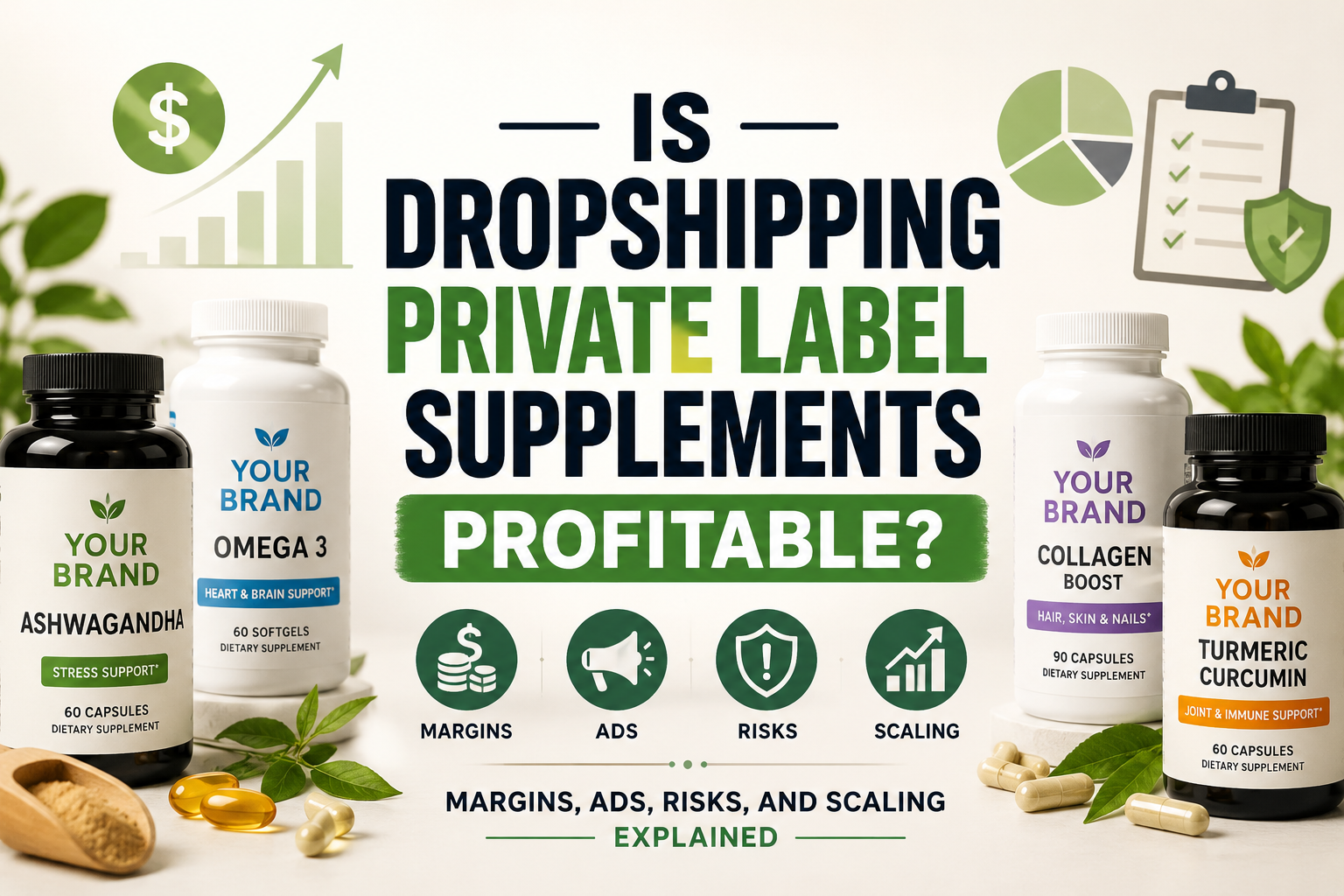
Is Dropshipping Private Label Supplements Profitable? A Real Profit Margin Breakdown of Costs, Margins, and Net Earnings
The profitability of dropshipping private label supplements is often misunderstood because sellers focus on retail pricing rather than full cost structure. On the surface, the niche looks extremely attractive: low product cost, high perceived value, and strong demand in fitness, wellness, and beauty categories. However, real profitability depends on how gross margins interact with advertising costs, fulfillment fees, and refund rates.
In most private label supplement setups, the gross margin typically ranges from 60% to 85%, depending on branding strength, order volume, and supplier negotiations. A bottle that costs $2 to $6 to manufacture can often retail for $20 to $60. This pricing gap is what makes the model attractive compared to standard dropshipping electronics or apparel, where margins are significantly lower.
However, gross margin alone does not determine profitability.
Cost Structure: Why High Margins Don’t Always Mean High Profit
A typical private label supplement business includes several layers of cost beyond manufacturing. First, there is fulfillment and shipping, which usually adds $3 to $8 per unit depending on destination and logistics method. While some suppliers offer “white label + fulfillment” packages, international shipping delays can also increase refund risk.
Second, and most importantly, is customer acquisition cost (CAC). In the supplement niche, paid traffic is highly competitive. On platforms like TikTok Ads and Meta Ads, CAC often ranges from $20 to $80 per customer, depending on targeting and creative performance. This means even a product with a $40 gross profit can become unprofitable if acquisition costs are too high.
For example, if a supplement sells for $39.99 with a $5 production cost and $6 shipping cost, the gross profit is around $28.99. But if ad spend per purchase is $35, the business immediately moves into negative territory before considering refunds or chargebacks.
Net Margin Reality: What Sellers Actually Earn
After factoring in advertising, payment processing fees, and refunds, the net profit margin in dropshipping private label supplements often falls between 10% and 25%, assuming the business is optimized. New stores frequently operate at break-even or even losses during the testing phase.
Refund and chargeback rates in this niche can also range from 5% to 15%, especially when marketing claims are aggressive or customer expectations are not properly managed. This further compresses net margins and makes scaling dependent on operational discipline rather than product selection alone.
Key Profit Drivers: What Separates Winners from Losses
The most profitable supplement stores are not those with the cheapest sourcing costs, but those that optimize for conversion rate and repeat purchases. Increasing conversion rate from 2% to 4% effectively cuts CAC in half, dramatically improving profitability without changing product cost.
Another critical factor is bundle and subscription strategy. Stores that sell multi-bottle bundles or monthly subscriptions can increase average order value (AOV) from $30 to $70 or more. This shift allows advertising costs to be absorbed more efficiently, pushing net margins closer to the upper end of the 10%–25% range.
Brand trust also plays a major role. Supplement buyers are highly sensitive to credibility, meaning better branding can reduce refund rates and increase lifetime value (LTV), which is essential for long-term profitability.
Is Dropshipping Private Label Supplements Profitable? Market Demand, Trend Cycles, and Long-Term Growth Potential
The private label supplements industry has experienced consistent global growth over the past decade, driven by increasing consumer interest in health optimization, fitness performance, and preventive wellness. Unlike many dropshipping niches that depend heavily on short-lived consumer trends, supplements are tied to fundamental and recurring human needs such as sleep, energy, immunity, weight management, and aging.
Global dietary supplement market estimates place annual growth at approximately 6% to 9% CAGR, with e-commerce capturing an increasing share of total sales. This steady expansion is one reason many entrepreneurs consider dropshipping private label supplements profitable, especially when compared to saturated physical goods markets like fashion or electronics.
However, strong demand does not automatically translate into stable profitability, because the supplement industry is highly cyclical at the product level even if the overall market is expanding.
Trend Cycles: The Hidden Volatility Behind “Evergreen” Demand
At the macro level, supplements are an evergreen category. But at the micro level, individual products often follow aggressive hype cycles driven by social media platforms such as TikTok, Instagram Reels, and YouTube Shorts.
A typical supplement trend cycle can last anywhere from 3 to 12 months, depending on virality and influencer adoption. For example, products like collagen gummies, ashwagandha sleep aids, or testosterone boosters often experience rapid spikes in demand followed by gradual saturation as competitors enter the market and consumer skepticism increases.
This creates a situation where many dropshipping private label supplement brands are not building long-term businesses, but rather capturing short-term arbitrage windows. Early entrants can achieve extremely high returns during the growth phase, sometimes reaching gross margins of 70%+ and ROAS above 3x–5x, but late entrants often struggle with declining conversion rates and rising ad costs.
Sub-Niche Demand Distribution: Where Profit Concentrates
Within the broader supplement market, demand is not evenly distributed. High-performing sub-niches tend to cluster around emotionally driven outcomes rather than general wellness claims. Categories such as weight loss, sleep improvement, gut health, skin glow, and hormonal balance consistently outperform generic multivitamins in both conversion rate and average order value.
For example, “sleep support” supplements often benefit from high repeat purchase rates, while “fat burner” products tend to generate faster initial sales but shorter product lifecycles. This distinction is critical for profitability because repeat purchase behavior significantly increases customer lifetime value (LTV), which can reduce reliance on paid advertising.
In many cases, brands with strong LTV can maintain profitability even when customer acquisition costs rise above $30–$60 per order, whereas low-retention products fail quickly under the same conditions.
Platform Influence: Why Trends Are Getting Shorter
One of the most important structural changes in this niche is the increasing speed of trend formation and decay. TikTok’s algorithm, in particular, accelerates product discovery but also accelerates saturation. Once a supplement concept becomes widely known, dozens of competing brands can enter the market within weeks due to the low barrier of entry in private label manufacturing.
This compresses the profitable window for dropshipping operators. In earlier e-commerce cycles, a winning product might remain profitable for 12–24 months. In the current environment, many supplement trends peak within 90–180 days before CPM inflation and audience fatigue reduce profitability.
As a result, successful operators no longer rely on a single product but instead build systems for continuous product testing and rapid scaling.
Long-Term Demand vs Short-Term Profitability
Although individual product trends are volatile, the long-term demand for supplements remains structurally strong. Aging populations, increased health awareness, and the rise of biohacking culture all contribute to sustained category growth.
However, this does not guarantee profitability for dropshipping private label sellers. The key distinction is between participating in a growing market and successfully capturing value within short-lived demand spikes.
Businesses that treat supplements as a brand-building opportunity rather than a one-product arbitrage model tend to achieve more stable outcomes. These operators focus on product line expansion, subscription models, and customer retention strategies rather than chasing viral trends.
Is Dropshipping Private Label Supplements Profitable? Advertising Costs, CAC, ROAS, and Real Break-Even Analysis
In the private label supplements space, profitability is far less dependent on product cost and far more dependent on advertising efficiency. Even with strong gross margins—often ranging from 60% to 85%—the business model can quickly become unprofitable if customer acquisition costs (CAC) are not tightly controlled.
Most dropshipping supplement brands rely heavily on paid traffic channels such as Meta Ads and TikTok Ads. These platforms have become increasingly competitive, pushing up CPMs and CPCs across health-related verticals. As a result, the cost to acquire a single customer in this niche typically ranges from $20 to $80, depending on targeting precision, creative quality, and landing page conversion rate.
This creates a narrow profitability window where even small inefficiencies can eliminate profit entirely.
Break-Even Structure: Why AOV Determines Survival
To understand whether dropshipping private label supplements is profitable, the most important metric is not product margin but break-even ROAS (Return on Ad Spend).
Consider a typical scenario:
- Product selling price: $39.99
- Product + fulfillment cost: $8–$12
- Gross profit per order: ~$28
At first glance, this appears highly profitable. However, if advertising costs per purchase reach $30, the store is already operating at a loss before factoring in payment fees, refunds, or chargebacks.
This is why average order value (AOV) becomes critical. Stores that rely on single-bottle purchases struggle to maintain profitability. In contrast, businesses that push bundles or subscription offers can increase AOV to $60–$120, significantly improving their ability to absorb CAC and maintain positive margins.
At an AOV of $80 with a $30 CAC, the business can maintain a gross operating margin of around 25%–35%, which is considered healthy for e-commerce.
ROAS Reality: What “Winning Campaigns” Actually Look Like
In theory, supplement ads can achieve high returns such as 3x–5x ROAS during early product testing. In practice, however, sustaining those numbers is difficult due to audience saturation and rising ad costs.
Most stable supplement stores operate at a breakeven ROAS between 1.8 and 2.5, depending on their margin structure. Anything below this range typically results in financial loss unless supplemented by strong repeat purchase behavior.
One of the biggest misconceptions in this niche is that high ROAS automatically equals profitability. In reality, many campaigns that appear successful at the ad level fail to generate net profit once backend costs and refunds are included.
Funnel Efficiency: Conversion Rate as the Hidden Profit Lever
While many beginners focus on ad metrics, conversion rate optimization (CRO) often has a greater impact on profitability than media buying itself. Increasing conversion rate from 2% to 4% effectively halves CAC, which can transform an unprofitable product into a scalable one without changing ad spend.
For example, if a store spends $40 to acquire a customer at a 2% conversion rate, improving that rate to 4% reduces CAC to approximately $20 under the same traffic conditions. This shift alone can move net margins from negative into the 15%–30% profitability range.
This is why top-performing supplement brands invest heavily in landing page design, trust signals, reviews, and before-after storytelling, rather than relying solely on ad optimization.
Scaling Pressure: Why Costs Increase With Growth
A major challenge in supplement dropshipping is that advertising efficiency rarely scales linearly. As budgets increase, audiences become saturated, and marginal CAC tends to rise. This creates diminishing returns at scale, especially in competitive sub-niches like weight loss or testosterone support.
At scale, even a small increase in CAC—from $25 to $45—can completely eliminate profit margins unless offset by higher AOV or improved retention. This is why many supplement brands shift toward subscription models or upsell funnels as they grow, rather than relying purely on one-time purchases.
Supply Chain Costs, Manufacturing Margins, and Hidden Private Label Expenses
The profitability of dropshipping private label supplements is heavily influenced by supply chain structure rather than just retail pricing. On paper, this niche is known for extremely attractive gross margins, often ranging from 60% to 85%, because the production cost of supplements is relatively low compared to their perceived retail value.
A typical private label supplement capsule or gummy product may cost between $1.50 and $6 per unit at scale, while retail prices commonly range from $25 to $60 per bottle. This gap creates the illusion of a highly profitable business model. However, the actual economics depend on how many layers of customization and compliance are added to the product.
Manufacturing Costs: The Real Base Layer of Pricing
In private label supplements, manufacturing cost is not just the raw ingredients. It includes formulation, encapsulation, testing, packaging, labeling, and often minimum order quantities (MOQs) that affect unit economics.
Low-MOQ suppliers may offer flexible entry points, but unit costs are usually higher—sometimes 20% to 40% more expensive compared to bulk production. On the other hand, larger MOQs reduce per-unit cost but require upfront capital, which introduces inventory risk that pure dropshipping models try to avoid.
Custom formulations significantly increase costs. A basic “white label” vitamin may cost $2 per unit, while a customized formula with branded ingredients can easily reach $4–$8 per unit, depending on complexity and certifications.
This cost variation directly impacts gross margin stability, especially when pricing pressure increases in competitive ad-driven markets.
Packaging and Branding Costs: The Hidden Margin Erosion Factor
Packaging is one of the most underestimated cost drivers in private label supplements. While basic packaging might only cost $0.50–$1 per unit, premium branding—including matte bottles, custom labels, shrink wrapping, and eco-friendly materials—can push packaging costs to $2–$5 per unit.
This is important because supplements are heavily influenced by perceived value. Consumers often judge product quality based on packaging design rather than formulation alone. As a result, sellers are incentivized to invest in branding, which reduces effective gross margins even before advertising costs are considered.
In many real cases, a product that appears to have an 80% gross margin on manufacturing alone may drop to 65%–70% after packaging upgrades.
Compliance and Certification Costs: The Regulatory Premium
Unlike general dropshipping products, supplements operate in a regulated environment. Depending on the target market (especially the US and EU), products may require compliance with standards such as GMP (Good Manufacturing Practice), third-party lab testing, and FDA-related labeling requirements.
These compliance costs are not always visible at the product level but can significantly impact unit economics. Lab testing alone may add $0.10–$1 per unit equivalent cost when amortized across production runs. Certifications and documentation requirements also increase time-to-market, which indirectly affects profitability by slowing down trend capture.
In stricter markets, compliance can become a barrier to entry that protects margins for established brands, but it also increases operational complexity for new dropshipping sellers.
Logistics and Fulfillment: The Dropshipping Cost Advantage (and Limitation)
One advantage of dropshipping private label supplements is reduced inventory risk, but fulfillment still carries meaningful cost implications. Shipping costs typically range from $3 to $8 per unit, depending on destination, packaging weight, and warehouse location.
While local fulfillment (US/EU warehouses) improves delivery speed and conversion rates, it increases storage and handling fees. International fulfillment may reduce cost per unit but introduces longer shipping times, which can increase refund rates by 5%–15% in some cases.
This creates a trade-off between cost efficiency and customer experience, both of which directly affect net profitability.
Real Margin Compression: From “Theoretical” to “Actual” Profitability
When combining manufacturing, packaging, compliance, and fulfillment, the initial 70%–85% gross margin often compresses significantly. In many realistic scenarios, effective pre-ad gross margins fall to around 50%–70%.
Once advertising costs are added, the net margin becomes highly dependent on marketing efficiency. This is why many supplement dropshipping businesses that appear highly profitable in product sourcing calculations struggle to maintain consistent profitability in practice.
The key insight is that private label supplements are not purely a product-margin business—they are a margin + marketing hybrid model, where supply chain efficiency sets the ceiling, but advertising determines whether that ceiling is reached.
Regulatory Risks, Compliance Costs, and Hidden Legal Challenges
At first glance, dropshipping private label supplements looks like a high-margin, low-risk e-commerce model. However, compared to general consumer products, supplements operate in a heavily regulated environment where compliance failures can directly affect profitability, ad account stability, and even business continuity.
While gross margins in this niche are often attractive—typically 60% to 85%—regulatory and legal constraints introduce hidden costs and operational risks that are often ignored in early-stage profitability calculations.
FDA and Market Regulations: The US Compliance Baseline
In the United States, dietary supplements fall under the regulatory oversight of the FDA (Food and Drug Administration). Although supplements are not approved in the same way as pharmaceuticals, manufacturers and sellers are still required to ensure truthful labeling, safe ingredient usage, and non-misleading claims.
One of the most common profitability risks comes from marketing language. Claims such as “cures anxiety,” “burns fat rapidly,” or “treats insomnia” can trigger enforcement actions or ad disapprovals. Even without formal penalties, such violations often result in ad account restrictions, product delistings, or payment processor scrutiny, all of which directly reduce revenue potential.
This means that compliance is not just a legal issue—it is a marketing constraint that affects scaling speed and profitability.
Advertising Policy Restrictions: The Invisible Cost Driver
Unlike standard e-commerce products, supplement advertising is heavily restricted on platforms like Meta Ads, TikTok Ads, Google Ads, and even Shopify payment systems.
Many health-related claims fall under “limited or prohibited content,” meaning that ads must be carefully phrased to avoid rejection. This creates indirect costs because compliant ads often perform worse than aggressive claims, reducing click-through rates and conversion rates.
For example, a compliant ad might convert at 2%–3%, while a more aggressive (but risky) version might initially reach 4%–6% before being flagged. This tension between compliance and performance creates a structural profitability ceiling in the industry.
In addition, frequent ad disapprovals increase creative testing costs, which can raise customer acquisition cost (CAC) by 10%–30% in competitive niches.
Refunds, Chargebacks, and Consumer Protection Pressure
Supplements are a high-expectation product category. Customers often expect fast results, especially in categories like weight loss, sleep improvement, or testosterone support. When results are not immediate, refund requests and chargebacks increase.
Industry estimates suggest refund rates in supplement dropshipping can range from 5% to 15%, depending on product claims and customer expectations. Chargebacks are particularly damaging because they not only reduce revenue but can also lead to payment processor penalties or account termination if thresholds are exceeded.
Even a small increase in refund rate can significantly reduce net profit. For example, a 10% refund rate on a product with a 25% net margin can reduce effective profitability by nearly half.
Liability and Product Risk: The Long-Term Threat
Another overlooked factor is product liability risk. If a supplement contains undeclared allergens, incorrect dosages, or contaminated ingredients, the legal and financial consequences can be severe. Even when manufacturers are responsible for production, the brand owner is often the first point of contact for regulators and customers.
This is why many established supplement brands invest heavily in third-party testing, insurance coverage, and compliance documentation. These protections add cost but reduce catastrophic risk exposure.
For dropshipping operators, this creates a structural imbalance: low upfront costs but potentially high downside risk.
International Complexity: EU and Global Expansion Barriers
Expanding private label supplements beyond the US introduces additional regulatory complexity. The European Union, for example, has stricter rules on ingredient approvals, labeling requirements, and health claims. Certain ingredients allowed in the US may be restricted or require reformulation in EU markets.
This fragmentation increases operational costs for global scaling. Brands often need market-specific formulations, packaging variations, and compliance documentation, which reduces economies of scale and complicates logistics.
As a result, international expansion—while attractive from a revenue perspective—can reduce overall margin efficiency if not carefully managed.
Branding, Subscription Models, and Long-Term Scaling vs Short-Term Dropshipping Arbitrage
Private label supplements are often introduced as a dropshipping opportunity, but their true profitability potential depends on whether the business remains a short-term arbitrage model or evolves into a long-term brand. While early-stage sellers may enjoy gross margins of 60% to 85%, long-term profitability is rarely sustained through product arbitrage alone.
The key distinction lies in whether the business is dependent on one-time customer acquisition or built around recurring customer value and brand equity.
Dropshipping Model vs Brand Model Economics
In a pure dropshipping setup, the focus is on quickly testing products, running paid ads, and capturing short-term demand spikes. This model is heavily dependent on customer acquisition cost (CAC), which in the supplement niche often ranges from $20 to $80 per customer.
While high margins can make early campaigns profitable, the lack of repeat purchases creates a fragile structure. Once ad costs increase or product fatigue sets in, profitability declines rapidly.
In contrast, brand-driven supplement businesses focus on lowering long-term CAC through repeat purchases and organic traffic. Even if initial margins are similar, the presence of returning customers significantly increases lifetime value (LTV), often by 2x to 5x compared to one-time buyers.
This shift fundamentally changes profitability dynamics.
Subscription Models: The Core of Sustainable Profitability
One of the most powerful strategies for improving long-term profitability in private label supplements is the subscription model. Instead of relying on single purchases, brands encourage monthly or quarterly replenishment of products such as vitamins, sleep aids, or wellness supplements.
Subscription-based customers dramatically improve revenue predictability and reduce reliance on paid ads. For example, a customer acquired at a $40 CAC who subscribes for $30/month over three months generates $90 in revenue, turning a marginal acquisition into a highly profitable relationship.
In many optimized supplement brands, subscription adoption can increase overall LTV by 40% to 200%, depending on product category and retention strategy.
This improvement directly stabilizes net profit margins, often pushing them into the 20%–40% range over time, compared to much lower margins in pure dropshipping setups.
Branding Effects: Why Trust Converts Into Margin
Supplements are a trust-sensitive category. Unlike low-involvement consumer goods, customers evaluate supplements based on credibility, perceived safety, and brand reputation. This means branding directly impacts conversion rate, refund rate, and repeat purchase behavior.
Strong branding—through professional packaging, transparent ingredient sourcing, clinical-style positioning, and consistent messaging—can significantly increase conversion rates, often from 2% to 4% or higher under the same traffic conditions.
At the same time, strong brand trust reduces refund rates, which in many supplement businesses range from 5% to 15%. Even a reduction of a few percentage points in refunds can materially improve net profitability.
Brand equity also lowers dependency on paid advertising over time. As organic search traffic, influencer mentions, and direct traffic increase, blended CAC decreases, allowing higher margins to be retained at scale.
Scaling Challenges: Why Many Dropshipping Stores Fail to Transition
Despite strong theoretical advantages, many dropshipping supplement stores fail to transition into sustainable brands. The main reason is that they remain locked in a “product testing loop” rather than investing in long-term assets such as customer lists, content, and retention systems.
Scaling also introduces operational pressure. As ad budgets increase, CAC typically rises due to audience saturation, often moving from $25 to $60+ per acquisition in competitive niches. Without corresponding increases in AOV or LTV, profitability erodes quickly.
Successful brands counteract this by expanding product lines, introducing bundles, and building ecosystems rather than single-product funnels.
Long-Term Profitability: The Compound Effect of Retention
The most important driver of long-term profitability in private label supplements is not initial margin but compounding customer value. Businesses that achieve even modest retention improvements—such as increasing repeat purchase rate from 20% to 35%—can significantly improve overall unit economics.
Over time, this creates a compounding effect where each new customer contributes more total revenue than the previous cohort, allowing the business to absorb higher acquisition costs while maintaining or even increasing profitability.
This is the key difference between businesses that plateau and those that scale sustainably.



No Comments