


Is Dropshipping Pet Accessories Profitable? Complete Guide to Market, Products, Ads, Supply Chain, and Risks

Pet accessories dropshipping is fundamentally profitable due to three structural advantages: high emotional demand, strong markup potential, and low regulatory friction. However, profitability is not automatic. Stores that rely purely on generic products and weak branding tend to face margin compression due to competition and rising ad costs.
In contrast, niche positioning, strong creative advertising, and product bundling strategies can consistently deliver sustainable gross margins above 60% and stable net profitability in the 25%–40% range, making it one of the more resilient e-commerce niches in 2026.
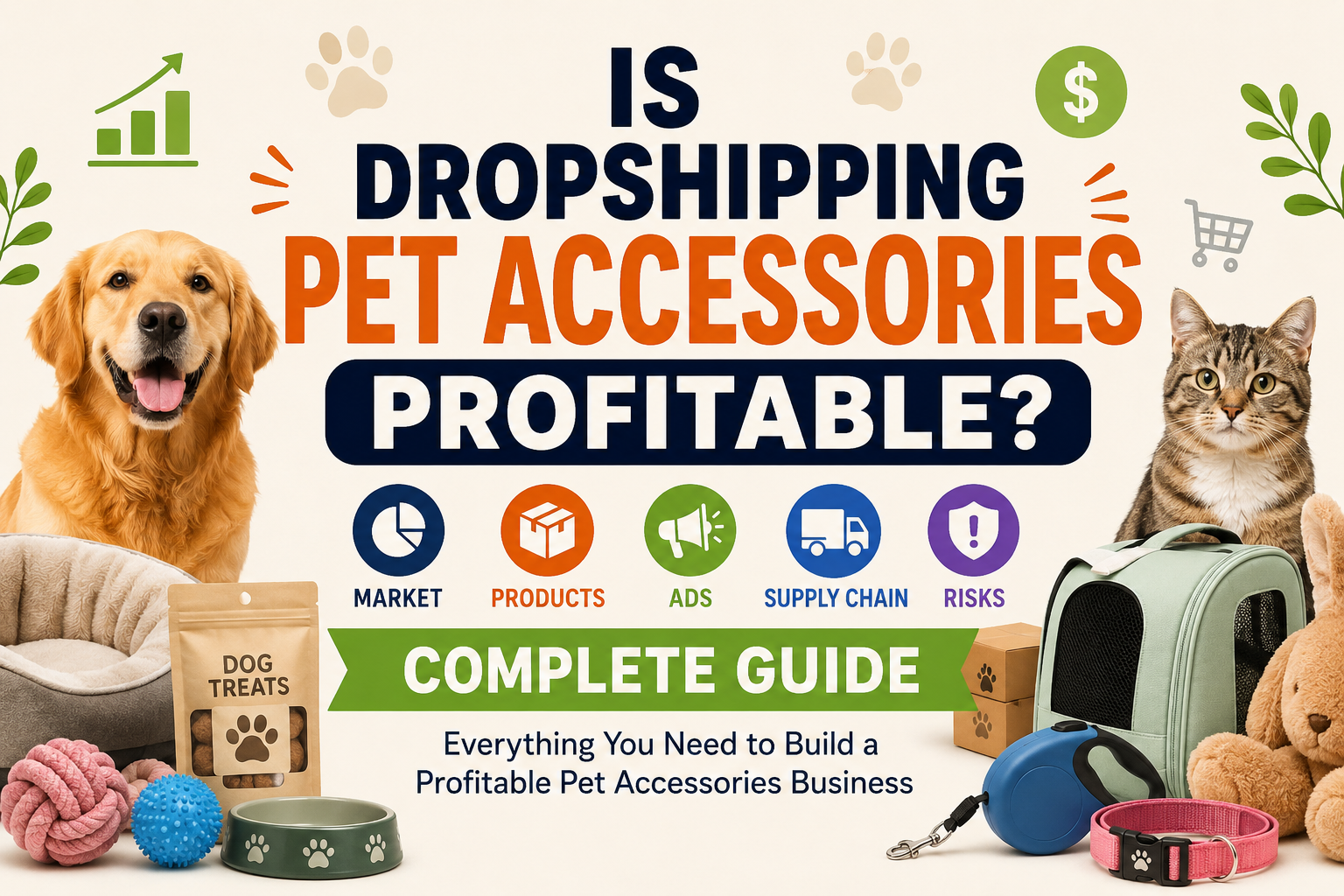
Is Dropshipping Pet Accessories Profitable? Market and Margin Breakdown
The global pet industry has been experiencing consistent expansion for more than a decade, driven primarily by the “pet humanization” trend, where pets are increasingly treated as family members rather than animals. In 2025, global pet industry spending is estimated to exceed $320 billion, with accessories accounting for a significant portion of non-food discretionary spending such as toys, collars, grooming tools, apparel, and smart pet devices.
From a dropshipping perspective, this category is structurally attractive because demand is both emotional and recurring. Unlike seasonal fashion or trend-driven electronics, pet accessories benefit from relatively stable year-round demand, with spikes during holidays and new pet adoption seasons.
Search trends for keywords like “dog harness,” “cat interactive toys,” and “pet grooming kit” have shown steady growth rates between 8%–15% annually, indicating long-term scalability for e-commerce sellers targeting this niche.
Gross Margin Structure in Pet Accessories Dropshipping
One of the strongest reasons why pet accessories are considered profitable in dropshipping is the wide margin flexibility between sourcing cost and retail pricing.
Typical supplier pricing from China or wholesale platforms:
- Simple pet toys: $0.80 – $3.00
- Collars and leashes: $1.50 – $5.00
- Grooming tools: $3.00 – $8.00
- Smart pet devices (feeders, trackers): $10 – $35
In contrast, retail prices in US/EU markets:
- Pet toys: $8 – $25
- Premium collars/leashes: $15 – $60
- Grooming kits: $20 – $80
- Smart devices: $40 – $150
This creates an average gross margin range of 55%–75%, depending on branding, positioning, and advertising efficiency.
Even after accounting for shipping ($2–$8 per order) and platform fees (typically 3%–5%), most well-optimized stores can still maintain net contribution margins of 25%–45%, which is considered strong in e-commerce.
Why Pet Accessories Work Especially Well for Dropshipping
Unlike high-ticket electronics or regulated products, pet accessories have relatively low barriers to entry. There are no strict certifications required for most subcategories, and product variations are easy to source and test quickly.
Another key advantage is impulse buying behavior. A large percentage of pet accessory purchases are emotional rather than necessity-driven. For example, a pet owner seeing a “fun interactive cat toy” on social media is significantly more likely to convert compared to rational B2B or utility-based products.
This allows paid advertising channels like TikTok Ads and Meta Ads to perform efficiently, especially when creative content focuses on pets’ emotional reactions.
Competitive Landscape and Real Profit Potential
Although competition is increasing, the market is still highly fragmented. Most sellers operate without strong branding, which means differentiation through creative marketing, bundles, and niche positioning still provides a clear edge.
For example:
- General stores often achieve only 10%–20% net margin
- Niche pet brands with optimized funnels reach 25%–45% net margin
- Strongly branded pet stores with repeat customers can exceed 50% lifetime ROI per customer
The key variable is not product availability, but customer acquisition cost (CAC). Average CAC for pet accessories ranges from $8–$25 per customer, while average order value (AOV) is typically $25–$70, making profitability highly dependent on conversion optimization and upselling strategies.
Most Profitable Pet Accessories in Dropshipping: A Product-Level Profitability Breakdown
While the overall pet accessories market is large and growing, profitability in dropshipping is not evenly distributed across all products. In fact, within the same niche, gross margins can vary dramatically—from as low as 20% for commoditized items to over 80% for differentiated or impulse-driven products.
This means that success in pet accessories dropshipping depends less on entering the market and more on selecting high-margin subcategories that align with consumer psychology, perceived value, and low shipping friction.
High-Margin Category 1: Interactive Pet Toys
Interactive toys such as motion-based cat balls, dog puzzle feeders, and LED chase toys are among the highest-performing products in this niche.
Supplier cost for most of these items ranges from $1.50 to $4.00, while retail pricing typically falls between $12 and $35, depending on complexity and branding.
This creates a gross margin range of approximately 65%–80%, especially when bundled or positioned as “behavior improvement” or “anti-anxiety” solutions.
The key driver here is emotional conversion. Pet owners are not simply buying toys; they are buying engagement, stimulation, and emotional satisfaction for their pets. This significantly increases willingness to pay.
High-Margin Category 2: Grooming Tools and Hygiene Products
Pet grooming tools such as deshedding brushes, nail clippers, and bathing gloves represent one of the most stable and repeatable segments in the market.
Cost structures are extremely favorable:
- Supplier cost: $2.00 – $6.00
- Retail price: $18 – $60
This leads to gross margins between 60%–75%, with even higher margins when branded as “professional grooming kits.”
Unlike toys, grooming products have stronger repeat demand cycles, which increases customer lifetime value (LTV). Customers often repurchase or upgrade tools as pets grow, making this category more suitable for long-term scaling.
High-Margin Category 3: Pet Safety and Outdoor Gear
Products like reflective harnesses, anti-pull leashes, and travel carriers belong to a high-conversion, utility-driven category.
While competition is higher, margins remain strong due to perceived necessity:
- Cost: $3 – $12
- Retail: $20 – $70
- Gross margin: 55%–70%
This category performs particularly well in colder regions such as North America and Europe, where pet walking safety and outdoor activity culture are strong behavioral drivers.
Conversion rates are typically higher than average because these products solve immediate functional problems rather than purely emotional desires.
High-Margin Category 4: Smart Pet Devices
Smart feeders, GPS trackers, and automatic water dispensers represent the premium tier of pet accessories dropshipping.
Although sourcing costs are higher, they allow significantly larger absolute profit per order:
- Cost: $15 – $40
- Retail: $60 – $180
- Gross margin: 50%–65%
The key advantage here is perceived innovation value. Customers are willing to pay a premium for automation and convenience, especially in urban households with busy lifestyles.
However, this category requires higher customer trust, meaning ad creatives, reviews, and brand positioning play a critical role in conversion performance.
High-Margin Category 5: Pet Apparel and Seasonal Products
Pet clothing, costumes, and seasonal items (Halloween outfits, winter jackets) are highly impulse-driven and trend-sensitive.
- Cost: $2 – $8
- Retail: $15 – $50
- Gross margin: 60%–75%
The major advantage is viral potential on social media platforms. However, this category is more seasonal and less stable compared to grooming or safety products.
Profitability depends heavily on timing, influencer marketing, and creative content cycles.
Strategic Insight: The Real Profit Formula
Across all categories, the most profitable pet dropshipping products share three structural characteristics:
First, they solve a visible emotional or functional problem (comfort, safety, engagement).
Second, they have low production cost but high perceived value.
Third, they are easy to demonstrate visually in short-form video ads.
When these three conditions align, it is common to see gross margins between 60% and 80%, with strong campaigns achieving 3x–5x ROAS on paid traffic platforms.
The pet accessories niche is not inherently profitable across all products. Instead, profitability is highly concentrated in specific subcategories that combine emotional appeal, problem-solving utility, and strong visual marketing potential.
Is Dropshipping Pet Accessories Profitable with Paid Advertising?
In the pet accessories dropshipping niche, product margins alone do not determine profitability. While gross margins typically range between 55% and 75%, the actual net profit is heavily influenced by customer acquisition cost (CAC), which is primarily driven by paid advertising performance.
This creates a situation where two sellers selling the same product at identical prices can have completely different outcomes: one profitable at 30% net margin, and another operating at break-even or loss due to inefficient traffic channels.
TikTok Ads: High Virality, Low Entry Cost, but Volatile Scaling
TikTok is currently one of the strongest acquisition channels for pet accessories due to its short-form video format, which aligns perfectly with emotional pet content.
Typical performance metrics:
- CPC: $0.30 – $1.20
- CPA (cost per purchase): $8 – $18
- Conversion rate: 2.5% – 5%
- Average ROAS: 2.5x – 4.5x
Given an average order value (AOV) of $30 – $60, TikTok ads can generate gross profit margins of 35%–60% when creatives are optimized.
However, TikTok is highly dependent on creative fatigue. Winning ads often lose efficiency within 7–14 days, requiring continuous content production. This makes it ideal for testing and scaling winners quickly, but less stable for long-term predictability.
Meta Ads (Facebook & Instagram): Stable Scaling and Strong Retargeting
Meta remains the most reliable platform for structured scaling in pet accessories dropshipping.
Typical performance metrics:
- CPC: $0.80 – $2.50
- CPA: $12 – $25
- Conversion rate: 2% – 4%
- Average ROAS: 2x – 3.5x
While slightly more expensive than TikTok, Meta excels in retargeting and audience segmentation. Pet owners often require multiple touchpoints before purchasing, especially for higher-ticket items like grooming kits or smart feeders.
This allows Meta campaigns to generate more stable 25%–45% net profit margins when properly optimized with retargeting funnels and email capture.
Meta is particularly effective for building long-term brand equity rather than one-off viral sales.
Google Ads: High Intent Traffic but Limited Scalability in Low-AOV Products
Google Ads operates differently because it captures existing demand rather than generating it.
Typical performance metrics:
- CPC: $1.50 – $4.50
- CPA: $15 – $35
- Conversion rate: 3% – 6%
- ROAS: 2x – 3x
Google works best for high-intent keywords like “best dog harness for pulling” or “automatic pet feeder review.” However, due to higher CPC, it is less efficient for low-ticket impulse products under $25 AOV.
Profitability becomes significantly stronger in premium segments, where AOV exceeds $70, allowing net margins of 20%–40%.
Cross-Channel Economics: Where Profit Actually Comes From
Across all channels, the key profitability equation in pet accessories dropshipping can be simplified as:
Net Profit = AOV × Gross Margin – CAC – Operational Costs
Given:
- AOV: $25 – $70
- Gross margin: 55% – 75%
- CAC: $8 – $30
We observe three typical scenarios:
Low optimization stores often operate at 0%–10% net margin, mainly due to high CAC and weak creatives.
Moderately optimized stores achieve 20%–35% net margin, typically through balanced TikTok + Meta strategies.
Highly optimized stores with strong branding, UGC creatives, and retargeting systems can reach 35%–55% net margin, especially when repeat purchases are included.
Creative Quality as the Hidden Profit Lever
In pet accessories, creative quality often has a larger impact on profitability than product selection itself.
Winning ads usually feature:
- Emotional pet reactions
- Problem-solution demonstrations
- Before/after behavior changes
- Owner satisfaction moments
These formats significantly improve CTR and reduce CAC by 20%–50% compared to static product images.
This means that creative iteration speed directly correlates with margin expansion.
While pet accessories inherently offer strong gross margins, true profitability depends on advertising efficiency across platforms.
TikTok provides rapid scaling potential with volatile results, Meta offers stable long-term ROI, and Google captures high-intent traffic but requires premium AOV to be effective.
Is Dropshipping Pet Accessories Profitable? A Supply Chain and Fulfillment Profitability Breakdown
While most discussions around pet accessories dropshipping focus on product selection and advertising performance, the real determinant of sustainable profitability often lies in the supply chain. Even with strong gross margins of 55%–75%, inefficient fulfillment can reduce net profitability by 10%–25%, making logistics optimization a critical component of the business model.
In practical terms, the difference between a profitable store and a losing store is often not the product itself, but how quickly and cheaply it can be delivered to the customer.
Supplier Pricing vs Real Landed Cost Reality
At first glance, sourcing pet accessories from suppliers in China or wholesale platforms appears highly profitable. However, many beginners underestimate the “hidden cost layers” beyond product unit price.
Typical baseline supplier pricing:
- Small accessories (toys, brushes): $0.80 – $4.00
- Mid-tier products (leashes, grooming kits): $3.00 – $10.00
- Smart devices: $15 – $40
However, the real landed cost structure includes:
- Shipping: $2 – $12 per order
- Packaging: $0.30 – $1.50
- Payment fees: 2.9% – 5%
- Refund/return risk: 3% – 8% revenue impact
When all components are included, the effective cost base can increase by 20%–40%, which directly compresses net margin if retail pricing is not adjusted accordingly.
Shipping Time as a Conversion and Profit Factor
In pet accessories dropshipping, shipping speed has a direct correlation with conversion rate and refund rate.
Standard China-based shipping timelines:
- Economy shipping: 10–20 days
- Standard ePacket or equivalent: 7–15 days
- Local warehouse fulfillment (US/EU): 2–5 days
Research across e-commerce categories shows that conversion rates can drop by 15%–35% when delivery exceeds 10 days, particularly for impulse-driven products like pet toys and apparel.
At the same time, long shipping times increase refund rates significantly. In pet accessories, refund rates typically range:
- Fast shipping (2–5 days): 3%–6%
- Medium shipping (7–15 days): 6%–12%
- Slow shipping (15+ days): 10%–18%
This means logistics speed is not just operational—it directly impacts gross profit retention.
Fulfillment Models and Their Impact on Margin
There are three dominant fulfillment structures in pet accessories dropshipping, each with distinct profit implications.
The first is direct sourcing from overseas suppliers. This model offers the highest theoretical gross margin, often 60%–75%, but suffers from long shipping times and inconsistent quality control.
The second is hybrid fulfillment using overseas warehouses. This reduces shipping time to 5–10 days, improving conversion rates and lowering refund rates. However, it adds storage and pre-stock costs, reducing gross margin slightly to around 50%–65%, but often increasing net profit stability.
The third is local fulfillment in the US or EU. While unit costs increase significantly, shipping times drop to 2–5 days, and conversion rates can improve by 20%–40% compared to China-only fulfillment. In this model, gross margins typically compress to 40%–55%, but net profitability may actually increase due to lower CAC waste and refund losses.
Supplier Reliability and Quality Control as Profit Protection
Pet accessories are highly sensitive to quality perception because they directly involve pets’ safety and comfort. Poor-quality products lead not only to refunds but also chargebacks and negative reviews, which increase long-term customer acquisition costs.
Industry data shows that stores with inconsistent suppliers can experience:
- Chargeback rates up to 2%–5%
- Repeat customer drop-off by 30%–60%
- Ad account instability due to poor customer feedback signals
By contrast, stable supplier relationships with quality control processes reduce defect rates below 2%, significantly improving long-term margin consistency.
Inventory Strategy and Cash Flow Efficiency
Unlike pure digital products, pet accessories require careful inventory planning if hybrid or local fulfillment is used.
Overstocking reduces cash flow efficiency, while understocking leads to missed advertising opportunities during viral spikes.
High-performing stores typically maintain inventory coverage of 2–4 weeks, balancing agility with availability. This allows them to scale winning products quickly while maintaining stable fulfillment performance.
Is Dropshipping Pet Accessories Profitable in a Competitive Market?
The pet accessories dropshipping market has become significantly more competitive over the past five years, driven by low entry barriers, viral TikTok products, and global supplier accessibility. However, increased competition does not necessarily eliminate profitability. Instead, it redistributes profits toward sellers who can build stronger branding, better customer retention, and differentiated positioning.
While average stores operate at 10%–20% net margins, well-positioned brands can still achieve 30%–50% net margins, even in saturated sub-niches.
The key issue is not market saturation itself, but the inability of most sellers to move beyond commodity-level competition.
Why Most Pet Accessories Dropshipping Stores Fail
The majority of failure cases in this niche can be traced back to three structural weaknesses.
The first is product sameness. Most sellers rely on identical supplier catalogs, meaning they are competing with thousands of stores selling the same dog harness, cat toy, or grooming brush. In this environment, price becomes the only differentiator, which compresses gross margins from 70% down to 30%–40%.
The second is weak brand perception. Without branding, customers treat the store as a temporary transaction source rather than a repeat purchase destination. This results in low customer lifetime value (LTV), typically below $30, compared to branded stores that can reach $80–$150 LTV.
The third is inconsistent advertising strategy. Many stores rely on short-term viral ads without building long-term creative systems or retargeting funnels, leading to unstable CAC fluctuations between $8 and $35 per customer, which destroys predictability.
Branding as the Primary Profit Multiplier
In a competitive market, branding becomes the most important factor for margin expansion.
Strong pet brands typically achieve:
- Higher AOV through bundling: $25 → $45–$80
- Higher conversion rate: +20% to +60%
- Lower CAC due to trust signals: -15% to -40%
- Repeat purchase rate: 20% → 45%+
This combination significantly improves overall profitability, pushing net margins from 15%–20% (non-branded stores) to 35%–55% (branded stores).
Branding in this niche is not limited to logos or packaging. It is primarily built through consistent messaging around pet care, emotional storytelling, and perceived product reliability.
Market Segmentation: Where Profit Still Exists
Despite competition, the market is not uniform. Profit opportunities still exist in underdeveloped micro-niches.
Premium positioning around “problem-solving pet care” remains highly profitable. For example, anxiety-reducing pet products, orthopedic support accessories, and smart monitoring devices continue to show strong willingness-to-pay.
In contrast, highly commoditized segments such as basic collars, standard toys, and low-end leashes experience severe price competition and low differentiation, often resulting in sub-20% net margins.
The key is not entering the pet niche broadly, but selecting subcategories where perceived value exceeds manufacturing cost by at least 5x–10x, allowing pricing flexibility.
Advertising Saturation and Creative Fatigue
As competition increases, advertising efficiency becomes harder to maintain. Platforms like TikTok and Meta experience rapid creative saturation, where winning ads lose performance within 7–10 days in crowded sub-niches.
This leads to rising CAC over time. In competitive pet product categories:
- Early-stage CAC: $8–$15
- Mid-stage saturation: $15–$25
- High saturation: $25–$40+
Brands that fail to continuously innovate creatives often experience declining ROAS and unstable scaling, even if the product is fundamentally strong.
Successful brands mitigate this through structured creative production systems, user-generated content (UGC), and influencer partnerships, allowing them to sustain stable acquisition costs.
The Shift from Dropshipping to Brand-Driven Commerce
The long-term evolution of pet accessories dropshipping is a transition from pure arbitrage toward brand-driven commerce. Pure dropshipping models are increasingly vulnerable to competition and ad cost inflation, while branded operators benefit from compounding advantages.
These advantages include email remarketing, repeat purchase cycles, and organic traffic accumulation. Over time, branded stores reduce dependency on paid ads from 80% of revenue to below 50%, significantly improving profit stability.
Is Dropshipping Pet Accessories Profitable in 2026? Risks, Refund Rates and Legal Considerations
While pet accessories dropshipping can generate attractive gross margins between 55% and 75%, profitability alone does not guarantee long-term business sustainability. In 2026, increasing platform regulation, rising customer expectations, and logistics complexity mean that risk management is equally important as revenue generation.
Many stores that appear profitable at the surface level fail due to hidden operational risks such as refund pressure, ad account instability, and compliance issues.
Refund and Return Pressure: The Silent Margin Killer
Refund rates in pet accessories dropshipping are significantly higher than in many other e-commerce categories due to product expectations and pet-related sensitivity.
Typical refund rate benchmarks:
- Fast shipping + quality suppliers: 3% – 6%
- Standard dropshipping model: 6% – 12%
- Poor logistics or low-quality sourcing: 12% – 20%
Refunds impact profitability in multiple layers. First, they directly reduce revenue. Second, they increase operational costs through reverse logistics and customer support. Third, they negatively affect advertising platforms’ algorithmic trust signals, increasing future customer acquisition costs.
In extreme cases, a 10% increase in refund rate can reduce net profit margins by 8%–15%, making it one of the most underestimated risks in the business model.
Legal and Compliance Considerations in Pet Products
Compared to categories like supplements or electronics, pet accessories are relatively low-regulation. However, compliance risks still exist, especially in specific subcategories.
Products such as pet tracking devices, electrical grooming tools, and smart feeders may require certifications such as FCC or CE depending on the target market. Failure to comply can lead to customs delays, marketplace delisting, or chargeback disputes.
In addition, consumer protection laws in regions like the EU and US increasingly require transparent return policies and accurate product claims. Misleading advertising—especially around health-related benefits—can increase legal exposure and payment processor disputes.
While not heavily regulated, the niche still requires careful attention to cross-border compliance, especially for scaling brands operating in multiple markets.
Payment Processing Risk and Platform Dependency
One of the most critical risks in dropshipping pet accessories is dependency on advertising platforms and payment processors.
High refund rates, inconsistent shipping times, or customer complaints can trigger:
- Stripe or PayPal account holds
- Increased reserve requirements (up to 10%–20% of revenue)
- Sudden account termination in extreme cases
This introduces cash flow instability even for stores with strong gross margins. A store may be technically profitable on paper but experience liquidity issues due to frozen funds or delayed payouts.
This is why mature operators prioritize risk diversification across payment gateways and maintain strict quality control on fulfillment performance.
Market Trend in 2026: From Commodity Dropshipping to Experience-Based Commerce
The pet accessories industry is undergoing a structural shift. In earlier stages, simple product arbitrage was sufficient to generate profit. However, by 2026, the market is clearly moving toward experience-based commerce.
This means customers increasingly expect:
- Faster shipping (under 5–7 days)
- High-quality packaging and branding
- Reliable post-purchase support
- Authentic product storytelling
As a result, traditional low-cost dropshipping models are becoming less viable, especially for stores relying solely on overseas fulfillment without branding or customer experience investment.
Long-Term Profitability Outlook
Despite increasing complexity, pet accessories dropshipping remains profitable, but only under more disciplined operational models.
Unoptimized stores typically see net margins decline to 5%–15% over time due to rising CAC and refund pressure. In contrast, structured brands that control supply chain quality, optimize creatives, and manage compliance effectively can sustain 25%–45% net margins even in competitive conditions.
The key differentiator is operational maturity rather than product availability.
In 2026, pet accessories dropshipping is no longer a simple high-margin arbitrage opportunity. It is a system-driven business that requires careful balancing of product quality, logistics reliability, advertising efficiency, and regulatory compliance.
Profitability exists, but it is increasingly conditional. Sellers who ignore refund rates, platform dependency, and compliance risk will see margins erode over time. Meanwhile, operators who treat risk management as part of their core strategy can still build scalable and sustainable businesses with strong long-term returns.



No Comments