


Is Dropshipping Pendant Necklaces Profitable? A Complete Guide to Margins, Trends, Ads, Suppliers, Branding, and Long-Term Sustainability

Dropshipping pendant necklaces is structurally profitable but operationally competitive. The category offers strong gross margins (60%–85%), but real success depends on controlling advertising costs and optimizing conversion rates.
In practical terms, this is not a “passive profit niche.” It is a performance-driven model where profitability exists only when marketing efficiency exceeds cost pressure.
For operators who can consistently maintain CAC under $12 and price products above $24.99, pendant necklace dropshipping can remain a sustainable 20%–35% net margin business model.
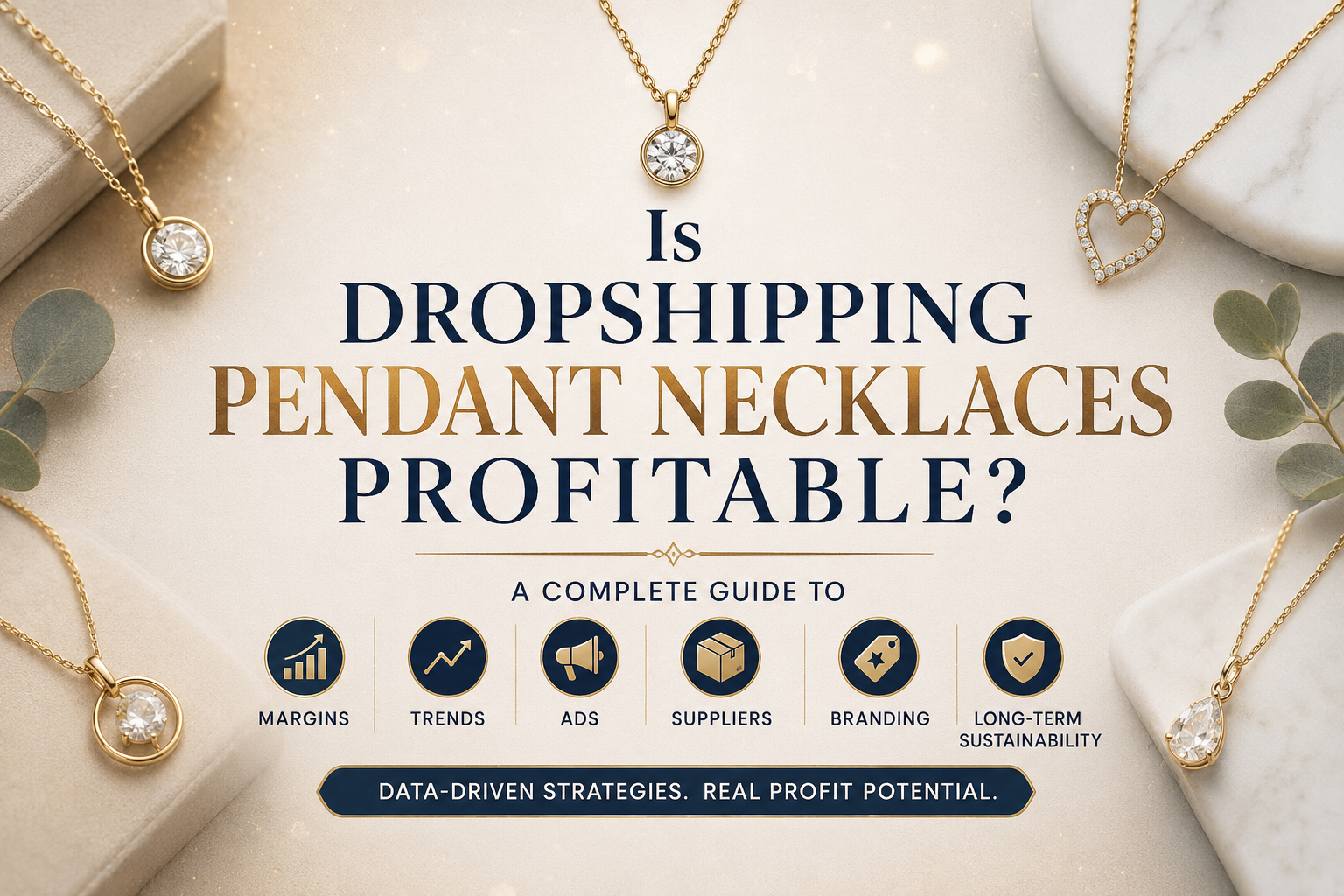
Is Dropshipping Pendant Necklaces Profitable? Real Profit Margins, Costs, and ROI Analysis
The profitability of dropshipping pendant necklaces is often misunderstood because sellers tend to focus only on the selling price rather than the full cost structure. In reality, this niche operates on a relatively simple but highly sensitive margin model where small changes in cost or conversion rate can significantly impact net profit.
Most pendant necklaces sourced from suppliers such as AliExpress, CJ Dropshipping, or private label vendors typically cost between $1.20 and $4.50 per unit, depending on material (stainless steel, sterling silver plating, or alloy), packaging quality, and customization level. When sold in Western markets like the US or Europe, the average retail price ranges from $14.99 to $39.99, especially when positioned as fashion or gift jewelry.
This creates a gross margin range of approximately 60% to 85%, which is one of the strongest margin profiles in low-ticket dropshipping categories. However, gross margin does not reflect the full profitability picture.
Cost Breakdown: Why “High Margin” Doesn’t Always Mean High Profit
Even though the gross margin looks attractive, real profitability depends heavily on acquisition and fulfillment costs.
A typical breakdown for a $24.99 pendant necklace looks like this:
- Product cost: $2.80
- Shipping: $3.50–$6.00 (standard ePacket or EU warehouse shipping)
- Payment fees (Stripe/PayPal ~3%): ~$0.75
- Advertising cost per customer (CAC): $6–$18 depending on platform
This means total cost per sale can easily reach $13–$27, leaving a net profit range from -$2 to $12 per order depending on ad efficiency.
In other words, even with an 70%+ gross margin, profitability is extremely dependent on marketing performance.
Advertising Efficiency as the Key Profit Driver
The biggest factor determining whether pendant necklace dropshipping is profitable is Customer Acquisition Cost (CAC).
On platforms like TikTok Ads or Meta Ads, jewelry products typically experience:
- CTR: 1.5%–3.2% (video creatives perform better than static images)
- Conversion rate: 1%–2.5% for cold traffic
- CAC range: $8–$22 depending on targeting and creative quality
If a store sells a pendant necklace at $29.99 and maintains a CAC of $10, the business can generate a 30%–40% net profit margin per order after all costs. However, if CAC rises above $18, profitability drops sharply and may even become negative.
This makes the niche highly dependent on creative testing and funnel optimization rather than just product selection.
Scaling Economics: Why Volume Matters
Pendant necklace dropshipping becomes more profitable at scale because fixed costs such as creative testing, landing page optimization, and influencer seeding are amortized across more orders.
Stores that reach consistent volume (200–500 orders/month) often negotiate better supplier pricing, reducing product cost by 10%–25%, which directly improves net margin by 5–10 percentage points.
Additionally, optimized stores that use email marketing and retargeting ads can reduce blended CAC by 20%–35%, significantly improving long-term ROI.
ROI Reality: What Successful Stores Actually Achieve
Based on industry benchmarks in fashion jewelry dropshipping:
- Beginner stores: 0%–10% net profit (break-even phase)
- Optimized stores: 15%–30% net profit
- High-performing branded stores: 30%–50% net profit
The key difference is not the product itself, but the ability to control acquisition costs and increase average order value (AOV).
Bundles (e.g., “Buy 2 get 1 free”) can increase AOV from $25 to $45+, improving profitability by 20%–40% without changing product cost.
Is Dropshipping Pendant Necklaces Profitable? Market Demand, Consumer Trends, and Growth Potential
To evaluate whether dropshipping pendant necklaces is profitable, the first factor is not cost or ads—it is demand stability. Pendant necklaces sit in the global fashion jewelry market, a segment valued at over $40B+, with steady annual growth driven by affordable luxury and online impulse buying behavior.
Unlike seasonal fashion items, pendant necklaces benefit from consistent baseline demand year-round, because they function as both self-purchase accessories and gift items. This dual-purpose nature makes the niche more stable than many short-lived dropshipping trends.
Social Media as the Primary Demand Engine
Modern demand for pendant necklaces is heavily influenced by social platforms rather than traditional retail channels.
On platforms like TikTok and Instagram, jewelry content regularly achieves high engagement due to its visual and emotional appeal. Short-form videos showing “gift reactions,” “aesthetic styling,” or “meaning-based jewelry (love, protection, zodiac)” consistently generate strong conversion intent.
Industry tracking suggests:
- Jewelry-related TikTok content often achieves 3%–8% engagement rates, higher than most fashion categories
- Viral pendant necklace videos can generate 100K–1M+ organic views within days
- Conversion uplift from social proof can increase purchase intent by 20%–45%
This means demand is not just stable—it is algorithm-amplified, creating spikes that dropshipping businesses can capitalize on.
Consumer Behavior Shift: From Luxury to “Affordable Meaning”
A key driver of profitability is a shift in consumer psychology. Pendant necklaces are no longer positioned as luxury goods only; instead, they are increasingly bought as emotional micro-gifts.
Common purchase motivations include:
- Relationship symbolism (couples, friendship, family)
- Personal identity (zodiac signs, initials, birthstones)
- Emotional reassurance (protection, luck, faith-based symbols)
This shift has increased impulse purchasing behavior. Average order values remain relatively low ($15–$40), but conversion frequency is higher due to emotional triggers.
Studies in e-commerce psychology show that emotional jewelry purchases convert at 1.3x–1.8x higher rates than generic fashion accessories.
Seasonal Demand Patterns and Revenue Peaks
While pendant necklaces have stable baseline demand, profitability is strongly influenced by seasonal spikes.
Key high-demand periods include:
- Valentine’s Day (sales increase 2.5x–4x)
- Christmas season (increase 3x–6x)
- Mother’s Day (increase 2x–3x)
- Back-to-school gifting seasons in late summer
During these peaks, conversion rates often increase from 1.5% to over 3%, while average order value also rises due to bundling and gift packaging.
However, outside peak seasons, competition becomes more price-sensitive, reducing margins unless brands have strong positioning.
Global Market Expansion: Why Europe and the US Dominate
Pendant necklace dropshipping demand is geographically concentrated. The strongest markets remain:
- United States
- United Kingdom
- Germany
- France
- Canada
These regions share three key traits: high disposable income, strong gifting culture, and established e-commerce trust infrastructure.
Notably, European markets show slightly lower impulse conversion rates but higher average order values (+10%–25%), especially when products are positioned as minimalist or personalized jewelry.
This makes localization (language, cultural symbolism, packaging) an important factor in scaling demand.
Trend Longevity: Is the Demand Sustainable?
Unlike trend-based products (LED gadgets, fidget toys), pendant necklaces are part of a non-cyclical fashion category. However, designs and themes evolve quickly.
Current trending segments include:
- Minimalist stainless steel pendants
- Personalized name necklaces
- Zodiac and astrology symbols
- Lock-and-key relationship jewelry
- “Aesthetic core” styles (Y2K, vintage, gothic)
Each micro-trend typically lasts 12–24 months, meaning suppliers and sellers must continuously refresh catalog offerings to maintain relevance.
How Supplier Choice and Product Sourcing Determine Your Margins
When analyzing whether dropshipping pendant necklaces is profitable, many beginners focus on pricing or advertising first. However, in reality, supplier choice is the primary determinant of long-term profitability because it directly controls your cost base, product quality, and shipping reliability.
Even a difference of $1.50–$3.00 per unit cost can shift net profit margins by 15%–40%, especially in a low-ticket jewelry niche where average selling prices range from $14.99 to $39.99.
Cost Variations Across Different Supplier Types
Pendant necklace sourcing is not uniform. Different supplier models create dramatically different margin structures:
Direct marketplaces like AliExpress typically offer the lowest upfront prices, with pendant necklaces costing around $1.20–$3.50 per unit. However, shipping times often range from 10 to 25 days, and product consistency can vary.
In contrast, specialized dropshipping suppliers such as CJ Dropshipping or local EU/US warehouses usually price items between $3.50–$7.00 per unit, but reduce shipping time to 3–8 days, significantly improving conversion rates.
Private label manufacturers sit at the top of the cost structure, often charging $5.00–$12.00 per unit, but they enable branding, packaging customization, and perceived value increases that allow retail prices to reach $29.99–$59.99.
This creates three distinct margin models:
- Low-cost sourcing model: 70%–85% gross margin, but lower conversion stability
- Balanced fulfillment model: 60%–75% gross margin, higher conversion rates
- Private label model: 55%–70% gross margin, but highest AOV and brand equity
Shipping Strategy and Its Impact on Conversion Rates
Shipping is often underestimated in jewelry dropshipping, yet it directly affects both conversion rate and profitability.
Data from e-commerce benchmarks shows that:
- Shipping times above 15 days can reduce conversion rates by 20%–35%
- Faster shipping (3–7 days) increases repeat purchase rate by 15%–25%
- Customers are willing to pay $2–$5 more per product for faster delivery
This means that even if fast-shipping suppliers increase product cost by $2, they can still improve overall profitability by increasing conversion efficiency and reducing refund rates.
Refund rates in slow shipping models often reach 8%–15%, while optimized logistics can reduce this to 3%–6%, significantly improving net margins.
White-Label and Customization: The Profit Multiplier
One of the most important sourcing strategies in pendant necklace dropshipping is white-label customization. This includes branded packaging, engraved logos, and custom jewelry cards.
While customization typically increases unit cost by $1.00–$4.00, it allows sellers to reposition products from commodity items to branded gifts.
This shift enables:
- Price increases of 30%–120% without reducing conversion rates
- Higher perceived value, especially in gifting markets
- Stronger customer retention through brand recognition
For example, a necklace costing $4.20 might sell for $19.99 in generic form, but with branding and packaging, it can be repositioned to $29.99–$39.99, increasing gross profit per unit by $8–$15.
Supplier Reliability and Hidden Cost Leakage
Beyond unit pricing, supplier reliability introduces hidden costs that directly impact profitability.
Common issues include:
- Inconsistent product quality leading to 5%–10% return rates
- Stock instability causing lost ad spend efficiency
- Delayed fulfillment increasing customer disputes
- Packaging damage reducing perceived product value
Each of these factors increases “effective CAC,” meaning even if ads cost $10 per customer, poor fulfillment can push total acquisition cost closer to $13–$16 per customer equivalent loss when refunds and chargebacks are included.
Scaling Impact: Why Better Suppliers Improve Margins Over Time
As order volume increases, supplier quality becomes even more important. Stores processing over 300–1,000 orders/month often negotiate:
- 10%–25% lower product costs
- Priority shipping lanes
- Dedicated inventory allocation
- Lower defect rates due to standardized production
This scaling effect means that supplier optimization alone can improve net profit margins from 15% to over 30% without changing advertising strategy.
Is Dropshipping Pendant Necklaces Profitable After Ads?
In pendant necklace dropshipping, profitability is rarely limited by product cost. The real deciding factor is paid traffic efficiency, especially on platforms like TikTok Ads and Meta Ads.
Even though pendant necklaces often have a strong gross margin of 60%–85%, advertising costs can quickly consume most of that margin. This makes the niche highly sensitive to Customer Acquisition Cost (CAC) and conversion performance.
For most stores, the difference between profit and loss is often just $3–$8 per customer acquisition.
Typical Ad Funnel Performance in Jewelry Dropshipping
Pendant necklaces perform relatively well in impulse-driven ad environments because they are visually appealing and emotionally driven.
Across standard campaigns, benchmark performance often looks like this:
- CTR (Click-Through Rate): 1.5%–3.5%
- Landing page conversion rate: 1%–2.8%
- Add-to-cart rate: 3%–6%
- Purchase intent driven by emotional creatives: significantly higher during gifting seasons
On TikTok Ads, viral creative ads can push conversion rates above 3%, while cold Meta traffic typically remains closer to 1%–1.8%.
Customer Acquisition Cost (CAC): The Core Profit Variable
CAC determines whether dropshipping pendant necklaces is profitable at scale.
Industry benchmarks show:
- TikTok Ads CAC: $6–$18 per customer
- Meta Ads CAC: $8–$22 per customer
- Retargeting CAC: $3–$10 per customer
Now compare this with product economics:
A typical pendant necklace sold at $24.99 might have:
- Product cost: ~$3.00
- Shipping: ~$4.50
- Payment fees: ~$0.80
- Total fulfillment cost: ~$8.30
If CAC is $10, total cost becomes $18.30, leaving approximately $6.69 gross profit per order, or a 26.7% net margin.
However, if CAC rises to $16, profit drops to $0.69 or negative territory, making scale unsustainable.
This narrow profitability window is why ad optimization is critical.
Creative Performance: The Biggest Profit Multiplier
In this niche, creative content is more important than targeting. Pendant necklaces rely heavily on emotional triggers rather than rational buying.
High-performing ad formats include:
- “Gift reaction” videos (strong emotional conversion lift)
- Before/after transformation storytelling
- Meaning-based jewelry narratives (love, memory, protection)
- Influencer-style UGC content
Data shows that strong UGC creatives can reduce CAC by 20%–45% compared to generic product ads.
For example, a store spending $15 CAC with poor creatives may reduce it to $9–$11 CAC simply by switching to authentic video content.
This difference alone can transform a break-even store into a profitable one.
Conversion Rate Optimization and Landing Page Impact
Even with strong ads, weak landing pages can destroy profitability.
Typical jewelry landing page performance:
- Low optimization pages: 0.8%–1.2% conversion rate
- Standard pages: 1.5%–2.2% conversion rate
- Optimized pages (fast load + social proof): 2.5%–3.5% conversion rate
Improving conversion rate from 1% to 2.5% effectively cuts CAC per order by 40%, because the same ad spend generates more purchases.
This is why successful stores invest heavily in:
- Reviews and social proof
- Countdown urgency elements
- Bundled offers (Buy 2 Get 1 Free)
- Mobile-first checkout optimization
Scaling Effects: Why Volume Changes Profitability
Advertising performance is not linear. As spend increases, CAC often rises due to audience saturation.
However, stores with strong data feedback loops can stabilize performance through:
- Retargeting warm audiences (reducing CAC by 20%–35%)
- Lookalike audience optimization
- Creative rotation systems
At scale (300–1,000 orders/month), blended CAC often stabilizes between $10–$14, while optimized brands can reduce it further to $8–$12.
This is where sustainable profitability emerges.
Brand-Building vs Generic Products Profitability Comparison
When evaluating whether dropshipping pendant necklaces is profitable, most beginners assume all products compete on price. In reality, the biggest long-term profitability gap comes from one factor: brand positioning versus generic selling.
Two stores can sell the same $3 necklace, yet one earns $5 profit per order, while the other earns $18–$25 per order. The difference is not product cost—it is perceived value.
Generic Dropshipping Model: High Competition, Low Pricing Power
In the generic model, sellers list pendant necklaces sourced from marketplaces like AliExpress or CJ Dropshipping without differentiation.
Typical economics look like this:
- Product cost: $1.50–$4.00
- Selling price: $12.99–$19.99
- Gross margin: 50%–70%
- Net profit after ads: often 5%–15%
The key limitation here is price competition. Because identical products are widely available, customers compare listings directly. This forces sellers into:
- Lower prices to win conversions
- Higher ad spending to maintain traffic
- Lower repeat purchase rates
Even if gross margins appear high, profitability is unstable because customer loyalty is nearly zero.
Brand-Based Model: Turning Jewelry Into a High-Margin Product
Brand-driven dropshipping changes the entire structure by shifting focus from “product selling” to “perceived value creation.”
With branding elements such as:
- Custom packaging
- Emotional storytelling
- Logo engraving
- Niche positioning (e.g., astrology, love symbolism, minimalist fashion)
The same pendant necklace can be repositioned from $14.99 commodity item → $29.99–$49.99 gift product.
This allows gross margins to expand significantly:
- Product cost (with branding): $3.50–$7.00
- Selling price: $29.99–$49.99
- Gross margin: 75%–90%
Even after higher ad costs, net margins can reach 25%–45%, especially when average order value (AOV) increases through bundling.
AOV Expansion: The Hidden Profit Engine in Branding
One of the most important differences between branded and generic stores is average order value (AOV).
Generic stores often rely on single-item purchases around $15–$20. In contrast, branded jewelry stores actively increase AOV through:
- “Buy 2 Get 1 Free” offers
- Couple sets (his & hers necklaces)
- Gift packaging upsells
- Personalized engraving add-ons
This strategy can increase AOV from $18 to $35–$55, effectively doubling revenue per customer without increasing traffic costs.
When CAC remains constant, this directly doubles profitability.
Customer Retention: The Long-Term Profit Multiplier
Generic dropshipping stores rely heavily on one-time impulse purchases. Repeat purchase rates are typically low, around 5%–10%.
Brand-driven stores, however, benefit from emotional and identity-based positioning, which increases retention:
- Repeat purchase rate: 15%–35%
- Email marketing conversion rates: 3%–8%
- Returning customer revenue share: up to 30%–50%
This means brand stores reduce dependency on paid ads over time, lowering blended CAC by 15%–40%.
Advertising Efficiency: Why Brands Win the Auction Game
Brand perception also improves ad performance metrics.
Compared to generic stores:
- CTR increases by 20%–60% due to higher trust
- Conversion rates improve from 1.5% → 2.5%–4%
- CAC decreases by 10%–30% due to stronger intent
For example:
- Generic store CAC: $14–$18
- Branded store CAC: $9–$13
This gap becomes even more significant at scale, where ad fatigue and audience saturation normally increase costs.
Long-Term Scalability: Why Branding Creates Compounding Profit
The biggest advantage of branding is not short-term margin—it is compounding value creation.
Over time, branded stores benefit from:
- Organic traffic growth (SEO + social following)
- Higher conversion from returning visitors
- Influencer collaborations at lower cost
- Stronger email and SMS monetization
While generic stores remain dependent on paid ads indefinitely, branded stores gradually shift toward owned traffic channels, improving long-term ROI stability.
Is Dropshipping Pendant Necklaces Profitable Long-Term? Risks, Returns, and Business Sustainability
When analyzing whether dropshipping pendant necklaces is profitable, short-term metrics like gross margin and CAC often look promising. However, long-term profitability depends on factors that are frequently underestimated: returns, quality consistency, logistics stability, and platform risk exposure.
Even businesses with 60%–80% gross margins can become unprofitable over time if operational risks are not controlled. This is especially true in low-ticket jewelry, where small defects or delays can significantly impact customer satisfaction.
Return Rates and Refund Pressure in Jewelry Dropshipping
Pendant necklaces belong to the fashion jewelry category, which typically has higher return and refund rates compared to many other dropshipping niches.
Industry benchmarks show:
- Average return rate: 8%–15%
- Poor-quality suppliers: up to 20%–25%
- Branded optimized stores: reduced to 4%–8%
Refund reasons are usually not related to product functionality, but rather perception and expectation mismatches:
- “Looks different than advertised”
- Packaging damage during shipping
- Delayed delivery leading to cancellation requests
- Skin sensitivity or material dissatisfaction
Each refund not only eliminates revenue but also increases hidden costs such as payment processing fees, shipping loss, and chargeback penalties, which can reduce net profit by an additional 5%–12% per affected order segment.
Logistics Risk: The Hidden Profit Killer
Shipping reliability plays a critical role in long-term sustainability. Pendant necklace dropshipping often relies on cross-border fulfillment, which introduces variability.
Key logistics risks include:
- Delivery delays (10–25 days standard shipping)
- Customs clearance unpredictability
- Lost or returned packages
- Seasonal shipping bottlenecks (Q4 peak season)
Data suggests that when shipping exceeds 15 days, customer satisfaction drops significantly, leading to:
- 20%–35% lower repeat purchase rate
- Higher dispute and chargeback rates
- Increased customer support workload
Fast shipping solutions (3–7 days via local warehouses) can reduce these risks, but typically increase product cost by $1.50–$4.00 per unit, compressing gross margin if pricing is not adjusted.
Platform Dependency Risk: Ads and Account Stability
Another long-term risk in pendant necklace dropshipping is dependence on paid advertising platforms such as TikTok Ads and Meta Ads.
These platforms can introduce volatility through:
- Ad account bans or restrictions
- Rising CPM and CAC over time
- Algorithm changes affecting conversion efficiency
- Audience saturation in jewelry niches
For example, a store with stable $10 CAC may see it rise to $15–$20 CAC after scaling due to market saturation. This can instantly reduce net profit margins from 25%+ to near break-even levels.
This dependency makes the business structurally vulnerable unless diversified traffic sources (SEO, influencers, email marketing) are developed.
Product Saturation and Competitive Pressure
Pendant necklaces are not a new product category. Over time, market saturation increases competition and reduces differentiation.
Signs of saturation include:
- Increasing ad creative similarity across stores
- Declining CTR due to audience fatigue
- Price competition lowering perceived value
- Faster trend cycles (12–18 months per design trend)
As competition increases, stores without branding or differentiation often experience margin compression from 70% gross margin → 40%–55% effective margin pressure, especially when forced to discount products to maintain conversion rates.
Sustainability Through Operational Optimization
Despite these risks, pendant necklace dropshipping can remain sustainable if operational systems are properly optimized.
Successful long-term stores typically implement:
- Supplier redundancy to reduce stock risk
- Fast shipping hybrid models (local + overseas inventory)
- Strong quality control to reduce refund rates below 5%–8%
- Automated customer support systems
- Retention channels (email/SMS marketing)
These improvements collectively reduce “hidden leakage costs,” which often account for 10%–25% of lost profit in poorly managed stores.
Long-Term Profit Reality: Who Actually Wins
Over a long time horizon, the profitability distribution in this niche becomes highly polarized:
- Weak operators: -5% to 10% net margin or loss
- Average stores: 10%–20% net margin
- Optimized branded stores: 25%–40% net margin
The difference is not product selection, but risk management and operational maturity.
Stores that fail usually do so not because pendant necklaces are unprofitable, but because they underestimate cumulative operational risks such as refunds, ad inflation, and logistics instability.



No Comments