


Is Dropshipping Legal in Dubai? A Complete Guide to UAE E-Commerce Laws, Business Licensing, Taxes, Shopify Compliance, and Restricted Products

Is dropshipping legal in Dubai? The answer is clearly yes. The UAE recognizes dropshipping as a legitimate form of e-commerce, and entrepreneurs can operate successfully within the country as long as they follow the applicable laws and regulations. Compliance with licensing requirements, consumer protection rules, tax obligations, and product restrictions is essential for long-term success.
Rather than viewing regulations as obstacles, entrepreneurs should consider them part of building a professional and trustworthy business. With proper planning and legal compliance, Dubai offers one of the most promising environments for developing a sustainable dropshipping operation in the Middle East and beyond.
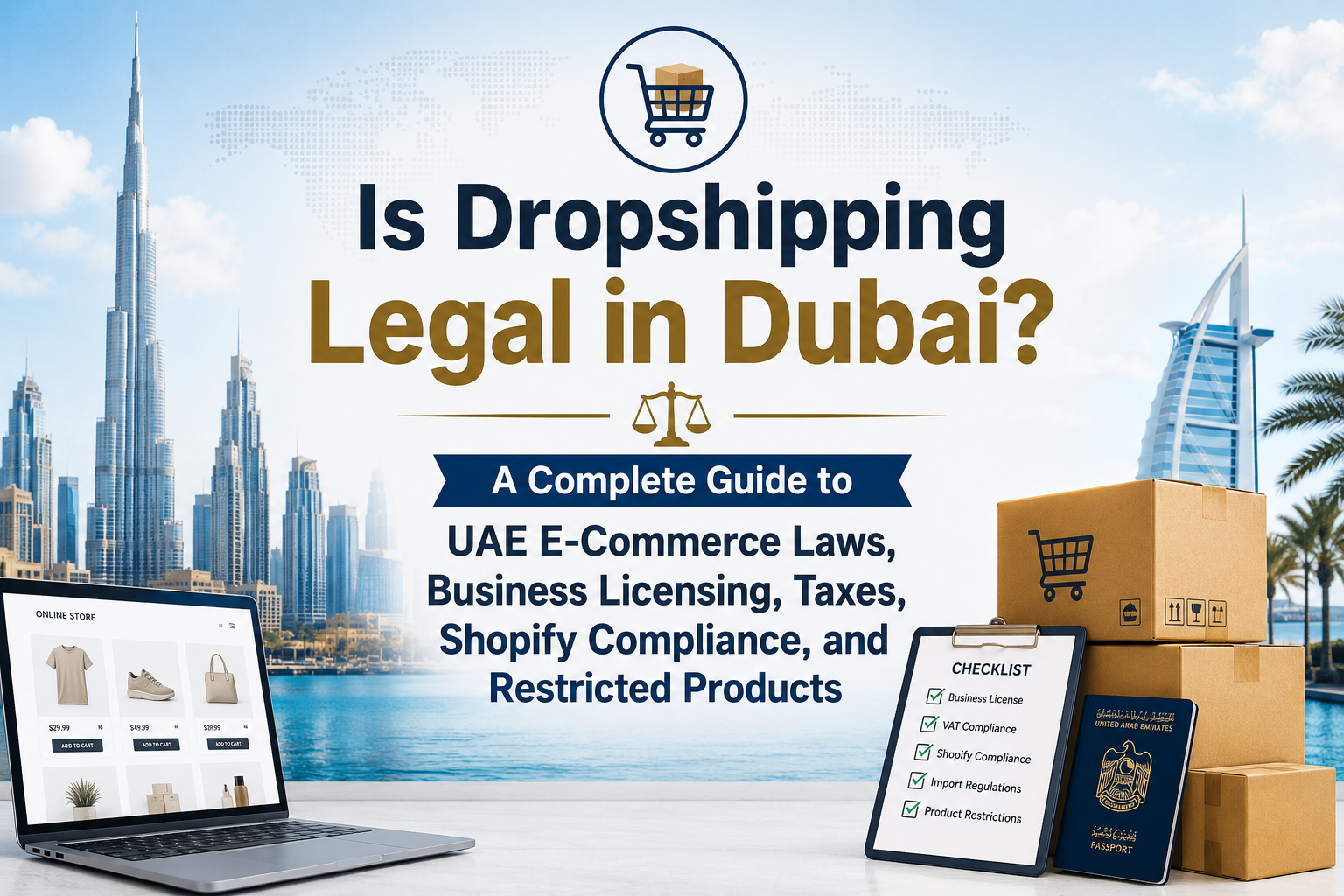
Is Dropshipping Legal in Dubai? UAE E-Commerce Laws and Regulations
One of the most common questions among entrepreneurs interested in the Middle East market is whether dropshipping is legal in Dubai. The short answer is yes. Dropshipping is a legal business model in Dubai and across the United Arab Emirates, provided that the business complies with local regulations and licensing requirements. Unlike some countries that impose restrictions on certain forms of online commerce, the UAE actively encourages digital entrepreneurship and has invested heavily in building a favorable environment for e-commerce companies.
Dropshipping itself is simply a fulfillment method where sellers market and sell products without keeping inventory. Since the model does not violate any commercial laws, it is fully accepted in Dubai. However, legality depends not only on the business model but also on how the business is structured and operated.
Why Business Compliance Matters in Dubai
Many beginners assume that because they do not hold inventory, they can operate an online store without registering a business. In reality, Dubai treats online retail activities the same way it treats traditional commerce. Whether products are shipped directly from suppliers in China or from warehouses in other countries, sellers are still conducting commercial activities and are expected to comply with local laws.
Authorities in the UAE place considerable emphasis on consumer protection, financial transparency, and fair competition. Businesses that fail to meet these standards may face penalties, restrictions, or difficulties with payment processing and banking services.
Therefore, understanding the legal framework before launching a store is an important part of building a sustainable dropshipping business.
Which Authorities Regulate E-Commerce Businesses in Dubai
Several government agencies oversee commercial activities in Dubai. The Department of Economy and Tourism (DET), formerly known as Dubai Economy, plays a major role in issuing licenses and regulating businesses. The Ministry of Economy is responsible for broader economic policies and consumer protection regulations.
Tax-related matters are handled by the Federal Tax Authority, which supervises VAT compliance and other financial obligations. Customs authorities also monitor imported products to ensure they meet safety and regulatory standards.
Although these organizations maintain strict standards, their goal is not to discourage entrepreneurs. Instead, they aim to create a transparent and trustworthy marketplace that benefits both consumers and businesses.
Consumer Protection Laws Apply to Online Sellers
Another important aspect of legality involves customer rights. E-commerce businesses operating in Dubai are expected to provide accurate product descriptions, clear pricing information, and transparent return policies. Misleading advertising or false claims can result in complaints and legal consequences.
Customers in the UAE enjoy strong consumer protection rights, and authorities encourage businesses to resolve disputes fairly. As a result, dropshippers should focus on maintaining high-quality customer service and choosing reliable suppliers to avoid delivery issues or product quality problems.
Building trust is particularly important because customer expectations in the UAE are generally high, especially in competitive sectors such as electronics, fashion, beauty products, and home goods.
Product Restrictions Can Affect Legal Compliance
Although dropshipping is legal, not every product can be sold freely. Certain categories are heavily regulated or prohibited altogether. Products involving alcohol, tobacco, pharmaceuticals, medical devices, and some cosmetics may require additional approvals or certifications before they can be imported and sold.
Intellectual property laws are also strictly enforced in the UAE. Selling counterfeit products or unauthorized replicas of branded items can lead to severe penalties and reputational damage. Entrepreneurs should carefully verify their suppliers and avoid products that may violate trademarks or copyrights.
A legally compliant business depends not only on obtaining the proper registration but also on selecting products that satisfy local regulations.
Why Dubai Continues to Attract Dropshipping Entrepreneurs
Dubai has become one of the most attractive locations for international e-commerce businesses. Its strategic position between Europe, Asia, and Africa provides access to a wide range of markets. Modern logistics infrastructure, advanced payment systems, and government support for innovation have further strengthened the city’s appeal.
In addition, recent reforms allowing greater foreign ownership and easier company formation have made Dubai increasingly accessible to global entrepreneurs. These advantages explain why many online sellers choose the UAE as a base for expanding their businesses.
Do You Need a Business License for Dropshipping in Dubai?
Many aspiring entrepreneurs are attracted to Dubai because of its business-friendly environment and growing e-commerce sector. However, one of the biggest misconceptions surrounding the industry is that dropshipping can be operated without official registration. Since sellers do not hold inventory and products are shipped directly from suppliers, some assume that a business license is unnecessary. In reality, online retail activities in Dubai are considered legitimate commercial operations and are subject to the same regulatory framework as traditional businesses.
Whether a seller operates through Shopify, WooCommerce, Amazon, or social media platforms, generating revenue from online sales is regarded as a commercial activity. Therefore, obtaining the appropriate business license is a crucial step toward operating legally and establishing a sustainable business.
Why Dubai Requires Online Businesses to Be Registered
Dubai has spent years developing itself into a global business hub. Maintaining transparency and protecting consumers are major priorities for the government. Licensing requirements help authorities regulate commercial activities, ensure tax compliance, and create trust within the marketplace.
From a practical perspective, having a licensed company also provides numerous advantages. Licensed businesses are generally able to open corporate bank accounts, access payment gateways, sign contracts with logistics providers, and build stronger relationships with suppliers. In contrast, unregistered operations often face limitations when scaling internationally.
As e-commerce continues to expand throughout the UAE, regulatory compliance has become increasingly important for maintaining long-term growth.
Mainland and Free Zone Licenses: Understanding the Difference
Entrepreneurs planning to start a dropshipping business in Dubai typically encounter two major options: Mainland companies and Free Zone companies. Each structure serves different business objectives and offers unique advantages.
Mainland companies are registered under the Dubai Department of Economy and Tourism and allow businesses to operate throughout the UAE market. This structure can provide greater flexibility for companies that intend to establish a local presence and work directly with customers inside the country.
Free Zone companies, on the other hand, are designed to attract international entrepreneurs and foreign investment. Many free zones offer simplified company formation procedures, competitive pricing, and full foreign ownership. For dropshipping businesses primarily targeting international customers, free zones are often considered an attractive solution because of their efficiency and lower administrative complexity.
Choosing between these structures depends largely on the entrepreneur’s market strategy, budget, and expansion plans.
Popular Free Zones for E-Commerce Businesses
Dubai and the wider UAE offer numerous free zones tailored to digital commerce and startup companies. Areas such as Dubai CommerCity, IFZA, Meydan Free Zone, and DMCC have gained popularity among e-commerce entrepreneurs because they provide specialized support for online businesses.
These free zones are designed to simplify company registration and often provide packages that include licensing services, office facilities, and visa options. Their international orientation makes them particularly appealing to foreign entrepreneurs seeking a gateway into the Middle East, Europe, Africa, and Asia.
As competition among free zones increases, entrepreneurs benefit from a wider range of options and more affordable company setup solutions.
the Costs Involved
The cost of obtaining a business license for dropshipping in Dubai varies depending on several factors, including the chosen jurisdiction, visa requirements, office space arrangements, and additional services.
Initial setup expenses generally include licensing fees, registration costs, and administrative charges. Entrepreneurs who wish to obtain residency visas may face additional expenses. Annual renewal fees should also be considered when calculating long-term operating costs.
Although setting up a company in Dubai requires an upfront investment, many entrepreneurs view these expenses as part of establishing a stable and internationally recognized business structure. The benefits associated with legal compliance often outweigh the initial costs, especially for businesses aiming to scale globally.
Can Foreign Entrepreneurs Own Their Business Completely?
One of the factors that has significantly increased Dubai’s attractiveness is the government’s progressive approach toward foreign investment. Recent reforms have made it possible for foreign entrepreneurs to enjoy full ownership in many business sectors, eliminating previous ownership restrictions that required local participation.
This development has transformed Dubai into one of the most accessible jurisdictions for international business owners. Entrepreneurs from Europe, North America, Asia, and other regions can establish companies while maintaining complete control over their operations.
As a result, Dubai has emerged as a preferred destination for digital entrepreneurs seeking both legal security and strategic access to international markets.
The Risks of Operating Without a License
Attempting to run a dropshipping business without proper registration can create various challenges. Unlicensed businesses may encounter difficulties opening corporate bank accounts, integrating with payment providers, and maintaining compliance with tax regulations. In some cases, authorities may impose fines or restrict commercial activities.
Beyond legal considerations, operating without a license can undermine customer confidence and hinder future expansion. Professional suppliers, logistics companies, and financial institutions often prefer to work with officially registered businesses.
For entrepreneurs with long-term ambitions, legal registration should be viewed not as an obstacle but as an investment in credibility and business stability.
Is Shopify Dropshipping Legal in Dubai? Rules for Online Stores, Payment Gateways, and Consumer Protection
As Shopify continues to dominate the global e-commerce industry, many entrepreneurs interested in the Middle East are asking whether Shopify dropshipping is legal in Dubai. The answer is yes. Using Shopify as an e-commerce platform is completely legal in the United Arab Emirates, and dropshipping through Shopify is widely accepted. However, the legality of the business does not depend on Shopify itself. Instead, it depends on whether the store owner complies with the regulations governing online commerce in Dubai.
Shopify simply provides the technological infrastructure for building an online store. The responsibility for licensing, taxation, customer service, and regulatory compliance rests with the business owner. Therefore, while the platform itself presents no legal issues, entrepreneurs must ensure that their operations meet the standards established by UAE authorities.
Why Shopify Is Popular Among Dubai Entrepreneurs
Dubai has emerged as one of the leading digital commerce centers in the Middle East. Combined with Shopify’s ease of use and scalability, this has created an attractive environment for online businesses. Entrepreneurs can quickly launch stores, integrate suppliers, and sell products to customers around the world.
The flexibility of Shopify also makes it suitable for both local and international markets. Businesses based in Dubai can target customers in the GCC region, Europe, North America, and Asia without maintaining large inventories. This combination of low operational complexity and global reach explains why Shopify dropshipping has become increasingly popular among startups and small businesses in the UAE.
Nevertheless, convenience does not eliminate the need for legal compliance.
Operating a Shopify Store Requires a Legitimate Business Structure
Some beginners mistakenly assume that owning a Shopify store alone is enough to conduct business legally. In reality, Shopify is merely a software platform. Selling products through Shopify is considered a commercial activity, which means entrepreneurs are generally expected to operate under a properly registered company.
Having a legal business structure provides more than regulatory protection. It also improves credibility and simplifies cooperation with banks, payment providers, logistics companies, and suppliers. Businesses that operate without proper registration may eventually face obstacles when trying to scale or process international payments.
For serious entrepreneurs, legal registration should be viewed as an important foundation rather than an unnecessary expense.
Payment Gateways and Financial Compliance
One of the most important aspects of Shopify dropshipping in Dubai involves payment processing. A store’s ability to accept online payments directly influences customer experience and revenue generation. Popular payment solutions such as Stripe, PayPal, Telr, and Checkout.com are widely used by businesses operating in the UAE.
However, payment providers generally require merchants to verify their identities and provide company documentation. Compliance procedures are designed to prevent fraud, money laundering, and financial misconduct. As a result, operating with a properly registered business often simplifies account approval and reduces the risk of payment disruptions.
Entrepreneurs should also pay attention to transaction fees, supported currencies, and international payment capabilities when selecting a gateway. Choosing the right provider can significantly improve operational efficiency and customer satisfaction.
Consumer Protection Laws Apply to Shopify Stores
Running a Shopify store in Dubai means complying with consumer protection regulations. Customers are entitled to accurate information regarding pricing, product descriptions, and delivery terms. Misleading advertising or false claims can result in complaints and potential legal consequences.
Transparency has become increasingly important in the modern e-commerce environment. Clear refund policies, responsive customer support, and reliable shipping arrangements help businesses establish trust and reduce disputes. Since dropshipping often involves international suppliers, entrepreneurs should carefully manage delivery expectations to avoid customer dissatisfaction.
Providing a positive customer experience is not only beneficial for compliance but also essential for long-term brand development.
Shipping and Import Regulations Should Not Be Ignored
Although Shopify allows merchants to source products from suppliers around the world, importing goods into the UAE still involves customs procedures and regulatory requirements. Certain products may require certifications or approvals before they can be sold legally.
Entrepreneurs should pay special attention to categories such as cosmetics, supplements, medical products, and electronics, which may be subject to stricter regulations. Understanding import restrictions can help prevent delays, penalties, or inventory issues.
Working with reputable suppliers and logistics partners is one of the most effective ways to minimize operational risks and maintain a smooth customer experience.
Intellectual Property Compliance Is Equally Important
Another area frequently overlooked by beginners is intellectual property protection. Dubai maintains strict laws against counterfeit goods and trademark infringement. Selling unauthorized replicas or products that violate copyrights can expose businesses to severe legal consequences.
This risk is particularly relevant in dropshipping because suppliers may offer products that resemble famous brands. Entrepreneurs should carefully evaluate suppliers and ensure that the products they sell are authentic and legally permissible.
Building a sustainable business depends heavily on maintaining ethical sourcing practices and respecting intellectual property rights.
Is Dropshipping in Dubai Tax-Free? VAT Rules and Corporate Tax for E-Commerce Sellers
Dubai is often described as a tax-free business destination, which leads many entrepreneurs to assume that dropshipping operations are completely exempt from taxation. While it is true that the UAE offers one of the most competitive tax environments globally, the reality is more nuanced. Dropshipping businesses in Dubai are not entirely tax-free, especially when certain revenue thresholds and regulatory conditions are met.
The UAE has introduced structured tax systems in recent years to align with international financial standards. This includes Value Added Tax (VAT) and corporate taxation frameworks that apply to many business activities, including e-commerce and dropshipping.
VAT in the UAE E-Commerce Environment
Value Added Tax was introduced in the UAE in 2018 at a standard rate of 5 percent. It applies to most goods and services sold within the country, including online retail transactions. For dropshipping businesses, VAT obligations depend on where the goods are shipped, who the customer is, and how the business is structured.
When a dropshipper sells products to customers in the UAE, VAT may need to be charged on those sales. However, if the business is selling exclusively to international customers outside the UAE, different tax rules may apply, potentially reducing or eliminating VAT obligations on those specific transactions.
The key factor is not the platform or business model, but the taxable supply chain and customer location.
VAT Registration Requirements for Dropshippers
Not every dropshipping business is required to register for VAT immediately. In the UAE, VAT registration becomes mandatory when a business exceeds a certain annual revenue threshold. Once this threshold is crossed, the business must register with the relevant authority and begin charging VAT on applicable sales.
The regulatory body responsible for tax administration is the Federal Tax Authority, which oversees VAT compliance, filing requirements, and enforcement.
Even businesses below the mandatory threshold may choose to register voluntarily. Many e-commerce entrepreneurs do this to enhance credibility, reclaim input VAT on expenses, and streamline operations with suppliers and logistics partners.
For dropshipping businesses that scale quickly, VAT registration often becomes a natural step rather than an optional one.
Corporate Tax and Its Impact on Dropshipping Businesses
In addition to VAT, the UAE has also introduced a federal corporate tax in recent years. This tax applies to business profits above a certain threshold and is part of the country’s broader effort to align with global tax frameworks such as OECD standards.
For dropshipping entrepreneurs, corporate tax is relevant once the business becomes profitable and meets the taxable income criteria. However, small businesses and startups may benefit from exemptions or reduced rates depending on their structure and earnings.
This means that while Dubai remains highly attractive from a tax perspective, it is no longer accurate to assume that all business income is entirely exempt from taxation.
International Sales and Cross-Border Tax Complexity
Dropshipping is inherently a cross-border business model, which means tax obligations can become more complex when dealing with international customers and suppliers. In many cases, goods are shipped directly from manufacturers in one country to consumers in another, bypassing the UAE entirely.
This structure raises important questions about where value is created and where taxes should be applied. Depending on the jurisdictions involved, businesses may encounter additional tax obligations outside the UAE, especially when selling into regions such as the European Union or North America.
Successful dropshipping entrepreneurs often work with tax advisors to ensure compliance across multiple regions, particularly when scaling globally.
Why Tax Compliance Strengthens Business Credibility
Although some entrepreneurs initially view taxes as a burden, in practice, tax compliance often strengthens a business rather than restricting it. Registered and compliant companies are more likely to gain access to reliable payment processors, banking services, and enterprise-level logistics providers.
In Dubai’s competitive e-commerce ecosystem, compliance is closely linked to credibility. Customers, suppliers, and financial institutions all prefer to work with businesses that operate transparently and follow legal frameworks.
Can Foreigners Start a Dropshipping Business in Dubai Without Living There?
One of the most frequently searched questions around UAE e-commerce is whether foreigners can start a dropshipping business in Dubai without physically relocating. The short answer is yes, it is possible, but it depends on how the business is structured and which jurisdiction you choose.
Dubai has positioned itself as a global business hub that attracts entrepreneurs from Europe, Asia, Africa, and North America. Unlike many traditional markets, it offers flexible company formation options that allow non-residents to establish and operate businesses remotely. However, while incorporation can often be done without living in the UAE full-time, certain operational steps may still require occasional visits or local representation depending on the business setup.
Company Formation Without Residency: What Is Actually Possible
Foreign entrepreneurs can legally establish a dropshipping business in Dubai without immediate residency. This is primarily done through free zone companies, which are designed to attract international investors and digital entrepreneurs.
Free zones typically allow 100 percent foreign ownership, simplified registration processes, and digital-first onboarding. This means you can incorporate your business, obtain a trade license, and begin operating an online store without being a UAE resident at the start.
In many cases, documents can be submitted online, and company formation can be completed remotely through authorized agents. This makes Dubai particularly attractive for entrepreneurs who want to test the Middle Eastern market before committing to relocation.
However, while company formation can be remote, operational banking and certain compliance procedures may still require identity verification or in-person processes depending on the financial institution.
The Role of Free Zones in Remote Dropshipping Operations
Free zones are central to Dubai’s strategy for attracting global e-commerce businesses. Areas such as Dubai CommerCity, IFZA, and Meydan Free Zone are specifically designed to support online retailers, logistics companies, and digital entrepreneurs.
These zones offer packages that often include trade licenses, visa eligibility, and business infrastructure tailored to e-commerce operations. For dropshipping businesses, this structure is especially useful because it aligns with a low-overhead, location-independent business model.
A major advantage of free zones is that they simplify regulatory requirements. Entrepreneurs can operate under a clearly defined legal framework while focusing on marketing, supplier management, and customer acquisition rather than complex administrative burdens.
Can You Operate a UAE Business Without a Physical Presence?
Although incorporation can be remote, long-term operation becomes more complex without any physical presence. Certain aspects of business management, such as banking relationships, visa processing, and compliance updates, may require periodic interaction with UAE institutions.
For example, opening a corporate bank account is often one of the most challenging steps for non-residents. Banks typically conduct strict due diligence checks to verify business activity, source of funds, and ownership structure. In some cases, a physical visit to the UAE may be required during onboarding.
Similarly, if an entrepreneur plans to scale their business significantly, obtaining a residency visa through the company can become beneficial for smoother operations and financial access.
Visa Options for Dropshipping Entrepreneurs
Although not mandatory for initial setup, many entrepreneurs eventually choose to obtain a UAE residency visa to simplify long-term operations. Business owners can typically apply for investor visas or residency permits linked to their company.
These visas provide additional benefits, including easier banking access, simplified administrative processes, and the ability to live and work in the UAE legally. For high-growth e-commerce entrepreneurs, this often becomes a strategic decision rather than a legal requirement.
Residency also enhances credibility when working with suppliers, logistics partners, and payment providers, especially in international trade environments.
Banking and Payment Challenges for Non-Residents
One of the most important considerations for foreign dropshipping entrepreneurs is access to financial infrastructure. While company registration may be straightforward, opening and maintaining a UAE business bank account can be more complex.
Banks in the UAE follow strict compliance standards aligned with international anti-money laundering regulations. As a result, they often require detailed business plans, supplier contracts, and evidence of real commercial activity.
Payment gateway integration can also depend on business verification status. Platforms such as Stripe alternatives or regional processors may require proof of business legitimacy and sometimes a local presence.
These requirements are not designed to restrict foreign entrepreneurs but to ensure financial transparency within the UAE’s rapidly growing digital economy.
Why Dubai Remains Attractive Even Without Relocation
Despite these considerations, Dubai continues to be one of the most attractive jurisdictions for global dropshipping businesses. Its strategic location between major markets, strong logistics infrastructure, and business-friendly regulatory environment make it a powerful hub for international e-commerce.
Additionally, the ability to start a company remotely gives entrepreneurs flexibility to test business models without committing to relocation. This lowers entry barriers while still providing access to a globally respected business jurisdiction.
For many entrepreneurs, Dubai serves as a strategic base rather than a permanent residence, offering legal structure, brand credibility, and international expansion potential.
What Products Are Restricted or Illegal for Dropshipping in Dubai?
While dropshipping is legal in Dubai and widely supported as a business model, not every product can be freely sold or imported. The legality of your business is not only determined by licensing or platform choice, but also by what you actually sell. The United Arab Emirates maintains strict import and consumer safety regulations designed to protect public health, intellectual property, and national standards.
For dropshipping entrepreneurs, this means product selection is not just a marketing decision—it is a compliance requirement. Selling restricted or prohibited goods, even unintentionally through overseas suppliers, can lead to shipment seizures, fines, or business suspension.
Categories of Prohibited Products in the UAE
Certain product categories are strictly prohibited from being imported or sold in Dubai under any circumstances. These restrictions are enforced at the customs level and apply regardless of whether the goods are sold through Shopify, Amazon, or independent websites.
Products related to narcotics, illegal drugs, and controlled substances are completely banned. Similarly, counterfeit goods and replicas of branded products are heavily restricted due to strict intellectual property enforcement. Even listing imitation luxury items or unauthorized branded merchandise can lead to serious legal consequences.
Additionally, items that conflict with cultural, religious, or moral standards in the UAE may also be prohibited. This includes certain publications, media content, or goods deemed inappropriate by regulatory authorities.
These restrictions are enforced at multiple levels, including customs inspection and post-sale monitoring, making compliance essential for any e-commerce operator.
Restricted Products That Require Approval or Certification
Beyond outright prohibitions, there is a large category of restricted goods that can be sold only if specific approvals, certifications, or import permits are obtained. These products are common in dropshipping stores, which makes this category particularly important for entrepreneurs.
Health-related products such as dietary supplements, vitamins, and medical devices often require approval from local health authorities before import. Cosmetics and skincare items may also need safety certifications to ensure they meet UAE standards.
Electronics can be subject to technical compliance requirements, especially if they involve wireless communication or safety-sensitive components. In some cases, products must be tested and certified before they can enter the market.
These regulatory requirements are not designed to prevent trade but to ensure that products meet safety and quality standards expected in the UAE market.
Intellectual Property Risks in Dropshipping
One of the most overlooked risks in dropshipping is intellectual property infringement. Many suppliers, particularly in global marketplaces, offer products that resemble well-known branded goods. While these items may appear profitable, selling them in Dubai can create significant legal exposure.
The UAE enforces strict intellectual property laws that protect trademarks, copyrights, and brand identities. Selling unauthorized replicas or using branded images without permission can result in product seizures, account suspension, and potential legal action.
Even if a supplier is willing to ship such products, responsibility ultimately falls on the seller. This makes supplier verification an essential part of compliance strategy in dropshipping operations.
Customs Regulations and Import Controls
Every product entering Dubai must pass through customs clearance procedures. These processes are designed to ensure that imported goods comply with national regulations and safety standards. Even if a product is legal in the seller’s country or supplier’s origin country, it may still be restricted in the UAE.
Customs authorities may inspect shipments randomly or based on risk profiles. Products that fail inspection can be delayed, returned, or confiscated. This can directly impact customer satisfaction and business reputation.
For dropshipping businesses, this creates a unique challenge because sellers do not physically handle inventory. As a result, they must rely heavily on suppliers who understand international shipping regulations and documentation requirements.
How Product Compliance Affects Business Sustainability
Product compliance is not just a legal issue—it directly affects operational stability. Businesses that unknowingly sell restricted products often face higher refund rates, shipping delays, and payment disputes. Over time, this can lead to account limitations on payment platforms or advertising networks.
On the other hand, businesses that carefully select compliant products tend to scale more smoothly. They experience fewer disruptions, stronger supplier relationships, and improved customer trust.
In competitive markets like Dubai, where consumer expectations are high, reliability often matters more than short-term profit margins.
Building a Safe and Scalable Dropshipping Strategy
Successful dropshipping businesses in Dubai typically focus on products that are clearly permitted, easy to ship, and unlikely to require complex regulatory approvals. Many entrepreneurs prioritize categories such as home goods, fashion accessories, fitness equipment, and general lifestyle products that do not fall into restricted categories.
Working with verified suppliers and conducting due diligence on product compliance can significantly reduce operational risks. In addition, maintaining transparency in product descriptions and avoiding exaggerated claims helps strengthen long-term brand credibility.
Not all products are suitable for dropshipping in Dubai, even though the business model itself is fully legal. Prohibited goods, restricted categories requiring approval, intellectual property violations, and customs regulations all play a critical role in shaping what can be sold safely and legally.
Entrepreneurs who understand these boundaries are better positioned to build stable and scalable businesses. In contrast, those who ignore product compliance risks often face operational disruptions and legal consequences.
In Dubai’s highly regulated yet opportunity-rich e-commerce environment, success depends not only on finding winning products but also on ensuring those products are fully compliant with UAE laws and import standards.




No Comments