


Is Dropshipping Legal for Teens? And How to Make Money from It in 2026: Everything Young Entrepreneurs Need to Know

In most countries, dropshipping is legal for teenagers under 18. The primary limitations come from contracts, payment processing, business registration, and tax compliance rather than the business model itself.
For teenagers willing to work with parents or legal guardians, dropshipping can provide practical business education, marketing experience, and even a meaningful source of income long before reaching adulthood.
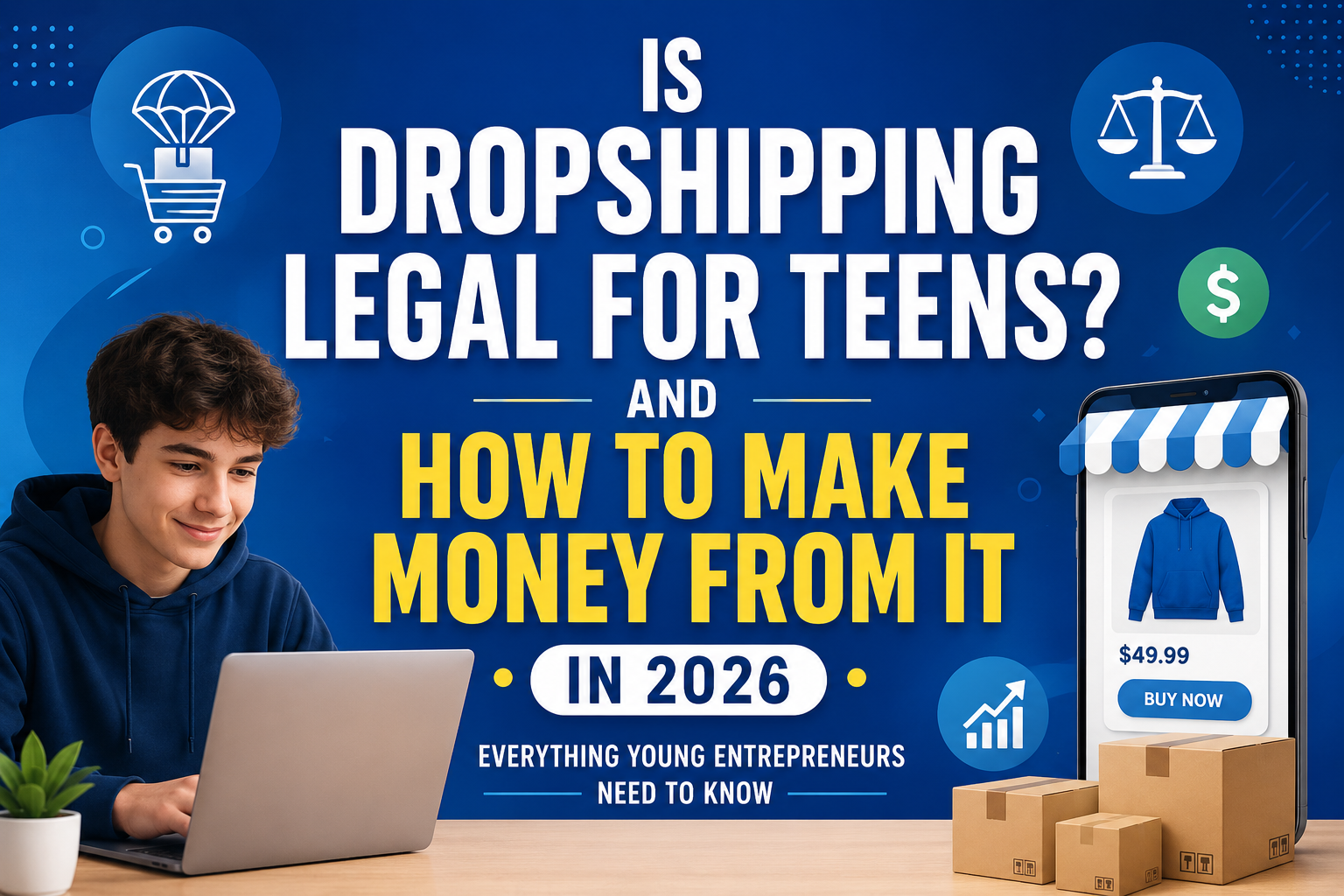
Is Dropshipping Legal for Teens? Age Limits, Business Registration Rules, and Platform Policies
The rise of social media entrepreneurship has encouraged many teenagers to explore online business opportunities earlier than ever before. Among the most attractive options is dropshipping, a business model that allows sellers to market products without holding inventory or managing warehouses. However, one important question appears repeatedly among young entrepreneurs and their parents: is dropshipping actually legal for teenagers under the age of 18?
The answer is more nuanced than a simple yes or no. In most countries, dropshipping itself is legal for minors, but the surrounding legal and financial infrastructure often creates restrictions that require parental involvement.
Selling Products Is Usually Legal, but Contracts Are Different
From a legal perspective, there is generally no law that specifically prohibits teenagers from selling products online. A 16-year-old selling handmade products, digital downloads, or dropshipping items is not automatically breaking any laws simply because of their age.
The challenge arises because running an online store involves entering into legally binding agreements. Creating accounts with e-commerce platforms, payment processors, advertising networks, and suppliers requires accepting contracts and terms of service. In many jurisdictions, minors cannot legally enter into enforceable commercial contracts without parental consent.
As a result, the legality issue surrounding teenage dropshipping is less about selling products and more about the ability to sign agreements with businesses that support the operation.
E-commerce Platforms Often Require Users to Be Adults
Most major e-commerce platforms impose age restrictions in their terms of service.
Shopify generally requires account holders to be at least 18 years old or to operate under parental supervision. Amazon Seller Central typically requires sellers to be legal adults in their country of residence. Similar requirements exist on platforms such as eBay and Etsy.
These rules are primarily designed to reduce financial risk and simplify legal responsibility rather than discourage young entrepreneurs.
For teenagers interested in dropshipping, this means the store owner listed on official documents often needs to be a parent or legal guardian.
Payment Processors Create the Biggest Barrier
While opening an online store may be relatively straightforward, receiving payments is usually more complicated.
Payment providers such as PayPal and Stripe almost universally require account holders to be at least 18 years old. Providing false information during registration can result in account suspension, frozen balances, and lengthy verification processes.
Since payment processors handle fraud prevention, chargebacks, tax reporting, and anti-money laundering compliance, they tend to apply stricter age verification standards than e-commerce platforms themselves.
For many teenage dropshippers, payment infrastructure becomes the single largest obstacle to operating independently.
Business Registration Rules Vary by Country
Business registration requirements differ significantly across countries and regions.
In the United States, minors may sometimes own businesses, but forming entities such as LLCs often requires adult involvement depending on state regulations. In the United Kingdom, company directors generally must be at least 16 years old. Other countries may require individuals to be 18 before registering a business entity.
Tax obligations add another layer of complexity. Once revenue reaches certain thresholds, income reporting and tax filing requirements usually apply regardless of age.
Teenagers considering dropshipping should therefore research both national regulations and local requirements before launching a store.
Why Family-Supported Businesses Are Common
Because of these legal limitations, many successful teenage entrepreneurs operate through family-supported business structures.
Parents may register the business, open payment accounts, and manage tax reporting responsibilities, while teenagers focus on product research, content creation, customer support, and advertising campaigns.
This arrangement allows young entrepreneurs to gain valuable business experience while remaining compliant with platform rules and financial regulations.
In practice, this model is far more common than fully independent teenage ownership.
The Real Opportunity for Young Entrepreneurs
Although legal restrictions exist, they should not be interpreted as barriers to entrepreneurship.
Teenagers often possess advantages that older business owners struggle to replicate. They understand social media trends more naturally, adapt quickly to changing consumer preferences, and are often highly skilled at creating engaging short-form content.
Modern dropshipping increasingly depends on marketing creativity rather than inventory ownership. In that environment, younger entrepreneurs may actually hold a competitive advantage.
The key is not finding ways to avoid age restrictions but building a business structure that operates within existing legal frameworks.
How Teens Can Legally Start a Dropshipping Business with Their Parents' Help
For many teenagers interested in entrepreneurship, dropshipping appears to be one of the most accessible online business models available. It requires relatively little startup capital, does not involve inventory management, and can be operated from a laptop anywhere in the world. However, while young entrepreneurs may have the motivation and technical skills to build an online store, legal and financial systems are often designed for adults.
This does not mean teenagers are excluded from e-commerce. In reality, many successful young dropshippers build their businesses with the support of their parents or legal guardians, creating a structure that satisfies legal requirements while allowing teenagers to gain real entrepreneurial experience.
Why Family Partnerships Have Become the Standard Approach
Most online businesses rely on a network of services that require legally binding agreements. E-commerce platforms, payment processors, tax authorities, and advertising platforms all expect account holders to accept contractual responsibilities.
Because teenagers under 18 may face restrictions when entering commercial agreements, family-supported businesses have become the most practical solution.
In this arrangement, parents act as the legal account holders while teenagers manage the operational side of the business. The model resembles a family business rather than a traditional employer-employee relationship.
For many households, this structure transforms dropshipping from an individual project into an educational business venture.
Dividing Responsibilities Creates Operational Efficiency
One of the advantages of involving parents is the ability to divide responsibilities according to strengths and legal requirements.
Parents typically handle company registration, payment processing accounts, tax reporting obligations, and official documentation. Teenagers often focus on product research, store design, customer engagement, content creation, and marketing campaigns.
This division of labor allows each participant to contribute in areas where they provide the greatest value.
Young entrepreneurs often have a natural understanding of internet culture and social media trends. Parents, on the other hand, usually bring experience in financial management and long-term planning.
When combined, these strengths can create a more stable business foundation than either party might achieve independently.
Social Media Marketing Gives Teenagers a Competitive Advantage
Modern dropshipping is increasingly driven by attention rather than logistics.
Platforms such as TikTok, Instagram Reels, and YouTube Shorts reward creators who understand current trends, online humor, and changing consumer interests. Teenagers frequently spend years developing an intuitive understanding of these platforms long before entering business.
This familiarity often allows younger entrepreneurs to identify viral products faster than traditional retailers.
Many successful stores are built not because their owners possess advanced business degrees but because they understand how to create content that captures attention and encourages sharing.
In many cases, this gives teenagers a significant competitive advantage over older competitors.
Starting Small Reduces Financial Risk
One of the biggest mistakes new entrepreneurs make is assuming they need large budgets to succeed.
Family-supported dropshipping businesses often perform better when they begin with modest expectations and controlled spending. Instead of investing thousands of dollars in advertising, many young entrepreneurs start by testing products through organic social media content.
This approach reduces financial risk while allowing valuable learning experiences to accumulate.
Early-stage businesses frequently encounter problems involving suppliers, product quality, shipping delays, and customer service. Experiencing these challenges on a smaller scale can prevent expensive mistakes later.
For teenagers, education and experience may be more valuable than short-term profits during the first year of operation.
Transparency Builds Long-Term Stability
When parents participate in the business, transparency becomes essential.
Clear agreements regarding expenses, profit distribution, reinvestment strategies, and responsibilities help avoid misunderstandings as revenue grows.
Some families treat the business as a learning project where profits are reinvested into future growth. Others allocate a percentage of earnings to the teenager while maintaining reserves for taxes and operational costs.
There is no universally correct model, but clearly defined expectations contribute significantly to long-term stability.
A business built on trust and communication tends to survive challenges more effectively than one built solely on excitement and rapid growth ambitions.
The Educational Value Often Exceeds the Financial Return
One of the most overlooked aspects of teenage entrepreneurship is the educational value created by the process itself.
Running a dropshipping store teaches skills that traditional education rarely emphasizes. Market research, customer psychology, advertising strategy, budgeting, negotiation, copywriting, and problem solving become daily responsibilities rather than theoretical concepts.
Even businesses that generate only modest profits may provide experiences that influence future careers in marketing, finance, technology, or entrepreneurship.
Viewed from this perspective, the business becomes an investment in skills rather than merely an attempt to generate income.
Can Teens Really Make Money with Dropshipping? Costs, Margins, and Income Expectations
Stories of teenagers becoming millionaires through dropshipping have spread rapidly across social media platforms over the past few years. Videos showing luxury cars, screenshots of large sales numbers, and claims of overnight success have attracted countless young entrepreneurs to the industry. Naturally, one question appears repeatedly: can teenagers actually make money with dropshipping, or are these success stories unrealistic exceptions?
The answer lies somewhere between the extreme optimism of social media and the skepticism of traditional business advice. Teenagers can absolutely generate income through dropshipping, but the path is often slower, more difficult, and less predictable than online marketing videos suggest.
Revenue and Profit Are Not the Same Thing
One of the biggest misconceptions among beginners is confusing revenue with profit.
A store generating $10,000 in monthly sales may appear highly successful at first glance. However, product costs, payment processing fees, advertising expenses, refunds, and transaction fees can consume a significant portion of that revenue.
For example, a product sold for $40 might cost $18 from the supplier, while advertising may require another $12 to acquire the customer. Payment fees and operational expenses could reduce the remaining margin even further.
As a result, many stores operate with net profit margins between 10% and 20%, while some beginners lose money despite producing impressive sales figures.
The First Months Often Produce Losses
Most profitable businesses require an investment period before they generate sustainable returns, and dropshipping is no exception.
New entrepreneurs frequently spend money testing products that never gain traction. Advertising campaigns may fail, product pages may convert poorly, and supplier issues may damage customer satisfaction.
These early failures are not unusual. In fact, they often represent the learning phase that teaches product selection, pricing strategy, customer psychology, and advertising optimization.
Many successful store owners report losing money during their first several months before finding products that consistently generate profit.
Teenagers entering the industry should therefore view initial losses as tuition costs rather than evidence of failure.
Organic Marketing Can Reduce Financial Barriers
One reason dropshipping remains attractive for younger entrepreneurs is the growing importance of organic traffic sources.
Traditional e-commerce growth depended heavily on paid advertising budgets that many teenagers simply cannot afford. Today, platforms such as TikTok, Instagram Reels, and YouTube Shorts allow creators to reach large audiences without significant financial investment.
A single viral video can produce thousands of visitors and sales opportunities.
This changes the economics of the business considerably.
Instead of competing primarily through advertising budgets, entrepreneurs increasingly compete through creativity, storytelling, and content production skills. Younger creators often possess advantages in exactly these areas.
For teenagers with limited capital, organic marketing may represent the most realistic path toward profitability.
Income Expectations Should Remain Conservative
One of the reasons many beginners become discouraged is because they expect unrealistic financial results.
Social media often promotes stories of sixteen-year-olds earning six figures within a few months. While these examples exist, they are statistical outliers rather than typical outcomes.
A more realistic progression might involve several months of experimentation before reaching break-even performance. Stores that survive this stage may eventually generate several hundred dollars per month in profit.
As operational experience improves, monthly profits may grow into the range of one thousand to several thousand dollars depending on market conditions, product selection, and marketing performance.
These numbers may seem less exciting than viral success stories, but they reflect the experience of many sustainable businesses.
Skill Development Becomes a Valuable Asset
Financial returns represent only one form of value generated by dropshipping.
Building an online store forces entrepreneurs to develop transferable skills including copywriting, video production, customer service, data analysis, negotiation, and digital marketing.
These abilities often remain useful regardless of whether the original business succeeds.
Many professionals working in advertising agencies, software companies, and e-commerce brands first developed their commercial understanding through small online businesses during their teenage years.
Viewed from this perspective, the return on investment extends beyond immediate profits.
The skills accumulated may eventually become more valuable than the first successful product itself.
Why Some Teenagers Outperform Older Entrepreneurs
Interestingly, age can sometimes create advantages rather than disadvantages.
Teenagers tend to understand emerging trends more quickly and often spend significant time consuming the same content as their target audiences. This familiarity allows them to identify viral products and create authentic marketing content that resonates with consumers.
Older entrepreneurs occasionally struggle to adapt to rapidly changing online culture, while younger business owners may recognize opportunities much earlier.
In industries driven by attention and trends, this advantage can be significant.
Best Dropshipping Niches for Teens: Low-Risk Products with High Viral Potential
Choosing the right niche is one of the most important decisions in any dropshipping business. For teenage entrepreneurs, this decision may be even more critical because most young sellers operate with limited budgets, smaller risk tolerance, and less business experience than established competitors. While many beginners focus exclusively on profit margins, the most suitable niche for a teenager is often one that combines manageable complexity with strong content potential and consumer demand.
The goal is not simply to find products that sell, but to find products that can be marketed effectively by someone who understands the audience better than larger companies do.
Products That Match Daily Interests Often Perform Better
One advantage teenagers possess is proximity to consumer trends.
Many successful businesses are built by entrepreneurs who understand their customers because they are part of the same demographic group. Teenagers spend significant time interacting with social media platforms, gaming communities, fitness trends, fashion culture, and online entertainment.
As a result, they often recognize emerging interests before market research reports identify them.
Products related to gaming accessories, desk setups, phone accessories, room decoration, sports equipment, or pet products often benefit from this familiarity. The entrepreneur naturally understands why customers would want the product and how they might discover it online.
Low-Cost Products Reduce Operational Pressure
For inexperienced entrepreneurs, low-ticket products often provide a safer starting point.
Products priced between twenty and fifty dollars generally create lower customer expectations than premium products costing several hundred dollars. Customers tend to tolerate slightly longer delivery times and are less likely to demand extensive customer support.
Lower-priced products also reduce refund risks and chargeback exposure.
Most importantly, testing advertising campaigns becomes significantly cheaper when customer acquisition costs remain manageable.
For teenagers working with limited budgets, preserving cash flow can be more important than maximizing individual order values.
A business that survives can always expand later into higher-priced categories.
Viral Potential Matters More Than Product Complexity
Modern dropshipping increasingly depends on content distribution rather than traditional retail advantages.
Products that demonstrate clear visual transformations or solve obvious problems tend to perform exceptionally well on short-form video platforms. Consumers often make purchasing decisions within seconds of seeing a product demonstration.
Items that create surprising results, improve convenience, or generate emotional reactions frequently outperform technically superior products that require lengthy explanations.
This is one reason why simple gadgets sometimes outperform expensive electronics.
Instead of asking whether a product is innovative, successful sellers increasingly ask whether a product can generate attention within the first few seconds of a video.
Avoiding Highly Regulated Niches Reduces Risk
Not every profitable niche is suitable for young entrepreneurs.
Medical devices, supplements, skincare products with health claims, and products intended for children often involve regulatory requirements that can become difficult to navigate. Returns, compliance issues, and customer disputes tend to occur more frequently in these categories.
Similarly, highly technical products often require advanced customer support knowledge that inexperienced entrepreneurs may struggle to provide.
Reducing complexity can improve operational stability.
For most beginners, success comes not from entering the most profitable industry but from entering a market they can realistically manage.
Passion Can Become a Competitive Advantage
Many entrepreneurs underestimate the value of genuine interest in a niche.
Running a dropshipping business involves content creation, customer communication, competitor analysis, and product research over extended periods of time. Motivation often declines rapidly when the entrepreneur has no personal interest in the products being sold.
By contrast, sellers who enjoy gaming, fitness, pets, or technology often find it easier to produce engaging content and maintain consistency.
Customers frequently notice this difference.
Authentic enthusiasm tends to produce stronger branding than purely financial motivation.
For teenage entrepreneurs especially, building around existing interests may provide a significant long-term advantage.
Trend Awareness Creates Opportunities
Consumer preferences change rapidly in digital markets.
Products that dominate social media one month may disappear completely the following quarter. Teenagers often possess an advantage because they are already immersed in online culture and emerging trends.
This awareness allows faster product discovery and shorter reaction times.
Large corporations may require months to identify and respond to changing consumer behavior, while independent entrepreneurs can launch campaigns within days.
Speed has become one of the most valuable competitive advantages in modern e-commerce.
Young entrepreneurs who use this advantage effectively may compete successfully against much larger businesses.
How Teens Can Use TikTok to Grow a Profitable Dropshipping Business
Over the past few years, TikTok has fundamentally changed how products are discovered online. Traditional e-commerce businesses often depended on expensive advertising campaigns and established brand recognition to generate sales. TikTok introduced a different model, one where attention can be earned through creativity rather than purchased through large marketing budgets.
For teenage entrepreneurs interested in dropshipping, this shift has created a significant opportunity. In many ways, younger creators are better positioned to understand the platform than established companies with larger financial resources.
The challenge is no longer access to advertising capital but the ability to capture attention and maintain engagement.
TikTok Rewards Content More Than Budget Size
One of the reasons TikTok has become attractive for new entrepreneurs is the structure of its recommendation algorithm.
Unlike traditional social media platforms that rely heavily on follower counts, TikTok frequently distributes content from small creators to large audiences if engagement metrics perform well during the initial testing phase.
This creates a relatively level playing field.
A teenager with a newly created account can sometimes achieve greater reach than a large company with years of brand history if the content resonates with viewers.
For dropshipping businesses, this means product discovery increasingly depends on storytelling and presentation rather than advertising expenditure.
The competitive advantage shifts toward creativity rather than financial resources.
Internet Culture Creates Marketing Advantages
Teenagers often underestimate how valuable their familiarity with internet culture can be.
Successful TikTok content rarely resembles traditional advertising. Instead, it frequently adopts the style of entertainment, humor, reactions, tutorials, or problem-solving demonstrations.
Younger creators usually understand these formats intuitively because they consume similar content every day.
This familiarity allows them to create videos that feel native to the platform rather than promotional interruptions.
Consumers are increasingly resistant to direct advertising but remain highly responsive to content that educates, entertains, or surprises them.
For teenage entrepreneurs, cultural understanding can become a meaningful competitive advantage.
Product Demonstrations Perform Better Than Sales Pitches
The most successful dropshipping videos on TikTok often avoid obvious sales language.
Instead of focusing on discounts or promotional claims, effective creators demonstrate products solving real problems or improving everyday experiences.
Visual evidence tends to outperform verbal persuasion.
A viewer who watches a product simplify a task or produce an unexpected result often develops interest naturally without requiring aggressive selling techniques.
This approach aligns closely with TikTok’s content-driven environment.
Products that can communicate value within a few seconds generally outperform products that require lengthy explanations or technical descriptions.
For this reason, product presentation frequently matters as much as product quality itself.
Consistency Matters More Than Individual Viral Videos
Many beginners approach TikTok with unrealistic expectations regarding virality.
While some products achieve immediate success through a single viral video, most sustainable businesses grow through repeated experimentation and gradual audience development.
Publishing multiple pieces of content allows creators to test different formats, narratives, and audience reactions.
The algorithm often rewards consistency because it provides more opportunities to identify content that resonates with viewers.
A store that receives moderate attention from dozens of videos may ultimately outperform a store that depends entirely on one viral event.
Patience therefore becomes an important component of growth strategy.
Organic Traffic Can Improve Profit Margins
Paid advertising costs have increased significantly across most e-commerce platforms over recent years.
This creates challenges for businesses operating with limited budgets.
TikTok’s organic distribution model provides an alternative growth path that can substantially reduce customer acquisition costs.
Generating sales without paid advertising improves profit margins and lowers financial risk.
For teenagers who may not have access to large amounts of startup capital, this can be particularly important.
Organic traffic effectively allows entrepreneurs to exchange time and creativity for visibility rather than relying entirely on financial investment.
This makes dropshipping more accessible than many traditional businesses.
Building a Personal Brand Creates Long-Term Value
One common mistake among beginners is treating TikTok solely as a source of immediate sales.
In reality, audience trust often becomes a valuable business asset over time.
Creators who consistently publish useful or entertaining content gradually develop communities that extend beyond individual products.
This audience can later support new product launches, brand expansion, or entirely different business ventures.
The long-term value of a personal brand may eventually exceed the profits generated by any single product.
Teenage entrepreneurs who begin building audiences early often accumulate advantages that continue compounding for years.
Teen Dropshipping Guide: Taxes, Payment Gateways, and Business Registration
Many young entrepreneurs spend significant time researching products, building websites, and learning marketing strategies before launching a dropshipping business. However, one of the most common reasons new stores encounter problems has little to do with advertising or sales performance. The real challenges often appear in areas such as payments, taxes, and business compliance.
Payment Infrastructure Is Often the First Major Challenge
Selling products online is relatively simple compared with collecting payments legally and securely.
Most major payment providers, including PayPal and Stripe, operate under strict financial regulations designed to prevent fraud, money laundering, and identity abuse. Because of these requirements, account holders are generally expected to meet minimum age requirements and complete identity verification procedures.
This creates practical limitations for younger entrepreneurs attempting to manage payment accounts independently.
Some teenagers mistakenly attempt to bypass these restrictions by providing inaccurate personal information during registration. While this may appear to solve the problem temporarily, verification requests often occur once transaction volume increases.
Frozen balances, account limitations, and delayed withdrawals are common consequences.
Building payment infrastructure on accurate information from the beginning usually creates greater long-term stability.
Taxes Apply Even to Small Businesses
Another common misunderstanding is the belief that taxes only affect large companies.
In reality, tax obligations often begin as soon as a business starts generating income. Whether profits are large or small, governments typically expect business owners to maintain records and report earnings according to local regulations.
The exact requirements vary by country and region, but the principle remains consistent.
Sales revenue, advertising expenses, supplier invoices, and software subscriptions may all become relevant for accounting purposes.
Maintaining organized financial records from the beginning reduces complexity later and makes compliance significantly easier.
For young entrepreneurs, developing this habit early can become a valuable business skill.
Business Registration Depends on Local Regulations
Business registration rules vary considerably across different jurisdictions.
Some countries allow minors to own businesses under specific conditions, while others require adult participation in formal registration processes. Certain regions permit sole proprietorships with relatively simple procedures, while others encourage incorporation through limited liability companies or equivalent legal entities.
The appropriate structure often depends on expected revenue levels, tax treatment, and legal responsibilities.
For small experimental projects, complex corporate structures may be unnecessary. As revenue grows, however, more formal arrangements may become beneficial for both financial and legal reasons.
Entrepreneurs should therefore view registration decisions as part of an evolving business strategy rather than a one-time event.
Record Keeping Supports Better Decision Making
Compliance requirements often create an unexpected advantage.
Businesses that track income and expenses carefully usually make better decisions than businesses that rely on assumptions.
Knowing advertising costs, profit margins, refund rates, and customer acquisition expenses allows entrepreneurs to identify profitable products more accurately.
Many stores fail not because products are unpopular but because owners misunderstand their true financial performance.
Accurate records transform business management from guesswork into analysis.
For teenage entrepreneurs developing their first business, this habit may become one of the most valuable lessons they acquire.
Growth Creates New Responsibilities
As stores begin generating more orders, operational complexity naturally increases.
Customer support requests become more frequent, inventory issues emerge, and international shipping regulations may require additional attention. Revenue growth often introduces new legal and accounting obligations that were irrelevant during the early stages of the business.
Preparing for these changes before they occur allows entrepreneurs to scale more smoothly.
Successful businesses rarely transition from hobby projects to professional operations overnight. Growth usually happens through a series of incremental adjustments and improvements.
Compliance Can Become a Competitive Advantage
Many entrepreneurs view regulations as obstacles that slow growth.
In practice, businesses that prioritize compliance often develop stronger foundations than competitors focused exclusively on rapid expansion.
Customers trust businesses that communicate clearly, process refunds efficiently, and operate transparently. Payment providers and advertising platforms also tend to favor businesses with lower dispute rates and stronger operational practices.
Compliance therefore supports reputation as much as legality.
For younger entrepreneurs planning long-term careers in e-commerce, building trustworthy systems early may provide advantages that continue for years.



No Comments