


Is Dropshipping Knives Profitable? Market Demand, Supply Chain Costs, Ads Economics, Legal Risks, Competition, and Real Profitability

Knife dropshipping can be profitable, but profitability is segment-dependent rather than universal. Kitchen knives provide stable but competitive margins around 40%–65%, outdoor knives offer higher margins up to 75% with moderate demand volatility, and tactical knives deliver the highest margins but also the highest operational risk.
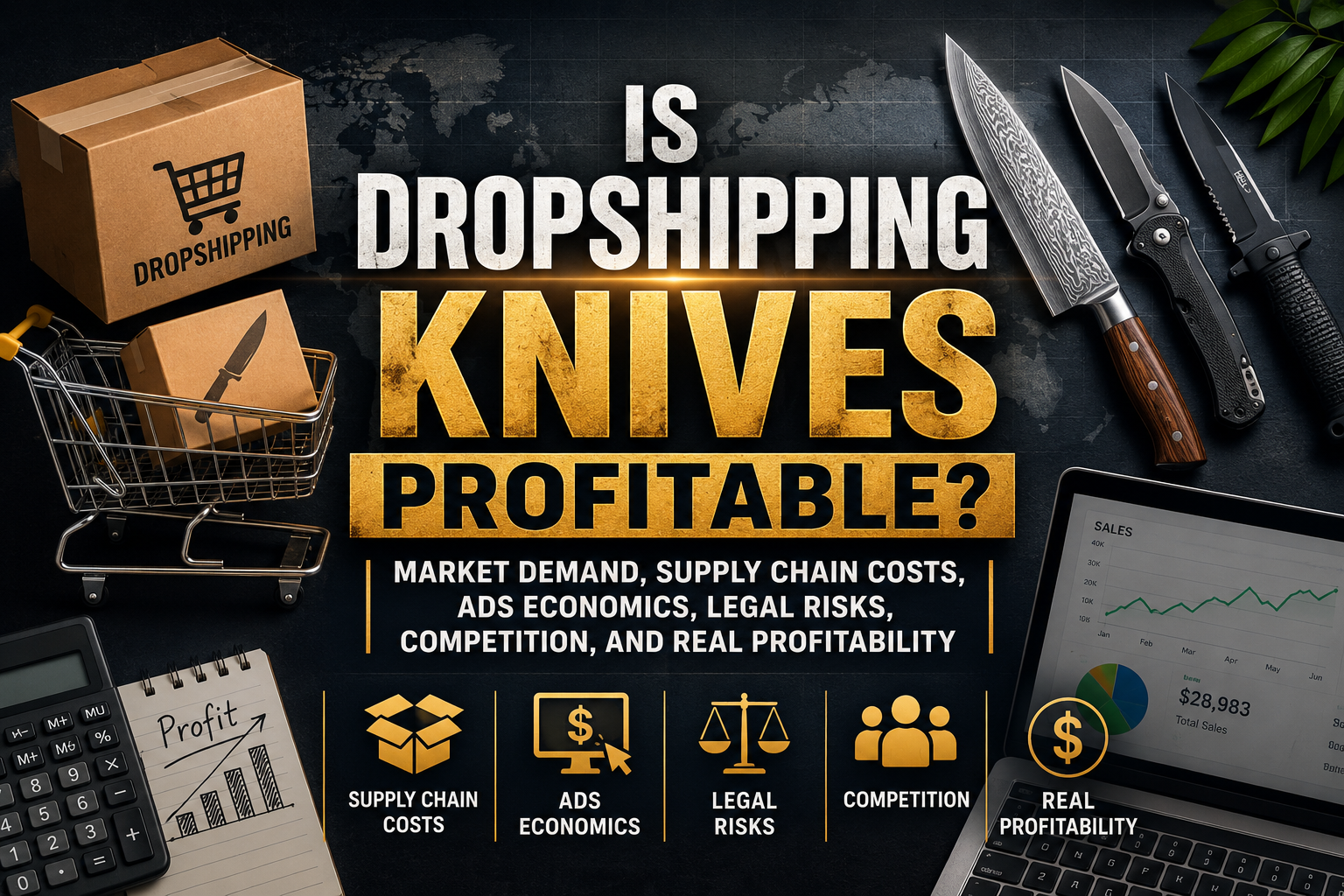
Is Dropshipping Knives Profitable? Knife Market Demand, Product Segments, and Gross Margin Breakdown
The global knife market is not a uniform category; it is divided into kitchen knives, outdoor survival knives, tactical knives, and collectible or EDC (Everyday Carry) knives. Each segment behaves differently in terms of demand elasticity, pricing power, and gross margin potential.
In general, the global kitchen knife market alone is valued in the multi-billion dollar range, driven by consistent household demand and replacement cycles. Outdoor and tactical knives, while smaller in volume, often carry significantly higher per-unit pricing and stronger branding influence. E-commerce data from independent Shopify stores suggests that average conversion rates for knife products typically range between 1.2% and 3.5%, depending on traffic source quality and product positioning.
Segment 1: Kitchen Knives – High Volume, Moderate Margins
Kitchen knives represent the most stable and scalable segment in dropshipping. The average sourcing cost from suppliers in China typically ranges from $4 to $15 per set depending on steel quality and packaging. Retail prices on Western markets usually range from $19.99 to $79.99 for mid-tier bundles.
This creates a gross margin range of approximately 40% to 65% before advertising costs. However, kitchen knives are highly competitive, meaning pricing pressure is strong and differentiation is limited unless bundled into sets or branded with private labeling.
From a demand perspective, search volume remains stable year-round, with spikes during holiday seasons such as Black Friday and Christmas. This makes kitchen knives a predictable but moderately competitive entry point for dropshipping.
Segment 2: Outdoor & Survival Knives – Lower Volume, Higher Margins
Outdoor knives, including camping and survival tools, typically sit in a higher perceived value category. Wholesale costs range from $8 to $25, while retail pricing often falls between $39 and $120 depending on branding and features such as stainless steel quality, folding mechanisms, and ergonomic design.
Gross margins in this segment are commonly between 55% and 75%, especially when products are marketed as tactical or survival gear. The key difference here is not just cost structure but customer psychology. Buyers in this segment are more brand-sensitive and willing to pay premiums for perceived durability and performance.
However, conversion rates can be more volatile. Unlike kitchen knives, demand is often driven by seasonal trends, outdoor activity cycles, and viral marketing content on platforms like TikTok.
Segment 3: EDC and Tactical Knives – High Margin but High Risk
EDC and tactical knives often deliver the highest gross margins in the knife dropshipping ecosystem. Product sourcing costs typically range from $10 to $30, while retail prices can exceed $80 to $200 for well-positioned listings.
Gross margins can reach 60% to 80%, especially when strong branding and storytelling are applied. However, this segment also carries higher risk, including advertising restrictions and payment processor scrutiny. Platforms such as Meta Ads may restrict targeting or creatives depending on perceived weapon-related content.
Because of these constraints, scaling requires careful compliance management and diversified traffic sources.
Market Demand Stability and Profitability Logic
Across all segments, the key profitability driver is not just margin percentage but the relationship between customer acquisition cost (CAC) and average order value (AOV). In many knife dropshipping stores, AOV ranges from $25 in entry-level kitchen products to over $120 in tactical bundles.
If CAC remains under $15–$25, most knife stores can achieve positive unit economics. However, once paid ads exceed that threshold, profitability rapidly declines unless bundling or upselling increases order value.
Is Dropshipping Knives Profitable? Real Supply Chain Costs, Hidden Fees, and True Gross Margin
When evaluating whether dropshipping knives is profitable, most beginners focus on surface-level margins such as “buy for $10, sell for $50.” However, the real profitability picture only becomes clear after analyzing the full supply chain structure. In knife dropshipping, the difference between theoretical gross margin and real net margin can easily exceed 25–40 percentage points once logistics, payment fees, and return risks are included.
Industry sourcing data from common China-based suppliers shows that knife products typically fall into a landed cost range of $4 to $25 depending on steel quality, packaging, and customization. While this appears favorable, downstream costs significantly reshape profitability.
Product Cost Breakdown: From Factory to Customer
The first component is the base manufacturing cost, which usually accounts for only 20%–40% of the final retail price in a typical dropshipping setup. For example, a kitchen knife set purchased at $8–$12 from suppliers often retails for $29.99 to $59.99 in Western markets, suggesting a gross margin of 50%–70% on paper.
However, once packaging upgrades (custom boxes, foam protection, branding inserts) are added, costs increase by $1–$3 per unit. This alone can reduce gross margin by 3–8%.
Shipping Costs and Their Impact on Margin Compression
Shipping is one of the most underestimated cost factors in knife dropshipping. Because knives are classified as dense, semi-restricted goods in many logistics networks, shipping rates are higher than lightweight consumer products.
Average China-to-US tracked shipping costs range between $5 and $12 per unit depending on carrier and delivery speed. Express shipping options can exceed $15 per order. This means that for a product retailing at $40, logistics alone can consume 15%–30% of revenue.
When combined with product cost, many “high margin” listings see their gross margin drop from an expected 65% down to 35%–50%.
Payment Processing Fees and Platform Cuts
Another often ignored factor is payment processing. Platforms like Shopify Payments, Stripe, or PayPal typically charge around 2.9% + $0.30 per transaction in the US market. On a $50 order, this equals roughly $1.75–$2.20 in fees.
While this seems small, at scale it reduces overall gross margin by another 3%–5%, especially for low-ticket knife products.
Additionally, currency conversion fees for international suppliers can introduce an extra 1%–3% cost depending on the payment method used.
Return Rates and Damage Risk in Knife Dropshipping
Knife products also carry moderate return and damage risk due to sharp-edge regulations, packaging failures, and customer expectations regarding quality.
Average return rates in this niche range between 5% and 12%, higher than general dropshipping categories. Each return not only eliminates profit but also introduces reverse logistics costs, which can average $5–$10 per return depending on destination.
When factoring in returns, effective gross margin can drop by another 5%–10%, especially for lower-priced SKUs.
True Gross Margin Reality in Knife Dropshipping
After combining all major cost layers—product sourcing, packaging, shipping, payment fees, and returns—the real gross margin structure becomes significantly tighter than surface-level expectations.
A typical knife dropshipping product that appears to generate 60% gross margin on listing data may realistically achieve:
- 35%–50% gross margin in kitchen knife sets
- 45%–60% in outdoor/survival knives
- 50%–65% in premium tactical or branded EDC knives
This variation explains why many stores appear profitable initially but struggle to scale sustainably.
Knife dropshipping is not inherently unprofitable, but its profitability is heavily dependent on supply chain efficiency. The key variable is not product price but cost stacking across logistics and fulfillment layers.
Businesses that optimize shipping routes, negotiate bulk fulfillment rates, and reduce return rates can preserve margins above 40%, while poorly optimized operations often fall below break-even despite strong product pricing.
Is Dropshipping Knives Profitable? TikTok & Facebook Ads Costs, CAC vs ROAS, and Real Profitability
When analyzing whether dropshipping knives is profitable, product margins alone are not enough. In most modern e-commerce operations, especially in competitive niches like knives, advertising economics determine whether the business scales or collapses. Even products with 50%–70% gross margins can become unprofitable if customer acquisition cost (CAC) exceeds a sustainable threshold.
Across Shopify knife stores using paid traffic, especially TikTok Ads and Meta Ads (Facebook/Instagram), average ROAS ranges from 1.5x to 3.2x depending on creative quality and targeting. However, profitability usually requires at least 2.5x–3.0x ROAS to maintain healthy margins after fulfillment and transaction costs.
Advertising Cost Structure: CPM, CPC, and Conversion Reality
Knife products sit in a “high interest but cautious purchase” category. This means users often engage with ads but take longer to convert compared to impulse-buy products like phone accessories.
On TikTok Ads, average CPM typically ranges between $4 and $12 in broad targeting campaigns. CPC (cost per click) often falls between $0.40 and $1.20. Meta Ads tend to be slightly higher, with CPMs between $8 and $18 depending on region and audience saturation.
However, the key metric is not CPC—it is conversion rate. Knife dropshipping stores generally see conversion rates between 1% and 2.8%. High-performing stores with strong branding and UGC creatives may reach 3.5%, but this is not the industry norm.
At a $1 CPC and 2% conversion rate, CAC becomes approximately $50 per sale, which immediately challenges profitability if AOV is not optimized.
AOV vs CAC: The Core Profitability Equation
Average order value (AOV) in knife dropshipping varies significantly by positioning:
- Basic kitchen knife listings: $25–$45
- Knife sets and bundles: $45–$90
- Tactical / EDC premium knives: $80–$150
The profitability threshold is simple: CAC must remain below approximately 25%–35% of AOV to maintain scalable profit after product and shipping costs.
For example, if AOV is $60, sustainable CAC should ideally stay under $15–$20. However, in many real campaigns, CAC ranges from $25 to $60, meaning most single-product campaigns operate at break-even or slight loss unless upsells are implemented.
ROAS Pressure and Break-Even Reality
To understand whether knife dropshipping is profitable under paid ads, ROAS becomes the key metric.
A typical cost structure after product and shipping expenses looks like this:
- Product cost: 20%–35% of revenue
- Shipping: 10%–25%
- Payment fees: ~3%
- Return/damage buffer: 5%–10%
This means total cost of goods sold (COGS) often reaches 45%–65% of revenue.
To break even, stores generally require at least 2.0x ROAS. However, to generate sustainable profit (10%–20% net margin), the required ROAS is closer to 2.8x–3.5x.
In practice, many knife ads campaigns stabilize around 2.0x–2.5x ROAS, which explains why scaling often becomes difficult without creative optimization or product bundling.
Why Creative Quality Determines Profitability
Unlike low-consideration products, knife ads rely heavily on visual storytelling. Winning campaigns often use:
- UGC-style “unboxing + slicing tests”
- Survival or outdoor scenarios
- Emotional positioning (gift, lifestyle, utility)
Creative performance can reduce CAC by 30%–60% when optimized correctly. For example, a weak ad may produce a $40 CAC, while a high-performing viral video can reduce it to $15–$20, effectively doubling profitability without changing the product.
This is why in knife dropshipping, ad creative is often more important than product selection itself.
Platform Risk: Why Scaling Ads Is Not Always Linear
Even when ROAS looks profitable in early testing, scaling knife campaigns introduces volatility. Meta Ads in particular may restrict or throttle delivery due to “weapon-related content classification,” even for kitchen or EDC knives.
This creates a ceiling effect where scaling budgets beyond a certain point leads to rising CPMs and declining ROAS. As spend increases, CAC often increases by 20%–40%, compressing margins further.
Is Dropshipping Knives Profitable? Legal Risks, Payment Restrictions, and Platform Policy
When evaluating whether dropshipping knives is profitable, many beginners focus only on margins and advertising performance. However, in this niche, legal and platform restrictions often become the true limiting factor. Even if a product has 50%–70% gross margin, operational shutdown risks from payment processors, ad platforms, or logistics compliance can make the model unstable.
Knife products sit in a “gray-risk category” in global e-commerce. They are legal consumer goods in most countries, but they are frequently classified under restricted or sensitive items in platform policies. This classification affects advertising, payment processing, and sometimes even fulfillment routes.
Shopify and E-Commerce Platform Constraints
From a platform perspective, Shopify itself does not explicitly ban knife sales. However, merchants are still subject to payment gateway rules such as Shopify Payments, Stripe, and PayPal compliance policies.
In practice, many sellers report that accounts selling knives face higher manual review rates, especially when:
- Products are labeled as “tactical” or “combat-style”
- Marketing visuals emphasize weapon-like usage
- Store lacks clear age restriction disclaimers
While kitchen knives are generally considered safe, EDC (Everyday Carry) and survival knives may trigger additional scrutiny. This does not always result in bans, but it increases operational friction, which indirectly affects scalability and profitability.
Payment Processor Risk: The Hidden Profit Killer
One of the most critical risks in knife dropshipping is payment stability. Payment processors are responsible for holding funds, and they are highly sensitive to perceived risk categories.
PayPal, for example, may impose rolling reserves of 10%–20% for high-risk product categories. This means a portion of revenue is withheld for up to 90–180 days, reducing cash flow efficiency even if gross margins appear strong.
Stripe and other processors may also require additional verification or limit account functionality if dispute rates increase above 1%–2%. In knife dropshipping, disputes often arise from:
- Misinterpreted product expectations
- Delivery delays from China-based logistics
- Customer perception of “weapon-like” products
Even if refund rates remain moderate (5%–10%), payment instability can significantly reduce effective profitability by increasing working capital requirements.
Advertising Platform Restrictions and Compliance Risk
Meta Ads (Facebook and Instagram) and TikTok Ads both have policies that restrict weapons and weapon-like products. While kitchen knives are usually allowed, enforcement is inconsistent and heavily dependent on ad creatives and targeting language.
Common risk triggers include:
- Words like “tactical,” “combat,” or “survival weapon”
- Visuals showing aggressive use cases
- Targeting audiences interested in weapons or military gear
Accounts in this niche often face:
- Ad rejection rates between 20%–60% during scaling phases
- Sudden account bans after policy updates
- Restricted delivery reducing ROAS stability
This introduces a structural limitation: even if a campaign is profitable at $2.5 ROAS, scaling budget may trigger policy filters that push ROAS down below break-even levels.
Cross-Border Shipping and Customs Restrictions
Another important legal dimension is international shipping classification. Knives may be treated differently depending on destination country regulations.
For example:
- Some EU countries require age verification for certain knife types
- Australia and Canada may restrict import of certain folding or tactical knives
- US domestic shipping is generally easier but still subject to carrier-specific rules
Logistics providers may also flag sharp objects, increasing inspection rates or insurance requirements. These factors slightly increase shipping costs (typically +5%–15%), which further compresses margins already impacted by ads and payment fees.
Return Liability and Consumer Protection Laws
In many Western markets, consumer protection laws require clear refund policies and accurate product descriptions. Knife dropshipping stores often face higher dispute rates when:
- Product quality differs from perceived marketing visuals
- Steel grade or sharpness expectations are not met
- Delivery delays exceed 10–20 days
Refund and chargeback rates in this niche often range from 5% to 12%, which is higher than general e-commerce averages. In regulated payment ecosystems, exceeding 1%–2% chargeback ratio can already trigger account review.
Is Dropshipping Knives Profitable? Why Most Stores Fail, Saturation Analysis, and the Branding Gap in the Knife Market
At first glance, knife dropshipping looks profitable. Gross margins often range from 40% to 70%, and some tactical or premium listings can even exceed that. However, the reality is that a large percentage of knife dropshipping stores fail within 3–6 months of launch. The main reason is not product cost or logistics—it is structural market saturation combined with weak differentiation.
In highly competitive e-commerce niches like knives, profitability is less about product availability and more about positioning power. Many stores are effectively selling identical products sourced from the same 10–20 Chinese suppliers, which creates intense price compression and low long-term sustainability.
Market Saturation: The Invisible Margin Killer
The knife dropshipping space is heavily saturated, especially in kitchen knives and general “EDC gear” categories. Market research on Shopify spy tools and ad libraries shows that a significant percentage of ads in this niche reuse similar product visuals, often identical supplier images or lightly modified videos.
This creates a structural issue: when dozens or even hundreds of stores sell the same knife at $29.99–$49.99, price becomes the only differentiator. Over time, this pushes average selling prices down while ad costs remain stable or increase.
Even if gross margin starts at 60%, competitive pressure can reduce effective margin to 25%–40% within months in saturated segments.
Commodity Trap: Why Product Alone Is Not Enough
One of the biggest mistakes in knife dropshipping is treating the product as the business. In reality, knives—especially kitchen and generic outdoor models—are commodities. This means:
- The same stainless steel grades are widely available
- Product differentiation is minimal at supplier level
- Packaging upgrades are easy to replicate
When a product becomes a commodity, brand perception determines pricing power. Without branding, stores enter a race to the bottom where competitors continuously undercut each other by $1–$5, slowly eroding profitability.
Branding Gap and Its Effect on Gross Margin Expansion
The key reason some knife stores remain profitable long-term is branding. Branded knife businesses are able to increase perceived value without increasing actual cost structure significantly.
For example:
- Generic knife set: supplier cost $10–$15, retail $29.99–$39.99 (gross margin ~45%–55%)
- Branded knife set with storytelling + packaging: same cost $12–$18, retail $59.99–$99.99 (gross margin ~60%–75%)
The difference is not product quality—it is perceived authority, lifestyle positioning, and trust signals.
Brands that successfully establish identity in this niche often achieve AOV increases of 30%–80%, which directly improves ad scalability and reduces CAC pressure.
Advertising Saturation and Creative Fatigue
Another major failure factor is advertising saturation. In knife dropshipping, winning ad creatives are often quickly copied across the market. A successful TikTok ad can be replicated within days, leading to rapid performance decay.
As more advertisers enter the same interest clusters, CPM rises while CTR declines. This creates “creative fatigue cycles” where:
- Early stage ROAS: 3.0x–4.0x
- Mid-cycle ROAS: 2.0x–2.8x
- Saturated cycle: 1.5x–2.0x
Once ROAS drops below break-even (typically around 2.0x for this niche), stores become unprofitable unless they continuously refresh creatives or expand into new sub-niches.
Supply Chain Uniformity and Lack of Competitive Moat
Another structural weakness is supply chain uniformity. Most knife dropshipping stores rely on similar platforms such as AliExpress, CJ Dropshipping, or 1688-based suppliers. This creates a situation where:
- Product differentiation is minimal
- Shipping times are similar
- Quality variance is small
Because of this, there is no strong supply-side moat. Any competitor can launch a similar store within days, further increasing competition and reducing long-term profitability stability.
Knife dropshipping is not inherently unprofitable, but most stores fail because they operate in a highly saturated commodity environment without sufficient branding or differentiation strategy.
While gross margins can look attractive on paper (40%–70%), real-world performance is often compressed by competition, creative duplication, and pricing pressure. The businesses that survive are those that move beyond product arbitrage and build defensible positioning through branding, storytelling, and AOV expansion.





No Comments