


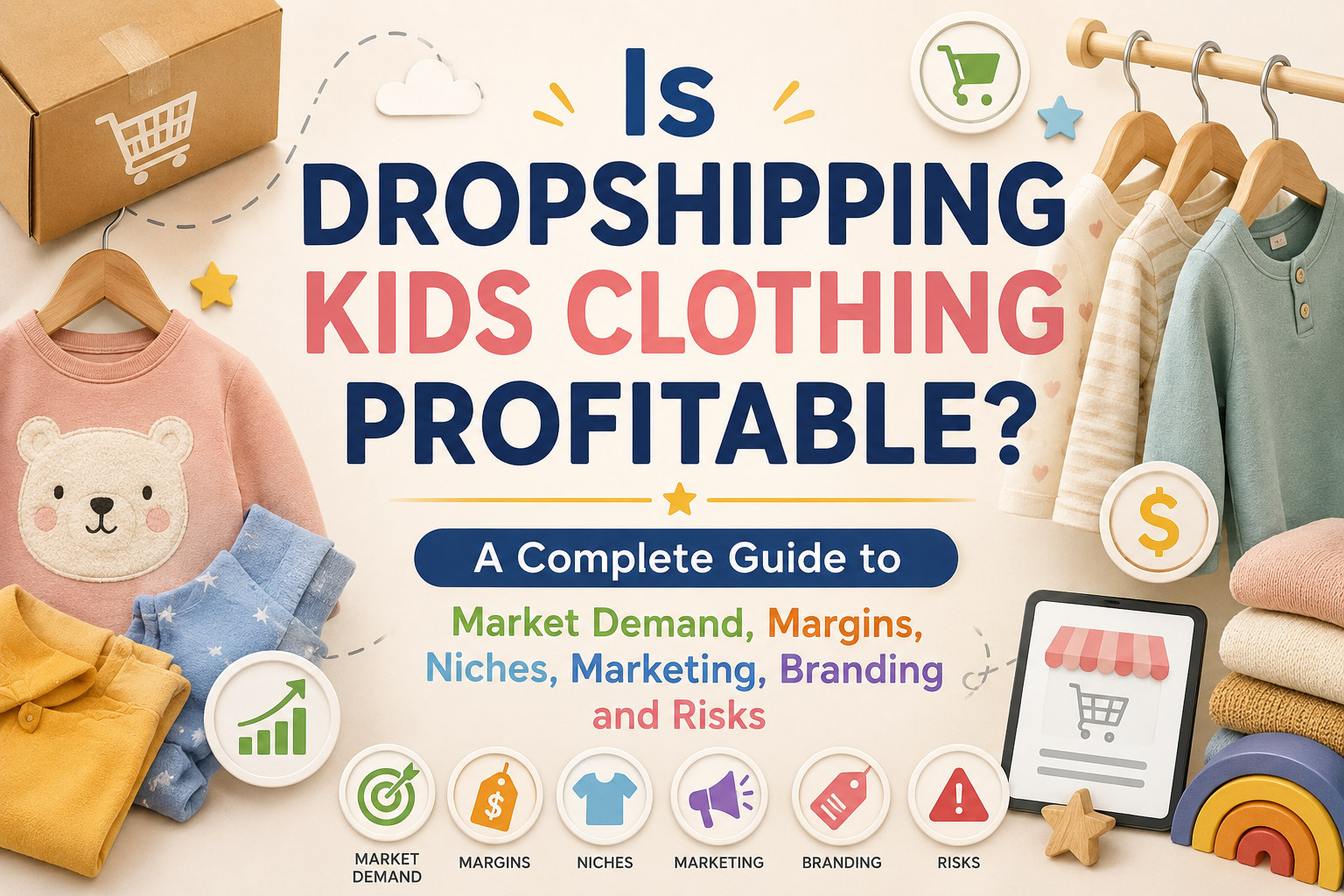
Is Dropshipping Kids Clothing Profitable? A Complete Guide to Market Demand, Margins, Niches, Marketing, Branding and Risks

From a market perspective, dropshipping kids clothing benefits from several structural advantages. The industry is supported by a multi-hundred-billion-dollar global market, predictable replacement cycles, and increasing e-commerce penetration. Premium and niche categories further enhance revenue potential by enabling higher gross margins. These characteristics make children’s apparel one of the more stable and scalable opportunities within the broader dropshipping landscape, especially for sellers focusing on long-term brand building rather than short-term trends.
Kids Clothing Market Demand and Industry Growth: Why the Opportunity Continues to Expand
When evaluating whether dropshipping kids clothing is profitable, the first factor worth examining is market demand. Unlike trend-driven categories that experience short life cycles, children’s apparel benefits from recurring purchases and consistent demand. Babies and children continuously outgrow their clothes, creating a natural replacement cycle that supports repeat buying behavior.
According to industry research, the global children’s apparel market exceeded $280 billion in recent years and is projected to surpass $400 billion before the end of the decade. Analysts expect a compound annual growth rate between 5% and 7%, which is higher than many traditional apparel segments. Rising disposable income, growing urbanization, and increasing spending on premium children’s products are among the major drivers behind this expansion.
Parents are also spending more per child than previous generations. In developed markets such as the United States, Canada, the United Kingdom, Australia, and Western Europe, families increasingly view children’s clothing as a combination of functionality, comfort, and fashion. This shift creates opportunities for online sellers offering niche products and unique styles.
High Purchase Frequency Creates Strong Repeat Demand
One of the biggest advantages of the kids clothing industry is the frequency of purchases. Adult consumers may update their wardrobe only a few times a year, but children require new clothing much more often due to rapid growth.
Newborns and infants can move through several sizes within their first year. Toddlers and young children also need regular replacements because of seasonal changes, school activities, and wear and tear. As a result, parents become repeat buyers rather than one-time customers.
Studies show that households with young children spend hundreds to several thousand dollars annually on children’s apparel. Seasonal events such as back-to-school periods, Christmas, Easter, birthdays, and family vacations further increase demand throughout the year. This purchasing pattern gives dropshipping businesses opportunities to increase customer lifetime value and generate recurring revenue.
E-Commerce Is Taking a Larger Share of the Market
Online shopping has significantly changed consumer behavior in the children’s apparel sector. More parents now prefer purchasing clothes online because of convenience, broader product selections, and competitive pricing.
The penetration rate of e-commerce within the apparel industry continues to rise, and children’s fashion has become one of the strongest-performing categories. Mobile shopping, social media recommendations, and influencer marketing have accelerated this transition. Platforms such as TikTok, Instagram, Pinterest, and Facebook increasingly influence purchasing decisions among young parents.
The ability to compare styles, read reviews, and receive products directly at home makes online shopping particularly attractive for busy families. This trend benefits dropshipping businesses because they can operate without maintaining inventory while serving customers across multiple countries.
Premium and Niche Segments Are Expanding
Another reason why kids clothing dropshipping remains profitable is the growth of premium and specialized categories. Consumers are becoming more selective and are willing to pay higher prices for products that offer additional value.
Organic cotton baby clothing, eco-friendly fabrics, gender-neutral styles, matching family outfits, and personalized children’s apparel have experienced strong growth in recent years. Many of these products command retail prices that are two to four times higher than their manufacturing costs.
For example, a baby romper sourced for $5 to $8 may sell online for $20 to $35. Organic cotton pajamas costing $10 to produce are often sold between $30 and $50. These pricing structures allow gross margins of 60% to 75%, which compares favorably with many other e-commerce categories.
Because parents prioritize quality and comfort over low prices, premium positioning can support stronger profitability and customer loyalty.
Long-Term Demand Makes the Industry Relatively Stable
Unlike fad products that rise and disappear quickly, children’s clothing belongs to an evergreen market. Birth rates may fluctuate, but every generation creates new consumers entering the market each year. Parents consistently need clothes regardless of broader economic cycles.
Although competition has increased, the market remains highly fragmented. Thousands of independent brands coexist with large retailers, leaving room for specialized stores targeting specific styles, age groups, or customer values.
For entrepreneurs looking for a sustainable niche, the combination of recurring purchases, expanding online adoption, and premium product opportunities explains why many sellers continue to enter this industry.
Kids Clothing Profit Margins and Cost Structure: How Much Can You Really Make?
Many entrepreneurs asking “Is dropshipping kids clothing profitable?” are less concerned about market demand and more interested in actual profitability. While children’s apparel is a highly competitive category, its economics can be attractive because of relatively low manufacturing costs and strong retail markups.
Compared with electronics and many consumer goods, kids clothing generally carries higher gross margins. Parents often prioritize comfort, design, and fabric quality over finding the lowest possible price, allowing sellers to charge premiums for products that provide perceived value.
However, profitability ultimately depends on understanding the entire cost structure rather than focusing solely on selling price.
Average Gross Margins Are Higher Than Many E-Commerce Categories
Gross margin refers to the difference between product cost and selling price before advertising and operational expenses are deducted. In the kids clothing industry, gross margins are usually healthy.
Basic cotton baby bodysuits sourced from suppliers may cost between $3 and $6. These same products are commonly sold online for $15 to $25. Simple dresses, hoodies, and pajamas that cost $8 to $12 can often be retailed for $25 to $45.
This creates gross margins ranging from 55% to 75%.
Premium products perform even better. Organic baby clothing, bamboo fabric pajamas, and matching family sets frequently achieve gross margins above 70%. Personalized products and limited-edition collections can sometimes reach 80%.
For comparison, many electronics dropshipping stores operate with gross margins below 30%, while consumer gadgets often struggle to maintain margins above 20%. From a pure markup perspective, children’s apparel is considerably more attractive.
Breaking Down the Cost Structure
Although gross margins appear high, net profit depends on several additional expenses.
Product cost usually represents 20% to 35% of revenue. Shipping and fulfillment account for another 8% to 15%, depending on destination countries and delivery speed.
Advertising remains the largest variable expense. Facebook Ads and TikTok Ads often consume 15% to 35% of sales revenue. New stores with little optimization may spend even more during customer acquisition.
Transaction fees, Shopify subscriptions, email marketing software, and customer support costs add another 3% to 8%.
After accounting for all operating expenses, successful kids clothing stores generally achieve net margins between 10% and 25%.
Stores relying heavily on paid advertising may remain closer to 10%, while businesses supported by SEO, Pinterest traffic, email marketing, and repeat customers can reach net margins above 20%.
Repeat Customers Improve Long-Term Profitability
One reason kids clothing dropshipping can be profitable is the industry’s strong customer lifetime value.
Children outgrow clothing quickly. Parents who purchase once often come back every few months as their child moves into larger sizes. Seasonal changes also create recurring demand.
Suppose a store acquires a customer for $25 through advertising. If that customer spends $60 on the first order and returns three more times during the year, total revenue may exceed $240.
With a gross margin around 65%, the lifetime gross profit generated from one customer could approach $156. In this scenario, the initial acquisition cost becomes much easier to absorb.
This recurring purchase behavior gives children’s apparel an advantage over many one-time purchase products.
Premium Niches Produce Better Margins
Not all kids clothing products generate the same level of profitability. Sellers competing solely on low prices often struggle because marketplaces and large retailers dominate that segment.
Premium categories generally perform much better.
Organic cotton baby clothes are increasingly popular among environmentally conscious parents. Bamboo fabric sleepwear, personalized outfits, sibling matching sets, and holiday-themed collections command higher prices and face less direct competition.
For example, a bamboo pajama set costing $12 to source may retail for $42. Even after shipping expenses, gross margins can exceed 70%.
Customized name embroidery or private-label packaging can further increase perceived value and allow stores to charge premium prices.
Logistics and Supplier Relationships Influence Profitability
Shipping efficiency directly affects profit margins. Long delivery times increase refund requests and reduce customer satisfaction.
Working with sourcing agents or fulfillment companies can lower logistics costs while improving delivery speed. Faster shipping often allows stores to charge higher prices and maintain better conversion rates.
Bulk purchasing and private-label arrangements can also reduce unit costs by 10% to 30%, improving margins as order volume grows.
As stores scale, economies of scale become increasingly important. Mature brands usually enjoy significantly higher profitability than beginner dropshipping stores.
Best Kids Clothing Niches with High Profit Potential
For entrepreneurs asking whether dropshipping kids clothing is profitable, selecting the right niche often determines long-term success. The children’s apparel market is enormous, but not every product category delivers the same returns. Generic low-cost clothing faces intense competition from Amazon, Walmart, Shein, and major retailers. Higher profitability usually comes from serving specialized audiences and offering products with stronger perceived value.
Experienced sellers often focus on segments where emotional purchasing behavior and premium positioning allow higher prices and healthier gross margins. Rather than trying to sell everything, successful stores frequently concentrate on one customer group or one lifestyle category.
Organic and Eco-Friendly Baby Clothing Continues to Grow
One of the fastest-growing niches is organic and sustainable children’s clothing. Modern parents are becoming increasingly concerned about skin sensitivity, chemical exposure, and environmental impact. As a result, demand for organic cotton and bamboo fabric apparel has risen steadily across North America and Europe.
Organic baby bodysuits that cost $6 to $10 from suppliers can retail for $25 to $40. Bamboo pajama sets sourced for around $12 are often sold between $35 and $50. This translates into gross margins between 65% and 75%.
Because customers in this segment prioritize safety and quality over price, stores can maintain premium positioning without engaging in aggressive price competition. Repeat purchase rates are also relatively high since parents continue buying larger sizes as children grow.
Gender-Neutral Clothing Appeals to Younger Parents
Another niche experiencing rapid expansion is gender-neutral children’s fashion. Millennials and Generation Z parents increasingly prefer minimalist colors and versatile designs that can be used for multiple children regardless of gender.
Neutral-toned rompers, oversized sweatshirts, earth-tone sets, and Scandinavian-inspired styles have become popular across social media platforms. Products in this category generally have production costs similar to traditional clothing but can command higher prices due to their modern aesthetic.
A neutral baby set costing $8 may sell for $30 to $45, creating gross margins above 70%. Since the category relies heavily on branding and visual presentation, small stores can compete effectively without needing massive inventories.
Matching Family Outfits Generate Higher Average Order Values
Family matching outfits represent one of the most profitable subcategories within children’s apparel. These products create emotional appeal and are commonly purchased for holidays, vacations, birthdays, and social media photos.
Instead of selling a single item, stores often sell complete bundles involving parents and children. This naturally increases average order value.
For example, individual shirts costing a total of $25 to source may retail as a coordinated family package for $80 to $120. Gross margins frequently exceed 65%, while average order values are significantly higher than standard kids apparel products.
Seasonal collections for Christmas, Halloween, Easter, and Mother’s Day further increase revenue opportunities. The emotional nature of these purchases often reduces price sensitivity and improves conversion rates.
Personalized Clothing Offers Exceptional Margins
Personalization has become one of the strongest trends in e-commerce. Parents enjoy purchasing products that feature their children’s names, birth dates, or unique messages.
Customized baby rompers, embroidered sweaters, personalized pajamas, and birthday outfits can command prices two to four times higher than ordinary apparel.
For instance, a plain sweatshirt costing $10 may sell for $40 after adding embroidery or personalized printing. Gross margins can reach 75% to 80%, making customization one of the highest-margin opportunities within the industry.
Because personalized products are difficult to compare directly with mass-market alternatives, stores gain greater pricing power and face less competition.
Seasonal and Holiday Collections Create Strong Revenue Peaks
Seasonal kids clothing remains an attractive niche because demand is predictable and emotionally driven. Christmas pajamas, Halloween costumes, Valentine’s Day outfits, and back-to-school collections experience recurring annual spikes.
Consumers are often willing to pay premium prices during holiday periods, especially when products are time-sensitive. Limited collections also create scarcity, encouraging faster purchasing decisions.
Many seasonal products sourced for under $10 can retail for $30 to $50. During peak periods, gross margins frequently remain above 65%.
Stores that combine seasonal collections with email marketing and repeat customers often enjoy strong fourth-quarter revenues.
Educational and Functional Apparel Is an Emerging Category
Another niche with growing potential involves clothing designed for specific functions. Sensory-friendly apparel, adaptive clothing, UV-protection swimwear, and educational designs are attracting increasing attention from parents seeking practical benefits.
These products solve real problems and therefore experience less price competition. Functional clothing also aligns well with premium branding strategies.
Adaptive clothing items costing $12 to manufacture may sell for $40 or more, producing gross margins approaching 70%. As awareness of children’s special needs and health concerns increases, this category is expected to expand further.
Marketing Strategies for Growing a Profitable Kids Clothing Dropshipping Business
Many entrepreneurs wondering, “Is dropshipping kids clothing profitable?” focus heavily on product selection and supplier costs. However, marketing efficiency often has a greater impact on profitability than product margins alone. A store with 70% gross margins can still struggle if customer acquisition costs are too high, while brands with lower margins can remain highly profitable if they acquire customers efficiently.
Children’s apparel is an emotional category. Parents do not simply purchase clothes because they are necessary; they often buy products because they are cute, memorable, and associated with important family moments. This emotional component creates significant opportunities for visual marketing and brand storytelling.
Successful kids clothing businesses typically combine multiple traffic sources instead of relying on a single advertising platform.
Facebook and Instagram Ads Continue to Deliver Strong Results
Meta advertising remains one of the largest traffic sources for children’s apparel brands. Parents between the ages of 25 and 40 represent a highly active demographic on Facebook and Instagram, making these platforms suitable for reaching potential customers.
Lifestyle photos and short videos usually outperform product-only images because consumers respond more strongly to emotional scenarios involving children and families. Seasonal campaigns and user-generated content can also improve engagement.
Average customer acquisition costs in the kids clothing niche typically range between $15 and $35, although costs vary depending on location and competition. Stores that maintain average order values above $60 and gross margins around 65% can often achieve healthy returns on ad spend.
Retargeting campaigns are particularly important. Since parents frequently compare products before purchasing, remarketing audiences generally convert at lower costs than cold traffic.
TikTok Has Become a Powerful Growth Channel
Short-form video content has transformed the e-commerce landscape, and children’s apparel has benefited from this shift. Cute outfits, family moments, and styling videos naturally fit TikTok’s algorithm-driven ecosystem.
Many brands have generated millions of views through organic videos rather than relying exclusively on paid advertising. Product demonstrations, outfit transitions, and behind-the-scenes content often perform well because they feel authentic.
Compared with Facebook advertising, TikTok frequently delivers lower CPMs and lower customer acquisition costs for younger audiences. Some brands report acquisition costs 20% to 40% lower than traditional social media campaigns.
This advantage can significantly improve profitability. A reduction in acquisition costs directly increases net margins, particularly for stores operating with gross margins between 60% and 75%.
Pinterest Generates High-Intent Traffic
Pinterest is frequently overlooked, yet it aligns extremely well with the children’s clothing market. Parents actively use Pinterest to search for baby shower ideas, family photography inspiration, seasonal outfits, and nursery designs.
Unlike social media platforms where content disappears quickly, Pinterest pins can generate traffic for months or even years. This gives businesses access to long-term organic exposure.
Keywords related to baby clothes, matching family outfits, holiday pajamas, and newborn essentials often perform particularly well. Stores that consistently publish optimized pins can gradually reduce their dependence on paid advertising.
Lower marketing expenses translate directly into higher profitability. Some established brands receive a substantial portion of their traffic from Pinterest while maintaining customer acquisition costs far below those of paid ads.
Influencer Marketing Builds Trust Faster
Parents tend to trust recommendations from other parents. For this reason, influencer marketing has become one of the most effective promotional strategies in the kids apparel industry.
Micro-influencers with audiences between 10,000 and 100,000 followers frequently provide better returns than celebrities because engagement rates are higher and partnerships are more affordable.
Sending free products to parenting creators, family bloggers, and mom influencers can generate authentic content that builds credibility. User-generated videos often outperform professionally produced advertisements because they appear more genuine.
Brands that integrate influencer content into Facebook and TikTok campaigns frequently experience improved conversion rates and lower advertising costs.
SEO Creates Sustainable Long-Term Growth
Paid advertising delivers immediate traffic, but search engine optimization provides long-term scalability. As customer acquisition costs rise across major advertising platforms, SEO has become increasingly valuable.
Parents frequently search for topics such as baby outfit ideas, organic children’s clothing, matching family pajamas, and seasonal apparel trends. These searches represent high-intent traffic with strong purchasing potential.
Publishing educational blog content allows stores to capture customers earlier in the buying journey. Over time, this strategy reduces reliance on paid traffic and improves profitability.
Unlike advertising campaigns that stop producing results once budgets are exhausted, SEO content can continue generating visitors and sales for years. This creates a more stable business model and contributes to stronger net margins.
Email Marketing Maximizes Customer Lifetime Value
Children outgrow clothing quickly, making repeat purchases one of the industry’s greatest advantages. Email marketing helps businesses capitalize on this recurring demand.
Welcome sequences, abandoned cart reminders, seasonal promotions, and size-up recommendations encourage existing customers to return. Since email marketing costs are relatively low, repeat orders usually produce much higher profits than first-time purchases.
For example, acquiring a customer through advertising might cost $25. However, if that customer places four orders within twelve months, the average acquisition cost per order falls dramatically.
This improvement in customer lifetime value is one reason why many successful children’s apparel brands achieve net profit margins above 20%.
Branding and Private Label in Kids Clothing Dropshipping: Turning Commodities into High-Margin Products
In the kids clothing industry, many beginners assume profitability comes mainly from finding “winning products.” In reality, long-term success depends far more on branding and perceived value. The same cotton baby romper that sells for $8 in a generic dropshipping store can often sell for $25–$40 when positioned under a strong brand identity.
This pricing gap is where private label and branding strategies directly increase profitability. While standard dropshipping models often struggle with thin margins after advertising costs, branded stores can maintain significantly higher gross margins—often 65% to 85% depending on positioning.
Branding transforms kids clothing from a commodity into an emotional purchase, which is especially important in a category driven by parents making decisions for their children.
Private Label Increases Gross Margin and Pricing Power
Private label refers to selling products manufactured by suppliers but branded under your own name, packaging, and identity. In kids clothing dropshipping, this shift can dramatically improve financial performance.
Unbranded baby clothing might cost $5–$10 per unit and sell for $15–$25, resulting in moderate margins. However, once the same product is customized with branded tags, packaging, and exclusive designs, retail prices often rise to $30–$60.
Even if sourcing costs increase slightly to $7–$12 due to customization, gross margins typically expand to 70% or more. In premium niches such as organic baby wear or personalized outfits, margins can reach 80%.
This is because parents are not only buying clothing—they are buying trust, safety perception, and emotional value associated with a brand.
Packaging and Unboxing Experience Drive Perceived Value
In kids apparel, packaging plays a surprisingly important role in profitability. A well-designed unboxing experience can significantly increase perceived product value without substantially increasing production costs.
Simple additions such as branded tissue paper, thank-you cards, eco-friendly packaging, or customized labels can elevate a product from “basic clothing” to “premium gift-worthy apparel.”
For example, a $10 garment with $1.50 additional packaging cost may be perceived as a $35 premium product. This allows sellers to increase retail pricing without proportional cost increases, effectively improving gross margins.
Many successful kids clothing brands invest 5% to 10% of product cost into packaging because the return in pricing power and customer retention is significantly higher.
Emotional Branding Is Especially Powerful in Kids Clothing
Unlike many other dropshipping categories, kids clothing is highly emotional. Parents often associate purchases with milestones such as birthdays, first steps, school events, or family photos.
Brands that successfully communicate emotional themes—such as “comfort for newborn moments,” “memorable family outfits,” or “safe organic fabrics for your baby”—tend to outperform generic stores.
This emotional positioning reduces price sensitivity. A parent is more likely to pay $40 for a meaningful outfit used in a photoshoot than $15 for a similar generic item. As a result, emotional branding directly contributes to higher conversion rates and stronger gross margins.
Differentiation Reduces Advertising Costs Over Time
One of the hidden financial benefits of branding is reduced dependence on paid advertising efficiency. Generic dropshipping stores often compete in crowded ad auctions, pushing customer acquisition costs to $25–$50 in competitive markets.
Branded stores, however, benefit from higher click-through rates and stronger trust signals. When users recognize a brand or perceive it as more premium, ad engagement increases and cost-per-click often decreases.
Over time, this improves return on ad spend (ROAS). A store operating at 65% gross margin may struggle to scale profitably with high acquisition costs, but a branded store with the same margin structure can achieve significantly better net profitability due to improved conversion efficiency.
Customer Loyalty and Repeat Purchases Increase Lifetime Value
Branding also plays a critical role in repeat purchase behavior. In kids clothing, where children constantly outgrow garments, customer lifetime value (LTV) can be very high if trust is established.
A strong brand increases the likelihood that parents return for future purchases instead of switching to competitors. This is especially true when customers are satisfied with quality, packaging, and overall experience.
For example, a customer who initially spends $50 may return three to five times per year, generating $200–$400 in annual revenue. With gross margins around 70%, this significantly increases long-term profitability compared to one-time buyers.
Transitioning from Dropshipping to a Real Brand
Many successful kids clothing businesses start as dropshipping stores but gradually transition into hybrid or fully branded models. This evolution often includes working with sourcing agents, customizing designs, and eventually holding small inventory batches to improve delivery speed and quality control.
As the brand grows, businesses may also introduce exclusive collections or limited-edition product lines. These strategies increase scarcity, allowing for even higher pricing and stronger gross margins.
The most profitable stores are rarely pure dropshipping operations. Instead, they operate closer to lightweight private label brands that combine flexibility with strong identity-driven pricing power.
Risks and Future Opportunities in Kids Clothing Dropshipping: Is the Market Becoming Saturated?
While many analyses suggest that dropshipping kids clothing is profitable, the category also carries structural risks that are often underestimated. The market is large and growing, but profitability is not evenly distributed. A significant portion of new entrants struggle to sustain margins once advertising costs, returns, and competition are fully accounted for.
In practice, the industry is best described as “high potential but execution-sensitive.” Gross margins can range from 55% to 80%, but net profit can vary dramatically depending on operational efficiency and differentiation strategy.
To understand the long-term viability of this niche, it is necessary to evaluate both saturation risks and emerging opportunities.
Increasing Competition and Rising Customer Acquisition Costs
One of the most important risks in kids clothing dropshipping is intensifying competition. Over the past several years, platforms like Shopify, TikTok Shop, and Meta Ads have significantly lowered the barrier to entry. As a result, thousands of new stores enter the market annually.
This increased competition directly affects advertising costs. In many regions, Facebook and Instagram CPMs for parenting-related audiences have risen steadily, with customer acquisition costs frequently ranging from $20 to $50 depending on targeting and creative quality.
When gross margins sit around 60% to 70%, rising ad costs can quickly compress profitability. Stores without strong branding or organic traffic channels often struggle to maintain stable net margins above 10%.
Product Quality Issues and Return Rate Pressure
Another key risk in kids clothing is product quality inconsistency. Dropshipping models often rely on third-party suppliers, which introduces variability in fabric quality, sizing accuracy, and shipping reliability.
Children’s apparel is especially sensitive to these issues because parents prioritize safety and comfort. Even small quality problems can lead to refunds, negative reviews, and increased customer service costs.
Return rates in this category can range from 5% to 15%, higher than many other apparel segments. Each return reduces effective gross margin and increases operational complexity, especially when cross-border logistics are involved.
For example, a product with a theoretical 65% gross margin may drop closer to 50% after accounting for returns, reshipping, and customer service expenses.
Size Complexity and Conversion Friction
Unlike adult clothing, kids clothing requires more precise sizing decisions across rapidly changing age groups. This creates friction in the purchase process and increases the likelihood of sizing-related returns.
Parents often hesitate before purchasing due to uncertainty about fit, especially for online-first stores without strong brand trust. This hesitation can reduce conversion rates and increase advertising costs per sale.
Stores that fail to provide clear sizing guides, customer reviews, or visual references may experience lower conversion efficiency, even if their product margins appear attractive on paper.
Platform Dependency Risk
Another structural risk is dependency on advertising platforms. Many kids clothing dropshipping businesses rely heavily on Meta Ads or TikTok Ads for traffic.
Changes in algorithm, rising CPMs, or account restrictions can significantly impact revenue overnight. This creates volatility that makes scaling difficult without diversification.
Businesses that rely solely on paid ads often experience unstable monthly profitability. In contrast, brands with SEO traffic, email lists, and organic social channels tend to maintain more predictable cash flow.
Saturation Myth vs Reality
Although many sellers believe the market is saturated, the reality is more nuanced. The kids clothing market itself is not saturated—it continues to grow steadily at a multi-billion-dollar scale globally. What is saturated is low-differentiation dropshipping.
Generic products such as basic baby bodysuits or mass-produced designs face intense competition and price pressure. However, niche segments such as organic clothing, personalized apparel, and family matching outfits still offer strong opportunities.
Saturation is therefore not market-wide, but segment-specific. The key challenge is no longer “finding products,” but “building differentiation.”
Emerging Opportunities in the Market
Despite risks, several structural opportunities are expanding within the kids clothing niche.
One major opportunity is personalization. Customized clothing with names, messages, or unique designs continues to grow because it cannot be easily commoditized. These products typically command gross margins of 70% to 85%, significantly higher than generic apparel.
Another opportunity lies in sustainable and ethical fashion. Parents are increasingly concerned about environmental impact and material safety. Organic cotton, bamboo fabrics, and eco-certified products are seeing higher demand in Europe and North America.
A third opportunity is content-driven commerce. Platforms like TikTok and Instagram increasingly reward storytelling rather than pure product ads. Brands that create engaging parenting content or lifestyle narratives can reduce customer acquisition costs and improve profitability.
Finally, hybrid fulfillment models are emerging. Instead of pure dropshipping, many businesses are shifting toward small-batch inventory or localized fulfillment to improve shipping speed and quality control. This improves customer satisfaction and reduces refund rates, which directly enhances net margin stability.
The Future: From Dropshipping to Micro-Brands
The long-term direction of the industry is moving away from traditional dropshipping and toward micro-brands. Pure arbitrage models are becoming less sustainable due to competition and advertising inflation.
Future winners in the kids clothing space are likely to be businesses that combine:
strong branding, niche positioning, owned traffic channels, and partial supply chain control.
In this model, dropshipping becomes only the starting point—not the final business structure.
Gross margins may remain similar (60%–75%), but net profitability improves significantly due to reduced acquisition costs and increased customer lifetime value.




No Comments