


Is Dropshipping Dog Harness Profitable? A Breakdown of Margins, Segmentation, Competition, LTV, Branding Strategy, and Market Growth Potential

Dropshipping dog harnesses can be considered profitable when the business is structured around three key variables: high perceived product value, controlled CAC through optimized creatives, and strong gross margin protection through sourcing efficiency.
Under stable execution conditions, this niche consistently supports net profit margins in the 20%–30% range, with significantly higher upside when bundled products and repeat purchases are introduced later in the funnel.
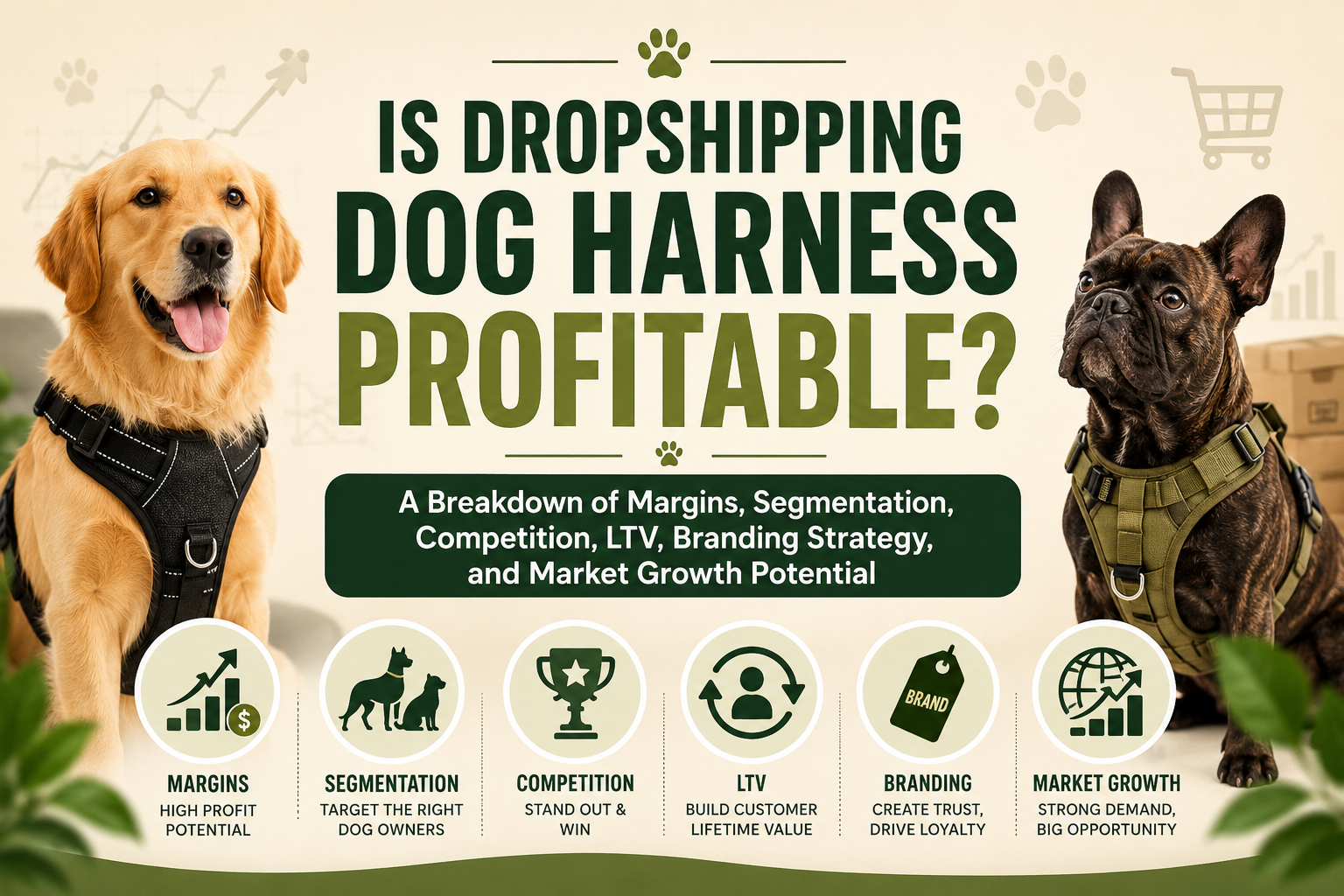
Breakdown of Product Costs, Gross Margins, and Customer Acquisition Expenses
The profitability of dropshipping dog harness products is not determined by the product itself, but by how efficiently the seller manages unit economics across sourcing, advertising, and fulfillment. At first glance, dog harnesses appear to be a low-cost commodity product, but in practice they often generate significantly higher margins than many general e-commerce categories due to strong emotional demand and willingness to pay for pet safety.
In most sourcing scenarios, a standard dog harness manufactured in China costs between $3 and $8 depending on material quality, stitching strength, padding, and design complexity. Entry-level mesh harnesses sit at the lower end, while padded no-pull or tactical-style harnesses fall closer to $6–$8. When shipped via bulk or optimized ePacket/3PL channels, average fulfillment costs typically range from $2 to $5 per unit, depending on destination and logistics method.
This creates a baseline landed cost of approximately $6 to $13 per product.
On the retail side, however, dog harnesses are rarely priced based on cost-plus logic. Instead, pricing is driven by perceived safety value and pet-owner emotional attachment. In the US and European markets, average selling prices commonly fall between $24.99 and $39.99 for standard harnesses, while tactical or premium ergonomic versions frequently reach $45 to $69.
This pricing gap creates a gross margin structure that is unusually favorable for dropshipping. A typical entry-level product sold at $29.99 with a landed cost of $9.50 results in a gross margin of approximately 68%. Premium listings priced at $49.99 with a $12 cost basis can achieve margins above 75%.
Advertising Costs and Net Profit Reality
While gross margin appears strong, the true profitability depends heavily on customer acquisition cost (CAC), especially in paid social channels such as Meta Ads and TikTok Ads.
For dog harness products, average CAC typically falls between $12 and $25 depending on creative quality, targeting precision, and seasonality. Pet products perform particularly well with video-based creative, especially when showing leash control improvements or “no-pull” transformations.
If we consider a realistic scenario:
A $34.99 selling price
A $10.50 landed cost
A $15 average CAC
A $1.5 payment processing fee
The net profit per order becomes approximately $8–$10. This represents a net margin of roughly 23%–28%, which is considered healthy in performance marketing-driven e-commerce.
However, this model is highly sensitive to conversion rate optimization. A landing page that improves conversion rate from 2.0% to 3.5% can reduce CAC by nearly 40%, directly increasing profitability without changing the product or ad spend.
Why Gross Margin Stability Is Higher Than Other Niches
One of the most overlooked advantages of dog harness dropshipping is pricing stability. Unlike electronics or fashion accessories, pet safety products are less subject to rapid price wars. Consumers are not comparing dog harnesses purely on price; instead, they evaluate comfort, durability, and perceived safety.
This allows sellers to maintain gross margins consistently in the 65%–80% range even in competitive markets. Additionally, product differentiation through color variations, size options, reflective strips, and ergonomic design increases SKU flexibility without significantly increasing inventory risk.
Break-Even and Scaling Logic
In most cases, break-even CAC for a dog harness store sits around $18–$22 depending on store conversion rate and average order value. Once ad creatives are optimized and social proof builds up, scaling becomes linear rather than exponential in cost.
Stores that successfully optimize creatives often see ROAS (Return on Ad Spend) between 1.8x and 3.2x, which is sufficient for sustainable scaling when combined with upsells such as leashes, collars, and bundles.
Is Dropshipping Dog Harness Profitable for Different Dog Breeds?
When analyzing whether dropshipping dog harnesses are profitable, one of the most underestimated factors is not cost or advertising, but breed segmentation. Dog owners do not behave as a single unified market. Instead, purchasing decisions vary significantly depending on dog size, strength, temperament, and even lifestyle expectations of the owner.
This segmentation directly impacts pricing power, conversion rates, and ultimately gross margin sustainability. In many cases, sellers who fail to segment by breed end up competing in low-margin “general harness” markets, while those who align products with specific breed needs can achieve substantially higher profitability.
Small Dog Segment: High Volume, Lower Price Elasticity Advantage
Small dog owners, such as Chihuahua, Pomeranian, and Toy Poodle segments, tend to prioritize aesthetics, comfort, and lightweight design over durability. This segment is highly responsive to visual branding and color variations.
Typical pricing in this segment ranges from $19.99 to $29.99, with sourcing costs often between $2.50 and $5.00 due to simpler material requirements. This creates a gross margin range of approximately 60% to 75%.
However, the real challenge is advertising efficiency. Small dog audiences are broader, which can lead to higher CPM competition in Meta Ads. Average CAC tends to range between $10 and $18, meaning net profit per order is relatively moderate, often around $6 to $9.
Despite lower per-order profitability, this segment benefits from higher conversion rates, often exceeding 3% on optimized landing pages due to impulse buying behavior driven by cute-focused creatives.
Medium Dog Segment: The Balanced Profitability Zone
Medium breeds such as Beagles, Cocker Spaniels, and Border Collies represent the most balanced segment in terms of demand consistency and profitability.
These users are more utility-driven. They are concerned about leash pulling, walking control, and durability during outdoor activities. This allows sellers to introduce slightly higher-priced products with reinforced stitching, anti-pull design, and reflective safety features.
Retail prices typically range from $29.99 to $39.99, while landed costs sit around $5 to $8. Gross margins in this segment generally remain stable between 65% and 78%.
What makes this segment particularly attractive is advertising efficiency. CAC is often lower compared to small dog audiences because intent signals are stronger. Users actively search for “no-pull dog harness” or “training harness,” which improves conversion quality.
Net profit per order commonly ranges from $9 to $14, making this one of the most scalable segments in dropshipping.
Large Dog Segment: High Ticket, High Risk, High Reward
Large breeds such as German Shepherds, Rottweilers, and Huskies represent a structurally different market. These customers prioritize safety, strength, and control mechanisms over aesthetics.
Products in this category require stronger materials, metal buckles, and reinforced chest support systems. Landed costs increase significantly, often ranging from $7 to $12.
However, selling prices also increase proportionally, typically ranging from $39.99 to $69.99 depending on design complexity and tactical features.
Gross margins remain healthy at 60% to 75%, but the real advantage lies in AOV (Average Order Value). Large dog owners are more likely to purchase bundles, including leashes, seat belts, and training accessories.
CAC in this segment can be volatile, ranging from $15 to $28 due to narrower targeting and higher creative demands. However, successful campaigns often generate higher net profits per order, typically $10 to $20.
Tactical and Service Dog Segment: The Premium Pricing Layer
Beyond standard segmentation lies the premium niche: tactical, service, and working dog harnesses. This segment is driven by functionality rather than lifestyle branding.
These products often include MOLLE systems, military-grade materials, and ergonomic load distribution. Landed costs may reach $10 to $15, but retail pricing can range from $49.99 to $89.99.
This creates one of the highest gross margin opportunities in the entire pet niche, often exceeding 70% even at higher cost bases.
CAC is also higher due to niche targeting, often $20+, but conversion rates can remain strong because purchase intent is highly specific and less price-sensitive.
Net profit per order in this segment can exceed $15 to $25, especially when bundled with service accessories.
Is Dropshipping Dog Harness Profitable Through Repeat Purchases and Customer Lifetime Value Growth?
At first glance, a dog harness looks like a classic one-time purchase product. However, in real e-commerce economics, profitability is not determined only by the first transaction. In fact, in the dog harness niche, a large portion of long-term profitability comes from customer lifetime value (LTV), not initial gross margin.
While many sellers focus on whether a single order generates $8–$15 profit, the real leverage appears when customers return for additional sizes, seasonal variations, and complementary pet products. This transforms dog harness dropshipping from a low-frequency commodity into a repeat-driven ecosystem.
Product Replacement Cycles and Size Progression Demand
One of the strongest drivers of repeat purchases is natural size progression. Puppies grow rapidly within their first 6–12 months, often requiring 2 to 3 harness replacements during this period alone.
For example, a customer who initially purchases a $29.99 small-size harness may later need a medium-size upgrade priced at $34.99–$39.99. This creates a predictable lifecycle-driven repeat purchase pattern.
From a unit economics perspective:
- First purchase AOV: $30–$40
- Second purchase AOV: $35–$45
- Third purchase (optional upgrade): $40–$60
Even if initial CAC is $15–$20, the blended profitability across multiple purchases significantly improves LTV efficiency, often increasing customer value by 2.5x to 4x over a 12-month period.
Seasonal and Environmental Purchase Triggers
Unlike many physical products, dog harness demand is influenced by environmental and seasonal conditions. This creates additional structured repurchase opportunities.
During warmer months, lightweight and breathable mesh harnesses are preferred, while winter months drive demand for padded, insulated, or reflective safety designs. Additionally, nighttime walking safety concerns increase demand for LED or reflective harnesses.
This seasonal rotation allows brands to re-engage customers multiple times per year without relying on new acquisition alone. Email marketing campaigns and retargeting ads can effectively reintroduce upgraded or seasonal variants, increasing repeat purchase frequency.
Cross-Selling and Ecosystem Expansion Strategy
Another major driver of profitability is cross-selling adjacent products within the pet walking ecosystem. Dog harness buyers are highly likely to purchase complementary items within a short timeframe.
Common high-conversion add-ons include:
Leashes
Collars
Poop bag holders
Seat belt attachments
Training clickers
Reflective safety lights
While a standalone harness may generate $10–$15 net profit, bundling strategies can increase AOV from $35 to $60 or more. This directly improves CAC efficiency because acquisition cost is amortized across a larger basket value.
In optimized funnels, bundle conversion rates often increase total order profitability by 25%–50%, even without increasing traffic volume.
Customer Retention Through Brand Trust in Pet Products
Pet-related purchases are heavily influenced by emotional trust rather than pure price comparison. Once a customer finds a harness that fits their dog comfortably, switching costs increase significantly.
This behavioral pattern results in strong brand retention effects. Even in dropshipping models, stores that maintain consistent quality and customer experience can achieve repeat purchase rates between 18% and 35%, which is notably high for a physical product niche.
When combined with email flows and remarketing campaigns, LTV can expand significantly beyond the initial purchase cycle.
LTV vs CAC: The Real Profit Equation
The true profitability of dog harness dropshipping becomes clear when comparing customer lifetime value to acquisition cost.
A simplified model looks like this:
Initial purchase profit: $8–$12
Second purchase profit: $10–$15
Cross-sell profit: $5–$10
Total LTV profit per customer: $23–$35
If CAC remains in the $15–$20 range, the business moves from marginal profitability to structurally scalable profit, especially when repeat purchases are accounted for.
This is why many successful pet brands tolerate break-even or low-profit first purchases—they are effectively investing in future revenue streams.
Is Dropshipping Dog Harness Profitable in a Market Dominated by Amazon and Established Pet Brands?
When people ask whether dropshipping dog harnesses is profitable, a common assumption is that Amazon and big pet brands make the market too saturated. However, this view oversimplifies how pet e-commerce actually works. The reality is not a single monopolized market, but a fragmented ecosystem where price competition and brand competition operate in completely different layers.
Amazon dominates search-based transactional buying. But Shopify and independent stores dominate emotional, branding-driven purchases—especially in pet categories where trust and perceived safety matter more than raw price.
This structural split is the key reason why dog harness dropshipping can still remain profitable even in a highly visible market.
Amazon Competes on Price, Not Brand Experience
On Amazon, dog harnesses are typically positioned as commoditized SKUs. Listings are optimized for price, reviews, and Prime delivery speed. A typical harness that costs $4–$7 to source may sell for $14.99 to $24.99, leaving limited room for margin expansion after Amazon fees, FBA costs, and advertising.
Effective margin structure on Amazon often compresses into:
- Gross margin: 25%–45%
- Net margin: 8%–15% (after fees and ads)
In contrast, dropshipping stores are not constrained by Amazon’s pricing environment. They can reposition identical or similar products at $29.99–$49.99 by shifting the value perception from “product listing” to “pet safety solution.”
This means profitability is not determined by Amazon’s pricing—it is determined by whether the seller can escape Amazon’s pricing logic.
Independent Stores Compete Through Perceived Safety and Emotional Branding
In pet products, purchase behavior is driven heavily by emotional reassurance. Dog owners are not simply buying a harness—they are buying safety, control, and peace of mind.
This allows independent stores to reframe identical products using branding elements such as:
“No-pull safety system”
“Veterinarian-recommended design”
“Escape-proof structure for anxious dogs”
“Night visibility reflective engineering”
These framing strategies shift consumer perception from commodity pricing to value-based pricing.
As a result, identical products can achieve:
- Amazon price: $19.99
- Shopify branded price: $39.99
Even if sourcing cost remains $6–$8, gross margins in branded environments can exceed 65%–80%, significantly higher than Amazon’s structural limits.
Advertising Advantage: Social Platforms vs Search Platforms
Another major difference lies in traffic acquisition models.
Amazon relies on search intent, meaning customers already know what they want. This creates high competition for keywords like “dog harness no pull” and drives up CPC over time.
Dropshipping stores rely on interruption-based marketing via Meta Ads, TikTok, and short-form video platforms. This allows sellers to:
- Create demand instead of competing for it
- Demonstrate product value visually
- Use emotional storytelling rather than keyword bidding
A single viral-style video showing a dog escaping a collar and then being controlled by a harness can outperform traditional search ads in both conversion rate and CPC efficiency.
This creates a structural advantage: dropshippers are not competing for existing demand—they are manufacturing demand.
Brand Tier Gap: Why Mid-Level Brands Are Missing
Between Amazon commodity sellers and established premium pet brands, there is a large underserved mid-market gap.
High-end brands like Ruffwear position themselves at $60–$100 price points with strong branding and outdoor positioning. Amazon sellers compete at $15–$25 with minimal branding.
Dropshipping stores often occupy the $29–$49 “psychological middle zone,” where:
- Price feels affordable
- Quality feels premium
- Branding feels trustworthy but not expensive
This mid-tier positioning is often the most profitable segment because it avoids both price wars and luxury brand skepticism.
Margin Compression vs Market Positioning
The real risk in this niche is not competition itself, but margin compression caused by poor positioning.
Stores that rely on generic product pages typically experience:
- High CPC ($1.50–$3.00)
- Low conversion rates (1.5%–2%)
- Weak repeat purchase behavior
However, stores that invest in branding and creative differentiation can achieve:
- CPC reduction through higher engagement ads
- Conversion rates of 3%–5%
- Gross margins consistently above 65%
This explains why two stores selling the same harness can have completely different profitability outcomes.
Is Dropshipping Dog Harness Profitable as a Private Label Brand Rather Than a Generic Product?
When evaluating whether dropshipping dog harnesses is profitable, the biggest shift in performance does not come from finding a “winning product,” but from moving away from generic dropshipping toward private label branding. The same dog harness can produce completely different financial outcomes depending on whether it is sold as a commodity or as a brand.
In a generic model, sellers rely on low pricing and short-term ad efficiency. In a private label model, profitability is driven by perceived value, repeat trust, and pricing power. This shift is what separates low-margin stores from scalable e-commerce businesses.
Gross Margin Expansion Through Branding and Perception
A standard dropshipping dog harness sourced for $4–$8 typically sells for $24.99–$34.99 in a generic store. This results in gross margins around 60%–70%, which already looks attractive on paper.
However, once private label branding is introduced, the same product can be repositioned at $39.99–$59.99 without changing core functionality. Branding elements such as logo embroidery, custom packaging, improved product photography, and lifestyle positioning significantly increase perceived value.
In this private label structure:
- Landed cost: $6–$10
- Selling price: $44.99–$59.99
- Gross margin: 70%–82%
This margin expansion is not caused by cost reduction, but by value perception inflation, which is one of the most powerful mechanisms in pet e-commerce.
Higher Average Order Value Through Brand Trust
Private label positioning directly increases AOV (Average Order Value). Instead of selling a single harness, branded stores can introduce structured product ecosystems:
- Premium harness + leash bundle
- Matching collar sets
- Training accessory kits
- Seasonal color collections
- Limited edition designs
This bundle strategy increases AOV from approximately $30 in generic stores to $55–$80 in branded setups.
Even if CAC remains constant, higher AOV directly improves contribution margin per order. For example, a $15 CAC represents 50% of revenue at $30 AOV, but only 18%–27% at $55–$80 AOV. This dramatically improves scalability.
Advertising Efficiency Improves With Brand Identity
Private label brands also perform better in paid advertising environments. Meta and TikTok algorithms reward engagement, and branded creative assets typically outperform generic product ads.
Instead of advertising “dog harness no pull,” branded stores advertise:
- Lifestyle imagery of dogs walking safely
- Emotional storytelling about control and comfort
- Real user-generated content showing transformations
This shift increases CTR (click-through rate) and improves conversion rates from an average of 2% to 3.5%–5%.
As a result, CAC often decreases from $18–$25 in generic dropshipping to $12–$18 in branded environments, even while selling at higher prices.
The Role of Repeat Purchase Loyalty in Brand Profitability
Private label branding also unlocks long-term customer retention. Once customers trust a brand for safety-related products, they are more likely to return for replacements, upgrades, and complementary accessories.
In pet products, trust is especially important because the product directly impacts animal safety. This creates a natural retention loop:
- Initial purchase: harness
- Follow-up: leash and collar set
- Seasonal upgrade: reflective or breathable version
- Gift purchases for other pet owners
This lifecycle increases LTV significantly, often reaching 2.5x–4x the value of the first purchase.
Exit Value and Business Multiples
Another overlooked aspect of profitability is business valuation. Generic dropshipping stores typically have little to no resale value because they lack brand equity and customer retention systems.
Private label pet brands, however, can be valued using revenue multiples:
- Small brands: 2x–3x annual profit
- Established niche brands: 3x–5x EBITDA
- Strong DTC pet brands: even higher under growth conditions
This means profitability is not only measured in monthly net profit, but also in long-term asset value creation.
Is Dropshipping Dog Harness Profitable in 2026? Market Growth, Consumer Trends, and Long-Term Opportunities
The global pet industry has continued to grow steadily, even during periods of inflation and reduced discretionary spending. This resilience comes from one key factor: pets are increasingly treated as family members, not optional expenses.
In major markets like the US and Europe, annual pet spending continues to rise, particularly in functional safety products such as harnesses, leashes, and travel accessories. Unlike trend-driven niches, pet safety products benefit from non-cyclical demand, meaning revenue is less sensitive to short-term economic fluctuations.
Within this category, dog harnesses sit in a particularly strong position because they combine necessity (control and safety) with emotional value (comfort and care).
Consumer Behavior Shift: Safety, Control, and “No-Pull” Demand Growth
One of the strongest demand drivers in 2026 is the continued rise of behavioral dog training awareness. More dog owners now actively search for solutions like “no-pull dog harness,” “escape-proof harness,” and “vet recommended walking gear.”
This shift indicates that the product is no longer just an accessory—it is becoming a behavioral tool.
This creates stronger purchase intent, which directly improves e-commerce performance metrics:
- Higher conversion rates (typically 2.5%–5% in optimized stores)
- Lower CAC due to keyword-driven intent traffic
- Stronger willingness to pay for premium features
As a result, even moderately competitive stores can maintain gross margins between 65% and 80% if positioning aligns with safety and training outcomes rather than simple product descriptions.
Product Innovation Trends Increasing Pricing Power
In 2026, dog harness products are no longer static. Innovation in materials and design continues to expand pricing tiers and profitability potential.
Key innovation trends include:
- Breathable anti-overheat mesh materials
- Reflective nighttime safety systems
- Escape-proof dual-clip designs
- Ergonomic pressure distribution systems
- Tactical MOLLE-style harness structures
- Adjustable growth-fit systems for puppies
These improvements allow sellers to justify higher price points without significantly increasing sourcing cost. For example, a basic harness may still cost $4–$7 to produce, while upgraded versions sell for $39.99–$69.99 depending on features.
This widening price gap continues to support strong gross margins in the 70%+ range for well-positioned products.
Advertising Landscape in 2026: Rising Costs but Higher Efficiency for Niches
While advertising costs on Meta and TikTok have generally increased, pet niches like dog harnesses remain relatively stable due to strong creative performance.
In 2026, the average CAC for dog harness products typically ranges:
- Low-optimization stores: $20–$30
- Optimized creative stores: $12–$18
- Viral-content-driven stores: $8–$15
The key shift is that creative quality matters more than targeting. Short-form video showing leash control improvement, safety demonstrations, and real dog transformations continues to outperform static ads.
This allows experienced sellers to maintain profitable unit economics even in higher CPM environments.
E-commerce Structure Shift: From One-Product Stores to Ecosystems
A major 2026 trend is the shift away from single-product dropshipping toward ecosystem-based pet stores.
Instead of selling only a dog harness, successful stores now build full walking systems:
- Harness
- Leash
- Collar
- Seat belt
- Training tools
- Reflective accessories
This increases AOV from roughly $30–$40 to $60–$90, which significantly improves CAC efficiency and overall profitability.
When AOV increases while CAC remains stable, net profit per order can increase by 40%–80% without changing traffic volume.
Long-Term Profitability Outlook: Why This Niche Remains Strong
Even with increased competition, dog harness dropshipping remains structurally profitable in 2026 for several reasons:
First, emotional buying behavior in pet products reduces pure price sensitivity.
Second, product differentiation through design and branding continues to expand margins.
Third, repeat purchase cycles driven by size changes and seasonal needs support LTV growth.
Fourth, social media platforms continue to favor visually engaging pet content.
When combined, these factors create a business model where:
- Gross margin: 65%–80%
- Net margin: 20%–30% (optimized stores)
- LTV growth: 2x–4x first purchase value
In 2026, dropshipping dog harnesses is still profitable, but not in a passive or generic way. The niche rewards sellers who understand modern e-commerce mechanics: creative-driven advertising, ecosystem product design, and brand-based pricing power.
The product itself remains strong, but profitability increasingly depends on how well it is positioned within a broader system of customer acquisition, retention, and brand storytelling.




No Comments