


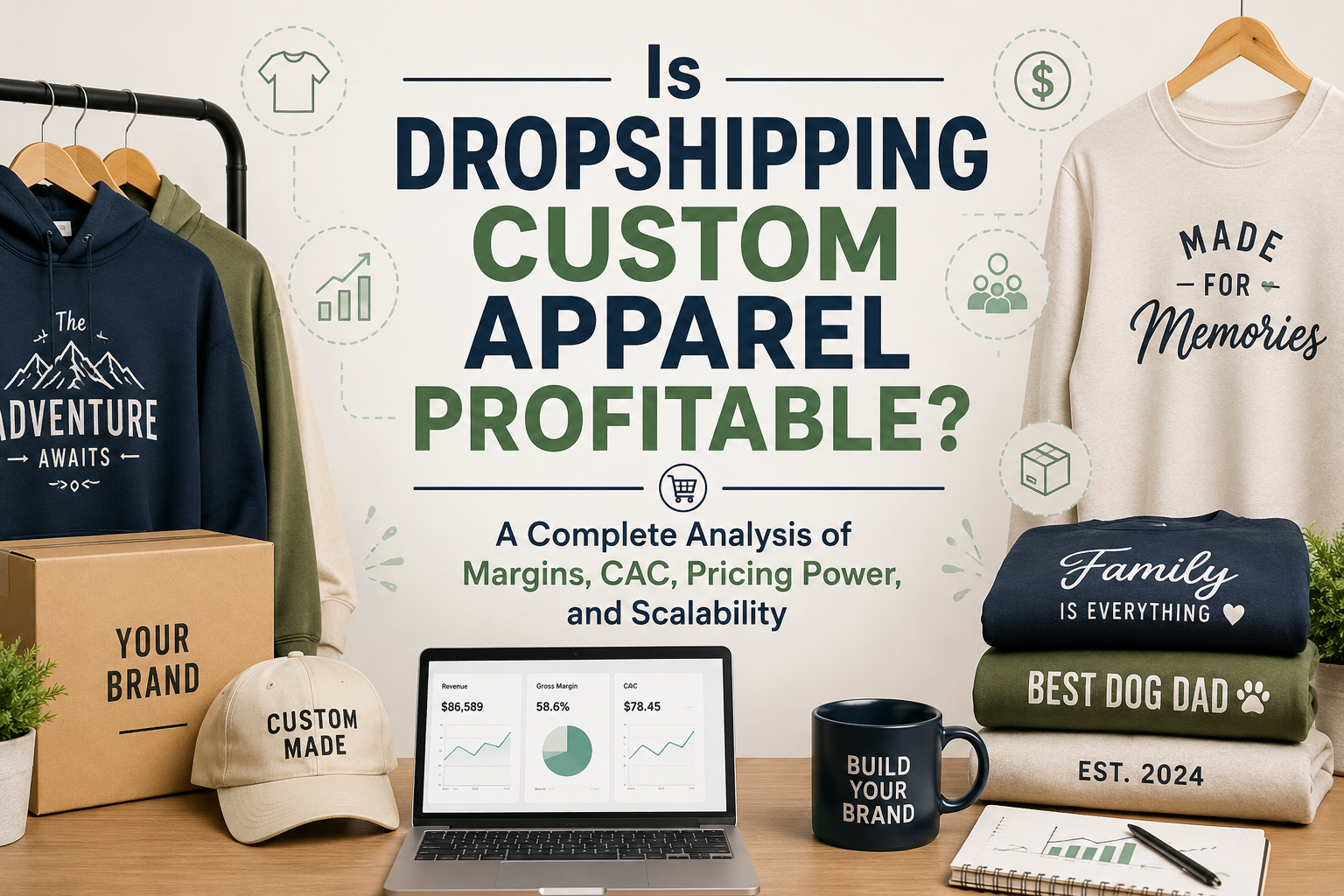
Is Dropshipping Custom Apparel Profitable? A Complete Analysis of Margins, CAC, Pricing Power, and Scalability

The answer depends largely on the level of customization offered.
Generic apparel dropshipping often struggles with gross margins below 35%, leaving little room for advertising volatility and operational expenses. Custom apparel, however, frequently operates with gross margins between 45% and 65%, especially when emotional value and personalization are central to the product experience.
For sellers capable of building a brand around personalization rather than commodity fashion, custom apparel represents one of the more attractive opportunities in modern dropshipping. The business model is not profitable because clothing itself carries high margins. It is profitable because consumers consistently assign higher value to products that feel uniquely their own.
Is Dropshipping Custom Apparel Profitable? Analysis of Gross Margins and Pricing Power
When entrepreneurs evaluate whether dropshipping custom apparel is profitable, the discussion often focuses on revenue growth or market size. However, the more important metric is gross margin. A business with strong sales but weak margins usually struggles to scale because advertising costs continue rising while product differentiation disappears. In contrast, businesses with higher gross margins gain more flexibility in customer acquisition, branding, and long-term expansion.
The global custom apparel market has grown rapidly during the past decade. Industry estimates suggest that personalized apparel sales are increasing at annual rates between 8% and 12%, significantly faster than traditional fashion categories. Consumers are increasingly willing to pay premium prices for products that reflect personal identity, hobbies, family relationships, pets, or memorable events. This willingness to pay creates pricing power that ordinary apparel sellers rarely possess.
The profitability of custom apparel dropshipping largely comes from this pricing advantage rather than production efficiency.
Traditional Apparel Dropshipping Often Operates on Thin Margins
A standard unbranded T-shirt sourced from suppliers may cost approximately $8 including production and fulfillment. If the product is sold for $29.99 and customer acquisition through Meta advertising costs around $12 per order, the gross profit before overhead expenses reaches only $9.99.
The resulting gross margin is approximately 33%.
This margin leaves limited room for payment processing fees, refunds, customer service, software subscriptions, and occasional shipping issues. If advertising costs rise by only a few dollars, profitability can disappear entirely.
This explains why many generic apparel stores fail despite generating significant revenue. Revenue growth without sufficient margins often creates operational pressure rather than financial stability.
Custom Apparel Creates Pricing Power Through Personalization
Custom apparel changes the economic equation because customers are purchasing emotional value rather than fabric alone.
A personalized pet portrait hoodie, a custom embroidered family sweatshirt, or a wedding-themed couple hoodie cannot easily be compared with products sold by competitors. Consumers become less sensitive to price because the product carries sentimental meaning.
Consider a customized hoodie with the following economics:
Production cost including personalization: $18
Shipping cost: $6
Advertising acquisition cost: $15
Selling price: $69.99
The gross profit reaches $30.99, resulting in a gross margin of approximately 44%.
Higher-end personalized apparel products frequently perform even better. Embroidered premium hoodies often sell between $79 and $99 in North America and Europe, while production costs rarely exceed $28 including fulfillment.
Under these conditions, gross margins often exceed 55%.
The increase in profitability comes primarily from higher selling prices rather than lower manufacturing costs.
Different Levels of Customization Produce Different Margins
Not all custom apparel products generate identical returns.
Simple print-on-demand T-shirts generally produce gross margins between 35% and 45%. The barrier to entry is low, competition is intense, and many products become commoditized quickly.
Products involving customer names, photographs, custom illustrations, or embroidery typically perform better. Their gross margins often fall between 45% and 60%.
Fully customized premium apparel, especially products targeting weddings, anniversaries, pet owners, or family gifts, can achieve margins exceeding 65%.
The relationship is relatively straightforward: the greater the emotional value created through customization, the greater the pricing power available to the seller.
This principle explains why many successful brands gradually move away from generic print-on-demand products toward deeper personalization.
Higher Margins Create Advertising Advantages
Advertising economics are often overlooked when discussing profitability.
Suppose two businesses spend the same $20 to acquire a customer.
The first store sells a generic hoodie for $39 and earns a gross profit of $10.
The second store sells a personalized hoodie for $79 and earns a gross profit of $35.
Although acquisition costs are identical, the second company can reinvest substantially more capital into growth. It can tolerate higher CPMs, test additional creatives, and expand into more expensive advertising channels.
Higher gross margins therefore create competitive advantages that compound over time.
This is one reason why many of the fastest-growing direct-to-consumer brands increasingly focus on personalization instead of competing purely on price.
Is Dropshipping Custom Apparel Profitable After Advertising Costs? The Truth About CAC and ROAS
For most dropshipping businesses, profitability is no longer determined by product cost alone. Customer acquisition costs have become the largest expense category for many stores, often exceeding manufacturing and fulfillment costs combined.
During the early years of Facebook advertising, acquiring a customer for less than $10 was relatively common in many western markets. By 2026, the economics have changed dramatically. Competition from direct-to-consumer brands, marketplaces, and established retailers has pushed advertising costs significantly higher.
Industry benchmarks across North America and Europe suggest that Meta advertising CPMs for apparel products frequently range from $12 to $22, while average CPC values often exceed $1.00. Conversion costs for fashion products regularly fall between $18 and $35 per purchase.
For many generic apparel businesses, these numbers make profitability extremely difficult.
The question is whether custom apparel can survive in this new advertising environment.
Generic Apparel Often Cannot Absorb Modern Acquisition Costs
Consider a typical apparel dropshipping store selling a standard hoodie.
The product sells for $39.99.
The landed product cost including shipping is approximately $17.
The average customer acquisition cost through Meta advertising is $22.
Gross profit after advertising falls to only $0.99 before payment fees, refunds, software subscriptions, and operational expenses.
Even a small increase in CPM or a temporary reduction in conversion rate can push the business into negative territory.
This explains why many general fashion stores struggle to scale despite generating impressive top-line revenue figures.
Revenue growth alone cannot compensate for weak acquisition economics.
Higher Average Order Values Change the Equation
Custom apparel operates under different economic conditions because consumers are generally willing to spend significantly more for personalized products.
A personalized pet hoodie may sell for $69.99.
A custom embroidered couple sweatshirt may reach $79.99.
Family matching apparel bundles frequently exceed $100 per order.
Assume the following example:
Selling price: $74.99
Production cost including personalization: $24
Advertising acquisition cost: $24
Gross profit after advertising: $26.99
Gross margin after advertising reaches approximately 36%.
Although customer acquisition costs remain identical to generic apparel stores, the higher selling price dramatically improves profitability.
The key difference is not cheaper advertising.
The key difference is stronger pricing power.
Custom Apparel Benefits From Emotional Purchasing Behavior
Traditional fashion purchases are usually rational decisions involving style, price, and convenience comparisons.
Personalized apparel purchases often follow different consumer psychology.
Customers buying anniversary hoodies, family reunion shirts, memorial apparel, or pet-themed products are purchasing emotional experiences rather than garments.
This emotional component reduces price sensitivity.
Research across personalized product categories consistently shows that consumers are willing to pay premiums between 30% and 80% compared with equivalent non-customized products.
This pricing flexibility allows advertisers to maintain profitability even as platform advertising costs continue increasing.
For many brands, emotional value effectively acts as protection against advertising inflation.
Average Order Value Often Determines Advertising Scalability
One of the most important metrics in modern ecommerce is Average Order Value, commonly referred to as AOV.
A business generating a $35 AOV faces very different scaling limitations than a business generating an $85 AOV.
Suppose two stores both achieve a return on ad spend of 2.5x.
Store A:
Average Order Value: $35
Advertising Cost: $14
Gross Profit Before Overhead: $7
Store B:
Average Order Value: $85
Advertising Cost: $34
Gross Profit Before Overhead: $23
Although the second business spends substantially more on advertising, it retains far more capital for reinvestment.
This additional margin supports email marketing, influencer partnerships, loyalty programs, and international expansion.
Higher AOV therefore creates strategic flexibility rather than simply improving profitability.
Upselling Creates Additional Margin Expansion
Custom apparel stores often possess another advantage that traditional apparel brands lack.
Personalized products naturally encourage complementary purchases.
Customers ordering a personalized pet hoodie may also purchase matching mugs, tote bags, or additional apparel items featuring the same design.
Wedding customers frequently purchase products for bridesmaids, groomsmen, parents, and family members simultaneously.
Many successful custom apparel brands increase order values through bundle offers and quantity discounts.
A customer who initially intended to purchase a single $69 hoodie may ultimately complete a $109 order after adding matching products.
As order values increase, customer acquisition costs become a smaller percentage of revenue.
This further improves advertising efficiency.
Advertising Platforms Favor Higher Margin Products
Modern advertising algorithms reward businesses capable of spending aggressively.
Companies with low margins often cannot afford the learning phase required for algorithm optimization. They stop campaigns too early because initial acquisition costs appear unprofitable.
Higher-margin businesses can tolerate temporary inefficiencies while algorithms gather conversion data.
As campaigns mature, customer acquisition costs frequently decline while conversion rates improve.
This creates a reinforcing cycle where profitable businesses become increasingly competitive over time.
Custom apparel businesses with strong margins therefore possess advantages that extend beyond immediate profitability.
Is Dropshipping Custom Apparel Profitable with Print on Demand or Private Label?
Many entrepreneurs enter the custom apparel industry believing that product selection is the primary driver of profitability. In reality, the underlying fulfillment model often has a greater impact on long-term margins than the apparel category itself.
A personalized hoodie sold through a print-on-demand supplier and an almost identical hoodie sold through a private label supply chain may generate dramatically different financial outcomes despite appearing identical to consumers.
Print on Demand Offers Low Risk but Limited Margins
Print on Demand remains the most common entry point for custom apparel businesses because it removes inventory risk entirely.
The seller uploads designs, receives orders, and the supplier handles production and fulfillment automatically. There are no minimum order quantities, no warehouse costs, and very little operational complexity.
This simplicity explains why thousands of new ecommerce entrepreneurs choose POD platforms every year.
However, convenience comes at a cost.
A premium blank T-shirt from a major POD provider often costs between $13 and $18 after printing fees are included. Shipping to North American customers frequently adds another $5 to $8.
A hoodie may cost between $28 and $35 before advertising expenses are even considered.
If that hoodie sells for $54.99, the remaining gross profit before advertising falls to approximately $20.
Once customer acquisition costs of $18 to $25 are included, profit margins become extremely narrow.
Many POD apparel businesses ultimately operate with gross margins between 30% and 40%.
While profitable in theory, these margins often limit advertising scalability and long-term growth.
Private Label Apparel Produces Stronger Unit Economics
Private label custom apparel follows a different economic structure.
Instead of relying on third-party POD networks, sellers work directly with manufacturers or fulfillment partners capable of producing customized products under their own brand.
Consider a typical embroidered hoodie sold through a private label model.
Blank hoodie production cost: $12
Embroidery cost: $4
Packaging cost: $2
Shipping cost: $6
Total landed cost: $24
If the product sells for $74.99, gross profit reaches approximately $51.
The resulting gross margin approaches 68%.
Even after advertising costs of $22 to $25 per customer, the business still retains meaningful profitability.
This difference explains why many successful ecommerce brands eventually migrate away from POD providers as order volume increases.
Scale Magnifies the Cost Advantage
The profitability gap between POD and private label widens as order volume grows.
A store processing twenty orders per month may prioritize convenience and automation over margin optimization.
A business processing two thousand orders per month faces a different reality.
Saving even five dollars per order creates an annual improvement of $120,000 in gross profit at that scale.
For many seven-figure brands, the decision to leave POD is not primarily about branding.
It is a financial necessity.
Lower production costs provide more budget for customer acquisition, content creation, influencer partnerships, and international expansion.
Margins become a strategic weapon rather than simply an accounting metric.
Branding Potential Differs Significantly Between Models
Another major distinction involves customer perception.
Most POD products arrive in generic packaging with little opportunity for brand customization. The customer relationship often ends with a single purchase because the experience feels transactional rather than memorable.
Private label apparel allows businesses to introduce custom packaging, branded inserts, premium materials, and a more consistent customer experience.
These details improve customer retention rates and increase lifetime value.
Industry estimates suggest that generic POD stores often generate repeat purchase rates between 15% and 25%.
Branded personalized apparel companies frequently achieve repeat purchase rates above 35%.
The additional customer lifetime value substantially improves acquisition economics over time.
Operational Complexity Increases Alongside Margins
Higher profitability rarely comes without trade-offs.
Print on Demand businesses can often be launched within days and managed by a single operator.
Private label operations require supplier management, quality control, inventory planning, and production coordination.
Lead times may increase from three days to ten days.
Communication with manufacturers becomes more important.
Returns management becomes more complicated.
The business becomes operationally heavier.
However, many entrepreneurs accept this additional complexity because the financial rewards increase proportionally.
The history of ecommerce repeatedly demonstrates that businesses willing to control more of their supply chain usually capture a larger percentage of industry profits.
Hybrid Models Are Becoming Increasingly Common
An emerging trend among successful custom apparel businesses involves combining both models.
Print on Demand is used during product validation and market testing because it minimizes financial risk.
Once a design proves demand and reaches stable sales volume, the business transitions toward private label manufacturing to improve margins.
This approach combines the flexibility of POD with the profitability of branded fulfillment.
Many modern direct-to-consumer brands follow this progression as they scale.
The transition often occurs when monthly order volume exceeds several hundred units for a particular product line.
At this point, the financial incentives become difficult to ignore.
Is Dropshipping Custom Apparel Profitable in 2026? The Highest-Margin Niches Revealed
One of the biggest misconceptions in ecommerce is the belief that all personalized products generate high profits simply because they are customized.
In reality, profitability varies dramatically across different custom apparel niches. Two products may require similar production costs yet produce completely different financial outcomes because consumers assign different levels of emotional value to each purchase.
A personalized gym hoodie and a memorial pet sweatshirt may cost nearly the same to manufacture, but the customer’s willingness to pay can differ by more than 50 percent.
For entrepreneurs evaluating whether dropshipping custom apparel is profitable, niche selection often matters more than manufacturing efficiency.
The most profitable niches are usually those where personalization becomes part of the emotional experience rather than a decorative feature.
Pet Apparel Has Become One of the Most Profitable Categories
The pet industry continues to outperform many traditional consumer sectors.
In the United States alone, annual pet spending has exceeded $150 billion, and premium personalization products represent one of the fastest-growing segments within that market.
Custom pet hoodies featuring illustrated portraits, embroidered pet names, or memorial designs often sell between $59 and $89.
Production costs generally range from $18 to $28 including customization and shipping.
Gross margins frequently fall between 55% and 68%.
Unlike traditional apparel buyers, pet owners rarely evaluate these products solely through a price comparison lens. Many purchases are driven by emotional attachment rather than utility.
This emotional purchasing behavior creates unusually strong pricing power.
As advertising competition in generic fashion continues increasing, pet personalization remains relatively resilient.
Couple Apparel Benefits From Life Events and Gift Purchases
Gift-driven ecommerce categories often outperform practical categories in terms of profitability.
Custom apparel for couples benefits from multiple recurring occasions including anniversaries, engagements, weddings, Valentine’s Day, and birthdays.
Personalized matching hoodies and embroidered relationship apparel commonly sell between $79 and $119 per order because customers frequently purchase multiple units simultaneously.
Production costs for a pair of customized hoodies may remain below $35.
Gross margins frequently exceed 55%.
The economics become even more attractive because customer acquisition costs are spread across multiple products rather than a single garment.
A customer purchasing two hoodies generates significantly stronger unit economics than a customer purchasing one standard sweatshirt.
This category demonstrates how bundling naturally improves profitability without requiring additional advertising expenditure.
Family Matching Apparel Creates Exceptionally High Order Values
Many ecommerce categories struggle with low average order values.
Family apparel operates under entirely different economics.
Customers purchasing matching holiday sweaters, vacation shirts, or family reunion apparel often place orders involving four to eight garments at once.
Average order values regularly exceed $100 and occasionally reach $200 or more.
A typical family package might include:
Two adult hoodies.
Two children’s hoodies.
Customized names or dates.
Gift packaging.
Although total production costs increase proportionally, customer acquisition costs remain largely unchanged because only one customer needs to be acquired.
This dynamic frequently pushes gross margins above 60%.
From an advertising perspective, family apparel often represents one of the strongest opportunities within personalized ecommerce.
Anime Apparel Combines Fandom With Personal Identity
Anime merchandise has evolved from a niche hobby into a global consumer market worth tens of billions of dollars.
Custom anime apparel adds another layer of personalization by allowing customers to combine favorite characters with names, gaming usernames, birthdays, or personalized artwork.
Premium anime hoodies often sell between $49 and $79.
Production costs generally range from $20 to $30.
Gross margins commonly reach 45% to 60%.
However, this niche introduces additional complexity due to intellectual property considerations.
Businesses relying on copyrighted artwork without licensing agreements face long-term legal risks.
Many successful brands therefore focus on original artwork inspired by anime aesthetics rather than direct reproductions of existing franchises.
Fitness Apparel Generates Volume But Lower Margins
Fitness apparel represents one of the largest segments within online fashion.
Demand remains strong due to increasing interest in wellness, bodybuilding, and active lifestyles.
However, profitability tends to be lower than many entrepreneurs expect.
Consumers purchasing gym apparel often compare prices aggressively because similar products are widely available from major brands.
Personalization usually takes the form of names, motivational phrases, or gym affiliations rather than deeply emotional experiences.
Average selling prices typically range between $39 and $69.
Gross margins generally remain between 35% and 50%.
While still profitable, fitness apparel rarely matches the pricing power found in gift-oriented categories.
The market rewards branding and community building more than customization alone.
Memorial and Sentimental Products Often Generate the Highest Margins
Across nearly every ecommerce sector, products connected to memories consistently outperform products connected to utility.
Memorial apparel honoring pets, relatives, or meaningful life events often commands premium prices despite modest production costs.
Customers purchasing these products rarely shop for the lowest available price.
Instead, they prioritize trust, design quality, and emotional resonance.
A memorial embroidered hoodie selling for $89 may cost only $25 to produce and fulfill.
Gross margins exceeding 70% are not uncommon.
This category illustrates an important principle within personalized commerce.
Consumers pay for emotional significance far more willingly than they pay for additional product features.
The Most Profitable Niches Share One Common Characteristic
Despite differences between pets, families, couples, and fandom communities, the highest-margin custom apparel niches share a common trait.
They all transform apparel into a form of personal expression or memory preservation.
The customer is not purchasing cotton fabric.
The customer is purchasing identity, relationships, nostalgia, or emotional connection.
This distinction fundamentally changes pricing behavior and profitability.
The strongest businesses in personalized ecommerce understand that customization itself is not the product.
Emotion is the product.
Customization is merely the delivery mechanism.
Is Dropshipping Custom Apparel Profitable in the Long Run? Building Defensible E-commerce Brands
Most discussions about dropshipping profitability focus on product costs and advertising expenses. While these factors are important, they are rarely the reason businesses disappear.
The largest problem facing traditional dropshipping businesses is the absence of competitive barriers.
A generic portable blender, LED lamp, or fashion accessory can usually be copied within days. Competitors source from identical suppliers, run similar advertising creatives, and compete almost entirely on price.
The result is predictable.
Advertising costs rise.
Margins decline.
Customer loyalty disappears.
Many products experience life cycles of less than twelve months before becoming saturated.
The question is whether custom apparel follows the same pattern or operates under different market dynamics.
Personalization Creates Natural Competitive Protection
Custom apparel introduces barriers that traditional products often cannot replicate.
A personalized embroidered hoodie containing a customer’s family name, wedding date, or pet illustration cannot be directly copied by competitors in the same way as a generic product.
The value of the product is partially created by customer input.
The customer becomes a participant in the manufacturing process rather than merely a buyer.
This changes the competitive landscape significantly.
Competitors may replicate the hoodie style or fabric quality, but they cannot duplicate the personal story attached to the product.
As a result, purchasing decisions become less dependent on price comparisons.
This phenomenon increases customer retention while reducing exposure to commoditization.
Price Competition Becomes Less Aggressive
Traditional ecommerce categories often experience severe pricing pressure.
When ten stores sell identical products, the easiest method of differentiation becomes discounting.
The economics quickly become destructive.
A product that originally generated a 40% gross margin may eventually fall below 20% after several rounds of price competition.
Custom apparel behaves differently.
Consumers purchasing personalized anniversary gifts or memorial products rarely search for the cheapest available option.
Trust, product quality, production accuracy, and delivery reliability become more important than saving a few dollars.
Industry studies across personalized ecommerce categories consistently show lower price elasticity compared with commodity products.
Many custom apparel brands maintain stable pricing for years while continuing to grow revenue.
Stable pricing creates predictability, which is essential for long-term planning and business valuation.
Customer Lifetime Value Is Often Significantly Higher
One of the strongest indicators of ecommerce sustainability is customer lifetime value.
Traditional dropshipping stores often struggle with repeat purchases because the customer relationship ends immediately after delivery.
The customer purchases a product.
The need is fulfilled.
The relationship ends.
Personalized apparel creates additional opportunities for future purchases.
A customer ordering a wedding hoodie today may return for anniversary gifts next year.
A pet owner purchasing one memorial sweatshirt may later purchase additional products featuring another design.
Families buying matching Christmas apparel frequently return during subsequent holiday seasons.
Industry benchmarks suggest that many generic apparel stores achieve repeat purchase rates between 20% and 28%.
Personalized apparel brands commonly report repeat purchase rates between 35% and 50%.
The financial implications are substantial.
Higher Lifetime Value Improves Advertising Economics
Customer acquisition costs continue increasing across nearly all digital advertising platforms.
Businesses that depend entirely on first-purchase profitability face growing challenges.
Lifetime value changes this equation.
Consider two businesses that both spend $25 acquiring a customer.
Business A generates only one purchase worth $50.
Business B acquires a customer who returns twice during the following two years and spends a total of $180.
The acquisition cost remains identical.
The long-term economics become completely different.
Higher customer lifetime value allows brands to bid more aggressively for traffic while remaining profitable.
This advantage compounds over time because competitors with lower retention rates eventually lose advertising auctions.
Many of the strongest direct-to-consumer brands intentionally accept lower first-order profitability in exchange for stronger lifetime value.
Custom apparel often supports this strategy more effectively than traditional dropshipping products.
User-Generated Content Creates Organic Growth Advantages
Another advantage of personalized apparel involves content creation.
Consumers frequently share customized products on social media because the products contain personal stories, names, relationships, or meaningful memories.
This behavior effectively turns customers into marketers.
A personalized wedding hoodie posted on social media may generate referrals among friends and family.
Pet memorial products often produce strong engagement because audiences connect emotionally with the stories behind them.
Family matching apparel regularly generates seasonal sharing behavior during holidays and vacations.
Generic products rarely achieve similar levels of organic exposure.
This user-generated content reduces dependence on paid advertising over time.
Lower customer acquisition costs further strengthen long-term profitability.
Brand Equity Accumulates More Efficiently
Perhaps the largest difference between traditional dropshipping and personalized apparel lies in brand development.
Commodity products typically build weak emotional relationships with customers.
Personalized products often become associated with important moments in people’s lives.
Weddings.
Birthdays.
Anniversaries.
Family celebrations.
Memorial events.
When a business becomes associated with these moments, customers remember the brand differently.
This emotional connection creates brand equity that competitors cannot easily purchase through advertising alone.
Over time, brand equity itself becomes an asset capable of generating future revenue.
This characteristic explains why personalized ecommerce businesses often achieve higher valuations than generic product stores with similar annual revenue.
The Long-Term Risks Still Exist
Despite these advantages, custom apparel is not immune to business risks.
Production errors can damage customer trust.
Long fulfillment times may reduce conversion rates.
Managing personalization workflows introduces operational complexity.
Quality control becomes increasingly important as order volume grows.
Businesses that fail to maintain consistency often struggle despite favorable economics.
Long-term profitability therefore depends not only on product selection but also on operational discipline.
The market rewards reliability as much as creativity.
Is Dropshipping Custom Apparel Profitable Once Production and Fulfillment Costs Are Included?
One of the most common mistakes made by new ecommerce entrepreneurs is assuming that revenue equals profitability.
A custom apparel store generating $100,000 in monthly sales may appear highly successful from the outside. However, once production expenses, fulfillment costs, customer service requirements, payment fees, and operational losses are included, the actual profit picture often looks very different.
This issue is particularly important in personalized ecommerce because every order contains variables that traditional retail businesses do not face.
Unlike standard products sitting on warehouse shelves, custom apparel is manufactured around individual customer input. Names, photos, dates, embroidery requests, and design modifications all introduce additional costs into the fulfillment process.
The real question is not whether custom apparel can generate revenue.
The question is whether enough profit remains after operational complexity is accounted for.
The True Cost Structure of a Custom Apparel Order
Consider a realistic example involving a premium personalized hoodie sold to a customer in the United States.
Retail price: $74.99
Blank hoodie manufacturing cost: $13.00
Customization cost: $6.00
Packaging materials: $2.00
Shipping and fulfillment: $7.50
Payment processing fees: $2.50
Customer acquisition cost: $20.00
At first glance, the gross profit appears attractive.
However, after deducting these direct expenses, only approximately $23.99 remains.
The effective gross margin falls to roughly 32%.
This figure still excludes refunds, customer service labor, software subscriptions, and operational overhead.
The difference between perceived profitability and actual profitability can therefore be significant.
Revision Requests Introduce Hidden Labor Costs
Traditional ecommerce products generally follow a simple process.
The customer purchases the product.
The warehouse ships the product.
The transaction ends.
Custom apparel introduces an entirely different workflow.
Customers frequently request design changes, spelling corrections, font modifications, size adjustments, or image replacements before production begins.
Even if these requests require only ten minutes of labor per order, the cumulative impact becomes substantial at scale.
A business processing one hundred personalized orders per day may spend more than sixteen labor hours handling revision requests alone.
At average labor costs of $18 per hour, this represents nearly $300 of daily operational expense.
Many businesses underestimate this category because it does not appear directly on supplier invoices.
Production Errors Carry Higher Financial Consequences
Personalization reduces product comparability but increases production risk.
A generic hoodie with a defect may be resold or returned to inventory.
A hoodie containing the wrong family name or an incorrect wedding date has virtually no resale value.
The product becomes a complete write-off.
Industry return rates for standard apparel ecommerce generally fall between 10% and 15%.
Personalized products often experience lower return rates because many custom items are non-refundable.
However, supplier errors and customer submission mistakes create disproportionately expensive losses when they occur.
Even a production error rate of only 2% can materially affect profitability if average order values exceed $70.
Operational accuracy therefore becomes a financial metric rather than merely a customer service issue.
Shipping Delays Can Reduce Conversion Rates
Modern consumers have become accustomed to fast delivery expectations created by major marketplaces.
Custom apparel businesses operate under different production timelines.
Manufacturing may require three to seven days before shipping even begins.
International shipping may add another seven to ten days.
Total delivery windows of ten to fifteen days are common.
Longer fulfillment periods frequently reduce conversion rates compared with standard ecommerce products.
Some customers simply abandon purchases when delivery estimates appear too long.
Businesses often compensate by upgrading shipping services, but faster logistics increase operating costs further.
Finding the balance between delivery speed and profitability becomes an important strategic decision.
Scaling Operations Requires Investment in Automation
Many custom apparel businesses remain profitable at small volumes but encounter operational bottlenecks during growth.
A store receiving twenty orders per day can manually process personalization requests without major issues.
A store receiving five hundred orders per day cannot.
Automation becomes essential.
Order routing software, design generation tools, customer approval systems, and supplier integrations reduce labor costs while improving accuracy.
These investments increase software expenses in the short term but often improve margins over time.
Businesses that automate early typically achieve stronger profitability than businesses relying heavily on manual workflows.
Operational efficiency becomes a competitive advantage in itself.
Supplier Quality Has a Direct Impact on Margins
In generic dropshipping, changing suppliers may involve minimal customer impact.
Custom apparel businesses face greater risks because product quality directly influences emotional customer experiences.
Poor embroidery quality, inaccurate colors, and low-quality printing can permanently damage customer trust.
The cheapest supplier rarely produces the highest long-term profit.
Businesses often discover that paying an additional two dollars for better production quality reduces refunds, chargebacks, and negative reviews sufficiently to improve overall margins.
Profitability therefore depends on total system efficiency rather than isolated cost reductions.
Net Profit Margins Remain Attractive Despite Complexity
Despite these additional costs, custom apparel often remains more profitable than generic ecommerce categories.
Many mature personalized apparel brands operate with net profit margins between 15% and 25%.
Strong operators with optimized supply chains and repeat customer bases occasionally exceed 30%.
By comparison, many general apparel dropshipping businesses struggle to maintain net margins above 10%.
The higher selling prices associated with personalization compensate for much of the additional operational complexity.
The economics remain attractive provided that businesses maintain discipline around fulfillment and quality control.




No Comments