


Is Dropshipping and Reselling the Same Thing? Differences, Profitability, Legal Issues, and Which Model Is Better

The more useful question for entrepreneurs is not whether dropshipping and reselling are identical, but which model aligns better with their goals and resources.
Entrepreneurs with limited capital often prefer dropshipping because it minimizes risk and allows rapid product testing. Businesses focused on branding, customer experience, and long-term margins often transition toward traditional reselling or hybrid inventory models over time.
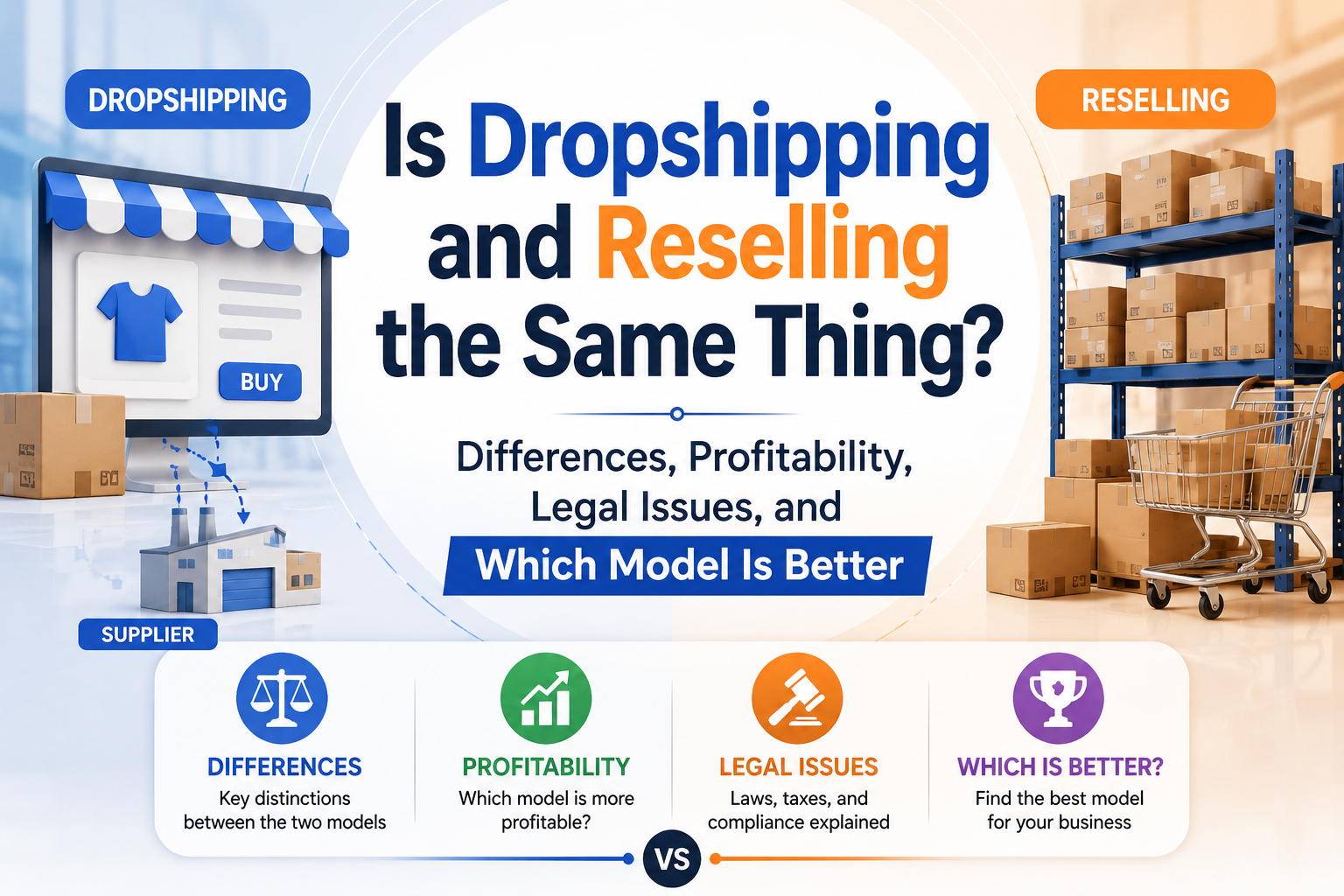
Is Dropshipping and Reselling the Same Thing? the Fundamental Differences Between the Two Models
The terms dropshipping and reselling are often used interchangeably, especially by beginners entering ecommerce for the first time. At first glance, both models appear nearly identical. In both cases, the seller markets products they did not manufacture, earns money from the price difference between cost and selling price, and relies on third-party suppliers somewhere in the supply chain. However, while the two models share similarities, they are not exactly the same thing.
The Similarities Between Dropshipping and Reselling
Both business models belong to the broader category of ecommerce retail. Neither requires the seller to create products from scratch, build factories, or invest in manufacturing equipment. Instead, the seller acts as an intermediary between suppliers and customers.
In both models, the seller focuses on finding demand, attracting traffic, and converting visitors into customers. Marketing skills, product selection, pricing strategy, and customer service often determine success more than technical expertise or production capabilities.
This is why many people assume that dropshipping and reselling are simply different names for the same business activity. From a customer’s perspective, both involve purchasing products from an online store that did not produce the goods itself.
However, the differences become obvious once inventory ownership and order fulfillment enter the discussion.
Inventory Ownership Creates the Biggest Difference
Traditional reselling usually requires purchasing inventory before making sales. A reseller buys products from wholesalers, manufacturers, distributors, or liquidation suppliers and stores them in a warehouse, office, or fulfillment center. The reseller owns the inventory and assumes the financial risk associated with unsold products.
Dropshipping works in the opposite direction.
A dropshipper only purchases inventory after a customer places an order. The supplier stores the products and ships them directly to the end customer on behalf of the seller. The seller never physically handles the products and never owns inventory in advance.
This difference dramatically changes the financial structure of the business.
Traditional reselling requires upfront capital investment and inventory planning, while dropshipping significantly reduces the amount of capital required to start.
Order Fulfillment Responsibilities Are Different
Another major distinction lies in logistics operations.
A reseller is responsible for warehousing, packaging, inventory management, and shipping operations unless third-party logistics providers are involved. As order volume increases, operational complexity often grows alongside revenue.
Dropshipping transfers much of this operational burden to suppliers.
The supplier manages stock levels, packaging, and shipping processes while the seller focuses primarily on customer acquisition and marketing. This makes dropshipping highly attractive for entrepreneurs seeking low operational complexity.
However, this convenience comes with trade-offs.
Because suppliers control fulfillment, dropshippers often have less control over delivery speed, packaging quality, inventory accuracy, and customer experience.
Profit Margins Often Reflect the Difference in Risk
Lower operational responsibility usually means lower profit margins.
Traditional resellers typically purchase products in bulk and negotiate lower unit costs. This creates higher gross margins and allows greater flexibility in pricing strategies.
Dropshippers generally pay higher per-unit costs because suppliers assume warehousing and fulfillment responsibilities. As a result, dropshipping businesses often rely heavily on advertising efficiency and high product turnover rather than large margins per order.
This does not mean dropshipping is less profitable overall. It simply means the profit model operates differently.
Dropshipping prioritizes low risk and fast testing, while reselling prioritizes economies of scale and purchasing power.
Is Dropshipping Simply a Type of Reselling?
From a broad business perspective, the answer is yes.
Dropshipping can be viewed as a specialized form of reselling because the seller purchases products from suppliers and sells them to customers at a higher price. The seller does not manufacture the goods and earns profits from the difference between purchase cost and retail price.
The distinction lies in when inventory ownership occurs and who handles fulfillment.
In many legal and tax environments, dropshipping businesses are treated similarly to resellers because both participate in retail transactions and assume responsibility for customer relationships and compliance obligations.
Dropshipping vs Reselling: Which Business Model Generates Higher Profits
Profitability is one of the first questions entrepreneurs ask when choosing an ecommerce business model. Since both dropshipping and traditional reselling involve selling products sourced from third-party suppliers, many people assume their profit potential is similar. In reality, the economics behind these two models are very different.
The answer is not as simple as declaring one model more profitable than the other. Profitability depends on capital requirements, operating costs, cash flow efficiency, and the stage of business development.
Why Dropshipping Looks More Profitable at the Beginning
For new entrepreneurs, dropshipping often appears to be the superior option because of its extremely low startup costs.
A traditional reseller may need to invest thousands of dollars into inventory before selling a single product. Inventory purchases, storage costs, packaging materials, and shipping operations all require capital. If products fail to sell, that inventory becomes a financial burden.
Dropshipping removes most of these upfront expenses.
Because products are purchased only after customers place orders, sellers avoid inventory risk and preserve cash flow. This allows entrepreneurs to test dozens of products with minimal investment and quickly adapt to market trends.
For beginners with limited budgets, this capital efficiency can create a higher return on investment even if individual product margins are smaller.
Traditional Reselling Usually Produces Higher Margins
While dropshipping minimizes risk, traditional reselling often delivers stronger gross margins.
Bulk purchasing gives resellers significant negotiating power with suppliers. Buying hundreds or thousands of units reduces per-unit costs and increases pricing flexibility. Lower acquisition costs translate directly into higher profits on every order.
Dropshippers rarely receive these wholesale discounts.
Suppliers charge higher prices because they absorb warehousing expenses, inventory management costs, packaging labor, and fulfillment responsibilities. The convenience of dropshipping is effectively built into the product cost.
As advertising expenses continue rising in 2026, many dropshippers find that customer acquisition costs consume a substantial portion of revenue, leaving relatively thin margins after marketing expenses are deducted.
Cash Flow Works Differently in Both Models
Cash flow management often determines whether an ecommerce business survives its growth phase.
Dropshipping creates a favorable cash conversion cycle because customers pay before the seller purchases products from suppliers. This means businesses can scale without investing heavily in inventory.
Traditional reselling requires the opposite approach.
Inventory must be purchased weeks or months before revenue is generated. Capital becomes tied up in stock, and forecasting errors can create cash shortages even in businesses with healthy sales volumes.
This advantage explains why many entrepreneurs use dropshipping to validate products before committing to larger inventory purchases.
Branding Opportunities Affect Long-Term Profitability
One of the biggest limitations of dropshipping is limited control over branding and customer experience.
Many suppliers use generic packaging and standardized shipping processes. Competitors often sell identical products from the same suppliers, making price competition inevitable.
Traditional reselling offers greater control.
Businesses can create branded packaging, improve delivery times, bundle products, and develop stronger customer loyalty. These advantages increase repeat purchase rates and reduce dependence on paid advertising over time.
Higher customer retention usually translates into higher lifetime customer value, which becomes increasingly important as advertising costs continue to rise.
Scalability Depends on Business Goals
Dropshipping scales efficiently from an operational perspective because suppliers handle fulfillment. A seller can increase order volume without significantly increasing warehouse staff or logistics infrastructure.
However, operational simplicity does not always equal maximum profitability.
Reselling businesses often become more profitable as scale increases because bulk purchasing, private labeling, and supplier negotiations improve margins over time.
Large ecommerce brands rarely remain pure dropshipping businesses indefinitely. Many begin with dropshipping to identify winning products and later transition toward inventory ownership once demand becomes predictable.
Is Dropshipping Legally Considered Reselling? Tax, Licensing, and Compliance
Many new ecommerce entrepreneurs assume that dropshipping exists in a legal gray area because sellers never physically own inventory or handle products themselves. This misunderstanding often leads to questions such as whether dropshipping is legally different from reselling, whether a business license is required, or whether suppliers are responsible for taxes and compliance.
From a legal perspective, the answer is surprisingly straightforward. In most countries and jurisdictions, dropshipping is generally treated as a form of reselling. The fact that inventory never passes through the seller’s hands does not change the seller’s legal responsibilities toward customers and regulatory authorities.
Selling Without Inventory Does Not Eliminate Legal Responsibility
The defining feature of dropshipping is that suppliers fulfill orders directly to customers. However, from the customer’s perspective, the transaction occurs with the store owner rather than the supplier.
Customers visit the website, make payments to the store, receive invoices from the store, and contact the store when problems occur. Legally speaking, the store acts as the retailer in the transaction.
Because of this relationship, regulators in many countries treat dropshipping businesses similarly to traditional resellers.
If a customer receives defective products, experiences misleading advertising, or requests a refund under consumer protection laws, responsibility usually falls on the seller rather than the manufacturer or fulfillment supplier.
The absence of inventory ownership does not transfer customer obligations to suppliers.
Tax Authorities Usually View Dropshipping as Retail Activity
Tax treatment is one of the clearest examples of how governments classify dropshipping businesses.
In most jurisdictions, revenue generated through dropshipping is considered retail sales income. Business owners may be required to collect sales taxes, value-added tax, or goods and services tax depending on where customers are located.
The exact rules vary by country, but the principle remains consistent.
The seller earns revenue from the end customer and therefore becomes responsible for reporting income and complying with applicable tax regulations.
Many entrepreneurs incorrectly assume suppliers handle taxes because suppliers ship the products. In reality, fulfillment responsibilities and tax responsibilities are separate issues.
A supplier may handle export documentation or import declarations, but the seller remains responsible for business taxation in most cases.
Business Licenses and Reseller Permits May Still Be Required
Another common misconception is that dropshipping businesses can operate without formal registration because they never store inventory.
In practice, many jurisdictions require ecommerce businesses to obtain standard business licenses regardless of fulfillment methods.
Depending on the country or state, sellers may also benefit from obtaining reseller permits or resale certificates. These documents often allow businesses to purchase products from suppliers without paying sales tax at the wholesale stage because taxes will eventually be collected from end consumers.
Again, the legal logic is identical to traditional reselling.
Governments generally care about the commercial transaction itself rather than the physical location of inventory.
Product Liability Can Become a Serious Issue
Product liability is one area where many dropshippers underestimate their exposure.
If products cause injuries, violate safety regulations, or fail to meet compliance standards, authorities may investigate not only manufacturers but also retailers who marketed the products.
This issue becomes particularly important when selling products in regulated industries such as cosmetics, supplements, electronics, children’s products, or medical accessories.
Even when suppliers are located overseas, local authorities may still hold the seller responsible for consumer protection violations.
Choosing reputable suppliers therefore becomes a legal risk management strategy rather than simply a sourcing decision.
International Ecommerce Creates Additional Compliance Challenges
Cross-border ecommerce introduces additional legal considerations.
Import regulations, customs duties, intellectual property laws, product certifications, and labeling requirements may differ significantly between markets.
A product that can legally be sold in one country may require additional certifications or approvals before entering another market.
Since dropshipping suppliers frequently ship products internationally, sellers must understand the rules of their target markets rather than assuming suppliers have already addressed compliance issues.
Failure to do so can result in customs delays, product seizures, penalties, or account suspensions on ecommerce platforms.
Why Beginners Think Dropshipping and Reselling Are the Same Thing — And Why They Are Wrong
One of the most common misconceptions in ecommerce is the belief that dropshipping and reselling are simply two different names for the same business model. The confusion is understandable. Both involve purchasing products from suppliers and selling them to customers at a higher price. Neither requires manufacturing products, owning factories, or developing proprietary technology.
Because of these similarities, many beginners conclude that the two models are interchangeable.
The reality is more nuanced. Dropshipping and reselling belong to the same commercial family, but they solve very different business problems and operate under different strategic assumptions.
The “Buy Low and Sell High” Principle Creates the Illusion
At the most basic level, both business models follow the same economic principle.
The seller acquires products at one price and sells them at a higher price to customers. Profit comes from the difference between cost and selling price.
This simple structure makes it easy for newcomers to categorize both models together.
Whether products are purchased from wholesalers, manufacturers, distributors, liquidation suppliers, or dropshipping platforms, the core transaction appears identical from the outside.
However, reducing ecommerce models to “buy low and sell high” ignores many of the operational decisions that determine how businesses function in practice.
Business models are not defined only by how money is earned. They are also defined by how risk is distributed.
Social Media Often Oversimplifies Ecommerce Models
The rise of short-form business content has contributed significantly to the confusion.
Videos frequently describe dropshipping as a method of buying products cheaply from suppliers and reselling them online for a profit. While technically correct, this explanation removes most of the operational context that separates dropshipping from other retail models.
As a result, many beginners enter ecommerce believing that all forms of reselling work in exactly the same way.
The differences between inventory ownership, supplier relationships, fulfillment control, and customer experience rarely fit into thirty-second tutorials or promotional content designed to attract attention.
Simplified explanations may increase accessibility, but they often reduce understanding.
Modern Ecommerce Contains Multiple Forms of Reselling
Another reason for confusion is the increasing number of retail models available today.
Wholesale businesses purchase inventory in bulk and resell products through online stores. Retail arbitrage businesses buy discounted products from physical stores and resell them through marketplaces. Private label brands source products from manufacturers and sell them under their own branding.
Dropshipping also involves selling products sourced from external suppliers.
From a broad perspective, all of these businesses participate in reselling.
The difference is that each model allocates inventory ownership, operational responsibility, and capital investment differently.
Dropshipping is not an alternative to reselling. It is one specific variation of reselling.
This distinction is subtle but important.
Entrepreneurs Often Focus on Products Instead of Systems
Beginners naturally pay attention to products because products are visible.
They analyze trends, margins, advertising opportunities, and competitors. What often receives less attention is the underlying system supporting those sales.
Experienced ecommerce operators tend to focus on supply chains, logistics, fulfillment speed, inventory turnover, and customer retention because these systems determine long-term scalability.
Two businesses can sell exactly the same product to the same customer at the same price while operating entirely different backend structures.
One may own inventory and operate warehouses while the other relies entirely on supplier fulfillment.
The customer sees one product listing, but behind that listing are fundamentally different business systems.
The Confusion Disappears as Businesses Grow
Interestingly, experienced ecommerce entrepreneurs rarely debate whether dropshipping and reselling are the same thing.
As businesses grow, the practical differences become impossible to ignore.
Inventory forecasting, supplier negotiations, shipping performance, return handling, and customer experience eventually become central business concerns. These operational realities force entrepreneurs to think beyond simple product sourcing.
Many successful ecommerce brands actually move through multiple models during their development.
They may begin with dropshipping to test demand, transition into inventory ownership to improve margins, and eventually create private label products to strengthen brand value.
Rather than competing models, dropshipping and traditional reselling often become different stages within the same growth journey.
Can You Be Both a Dropshipper and a Reseller? How Hybrid Ecommerce Models Are Changing Online Business
For many years, ecommerce discussions treated dropshipping and reselling as competing business models. Entrepreneurs were often encouraged to choose one side: either operate a low-risk dropshipping business or invest in inventory and become a traditional reseller.
The reality in 2026 looks very different.
An increasing number of successful ecommerce businesses combine both approaches at different stages of growth. Instead of viewing dropshipping and reselling as mutually exclusive, modern sellers use each model strategically to solve different operational challenges.
This hybrid approach is becoming one of the most efficient ways to build scalable ecommerce businesses.
Product Validation Is Where Dropshipping Creates the Most Value
One of the largest risks in ecommerce is buying inventory for products that customers do not want.
Traditional resellers often face difficult forecasting decisions before collecting any customer data. A poor purchasing decision can lock capital into slow-moving inventory for months.
Dropshipping eliminates this problem.
By allowing sellers to list products without purchasing stock in advance, dropshipping becomes an efficient market testing tool. Entrepreneurs can launch advertising campaigns, measure conversion rates, and identify customer demand before making inventory commitments.
Instead of making assumptions, businesses can make decisions based on actual purchasing behavior.
For this reason, many brands use dropshipping not as a permanent strategy but as an intelligence-gathering phase.
Winning Products Often Move Into Inventory-Based Fulfillment
Once a product consistently generates sales, the economics begin to change.
Stable demand creates predictability, and predictability changes the financial equation. Purchasing inventory in larger quantities often reduces unit costs, improves shipping performance, and increases operational control.
At this stage, many businesses transition successful products away from dropshipping suppliers and into local warehouses or fulfillment centers.
The objective is no longer simply reducing risk.
The objective becomes improving margins, increasing delivery speed, and strengthening customer experience.
This transition explains why many seven-figure ecommerce brands no longer describe themselves as pure dropshipping companies even though dropshipping played a major role in their early growth.
Different Products Can Require Different Fulfillment Strategies
Hybrid businesses frequently use different fulfillment methods for different product categories.
High-volume products with predictable sales may justify inventory ownership because purchasing in bulk improves profitability.
Seasonal products, experimental items, and trend-based products often remain under dropshipping arrangements because demand can disappear quickly.
This creates a flexible supply chain structure.
Businesses avoid overinvesting in uncertain opportunities while maximizing profits from proven products.
Rather than choosing a single business model, sellers choose the most efficient fulfillment strategy for each individual product.
Market Conditions Have Made Hybrid Models More Attractive
Several market changes have accelerated the adoption of hybrid ecommerce systems.
Advertising costs continue increasing across major platforms. Consumers expect faster shipping times than they did several years ago. Competition has also intensified in many product categories.
These trends place pressure on pure dropshipping businesses because slower delivery times and lower margins become increasingly difficult to justify.
At the same time, inventory-heavy businesses face growing financial risks associated with forecasting errors and unsold stock.
Hybrid models provide a compromise between flexibility and control.
Businesses maintain the ability to test products rapidly while still benefiting from inventory ownership where it creates clear economic advantages.
Brand Building Often Requires Moving Beyond Pure Dropshipping
Brand differentiation has become one of the most important factors in ecommerce success.
Private packaging, customized inserts, loyalty programs, and premium unboxing experiences are difficult to achieve when suppliers control the entire fulfillment process.
As businesses mature, many discover that stronger branding requires greater operational control.
Owning inventory allows businesses to standardize quality, improve delivery reliability, and create memorable customer experiences that competitors struggle to replicate.
This does not eliminate the value of dropshipping.
Instead, dropshipping evolves into one component of a broader business system rather than the entire business model.
Dropshipping and Reselling: Which Business Model Is Better for Beginners?
Choosing the right business model is one of the first major decisions every ecommerce entrepreneur faces. For beginners, the debate often comes down to two options: dropshipping or traditional reselling.
Both models offer opportunities to build profitable online businesses, but they require different resources, tolerate different levels of risk, and reward different types of entrepreneurs.
The best choice is rarely determined by market trends or social media success stories. It is usually determined by the entrepreneur’s financial situation, operational experience, and long-term objectives.
Capital Availability Often Determines the Starting Point
For most beginners, access to capital becomes the deciding factor.
Traditional reselling typically requires purchasing products before sales occur. Even relatively small inventory orders can require several thousand dollars once product costs, shipping fees, packaging materials, and storage expenses are included.
This creates immediate financial pressure.
If demand estimates prove inaccurate, inventory may remain unsold while capital remains locked inside stock that cannot easily be converted back into cash.
Dropshipping changes this equation.
Because inventory is purchased only after customers complete their orders, entrepreneurs can start businesses with significantly lower financial commitments. This reduces the consequences of mistakes and allows experimentation without substantial losses.
For beginners with limited budgets, this flexibility can be extremely valuable.
Experience Level Influences Operational Complexity
Running an ecommerce business involves far more than building a website and launching advertisements.
Inventory management, supplier coordination, shipping operations, returns processing, and stock forecasting all become increasingly important as sales volume grows.
Traditional reselling requires business owners to manage many of these operational processes directly or outsource them to fulfillment partners.
Dropshipping simplifies much of this complexity by allowing suppliers to handle logistics operations.
As a result, beginners can spend more time learning customer acquisition, advertising strategy, conversion optimization, and product selection rather than warehouse management.
For entrepreneurs entering ecommerce for the first time, reducing operational variables often increases the probability of survival during the early stages.
Business Objectives Matter More Than Short-Term Convenience
The right model also depends on what the entrepreneur hopes to achieve.
Some beginners want to learn ecommerce fundamentals while minimizing financial exposure. Others intend to build long-term brands with strong customer loyalty and differentiated products.
Dropshipping tends to align better with experimentation and education.
Because financial risk remains relatively low, entrepreneurs can explore multiple niches, test different marketing channels, and gain practical experience without committing to large inventory purchases.
Traditional reselling often aligns better with businesses that prioritize control, brand consistency, and premium customer experiences from the beginning.
Neither objective is inherently superior.
The important factor is matching business structure to business goals.
Risk Tolerance Plays a Major Role
Every business model transfers risk to different areas of operation.
Traditional reselling concentrates risk in inventory ownership. Unsold products, changing trends, and inaccurate demand forecasting can create significant losses.
Dropshipping shifts much of that risk away from inventory and toward supplier dependency, advertising efficiency, and customer acquisition costs.
Some entrepreneurs prefer predictable operational control even if it requires larger investments.
Others prefer uncertainty in demand generation rather than uncertainty in inventory management.
Many Beginners Eventually Transition Between Models
An important reality often overlooked in ecommerce discussions is that initial decisions are rarely permanent.
Many successful businesses begin with dropshipping because it offers affordable access to market data and customer feedback.
As products prove successful and demand becomes more predictable, businesses frequently transition toward inventory ownership to improve margins and delivery performance.
This progression allows entrepreneurs to learn gradually while reducing early-stage risk.
Choosing dropshipping today does not prevent becoming a reseller tomorrow.
Similarly, starting with inventory does not eliminate future opportunities to use dropshipping for product testing or expansion into new categories.



No Comments